Private Telmessos and the Tomb of Amyntas Programme
Share your dates, interests and travel party so we can check access and propose a suitable route.
Request Your Private Programme





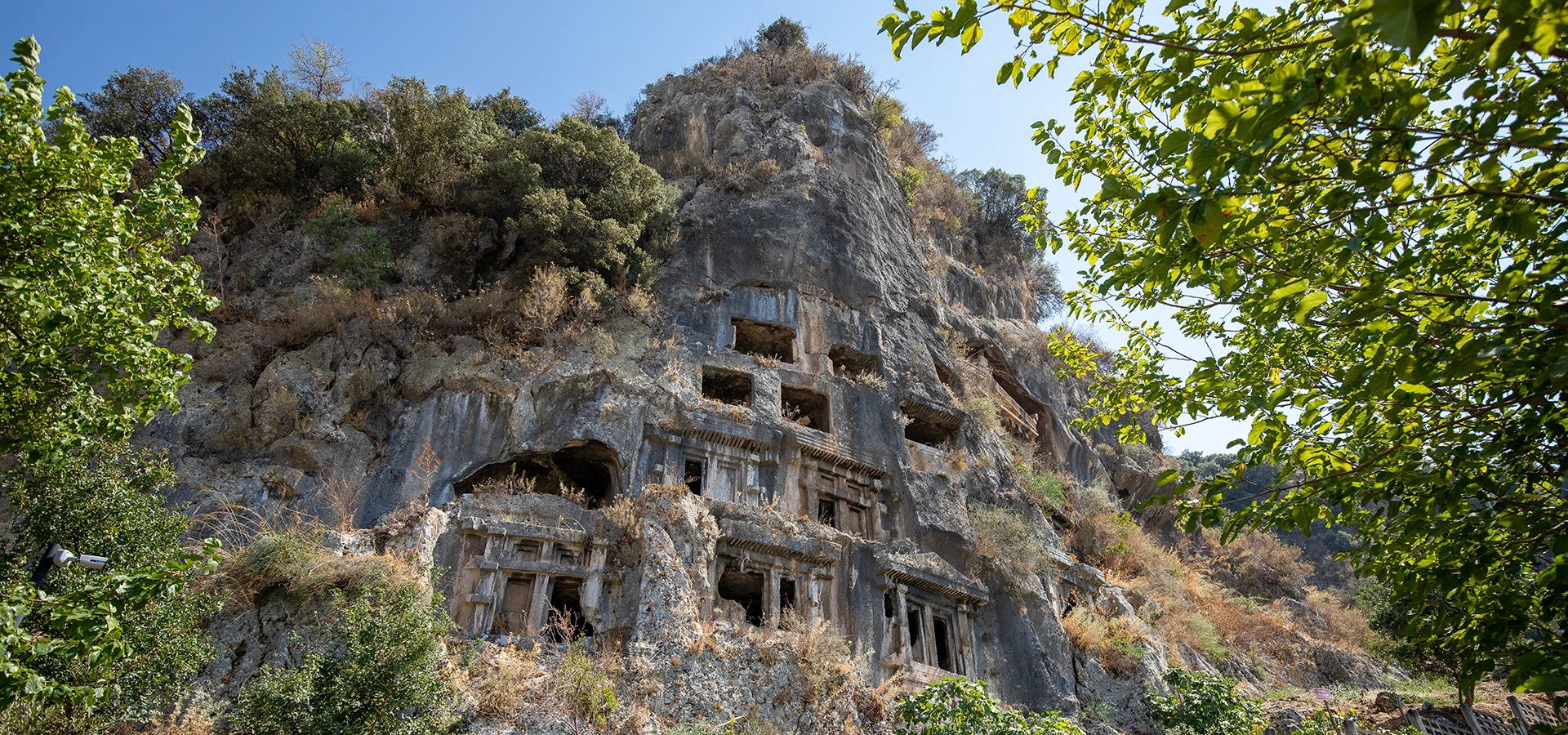
The Tomb of Amyntas is the most recognisable surviving monument of ancient Telmessos, the Lycian city beneath modern Fethiye. Cut into the rock high above the town, its façade imitates a temple with columns and a pediment.
The tomb is associated with an inscription naming Amyntas, son of Hermapias, and is generally dated to the fourth century BC. The striking architecture belongs to a funerary monument, not to a temple that once stood in front of the cliff.
Modern Fethiye covers much of the ancient city, so visitors should read the tombs, harbour and scattered remains as parts of a layered urban landscape rather than expect a continuous excavated archaeological park.
The inscription identifying Amyntas as son of Hermapias gives the tomb its modern name.
The Ionic-style columns and pediment are sculpted into the cliff.
Several rock-cut tombs appear across the hillside.
The modern town occupies the ancient settlement area.
An orientation to the landscape, heritage and practical visitor experience.
Fethiye town, Muğla
Lycian rock-cut tombs and ancient urban landscape
Fourth-century BC tomb; later Hellenistic and Roman city
Rock face above modern Fethiye
1–2 hours for the tomb area, subject to access
Ionic temple-style façade of the Amyntas tomb
Telmessos and the Tomb of Amyntas offers a distinctive experience in Fethiye town, Muğla: ionic temple-style façade of the Amyntas tomb. It is best appreciated with enough time to observe its setting and the details that make it different from other Muğla destinations.
The main reason to make time for Telmessos and the Tomb of Amyntas is ionic temple-style façade of the Amyntas tomb. The setting—rock face above modern fethiye—adds meaning to the experience, but the details deserve attention as well as the view.
A thoughtful visit separates what is documented from what is only assumed. The place is part of a wider region with many layers of history, and its current visitor experience may differ from photographs or old guidebooks.
Telmessos was an important city at the western edge of the Lycian world. Its history includes local traditions, contact with neighbouring regions and later incorporation into the Hellenistic and Roman political landscape.
The rock-cut tombs are among the clearest visible expressions of Lycian funerary architecture. The Amyntas monument is especially well known because its temple-like façade has survived as a dramatic landmark above town.
Fethiye’s ancient theatre was identified in the modern urban area, demonstrating how much of the historic city lies under or beside later development. What visitors see today is a fragmentary but meaningful record.
Fourth-century BC tomb; later Hellenistic and Roman city
Ionic temple-style façade of the Amyntas tomb
Rock face above modern Fethiye
Confirm current admission, visiting hours and any closed sections with the relevant museum or heritage authority.
Telmessos and the Tomb of Amyntas occupies rock face above modern fethiye in Fethiye town, Muğla. This geography is not simply scenery: it shapes how people have moved through, used and understood the place.
The setting invites visitors to think about the relationship between this kind of place and the region's changing geography. It is worth slowing down to notice what can be seen from safe, permitted viewpoints.
A map can make the region look compact, but road bends, walking routes, protected zones and boat access can change what is realistic in a day. The tombs stand on the hillside above central Fethiye; use the official approach and expect an uphill walk.
The inscription identifying Amyntas as son of Hermapias gives the tomb its modern name. It is a rare direct personal link within a monument that otherwise speaks through architectural form.
Look for how this detail relates to the surrounding landscape and the wider regional story. It is worth comparing what can be seen today with what historical or local interpretation explains.
The Ionic-style columns and pediment are sculpted into the cliff. This architectural language gave an elite burial place the dignity of a sacred-looking façade without making it a functioning temple.
Look for how this detail relates to the surrounding landscape and the wider regional story. It is worth comparing what can be seen today with what historical or local interpretation explains.
Several rock-cut tombs appear across the hillside. Comparing their shapes helps reveal different funerary types and the importance of prominent positions above the city.
Look for how this detail relates to the surrounding landscape and the wider regional story. It is worth comparing what can be seen today with what historical or local interpretation explains.
The modern town occupies the ancient settlement area. Urban archaeology is therefore selective and complex, with ancient remains appearing in the midst of everyday streets.
Look for how this detail relates to the surrounding landscape and the wider regional story. It is worth comparing what can be seen today with what historical or local interpretation explains.
The position of Telmessos near a sheltered gulf supported its role as a coastal centre. Looking down from the tombs gives a sense of how burial monuments overlooked routes and settlement.
Look for how this detail relates to the surrounding landscape and the wider regional story. It is worth comparing what can be seen today with what historical or local interpretation explains.
Stone surfaces are vulnerable to touch and erosion. Follow the authorised visitor route and avoid climbing onto tomb façades or entering cavities unless specifically permitted.
This is one reason to spend time observing the place carefully instead of treating it as a quick stop. Stay behind barriers and avoid touching carved stone, especially in wet conditions.
A visit to Telmessos and the Tomb of Amyntas becomes more meaningful when placed alongside other destinations in Muğla. Fethiye Travel Guide and Kayaköy (Livissi) offer contrasting perspectives, but they should be linked by realistic travel times rather than their apparent proximity on a map.
The province brings together Lycian and Carian archaeology, village heritage, protected coastlines and contemporary maritime life. Choosing a small number of complementary stops helps each retain its own identity instead of blending into a generic sightseeing day.
The historical setting of Telmessos and the Tomb of Amyntas includes fourth-century bc tomb; later hellenistic and roman city. Different kinds of evidence—landscape, surviving architecture, local records and archaeological research—answer different questions and should not be treated as interchangeable.
To interpret Telmessos and the Tomb of Amyntas responsibly, distinguish physical remains and documented facts from local tradition, travel marketing and uncertain reconstructions. Ionic temple-style façade of the Amyntas tomb is a useful starting point, but it does not explain the entire place.
Visitors should also consider what is absent from the visible scene: former buildings, seasonal activities, changing shorelines or communities whose history is not obvious in a photograph. A guide can help connect those layers without inventing certainty.
Focus on the features that are actually visible and accessible during your visit. Some places change with excavation, season, weather or conservation work; the points below are an interpretive guide, not a guarantee that every area is open.
The inscription identifying Amyntas as son of Hermapias gives the tomb its modern name.
The Ionic-style columns and pediment are sculpted into the cliff.
Several rock-cut tombs appear across the hillside.
The modern town occupies the ancient settlement area.
The position of Telmessos near a sheltered gulf supported its role as a coastal centre.
Stone surfaces are vulnerable to touch and erosion.
Practical details may change by season, conservation work, weather and local management. Verify the relevant official or local information before making a special journey; no fixed entrance fee or opening hour is assumed here.
Start with the tombs, look across Fethiye Bay, then continue to the town centre and harbour for the wider Telmessos context.
For a fuller day, consider Fethiye Travel Guide and one other nearby place rather than adding every attraction in the district. Confirm whether each stop needs a road journey, boat transfer or substantial walk.
Allow time for breaks, local food and changes in weather. A flexible plan is more enjoyable and more respectful of protected landscapes than an itinerary built around exact minute-by-minute promises.
The tombs stand on the hillside above central Fethiye; use the official approach and expect an uphill walk.
1–2 hours for the tomb area, subject to access
Consider Fethiye Travel Guide if travel conditions allow.
Confirm current admission, visiting hours and any closed sections with the relevant museum or heritage authority.
Morning or late afternoon is generally more comfortable on exposed steps, especially in summer.
The best time of day also depends on your goal: softer light for photography, comfortable temperatures for walking or suitable sea conditions for a boat or swim. Check the forecast and local guidance rather than assuming the same conditions every day.
A lower viewpoint can show the entire rock-cut façade; do not climb onto ancient masonry for a closer shot.
The most useful images often include enough surrounding landscape to explain the place, rather than isolating one attractive detail. Respect private property, wildlife, archaeological barriers and any drone restrictions.
The ascent includes stairs and sloping terrain; access may be difficult for visitors with mobility limitations.
Ask about the exact route, distance, surface and available assistance if anyone in your group has mobility needs. A location may be reachable by vehicle yet still have steps, loose ground, boat ladders or uneven archaeological paths.
The tombs stand on the hillside above central Fethiye; use the official approach and expect an uphill walk.
Confirm the final approach, parking or boat departure point and return options before travelling. The shortest straight-line distance is rarely the most useful estimate on the Datça Peninsula or around Fethiye’s mountain and island routes.
Use our Muğla travel guide to build a route. The places below are related by region or theme, not necessarily a short walk from Telmessos and the Tomb of Amyntas.
Explore Fethiye Travel Guide as a complementary stop. Check its access and the actual travel time from Telmessos and the Tomb of Amyntas before adding it to your itinerary.
Explore Kayaköy (Livissi) as a complementary stop. Check its access and the actual travel time from Telmessos and the Tomb of Amyntas before adding it to your itinerary.
Explore Kadyanda Ancient City as a complementary stop. Check its access and the actual travel time from Telmessos and the Tomb of Amyntas before adding it to your itinerary.
Explore Çalış Beach as a complementary stop. Check its access and the actual travel time from Telmessos and the Tomb of Amyntas before adding it to your itinerary.
Telmessos and the Tomb of Amyntas is in Fethiye town, Muğla, in Muğla Province, southwestern Türkiye.
The main attraction is ionic temple-style façade of the Amyntas tomb. Its setting is rock face above modern fethiye.
Telmessos was an important city at the western edge of the Lycian world. Its history includes local traditions, contact with neighbouring regions and later incorporation into the Hellenistic and Roman political landscape.
A useful starting estimate is 1–2 hours for the tomb area, subject to access. Allow extra time for transport, rest stops and any site-specific restrictions.
The tombs stand on the hillside above central Fethiye; use the official approach and expect an uphill walk.
Confirm current admission, visiting hours and any closed sections with the relevant museum or heritage authority.
Morning or late afternoon is generally more comfortable on exposed steps, especially in summer.
The ascent includes stairs and sloping terrain; access may be difficult for visitors with mobility limitations.
Consider Fethiye Travel Guide or Kayaköy (Livissi), allowing for actual road, trail or boat conditions.
Stay behind barriers and avoid touching carved stone, especially in wet conditions.
Follow local access rules, avoid leaving waste and give residents, other visitors and protected habitats space. A thoughtful visit helps keep the destination welcoming and its heritage intact for future travellers.
Ask Wow Cappadocia / Venere Travel to help design a private regional journey according to your interests, realistic travel times and confirmed site access, without compulsory shopping stops.
Combine Telmessos and the Tomb of Amyntas with a small number of complementary places in a well-paced itinerary.
Share your dates, interests and travel party so we can check access and propose a suitable route.
Request Your Private Programme
Discover ancient cities, coastal villages, protected nature and local traditions across the province.
View the Muğla Travel Guide