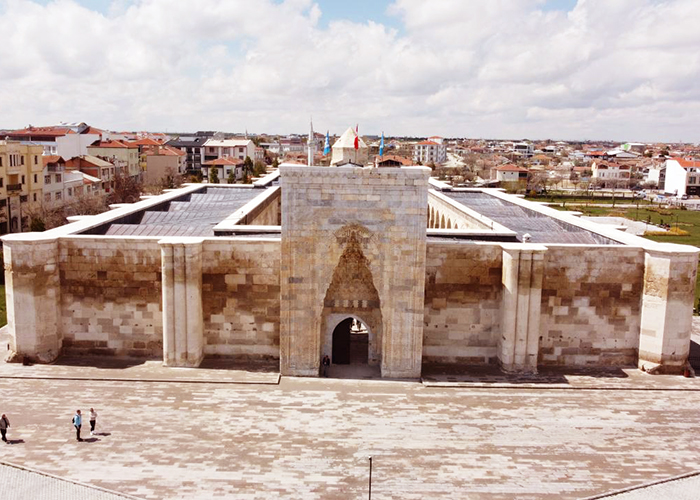
The Outer Portal
Stand before the 13-meter high entrance, a masterpiece of Seljuk stonemasonry.






Located on the Konya-Aksaray road, Sultanhani Caravanserai is not just a building; it is a masterpiece of Anatolian Seljuk art and the largest caravanserai in Turkey. Built in 1229 by Sultan Alaattin Keykubat I, this massive stone structure served as the primary resting point for merchants, diplomats, and travelers navigating the legendary Silk Road.
The caravanserai was designed to be a "palace for the people." It provided everything a weary traveler could need: a secure place to sleep, food from the communal kitchen, a stable for camels and horses, a bathhouse for hygiene, and a mosque for prayer—all provided free of charge for the first three days as part of the Sultan's charitable legacy.
Walking through its monumental "Crown Gate" (Taç Kapı), visitors are immediately struck by the scale of the architecture. The intricate geometric carvings, the soaring stone vaults, and the unique elevated mosque in the center of the courtyard showcase the incredible engineering skills of the medieval Islamic world. It remains one of the best-preserved examples of high-status Seljuk architecture globally.
A world-famous stone gateway featuring incredibly detailed muqarnas and geometric lace-like carvings.
A rare, square mosque built on four arches in the center of the courtyard, accessible by twin stone staircases.
A cavernous indoor cathedral of stone, featuring 32 massive pillars to support the weight of the vaults.
High, thick walls and corner towers that allowed the caravanserai to double as a fortress against bandits.
Aksaray Province, situated 40km west of Aksaray city on the route to Konya.
The largest caravanserai in Anatolia, covering nearly 5,000 square meters.
45 to 90 minutes to explore the courtyard, mosque, and the great hall.
Currently on the UNESCO World Heritage Tentative List for its cultural value.
The Sultanhani Caravanserai was constructed during the "Golden Age" of the Seljuk Empire. Sultan Alaattin Keykubat I commissioned the famous architect Muhammad bin Khalwan al-Dimashqi to build a structure that would demonstrate the power and wealth of the Sultanate while fostering international trade. After a fire partially damaged the building in 1278, it was expanded and restored by the governor Seraceddin Ahmed, making it even more grand than the original.
The layout is a classic example of the Anatolian Caravanserai: an open courtyard for use during the pleasant summer months and a covered, vaulted section for the harsh, snowy winters of the central plateau. The stonework is predominantly local marble and limestone, carved with "rinceau" patterns and symbolic motifs that represent the eternal nature of the universe.
Historically, Sultanhani was more than just an inn; it was a hub of cultural exchange. Here, Persian poets, Chinese silk merchants, and European diplomats shared meals and stories. This exchange of ideas was just as important as the exchange of goods, making the caravanserai a vital link in the chain of human civilization between the East and the Mediterranean.
Stand before the 13-meter high entrance, a masterpiece of Seljuk stonemasonry.
The unique "kiosk mosque" elevated in the center, symbolizing the elevation of the spirit.
Enter the massive, cool interior where the central dome allows light to filter through a high oculus.
Explore the ruins of the historic Turkish bath where travelers washed away the dust of the road.
The area once used as a grand dining hall to serve hundreds of travelers simultaneously.
Look closely at the walls to find "Seljuk Stars" and intricate interlocking marble patterns.
Sultanhani is an active museum and a popular stop for those traveling between Cappadocia and Konya or Antalya. Its location makes it the perfect midpoint break.
There is a moderate entrance fee. The site is open daily from 08:30 until sunset. Tickets are available at the entrance booth.
The most common way to visit is via a private tour or rental car. It is located exactly on the main D300 highway. Buses between Konya and Aksaray also stop nearby.
The morning sun illuminates the main portal perfectly. For the best interior shots, the midday sun through the dome's oculus creates dramatic lighting.
The town of Sultanhani itself is famous for carpet restoration. Many workshops nearby continue the medieval tradition of weaving and repairing antique rugs.
If you want to understand the spirit of the Silk Road, there is no better place in Turkey to feel the weight of history than within these walls.
It is the absolute largest and most impressive caravanserai of its era, offering a sense of scale that photos cannot capture.
The stone carvings are considered the pinnacle of Seljuk decorative art, rivaling the great cathedrals of Europe from the same period.
It serves as the perfect "historical rest stop" during the long drive from Cappadocia to Konya or the Mediterranean coast.
Despite its fame, it retains a quiet, powerful atmosphere that allows you to imagine the sounds of camel caravans arriving at dusk.
Technically it is in the Aksaray Province, about 1 hour and 15 minutes drive from Göreme. It is usually visited as part of a day trip or while traveling through the region.
The Köşk Masjid in the courtyard is a museum piece, but the site remains a respected cultural monument. It is no longer a functioning local mosque for daily prayers.
While Saruhan and Ağzıkarahan are beautiful, Sultanhani is significantly larger and more elaborately decorated. It is the "King" of all caravanserai.
We include a visit to Sultanhani on our spiritual and cultural journey to the city of the Whirling Dervishes, ensuring you experience the true scale of medieval Seljuk hospitality.
The ultimate cultural journey. We stop at the monumental Sultanhani Caravanserai to marvel at its Seljuk architecture before exploring the spiritual Mevlana Museum in Konya.
View TourPlanning a trip from Cappadocia to Konya or Antalya? Don't miss Sultanhani. Contact us for private transfers, guided history tours, or custom itineraries.