From Ancient Edessa to Modern Şanlıurfa
The History of Selahaddin Eyyubi Mosque
Discover how an early Christian sacred site, a nineteenth-century
cathedral, an industrial building, and an active mosque became part
of one continuous urban story.
Şanlıurfa was known in antiquity as Edessa, a major centre
of trade, learning, Syriac language, and Christian culture. Churches,
monasteries, schools, and pilgrimage traditions once formed an important
part of the city’s religious landscape.
According to official regional sources, a church dedicated to
Saint John the Baptist was constructed at this site in
AD 457 by Bishop Nona. The surviving
mosque is not simply that fifth-century building. The present monumental
structure is generally dated to the early nineteenth century and is
believed to have been erected above or in association with the remains
of the earlier sanctuary.
The later church became known as the
Saint Johannes Prodromos Addai Church. The Greek title
“Prodromos” refers to John the Baptist as the forerunner, while “Addai”
recalls the apostolic traditions associated with Edessa and the wider
Syriac Christian world.
Because the building was among the largest churches in the region during
its period of use, local sources describe it as a
cathedral. Its broad interior, monumental masonry,
generous windows, entrance arrangement, and courtyard structures reflect
this elevated status.
A local historical tradition states that the earlier church was used
as a mosque for a period during the time of
Selahaddin Eyyubi, or Saladin. When the restored building
was later opened as a mosque, this association inspired its present name.
The precise details of the medieval phase should be understood as a
regional historical tradition rather than a fully documented construction
chronology for the existing nineteenth-century building.
After the Christian congregation no longer used the church, the structure
remained abandoned and deteriorated over a long period. At one stage it
served as an electric power station, an unusual phase that
introduced industrial use into a former sacred building.
The monument was eventually repaired and adapted for Muslim worship.
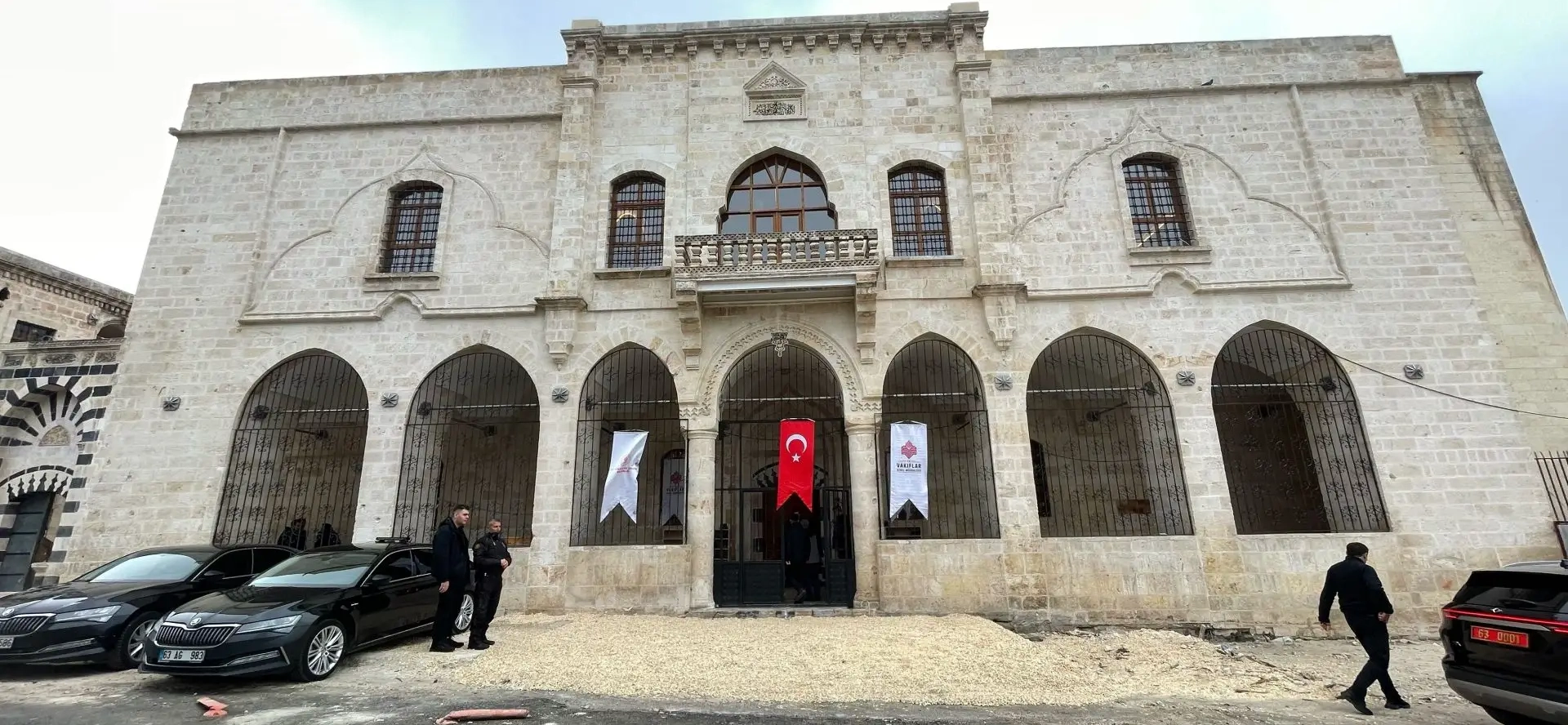
On 28 May 1993, it reopened as
Selahaddin Eyyubi Mosque. The former narthex on the west
side was incorporated into the mosque’s entrance and last-congregation
area, while the spacious church interior became the main prayer hall.
Further conservation work was undertaken by the
General Directorate of Foundations in
2010–2011. The restoration helped protect the building’s
stone fabric and maintain its continued religious use.
The earthquakes centred in Kahramanmaraş on
6 February 2023 caused damage to the mosque, leading to
its closure. A major restoration programme began later in 2023, including
structural investigations, ground and building analysis, repair, and
environmental improvements.
The work was completed ahead of schedule, and the mosque reopened with
the Ramadan Bayram prayer on 20 March 2026. Today,
Selahaddin Eyyubi Mosque again serves the local community while preserving
visible evidence of Şanlıurfa’s Christian, Islamic, civic, and industrial
history.