Rock-Cut Tombs of Ancient Edessa

Kızılkoyun Necropolis – Complete Visitor Guide

Walk among Roman-era rock tombs, decorated façades, burial chambers,
ancient reliefs, mosaics, and illuminated terraces in the heart of Şanlıurfa.

Explore Kızılkoyun

Discover the Rock-Cut Tombs of Ancient Edessa

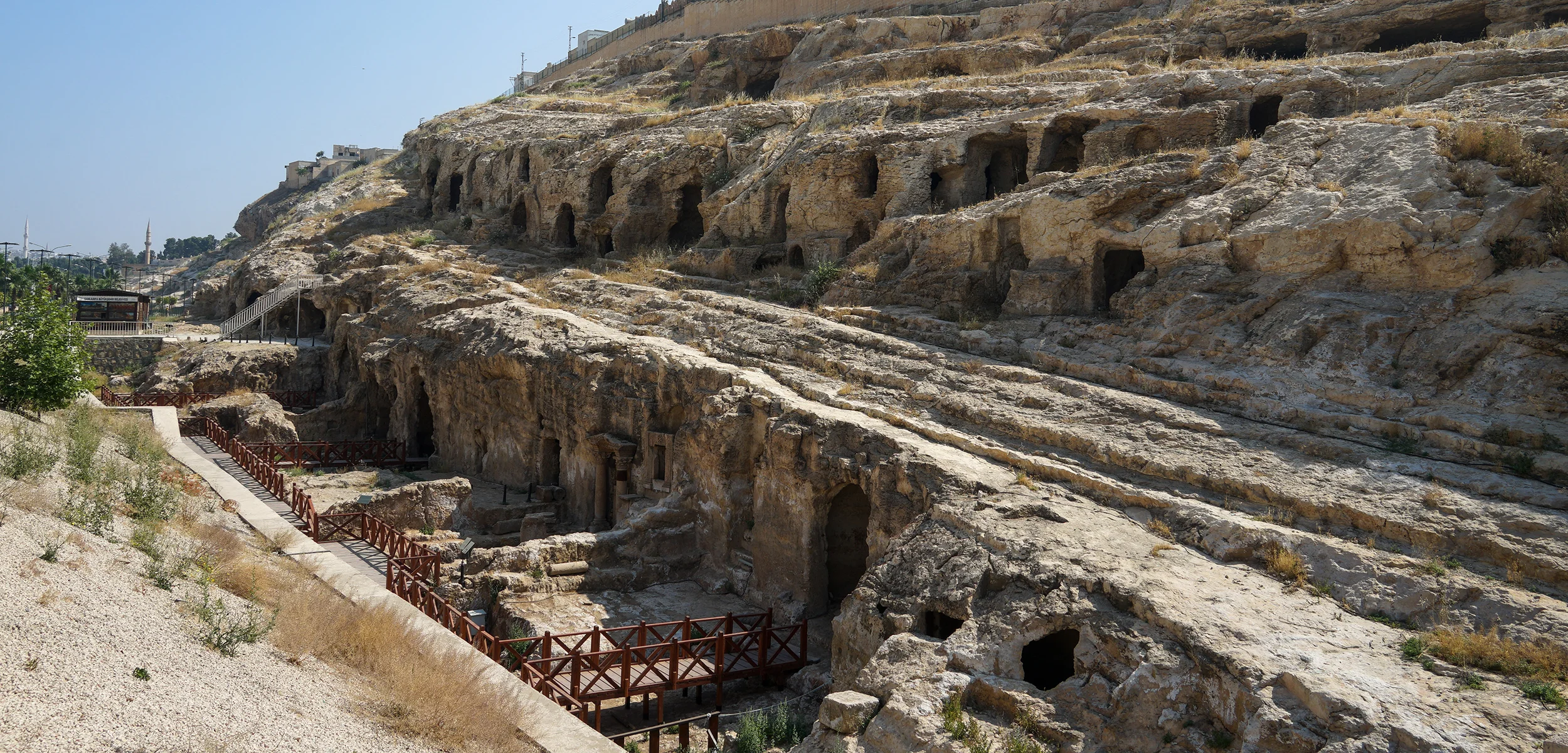
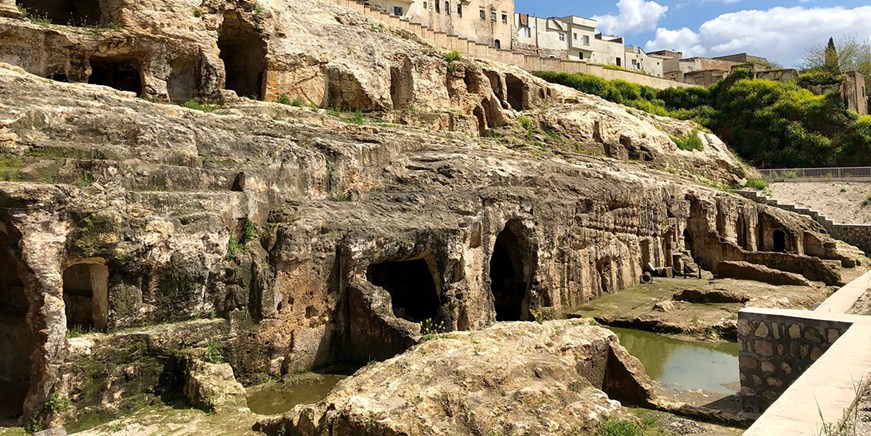
Located on the slopes of Tılfındır Hill, immediately north of Balıklıgöl and east of the Haleplibahçe district, Kızılkoyun Necropolis is one of the most remarkable archaeological areas in central Şanlıurfa. More than one hundred burial chambers have been uncovered across the limestone hillside, revealing an extensive cemetery connected with ancient Edessa.

Most of the visible rock-cut tombs date from approximately the second to fourth centuries AD. Their interiors contain arcosolia, burial platforms, niches, columns, pediments, reliefs, and traces of painted or mosaic decoration. Together, these chambers provide valuable evidence about the funerary traditions, artistic preferences, social hierarchy, and multicultural character of Roman-period Edessa.

In this complete Kızılkoyun Necropolis visitor guide, you will discover the history of the archaeological site, the meaning of a necropolis, the architecture of the tomb chambers, the most important decorated tombs, practical entrance information, suggested visiting routes, photography advice, nearby attractions, and private travel options combining Kızılkoyun with Balıklıgöl, Şanlıurfa’s museums, Göbeklitepe, Karahantepe, Harran, Halfeti, Zeugma, and Mount Nemrut.

Rock-Cut Tombs

Explore burial chambers carved directly into the limestone slopes of ancient Edessa between approximately the second and fourth centuries AD.

Funerary Art

See columned façades, pediments, family reliefs, mythological creatures, peacock imagery, niches, and reconstructed burial displays.

Illuminated Terraces

Follow landscaped paths through the terraced archaeological area, which becomes especially atmospheric when the rock chambers are illuminated.

Historic-Centre Location

Combine the necropolis easily with Balıklıgöl, Şanlıurfa Castle, Haleplibahçe, the Archaeology Museum, and the old bazaar district.

Plan Your Visit

Kızılkoyun Necropolis – Quick Facts

Essential information for visiting Şanlıurfa’s impressive Roman-era rock-cut cemetery.

📍

Location

On Haleplibahçe Caddesi in central Şanlıurfa, north of Balıklıgöl and close to the city’s museum complex.

Open on Google Maps
🏺

Famous For

More than one hundred rock-cut tomb chambers, arcosolia, decorated façades, funerary reliefs, mosaics, and night illumination.

Visit Duration

Allow approximately 45–90 minutes for the walking paths, tomb façades, selected chambers, interpretation, and photography.

🎟

Visitor Access

The archaeological area is generally visited without a separate admission ticket, although current hours and access arrangements should be confirmed locally.


Burial Traditions of Ancient Edessa

The History of Kızılkoyun Necropolis

Discover how the limestone slopes outside ancient Edessa became an extensive cemetery filled with family tombs and monumental burial chambers.

In the ancient Greek and Roman worlds, a necropolis was a cemetery located beyond the main inhabited area of a city. The word is formed from the Greek words associated with the dead and the city, and can be understood as a “city of the dead.”

Ancient Edessa, corresponding broadly with modern Şanlıurfa, developed into an important political, commercial, and religious centre between Anatolia, Syria, and northern Mesopotamia. Like many ancient cities, Edessa had several burial areas positioned outside its gates and along roads leading toward the urban centre.

Kızılkoyun was established on the western-facing slopes of Tılfındır Hill. The local limestone could be cut relatively easily, allowing families and stone workers to create chambers directly inside the hillside. These tombs were arranged on several levels and terraces, producing the dense landscape of entrances visible today.

Most of the uncovered chambers are dated to approximately the second, third, and fourth centuries AD. This was a period during which Edessa stood at the meeting point of Roman, Syrian, Aramaic, Mesopotamian, and local artistic traditions.

Over time, the ancient cemetery was partly covered by later buildings and neighbourhoods. Archaeological work required extensive expropriation, demolition, excavation, cleaning, restoration, landscaping, and documentation before much of the rock-cut landscape could be revealed again.

Successive archaeological and municipal projects uncovered more than one hundred burial chambers. Different publications may provide slightly different totals because excavation, cleaning, and development took place in several separate phases.

Today, Kızılkoyun Necropolis is protected as an archaeological area and has been equipped with walking paths, stairs, barriers, landscaping, and illumination. It forms part of a wider historic landscape that includes Balıklıgöl, Urfa Castle, the Kale Eteği necropolis, Haleplibahçe, Roman baths, museums, and traditional neighbourhoods.

What to See

Top Highlights of Kızılkoyun Necropolis

Look closely at the burial architecture, decorated entrances, reliefs, reconstructed displays, and symbols preserved throughout the terraced site.

Terraced Rock-Cut Necropolis

Kızılkoyun extends across a steep limestone outcrop with tomb entrances arranged on several different levels. The terraced organisation demonstrates how ancient builders adapted the cemetery to the natural shape of the hill.

  • Landscape: Burial chambers arranged across a rocky hillside
  • Construction: Rooms carved directly into the natural limestone
  • Visitor experience: Paths, bridges, stairs, and viewing areas

Rock-Cut Burial Chambers

Many tombs have square or rectangular plans and vary considerably in size. Some were designed for a small number of burials, while larger chambers provided space for extended families across several generations.

  • Typical plan: Single or multiple rooms
  • Approximate size: From small 3 × 3 metre rooms to much larger chambers
  • Main feature: Burial spaces cut into the chamber walls

Arcosolia and Klinai

The interiors frequently contain arcosolia—arched recesses created above burial platforms or sarcophagus-like spaces. Other chambers contain klinai, stone beds associated with the placement or symbolic presentation of the dead.

  • Arcosolium: Arched burial recess carved into a wall
  • Kline: Stone burial bed or funerary platform
  • Purpose: Family burial and commemoration

Decorated Tomb Façades

While many entrances are simple, important tombs were given architectural façades resembling small temples or monumental buildings. Visitors can see carved columns, capitals, framed doorways, cornices, and triangular pediments.

  • Architectural elements: Columns, capitals, pediments, and door frames
  • Meaning: Status, wealth, and family prestige
  • Influences: Greco-Roman design combined with local traditions

Mosaic Rock Tomb

One chamber originally contained a mosaic floor and five arcosolia. A reconstructed display helps visitors imagine the burial environment, while the surviving original mosaic is preserved in a museum collection.

  • Plan: Rectangular chamber with five arcosolia
  • Decoration: Mosaic floor
  • Display: Replica elements recreate the original funerary setting

Rock Tomb M13 – Peacock Relief

Tomb M13 preserves a partially damaged peacock carved into the central section of a pediment. The surviving body, neck, wings, and surrounding decorative details offer a rare example of symbolic animal imagery.

  • Main symbol: Peacock carved on the pediment
  • Condition: Partly damaged but still recognisable
  • Possible meaning: Immortality, renewal, prestige, or paradise

Rock Tomb M14 – Sea Centaur Relief

Tomb M14 is one of the most elaborate chambers at Kızılkoyun. It contains five arcosolia, statue niches, columns with Ionic-style details, and a high-relief representation of an ichthyocentaur or sea centaur.

  • Interior: Single chamber with five arcosolia
  • Architecture: Columns and statue niches
  • Relief: Mythological sea centaur above an arcosolium

Rock Tomb M16 – Family Banquet Relief

Tomb M16 includes a relief showing a reclining man holding a drinking vessel, accompanied by a boy and two women. Another carved figure represents an armed soldier wearing a helmet and carrying a sword.

  • Main scene: Reclining man accompanied by family members
  • Additional image: Helmeted soldier with a sword
  • Interpretation: Family identity and commemoration of the deceased

Illuminated Rock Chambers

Dozens of tomb entrances and cavities have been illuminated to reveal the textures and shapes of the limestone hillside after sunset. Evening access can create a dramatically different experience from a daytime visit.

  • Best feature: Warm lighting inside rock-cut entrances
  • Photography: Strong contrast between stone and dark sky
  • Visitor note: Evening opening arrangements may vary

Kızılkoyun and the Necropolises of Edessa

Ancient Edessa was surrounded by several burial areas positioned outside the inhabited city and near roads leading toward its gates. Kızılkoyun was one part of this larger funerary landscape.

Beyond the City Walls

Ancient burial grounds were normally placed outside the residential and ceremonial centre of a city for religious, practical, and legal reasons.

Western Routes

The necropolis stood close to routes approaching Edessa from the west, allowing tombs and memorials to be seen by travellers entering the city.

Several Necropolises

Other ancient burial areas are known around Şanlıurfa, including the slopes below the castle and districts surrounding the historic centre.

City of Many Cultures

Funerary imagery reflects the mixture of Greco-Roman artistic language, local Edessan identity, Aramaic traditions, and wider Mesopotamian influences.

The Architecture of the Kızılkoyun Tombs

The tombs were not all built according to one standard design. Their size, complexity, architectural decoration, and number of burial places depended on the needs and resources of the families who commissioned them.

Single-Room Tombs

Many chambers consist of one main rectangular or square room containing three or more arcosolia positioned along the walls.

Multi-Room Tombs

Wealthier families could create several connected chambers with additional arcosolia, niches, platforms, and spaces for repeated burials.

Dromos Entrances

Some tombs were approached through a sloping corridor or staircase known as a dromos, leading visitors below the original ground level.

Monumental Façades

Decorated chambers imitate free-standing architecture with carved pillars, capitals, pediments, mouldings, and carefully framed doorways.

Burial Platforms

Bodies could be placed on stone klinai, inside arcosolia, in loculi, or in sarcophagus-like spaces cut directly into the limestone.

Family Ownership

Large chambers were often designed as long-term family tombs and could be reopened when another member of the household died.

Funerary Art at Kızılkoyun Necropolis

Decoration transformed selected burial chambers into memorial spaces. Images of families, animals, mythological creatures, architectural elements, and ceremonial scenes communicated identity, status, beliefs, and remembrance.

Family Reliefs

Reliefs could show the deceased reclining or seated with relatives, presenting the family as a continuing social unit beyond death.

Funerary Banquets

Reclining figures holding cups recall banquet imagery used across the Roman East to represent status, hospitality, commemoration, and eternal rest.

Mythological Creatures

The ichthyocentaur in Tomb M14 combines human, horse, and fish forms, connecting the chamber with mythological imagery from the Greco-Roman world.

Peacock Symbolism

Peacock imagery became associated with prestige, beauty, immortality, renewal, and the hope of life beyond death.

Mosaic Floors

Some Edessan tombs contained mosaic pavements decorated with geometric patterns, inscriptions, portraits, or representations of family members.

Greek and Syriac Inscriptions

Inscriptions found in Edessa’s cemeteries preserve personal names, family relationships, ownership statements, and languages used by the city’s ancient population.

Why Kızılkoyun Necropolis Is So Important

Kızılkoyun is valuable not simply because of the number of tombs, but because it preserves evidence of family life, social structure, artistic exchange, religious ideas, and urban development in ancient Edessa.

Ancient Edessa

The tombs help archaeologists understand the inhabitants of one of northern Mesopotamia’s most important Hellenistic and Roman cities.

Funerary Traditions

Chamber plans, burial platforms, grave goods, reliefs, and mosaics reveal how ancient families cared for and commemorated their dead.

Local Identity

Edessan families adopted elements of Roman art while continuing to express distinctive local clothing, language, symbols, and family customs.

Urban Archaeology

The project demonstrates how major archaeological remains can survive beneath modern neighbourhoods in a continuously inhabited city.

Excavation and Restoration at Kızılkoyun

Much of the ancient necropolis remained hidden beneath later houses and commercial buildings. Revealing the site required a long-term urban archaeology project rather than a single excavation season.

Expropriation

Buildings occupying the protected archaeological zone were gradually acquired so that the ancient rock surface could be investigated safely.

Archaeological Cleaning

Soil, rubbish, later walls, and accumulated deposits were removed from chambers, entrances, corridors, and terraces.

Documentation

Archaeologists recorded chamber plans, architectural details, reliefs, inscriptions, burials, and movable finds discovered during the work.

Visitor Improvements

Walkways, bridges, barriers, stairs, interpretation areas, landscaping, lighting, and public spaces were introduced after excavation.


Archaeological research may continue in surrounding areas, and individual sections can occasionally be closed for conservation, safety work, maintenance, or further investigation.

Kızılkoyun Necropolis Entrance Fee

Kızılkoyun is an open-air archaeological area managed within Şanlıurfa’s historic centre rather than a conventional enclosed museum with a nationally standardised admission ticket.

General Admission

The necropolis is generally visited without a separate entrance fee. Local arrangements should nevertheless be confirmed when you arrive.

Museum Pass

A Museum Pass is not normally required for the open-air necropolis itself. Nearby museums follow their own ticket systems.

Guided Visits

Professional guiding, private transportation, and organised city tours are charged separately from entrance to the archaeological area.

Special Events

Concerts, exhibitions, educational activities, or special programmes may follow separate access and reservation arrangements.


Visitor policies can change because the site is locally managed. Confirm the current situation before travelling when entrance conditions are important to your itinerary.

Kızılkoyun Necropolis Opening Hours and Best Time to Visit

Published opening schedules can vary according to season, local management, weather, maintenance, special events, and evening illumination programmes. A daytime visit is the safest option when planning without advance confirmation.

Recommended Daytime Visit Approximately 09:00–17:00, subject to the current local schedule
Possible Evening Access Illuminated visits may be available, but closing times can vary
Best Seasons March–May and September–November for comfortable temperatures
Quietest Period Weekday mornings before larger city-tour groups arrive
Best Photography Morning for soft stone textures or evening when lighting is operating

Şanlıurfa can be extremely hot during summer. Early morning or late afternoon visits are more comfortable than the middle of the day, particularly when walking between exposed terraces.

Rain can make stone paths and steps slippery. Some chambers or upper terraces may be temporarily restricted following heavy weather or during conservation work.

How to Get to Kızılkoyun Necropolis

Kızılkoyun is located in the historic centre of Şanlıurfa and is much easier to reach than archaeological sites outside the city such as Göbeklitepe, Karahantepe, or Soğmatar.

From Balıklıgöl

The necropolis can be reached on foot from the Balıklıgöl complex in approximately 10–15 minutes, depending on the selected route.

From the Museum Complex

Kızılkoyun stands close to Şanlıurfa Archaeology Museum and Haleplibahçe Mosaic Museum and can easily be combined with both.

By Taxi

Ask the driver for Kızılkoyun Nekropolü or Haleplibahçe Caddesi. The location is well known within central Şanlıurfa.

By Private Tour

A guided city tour can coordinate Kızılkoyun with Balıklıgöl, the museums, old bazaars, historic streets, and Şanlıurfa Castle.


Parking close to the archaeological area can be limited during busy periods. Visitors staying in the historic centre may find walking or using a taxi more convenient than driving.

Best Route for Visiting Kızılkoyun Necropolis

Kızılkoyun works best as part of a walking or privately guided route through Şanlıurfa’s historic centre.

1. Begin at Balıklıgöl Visit the Pool of Abraham, sacred carp ponds, Rizvaniye Mosque, Halil-ür Rahman Mosque, and surrounding gardens
2. Walk Toward Kızılkoyun Continue north through the historic district toward the archaeological slopes of Tılfındır Hill
3. Follow the Lower Path Examine the accessible tomb façades, entrances, burial chambers, platforms, and carved architectural details
4. Continue Through the Terraces Use the designated stairs and pathways to understand how the cemetery was arranged across several levels
5. Visit the Museum Complex Continue to Şanlıurfa Archaeology Museum and Haleplibahçe Mosaic Museum for a deeper understanding of Edessa
6. End in the Old Bazaar Walk toward the historic bazaars, Gümrük Han, traditional workshops, restaurants, and old stone streets

Kızılkoyun Necropolis Visitor Tips

Visit During Cooler Hours

Early morning or late afternoon is more comfortable, especially between June and September when Şanlıurfa can become extremely hot.

Wear Suitable Shoes

The site includes uneven limestone, stairs, ramps, bridges, and potentially slippery surfaces around the rock chambers.

Stay on the Paths

Follow barriers and designated routes. Unprotected edges, cavities, unstable surfaces, and restricted chambers may be present.

Do Not Touch the Reliefs

Oils, pressure, scratching, and repeated contact can damage fragile carvings, surfaces, pigments, and inscriptions.

Look Beyond the Entrances

Examine the number of arcosolia, chamber plans, carved columns, pediments, niches, and differences between simple and elite tombs.

Use a Guide for Context

A professional guide can explain burial terminology, ancient Edessa, funerary banquets, family imagery, and local artistic traditions.

Confirm Evening Access

The illuminated chambers are atmospheric, but evening opening hours are not guaranteed throughout every season.

Combine Nearby Sites

Kızılkoyun requires less time than the museum complex and is best visited as one part of a broader historic Şanlıurfa itinerary.

Accessibility at Kızılkoyun Necropolis

Accessibility is mixed because the necropolis occupies a naturally steep limestone hillside. Modern paths improve access, but not every chamber or terrace can be reached without steps.

Lower Visitor Areas

Some lower pathways and viewpoints are easier to approach and may allow visitors to see several important façades without climbing every terrace.

Upper Terraces

Access to elevated tombs can require stairs, bridges, sloping paths, and walking across uneven surfaces.

Wheelchair Access

Wheelchair access may be possible in limited sections, but assistance and advance confirmation are recommended.

Private Transportation

A vehicle stopping close to the entrance can reduce walking from Balıklıgöl or the museum area.

Frequently Asked Questions About Kızılkoyun Necropolis

What is Kızılkoyun Necropolis?

Kızılkoyun is an extensive ancient cemetery containing rock-cut tomb chambers carved into the limestone slopes of Tılfındır Hill in central Şanlıurfa.

Where is Kızılkoyun Necropolis?

It is located on Haleplibahçe Caddesi, north of Balıklıgöl and close to Şanlıurfa Archaeology Museum and Haleplibahçe Mosaic Museum.

What does necropolis mean?

Necropolis is a Greek-derived word meaning a “city of the dead.” It describes an organised cemetery containing multiple tombs or funerary monuments.

How old is Kızılkoyun Necropolis?

Most of the visible tomb chambers are dated to approximately the second through fourth centuries AD, around 1,700–1,900 years ago.

Which civilisation built the Kızılkoyun tombs?

The tombs belonged to inhabitants of ancient Edessa during the Roman period. Their architecture and art combine Greco-Roman forms with local Syrian, Aramaic, Edessan, and Mesopotamian traditions.

How many tombs are at Kızılkoyun?

More than one hundred rock-cut chambers have been uncovered during different excavation and urban-restoration phases. Published totals vary according to the date and phase being described.

Is Kızılkoyun Necropolis free to visit?

The open-air site is generally visited without a separate admission ticket. Current local access arrangements should be confirmed at the time of your visit.

What are the opening hours?

Opening schedules can vary seasonally. Daytime access is commonly planned between approximately 09:00 and 17:00, while evening access depends on current lighting and management arrangements.

Can Kızılkoyun be visited at night?

The necropolis has an extensive lighting system and has previously welcomed evening visitors. However, night access is not guaranteed every day or throughout every season.

How long should I spend at Kızılkoyun?

Approximately 45–90 minutes is suitable for most visitors. Archaeology enthusiasts may prefer more time to study the tomb plans and decorative details.

What is an arcosolium?

An arcosolium is an arched recess cut into the wall of a burial chamber, usually positioned above a stone burial platform or sarcophagus-like space.

What is a kline?

A kline is a stone bed or platform associated with the placement or representation of the deceased inside an ancient burial chamber.

Are there mosaics at Kızılkoyun?

Yes. Mosaic decoration has been identified in tomb contexts associated with the necropolis. Original archaeological material may be protected or displayed in museum collections rather than left exposed.

What is special about Tomb M14?

Tomb M14 contains five arcosolia, carved columns, statue niches, and a high-relief ichthyocentaur—a mythological sea centaur combining human, horse, and fish features.

What can be seen in Tomb M16?

Tomb M16 contains a funerary family relief showing a reclining man, a boy, and two women, together with an additional relief of an armed soldier.

Why is there a peacock at Kızılkoyun?

Tomb M13 contains a partially preserved peacock relief. In ancient and late-antique art, the peacock could symbolise beauty, status, renewal, immortality, or paradise.

Is Kızılkoyun suitable for children?

Yes, but children should remain supervised around stairs, bridges, uneven rock, barriers, dark chambers, and exposed archaeological surfaces.

Is the necropolis accessible for visitors with limited mobility?

Accessibility is mixed. Some lower areas are easier to approach, but several terraces require stairs and movement across uneven or sloping paths.

Can I take photographs?

Personal photography is generally possible in open visitor areas. Avoid touching surfaces, crossing barriers, using equipment that blocks pathways, or using flash where restrictions are displayed.

Can Kızılkoyun be combined with Balıklıgöl?

Yes. The two attractions are close to one another and can easily be included in the same walking or privately guided city itinerary.

Can I visit Kızılkoyun and the museums on the same day?

Yes. A strong half-day route can combine Kızılkoyun, Şanlıurfa Archaeology Museum, Haleplibahçe Mosaic Museum, and Balıklıgöl.

Is Kızılkoyun Necropolis worth visiting?

Yes. It is one of the best places in central Şanlıurfa to understand ancient Edessa, Roman-period burial architecture, local funerary art, and the archaeological layers beneath the modern city.

Best Photo Spots at Kızılkoyun Necropolis

Kızılkoyun offers strong compositions combining weathered limestone, shadowed chambers, decorated façades, wooden bridges, terraces, carved details, and modern Şanlıurfa above the ancient hillside.

Panoramic Lower Terrace

Use a wide composition to show several levels of tomb entrances carved across the natural slope.

Columned Tomb Façades

Frame the surviving columns, capitals, doorways, pediments, and surrounding rock to emphasise the monumental design.

Wooden Footbridges

Use bridges and pathways as leading lines guiding the viewer toward dark chamber entrances.

Peacock Relief

Photograph the surviving outline and carved feathers in angled natural light that reveals the shallow relief.

Interior Arcosolia

When chamber access is permitted, use wider framing to show the relationship between the central room and its burial recesses.

Evening Illumination

Warm artificial light inside the tomb entrances creates dramatic contrast with the dark sky and textured limestone.


Avoid climbing onto archaeological remains or crossing barriers for a photograph. Tripods, professional filming, drones, and commercial photography may require permission from the relevant authorities.

Private Kızılkoyun and Şanlıurfa Tours

Kızılkoyun Necropolis can be included in a private Şanlıurfa itinerary combining Balıklıgöl, the museum complex, traditional bazaars, Göbeklitepe, Karahantepe, Harran, Halfeti, Zeugma, and Mount Nemrut.

Private Şanlıurfa City Experiences

Custom-designed services with private transportation, flexible timing, and optional professional guiding.

Şanlıurfa and Southeastern Türkiye Tours

Add Kızılkoyun to a private journey through Göbeklitepe, Harran, Karahantepe, Gaziantep, Zeugma, Halfeti, and Mount Nemrut.