A Village Mosque Transformed by Art
History & Cultural Significance
Discover how a modest rural mosque became one of the Denizli region’s finest surviving examples of painted Ottoman religious architecture.
Boğaziçi Eski Mosque was constructed during the late 18th century. Published official sources do not
give one completely consistent date: some identify the building with the Islamic year 1181, corresponding approximately
to 1767–1768, while other cultural inventories use 1772. The later date may relate to
the execution of the mosque’s painted decoration rather than the earliest construction phase.
The building follows a long rectangular plan. Its lower walls were constructed with stone, while the upper sections
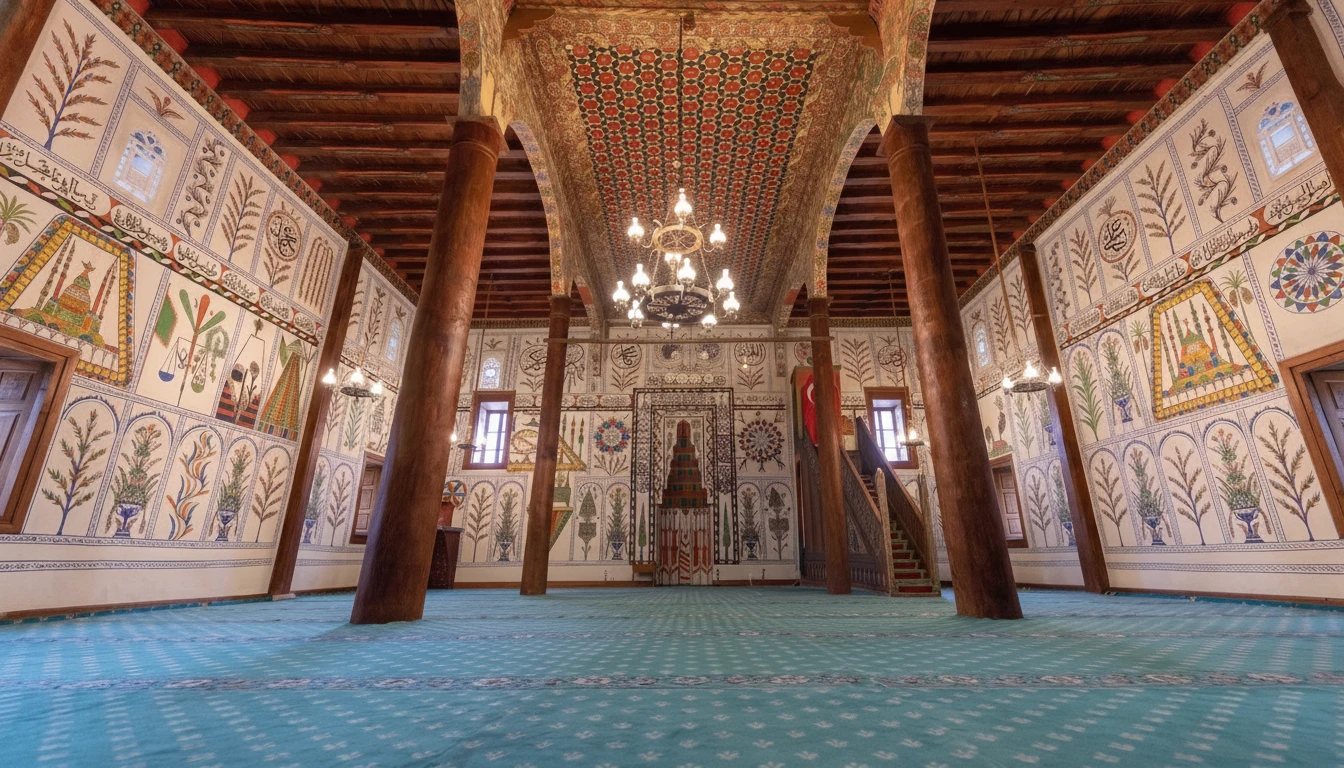
use mudbrick. Inside, thick wooden columns divide the prayer hall into three aisles. The supports are
connected with decorative wooden forms commonly described as Bursa arches, creating a warm and highly
distinctive interior rhythm.
What makes the mosque exceptional is the almost continuous painted decoration covering its walls, arches, supports and ceiling.
These paintings combine traditional floral ornament, geometric patterns, religious inscriptions and symbolic visual narratives.
They reflect the local interpretation of Ottoman decorative art and demonstrate how provincial communities adapted major
religious and artistic themes to rural architecture.
The interior includes representations of mosques and the Kaaba as well as scenes connected with paradise, hell and the
Mizan, or scales of judgment. Other unusual images include a yataghan sword, flintlock firearms and objects
associated with Ottoman material culture. Together, these details make the mosque feel almost like a painted historical archive.
The mosque originally had a flat earthen roof. During repairs in 1948, the earth covering was removed and
replaced by a roof sloping in four directions and covered with tiles. A minaret was added during the mid-20th century.
Despite these later interventions, the historic prayer hall and its painted surfaces remain the building’s defining features.