Jewish Heritage in Galata
Ashkenazi Synagogue History & Significance
Explore the story of Istanbul’s Ashkenazi community and a synagogue shaped by Ottoman, Austrian and European connections.
Ashkenazi Jewish religious life in the Galata area predates the current building. A house on Büyük Hendek Street
was reportedly used as a synagogue from 1831, but it was destroyed by fire in 1866. Members of Istanbul’s
Austrian-origin Ashkenazi community then established a wooden synagogue on the site of the present building,
remembered as the Österreichischer Tempel.
Historical records indicate that two separate German-Jewish rite congregations operated on Yüksekkaldırım
during the late nineteenth century. In 1900, permission was granted by decree of Sultan Abdülhamid II to replace
the earlier wooden structures with a new synagogue.
Construction was supported through issued bonds and financial contributions from Jewish communities in Austria.
The present synagogue, designed by the Venetian architect G. J. Cornaro, was formally opened
with a ceremony on 17 September 1900.
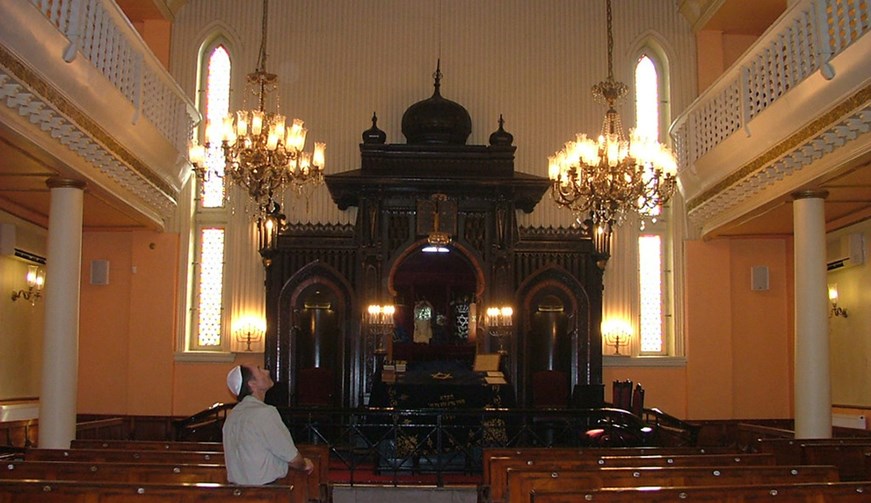
The synagogue’s handcrafted ebony Aron ha Kodesh, where the Torah scrolls are kept,
and its Bimah, the platform used for Torah reading and prayer, were commissioned in 1904.
They were created by the master craftsman Fogelstein in memory of Rachel Carlman.
Today, the Ashkenazi Synagogue remains a living religious site and an important reminder of the diverse Jewish
communities that helped shape the commercial and cultural life of Galata and Beyoğlu.