Persimmon, Not Date Fruit
Kocaali Hurma Kurusu is made from Asian persimmon rather than fruit from the date palm.
- Species: Diospyros kaki L.
- Turkish names: Cennet hurması, Trabzon hurması
- English: Persimmon






Kocaali Hurma Kurusu is a geographically indicated dried fruit produced in Kocaali district of Sakarya Province. Despite the Turkish word hurma sometimes being translated as “date,” this local speciality is made from persimmon — the fruit widely known in Türkiye as cennet hurması or Trabzon hurması, scientifically Diospyros kaki L.
The fruit is closely connected with Kocaali’s humid Black Sea climate and rural garden culture. Persimmon trees are common around village homes and orchards, and autumn brings bright orange fruit to the district before selected persimmons are peeled, tied to strings and dried.
The protected method transforms firm, not-yet-fully-ripe persimmons into a dark brown, wrinkled and naturally sweet dried fruit. The process depends on careful harvesting, peeling, handling, stringing and drying, and local skill plays an important role in achieving the characteristic appearance and texture.
This complete guide explores the product’s geographical-indication status, the difference between persimmons and dates, harvest season, traditional preparation, drying techniques, flavour, texture, storage, buying tips, local food culture, photography opportunities, nearby attractions and the best ways to combine a tasting with a wider journey through northern Sakarya.
Kocaali Hurma Kurusu is registered in Türkiye as a geographical indication with registration number 815.
The fruit is Diospyros kaki, known locally as cennet hurması or Trabzon hurması — not the date-palm fruit.
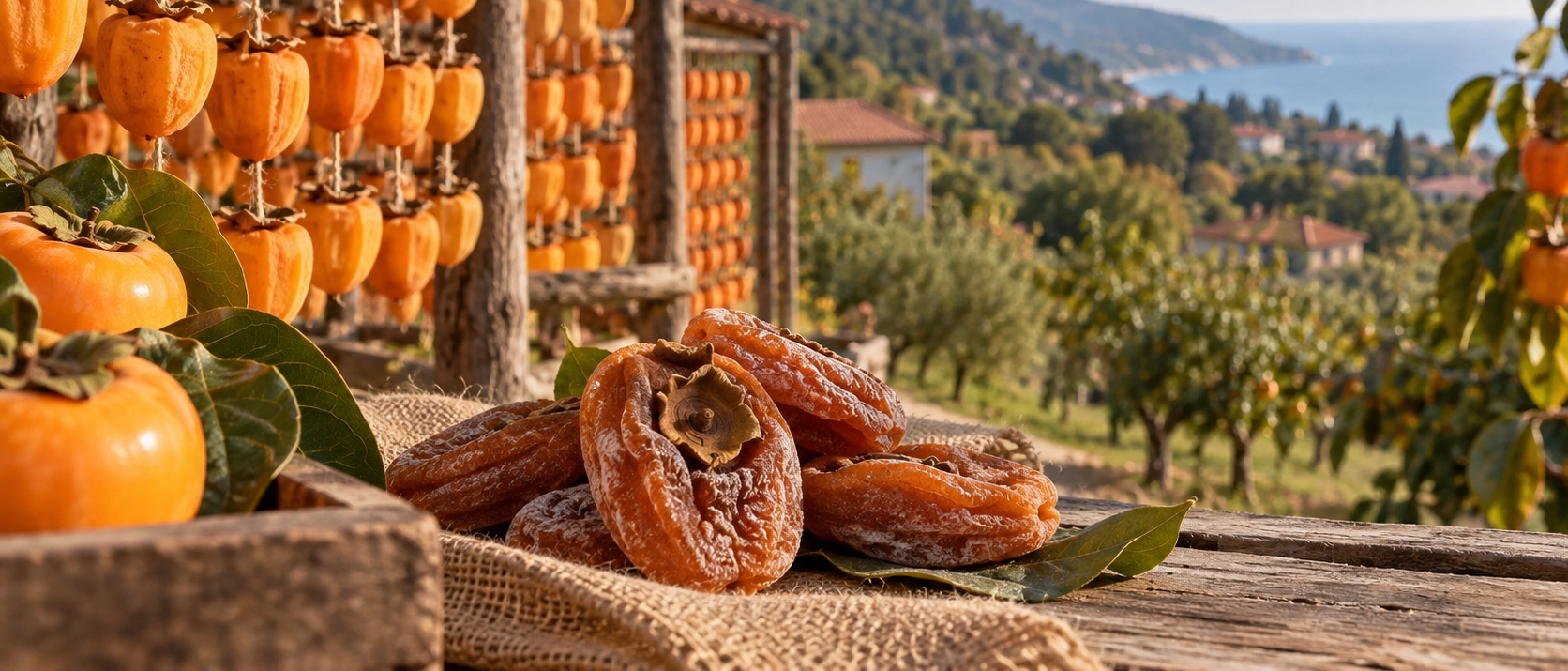
Firm autumn persimmons are peeled, tied by their stems and dried while hanging in carefully managed conditions.
Drying changes the initially astringent fruit into a naturally sweet, chewy and intensely flavoured seasonal speciality.
Essential information about one of Kocaali’s best-known protected food products.
Kocaali district in northern Sakarya Province, Türkiye.
Open Kocaali on Google MapsPersimmon (Diospyros kaki L.), locally called cennet hurması or Trabzon hurması.
Peeled fruits are tied to food-safe strings and dried while hanging without touching one another.
Registered as Kocaali Hurma Kurusu with registration number 815.
Dried persimmon connects Kocaali’s humid landscape, household gardens and generations of practical food preservation.
Kocaali lies in northern Sakarya near the Black Sea, where green hills, frequent humidity and productive village gardens shape everyday agricultural life. Hazelnuts dominate much of the district’s rural economy, but persimmons are another familiar sight around homes and small holdings.
Locally, the fruit is commonly called cennet hurması or Trabzon hurması. Trees can produce generous autumn crops, and drying provides a practical way to preserve the fruit beyond its short fresh season.
The traditional process begins before the persimmons become completely soft. Growers select fruit that has developed its orange colour but is still firm enough to peel, handle and hang without collapsing.
After peeling, the fruit is tied by its retained stem and suspended in strings. Air must circulate around each piece, and the fruits should not touch surrounding surfaces or one another. This visually striking stage is one of the defining images of Kocaali’s autumn food culture.
Over time, the method became strongly associated with Kocaali. The product’s connection with local practice, reputation and skill led to official geographical-indication registration in 2021.
Today, Kocaali Hurma Kurusu is both a household tradition and a marketable regional product. It gives visitors a simple but meaningful introduction to how seasonal abundance can be transformed into a distinctive winter food.
The protected product is defined by its fruit, harvest stage, preparation method, drying technique and recognisable finished appearance.
Kocaali Hurma Kurusu is made from Asian persimmon rather than fruit from the date palm.
The registered method notes that Fuyu and Hachiya-type persimmons suitable for drying are generally preferred.
Fruit intended for drying is picked after colouring but before it softens completely.
The skin is removed while the stem is kept intact so the fruit can be tied and suspended.
Peeled persimmons are tied to food-safe strings and hung where air can circulate around the entire fruit.
The finished fruit develops dark brown tones, a wrinkled surface and a naturally powdery-looking exterior.
Drying concentrates the fruit’s sugars and changes its fresh astringency into a much sweeter eating experience.
Harvest timing, stem cutting, peeling, stringing and drying all require care and practical experience.
Kocaali Hurma Kurusu is officially registered by the Turkish Patent and Trademark Office as a geographical indication connected with Kocaali district in Sakarya Province.
The official geographical-indication name is Kocaali Hurma Kurusu.
The product carries geographical-indication registration number 815.
The geographical indication was registered on 28 July 2021.
The geographical-indication application was filed on 29 June 2020.
It is registered as a Mahreç İşareti, a Turkish geographical-indication category based on the product’s connection with its place and recognised production tradition.
The registration holder is Kocaali Municipality.
The defined geographical area is Kocaali district of Sakarya Province.
It is registered within the group covering processed and unprocessed fruits, vegetables and mushrooms.
The protected name links the finished dried fruit with Kocaali’s reputation and production knowledge. The specification emphasises the local preparation method and the skill required at several stages, particularly fruit selection, peeling, stringing and drying.
The Turkish word hurma can cause confusion for English-speaking travellers because it is also used for the fruit of the date palm. In Kocaali Hurma Kurusu, however, the fruit is persimmon.
Cennet hurması is one of the most common local names for persimmon.
Trabzon hurması is another widely used Turkish name for the same fruit.
The species identified in the protected specification is Diospyros kaki L..
The clearest English name is persimmon or Asian persimmon.
It is botanically different from dates, which grow on date palms and belong to a completely different plant family.
For international visitors, “Kocaali Dried Persimmon” is the most accurate and understandable description.
Kocaali’s coastal and inland landscapes are intensely green compared with many parts of central Anatolia. Humidity, rainfall, fertile garden soils and village-scale agriculture create favourable conditions for a wide variety of fruit and tree crops.
The district’s moisture-rich climate supports lush vegetation and productive household gardens.
Persimmon trees are commonly found around rural homes, small orchards and family gardens.
Bright orange persimmons become especially conspicuous in the landscape as leaves begin to fall.
Hazelnuts remain economically important, while persimmon provides an additional seasonal product for some households and growers.
Coastal humidity and green inland hills give northern Sakarya a landscape strongly influenced by the western Black Sea.
Drying allows a highly seasonal autumn fruit to be enjoyed and sold during winter and beyond.
Successful drying begins with fruit selection. Persimmons intended for Kocaali Hurma Kurusu are generally harvested while they are fully coloured but still firm and not yet completely ripe.
The registered production description places the main harvest for drying roughly between mid-October and mid-November. Exact timing can shift with weather, variety, elevation and the progress of ripening.
The drying season generally begins as suitable fruits develop colour but remain firm.
Harvesting, peeling and stringing can become a major seasonal activity during the heart of autumn.
Fruit continues to be selected according to firmness and colour rather than by calendar date alone.
The usual harvesting window for drying generally comes to an end around the middle of November.
Temperature, humidity and rainfall influence both fruit maturity and the conditions available for drying.
Choosing the correct harvest stage helps the fruit keep its shape and develop the desired final texture.
The protected method follows a careful sequence before drying begins. Each step helps preserve the fruit’s shape, cleanliness and ability to hang securely.
The geographical-indication specification allows more than one drying environment, but all methods share the same goal: remove moisture safely while preserving the characteristic sweet fruit, dark colour and wrinkled appearance.
Strings of peeled persimmons can be dried in cool, breezy, well-ventilated conditions protected from adverse weather.
Traditional drying in suitable cool and windy conditions can take approximately 30 to 45 days.
Hanging fruit should not become wet during drying, so covered locations are important.
Each fruit needs air around its surface and should not rest against neighbouring fruit or another surface.
In heated closed environments at approximately 28–35°C, drying can be completed much more quickly.
The registered method notes that suitable warm indoor drying may take around 4 to 5 days.
Technology-assisted cabinet systems with managed temperature and humidity can also be used.
In Kocaali households, persimmons have also been associated with drying near wood-burning stoves during the cool season.
Fresh persimmons selected for drying are intentionally firm and can taste noticeably astringent. Over time, moisture leaves the fruit, sugars become more concentrated and the flavour changes dramatically.
Drying removes a large amount of the water naturally present in fresh fruit.
As the fruit loses water, its natural sugars become more pronounced.
The harsh puckering sensation of firm persimmon is greatly reduced through ripening and drying.
The bright orange fresh fruit develops progressively deeper brown tones.
The skinless fruit contracts as it dries, creating the characteristic wrinkled exterior.
The finished fruit becomes compact, chewy and rich compared with fresh persimmon.
Kocaali Hurma Kurusu offers a very different experience from fresh persimmon. Drying concentrates the fruit’s sweetness and aroma while creating a dense, pleasantly chewy texture.
The fruit develops a rich sweetness without needing to be confused with confectionery or candied fruit.
The flavour is deeper and more intense than in a fresh, firm persimmon.
The dried flesh is soft to dense and chewy rather than crisp.
Some batches may suggest naturally caramelised or honeyed fruit notes as sweetness concentrates.
Texture and sweetness can vary with variety, harvest stage, drying method and storage.
Its dense sweetness makes it particularly appealing with tea and other cool-season foods.
The protected product has a recognisable general appearance, though natural fruit variation means that no two pieces will be exactly alike.
The finished fruit is typically much darker than the bright orange persimmon from which it began.
Loss of moisture causes the exterior to contract into folds and wrinkles.
The registered description notes a naturally floury or powdery-looking surface as part of the product’s appearance.
Traditional hanging preserves the recognisable shape of the fruit even as it shrinks.
The flesh becomes concentrated and substantially firmer than a fully ripe fresh persimmon.
Size, colour and texture differ according to the original fruit and drying conditions.
Proper storage helps protect dried persimmon from moisture, unwanted odours and deterioration. The protected production description provides clear guidance for the finished product.
Store dried persimmon in a cool environment rather than near heaters or other sources of unnecessary warmth.
Moisture can damage dried fruit, so the storage area should remain dry.
Keep the product away from windows and other places exposed to strong direct sunlight.
The official method recommends storage in an environment free from unwanted smells.
Under suitable cool, dry and protected conditions, the specification notes storage for up to approximately one year.
For packaged products, always follow the producer’s stated storage instructions and best-before information.
Visitors may encounter dried persimmon through local producers, village sellers, regional-product shops, markets and selected retailers in Kocaali and elsewhere in Sakarya.
Kocaali Hurma Kurusu needs little preparation. Its concentrated sweetness and chewy texture make it easy to enjoy on its own or alongside simple foods and drinks.
Start with a small piece at room temperature to appreciate the fruit’s natural sweetness and dense texture.
The rich sweetness pairs naturally with a glass of unsweetened Turkish tea.
Dried persimmon can add a seasonal fruit element to a breakfast of bread, cheese and other local products.
Walnuts or hazelnuts provide a contrasting crunch beside the soft, sweet fruit.
Its dark colour and distinctive shape make it an interesting addition to a dried-fruit assortment.
The product is traditionally associated with preserving autumn abundance for the colder months.
October and November offer the strongest connection with harvest, peeling and early drying activity.
Strings of peeled persimmons create one of the most photogenic scenes associated with the local production tradition.
Drying areas may be part of private homes or working farms, so always ask before entering or taking close-up photographs.
Local sellers who can explain origin, harvest and drying method offer a more meaningful tasting experience.
A food-focused stop can easily be paired with the Black Sea coast for a varied day in the district.
The countryside behind the coast reveals orchards, hazelnut gardens and green rural landscapes.
If taking dried persimmon home, protect the package from moisture, crushing and heat during travel.
If you see “hurma kurusu,” remember that in Kocaali it refers to dried persimmon rather than dried date fruit.
Persimmon trees return to leaf while Kocaali’s countryside becomes intensely green.
Fruit develops on the trees while beaches and the Black Sea coast draw most seasonal visitors.
Persimmons begin to colour strongly and the main harvest-for-drying period approaches.
Harvesting, peeling, stringing and drying make this one of the most interesting months for food-focused visitors.
Slow air-dried fruit reaches its finished stage and becomes closely associated with winter snacking.
Properly stored packaged dried persimmon may be available beyond the harvest season depending on producer stocks.
Kocaali’s food culture reflects a landscape where Black Sea humidity, forested hills, orchards, hazelnut gardens and household food preservation meet. Dried persimmon is one of the district’s most recognisable examples of turning seasonal fruit into a product that can be enjoyed long after harvest.
Kocaali Hurma Kurusu is a protected local speciality and an appealing edible souvenir.
Kocaali Çamdağı Chestnut Honey is another geographically indicated product closely tied to the district’s natural environment.
Hazelnut agriculture is a major presence in the district and shapes much of Kocaali’s rural landscape.
Fruit trees around homes and smallholdings contribute to a strong tradition of seasonal household production.
Drying extends the availability of autumn fruit into the colder months and reduces waste from abundant crops.
Meeting growers can turn a simple dried fruit into a deeper introduction to everyday rural life in northern Sakarya.
Geographical-indication recognition has helped draw attention to a product that was once largely associated with household use. Dried persimmon has increasingly been seen as an additional source of value for local growers alongside Kocaali’s better-known agricultural products.
Fruit that might otherwise remain unused can be turned into a shelf-stable regional product.
Harvesting, peeling, tying, drying, sorting and packing create seasonal work during autumn and early winter.
Household and small-scale production has provided income opportunities for women in rural neighbourhoods of Kocaali.
Greater visibility for the product has also encouraged interest among younger local producers.
Geographical-indication status helps distinguish the Kocaali name in the wider dried-fruit market.
Visitors interested in local food can combine tastings with countryside, beach and nature experiences.
A dried-persimmon tasting can easily be combined with Black Sea beaches, forest landscapes, lakes and other food traditions across northern Sakarya.
Continue from Kocaali’s orchards and villages to the district’s long Black Sea shoreline for broad sea views and a refreshing coastal stop.
Discover a peaceful natural landscape close to the Black Sea, with water, reeds and quiet coastal scenery.
Taste another geographically indicated Kocaali speciality shaped by the district’s chestnut-rich forests and beekeeping tradition.
You are exploring Kocaali Hurma Kurusu, a protected local speciality shaped by autumn harvests and traditional fruit-drying knowledge.
Add a historical stop to your Sakarya route at one of the province’s lesser-known fortifications.
Enjoy lakeside scenery and woodland atmosphere on a wider northern Sakarya journey.
It is a geographically indicated dried persimmon produced according to a recognised local method associated with Kocaali district in Sakarya Province.
No. Despite the word hurma, this product is made from persimmon, not date-palm fruit.
The fruit is Asian persimmon, scientifically known as Diospyros kaki L..
It is commonly called cennet hurması or Trabzon hurması.
“Kocaali Dried Persimmon” is the clearest English translation for international travellers.
Its protected geographical connection is with Kocaali district in northern Sakarya Province, Türkiye.
Yes. Kocaali Hurma Kurusu is officially registered as a geographical indication in Türkiye.
The registration number is 815.
The geographical indication was registered on 28 July 2021.
The application was filed on 29 June 2020.
The registration holder is Kocaali Municipality.
It is registered as a Mahreç İşareti.
The registered production method notes that drying-suitable Fuyu and Hachiya-type persimmons are generally preferred.
No. Fruit for drying is generally selected after it has coloured but before it becomes fully soft and ripe.
The usual period described in the registered method is approximately from mid-October to mid-November.
The stem is needed so the peeled persimmon can be tied securely to string and suspended during drying.
Yes. The selected fruits are peeled before they are tied and dried.
They are tied to food-safe strings, usually in sequences, while being spaced so their surfaces do not touch.
Yes. The registered method describes dipping the prepared persimmons in boiling water for approximately 30 seconds before hanging.
In suitable cool, breezy conditions protected from rain, drying can take approximately 30–45 days.
Yes. The registered method also allows warm indoor or controlled technological drying.
The specification describes heated closed environments at approximately 28–35°C.
Under suitable heated conditions, the registered method notes approximately 4–5 days.
Yes. Cabinet systems that allow temperature and humidity to be controlled can also be used.
Separation allows air to reach the fruit surface more evenly and supports clean, controlled drying.
Rewetting can interfere with the drying process and reduce product quality, so protected drying locations are preferred.
The finished product is characterised by dark brown colour and tones.
The protected description notes a wrinkled surface with a naturally powdery or floury appearance.
It is naturally sweet, with concentrated persimmon flavour and a dense, chewy texture.
Persimmons selected before full ripeness can have a puckering taste, which softens as the fruit ripens and dries.
Keep it in a cool, dry place away from direct sunlight, excess moisture and strong odours.
Under appropriate protected conditions, the registered description notes storage for up to approximately one year.
Yes. Properly dried and packaged fruit may be available beyond autumn depending on producer stocks and storage conditions.
Late October through November is generally the most atmospheric period for seeing harvest, peeling, stringing and hanging fruit.
Yes. Its local identity, compact size and geographical-indication status make it an interesting food souvenir when properly packaged for travel.
Yes when permission is granted, but many drying spaces are private homes or working production areas, so always ask first.
Kocaali Çamdağı Chestnut Honey is another geographically indicated product strongly connected with the district’s landscape.
Kocaali Beach, Küçükboğaz Lake and the green countryside behind the Black Sea coast can easily be combined with a food-focused visit.
Yes. Kocaali and neighbouring Karasu form a natural northern Sakarya route for travellers interested in beaches, river scenery, local food and rural landscapes.
The most memorable photographs tell the whole transformation from bright orange fruit on the tree to rows of peeled persimmons hanging in the autumn air and finally the dark, wrinkled dried product ready to eat.
Photograph orange fruit against fading autumn leaves or bare branches for a strong seasonal image.
With permission, close-up images of careful hand peeling show the craft behind the product.
Rows of bright peeled fruit hanging vertically create the most iconic photographs of the drying process.
Wide photographs can place the hanging fruit within the rural architecture and green landscape of Kocaali.
Use soft side light to reveal the dark brown colour, wrinkled surface and dense texture of the finished product.
A plate of dried persimmon with tea, hazelnuts or walnuts can create a simple regional food composition.
Always ask permission before photographing people, private gardens, homes, drying rooms or working production spaces. A respectful approach is especially important in small rural communities where the food tradition is part of everyday family life.
Combine local food traditions, persimmon country, chestnut-honey landscapes and Black Sea scenery on a private journey through northern Sakarya.
Custom-designed private journeys with flexible timing, private transportation and opportunities to discover regional foods, village landscapes, beaches and cultural sites across Sakarya Province.
Explore Kocaali’s dried-persimmon tradition, rural countryside and selected regional foods with time for local producers and scenic stops when available.
Request This Tour
Combine Kocaali’s local food heritage with Kocaali Beach, nearby lakes, forest scenery and selected highlights of northern Sakarya on a flexible private route.
Request This Tour