Sephardi Jewish Heritage in Historic Edirne

Grand Synagogue of Edirne – Complete Visitor Guide

Discover one of Türkiye’s most remarkable restored synagogues
and the living memory of Edirne’s historic Sephardi community.

Discover the Synagogue

Step Inside a Monument Reborn from the Great Edirne Fire

The Grand Synagogue of Edirne, historically known as Kal Kados HaGadol, rises in the city’s old Kaleiçi district. Built after the devastating fire of 1905, it brought Edirne’s neighborhood Jewish congregations together beneath one monumental roof and became one of the most important Sephardi synagogues in the Balkans.

Designed by French architect France Depré and opened for worship in 1907, the synagogue was inspired by the former Leopoldstädter Tempel in Vienna. Its tall arched windows, corner towers, women’s galleries, painted ceilings, timber details and carefully restored prayer hall create one of Edirne’s most memorable interiors. After decades of abandonment and a catastrophic collapse, the building was restored and ceremonially reopened on 26 March 2015.

Opened in 1907

Explore a monumental synagogue created after the Great Edirne Fire destroyed the city’s earlier prayer houses.

Sephardi Heritage

Discover the language, worship, music and community memory of Jewish families who shaped Edirne for centuries.

Remarkable Interior

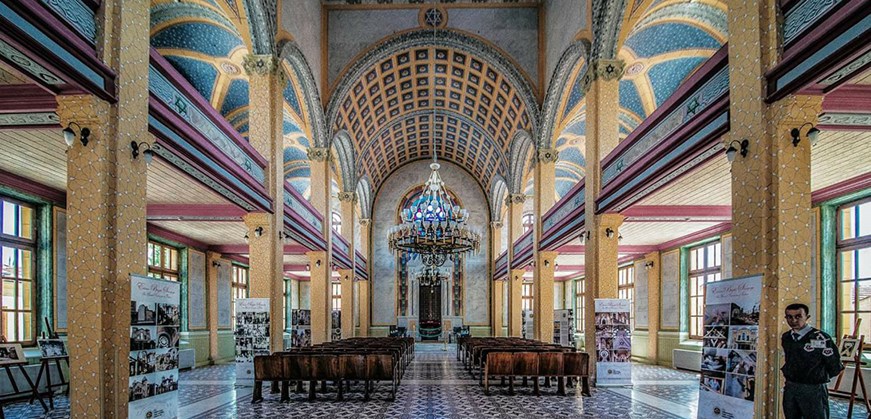
See the central prayer hall, women’s galleries, Torah ark, bimah, painted surfaces and richly patterned ceiling.

Restored in 2015

Experience a major heritage restoration that returned a nearly lost monument to worship, culture and public visitation.

Plan Your Visit

Grand Synagogue of Edirne – Quick Facts

Essential information for visiting this restored Sephardi landmark in central Edirne.

📍

Location

Maarif Street in the Dilaverbey neighbourhood, within Edirne’s historic Kaleiçi district.

🕍

Opened

Construction was authorized in 1906, and the synagogue opened for worship in 1907.

Visit Duration

Allow approximately 45 to 75 minutes for the prayer hall, galleries, exhibitions, courtyard and architectural details.

Main Highlights

Monumental façade, twin corner towers, women’s galleries, painted ceiling, bimah, Torah ark and restoration displays.


A Sephardi Landmark in Ottoman Edirne

Grand Synagogue of Edirne History & Significance

Follow the story of a congregation shaped by migration, fire, music, loss and restoration.

Jewish life in Edirne developed over many centuries. Romaniote Jews had lived in the region before the Ottoman period, while Sephardi families expelled from Spain in 1492 and later from Portugal found new homes across Ottoman lands. Edirne became one of the most important Jewish centers in the Balkans, with synagogues, schools, charitable institutions, workshops and commercial networks woven into the city.

Before the twentieth century, Edirne’s Jewish communities worshipped in a number of smaller synagogues associated with different neighbourhoods and places of origin. The Great Edirne Fire of 1905, known as Harik-i Kebir, devastated Kaleiçi, destroying homes, businesses and the city’s network of Jewish prayer houses. The disaster created an urgent need for a single large synagogue.

On 6 January 1906, construction of a new central synagogue was authorized during the reign of Sultan Abdülhamid II. French architect France Depré designed the building with inspiration from Vienna’s Leopoldstädter Tempel. Financial support came from Edirne’s Jewish community and from Jewish donors in other parts of Europe.

The synagogue opened in 1907 under the name Kal Kados HaGadol. Its broad prayer hall and upper galleries could accommodate a large congregation, while the adjoining complex included a smaller midrash building and administrative or educational spaces. For decades, it hosted Sabbath worship, festival prayers, weddings, community gatherings and Edirne’s distinctive Sephardi musical traditions.

The Jewish population of Edirne declined during the twentieth century because of political upheaval, the 1934 Thrace events, economic change and migration to Istanbul, Israel, Europe and the Americas. The synagogue closed in 1983. Its ownership passed to the General Directorate of Foundations in 1995, and much of the already weakened structure collapsed in 1997.

A major reconstruction and conservation project began in 2010. Using historical photographs, architectural surveys and surviving fabric, the prayer hall, galleries, façades and associated buildings were restored. The Grand Synagogue reopened on 26 March 2015 with prayers, music and a large gathering of members of Türkiye’s Jewish community. Today, it functions as a synagogue, cultural venue and powerful memorial to Edirne’s multicultural past.

What to See at the Grand Synagogue of Edirne

Explore the architectural and religious features that reveal the synagogue’s community story.

The Monumental Façade

The yellow-painted exterior is one of the synagogue’s most recognizable features. Tall arched windows, pilasters, decorative mouldings and a formal central entrance give the building a strong urban presence along Maarif Street.

  • Style: Moorish Revival with European historicist influences
  • Colour: Warm yellow façade with contrasting architectural details
  • Focus: Central entrance framed by tall vertical openings

The Corner Towers

Tower-like corner masses rise above the main façade and strengthen the synagogue’s symmetrical composition. Their upper sections and patterned roofs create a distinctive silhouette that can be recognized from surrounding streets.

  • Position: Flanking the principal façade
  • Purpose: Architectural emphasis and vertical balance
  • Best view: From the opposite side of Maarif Street

The Main Prayer Hall

The long rectangular hall is organized around the central axis between the entrance, bimah and Torah ark. Rows of columns, timber benches, galleries and painted ceilings create a ceremonial space designed for a large congregation.

  • Plan: Broad basilica-like rectangular worship space
  • Capacity: Historically designed for several hundred worshippers
  • Orientation: Focused toward the Torah ark at the sacred end

The Women’s Galleries

Upper galleries extend along the sides of the prayer hall. Traditionally known as the women’s section or azara, they provide elevated views across the central space and add an impressive second level to the interior.

  • Position: Raised above the side aisles
  • Function: Traditional women’s prayer area
  • Detail: Decorative fronts, columns and rhythmic timber structure

The Bimah

The bimah is the raised platform from which the Torah is read during worship. Its central position reinforces the communal nature of Sephardi liturgy and creates a visual relationship between the congregation and the sacred text.

  • Function: Torah reading and prayer leadership
  • Location: Within the central area of the prayer hall
  • Visitor note: Observe without entering restricted liturgical areas

The Torah Ark

The Torah ark, often called the Ehal or Hechal in Sephardi tradition, marks the most sacred architectural focus of the synagogue. Its restored timberwork, ornament and elevated position draw the eye through the length of the hall.

  • Purpose: Houses the Torah scrolls during active worship
  • Position: At the eastern end of the prayer hall
  • Respect: Do not touch or approach unless invited

Architecture & Design

The Grand Synagogue combines a European monumental plan with Moorish Revival details and the practical requirements of Sephardi worship. Its symmetrical exterior, spacious hall, galleries and decorative ceiling were designed to express both communal confidence and sacred dignity.

Moorish Revival Influence

Arched openings, decorative geometry and historicist details connect the building with a wider European synagogue tradition.

Vienna Inspiration

France Depré drew inspiration from the Leopoldstädter Tempel, a major Vienna synagogue destroyed during the Nazi pogroms of 1938.

Large Rectangular Plan

The main building is organized as a long, high-volume prayer hall supported by masonry walls, columns and internal structural elements.

Light-Filled Interior

Tall windows illuminate the prayer hall from several directions, highlighting the galleries, ceiling patterns and central liturgical axis.


Architectural Perspective Stand near the central entrance and look toward the Torah ark. The long axis, galleries and patterned ceiling reveal the synagogue’s full ceremonial scale.

Ceilings, Columns, Windows & Sacred Details

The interior is the emotional center of the visit. Decorative surfaces, painted vaults, timber galleries, chandeliers and tall windows transform the hall into a space of light, rhythm and colour. The restoration recreates the appearance of the historic synagogue while clearly presenting its continuing religious function.

Painted Ceiling

Geometric panels, stars, floral motifs and blue-toned surfaces create one of the building’s most photographed features.

Columned Galleries

Slender supports and gallery fronts frame the central nave-like space and give the interior a strong visual rhythm.

Stained & Coloured Glass

Decorative glazing filters daylight into the hall and adds changing colour to the restored walls and timber furnishings.

Jewish Symbols

Stars of David, Hebrew inscriptions and liturgical forms communicate the identity and sacred purpose of the building.


The synagogue remains a place of worship. Exhibitions or cultural programming may be present, but visitors should never treat the prayer hall as an ordinary event venue. Speak quietly, follow staff instructions and avoid entering roped or sacred areas.

The Jewish Community of Edirne

Edirne’s location between Anatolia, the Balkans and Europe made it a major center of movement, trade and cultural exchange. Jewish families contributed to commerce, medicine, printing, craftsmanship, education, religious scholarship and music, while preserving forms of Ladino, the Judeo-Spanish language carried from the Iberian Peninsula.

Romaniote Roots

Jewish communities existed in the wider region before the arrival of the Sephardim and formed part of Edirne’s early urban history.

Sephardi Migration

Families expelled from Spain and Portugal settled in Ottoman cities, bringing languages, professions, traditions and religious customs.

Community Institutions

Synagogues, schools, charities, workshops and associations supported a complex Jewish social life across Edirne.

Cross-Balkan Connections

Family and commercial networks linked Edirne with Istanbul, Thessaloniki, Plovdiv, Sofia and other Balkan centers.

The Great Edirne Fire of 1905

The fire of 1905 was a defining event in the history of the synagogue. It swept through the densely built Kaleiçi district, destroying houses, shops and communal buildings. Edirne’s smaller Jewish congregations lost their individual prayer houses and decided to build a shared central synagogue on a far more monumental scale.

Harik-i Kebir

The disaster became known as the Great Fire and remains one of the most destructive urban events in modern Edirne history.

Lost Synagogues

The city’s network of neighbourhood synagogues was destroyed or rendered unusable, leaving congregations without suitable worship space.

A Unified Project

Rather than rebuild every smaller synagogue, community leaders supported one large building capable of serving the wider Jewish population.

International Support

Donations from Jewish communities beyond Edirne helped finance the new synagogue and reflected strong European connections.


Historical Meaning The Grand Synagogue is both a response to disaster and a statement of communal resilience. Its scale reflects the strength of Jewish life in Edirne at the beginning of the twentieth century.

Sephardi Music & the Maftirim Tradition

Edirne developed an important tradition of Jewish religious music. The city became closely associated with Maftirim, Hebrew devotional poetry performed using musical modes related to Ottoman classical music. This tradition reflects centuries of artistic exchange between Jewish musicians and the wider musical culture of the Ottoman world.

Hebrew Poetry

Maftirim compositions set sacred Hebrew poems to elaborate melodies performed by trained singers and congregational groups.

Ottoman Makam

The music shares modal structures with Ottoman classical music, demonstrating deep cultural interaction across religious communities.

Synagogue Acoustics

The large prayer hall and galleries create a resonant space suited to collective prayer, chanting and ceremonial music.

Living Cultural Memory

Concerts, commemorations and research continue to introduce visitors to Edirne’s distinctive Jewish musical heritage.

The Synagogue Complex

The Grand Synagogue was planned as part of a broader communal complex. In addition to the main sanctuary, the site included a smaller midrash and an administrative or educational building. Together, these spaces supported worship, study, community organization and social life.

Main Synagogue

The monumental prayer hall formed the ceremonial heart of the complex and hosted major services and community gatherings.

Midrash Building

A smaller prayer and study space offered a more practical setting for daily use and colder periods.

Administrative Building

Associated rooms supported community management, education and other institutional functions.

Courtyard

The enclosed grounds create a transition between busy Maarif Street and the quieter religious interior.

Closure, Abandonment & Collapse

The synagogue’s decline was closely connected with the shrinking Jewish population of Edirne. Migration accelerated after the political and social upheavals of the twentieth century. With fewer worshippers and limited resources for maintenance, the enormous building became increasingly difficult to protect.

Community Decline

Many Jewish families moved to Istanbul, Israel, Europe and the Americas, leaving only a very small local congregation.

Closed in 1983

Regular use ended when the remaining community could no longer sustain the large synagogue.

Transferred in 1995

Responsibility for the property passed to Türkiye’s General Directorate of Foundations.

Collapsed in 1997

After years of deterioration, most of the structure failed, leaving only limited historic fabric standing.


Before Restoration Historical photographs and exhibitions at the site reveal how close the synagogue came to disappearing completely.

Restoration & Reopening in 2015

Restoring the Grand Synagogue required far more than repairing a roof. Much of the building had collapsed, so specialists studied surviving walls, archival photographs, drawings and community records to reconstruct the synagogue’s historic form, decorative programme and liturgical arrangement.

Work Began in 2010

The General Directorate of Foundations launched the major restoration after years of documentation and project preparation.

Structural Reconstruction

Walls, roof systems, galleries and interior supports were rebuilt while surviving historic elements were conserved where possible.

Decorative Recreation

Painted ceilings, timber details, windows, furnishings and symbolic ornament were recreated using archival evidence.

Reopened in 2015

The synagogue returned to worship and public life with an international ceremony on 26 March 2015.


Restoration Perspective Look for exhibition panels and historical photographs comparing the ruined building with the restored interior. They help visitors understand the scale of the conservation project.

Worship, Ceremonies & Cultural Events

The Grand Synagogue is not maintained only as a static museum. Although Edirne no longer has the large permanent Jewish community that once filled the building, the synagogue hosts special prayers, commemorations, weddings, concerts, exhibitions and cultural gatherings.

Special Services

Jewish community groups may gather for festival prayers, commemorations and organized religious visits.

Weddings

The restored synagogue has again hosted Jewish wedding ceremonies, reconnecting the building with family and community traditions.

Concerts & Exhibitions

Selected cultural programmes explore Sephardi music, Edirne history, restoration and interfaith heritage.

Visitor Etiquette

Religious services and private ceremonies always take priority over tourism and photography.

Entrance Fee, Opening Days & Visiting Conditions

The Grand Synagogue is generally open to visitors as a religious and cultural monument. Official tourism information lists admission as free and identifies Monday as the weekly closing day. Daily hours can change because of religious services, security arrangements, maintenance, public holidays and special events.

Entrance Fee

General admission is normally free. Special events may follow separate access arrangements.

Weekly Closing Day

The synagogue is generally closed to ordinary visitors on Mondays.

Opening Hours

Confirm the current daily timetable locally before making a special journey, especially outside the main travel season.

Security & Events

Access may be limited during worship, private ceremonies, official visits or enhanced security periods.


Important Opening arrangements can change without appearing immediately on travel websites. Check current local information when interior access is essential.

Why Visit the Grand Synagogue of Edirne?

Edirne is often introduced through Ottoman mosques and imperial monuments, but the Grand Synagogue reveals another essential layer of the city. Its story connects Iberian exile, Ottoman refuge, Balkan Jewish life, urban disaster, migration and twenty-first-century restoration within one building.

Multicultural Edirne

The synagogue expands the city’s story beyond imperial architecture and shows how different communities shaped its neighbourhoods.

Sephardi Memory

The building preserves connections with Ladino culture, Jewish worship, family history and migration across the Balkans.

Architectural Drama

The luminous prayer hall, galleries and painted ceiling create one of the most striking restored interiors in Edirne.

A Story of Renewal

Few monuments demonstrate the passage from near-total ruin to active cultural and religious use as clearly.

How to Get to the Grand Synagogue of Edirne

The synagogue stands on Maarif Street in the Dilaverbey neighbourhood, within the historic Kaleiçi area. It is close enough to the city center to reach on foot, while taxis and private vehicles provide convenient access from hotels, the bus terminal and outer districts.

From Selimiye Mosque

The synagogue can be reached by a moderate walk through central Edirne or by a short taxi ride.

On Foot

Walking through Kaleiçi allows visitors to see historic houses, local streets and other layers of the old city.

By Taxi

Ask for “Edirne Büyük Sinagogu” or “Maarif Caddesi’ndeki Büyük Havra.”

By Private Vehicle

Use legal street parking in the surrounding area and avoid blocking residential entrances or security access.


Map Search Search for “Edirne Büyük Sinagogu” or “Grand Synagogue of Edirne.”
Address Dilaverbey, Maarif Caddesi No:75, Edirne Merkez, Edirne.

Visitor Tips

Avoid Monday

Monday is generally the weekly closing day, so plan your Edirne heritage route for another day.

Dress Respectfully

Choose modest clothing suitable for an active place of worship and follow any head-covering guidance from staff.

Study the Exterior First

Pause across Maarif Street to appreciate the full façade, corner towers, arched windows and roofline.

Ask Before Photographing

Photography rules may change during services, ceremonies, exhibitions or official events.

Read the Displays

Historical photographs and restoration panels make the transformation from ruin to renewal far more powerful.

Combine Faith Heritage

Visit a mosque, synagogue and church on the same day to understand Edirne’s multicultural urban history.

Accessibility & Family Visits

The restored complex is generally easier to navigate than many ancient monuments, but thresholds, security arrangements and access to upper galleries may present difficulties. Visitors with limited mobility should confirm the available route before arrival when step-free access is essential.

Ground-Floor Access

The courtyard and main prayer level may be manageable for many visitors, subject to the entrance route in use that day.

Upper Galleries

Gallery access involves stairs and may be restricted for safety, preservation or event arrangements.

Seating & Rest

Do not assume historic benches are available for general resting; ask staff before sitting in liturgical areas.

Families with Children

Children are welcome when supervised, but they should not climb on benches, touch displays or enter restricted sacred spaces.


Accessibility Advice Contact local tourism authorities or the site before visiting when wheelchair access, accessible toilets or gallery entry is important.

Who Should Visit the Grand Synagogue?

Jewish Heritage Travelers

An essential stop for visitors tracing Sephardi history, Ladino culture and Jewish life across the former Ottoman world.

Architecture Lovers

The monumental façade, galleries, painted ceiling and restored timber details reward close architectural study.

Balkan History Enthusiasts

The building reflects migration, border change, urban disaster and community transformation across Thrace and the Balkans.

Music & Culture Travelers

Edirne’s Maftirim and Sephardi musical traditions add a rich cultural dimension beyond the physical monument.

Photographers

Symmetry, coloured glass, ceiling decoration, timber galleries and the yellow façade create memorable compositions.

Slow-Travel Explorers

The synagogue fits perfectly into a deeper walk through Kaleiçi, away from a rushed checklist of Edirne’s most famous sights.

Frequently Asked Questions

What is the Grand Synagogue of Edirne?

It is a monumental Sephardi synagogue built in Edirne after the Great Fire of 1905. Opened in 1907 and restored in 2015, it is one of the most important surviving Jewish heritage sites in Türkiye.

What is the synagogue’s historical name?

It is historically known as Kal Kados HaGadol, meaning the Great Holy Synagogue or Congregation.

When was the Grand Synagogue built?

Construction was authorized on 6 January 1906, and the synagogue opened for worship in 1907.

Who designed the synagogue?

French architect France Depré designed the building with inspiration from Vienna’s former Leopoldstädter Tempel.

Why was such a large synagogue constructed?

The Great Edirne Fire destroyed the city’s smaller Jewish prayer houses. Community leaders chose to create one large central synagogue capable of serving several congregations.

What happened to the synagogue during the twentieth century?

As Edirne’s Jewish population declined, regular use ended in 1983. The building deteriorated, and most of it collapsed in 1997.

When was the Grand Synagogue restored?

Major restoration began in 2010, and the completed synagogue reopened on 26 March 2015.

Is the synagogue still active?

Yes. It hosts selected Jewish services, ceremonies and community gatherings as well as exhibitions, concerts and cultural events.

Is there an entrance fee?

General visitor admission is normally free, although special events may have separate arrangements.

Which day is the synagogue closed?

Monday is generally listed as the weekly closing day. Confirm locally during public holidays or special-event periods.

How long should I spend at the synagogue?

Allow approximately 45 to 75 minutes for the prayer hall, exhibits, courtyard and architectural details.

Where is the Grand Synagogue of Edirne?

It is located at Maarif Caddesi No:75 in the Dilaverbey neighbourhood, within the historic Kaleiçi district of central Edirne.

Can I take photographs inside?

Photography is often possible during ordinary visits, but visitors should follow staff instructions and avoid flash, tripods or photographing worshippers without permission.

What should visitors wear?

Wear modest clothing suitable for a sacred place. Men may be asked to cover their heads during religious services or in designated areas.

Best Photo Moments at the Grand Synagogue

The synagogue offers strong compositions both outside and inside. Its best photographs balance monumental symmetry with the quieter details of timber, glass, painted surfaces and religious symbolism.

Full Street Façade

Photograph the complete yellow elevation from across Maarif Street, including the corner towers and central entrance.

Central Prayer Hall

From the entrance, align the benches, columns, galleries and Torah ark along the building’s main axis.

Painted Ceiling

Use a wide-angle composition to capture the geometric coffers, blue vaults and decorative transitions above the nave.

Gallery Symmetry

Frame the matching upper galleries and columns to emphasize the depth and rhythm of the interior.

Torah Ark Details

When permitted, photograph the restored timberwork and sacred focal point from a respectful distance.

Restoration Contrast

Include historical images or exhibition panels in your visual story to show the building’s transformation from ruin to renewal.

Best Time to Visit

The synagogue can be visited throughout the year on open days. Spring and autumn are especially comfortable for combining the site with a walking route through Kaleiçi and central Edirne. Interior photography is often best when natural daylight enters through the tall side windows.

Spring (April – June)

Mild temperatures make it easy to combine the synagogue with Selimiye Mosque, Kaleiçi and riverside landmarks.

Summer (July – August)

Long daylight supports a full sightseeing day, although midday heat can make extended walking uncomfortable.

Autumn (September – October)

Comfortable weather and softer light create excellent conditions for architecture and neighbourhood photography.

Winter (November – March)

The interior remains rewarding in colder weather, but shorter daylight and event schedules require more careful planning.


Best Overall Season Late spring or early autumn
Best Interior Light Late morning or early afternoon, depending on weather and open hours
Avoid Monday, the generally listed weekly closing day

Plan a Journey Including the Grand Synagogue of Edirne

Add the synagogue to a private Edirne excursion, a Jewish heritage route or a customized journey through Thrace. Share your travel date, starting city and interests so our team can help design the most practical experience.

Private & Heritage Travel Planning

Ideal for couples, families, Jewish heritage groups, photographers and travelers interested in Ottoman, Sephardi and Balkan history.