Edremit Olive Variety
The protected oil is produced from the Edremit olive, the dominant local variety of the Gulf. Under the EU specification, olives of other varieties mixed during harvest may not exceed 2%.






Edremit Olive Oil, officially protected as Edremit Zeytinyağı, is one of the defining products of the North Aegean coast of Türkiye. Produced from the local Edremit olive variety in the olive-covered landscape around the Edremit Gulf, it reflects the meeting of Mediterranean sunshine, Kaz Mountain winds, water-rich foothills, clay-influenced soils, careful harvesting, and generations of olive-growing knowledge.
The protected extra virgin olive oil is known for a graceful sensory profile that can include spring flowers, green grass, green almond, and golden apple. Its bitterness and pungency are generally delicate, becoming more noticeable in early-harvest oils. This complete guide explains the olive variety, terroir, harvest season, production method, Turkish geographical indication, European Union PDO status, tasting profile, buying and storage advice, culinary uses, local traditions, visitor tips, and the best ways to experience Edremit’s remarkable olive culture.
A deeply established local variety that dominates the protected production landscape around the Edremit Gulf.
Mountain winds, Mediterranean warmth, water reserves and local soils influence the slow ripening and sensory character of the fruit.
Registered in Türkiye as a designation of origin and protected in the European Union as Edremit Zeytinyağı PDO.
The protected-production specification describes a harvest season beginning in mid-October and continuing until the end of December.
Essential information about one of the most characteristic protected olive oils of Türkiye’s North Aegean coast.
Edremit Gulf in Balıkesir Province, with the protected production area centred on Edremit and Havran.
Open Edremit on Google MapsProduced from the Edremit olive variety, the defining olive of the protected geographical area.
Natural extra virgin olive oil with floral, grassy and fruity aromas and a characteristically fluid body.
TÜRKPATENT designation of origin no. 273 and European Union Protected Designation of Origin.
In Edremit, olive oil is not simply an ingredient. It is part of the agricultural landscape, local economy, food culture, seasonal rhythm, and identity of the Gulf.
The Edremit Gulf has been an olive-growing landscape for generations. Olive groves spread from the coastal plain toward the lower slopes beneath the Kaz Mountains, surrounding towns, villages, farm roads, old houses, mills, workshops, and family properties.
The official European PDO specification describes Edremit as an ancient settlement area with more than three thousand years of human history and identifies olive cultivation and olive-oil production as primary agricultural activities shaped by the region’s natural conditions.
Olive culture is visible throughout everyday life. Fresh oil appears at breakfast tables, in vegetable dishes, salads and home cooking; local producers sell harvest-season oils; mills become active during autumn; and families follow the progress of the crop from flowering and fruit set to ripening and pressing.
The rhythm intensifies in autumn. Harvest begins around the middle of October under the protected-production specification and may continue until the end of December. The timing of picking changes the flavour of the finished oil: greener fruit can produce firmer bitterness and pungency, while later-harvest fruit gives a softer, riper profile.
Edremit’s olive heritage is still actively celebrated. Local harvest events and tasting festivals bring together producers, residents and visitors, while historic mills and olive-oil buildings form part of the district’s industrial and cultural memory.
This living relationship between geography, variety, production knowledge and regional culture is the foundation of the protected name Edremit Zeytinyağı.
The protected oil is defined not by one single feature, but by the relationship between the Edremit olive variety, local terroir, careful harvesting, rapid processing, and its recognisable sensory profile.
The protected oil is produced from the Edremit olive, the dominant local variety of the Gulf. Under the EU specification, olives of other varieties mixed during harvest may not exceed 2%.
One of the most characteristic sensory descriptions is a fresh aroma reminiscent of spring flowers and green grass.
Depending on harvest maturity and the individual oil, tasters may notice green-almond aromas that give the oil a fresh, clean character.
Golden-apple notes may appear alongside floral and grassy aromas, contributing to the elegant fruit profile associated with Edremit Zeytinyağı.
Bitterness is generally delicate. Early-harvest oils may show a more noticeable, moderate bitterness while still remaining balanced.
The peppery sensation in the throat is normally delicate, becoming more pronounced in oils made from earlier-harvest fruit.
Colour varies naturally with harvest maturity, from golden yellow to darker green. Colour alone is not a reliable measure of quality.
The official specification describes the oil as having a notably thin body in terms of viscosity, one of the sensory traits linked with the Edremit Gulf terroir.
Edremit Zeytinyağı is officially registered by the Turkish Patent and Trademark Office as a geographically indicated product with a Menşe Adı, or designation of origin. This form of protection links the identity of the product directly to its defined production area and production rules.
The protected Turkish geographical-indication name is Edremit Zeytinyağı.
TÜRKPATENT geographical-indication registration number 273.
Registered in Türkiye on 13 December 2017.
Registered as a Menşe Adı, meaning a designation of origin tied closely to its defined production area.
The geographical indication was registered by the Edremit Chamber of Commerce.
Edremit Zeytinyağı was also entered in the European Union register as a Protected Designation of Origin (PDO) in 2023.
The Turkish registration protects the recognised relationship between Edremit olive oil and its place of origin. The defined geography, local olive variety, growing conditions and recognised production method are therefore central to the protected identity rather than optional marketing details.
In 2023, Edremit Zeytinyağı was entered into the European Union register as a Protected Designation of Origin (PDO). The registration recognises the oil as a product whose qualities and characteristics are closely connected with its defined geographical area.
The EU specification states that the protected product is a natural extra virgin olive oil produced from Edremit olives grown in the demarcated area. Cultivation, harvesting, leaf separation, washing, crushing, malaxation and extraction must all take place within that geographical area.
The character of Edremit olive oil begins in the landscape. The protected area lies around the northern side of the Edremit Gulf, where Mediterranean climatic conditions meet the slopes, winds and water systems of the Kaz and Madra mountain environments.
Cooler air and winds descending from the Kaz Mountains influence the slopes around the Gulf and help slow the ripening of the olives.
Regional air movements connected with the Madra Mountains also contribute to the distinctive microclimatic conditions of the olive-growing landscape.
Warm Mediterranean summers support olive development, while the surrounding mountain geography moderates conditions across the Gulf.
Winter rain and snowmelt replenish regional water reserves, reducing drought stress and supporting fruit development.
Soils with strong water-holding capacity help olive trees retain moisture through the dry season.
The combination of slope, wind, water and soil slows maturation compared with hotter southern growing areas, contributing to the oil’s characteristic sensory profile.
According to the official PDO description, these combined conditions reduce stress on the trees, help the Edremit olive develop its characteristic form and contribute to the oil’s spring-flower, green-grass, green-almond and golden-apple aromas.
The European PDO specification defines the production area around the Edremit and Havran districts of Balıkesir Province. The protected landscape covers approximately 224,580 decares and is framed by major natural and administrative boundaries of the Edremit Gulf.
For the protected PDO product, origin is not limited to where the olives are grown. The production steps from cultivation and harvesting through extraction must take place within the defined geographical area.
Harvest timing has a major influence on the aroma, bitterness, pungency, colour and oil yield of the fruit. Edremit’s protected-production rules place special emphasis on careful picking and fast processing.
The protected-production specification describes the olive harvest as beginning around the middle of October.
Harvest continues through autumn and may extend until the end of December depending on ripeness and seasonal conditions.
Olives are harvested with care to reduce bruising and damage that can harm freshness and raise acidity.
For protected Edremit Zeytinyağı, the olives are processed within 10 hours after harvest.
Greener fruit generally gives a more pronounced bitter and peppery character and a greener aromatic profile.
As the fruit matures, the oil tends toward softer bitterness and riper-fruit sensations.
Visitors arriving during harvest season may see collection nets beneath the trees, crates of freshly picked olives, tractors moving fruit to mills and tasting rooms offering the new season’s oil. Activity varies from grove to grove, and private farmland should only be entered with permission.
Modern olive-oil production is a controlled mechanical process. For protected Edremit Zeytinyağı, preserving freshness begins with undamaged fruit, rapid transport and strict attention to processing time, temperature and storage.
The EU PDO specification defines measurable chemical and sensory characteristics for the protected oil. These standards help describe the product consistently and distinguish the protected origin from a general bottle of olive oil sold under a place-inspired name.
Maximum 0.8%, expressed as oleic acid, consistent with the extra virgin category.
The protected specification describes a range of approximately 150–250 mg/kg.
The protected specification gives a range of approximately 100–200 mg/kg.
The protected specification describes a comparatively high range of approximately 2,000–3,000 mg/kg.
These laboratory values are part of the protected-product description, but visitors buying olive oil do not need to become chemists. For everyday selection, trustworthy origin, recent production, correct storage, clean fresh aromas and a balanced taste are practical starting points.
Edremit olive oil is generally elegant rather than aggressively bitter. Its sensory identity is associated with fresh plant aromas, delicate to medium fruitiness and a fluid texture.
Usually delicate to medium, with fresh plant aromas and fruit notes rather than an aggressive profile.
Typically delicate, although early-harvest examples can show a clear but balanced bitter edge.
Normally gentle, with a livelier throat sensation in earlier-harvest oils.
Spring flowers, green grass, green almond and golden apple are among the official sensory descriptors.
Fluid and relatively thin in body, giving the oil an elegant and clean mouthfeel.
Fresh herbal and fruity notes may linger after swallowing, especially in well-stored recent-harvest oils.
Early-harvest oils may feel greener and more assertive, while oils produced from riper fruit may show softer bitterness and riper-fruit aromas. Natural variation between harvests and producers is normal.
A simple olive-oil tasting helps you notice aromas that can disappear when the oil is mixed immediately with bread, lemon, tomatoes or other strong flavours.
Professional tasting uses specialised blue or dark glasses because colour can bias judgement. For travellers, an ordinary small glass is enough to understand the basic idea: smell, sip, notice the balance, and only then taste the oil with food.
The relatively elegant profile of Edremit olive oil makes it highly versatile. It can be used raw to emphasise aroma or incorporated into classic Aegean and Turkish cooking.
Drizzle over tomatoes, cucumbers, white cheese, village bread, olives and herbs for an Aegean-style breakfast.
Use raw over seasonal greens, tomatoes, onions and herbs where the oil’s floral and grassy notes remain easy to notice.
Edremit olive oil is ideal for classic Turkish zeytinyağlı vegetable dishes served warm or at room temperature.
Its relatively delicate bitterness works well with grilled or baked fish from the North Aegean coast.
Finish lentil, bean and vegetable dishes with a small raw drizzle just before serving.
For the clearest sensory impression, taste it simply with good bread—or professionally from a tasting glass without food.
Edremit has many local brands, cooperatives, mills and specialist food shops. Packaging and marketing styles vary, so focus on protected origin, freshness and storage rather than decorative labels alone.
For protected product, the label should clearly identify Edremit Zeytinyağı.
Protected-designation logos, geographical-indication marks and authenticity elements help distinguish certified products.
When possible, check harvest or production information and choose oil that has been stored correctly.
Dark glass, opaque tins and other light-protective packages help shield olive oil from one of its main enemies: light.
Do not choose bottles that have spent long periods in direct sun or next to hot display areas.
At mills and specialist shops, ask about harvest date, olive maturity, filtration and storage conditions rather than judging only by colour.
Olive oil gradually loses aroma when exposed to light, heat and oxygen. Good storage helps preserve the qualities you tasted at the producer or shop.
Autumn is the most atmospheric time to see the olive landscape in action, with groves, tractors, crates and mills working through the season.
When a producer offers a tasting, compare more than one oil and notice fruitiness, bitterness, pungency and finish.
Green oil is not automatically better than golden oil. Ripeness, filtration and storage can all influence colour.
Once purchased, keep the bottle or tin away from direct sunlight.
Store olive oil in a cool cupboard rather than beside the cooker, oven or a sunny window.
Oxygen gradually damages aroma, so replace the cap tightly after each use.
If you use olive oil slowly, several smaller containers can preserve freshness better than one very large opened tin.
Olive culture is best understood beyond the shop shelf: drive through Edremit, Güre, Altınoluk, Zeytinli, Akçay and the surrounding foothill settlements.
A bottle of oil is only the final stage of a much larger cultural landscape. In Edremit, olive trees shape the appearance of the countryside, the calendar of agricultural work, family businesses, seasonal employment, local trade and everyday cooking.
Groves cover wide areas between the Gulf and mountain foothills, creating one of the most recognisable agricultural landscapes of the region.
Olive growing and olive-oil knowledge are often passed between generations, linking current production with long-established local experience.
During harvest season, local mills and cooperative facilities become the centre of activity as fresh fruit arrives for processing.
Local events such as harvest-end traditions and olive-oil tasting festivals celebrate the social as well as agricultural meaning of the crop.
Old olive-oil factories are part of Edremit’s industrial heritage, preserving the memory of earlier production technologies and local commerce.
Olive oil appears constantly in breakfast, salads, vegetable dishes, seafood, legumes and home cooking throughout the North Aegean.
An olive-oil experience combines naturally with the Kaz Mountain foothills, coastal towns, ethnographic heritage, ancient sites and neighbouring olive landscapes of the North Aegean.
Explore a foothill settlement between the Kaz Mountains and the Gulf, known for thermal traditions, olive landscapes and easy access to nature.
Combine olive-country scenery with the North Aegean coast, old village streets, Kaz Mountain foothills and nearby ancient heritage.
Visit a mountain village and ethnography gallery that introduces the cultural landscape and traditions of the Kaz Mountains.
Continue along the North Aegean olive route to explore historic houses, old factories, island scenery and another celebrated olive-oil tradition.
Experience the cool streams, forests, villages and mountain air that form the northern natural setting of the Edremit olive-growing zone.
Discover the ancient landscape near Altınoluk, where archaeology, coastal geography and olive-growing countryside meet.
Edremit Zeytinyağı is a natural extra virgin olive oil made from Edremit olives grown and processed within its protected geographical area around Edremit and Havran in Balıkesir Province.
Yes. Edremit Zeytinyağı is registered in Türkiye as a designation of origin and is also protected in the European Union as a PDO.
The TÜRKPATENT registration number for Edremit Zeytinyağı is 273.
Its Turkish geographical-indication registration date is 13 December 2017.
The European Commission entered Edremit Zeytinyağı in the EU register through Implementing Regulation (EU) 2023/1489, adopted on 13 July 2023.
The protected oil is produced from the Edremit olive variety. Other olive varieties accidentally mixed during harvest may not exceed 2% under the EU specification.
The EU specification defines a production area centred on the Edremit and Havran districts of Balıkesir Province, between the Kaz Mountains, Mıhlı Stream and the neighbouring Burhaniye area.
Typical descriptors include spring flowers, green grass, green almond and golden apple, with delicate to medium fruitiness and generally gentle bitterness and pungency.
Usually only delicately bitter, although early-harvest oils can show a moderate bitterness that softens as the fruit ripens.
It normally has delicate pungency, but early-harvest oils can give a clearer peppery sensation in the throat.
Depending on harvest maturity and other natural factors, the oil can range from golden yellow to dark green.
No. Colour is not a reliable quality test. Freshness, aroma, flavour balance, processing, storage and chemical quality are more meaningful.
The protected-product specification describes the harvest as beginning in mid-October and continuing until the end of December.
For protected Edremit Zeytinyağı, olives are processed within 10 hours after harvest.
The official specification recommends that olive-paste temperature should not exceed 27°C during extraction.
The protected-production specification states that crushing and malaxation together should not exceed 45 minutes.
Keep it tightly closed, away from light, heat and oxygen. A cool cupboard and a protective bottle or tin are preferable to a sunny countertop.
Yes. It can be used for salads, breakfast, vegetable dishes, legumes, fish and everyday cooking, while raw use makes its floral and grassy aromas easiest to appreciate.
Look for local producers, mills, cooperatives and specialist food shops around Edremit and the Gulf. For protected oil, check the label for the registered name and applicable origin marks.
For visitors interested in harvest and production, the period from mid-October through the autumn harvest season is especially rewarding.
The district has a long-standing network of olive-oil producers and mills. Visitor access varies by facility, so tasting or mill visits should be arranged directly in advance.
Olive growing has long been a primary agricultural activity around the Edremit Gulf. The combination of established local variety, climate, mountain winds, soils, water resources and accumulated production knowledge shaped a distinctive regional olive-oil culture.
The combination of silver-green olive groves, rugged mountain slopes, autumn harvest activity, mills, fresh oil and North Aegean light makes Edremit especially rewarding for food and landscape photography.
Photograph mature trunks, silver-green leaves and the layered olive-covered slopes below the Kaz Mountains.
Capture the texture of olives, collection nets and baskets while respecting workers and staying clear of machinery.
Close-up photographs of green, turning and ripe olives show how colour changes through the harvest season.
Stainless-steel equipment, olive paste and flowing fresh oil can tell the production story when photography is permitted.
A simple tasting scene with a small glass, bread and olive branches creates a clean visual story without overwhelming the oil itself.
Combine olive groves with mountain slopes and glimpses of the North Aegean to show why Edremit olive oil is inseparable from its geography.
Always ask permission before photographing workers, producers or private facilities. During harvest, stay clear of tractors, shaking equipment, collection machinery and active mill areas.
Add olive groves, local producers, tastings and North Aegean food culture to a private journey through Edremit, Güre, Altınoluk, the Kaz Mountains and the wider Balıkesir region.
Custom-designed private services can combine scenic drives, village visits, olive-oil tastings, local food, coastal stops and cultural sites according to season and producer availability.
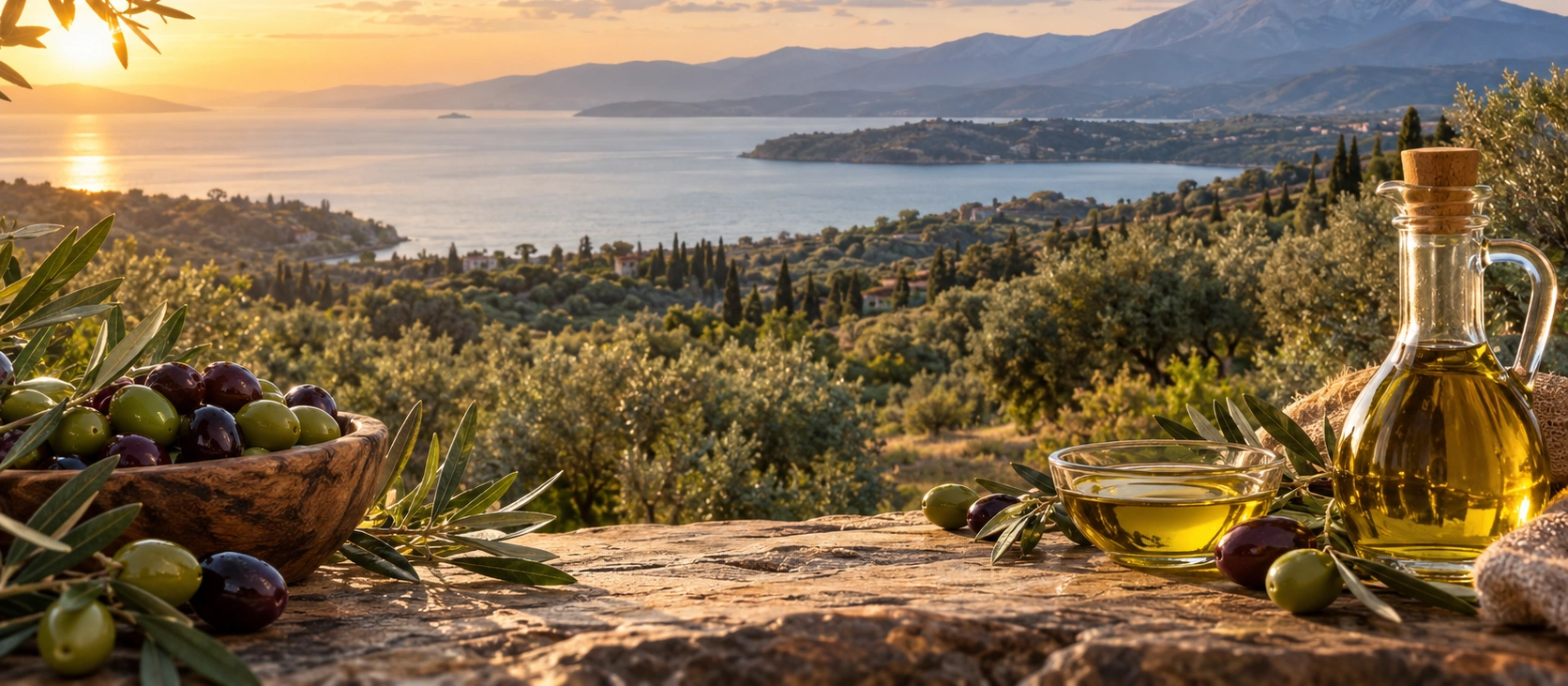
Discover the olive landscapes of the Edremit Gulf with a flexible private program that can include a producer or mill visit, guided tasting, local food and scenic stops in the Kaz Mountain foothills.
Request This Experience
Combine olive-country scenery with Güre, Altınoluk, mountain villages, local culture and selected viewpoints along one of the most beautiful sections of Türkiye’s North Aegean coast.
Request This Tour