Green Lentil Filling
The defining filling is prepared with locally specified green lentils rather than minced meat.
- Variety: Kayı-91
- Origin: Bilecik
- Seasoning: Onion, black pepper and salt






Bozüyük Mercimekli Mantısı, which can be described in English as Bozüyük lentil mantı or lentil-filled ravioli, is one of the most distinctive traditional dishes of Bozüyük in Bilecik Province. Instead of the minced-meat filling associated with many better-known forms of Turkish mantı, this regional speciality is filled with seasoned green lentils.
Its identity is defined by far more than the filling. The protected version uses the Kayı-91 variety of green lentil grown in Bilecik, carefully prepared wheat dough, a characteristic rectangular form with the upper centre left slightly open, and an unusual two-stage cooking process involving both baking and hot-water absorption.
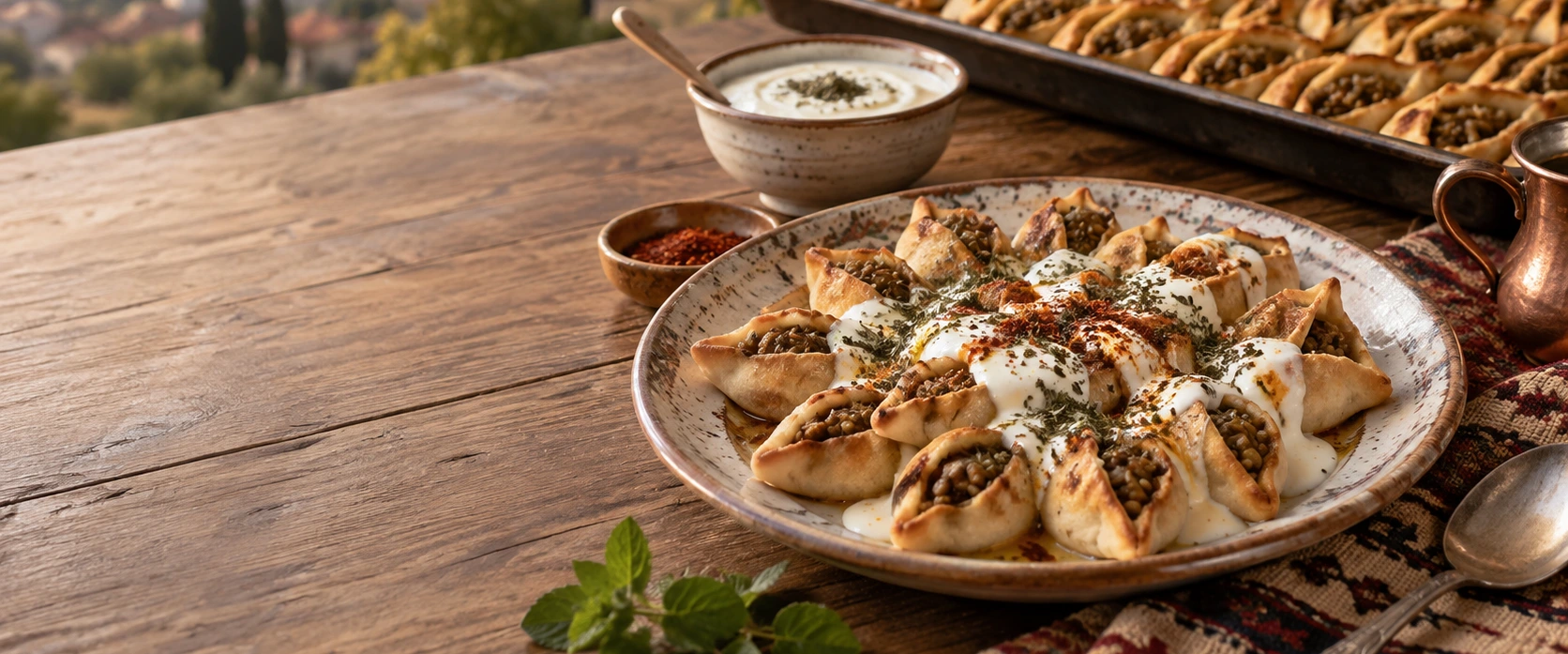
The characteristic form of each piece is known locally as “kayık şekli” — the boat shape. The filled mantı are arranged in a tray, baked until browned and then covered with hot salted water, or sometimes a mixture containing chicken or meat broth. The baked dough absorbs the liquid and softens while retaining some of the deeper flavour created during oven cooking.
Bozüyük Mercimekli Mantısı is officially protected in Türkiye as a Mahreç İşareti geographical indication. It carries registration number 511 and was registered on 27 July 2020. Its documented roots lie in villages between Bozüyük and Söğüt.
This complete guide explores the dish’s history, geographical-indication status, Kayı-91 lentils, traditional dough, unusual boat-shaped form, baking method, final cooking with hot water or broth, serving styles, flavour, texture, dietary information, visitor tips, photography ideas and ways to combine a food experience with Bozüyük’s historical and natural attractions.
Bozüyük Mercimekli Mantısı has been officially registered as a geographical indication since 2020.
The protected preparation specifically uses the Kayı-91 lentil variety grown in Bilecik.
Each piece is closed in a characteristic form called “kayık şekli,” meaning boat shape.
The mantı are first browned in the oven and then cooked further by absorbing hot salted liquid.
Essential information about one of Bilecik Province’s most distinctive protected regional dishes.
Bozüyük, Bilecik Province, Türkiye.
Open Bozüyük on Google MapsBaked and hydrated Turkish mantı filled with green lentils.
Bilecik-grown Kayı-91 green lentils.
Mahreç İşareti registration number 511.
A regional mantı tradition shaped by village kitchens, local lentils and generations of dough-making knowledge.
Bozüyük Mercimekli Mantısı is closely associated with the rural food traditions of western Bilecik Province. According to its official geographical-indication documentation, the dish first developed in villages located between the districts of Bozüyük and Söğüt.
This geographical setting helps explain the character of the dish. Bilecik cuisine has a strong tradition of handmade dough dishes, mantı, noodles, börek and other cereal-based foods. Lentils and other pulses also fit naturally into the agricultural cooking traditions of inland western Anatolia.
Rather than filling the dough with minced meat, cooks developed a version based on seasoned green lentils. The result is substantial and satisfying while remaining clearly different from many better-known forms of Turkish mantı.
The method also differs from ordinary boiled dumplings. The filled pieces are arranged closely in a tray and baked until browned. Only afterwards is hot salted liquid poured over them, allowing the mantı to absorb moisture and complete the cooking process.
Today the dish remains particularly associated with Bozüyük and is one of the foods through which visitors can explore the lesser-known culinary identity of Bilecik Province.
Lentil filling, carefully prepared dough, boat-shaped pieces and two-stage cooking distinguish this mantı from more familiar versions.
The defining filling is prepared with locally specified green lentils rather than minced meat.
The rectangular dough is closed while leaving the upper centre slightly open.
The assembled mantı are baked before liquid is added.
After baking, hot salted water or a broth mixture is poured over the mantı.
The dough is deliberately somewhat firmer than the texture often described as earlobe softness.
The registered production method links the dish specifically with Bozüyük and Bilecik-grown lentils.
Bozüyük Mercimekli Mantısı is officially registered by the Turkish Patent and Trademark Office. Its protected specification establishes the product name, geographical connection, distinctive ingredients, dough characteristics, traditional shaping, cooking method and serving alternatives.
The official protected name is Bozüyük Mercimekli Mantısı.
The geographical-indication registration number is 511.
The product was registered on 27 July 2020.
The application was filed on 9 February 2018.
The official application number is C2018/040.
It is registered as a Mahreç İşareti.
The registration holder is the Bilecik Chamber of Commerce and Industry.
The geographical boundary listed in the registration is Bilecik Province.
The specification gives Bozüyük a particularly important role in production. The required lentil is the Kayı-91 variety grown in Bilecik, while the document states that the production stages should be carried out in Bozüyük, where the dough-making and traditional technique are associated with local skill and experience.
Bozüyük Lentil Ravioli is an English-friendly description of Bozüyük Mercimekli Mantısı, but the Turkish word mantı is more accurate. Mantı belongs to a broad family of filled dough dishes found across Türkiye and neighbouring culinary traditions, and the Bozüyük version has its own highly distinctive local technique.
This is a regional Turkish mantı rather than Italian ravioli, despite the useful visual comparison for international visitors.
The filling is based on green lentils combined with onion, black pepper and salt.
The traditional dough combines wheat flour, eggs, water and salt.
The shaped mantı are browned together in a lightly oiled tray.
Hot salted water or broth is added after baking and absorbed into the mantı.
The finished dish may be eaten plain or with butter, yogurt, garlic and tomato-paste based accompaniments.
One of the most important details in the geographical-indication specification is the use of the Kayı-91 green lentil variety grown in Bilecik. The lentil is not treated as an interchangeable ingredient but as part of the protected identity of the dish.
The Kayı-91 lentils specified for the registered dish must be grown within Bilecik.
The cooked lentils form the substantial centre of each piece of mantı.
The lentils are soaked before being boiled as part of the filling preparation.
Onion, black pepper and salt support the flavour of the lentils without overwhelming them.
The cooked mixture is prepared to a soft, cohesive consistency before being drained and placed in the dough.
The lentil requirement connects the finished dish directly with agricultural production in Bilecik Province.
The geographical-indication document places unusual emphasis on the quality and handling of the wheat dough. The dough must be strong enough to hold the lentil filling, survive shaping and baking, and later absorb hot liquid without falling apart.
The protected formula describes the dough using one kilogram of suitable wheat flour.
Eggs contribute structure and richness to the traditional dough.
The amount of water depends on the absorption characteristics of the flour.
The official specification gives the dough salt proportion as approximately 1.2%.
The finished dough should be slightly firmer than the softness traditionally compared with an earlobe.
Proper kneading is specifically identified as one of the most important stages of production.
Unlike many traditional recipes that simply specify “flour,” the official registration gives technical criteria for the wheat flour used in Bozüyük Mercimekli Mantısı. These standards help ensure that the dough is strong enough for rolling, filling, baking and subsequent hydration.
The flour needs enough strength for the dough to hold the relatively substantial lentil filling.
The registration specifies an öz or gluten value of at least 30%.
The official specification also gives a minimum protein criterion for the flour used in the protected product.
The dough needs sufficient extensibility to be rolled thinly without tearing.
Overly thin dough may fail to support the lentil filling.
Excessively thick dough may remain undercooked after the traditional heat treatment.
The protected dish is built from familiar ingredients, but their preparation and proportions are carefully defined. The character comes from the combination of wheat dough, Kayı-91 lentils and the unusual cooking method.
The dough begins with wheat flour suitable for strong mantı dough.
The protected dough formula uses approximately two to three eggs per kilogram of flour.
Bilecik-grown green lentils provide the defining filling.
Onion is combined with the cooked lentils for additional savoury flavour.
Black pepper provides the main spice note in the filling.
Salt is used in the dough, filling and final hot cooking liquid.
Yogurt may accompany the finished mantı, either plain or mixed with garlic.
Butter can be used as part of the traditional serving sauce.
One recognised serving style combines tomato paste with butter and garlic yogurt.
Chicken or meat broth may replace part of the salted water used after baking.
The registered technique is more elaborate than simply filling and boiling pasta. Dough preparation, resting, precise rolling, filling, shaping, baking and hydration all contribute to the finished character.
The official specification describes kneading as one of the most important stages in producing Bozüyük Mercimekli Mantısı. The finished dough needs enough strength to remain intact through every later stage.
Traditional manual kneading requires sustained work to develop the required dough structure.
Mechanical kneading also needs sufficient time rather than simply combining the ingredients briefly.
The desired consistency is a little firmer than classic “earlobe softness.”
Resting allows the dough to relax before the rolling stage.
Consistent thickness helps the individual pieces cook at a similar rate.
The technique reflects practical knowledge developed through repeated home and local production.
The visual identity of Bozüyük Mercimekli Mantısı comes from its distinctive shape. Unlike tiny sealed mantı parcels, the Bozüyük pieces are rectangular and remain slightly open along their upper centre.
The dough is cut into small rectangles rather than simple squares.
The protected specification gives an approximate width for the cut dough pieces.
The rectangular pieces are slightly longer than they are wide.
The lentil mixture occupies a substantial part of each piece without being packed so heavily that the dough breaks.
The upper middle remains slightly open when the sides are brought together.
The finished shape resembles a small boat, giving the form its local name.
Baking before adding liquid is one of the clearest differences between Bozüyük Mercimekli Mantısı and many boiled forms of mantı. The dry heat browns the exposed dough and develops a deeper toasted character.
A small amount of vegetable oil is used before arranging the filled pieces.
The mantı are placed in one layer without excessive crowding.
The registered method uses a hot oven to brown the mantı efficiently.
The baking stage continues until the mantı develop their characteristic browned colour.
Oven browning creates flavours that would not develop through boiling alone.
The mantı are not yet finished when they leave the oven; hot liquid is added immediately afterwards.
Immediately after baking, the mantı undergo a second transformation. Hot salted liquid is poured over the tray until it rises slightly above the pasta. The baked dough then absorbs the liquid, becoming tender and ready to eat.
The simplest traditional option uses freshly boiled water containing approximately 1% salt.
The liquid level is traditionally brought to roughly one centimetre above the mantı.
The mantı take up the hot liquid rather than being transferred into a separate pot of boiling water.
Approximately 20–30% of the liquid may be chicken broth, with salted water making up the remainder.
A similar proportion of meat broth may be used instead for a richer result.
The combination of oven browning and liquid absorption gives the dish its distinctive texture.
The registered tradition allows several serving styles. This means visitors may encounter a relatively simple plate in one kitchen and a richer yogurt-and-butter presentation in another while still experiencing the same underlying regional dish.
The hydrated mantı may be eaten without an additional sauce.
One recognised serving combination pairs the mantı with yogurt and butter.
Garlic can be incorporated into the yogurt for a stronger and more familiar mantı-style accompaniment.
A richer version incorporates tomato paste and butter alongside garlic yogurt.
The dish is best experienced after the baked mantı have absorbed their hot cooking liquid.
Local restaurants and home kitchens may differ slightly in their preferred final sauce.
Bozüyük Mercimekli Mantısı combines several contrasting elements. The lentils bring an earthy and savoury character, the oven develops toasted notes in the dough, and the final liquid softens the pieces without completely erasing the flavour created during baking.
The green-lentil filling gives the dish a deeper pulse-based flavour than meat-filled mantı.
Onion adds savoury depth to the cooked filling.
Black pepper gives warmth without turning the dish heavily spicy.
Baking creates browned flavours before the dough is softened with hot liquid.
The hydration stage turns the oven-browned mantı into a softer, comforting tray dish.
Yogurt adds freshness and acidity that contrast with the lentils and butter.
International visitors often first encounter Turkish mantı as tiny meat-filled dumplings served with garlic yogurt and butter. Bozüyük Mercimekli Mantısı demonstrates how diverse Türkiye’s mantı traditions actually are.
The filling is based on green lentils rather than minced beef or lamb.
The pieces are longer than the tiny square parcels associated with some other mantı traditions.
The traditional boat-shaped form is intentionally not completely sealed.
The mantı are browned in a tray before being exposed to boiling liquid.
The hot water or broth is poured onto the baked mantı instead of simply boiling them loose in a pot.
The Kayı-91 lentil and Bozüyük production tradition are central to its geographical indication.
Bilecik’s traditional cuisine gives an important place to grain, handmade dough and home-prepared foods. Regional dishes include mantı, noodles, börek, soups, meat dishes, molasses products and other recipes connected with rural household production.
Bozüyük Mercimekli Mantısı fits naturally into this culinary landscape. Wheat dough forms the outer structure, while locally grown lentils provide an economical and nourishing filling. The technique transforms modest ingredients through labour, experience and careful preparation.
Bilecik cuisine includes many foods based on rolled, cut and baked dough.
The use of lentils reflects the importance of practical agricultural ingredients in regional cooking.
The dish is strongly associated with skills traditionally practised in family and village kitchens.
The protected name places the district directly at the centre of the dish’s modern culinary identity.
Visitors can combine it with other regional foods while exploring Söğüt, Bozüyük, Osmaneli and central Bilecik.
It is especially rewarding for travellers who already know meat-filled mantı and want to discover a lesser-known regional variation.
Bozüyük Mercimekli Mantısı has a lentil-based filling, but the complete traditional recipe should not automatically be considered vegan, dairy-free or gluten-free. Travellers with dietary restrictions should always ask how an individual portion has been prepared.
The traditional dough is made with wheat flour and therefore contains gluten.
The registered dough formula includes eggs.
The central filling is based on green lentils rather than meat.
Even when no dairy sauce is used, the standard protected dough contains egg.
Yogurt and butter are common accompaniments but the specification also allows the mantı to be eaten without sauce.
Chicken or meat broth can be used during the final cooking stage, so vegetarians should confirm the preparation.
For the most authentic experience, ask specifically for Bozüyük Mercimekli Mantısı. The protected name distinguishes it from generic lentil mantı recipes made elsewhere or prepared with different lentil varieties and techniques.
The natural place to look for the dish is Bozüyük. Because traditional regional foods are not necessarily prepared every day by every restaurant, visitors interested specifically in Mercimekli Mantı should ask locally or check availability before planning a meal around it.
Local restaurants specialising in mantı or traditional cooking are natural places to ask for the dish.
Regional festivals and culinary events may provide opportunities to encounter local dishes prepared by experienced cooks.
The dish has strong roots in domestic and village food traditions rather than exclusively restaurant cuisine.
Preparation requires considerable dough work, shaping and oven time, so availability can vary.
Ask whether the mantı are prepared using the traditional oven-and-hot-liquid method.
Bozüyük’s historic sites and countryside make it easy to build a wider day around a traditional lunch.
Combine a traditional lunch with the green landscapes and countryside around Bozüyük.
Pair a lighter yogurt-topped serving with excursions into Bozüyük’s higher and cooler rural landscapes.
The lentils, baked dough and warm serving style make this an excellent dish for cooler autumn days.
Warm mantı with yogurt, butter or broth is particularly satisfying during Bilecik’s cold season.
The main ingredients are not dependent on a short fresh-produce season.
Its filling combination of pasta and lentils makes it particularly suitable for a substantial midday meal.
Ask for Bozüyük Mercimekli Mantısı when searching for the protected local style.
The defining characteristic is its green-lentil filling.
Traditional pieces have the distinctive slightly open “kayık” or boat form.
The dough is baked before the hot-liquid stage, producing deeper colour and flavour.
Different kitchens may serve it plain or with yogurt, garlic, butter and tomato paste.
Some preparations use chicken or meat broth during the final cooking stage.
The traditional dough is based on wheat flour and egg.
This is a substantial regional dish worth enjoying slowly rather than treating simply as a quick snack.
The strongest photographs communicate why this regional mantı is different. Focus on the green-lentil filling, repeated boat-shaped pieces, oven-browned tray and the contrast created by yogurt or butter at service.
Photograph the mantı arranged together in the traditional round or rectangular baking tray.
Use a close view to show the distinctive slightly open upper centre of each mantı.
Capture one open piece so viewers can clearly identify the green-lentil centre.
The colour change between pale raw dough and browned baked mantı tells an important part of the story.
A white yogurt topping creates visual contrast with the golden-brown mantı.
Rolling pins, flour, lentils and a large tray provide useful context for the handmade preparation.
A traditional meal can easily become part of a full Bozüyük itinerary combining early Ottoman history, national-memory sites and the district’s forested highlands.
Explore a site connected with the modern history of Bozüyük before or after your regional food experience.
Discover an important Ottoman-era landmark in Bozüyük and add architectural heritage to your visit.
Visit one of the district’s important sites associated with the İnönü Battles and the Turkish War of Independence.
Combine regional cuisine with the forests, open landscapes and fresh air of the Bozüyük countryside.
Continue into Bozüyük’s highland landscapes for a quieter nature experience.
Extend the historical journey through sites associated with the İnönü Battles.
The dish has a documented connection with Bozüyük and neighbouring villages in Bilecik.
Travellers who associate mantı only with meat filling discover an entirely different interpretation.
Kayı-91 links the dish directly with Bilecik agriculture.
Baking followed by hot-liquid absorption gives the mantı an identity beyond its filling.
Proper dough consistency, rolling and shaping all depend on practical experience.
A local meal adds another layer to a district often visited mainly for its historical sites.
It is a traditional Bozüyük mantı made with wheat dough and a seasoned green-lentil filling. The pieces are oven-baked and then finished by absorbing hot salted water or broth.
“Mercimekli” means “with lentils,” while mantı refers to the wider Turkish family of filled dough dishes.
“Lentil ravioli” is a convenient English description, but mantı is the more accurate cultural and culinary term.
Its documented tradition developed in villages between Bozüyük and Söğüt in Bilecik Province.
Yes. It is officially registered in Türkiye as a geographical indication.
The registration number is 511.
It was registered on 27 July 2020.
The geographical-indication application was filed on 9 February 2018.
The official application number is C2018/040.
It is registered as a Mahreç İşareti.
The registration holder is the Bilecik Chamber of Commerce and Industry.
The geographical boundary listed in the registration is Bilecik Province, while the specification gives Bozüyük an essential role in the production process.
The protected dish uses Kayı-91 green lentils grown in Bilecik.
The official specification identifies it as the lentil variety suited to the characteristic filling and dough combination of the protected dish.
No. The defining filling is based on green lentils, onion, black pepper and salt.
The registered dough uses wheat flour, eggs, water and salt.
The specification describes approximately 2–3 eggs for 1 kg of wheat flour.
Approximately 15–18 minutes by hand or at least 12 minutes when kneaded mechanically.
The dough is traditionally rested for approximately 20–25 minutes.
The official method gives an approximate thickness of 2–2.5 mm.
It is rectangular and closed while leaving the upper centre slightly open.
It means “boat shape” and refers to the distinctive slightly open form of each mantı piece.
The registration describes pieces approximately 2.3–2.5 cm wide and 3–3.4 cm long.
Not in the same way as many other pasta dishes. It is first baked and then hot liquid is poured over the tray and absorbed by the mantı.
The protected method specifies approximately 200–210°C.
Approximately 20–25 minutes, until the mantı become browned.
Boiling salted water is poured over the hot mantı until the liquid rises slightly above them.
Yes. Part of the cooking liquid may be replaced with chicken broth or meat broth.
It may be eaten plain or with combinations of butter, yogurt, garlic yogurt and tomato paste.
Yes. Traditional Bozüyük Mercimekli Mantısı is made with wheat flour.
Yes. Eggs are part of the protected dough formula.
The lentil filling contains no meat, but some versions use chicken or meat broth during cooking. Vegetarians should ask how the individual serving has been prepared.
No, not in its protected traditional form, because the dough contains egg. Butter and yogurt may also be used for serving.
The dough itself does not require dairy, but traditional serving options commonly include yogurt and butter.
No. Black pepper provides gentle warmth, but the traditional dish is not generally considered hot or chilli-spicy.
Expect earthy lentils, savoury onion and pepper, toasted wheat dough and, depending on the service, creamy yogurt and rich butter.
Bozüyük is the best place to look for the traditional speciality. Availability can vary, so asking local restaurants in advance is useful.
Yes. The geographical-indication specification includes serving the finished mantı without sauce as one of the recognised options.
Among the major differences are the lentil filling, larger boat-shaped pieces, tray baking and the final hot-liquid absorption method.
Atatürk Mansion, Kasımpaşa Mosque, Metristepe Victory Monument and the plateaus around Bozüyük can all be combined with a local food experience.
Combine Bozüyük’s protected cuisine, early Ottoman heritage, War of Independence sites and countryside landscapes on a private journey designed around your interests.
Custom-designed private journeys can combine Bozüyük Mercimekli Mantısı with Bozüyük’s historic landmarks, Metristepe, Söğüt, Bilecik, traditional regional foods and scenic plateau landscapes.
Explore Bozüyük’s local food traditions through Mercimekli Mantı while combining your meal with Atatürk Mansion, Kasımpaşa Mosque, Metristepe and other cultural landmarks.
Request This Tour
Build a flexible route through Bozüyük, Söğüt and Bilecik combining protected regional foods, early Ottoman heritage, local culinary traditions and the landscapes of this lesser-known part of Türkiye.
Request This Tour