Buffalo Milk
The defining ingredient is milk obtained from Anatolian buffalo raised in the registered production area.






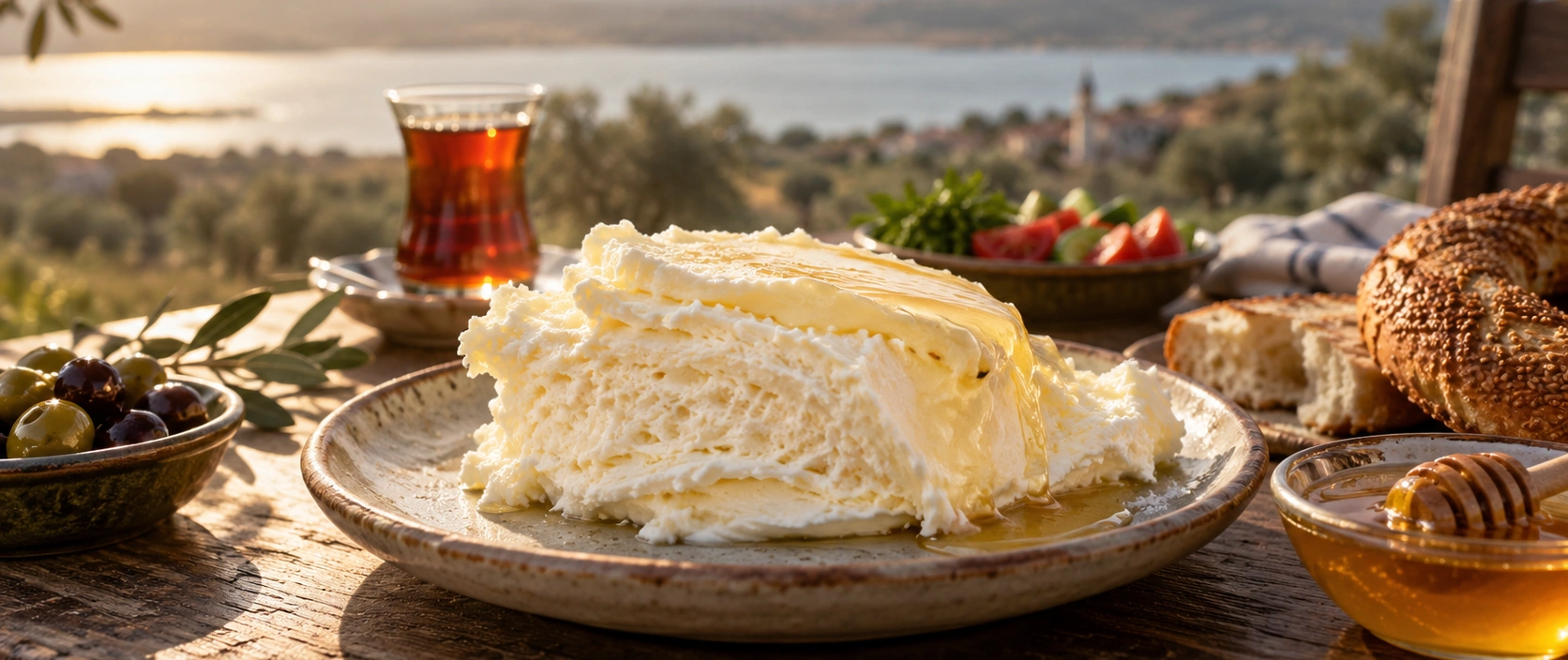
Balıkesir Manda Kaymağı is one of the richest traditional dairy products of western Türkiye. Made from the milk of Anatolian water buffalo raised in designated parts of Balıkesir Province, this traditional cream is known for its opaque white colour, soft consistency, creamy flavour and distinctive surface resembling a honeycomb.
Its character begins with manda sütü, or buffalo milk. Naturally rich milk is heated according to a traditional method, rested, cooled and allowed to develop a thick layer of cream at the surface. That layer is then carefully cut and folded by hand—a step requiring experience so that its characteristic structure is preserved.
Balıkesir Manda Kaymağı is officially protected in Türkiye as a geographical indication. Its registered production method specifies local Anatolian buffalo milk and requires the production stages to take place inside the defined geographical area of Balıkesir.
Produced from milk obtained from Anatolian water buffalo raised within the registered geographical area.
The milk is heated, rested and chilled before the naturally formed cream layer is carefully removed and folded by hand.
Balıkesir Manda Kaymağı is registered in Türkiye as a Mahreç İşareti geographical indication.
One of its most recognisable characteristics is its open, porous surface with an appearance compared to honeycomb.
Essential information about one of Balıkesir's protected traditional dairy specialities.
Produced within designated buffalo-raising communities of Balıkesir Province in western Türkiye.
Open Balıkesir on Google MapsMade with milk from Anatolian water buffalo raised within the registered geographical area.
A traditionally prepared buffalo-milk kaymak with a rich, soft and creamy structure.
TÜRKPATENT geographical-indication registration number 1428, registered as a Mahreç İşareti.
Buffalo farming and dairy production form a small but distinctive part of Balıkesir's extraordinarily varied agricultural heritage.
Balıkesir lies between the Marmara and Aegean regions, giving the province an unusually diverse agricultural landscape. Olive groves, grazing lands, fertile plains, wetlands, forests and farming villages have supported numerous local food traditions.
Among them is the raising of Anatolian water buffalo, known in Turkish simply as manda. Buffalo milk has traditionally been valued for dairy products requiring richness and body, especially yoghurt and kaymak.
In communities where buffalo raising survived, freshly collected milk became an important household product. Families developed practical skills for slowly heating, resting and cooling the milk so that a generous layer of fat-rich cream formed naturally at the surface.
Removing that layer without destroying its structure requires experience. The resulting cream is rich but soft, with a distinctive porous appearance quite different from ordinary whipped cream or industrial cream.
Balıkesir Manda Kaymağı became strongly associated with the province's food traditions and rural economy. That reputation eventually led to formal geographical-indication protection.
Today, tasting authentic buffalo kaymak offers travellers a small but memorable introduction to the pastoral side of Balıkesir cuisine.
The registered product is recognised by a combination of its milk source, traditional technique, texture, colour and characteristic surface.
The defining ingredient is milk obtained from Anatolian buffalo raised in the registered production area.
Balıkesir buffalo cream has a particularly light, opaque-white appearance rather than a strongly yellow colour.
The surface develops relatively large pores that produce the characteristic appearance traditionally compared with honeycomb.
The traditional product is softer in texture than many other styles of kaymak.
Its flavour is distinctly creamy, reflecting the richness of the buffalo milk from which it is made.
The official product description also recognises a slight sour or tangy quality alongside its creamy flavour.
The formed cream layer is traditionally cut and removed using a skilled hand-folding technique.
The registered production method does not use food additives, flavourings or flavouring food ingredients.
Kaymak is a rich dairy product formed from the concentrated fatty layer that develops at the surface of heated milk. It has been part of the food traditions of Türkiye, the Balkans and neighbouring regions for generations.
English descriptions sometimes compare kaymak with clotted cream. The comparison is useful for understanding its richness, but traditional Turkish kaymak is its own product with distinctive preparation techniques, textures and serving traditions.
Kaymak is not made by mechanically whipping liquid cream. Its characteristic layer develops naturally during heating, resting and cooling.
The fat is not churned and separated in the way used to produce butter.
Traditional kaymak production does not depend on converting the entire milk into cultured yoghurt.
The prized layer forms at the top of prepared milk and is carefully lifted or folded once sufficiently set.
What distinguishes Balıkesir Manda Kaymağı from generic kaymak is the protected relationship between local buffalo milk, geographical origin and a documented regional method of production.
Balıkesir Manda Kaymağı is registered by the Turkish Patent and Trademark Office as a Mahreç İşareti, a form of Turkish geographical-indication protection.
Balıkesir Manda Kaymağı
TÜRKPATENT geographical-indication registration number 1428.
The original application number is C2021/000261.
The geographical-indication application was filed on 29 June 2021.
The product was formally registered on 28 July 2023.
The geographical indication was registered by Balıkesir Metropolitan Municipality.
The geographical indication protects more than the product name. It establishes important requirements relating to the milk, production area, traditional preparation, storage and presentation of authentic Balıkesir Manda Kaymağı.
Despite carrying the name of the entire province, the registered geographical area is considerably more specific. The official specification identifies traditional buffalo-producing neighbourhoods within Altıeylül, Karesi, Gönen and Dursunbey.
Yakupköy in Altıeylül is included within the registered geographical boundary for Balıkesir Manda Kaymağı.
Halalca in Altıeylül forms part of the protected production landscape.
Balıklı is another Altıeylül neighbourhood listed in the official geographical indication.
Karaman in Altıeylül is included among the recognised buffalo-raising communities.
Ayşebacı completes the group of Altıeylül neighbourhoods specifically identified in the registration.
Köteyli in Karesi district forms another part of the geographical production area.
Bostancı neighbourhood in Gönen is included within the officially protected production zone.
Mahmudiye in Dursunbey is the easternmost of the communities specifically identified in the registration.
The milk used for the protected product must come from Anatolian buffalo raised within this defined area, and the registered specification requires the production stages of Balıkesir Manda Kaymağı to take place within the geographical boundary.
The traditional Turkish water buffalo, known as the Anadolu mandası, is fundamental to Balıkesir Manda Kaymağı. Without local buffalo milk, the registered product cannot be produced according to its specification.
Buffaloes are particularly well associated with landscapes containing grazing areas and access to water. Within Balıkesir's protected production communities, their seasonal feeding changes according to pasture availability.
During the productive grazing season, buffaloes can feed on naturally occurring vegetation in meadows, pastures and grazing lands.
Natural grazing remains an important component of buffalo husbandry during the warmer months.
Animals continue to make use of local pasture vegetation while seasonal conditions allow.
As pasture becomes less abundant, traditional winter feed can be supplemented with hay, straw, oats, maize, wheat bran and oilseed products.
The geographical-indication specification requires milk from buffalo raised within the defined production area.
Buffalo raising connects the finished kaymak with livestock husbandry traditions that survive in several Balıkesir villages.
Kaymak depends heavily on milk fat, and buffalo milk is particularly well suited to creating a generous surface layer during traditional preparation.
The official Balıkesir specification records an average buffalo-milk fat content of approximately 7.20 g per 100 g, helping explain why relatively small quantities of milk can produce an intensely rich dairy product.
The registered specification records total dry matter of approximately 17.65 g per 100 g in the buffalo milk studied for the product.
The official specification records an average milk-fat value of approximately 7.20 g per 100 g.
The registered description records approximately 5.13 g protein per 100 g of the buffalo milk used in its analysis.
Buffalo dairy products are often noticeably pale, contributing to the characteristic opaque-white appearance of Balıkesir kaymak.
The richness of buffalo milk is concentrated further during kaymak production, creating a finished product intended to be eaten in relatively modest portions.
Traditional Balıkesir buffalo cream is produced through a deceptively simple sequence of filtering, heating, resting and cooling. The ingredients are uncomplicated; the skill lies in controlling temperature, timing and the delicate cream layer.
This slow method explains why true traditional kaymak cannot simply be treated as ordinary packaged cream. Its structure is created during the resting process itself.
One of the easiest ways to recognise traditional Balıkesir Manda Kaymağı is its surface. Instead of appearing perfectly smooth, it contains noticeable pores and irregular openings.
The official geographical-indication specification describes this characteristic as a bal peteği görünümü—literally a honeycomb appearance.
The surface contains relatively prominent openings rather than being completely dense and uniform.
The structure develops as part of the traditional heating, cooling and surface-cream formation process.
Careful cutting and folding help preserve the characteristic form once the cream layer is removed.
The honeycomb-like surface is one of the features used to distinguish Balıkesir Manda Kaymağı from many other traditional kaymaks.
Balıkesir Manda Kaymağı is exceptionally rich, yet its flavour is relatively clean and delicate. The official description characterises the taste as both creamy and lightly tangy.
The first impression is the unmistakable richness expected from a high-fat buffalo-milk product.
Authentic plain kaymak allows the flavour of the milk itself to remain central.
A subtle acidic note prevents the cream from tasting simply heavy or one-dimensional.
Traditional protected production does not depend on vanilla, sugar or artificial flavourings.
Its mild dairy character provides a classic contrast to floral honey at the Turkish breakfast table.
The richness pairs especially well with bread, pastry and desserts containing relatively simple flavours.
Balıkesir buffalo cream should not resemble a completely homogeneous industrial spread. Its appearance tells part of the story of how it was produced.
The cream is noticeably pale and opaque, an important characteristic identified in its official registration.
Balıkesir kaymak is recognised for a softer consistency than many other traditional forms of kaymak.
Large pores create the characteristic honeycomb appearance visible on the upper surface.
Traditional hand removal and folding can produce attractive natural layers rather than a perfectly moulded block.
Despite its visual softness, its high fat content creates a concentrated and coating sensation on the palate.
It is best handled gently so that the cream retains its traditional surface and layered appearance.
The registered geographical-indication specification includes laboratory measurements illustrating just how concentrated the finished buffalo cream becomes.
The specification records approximately 60.15 g of fat per 100 g of Balıkesir Manda Kaymağı.
Approximately 64.78 g per 100 g is recorded as dry matter.
The registered analytical value for moisture is approximately 35.22 g per 100 g.
The specification records approximately 2.04 g protein per 100 g.
The analytical description records approximately 0.82 g lactose per 100 g.
The registered analysis gives an average pH of approximately 6.35.
These values describe the registered product specification and should not be interpreted as the exact nutritional composition of every individual package. Natural dairy products can vary according to milk and production conditions.
Kaymak may be extraordinarily rich, but Turkish cuisine usually pairs it with very simple accompaniments. The contrast between cool dairy cream, warm bread and something sweet is one of its greatest pleasures.
Serve buffalo kaymak beside good-quality honey for one of the most classic combinations in Turkish breakfast culture.
Spread a modest amount onto warm village bread, sourdough or fresh Turkish bread.
Rich kaymak creates an excellent contrast with the toasted sesame flavour and chewy texture of fresh simit.
Serve alongside cheese, olives, tomatoes, cucumber, eggs, preserves and tea as part of a generous Turkish breakfast.
Cherry, sour-cherry, fig, strawberry or other preserves provide acidity and sweetness that balance the richness.
A spoonful of kaymak can accompany traditional Turkish desserts where its unsweetened creaminess offsets syrup and sugar.
For many visitors, the most natural place to encounter kaymak is at breakfast. Turkish breakfast is built around numerous small dishes rather than a single main plate, making rich foods such as kaymak easy to enjoy in small quantities.
Visitors researching Balıkesir food may encounter two protected products whose names can easily be confused: Balıkesir Manda Kaymağı and Balıkesir Kaymaklısı.
They are not the same product.
Not every product labelled simply as kaymak is Balıkesir Manda Kaymağı. Kaymak is produced throughout Türkiye from different types of milk and according to different methods.
For the protected product, look for the registered wording Balıkesir Manda Kaymağı.
Authentic protected products may display the appropriate Turkish geographical-indication emblem together with the registered name.
Ask whether the product is genuine manda kaymağı produced from buffalo milk rather than generic milk cream.
Kaymak is highly perishable, so buy from sellers maintaining proper refrigerated storage.
Traditional Balıkesir buffalo cream should show its characteristic porous or honeycomb-like structure.
Because traditional fresh kaymak has a short storage life, purchasing only what you can consume quickly is sensible.
Traditional buffalo kaymak is a fresh dairy product with a considerably shorter life than aged cheese, butter or preserved foods. Temperature control is therefore essential.
Travellers carrying kaymak between destinations should remember that it is not a convenient room-temperature souvenir. Cheese, olive oil or packaged foods are usually much easier to transport over long distances.
Breakfast is the easiest setting in which to appreciate kaymak alongside honey, bread and tea.
Restaurants may serve ordinary kaymak, so ask whether the cream is actually produced from buffalo milk.
The protected product comes from traditional buffalo-raising communities spread across several Balıkesir districts.
Food markets and specialist dairy shops can be good places to discover Balıkesir cheeses, yoghurt, kaymak, honey and other regional foods.
Tasting local cheeses, olives, olive oil and other geographical-indication products reveals how diverse the province's cuisine really is.
Fresh dairy products should always be displayed and transported under appropriate chilled conditions.
If travelling, purchasing fresh kaymak shortly before returning to your accommodation reduces unnecessary time outside refrigeration.
Buffalo farms and dairy-production areas are working private properties and should only be entered with permission.
The importance of Balıkesir Manda Kaymağı extends beyond breakfast. Every portion represents a chain of rural activities beginning with livestock breeding and continuing through feeding, milking, dairy processing and local sale.
Buffalo husbandry survives largely through rural producers who maintain specialised livestock knowledge.
Meadows and grazing areas are important parts of the traditional production environment.
Fresh buffalo milk can be transformed into several valuable products, particularly yoghurt and kaymak.
Recognising the correct heating, resting and folding conditions requires practical experience rather than ingredients alone.
The geographical-indication registration recognises the product's longstanding place in Balıkesir's culinary culture and economy.
Registration helps identify a traditional product whose reputation is closely associated with specific Balıkesir communities.
The district of Dursunbey is particularly interesting for travellers exploring the modern continuation of Balıkesir's buffalo-milk tradition. Mahmudiye neighbourhood is specifically included in the protected geographical area for Balıkesir Manda Kaymağı.
In December 2023, the Balıkesir Provincial Directorate of Agriculture and Forestry announced the opening of the province's first officially approved buffalo-milk processing facility in Mahmudiye, Dursunbey.
The development illustrates how an old rural tradition can continue through modern food-production standards while creating greater economic value for buffalo farmers.
Buffalo cream makes even more sense when understood within Balıkesir's broader culinary landscape. The province is famous for livestock farming, dairy production, olives, olive oil, vegetables, grains and foods influenced by both the Aegean and Marmara regions.
Balıkesir has a remarkably diverse cheese culture shaped by cow, sheep and goat farming throughout the province.
Buffalo cream represents the exceptionally rich end of the province's dairy traditions.
The western districts around the Edremit Gulf and Ayvalık form one of Türkiye's great olive-growing landscapes.
Protected olive oils and historic oil-production traditions give the coastal districts a particularly strong Aegean identity.
Livestock farming has also shaped numerous traditional meat dishes and restaurant traditions associated with Balıkesir.
Rich dairy products naturally complement the province's pastries, sweets and baked specialities.
A search for local flavours can easily be combined with Balıkesir's historic city centre, countryside, thermal districts and surrounding cultural attractions.
See one of the historic landmarks of central Balıkesir while exploring the city's traditional streets and food culture.
Discover surviving examples of traditional urban architecture and the historical character of the provincial capital.
Combine a culinary visit with woodland scenery and an easy nature escape just outside central Balıkesir.
Explore one of the districts included in the buffalo-cream tradition while discovering thermal springs and archaeological heritage.
Continue your Balıkesir food journey through the protected olive-oil traditions of the North Aegean coast.
Discover another protected Balıkesir food shaped by local agriculture, traditional processing and regional identity.
It is a traditional buffalo-milk kaymak produced in designated parts of Balıkesir Province according to a registered regional production method.
Manda means water buffalo and kaymak refers to the rich dairy cream traditionally obtained from the surface of prepared milk.
Yes. It is registered by the Turkish Patent and Trademark Office as a Mahreç İşareti geographical indication.
The TÜRKPATENT registration number is 1428.
Its official registration date is 28 July 2023.
The geographical-indication application was submitted on 29 June 2021.
The registration holder is Balıkesir Metropolitan Municipality.
The protected product is made from milk obtained from Anatolian water buffalo raised within the defined geographical area.
No. Kaymak can be produced from different types of milk. Balıkesir Manda Kaymağı specifically uses local Anatolian buffalo milk and follows its registered production method.
The registered geographical area includes Yakupköy, Halalca, Balıklı, Karaman and Ayşebacı in Altıeylül; Köteyli in Karesi; Bostancı in Gönen; and Mahmudiye in Dursunbey.
Yes. The specification requires the milk to come from buffalo raised within the geographical boundary and requires production stages to take place there.
It has a characteristic opaque-white appearance.
Its traditional production method creates relatively large pores in the cream layer, producing a distinctive honeycomb-like surface.
It is exceptionally creamy and rich with a mild tangy quality recognised in the registered product description.
The kaymak itself is not primarily a sweet product. Sweetness usually comes from serving it with honey, preserves, pastries or desserts.
No. The protected production method specifies that food additives, flavourings and flavouring food ingredients are not used.
Buffalo milk is filtered, mixed with water according to the registered recipe, heated to approximately 90–95°C, rested, chilled for about 24 hours and then the formed cream layer is cut and folded by hand.
The geographical-indication specification describes approximately 7 litres of buffalo milk and 2.5 litres of water for producing around 1 kg of Balıkesir Manda Kaymağı.
The addition of water is part of the officially registered traditional Balıkesir production method before the milk mixture is heated and the cream is allowed to form.
The registered production process specifies heating the buffalo-milk mixture to approximately 90–95°C.
After heating, it is initially rested for at least about three hours and is then refrigerated for approximately 24 hours so that the kaymak layer forms.
Yes. The formed surface is cut and traditionally removed using a skilled hand-folding technique.
The registered product specification records approximately 60.15 g of fat per 100 g in its analytical description.
It should remain refrigerated. The official specification requires storage and transport at approximately 4°C.
The registered specification describes approximately 4–5 days under refrigerated conditions, extending to around 6–7 days during winter. Commercial packaging instructions should always be followed.
One of the classic combinations is fresh kaymak with honey and bread as part of a Turkish breakfast.
Yes. Unsweetened kaymak pairs particularly well with sweet Turkish pastries and syrup-based desserts because its rich dairy flavour balances their sweetness.
No. Balıkesir Manda Kaymağı is a buffalo-milk dairy product, while Balıkesir Kaymaklısı is a separate traditional pastry with its own geographical-indication registration.
Only if you can maintain suitable refrigeration and comply with any food-import rules at your destination. Fresh kaymak is highly perishable and is not ideal for unrefrigerated travel.
Look for reputable local dairy producers, specialist food shops, markets and breakfast establishments in Balıkesir, and ask specifically whether their kaymak is produced from buffalo milk.
Its geographical-indication registration recognises the product's longstanding connection with local culinary culture, rural buffalo husbandry and the economy of its traditional production communities.
From buffaloes grazing in rural Balıkesir to thick folds of snow-white kaymak beside golden honey, this traditional product offers beautiful opportunities for food and agricultural photography.
Use close-up photography to show the distinctive porous structure that immediately separates the product from ordinary cream.
A white plate of buffalo cream with amber-coloured honey creates one of the strongest traditional food compositions.
Place the kaymak among bread, olives, cheese, tomatoes, preserves and tea to show its wider cultural context.
Photographs of Anatolian buffalo in Balıkesir's rural landscape connect the finished product directly with its milk source.
Where permission is available, document the skilled moment when the formed surface cream is cut and folded.
Natural wooden tables, village bread and simple ceramics suit the rustic character of this traditional Balıkesir food.
Always request permission before entering farms, photographing producers or taking photographs inside dairy-processing facilities.
Discover buffalo kaymak alongside Balıkesir's cheeses, markets, local producers, olive traditions, historic neighbourhoods and beautiful rural landscapes.
Custom-designed private programs can combine regional food tastings, traditional dairy culture, city heritage, village landscapes and selected local producers according to season and availability.
Explore the flavours of Balıkesir through buffalo kaymak, regional cheeses, local markets, traditional products and the culinary traditions connecting the Marmara and Aegean regions.
Request This Experience
Combine Balıkesir's historic centre, traditional houses, local markets and regional food culture on a flexible private journey designed around your interests.
Request This Tour