Whole Okra
Okra is the principal vegetable and is added to the cooking liquid before the meatballs.
- Amount: 500 g
- Preparation: Vinegar-and-water rest
- Cooking: Simmered in the pot






Ekşili Köfteli Bamya is one of the regional dishes officially documented by the Yalova Provincial Directorate of Culture and Tourism. It combines okra with small hand-rolled meatballs made from minced meat, rice, grated onion, salt and black pepper.
The traditional method gives special attention to the okra. Before cooking, it is rested in vinegar and water and drained. A base of oil, finely chopped onion, tomato paste and hot water is brought together in a pot; the okra is added first, followed by the small meatballs once the liquid begins to boil.
Okra forms the vegetable heart of the dish and is prepared with a vinegar-and-water resting step before cooking.
Minced meat is mixed with rice, grated onion and seasoning, then rolled into small marble-sized pieces.
Vinegar is used in preparing the okra, while lemon also appears in the official ingredient list.
The dish appears in the official culinary collection of the Yalova Provincial Directorate of Culture and Tourism.
Essential information about Yalova’s traditional okra dish with miniature rice meatballs.
Ekşili Köfteli Bamya is listed among the traditional dishes presented by Yalova’s official tourism authority.
Open Yalova on Google MapsThe official recipe uses 500 grams of okra, prepared with a vinegar-and-water resting step before cooking.
The köfte mixture combines 300 grams of minced meat with 100 grams of rice, grated onion and seasoning.
Vinegar is part of the okra preparation, and one lemon is included in the official ingredient list.
A familiar Anatolian vegetable becomes a distinctive regional main dish when paired with tiny hand-rolled meatballs.
Ekşili Köfteli Bamya belongs to the group of dishes officially presented as part of Yalova’s local cuisine. Its character comes from the meeting of two familiar elements of Turkish home cooking: gently cooked okra and small köfte.
In the documented Yalova preparation, the meatballs are not large grilled köfte. Minced meat is kneaded with rice, salt, black pepper and grated onion, then rolled into small marble-sized balls. The pieces are lightly coated in flour before they enter the cooking pot.
The okra receives its own preparation. It is rested beforehand in a mixture of vinegar and water and then drained. Meanwhile, finely chopped onion is cooked in oil, tomato paste is added, and the mixture is loosened with hot water to create the cooking liquid.
The drained okra is added to the boiling pot first. Once the dish begins boiling again, the prepared meatballs are added and everything cooks together until done. The result is a spoonable main dish in which vegetables, meat, rice and a tangy element share the same broth.
The official ingredient list also includes one lemon. However, the published preparation method does not specify exactly when the lemon is added. For that reason, it is best understood as part of the documented ingredient framework without inventing a precise step that the source itself does not provide.
Its identity comes from whole okra, miniature rice meatballs, a tomato-paste broth and a deliberately tangy preparation.
Okra is the principal vegetable and is added to the cooking liquid before the meatballs.
The köfte are deliberately small, allowing the meat to distribute throughout the okra dish.
Rice is kneaded directly into the minced-meat mixture rather than being served only as a side dish.
The official method specifically says the okra is rested in vinegar and water before being drained.
Chopped onion is cooked in oil before tomato paste and hot water are added to form the cooking broth.
One onion is grated into the köfte mixture while another is finely chopped and cooked for the sauce base.
One lemon is included in the official recipe ingredients, reinforcing the dish’s “ekşili,” or tangy, identity.
Once the base is ready, okra and köfte complete their cooking together in the same pot.
The Yalova Provincial Directorate of Culture and Tourism records the dish with 500 g okra, 300 g minced meat, 100 g rice, two tablespoons of vegetable oil, one tablespoon of tomato paste, two onions, one teaspoon of black pepper, one lemon, one tea glass of vinegar and three glasses of hot water. Salt and flour are also required in the preparation even though fixed quantities are not provided for them.
500 grams of okra form the vegetable base of the dish.
300 grams are used for the small hand-rolled köfte.
100 grams are mixed directly into the minced meat.
Two onions are used: one grated for the köfte and one finely chopped for the pot.
Two tablespoons are used to cook the chopped onion at the beginning.
One tablespoon gives the cooking broth colour and savoury depth.
Black pepper and salt season the meatball mixture.
One lemon appears in the official ingredient list, although the exact addition stage is not specified.
One tea glass is used in the pre-cooking preparation of the okra.
Three glasses create the simmering liquid with onion and tomato paste.
A small amount is needed to coat the miniature meatballs before cooking.
Recipe note: the official preparation mentions salt and flour but does not give fixed quantities for either. It also lists one lemon without specifying in the published method exactly when the lemon should be added.
The traditional method has three main parts: preparing the miniature meatballs, preparing the okra, and building the onion-and-tomato-paste cooking liquid. The components then come together in one pot.
Lemon note: one lemon is included in the official ingredient list. Because the published preparation does not state exactly when it is added, this guide does not invent a specific lemon step.
The köfte distinguish this dish from a standard pot of okra. They are intentionally small and include rice within the meat mixture, so every serving can contain several tender pieces alongside the vegetables.
The official quantity is 300 grams.
Mix in 100 grams of rice before shaping.
One of the two onions is grated directly into the meat mixture.
Salt and one teaspoon of black pepper provide the documented seasoning.
The official method describes the köfte as small, marble-shaped pieces.
The shaped pieces are coated in flour before being added to the pot.
The official Yalova method specifically instructs cooks to rest the okra in vinegar and water before cooking and then drain it. This is therefore an important part of the documented regional preparation, not an optional detail added by this guide.
The Turkish word ekşili means “with a sour or tangy character.” In the official Yalova recipe, vinegar is explicitly used during the okra preparation and one lemon is included among the ingredients. Together, these details explain why acidity is part of the dish’s identity.
One tea glass is part of the documented recipe and is used with water to prepare the okra.
One lemon is listed by the official source.
The savoury tomato base provides depth against the dish’s acidic elements.
The tangy element belongs within a savoury vegetable-and-meat main dish.
The dish combines the green, gently earthy character of okra with savoury minced-meat köfte, soft rice, cooked onion and tomato paste. Its “ekşili” identity adds a tangy counterpoint to the meat and vegetables, making the broth feel brighter than a purely rich meat stew.
Minced meat, onion and tomato paste create the main savoury foundation.
Acidity is part of the dish’s defining character, reflected by vinegar and lemon in the official recipe.
With 500 grams of okra, the dish remains clearly centred on vegetables.
Rice-filled miniature köfte and warm cooking broth give it the character of a substantial home meal.
Ekşili Köfteli Bamya is best understood as a warm, spoonable main dish rather than a dry plate of grilled köfte. Serve enough cooking liquid to carry the flavour of the onion-and-tomato base while keeping the okra and small meatballs clearly visible.
The official method specifically calls for marble-sized pieces rather than large meatballs.
Rice is part of the documented köfte recipe and should not be treated only as a side dish.
The grated onion belongs inside the köfte mixture.
The second onion is cooked in oil to begin the sauce base.
The vinegar-and-water preparation is explicitly included in the official Yalova method.
The rested okra is drained before it enters the cooking pot.
The sequence in the official recipe places the okra in the hot liquid first.
Wait until the pot returns to a boil before gently adding the small meatballs.
The Yalova Provincial Directorate of Culture and Tourism includes Ekşili Köfteli Bamya in its official presentation of the province’s cuisine alongside dishes such as Milföylü Yalova Kebabı, Termal Sarma, Termal Çorbası, Ispanaklı Yalova Böreği, Böğür, Yumurta Dolması, Tavuklu Mantı, Cennet Küngü and Kaçamak.
The dish has a dedicated recipe page on Yalova’s official provincial culture and tourism website.
Its one-pot method, vegetables and hand-shaped köfte give it the feel of a traditional family meal.
Okra remains central while small meatballs make the dish more substantial.
The vinegar-water okra step and rice-filled miniature köfte distinguish the documented Yalova version.
For the official Turkish recipe, see the Yalova Provincial Directorate of Culture and Tourism .
Ekşili Köfteli Bamya is part of Yalova’s documented regional cuisine, but traditional home dishes can vary in daily restaurant availability. If tasting it matters to your visit, ask locally focused restaurants, home-style kitchens and regional-food venues specifically for “Ekşili Köfteli Bamya” and confirm availability before travelling only for the dish.
Using “Ekşili Köfteli Bamya” helps distinguish the dish from ordinary bamya yemeği.
Traditional family-style restaurants are especially relevant for vegetable stews and regional pot dishes.
The Yalova recipe uses tiny rice meatballs rather than large grilled köfte.
Regional dishes may not be prepared every day, especially outside the normal menu cycle.
This is a warm vegetable-and-meat preparation rather than a snack or appetiser.
Marble-sized köfte are one of the clearest signs of the documented Yalova style.
Rice is incorporated into the meatballs themselves.
The dish is cooked in a hot-water base flavoured with onion and tomato paste.
The name “ekşili” signals acidity as part of the dish’s intended character.
The meatballs cook directly in the okra pot.
Pair this dish with other documented local specialities rather than viewing it in isolation.
Traditional pot dishes may appear as changing daily meals rather than permanent menu items.
The documented Yalova recipe contains minced meat, rice, okra, onion, tomato paste, vegetable oil, black pepper, lemon and vinegar. The miniature meatballs are also coated in flour, so the traditional preparation should not be assumed to be gluten-free.
The recipe uses 300 grams of minced meat and is not vegetarian or vegan.
Rice is mixed into the köfte rather than simply served beside the dish.
The meatballs are coated in flour in the official method, so the traditional version is not reliably gluten-free.
The official recipe does not list milk, yogurt, butter or cheese, but restaurant practices can vary.
This information describes the documented Yalova preparation and should not be treated as a guarantee of ingredients, substitutions, stock bases, flour type or cross-contact practices used by every restaurant or household.
A strong food photograph should make the dish recognisable immediately: whole green okra, numerous small round meatballs and a warm reddish tomato-paste broth presented together in a shallow traditional bowl or ceramic plate.
The green pods should remain the strongest vegetable element in the frame.
Several marble-sized meatballs help communicate what makes this different from ordinary okra stew.
A little red-orange cooking liquid should be visible around the okra and köfte.
The dish should look home-cooked and appetising rather than overly styled or glossy.
Soft directional light can bring out the green okra, browned meatballs and tomato broth.
Do not make the hero image look like a plate of grilled köfte with okra on the side.
A search for traditional Yalova flavours can easily be combined with the province’s thermal heritage, Atatürk landmarks, museums and botanical attractions.
Explore the city’s historical development and local identity before discovering its regional cuisine.
Discover Yalova’s historic thermal waters, spa tradition and forest setting.
Add an important republican-era heritage stop to your Yalova itinerary.
Visit one of Yalova’s best-known Atatürk landmarks on the Marmara coast.
Explore one of Türkiye’s significant privately established botanical collections.
Continue with another distinctive Yalova attraction dedicated to miniature living trees.
Ekşili Köfteli Bamya sits within a wider Yalova food tradition that includes meat dishes, soups, pastries, stuffed preparations, sweets and local agricultural products.
Discover Yalova’s savoury lamb preparation served in a baked puff-pastry shell.
Explore thin beef wrapped around a mushroom-and-onion filling and finished with tomato.
Try Yalova’s vegetable-rich soup finished with a yogurt, flour and egg-yolk terbiye.
Discover coiled yufka pastry filled with spinach, white cheese and yogurt.
Explore a substantial stuffed sheep-rib preparation filled with seasoned meat-and-rice pilaf.
Discover Yalova’s oven-browned mantı filled with chicken offal and rice and finished with chicken broth.
Finish with Armutlu’s spiral-fried syrup dessert, also known as Çatal Tatlısı.
Explore Yalova’s geographically indicated forest honey connected with chestnut woodlands.
Ekşili Köfteli Bamya is a traditional Yalova dish made with okra and small rice meatballs cooked in an onion, tomato-paste and hot-water base with tangy elements in the recipe.
It is officially documented in the culinary collection of the Yalova Provincial Directorate of Culture and Tourism.
The official Yalova recipe lists 500 grams of okra.
The documented recipe uses 300 grams of minced meat.
Yes. The official köfte mixture contains 100 grams of rice together with minced meat, grated onion, salt and black pepper.
They are rolled into small marble-sized balls rather than large köfte.
Yes. The official method says the small shaped köfte are coated in flour before cooking.
The recipe uses two onions. One is grated into the meat mixture and the other is finely chopped and cooked in oil for the sauce base.
Yes. One tablespoon of tomato paste is added after the chopped onion has been cooked.
The official recipe lists three glasses of hot water.
“Ekşili” describes a sour or tangy character. Vinegar is used in the okra preparation and one lemon also appears in the official ingredient list.
Yes. The official recipe lists one tea glass of vinegar and says the okra is rested beforehand in vinegar and water.
Yes. One lemon appears in the official ingredient list, although the published preparation does not specify exactly when it should be added.
After the onion, tomato paste and hot water form the cooking base, the drained okra is added to the pot.
The official method says to add the köfte after the pot with the okra begins boiling.
No. The traditional recipe contains minced meat.
No. The documented preparation contains minced meat.
Not reliably in its traditional form, because the official method coats the meatballs in flour.
The published ingredient list does not include dairy, although restaurant substitutions and cross-contact practices can vary.
Ask locally focused restaurants and home-style kitchens specifically for Ekşili Köfteli Bamya and confirm availability in advance, as traditional pot dishes may not appear on every menu every day.
The documented combination of vinegar-rested okra, miniature rice meatballs, flour coating and an onion-and-tomato-paste broth gives the Yalova recipe its recognisable structure.
The strongest hero image should clearly show this as okra with miniature meatballs, not generic köfte. Use a shallow ceramic bowl filled with glossy green okra, small round meatballs and a modest amount of warm red-orange cooking broth.
This shows the depth of the bowl while keeping the okra and small köfte clearly visible.
The vegetable should dominate the composition rather than becoming a minor garnish.
Marble-sized meatballs are essential to an accurate visual representation.
A warm reddish cooking liquid helps communicate the onion-and-tomato-paste base.
Soft window-style light brings out the green pods and the texture of the meatballs.
Keep the image traditional and home-style rather than adding unrelated restaurant decorations.
Turn a traditional-food stop into a wider journey through Yalova’s thermal landscapes, museums, Atatürk heritage and local flavours.
Pair your food journey with two of the province’s most characteristic cultural and wellness attractions.

Explore Yalova’s history, social memory and local identity before continuing into the province’s traditional cuisine.
Discover Yalova City Museum
Discover Yalova’s historic mineral waters and spa culture as part of a wider route combining regional food, nature and heritage.
Discover Termal Hot SpringsCombine Yalova city, Termal, Atatürk heritage, gardens, countryside and regional-food stops in a personalised route.

Create a personalised day combining Yalova city, Termal, Atatürk heritage, botanical gardens, waterfalls and local cuisine.
Request a Private Journey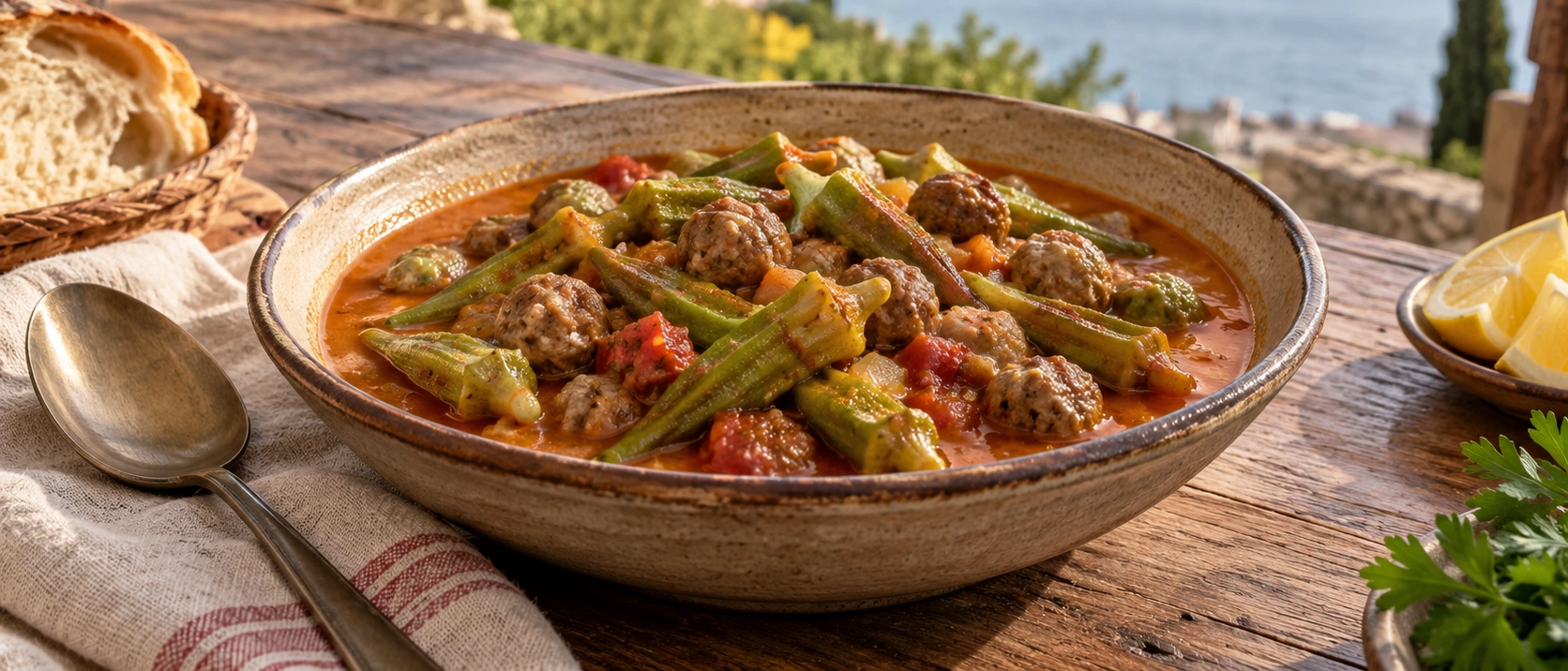
Build a food-focused route around Ekşili Köfteli Bamya, Milföylü Yalova Kebabı, Termal Çorbası, Tavuklu Mantı, Cennet Küngü and other regional specialities.
Ask About Custom Options