Private Yalova Heritage Experience
Ask us about a tailor-made route combining Yürüyen Köşk, Yalova city centre, Termal, Atatürk heritage and selected cultural or natural places across the province.
Request a Custom Tour





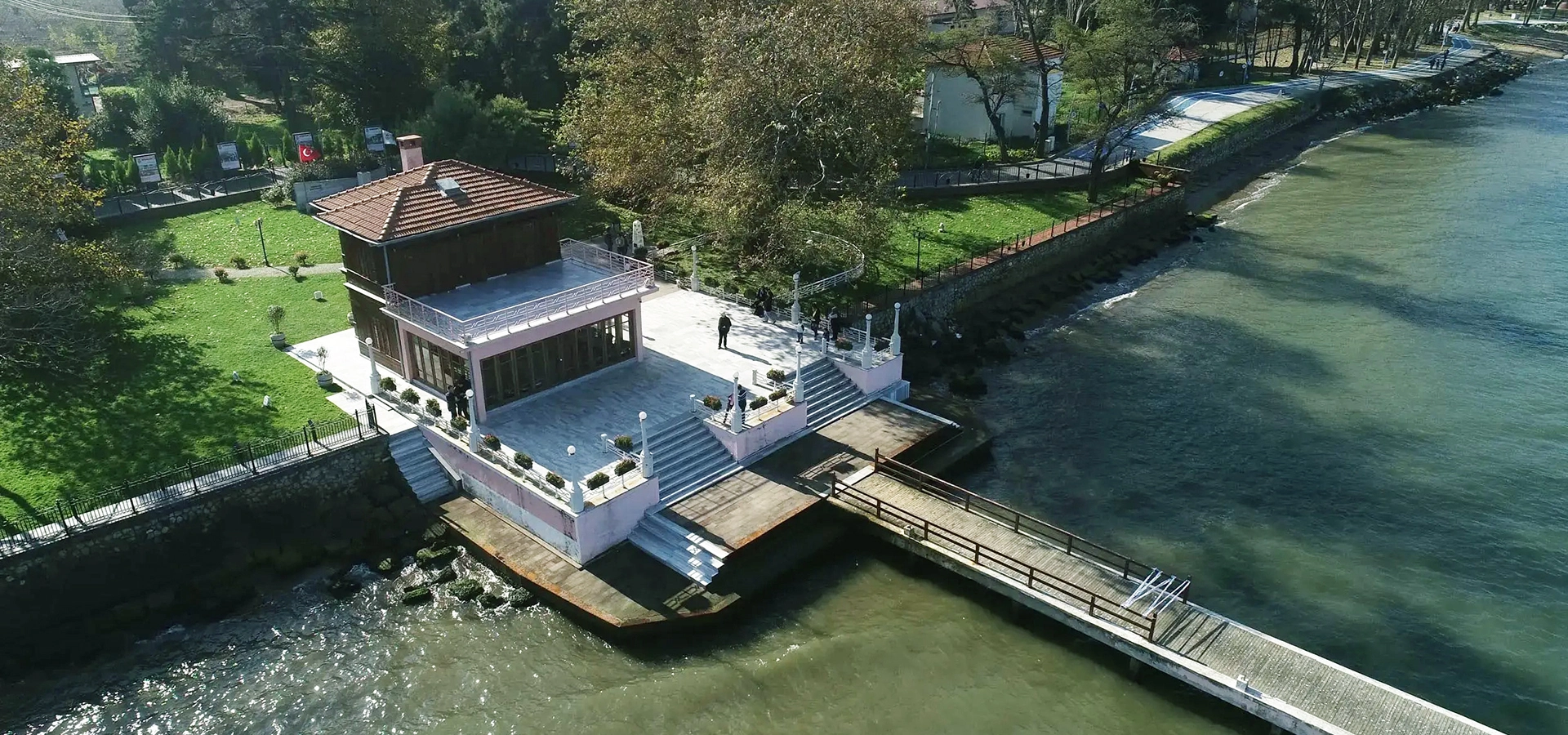
Yürüyen Köşk, meaning the “Walking Mansion”, is one of the most memorable historical landmarks in Yalova, Türkiye. The small seaside residence is closely associated with Mustafa Kemal Atatürk and a famous decision that turned an ordinary maintenance problem into a lasting story about respect for nature.
Atatürk first noticed the large plane tree on the Yalova shoreline on 21 August 1929 while travelling aboard the yacht Ertuğrul. Impressed by the tree and its setting, he went ashore and later ordered a small residence to be built beside it. The two-storey wooden house was completed on 12 September 1929, only twenty-two days after construction began.
The following summer, workers proposed cutting a branch that had grown against the building. Instead, Atatürk ordered that the tree should remain and the mansion should be moved. Engineers placed rails beneath the structure and, between 8 and 10 August 1930, shifted the building approximately 4.80 metres east.
The unusual operation gave the building its enduring name, Yürüyen Köşk. Today the restored mansion functions as a museum, preserving rooms, photographs, documents and personal objects connected with Atatürk. It is also one of the essential stops on a wider journey through Yalova’s history, nature and thermal landscapes.
The seaside residence was completed on 12 September 1929 after a rapid twenty-two-day construction period.
The mansion was shifted approximately 4.80 metres east to protect the neighbouring plane tree.
The relocation operation was carried out between 8 and 10 August 1930 using rails beneath the building.
The old eastern plane beside the mansion remains the living centre of the Yürüyen Köşk story.
Essential information for understanding Atatürk’s famous seaside mansion and planning a visit in Yalova.
Yalova city centre, on the waterfront in the Süleymanbey area.
Search on Google MapsHistoric seaside residence and museum associated with Mustafa Kemal Atatürk.
The residence was completed on 12 September 1929.
The building was shifted on rails between 8 and 10 August 1930.
Approximately 4.80 metres toward the east.
The mansion was moved so the branch of the old eastern plane would not need to be cut.
A compact two-storey timber-framed residence with a sea-facing meeting room and terrace.
Displays include photographs, documents, furnishings and personal objects connected with Atatürk.
The mansion was officially registered as a protected cultural asset in 1980.
Yalova Municipality restored the building in 2006 and reopened it to visitors.
Its importance comes not from monumental scale, but from the story connecting Atatürk, engineering, cultural memory and respect for nature.
At first glance, Yürüyen Köşk is a modest wooden seaside residence. Its historical power comes from the decision made when the neighbouring plane tree began to interfere with the building.
Instead of changing the tree to fit the architecture, the architecture was changed to accommodate the tree. The solution required engineers to place rails beneath the mansion and physically move it away from the branches.
That choice transformed the building into a symbol far beyond Yalova. The story is now closely associated with environmental awareness, practical problem-solving and respect for living heritage.
The site is especially meaningful because both parts of the story remain visible: the historic mansion and the plane tree whose preservation caused the building to move.
The story begins on 21 August 1929. Mustafa Kemal Atatürk was travelling from Istanbul toward Bursa aboard the yacht Ertuğrul when a large plane tree on the Yalova coast attracted his attention.
He went ashore and spent time beneath the tree. The setting impressed him enough that he requested a small residence to be built nearby.
Construction began immediately and was completed in only twenty-two days. The house was ready on 12 September 1929.
The site formed part of the agricultural landscape associated with Atatürk’s Millet Çiftliği in Yalova. Its waterside position offered both a peaceful retreat and direct connection with the Marmara coast.
Atatürk noticed the plane tree while passing Yalova by yacht and went ashore.
The residence was deliberately placed near the tree that had first drawn Atatürk to the site.
The small seaside mansion was constructed in a notably short period.
The residence was completed and entered use.
During the summer of 1930, Atatürk learned that a branch of the plane tree had grown against the mansion and was creating a problem for the building. The practical suggestion was to cut the branch.
Atatürk chose a different solution: the tree would remain and the building would move. The task was transferred to the technical staff of Istanbul Municipality.
Work began on 8 August 1930. The ground around the building was carefully excavated to foundation level and tram rails brought from Istanbul were placed beneath the structure.
The terrace section was moved first. The main body of the mansion was then shifted progressively along the rails. By 10 August 1930, the operation had been completed and the building stood approximately 4.80 metres farther east.
The relocation was observed by Atatürk and several people present at the site, including Makbule Atadan and journalist Yunus Nadi. The successful operation protected both the building and the tree.
In Turkish, Yürüyen Köşk literally means “Walking Mansion” or “Walking Pavilion.”
The name is a direct reference to the 1930 relocation. The mansion did not simply receive repairs or have a wall rebuilt. The entire structure was shifted on rails while remaining intact.
The story became so closely associated with the building that the new name replaced its more ordinary identity as a small farm residence. Today, the phrase Yürüyen Köşk immediately evokes the relationship between Atatürk, the mansion and the plane tree.
The plane tree is not simply part of the garden. It is the central living element in the history of the site. Without the tree, there would be no story of a mansion being moved.
Official records identify it as an eastern plane (Platanus orientalis), a long-lived species strongly associated with public spaces, water sources and historic landscapes across Türkiye.
A report prepared in 2015 described the tree as approximately 390 years old and healthy, while Türkiye’s monumental-tree registry now presents it as roughly 400 years old. Age estimates for ancient living trees should naturally be understood as approximate.
When visiting, take time to look at the relationship between the tree canopy and the mansion. The value of the site becomes much clearer when both are experienced together rather than as separate attractions.
Eastern plane, known scientifically as Platanus orientalis.
Its branch led directly to the decision to relocate the mansion in 1930.
Modern official records describe the tree as around four centuries old.
The tree remains an essential part of the historic landscape rather than merely a background feature.
Yürüyen Köşk is a square-plan, timber-framed building with two principal levels. Its relatively small scale is part of its charm and helps visitors understand that this was not designed as a monumental palace.
The ground floor includes a small room, sitting room and service spaces, together with a sea-facing meeting room enclosed with crystal glass. This room is one of the building’s most recognizable interior spaces.
A wooden staircase leads to the upper floor, where the arrangement includes resting and bedroom spaces along with access toward the terrace.
Columns around the exterior reinforce the light pavilion-like character of the building. The relationship between veranda, garden, tree and shoreline is just as important as the rooms themselves.
The mansion is primarily a wooden-framed residence rather than a masonry monument.
Public and reception functions are concentrated below, with more private rooms above.
The glass-enclosed meeting space creates a close visual connection with the Marmara shoreline.
The upper-level terrace and exterior spaces strengthen the relaxed seaside character of the residence.
Today the building is presented as a museum connected with Atatürk’s life in Yalova and the extraordinary 1930 relocation. Visitors can see period rooms together with objects, photographs and documents.
Yalova Municipality highlights a number of notable pieces and interior details, including Atatürk’s gramophone, dining ware, personal textile objects, historic photographs and other items associated with the residence.
Among the objects described by the municipality are Belgian porcelain dining pieces, a quilt made by Zübeyde Hanım, a specially designed coffee cup and a life-size wax representation of Atatürk.
The interior is best appreciated slowly. Rather than treating the building as a large conventional museum, think of it as an intimate historic house where rooms, furniture, documents and the surrounding landscape form one story.
Yürüyen Köşk should be understood within Atatürk’s broader relationship with Yalova. The city and its surroundings became an important place for rest, agriculture, planning and official visits during the early Republican period.
According to Yalova’s official records, Atatürk continued to use the mansion intermittently between 1930 and 1937. He also received Turkish and foreign guests there.
The small building therefore carries more than the famous tree story. It forms part of a wider historical landscape associated with the development of modern Yalova and the early decades of the Republic.
Visitors interested in this context can combine Yürüyen Köşk with Termal Atatürk Köşkü and other sites connected with Atatürk’s presence in Yalova.
Yürüyen Köşk is widely presented in Yalova as a symbol of environmental awareness and respect for nature. The power of the story lies in the practical choice that was made: alter the human-built object rather than destroy the living tree.
The event took place decades before environmental sustainability became a common public-policy term. For modern visitors, however, the message feels immediately recognizable.
The mansion also offers a useful lesson in adaptive problem-solving. The decision was not simply to preserve nature at any cost, but to find an engineering method that allowed both the tree and the building to survive.
This is why the site is frequently used in educational programs. It allows children and adults to discuss heritage conservation, environmental responsibility and the relationship between architecture and landscape through one simple and memorable event.
Yürüyen Köşk is especially photogenic because several elements come together in a small area: the white historic residence, the old plane tree, landscaped grounds and the Marmara Sea.
A wide view that includes both the mansion and the tree is the most important image to capture. It visually explains the historical story better than a tightly framed photograph of the building alone.
Morning or late-afternoon light can create softer shadows around the timber exterior and tree canopy. The waterfront can also provide attractive reflections and open sky.
Inside the museum, photography rules may vary according to current conservation policy. Always follow posted instructions and staff guidance before photographing exhibits.
Compose both together whenever possible so the historical relationship is immediately visible.
Use the Marmara Sea and open shoreline to give context to the mansion’s setting.
Look for windows, timber surfaces, columns, veranda elements and the glass meeting salon.
Check before photographing inside, especially around delicate objects and furnished rooms.
Yürüyen Köşk can be visited throughout the year, but the experience changes with weather, daylight and the appearance of the plane tree.
Spring is especially attractive when the gardens and tree canopy become fresh and green. Mild weather also makes the waterfront more pleasant for walking.
Summer offers long daylight hours and lively conditions along the Yalova shore. Weekends and public holidays can naturally be busier.
Autumn brings changing foliage around the plane tree and softer seasonal light, making it one of the most atmospheric times for photography.
Winter is quieter and can suit visitors who want to focus on the museum interior, although rain, wind and shorter daylight may reduce time spent in the garden.
Yürüyen Köşk operates as a museum under Yalova Municipality and is open to visitors. Because opening hours, admission arrangements and maintenance closures can change, check the municipality’s current museum information before travelling.
The site lies close to Yalova city centre and is much easier to reach than many rural attractions in the province. Its waterfront setting also makes it convenient to combine with a city walk.
Allow enough time to experience both the museum interior and the outdoor relationship between the mansion and plane tree. Visiting only the rooms without seeing the garden misses an essential part of the story.
The museum can become busier on national commemorative days, school visits, weekends and public holidays. A quieter weekday visit can provide a more relaxed experience.
The grounds around Yürüyen Köşk are generally easier to experience than many natural attractions, but the interior remains a historic two-storey building with architectural limitations.
Visitors who require step-free access should verify current museum accessibility arrangements before travelling, particularly for upper-floor rooms.
Even when full interior access is not possible, the exterior of the mansion, the plane tree and the waterfront setting remain important parts of the visit.
Yürüyen Köşk is located on the Yalova waterfront, within the central urban area and close to the main coastal approaches.
For navigation, search “Yürüyen Köşk Yalova”. The attraction is well known locally and is easier to identify than many smaller historical buildings.
Visitors arriving in Yalova by ferry, bus or private vehicle can normally include the mansion comfortably within a city-centre itinerary. Exact travel time depends on the arrival point and traffic.
If driving, follow current local signs and use designated parking areas rather than stopping on access roads around the museum.
Use the coastal road network toward the Yürüyen Köşk museum area.
Search “Yürüyen Köşk Yalova” in your preferred map application.
Check current Yalova municipal transport options for the closest stop to the museum.
The attraction is widely known and can be reached easily from central Yalova by taxi.
For most visitors, 45–90 minutes is comfortable for exploring the historic house, looking at the museum displays and spending time around the plane tree.
A quick visit of 30–45 minutes can work if you mainly want to see the mansion exterior, the tree and the principal rooms.
Allow 1.5–2 hours if you enjoy photography, want to read museum information carefully or plan to relax along the waterfront afterward.
The mansion also works well as the beginning of a half-day Yalova heritage route combined with the city museum, waterfront and other central attractions.
A focused visit to the principal rooms, exterior and plane tree.
The best range for most first-time visitors.
Ideal for slower museum exploration, photography and time by the water.
Combine Yürüyen Köşk with other historical places around central Yalova.
Begin outside the mansion rather than rushing directly indoors. First locate the plane tree and the building together so you can understand why moving the structure became necessary.
Walk around the exterior and look at the scale of the residence. Imagine the foundations being exposed and rails placed beneath the building in August 1930.
Continue into the museum and explore the furnished rooms, photographs, documents and personal objects that connect the site with Atatürk.
Pay particular attention to the sea-facing meeting room and the way the building opens toward the Marmara coast.
Finish outside beneath or near the old plane tree, then continue along the Yalova waterfront or explore additional sites through our Yalova travel guide.
The mansion is easy to combine with a broader Yalova city and heritage itinerary. Several of the province’s best-known cultural and natural attractions are reachable within the same day.
Walk the waterfront, explore central streets and experience the compact urban heart of Yalova.
Learn more about the city’s local history, urban development and cultural memory.
Continue the Atatürk theme in Yalova’s famous thermal district with another historic residence.
Explore an important botanical collection that complements the nature theme of Yürüyen Köşk.
Discover the province’s long tradition of hot springs, spa culture and wooded thermal landscapes.
Continue across the province for waterfalls, forests, thermal springs, beaches, museums and historic places.
Yürüyen Köşk was formally registered as a protected cultural and natural heritage property by a decision dated 12 July 1980.
The building later underwent restoration by Yalova Municipality in 2006 and was opened to the public as a museum.
Conservation at Yürüyen Köşk involves more than maintaining timber walls and historic rooms. The plane tree, garden and spatial relationship between the house and shoreline are all essential to the meaning of the site.
For visitors, this means treating the mansion as a fragile historic environment: avoid touching delicate objects, follow staff instructions and respect barriers around both the building and tree.
Do not climb, carve, nail objects into or otherwise damage the historic plane tree.
Respect staff instructions, barriers and any restrictions protecting the historic rooms.
Historic furnishings and personal items may be fragile even when they appear robust.
Maintain a calm atmosphere inside the compact museum and around guided groups.
Keep the landscaped grounds and waterfront free of litter.
Ask before using flash, tripods or other equipment inside the historic building.
Historic interiors and the waterfront require attentive adult supervision.
Leave the site exactly as you found it so future visitors can experience the same historic landscape.
Yürüyen Köşk is a historic seaside residence in Yalova associated with Mustafa Kemal Atatürk. It became famous after the building was moved on rails in 1930 to protect a neighbouring plane tree.
It literally means “Walking Mansion”. “Walking Pavilion” is another possible translation.
A branch of the plane tree beside the building had grown against the mansion. Instead of cutting the branch, Atatürk ordered the building to be moved away from the tree.
The building was shifted approximately 4.80 metres east.
The relocation work began on 8 August 1930 and was completed on 10 August 1930.
Engineers excavated around the foundations, placed rails beneath the structure and gradually shifted the mansion along the rails.
Construction began in August 1929 and the residence was completed on 12 September 1929.
He was impressed by the large plane tree and its seaside setting after seeing it from the yacht Ertuğrul while passing Yalova in August 1929.
Yes. The old eastern plane remains beside the mansion and is an essential part of the historic site.
Official records describe it as approximately four centuries old. Because it is a living ancient tree, age figures should be understood as estimates.
Yes. The building functions as a museum under Yalova Municipality, subject to current opening schedules and conservation arrangements.
Visitors can see period rooms, photographs, documents, furnishings and personal objects connected with Atatürk and the history of the residence.
Admission arrangements can change. Check the current Yalova Municipality museum information before visiting rather than relying on older fee listings.
The museum has scheduled visiting hours, but these can change seasonally or during maintenance and commemorative events. Verify the current schedule shortly before your visit.
Most visitors will find 45–90 minutes comfortable for the museum, plane tree and grounds.
Yes. The story is especially easy for children to understand and is often used to discuss nature, history and environmental responsibility. Young children should still be supervised carefully inside the historic house and near the waterfront.
The outdoor setting is easier to experience than the upper floor of the historic two-storey building. Visitors who need step-free access should verify current arrangements with the museum before travelling.
Yes. The combination of the historic mansion, old plane tree, landscaped grounds and Marmara Sea creates excellent exterior compositions.
Good combinations include Yalova city centre, Yalova City Museum, Termal Atatürk Köşkü, Karaca Arboretum and the thermal district.
It is especially rewarding for visitors interested in Atatürk, early Republican history, architecture, environmental heritage and distinctive local stories.
Combine Yürüyen Köşk with Yalova’s thermal heritage, historic sites, gardens and selected natural attractions through a private itinerary designed around your interests and pace.
Discover Atatürk’s Yalova, the famous Walking Mansion and selected historical and natural places across the province in a tailor-made private day.
Ask us about a tailor-made route combining Yürüyen Köşk, Yalova city centre, Termal, Atatürk heritage and selected cultural or natural places across the province.
Request a Custom Tour
Discover thermal springs, waterfalls, forests, historic mansions, coastal towns, gardens and cultural attractions throughout Yalova Province.
View Yalova GuidePair Yürüyen Köşk with other places that reveal Yalova’s connection with Atatürk, thermal culture and the natural landscapes of the Marmara region.
Explore Yürüyen Köşk together with selected places connected with Atatürk’s years in Yalova and Termal.
Plan a Private Route
Combine cultural heritage with thermal landscapes, gardens, forests or waterfalls depending on the season.
Request a Custom Day
Continue exploring beaches, thermal springs, waterfalls, museums, historic buildings, forests and coastal scenery across Yalova Province.
Explore Yalova