Private Bilecik Food & Dessert Discovery
Explore regional dishes, local pastry traditions, markets and food stories on a flexible private route.
Request This Tour





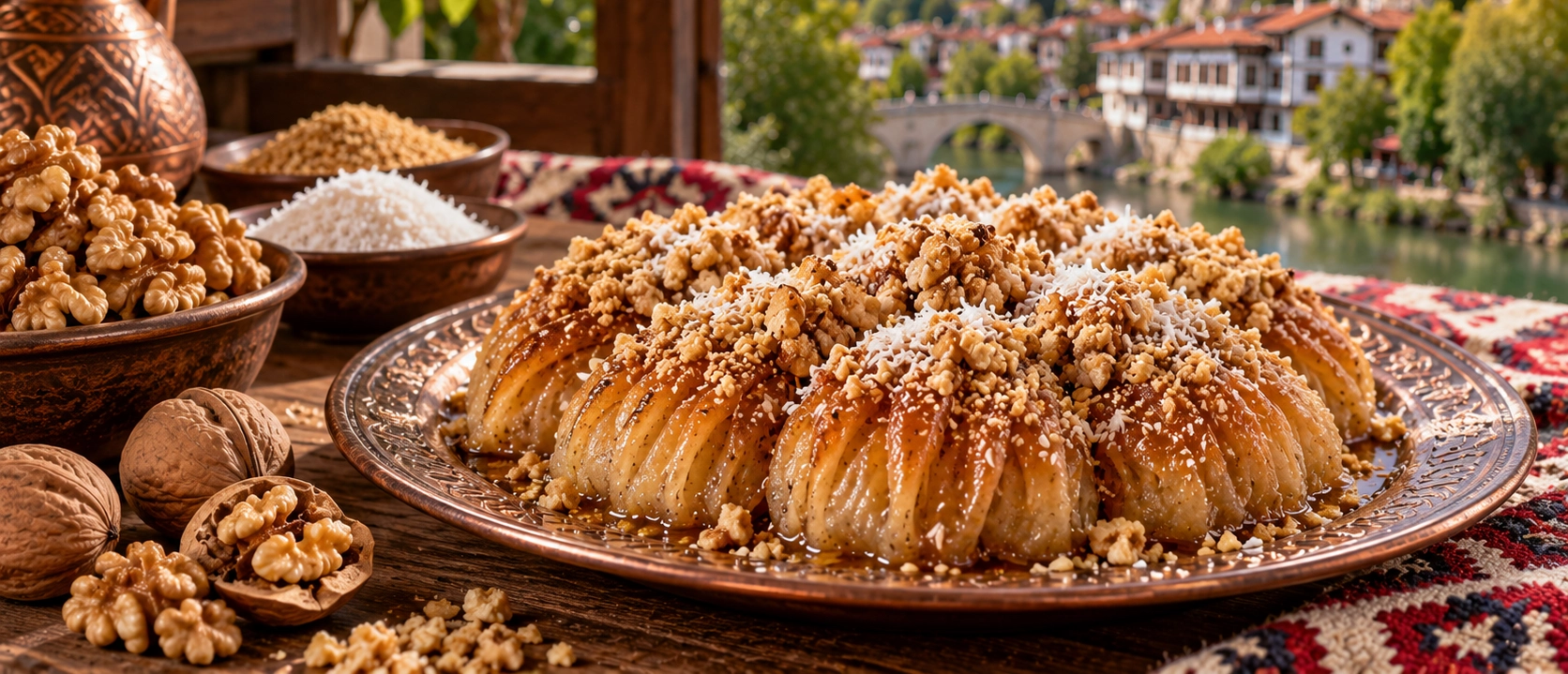
Cevizli Büzme Tatlısı is one of the traditional desserts associated with Bilecik Province in northwestern Türkiye. Its defining technique begins with thin sheets of hand-rolled dough, generously scattered with ground walnuts.
Each sheet is wrapped around an oklava, the long Turkish rolling pin used for opening yufka and pastry dough. While still on the pin, the dough is pushed inward from both ends so that it gathers into the characteristic wrinkled form that gives the dessert its name.
The gathered pastry is removed from the rolling pin, cut into portions, arranged in a tray and baked with melted butter until crisp and golden. A sugar-and-water syrup known locally in the recipe as ravak is then poured over the baked pastry.
Bilecik's official local recipe adds a distinctive final layer: roasted sesame is spread over the dessert, followed by a light garnish of coconut. The result combines crisp pastry, rich walnut filling, syrupy sweetness and nutty toasted aromas.
For travellers exploring Bilecik through its food, Cevizli Büzme Tatlısı offers a particularly visual example of Anatolian pastry craftsmanship — a dessert whose identity is shaped as much by hand technique as by its ingredients.
Recorded among the regional dishes presented by Bilecik's official culture and tourism authorities.
Thin dough sheets are generously filled with ground walnuts before being rolled and gathered.
The pastry is compressed on the rolling pin to create its signature folded, ridged appearance.
After baking, the pastry receives syrup and is finished with roasted sesame and coconut.
Essential information about one of the best-known traditional sweets associated with Bilecik cuisine.
Bilecik Province in northwestern Türkiye.
Open Bilecik on Google MapsWalnut-filled, oven-baked pastry finished with sugar syrup.
Generous ground walnut filling between thin sheets of hand-rolled dough.
The rolled dough is gathered on an oklava to create the dessert's distinctive ridged form.
A regional pastry where thin dough, walnuts and the movement of the rolling pin create the final shape.
Bilecik's official regional cuisine pages include Cevizli Büzme Tatlısı among the province's traditional foods, preserving a detailed preparation method based on hand-rolled dough and walnuts.
The recipe belongs to a wider Anatolian world of tray pastries in which dough is opened extremely thin, layered or rolled with nuts, baked with butter and then balanced with syrup.
What makes this version immediately recognisable is the büzme stage. Rather than leaving the rolled pastry smooth and straight, the cook compresses it while it is still wrapped around the oklava.
That simple hand movement changes both appearance and texture. The gathered folds create extra edges and ridges that crisp in the oven and later hold syrup between the layers.
The official Bilecik recipe further distinguishes the finished tray with roasted sesame and coconut, creating a combination of walnut, toasted seed, crisp pastry and sweet syrup in a single bite.
Cevizli Büzme Tatlısı can be described in English as a walnut-filled gathered pastry with syrup. It begins with a supple dough made with flour, eggs, milk, oil, vinegar, a little sugar and salt.
The dough is divided into small pieces and opened into thin yufka-like sheets using starch to prevent sticking. Ground walnuts are spread across the surface, and the sheet is then rolled around a long rolling pin.
The cook pushes the rolled pastry inward so that it bunches together. Once removed from the rolling pin, the gathered pastry is portioned, arranged in a tray, covered with melted butter and baked.
The pastry begins with hand-opened sheets that are rolled thin with starch.
Ground walnuts form the main filling and give the dessert its rich, earthy flavour.
The dough is compressed on the rolling pin, creating folds and a visibly ridged shape.
Melted butter is poured over the arranged pastry before it is baked until golden.
A cooked sugar-and-water syrup is poured over the baked pastry after a short cooling period.
Roasted sesame and coconut provide the characteristic final garnish in Bilecik's official recipe.
The Turkish word büzme comes from the idea of gathering, puckering or drawing something inward. In this dessert, the name describes the physical movement used to shape the pastry.
After the walnut-filled sheet is wrapped around the oklava, the cook pushes the dough from both sides toward the centre. The smooth roll transforms into a tightly gathered pastry with repeated folds.
The walnut-covered sheet is wound carefully around the rolling pin.
The dough is compressed from the ends while still wrapped around the pin.
The pastry forms closely packed ridges rather than remaining as a smooth cylinder.
The gathered pastry is gently removed without losing its compressed form.
The long piece is divided into serving-sized sections before baking.
The folds become crisp, golden and especially effective at catching syrup.
Bilecik's official culture and tourism recipe gives a large family- or tray-sized preparation. Quantities can be scaled for home use, but the traditional ingredient profile is useful for understanding the dessert's character.
The dough is mixed from eggs, milk, vegetable oil, vinegar, sugar, salt and flour, then kneaded until it becomes smooth enough to roll. It is divided into pieces roughly suitable for opening into individual pastry sheets.
The purpose is not to create thick bread-like layers. The dough must be workable enough to open very thinly, because the final texture depends on many delicate folds rather than on a heavy pastry shell.
Provide structure and richness to the pastry dough.
Adds moisture and softness while the dough is being formed.
Helps produce a flexible dough that can be opened into thin sheets.
A small amount is included in the official local recipe for the pastry dough.
Forms the body of the dough and is worked until a smooth, rollable texture is achieved.
Evenly sized pieces help produce consistent sheets and regular portions.
The dough pieces are opened with an oklava into broad, thin sheets. Starch is sprinkled during rolling so that the dough remains manageable and does not stick to the work surface or rolling pin.
This stage is one of the most skill-dependent parts of the recipe. Thinness matters because each sheet must be flexible enough to wrap around the oklava, yet strong enough to hold the walnut filling and survive the gathering motion.
A long, narrow rolling pin makes it easier to open and later gather the pastry.
Starch reduces sticking and helps the dough open into a thinner sheet.
Consistent thickness helps the pastry bake at the same rate across the tray.
Very thin dough should remain intact enough to hold walnuts during rolling.
The technique is easiest when filling, rolling and gathering are completed in a steady sequence.
Excess moisture can make the pastry difficult to roll and gather cleanly.
The word cevizli means “with walnuts,” and the official Bilecik recipe uses walnuts very generously. Once the dough is rolled thin, crushed walnut kernels are spread across the sheet before it is wound around the oklava.
Walnuts provide more than flavour. Their small pieces sit between the pastry folds, helping keep the layers distinct and creating a contrast between crisp dough, soft nut filling and syrup.
Walnut gives the dessert its dominant aroma beneath the sweetness of the syrup.
Crushed nuts interrupt the pastry folds with a pleasantly substantial bite.
The official tray recipe uses a large quantity of walnut, making it central rather than decorative.
Spreading the nuts evenly helps every gathered section contain filling.
Walnut's slight bitterness and earthy character balance concentrated sweetness.
The final roasted sesame layer reinforces the dessert's toasted nut-and-seed profile.
Once the gathered pieces fill the tray, melted butter is poured over the pastry. The tray is then baked until the dough takes on an even golden colour and the ridged surfaces become crisp.
The folds are important here: exposed ridges colour quickly, while the deeper creases protect softer layers and pockets of walnut. That variation is part of the dessert's texture.
Butter coats the pastry before baking and supports rich browning.
The pastry goes into a hot oven so the outer folds begin crisping promptly.
The visual cue is an evenly baked tray with crisp, browned ridges.
Raised edges can colour faster than the deeper areas of the pastry.
The filling remains mostly enclosed within the gathered layers during baking.
The baked pastry is allowed to settle while the syrup is prepared and rested.
In the Bilecik recipe, the syrup poured over the dessert is referred to as ravak. It is made by boiling sugar and water until they form a syrup suitable for soaking the baked pastry.
The official recipe uses six glasses of sugar to five glasses of water. After boiling, the syrup is rested for approximately fifteen minutes before being poured over the tray.
Provides the concentrated sweetness expected from a traditional syrup pastry.
Creates the fluid base that carries sweetness into the pastry folds.
The mixture is cooked until it reaches a syrup-like consistency.
The syrup is not poured immediately from the boil; the traditional instructions allow it to rest first.
Distribution across the tray helps the gathered pieces absorb sweetness consistently.
The finished dessert is left to cool so syrup can move into the pastry layers.
After the syrup is added, Bilecik's official recipe calls for sesame to be crushed and roasted before being scattered over the dessert. Coconut is then used as the final garnish.
This topping changes both appearance and flavour. Sesame adds a roasted, slightly savoury nuttiness, while the pale coconut creates a visual contrast over the golden-brown pastry.
Breaking the seeds slightly helps release their aroma during roasting.
Heat deepens the nutty character of sesame before it reaches the tray.
The seeds add a delicate bite over the syrup-softened pastry surface.
A light final layer of coconut completes the official local presentation.
Together they create a complex toasted profile rather than sweetness alone.
Golden ridges, dark walnut, sesame and white coconut make the dessert especially photogenic.
The dessert combines several strong textures and flavours rather than tasting like a simple sugar pastry. The outer folds can remain crisp, deeper layers become tender with syrup, and walnuts provide a dense nutty centre.
Raised folds bake into delicate crunchy edges.
Deeper pastry absorbs ravak and becomes tender without losing the gathered structure.
Walnuts give the dessert an earthy flavour that balances the syrup.
Melted butter contributes a warm baked-pastry fragrance.
The seed topping adds a toasted note not found in every syrup pastry.
Coconut provides a light final aroma and decorative contrast.
The gathered shape is not only decorative. It increases the number of edges exposed to heat and creates channels through which syrup can move after baking.
Many small folds create extra browned surfaces.
Walnut filling remains between softer inner layers of pastry.
The folds naturally trap syrup as it spreads across the tray.
A good portion can combine crisp ridges with syrup-softened inner pastry.
Walnut pieces stay noticeable between the layers rather than disappearing into a paste.
Roasted sesame adds one more dry, lightly crunchy texture on top.
It belongs to the same broad family of nut-filled, syrup-soaked pastries, but it is not simply a standard tray of layered baklava. The preparation method and final shape are different.
Instead of stacking many flat sheets with nuts between them, Cevizli Büzme Tatlısı rolls each walnut-filled sheet around an oklava and then gathers it into ridges. That technique gives the pastry a different structure and eating experience.
Thin dough, nuts, butter and syrup connect it with the wider family of Anatolian syrup pastries.
Büzme is rolled and gathered rather than built primarily as flat stacked layers.
The finished pieces have visible pleats and ridges created on the rolling pin.
Bilecik's version places walnut at the centre of the filling.
Roasted sesame adds a distinctive final note in the official local recipe.
The final coconut decoration further separates its presentation from many classic baklava styles.
The dessert is served after the syrup has had time to settle into the baked pastry. Portions are cut so that each piece keeps its gathered form and carries both walnut filling and the sesame-coconut topping.
Because it is rich in walnuts, butter and syrup, a modest piece is often enough to appreciate the texture.
A short resting period helps the sweetness distribute through the pastry.
Serve with the sesame and coconut side facing upward to preserve the local presentation.
Unsweetened black tea provides a refreshing contrast to the syrup-rich pastry.
A small coffee works well when the dessert is served as a concentrated sweet finish.
Fresh pastry emphasizes crispness, while a longer rest allows syrup to soften more of the inner layers.
Cevizli Büzme Tatlısı represents a kind of cooking in which technique is passed through repetition: kneading, opening dough, handling the oklava, judging when the pastry has browned and balancing baked layers with syrup.
For food travellers, watching or understanding this process can be as meaningful as tasting the finished dessert. The recipe connects flour, walnuts, butter and sesame with the practical skills of the regional kitchen.
The pastry begins with manual work rather than a pre-shaped commercial shell.
The rolling pin is both a tool for opening the dough and the mould around which the pastry is gathered.
Walnut provides the deep flavour around which the rest of the dessert is built.
The dessert is prepared as a shared tray rather than as individually assembled pastries.
The timing and consistency of ravak affect how the final pastry absorbs sweetness.
Its inclusion in Bilecik's official traditional cuisine records the dessert as part of the province's food story.
Availability can vary because traditional local desserts are not always produced every day in every restaurant. Travellers should ask specifically for Cevizli Büzme Tatlısı when visiting Bilecik.
Traditional sweet shops and bakeries are natural first places to ask about walnut büzme.
Restaurants serving Bilecik cuisine may prepare it or know where it is available locally.
Ask for “Cevizli Büzme Tatlısı” to distinguish the Bilecik-style walnut version from other syrup pastries.
A recently prepared tray gives the clearest contrast between crisp ridges and syrup-softened layers.
Regional sweets may appear in neighbourhood pastry shops and home-style establishments rather than only in major visitor areas.
Local teams can often identify where a traditional dessert is currently being prepared.
The gathered ridges are the easiest visual clue that you are looking at a true büzme-style pastry.
A cut piece should reveal walnut between the rolled and gathered layers.
Roasted sesame is a particularly interesting feature of Bilecik's documented recipe.
This is a traditional syrup dessert, so sweetness is part of its identity rather than an optional finishing touch.
Plain Turkish tea helps reset the palate between rich bites.
The most informative image shows both the gathered exterior and the walnut-filled interior.
Continue with Kapama, Papaz Yahnisi, Pazaryeri Boza and other local dishes to understand the wider cuisine.
The shaping method is central to the dessert, so the preparation story adds greatly to the tasting experience.
Photograph the complete baked tray to show the repeated rhythm of gathered pastry pieces.
Capture the moment the dough is being pushed inward on the rolling pin.
Show the thin dough covered with walnuts before it is rolled.
Use side light to emphasize the crisp peaks and syrup-filled valleys.
A macro shot can reveal the distinctive topping against the golden pastry.
Place a serving beside Turkish tea for a natural food-travel scene.
Bilecik cuisine brings together substantial meat dishes, grain preparations, fermented drinks, orchard fruits, vegetable traditions and sweets. Cevizli Büzme Tatlısı adds a rich pastry tradition to that wider picture.
A sweet-and-sour meat stew built around onions, vinegar and warm flavours.
A substantial regional rice-and-meat dish that represents another side of Bilecik home cooking.
A slow-cooked meat speciality for travellers interested in the province's savoury dishes.
A traditional fermented grain drink associated with Pazaryeri district.
Another Bilecik sweet worth comparing with the walnut-and-syrup character of büzme.
Pomegranate, quince and watermelon show the agricultural diversity behind the regional table.
Compare Bilecik's walnut-filled syrup pastry with another traditional regional sweet.
Continue with Bilecik's traditional fermented grain drink.
Discover a fruit-based sweet inspired by one of Bilecik's strongest agricultural traditions.
Explore another local sweet connected with the Sakarya Valley's fruit-growing heritage.
Begin with a savoury regional speciality before finishing the meal with Cevizli Büzme Tatlısı.
Continue through the province's traditional kitchen with a rice-and-meat favourite.
Pair a regional meat speciality with a traditional syrup dessert for a broader food journey.
Move from sweets to Bilecik's protected agricultural products and seasonal kitchen traditions.
Add archaeological and cultural context to a day focused on regional food.
Combine Bilecik's culinary heritage with one of the city's important historical landmarks.
Continue toward Söğüt for landscapes and monuments linked with early Ottoman history.
Extend the journey westward with another layer of Bilecik Province's historical story.
Combine Ottoman architecture with the food and agricultural traditions of the Sakarya Valley.
Ask us to combine local cuisine, Ottoman heritage, villages and countryside into a private itinerary.
The preparation described on this page follows the traditional recipe published by official Turkish culture and tourism sources for Bilecik. Those records identify the dessert's defining ingredients and the rolling, gathering, baking, syrup and topping stages.
It is a traditional Bilecik walnut-filled pastry made from thin hand-rolled dough that is gathered on an oklava, baked with butter and finished with syrup.
It is recorded as part of the traditional cuisine of Bilecik Province in northwestern Türkiye.
Cevizli means “with walnuts,” referring to the generous walnut filling inside the pastry.
It refers to the gathering or puckering technique used to compress the rolled pastry on the oklava.
An oklava is a long, narrow Turkish rolling pin commonly used to open thin pastry and yufka dough.
The main filling is ground or crushed walnut.
Yes. The gathered pastry is arranged in a tray, covered with melted butter and baked until golden.
Yes. The baked pastry is soaked with a sugar-and-water syrup called ravak in the traditional Bilecik recipe.
In this recipe, ravak is the cooked sugar-and-water syrup poured over the baked pastry.
Yes. The official recipe finishes the dessert with crushed roasted sesame.
Yes. Coconut is used as a final garnish in the documented Bilecik preparation.
No. It shares thin dough, nuts, butter and syrup with the wider baklava family, but its dough is rolled and gathered into pleated pieces rather than simply stacked in flat layers.
The walnut-filled dough is wrapped around an oklava and pushed inward while still on the pin, producing repeated folds.
Expect crisp golden ridges, softer syrup-soaked inner layers and a substantial walnut filling.
It is a traditional syrup dessert, so it is distinctly sweet, balanced by walnuts, butter and roasted sesame.
Unsweetened Turkish tea or Turkish coffee both provide a pleasant contrast to the rich syrup pastry.
Ask local pastry shops, bakeries and restaurants serving regional cuisine. Availability can vary, so using the full Turkish name is helpful.
Look for gathered pastry ridges, visible walnut filling and the sesame-and-coconut finish associated with Bilecik's documented version.
Continue with Pazaryeri Halva, İnhisar Pomegranate Delight and Osmaneli Quince Delight.
Explore Bilecik Papaz Yahnisi, Bilecik Kapama, Bilecik Oven Kebab and Bilecik Quail Kebab.
Yes. It fits naturally into a food-focused journey combining local restaurants, pastry shops, regional products, markets and historical sites.
The strongest visual sequence should explain the technique: dough preparation, thin rolling, walnut filling, wrapping around the oklava, gathering the pastry, golden baking, syrup pouring and the final sesame-coconut finish.
Show the oklava, starch and thinly opened sheet in a traditional kitchen setting.
Capture hands spreading crushed walnuts across the delicate dough.
Photograph the pastry being pushed inward while wrapped around the rolling pin.
Use a slightly angled overhead view to reveal the repeated gathered forms after baking.
Freeze the moment ravak runs between the crisp pastry ridges.
End with a close cross-section showing walnut filling, sesame, coconut and glossy syrup.
Combine traditional Bilecik dishes and desserts with Ottoman heritage, local markets, village culture and the landscapes of the Sakarya Valley on a private journey designed around your interests.
Custom-designed private journeys with flexible timing, private transportation and opportunities to explore regional cuisine, traditional sweets, historical sites and lesser-known corners of Bilecik Province.
Explore regional dishes, local pastry traditions, markets and food stories on a flexible private route.
Request This Tour
Combine Bilecik city, Söğüt, Osmaneli, Bozüyük and surrounding countryside on a private route linking history, regional cuisine and traditional sweets.
Request This Tour