Corn-Flour Base
The registered Pazaryeri style is prepared primarily from corn flour.
- Main grain: Corn flour
- Role: Body and cereal character
- Preparation: Long controlled cooking






Pazaryeri Bozası is one of the best-known traditional flavours of Pazaryeri in Bilecik Province. Thick, creamy and gently tangy, it belongs to Türkiye’s centuries-old family of fermented grain drinks while preserving a distinctive local production style.
The registered Pazaryeri version is based on corn flour, water and granulated sugar. The cooked grain mixture is cooled, strained, sweetened and then naturally fermented. No separate yeast is added during the registered process; fermentation develops from the natural microflora associated with the ingredients and production environment.
Pazaryeri Boza is known for its homogeneous, creamy body, drinkable but substantial consistency, pale yellow to light golden colour and characteristic balance between sweetness and gentle acidity. The registered specification places fermentation at approximately 16–25°C for around 24 hours, with the finished product reaching a pH of approximately 4.0–4.5.
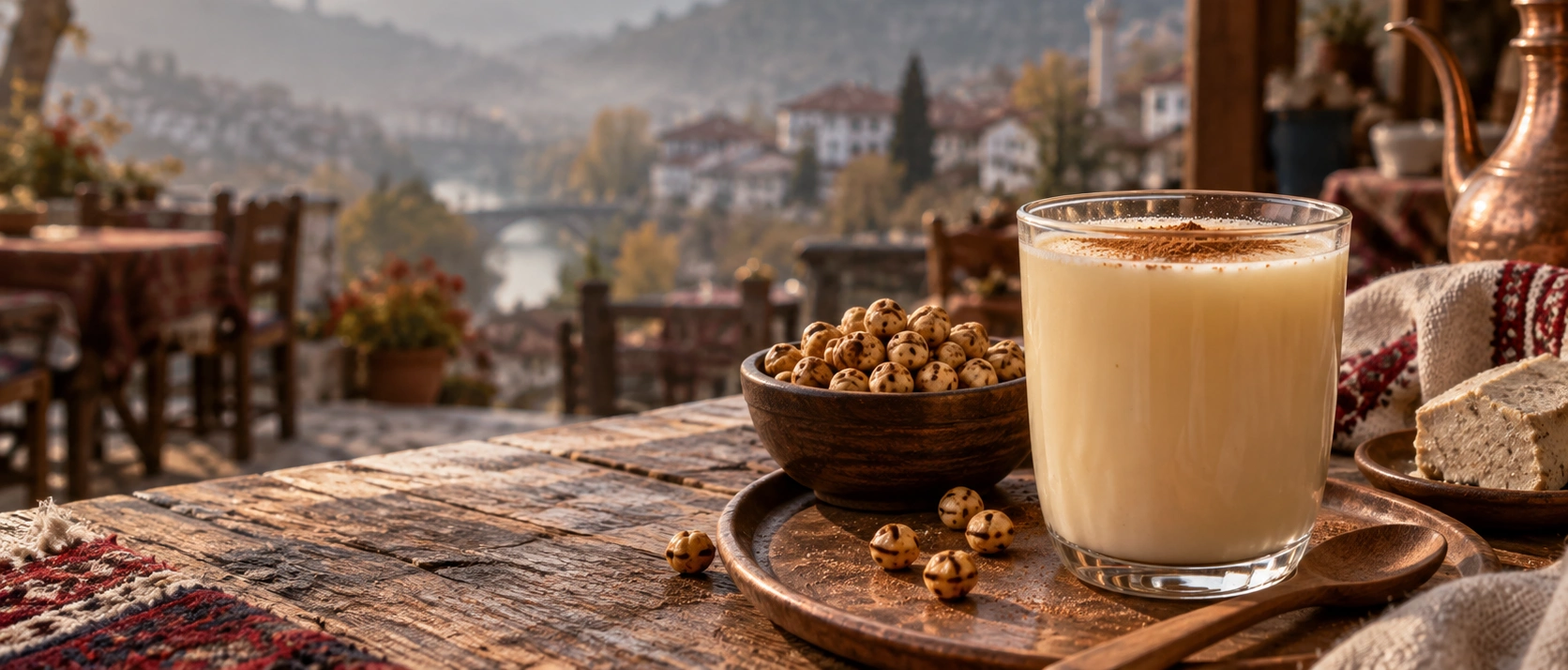
The drink is especially associated with the colder months. Local tourism sources traditionally mark the beginning of boza season around late September, when cooler evenings return to Pazaryeri. It is commonly served with cinnamon and roasted chickpeas, and in Pazaryeri it is also famously paired with the district’s traditional halva.
In 2026 Pazaryeri Boza received official geographical-indication protection in Türkiye as a Mahreç İşareti. Registration number 1891 protects a product whose identity is closely connected with production inside Pazaryeri district.
This complete guide explores Pazaryeri Boza’s local history, geographical indication, ingredients, corn-flour base, natural fermentation, production method, flavour, texture, traditional serving style, storage, seasonal culture, buying tips, photography ideas and places to visit around Pazaryeri.
Pazaryeri Bozası became a registered geographical indication in 2026.
The registered local style uses corn flour as the grain base of the drink.
No separate yeast is added in the registered method; fermentation develops naturally.
Boza season is traditionally associated with the return of cooler weather in late September.
Essential information about one of Bilecik Province’s most distinctive fermented drinks.
Pazaryeri, Bilecik, Türkiye.
Open Pazaryeri on Google MapsTraditional fermented grain beverage.
Corn flour.
Mahreç İşareti registration number 1891.
A local fermented drink shaped by Balkan migration, family producers, winter culture and generations of craftsmanship.
Boza has a much wider history across Anatolia, the Balkans and neighbouring regions, but Pazaryeri developed its own recognised local tradition. In Bilecik, the drink became closely associated with the district’s cold-weather food culture and with family producers who continued the craft across generations.
Local histories connect some of Pazaryeri’s established boza-making families with migration from the Balkans during the early twentieth century. Producer traditions recorded in tourism sources reach back to the 1920s and 1930s, helping establish Pazaryeri as one of Bilecik’s best-known centres for the drink.
The district gradually became known for a memorable seasonal pairing: boza in winter and halva as a companion sweet. The rich, dense character of Pazaryeri Halva contrasts naturally with the cool, tangy and creamy profile of the fermented drink.
Unlike an instant beverage, traditional boza depends on time. Grain must be cooked thoroughly, the mixture cooled to the proper range, strained to produce a smooth consistency and then allowed to ferment under controlled conditions.
Craftsmanship remains important because fermentation is a living process. Temperature, hygiene, ingredient balance, sugar level, acidity and final consistency all influence the quality of the finished boza.
In 2026, Pazaryeri’s connection with this drink received formal recognition when Pazaryeri Bozası was registered as a geographical indication in Türkiye.
The protected drink is defined by its corn-flour base, creamy homogeneous structure, gentle acidity and carefully controlled natural fermentation.
The registered Pazaryeri style is prepared primarily from corn flour.
The drink is thick and smooth while remaining fluid enough to drink.
No separate yeast addition is used in the registered method.
Temperature is carefully controlled so the characteristic acidity develops correctly.
The colour may vary naturally from pale yellow to soft golden tones.
The classic serving style brings fragrance and crunch to the creamy drink.
Pazaryeri Bozası is officially registered in Türkiye as a geographical indication. The registration protects the name, local production method, physical and chemical characteristics and the product’s connection with Pazaryeri district.
The official protected name is Pazaryeri Bozası.
The geographical-indication registration number is 1891.
The product was registered on 24 August 2026.
The application was filed on 19 November 2024.
The official application number is C2024/000327.
It is protected as a Mahreç İşareti.
The registration holder is the Bilecik Commodity Exchange (Bilecik Ticaret Borsası).
The protected geographical boundary is Pazaryeri district in Bilecik Province.
The registered specification requires the production stages connected with the protected product to take place within Pazaryeri district, reinforcing the drink’s link with local knowledge, producers and the district’s longstanding boza culture.
Pazaryeri Boza is a thick fermented grain drink made by cooking corn flour with water, cooling and straining the mixture, adding sugar and allowing controlled natural fermentation to develop its characteristic acidity, aroma and texture.
Boza is found in different forms throughout Türkiye and the Balkans. What distinguishes the registered Pazaryeri version is its specified corn-flour base, natural fermentation without separately added yeast, controlled acidity and close geographical link with Pazaryeri.
Corn flour provides the cereal foundation and body of the registered drink.
Lactic acid and alcoholic fermentation develop naturally during the controlled resting stage.
Granulated sugar balances the gentle acidity created by fermentation.
Pazaryeri Boza is creamy and dense while retaining a smooth flowing consistency.
Local culture strongly associates the drink with autumn and winter.
The finished drink is chilled after production and commonly served cool with cinnamon and roasted chickpeas.
Boza can be made from different grains depending on region and producer. The protected Pazaryeri specification narrows that broad tradition into a clearly defined local product.
The protected formulation is based on corn flour rather than a mixed-grain recipe.
Fermentation develops from the natural microflora present in the ingredients and production environment.
The finished drink is expected to fall within a pH range of approximately 4.0–4.5.
The protected style should be creamy, homogeneous, dense and still drinkable.
The geographical indication ties production directly to Pazaryeri district.
The drink remains closely connected with the district’s cold-season culinary identity.
The registered production specification provides a reference formulation for approximately 10–11 litres of Pazaryeri Boza. Exact commercial batches may be scaled, but the relationship between grain, water, sugar and controlled fermentation remains central.
Corn flour forms the principal grain base of the registered drink.
Water is used across the boiling and straining stages to cook and adjust the mixture.
Granulated sugar balances flavour and supplies fermentable carbohydrate.
The registered serving guidance includes approximately 30 g of cinnamon for the reference batch.
Approximately 150 g of roasted chickpeas is listed for serving the reference batch.
The characteristic aroma develops from the ingredients and production process rather than added flavouring.
The registered definition of Pazaryeri Boza is specifically corn-flour based. During boiling, the grain’s starch absorbs water, swells and gelatinises, creating the foundation for the creamy final consistency.
Corn flour supplies the starch that thickens the drink during the long boiling stage.
Stirring helps prevent lumps and promotes a smooth, even cooked mixture.
As the mixture cooks, starch granules absorb water and form the characteristic thick base.
The finished boza retains a soft grain aroma beneath its sweetness and acidity.
Correct cooking is essential because fermentation cannot compensate for an improperly prepared grain base.
The quality of the final drink depends as much on process control as on the ingredient list itself.
The registered production method follows a carefully controlled sequence in which cooking, cooling, straining, sweetening, fermentation, pasteurisation and storage each contribute to the final character.
The boiling stage transforms simple corn flour and water into the smooth base needed for successful Pazaryeri Boza. If the grain is undercooked or allowed to form persistent lumps, later stages cannot easily correct the texture.
The first cooking stage uses water at approximately six times the weight of the corn flour.
The registered reference method uses roughly this quantity during the main boiling stage.
Boiling time may vary with equipment capacity but can last approximately one to two hours.
Constant movement prevents clumping and supports a homogeneous cereal base.
Heat causes the corn starch to absorb water, swell and become fully cooked.
The registered boiling stage does not rely on aroma additives to define the drink.
After boiling, the thick grain mixture must be brought down to a temperature suitable for fermentation and then strained to remove coarse particles and establish the drink’s smooth consistency.
The hot mixture is transferred into broad vessels to help heat escape more efficiently.
This range prepares the mixture for the controlled fermentation stage.
Cooling time can vary significantly with room temperature and equipment capacity.
Straining removes larger particles and helps create a uniform, creamy drink.
The registered reference method uses additional water during straining to adjust consistency.
Clean cooling vessels, sieves and mixing equipment are essential before fermentation begins.
Fermentation creates the drink’s characteristic gentle acidity, aroma and complexity. In the registered method, no separate yeast is added. Instead, fermentation develops naturally through microorganisms originating from the raw materials and production environment.
The registered method allows the sweetened mixture to ferment for about one day.
This temperature range supports the intended fermentation profile.
Lactic acid bacteria contribute the gentle sourness associated with the finished drink.
A small amount of ethanol develops naturally as part of the fermentation process.
The registered specification uses this acidity range as part of the finished product profile.
The local registered process depends on naturally developing microflora rather than a dedicated yeast addition.
The geographical-indication specification provides measurable characteristics that help define the protected product and support quality control.
The total dry-matter content reflects the drink’s substantial, creamy body.
Sugar provides sweetness and contributes to the fermentation process.
The acidity range gives Pazaryeri Boza its characteristic gently tangy profile.
The registered acidity range is expressed as grams of lactic acid per 100 g.
A small amount of ethyl alcohol develops naturally during fermentation.
The specification includes this analytical value as part of the product profile.
These values describe the protected product specification and should not be substituted for the nutritional or laboratory declaration printed by an individual commercial producer.
Once fermentation reaches the intended acidity, the registered method applies a controlled pasteurisation stage to improve microbiological stability and extend the drink’s usable shelf life.
The registered process heats the fermented boza to approximately eighty degrees Celsius.
The specification gives a pasteurisation duration of approximately twenty minutes.
After pasteurisation, the drink is cooled quickly before packaging and storage.
The finished boza is filled into hygienic containers suitable for food storage.
Packaging practices aim to reduce unnecessary oxygen remaining inside the container.
Once chilled, the drink develops the refreshing thick texture associated with classic boza service.
Pazaryeri Boza combines a naturally cereal-like aroma with noticeable sweetness and gentle fermentation acidity. Its texture is one of its defining qualities: much thicker than milk, yet still fluid enough to sip from a glass.
Lactic fermentation produces a mild tang that keeps the drink from tasting simply sugary.
Granulated sugar rounds the acidity and gives the drink its familiar comforting character.
Cooked corn starch and careful straining create a smooth, substantial body.
The flavour retains a gentle cereal note beneath the fermentation profile.
The appearance can range from pale yellow to softly golden.
A dusting of cinnamon adds warm spice to the cool fermented drink.
Traditional boza service is simple. The drink itself remains the focus, while cinnamon, roasted chickpeas and local halva create contrasting aromas and textures.
Boza is generally enjoyed chilled or cool rather than hot.
A light layer of ground cinnamon adds fragrance without masking the fermented flavour.
Leblebi provides a crunchy contrast to the thick creamy drink.
Taste a spoonful or sip before adding toppings so you can recognise the base flavour.
The district’s famous tahini halva is one of the most characteristic local accompaniments.
Its dense consistency makes boza closer to a substantial snack-drink than an ordinary refreshment.
The registered specification classifies Pazaryeri Boza within the non-alcoholic beverages product group under the applicable Turkish food rules, but fermentation naturally creates a very small amount of ethyl alcohol.
This is the registered range for naturally occurring ethyl alcohol in the finished drink.
The small amount develops naturally through the fermentation process.
Boza is a fermented grain beverage, not a spirit or distilled alcoholic drink.
Anyone avoiding alcohol completely should consult the producer’s current product information.
Fermentation conditions influence the exact chemistry of each commercial batch.
Producers using the protected name are expected to comply with the official product specification.
Because boza is a fermented food, storage conditions are important. Always follow the producer’s package instructions first, especially after opening.
The registered specification states that sealed product can retain freshness for approximately three months when stored at or below 15°C.
Opened boza should be kept in the refrigerator at approximately +4°C.
The registered guidance recommends finishing an opened container within three days.
Reseal the package carefully to protect flavour and hygiene.
Do not leave boza for prolonged periods in a hot vehicle or direct sun.
Commercial storage instructions and best-before dates should always take priority.
The registered core formulation is based on corn flour, water and sugar, but travellers with food allergies, coeliac disease or strict dietary requirements should always confirm the exact commercial product and the producer’s processing environment.
The protected grain base is corn flour rather than wheat flour.
Dairy ingredients are not part of the registered core formulation.
Egg is not part of the registered core formulation.
The registered formula uses corn flour, water and granulated sugar; strict vegan visitors should still check commercial processing details.
Shared equipment may matter for people with serious allergies or medically required gluten avoidance.
Anyone with a medical condition requiring dietary restrictions should use the producer’s current label rather than general descriptions.
The easiest way to seek the protected regional product is to ask specifically for Pazaryeri Bozası and check the producer’s geographical-indication information and storage guidance.
Pazaryeri Boza is strongly associated with autumn and winter. Local tourism sources traditionally describe the season beginning around late September, when cooler weather returns to Bilecik.
The return of cool weather traditionally marks the beginning of the local boza season.
Cool evenings make autumn an excellent time to combine boza with countryside travel around Pazaryeri.
This is the season most strongly associated with boza drinking in local culture.
Packaged products may still be available depending on producer schedules and storage.
Availability can be more limited, and careful cold storage becomes especially important.
If boza is the main reason for your visit, check current production and shop opening times in advance.
Autumn and winter provide the most traditional setting for a Pazaryeri boza tasting.
Use “Pazaryeri Bozası” when looking for the protected local product.
A light dusting of cinnamon is one of the classic ways to enjoy the drink.
Leblebi brings texture and is one of boza’s most familiar companions.
The district’s protected tahini halva creates a distinctly local food combination.
Good boza should have gentle fermentation acidity rather than tasting like a plain sweet cereal drink.
If taking boza home, follow the storage temperature printed on the package.
Combine your tasting with Kınık pottery, forest scenery and Pazaryeri’s peaceful reservoir landscapes.
Bilecik’s cuisine reflects the province’s location between Marmara, Central Anatolia and western Türkiye. Village agriculture, cereal products, fruit, sweets and preserved foods all contribute to a culinary landscape that changes noticeably from district to district.
Pazaryeri Boza represents the fermented-beverage side of this heritage. Its identity sits naturally beside other Pazaryeri traditions, especially tahini halva, pottery-making villages and the district’s agricultural products.
A geographically indicated fermented corn-based drink associated especially with colder weather.
A protected tahini sweet that is traditionally enjoyed alongside local boza.
A regional savoury speciality showing another side of Bilecik’s grain-based culinary traditions.
A distinctive local agricultural product linked with village cultivation and Bilecik food culture.
A fruit-based local sweet reflecting the province’s tradition of preserving seasonal produce.
Bilecik’s rural districts preserve recipes and production techniques closely connected with local ingredients.
A boza tasting can easily become part of a wider Pazaryeri countryside journey through pottery villages, forest roads, reservoirs and neighbouring highland landscapes.
Discover the protected tahini sweet traditionally paired with local boza.
Explore one of Pazaryeri’s most distinctive craft traditions and its longstanding relationship with pottery.
Continue into Pazaryeri’s wooded countryside for a peaceful reservoir surrounded by forest scenery.
Combine a food stop with one of the district’s attractive reservoir landscapes.
Extend the journey into the highland landscapes around neighbouring Bozüyük.
Explore another peaceful upland landscape within a wider southern Bilecik nature route.
It is a traditional fermented grain drink from Pazaryeri in Bilecik Province, made in its registered form primarily from corn flour, water and sugar.
Its protected geographical home is Pazaryeri district in Bilecik Province, Türkiye.
Yes. It is officially registered in Türkiye as a geographical indication.
The geographical-indication registration number is 1891.
It was registered on 24 August 2026.
The official geographical-indication application number is C2024/000327.
The application was filed on 19 November 2024.
It is registered as a Mahreç İşareti.
The registration holder is the Bilecik Commodity Exchange (Bilecik Ticaret Borsası).
The protected geographical boundary is Pazaryeri district in Bilecik Province.
The registered product is based on corn flour.
The protected core formulation uses corn flour, water and granulated sugar.
Cinnamon is mainly used for serving rather than as the defining base ingredient of the drink.
Roasted chickpeas provide a crunchy savoury contrast to the drink’s thick, sweet-tangy texture.
Yes. Both lactic acid fermentation and alcoholic fermentation occur during production.
No separate yeast is added in the registered production method; fermentation develops naturally.
The registered process uses approximately 24 hours of fermentation.
The registered fermentation range is approximately 16–25°C.
The registered finished-product range is approximately pH 4.0–4.5.
Fermentation naturally creates a small amount of ethyl alcohol. The registered range is approximately 0.5–1.23 g/L.
The official product group is non-alcoholic beverages under the applicable Turkish food rules, although natural fermentation creates a small measurable amount of ethanol.
Its colour can range from pale yellow to light golden tones.
It should be creamy, homogeneous and dense while remaining fluid enough to drink.
It combines cereal sweetness with gentle fermentation acidity and a creamy mouthfeel.
Depending on equipment, the registered method allows approximately one to two hours of boiling.
Straining removes larger particles and helps create the smooth homogeneous texture associated with the drink.
Yes. The registered process includes pasteurisation after fermentation.
The specification gives approximately 80°C for 20 minutes.
The registered guidance states that sealed product may retain freshness for about three months when stored at or below 15°C.
Opened boza should be refrigerated at approximately +4°C.
The registered guidance recommends consuming it within about three days after opening.
Local tourism sources traditionally associate the start of the season with the cooler weather arriving around late September.
Yes. It is especially associated with autumn and winter, although packaged availability can vary by producer.
Cinnamon and roasted chickpeas are classic accompaniments.
Pazaryeri’s geographically indicated tahini halva is a particularly traditional local pairing.
Milk is not part of the registered core formulation.
Egg is not part of the registered core formulation.
The registered base uses corn flour. People with coeliac disease or serious allergies should still confirm cross-contact with the individual producer.
The registered core ingredients are plant-based, but strict vegan visitors should confirm each producer’s processing and serving practices.
Yes, if it is properly packaged and kept within the producer’s required storage temperature during transport.
Kınık Pottery Village, Bozcaarmut Pond and Günyurdu Pond are excellent additions to a Pazaryeri food and countryside itinerary.
Yes. It combines naturally with Pazaryeri Halva, Bozüyük regional dishes, Osmaneli fruit products and wider Bilecik cultural visits.
The strongest photographs show why boza is different from an ordinary drink: its creamy thickness, pale golden colour, cinnamon topping, roasted chickpeas and connection with cold-weather food culture.
Use side light to reveal the thick creamy texture and soft golden colour.
Photograph the moment cinnamon falls over the surface for a dynamic food image.
Place roasted chickpeas beside the glass to show the traditional pairing.
Photograph both local specialities together to tell a stronger Pazaryeri food story.
A slow pour clearly communicates the drink’s dense consistency.
Cool-weather scenes, shop windows and evening light help place the drink in its traditional seasonal context.
Combine Pazaryeri Boza, traditional halva, village craftsmanship, Ottoman heritage, local cuisine and peaceful countryside on a private journey designed around your interests.
Custom-designed private journeys with flexible timing, private transportation and opportunities to discover Pazaryeri Boza, Pazaryeri Halva, Kınık pottery, Bilecik’s historical towns, regional foods, forest scenery, lakes and rural landscapes.
Discover Pazaryeri Boza together with local halva, the pottery traditions of Kınık Village, peaceful countryside scenery and selected regional food experiences on a flexible private route.
Request This Tour
Build a private Bilecik journey combining Pazaryeri Boza and Halva with Söğüt’s early Ottoman heritage, Bilecik monuments, Osmaneli traditions and the province’s beautiful rural landscapes.
Request This Tour