Private Bilecik Gastronomy Discovery
Explore Bilecik’s local dishes, geographically indicated products, traditional sweets and agricultural heritage on a flexible private food-focused route.
Request This Tour





Bilecik Quail Kebab, known locally as Bilecik Bıldırcın Kebabı, is one of the most distinctive meat dishes associated with the traditional cuisine of Bilecik Province in northwestern Türkiye. Prepared from whole quail together with vegetables, butter, tomato and pepper pastes, garlic and aromatic spices, the dish combines slow preparation with a final oven-baking stage that brings the ingredients together.
Unlike many dishes carrying the word “kebab,” Bilecik Quail Kebab is not primarily cooked on a skewer or open charcoal grill. The registered preparation involves first gently cooking the quail, coating it with a concentrated tomato-and-pepper sauce, preparing vegetables separately and then finishing everything together in an oven dish or traditional casserole.
The dish also reflects an older relationship between Bilecik’s cuisine and game-related food traditions. Historical records referenced in the geographical-indication registration note that quail production was carried out by the state in Bilecik’s former Fidanlık area during the Republican period until 1980, after which private-sector production continued.
Recognition of the dish reached an important milestone in 2025, when Bilecik Bıldırcın Kebabı was officially registered as a Turkish geographical indication. Its registration recognises both the established culinary reputation of the dish and the preparation knowledge connecting it specifically with Bilecik.
This complete guide explores the history of Bilecik Quail Kebab, its geographical-indication status, ingredients, preparation stages, sauce, vegetables, cooking technique, flavour and texture, serving tradition, culinary importance, visitor tips, regional food culture and other Bilecik specialities worth discovering.
Bilecik Bıldırcın Kebabı has been registered as a Turkish geographical indication since January 2025.
The traditional preparation uses whole quail rather than minced or diced meat.
The quail and vegetables are prepared before being brought together for the final oven cooking.
The dish reflects the long-standing place of game-related foods and quail production in the province’s food culture.
Essential information about one of Bilecik Province’s protected regional dishes.
Bilecik Province, northwestern Türkiye.
Open Bilecik on Google MapsWhole fresh quail cooked with vegetables, butter, sauce and spices.
Bilecik Bıldırcın Kebabı – geographical indication registration no. 1690.
Pre-cooked quail and vegetables finished together in a casserole or oven dish.
How quail became part of Bilecik’s culinary identity and one of the province’s recognised regional dishes.
Bilecik’s cuisine developed within a landscape of agricultural villages, forested countryside, migration routes and long-established rural communities. Meat dishes, cereals, vegetables, seasonal produce and foods associated with hunting traditions all became part of this regional culinary environment.
Quail occupies a particularly interesting position within that story. The official geographical-indication registration for Bilecik Bıldırcın Kebabı notes the importance of hunting and game-related products in Bilecik’s culinary culture.
During the Republican period, quail production also developed locally. Government-run quail breeding took place in an area of Bilecik traditionally known as the Fidanlık, close to the station area, until 1980. Private producers subsequently continued quail production.
Over time, local preparation methods transformed the small bird into a substantial cooked dish. Instead of simply roasting the meat, cooks developed a layered method involving initial cooking, a concentrated tomato-and-pepper sauce, vegetables, butter and a final oven stage.
This preparation became recognised as part of the culinary identity of the province. Its reputation and connection with local food tradition ultimately led to formal geographical-indication protection in 2025.
Bilecik Bıldırcın Kebabı is a regional dish prepared from fresh whole quail that is first cooked, coated with a seasoned tomato-and-pepper paste sauce and then baked together with vegetables in a casserole or oven dish.
The bird remains whole during the principal preparation and oven-cooking stages.
Butter enriches the base of the baking dish and contributes richness to the finished meal.
A concentrated paste-based sauce coats the quail before the final oven stage.
Potatoes, aubergine, peppers, tomato, onion and garlic accompany the meat.
Black pepper and thyme form part of the registered preparation, with chilli flakes and cumin optional.
The ingredients are brought together and baked until the vegetables develop colour and the flavours combine.
The traditional identity of Bilecik Quail Kebab was formally recognised when Bilecik Bıldırcın Kebabı received Turkish geographical-indication registration in January 2025.
The protected specification connects the dish with Bilecik’s established culinary tradition and requires its registered production stages to take place within the defined geographical boundary.
For visitors, geographical-indication status provides valuable context. It means that Bilecik Quail Kebab is not merely a restaurant name or a modern interpretation using quail, but a formally documented regional preparation with an established recipe and cooking method.
The dish belongs to a province where game-related foods and quail production have an established historical connection.
Using whole quail creates a visually distinctive presentation unlike ordinary diced-meat kebabs.
The meat, sauce and vegetables are prepared in stages rather than simply being placed raw into an oven.
Tomato paste, pepper paste, black pepper and thyme create a concentrated coating around the bird.
Aubergine, potatoes, peppers, onion, garlic and tomato make the dish a complete savoury plate.
The 2025 geographical indication provides an official reference point for ingredients and preparation.
The geographical-indication specification provides a detailed ingredient list for a traditional preparation. Exact quantities can vary with portion size, but the defining ingredients reveal the balance between quail, vegetables, butter, concentrated tomato flavours and aromatic seasoning.
Fresh whole quail forms the centrepiece of the dish and provides its characteristic meat flavour.
Cubed aubergine absorbs the cooking juices and adds a soft, savoury vegetable element.
Potatoes provide substance and balance the concentrated sauce surrounding the quail.
Sivri peppers and kapya pepper contribute colour, sweetness and vegetal aroma.
These aromatic ingredients deepen the savoury character of the cooking liquid and vegetables.
Fresh tomato brings moisture, acidity and another layer of flavour to the oven-baked vegetables.
The oven dish is coated with butter, giving the finished meal additional richness.
Tomato paste forms one half of the thick sauce used to coat the cooked quail.
Biber salçası adds depth, colour and a distinctly Turkish savoury character.
Black pepper seasons the sauce and complements the relatively delicate quail meat.
Thyme introduces a herbal note that works particularly well with poultry and oven-cooked vegetables.
Red chilli flakes and cumin can be added according to the registered preparation.
One of the most interesting aspects of Bilecik Quail Kebab is its staged preparation. The quail is not simply roasted together with raw vegetables. Instead, each component receives preliminary preparation before everything is assembled for the final oven cooking.
The sauce plays a defining role in the registered version of Bilecik Quail Kebab. It is intentionally thick rather than watery, allowing it to cling closely to the surface of the bird during the final oven cooking.
Provides concentrated tomato flavour, natural sweetness and deep red colour.
Adds another layer of savoury depth characteristic of many Turkish regional dishes.
Gives gentle warmth without overwhelming the flavour of the quail.
Brings a familiar Anatolian herbal aroma to the poultry.
The sauce is prepared with a paste-like texture so that it remains on the meat.
The final baking stage concentrates the coating and blends it with the butter and vegetable juices.
Traditional preparation begins with properly cleaned whole quail. Historically documented versions of the Bilecik recipe describe the birds being cleaned, singed and washed before cooking.
In the registered production method, the prepared quail is placed in approximately 400 ml of water and cooked briefly. After this first stage, the meat is allowed to cool before being completely covered with the tomato-and-pepper sauce.
Keeping the quail whole preserves the dish’s traditional appearance and presentation.
Brief preliminary cooking ensures that the small bird begins cooking evenly before baking.
A short cooling stage makes it easier to coat the surface with the thick sauce.
The quail is coated on all sides so the seasoning remains closely connected with the meat.
The flavourful liquid from the initial cooking stage is retained for the vegetables and final baking.
Because quail is relatively small, the oven stage must finish the dish without unnecessarily drying the meat.
The vegetables are not merely decorative garnishes. They form an important part of the registered preparation and absorb the butter, sauce and savoury cooking juices surrounding the quail.
Cut into substantial cubes, aubergine develops a soft texture that readily absorbs the surrounding flavours.
Potatoes provide a mild, filling element that balances the more intense sauce.
Red kapya pepper brings sweetness, colour and a soft texture after oven cooking.
Green Turkish peppers add a fresher vegetable aroma and slight savoury sharpness.
Fresh tomato contributes moisture and acidity as the vegetables bake.
These ingredients create the aromatic foundation that connects the vegetables with the meat.
The final stage transforms individually prepared ingredients into one unified dish. A casserole or oven dish is first coated with butter, after which the sauce-covered quail and prepared vegetables are arranged together.
Butter prevents sticking while enriching the juices collecting at the bottom of the dish.
The sauce-coated whole birds are positioned as the principal element of the presentation.
The partially cooked vegetables are distributed around the quail.
Fresh onion rings are spread over the assembled ingredients before baking.
The retained quail broth adds moisture and helps prevent the dish from becoming dry.
The registered method describes approximately 25 minutes of baking, until the vegetables develop colour.
Quail has a distinctive but relatively delicate poultry flavour. In Bilecik Quail Kebab, this character is reinforced rather than hidden by butter, concentrated tomato and pepper pastes, thyme, black pepper, roasted vegetables and savoury cooking juices.
The combination of poultry, butter, garlic, onion and concentrated pastes creates a deeply savoury profile.
Tomato paste and fresh tomato provide both sweetness and gentle acidity.
Pepper paste and oven-cooked peppers give the dish a warm Anatolian flavour.
Thyme adds a fragrant herbal character that complements the quail.
Butter enriches both the meat and the juices absorbed by the vegetables.
Red chilli flakes may introduce gentle heat depending on the cook’s interpretation.
The initial cooking followed by oven finishing aims to produce meat that remains tender while fully cooked.
The thick tomato-and-pepper coating adheres to the exterior of the bird.
Aubergine absorbs the cooking juices and develops a yielding texture.
Potatoes become soft inside while their surfaces can develop additional colour during baking.
The peppers soften and become sweeter during the final oven stage.
Butter, broth, vegetable juices and sauce combine at the bottom of the dish.
Travellers sometimes associate the word kebab exclusively with meat cooked over charcoal or rotating on a vertical spit. Turkish cuisine, however, uses the term for a much broader family of meat preparations.
Regional kebabs may be grilled, baked, cooked in clay vessels, combined with vegetables or prepared using techniques unique to a particular town or province. Bilecik Quail Kebab belongs to this broader culinary tradition.
The defining preparation is based on an oven dish or casserole rather than skewered meat.
The principal ingredient is a whole small bird rather than minced meat.
Its identity comes from the combination of ingredients, preparation technique and association with Bilecik.
The dish incorporates several vegetables as integral components rather than side garnishes.
Bilecik lies at a geographical crossroads between the Marmara, Central Anatolian and Aegean spheres. Its food culture reflects rural agriculture, migration, Ottoman-era settlement history and village cooking traditions.
Within this broader environment, quail provides a reminder of an older culinary world in which small game birds and countryside food resources played a more visible role than they do in many modern urban kitchens.
Traditional cuisine developed alongside farming, livestock keeping, orchards, forests and village life.
Official registration records note the importance of hunting-related products within Bilecik’s culinary culture.
Bilecik also has a documented history of organised quail production during the Republican period.
The casserole-style method reflects a practical approach to preparing meat and vegetables together.
The long-standing association between the dish and Bilecik ultimately supported geographical-indication registration.
The protected recipe gives restaurants and local cooks a reference point for preserving the dish’s identity.
The history behind Bilecik Quail Kebab becomes especially interesting when viewed alongside documented quail production in the province.
According to the official geographical-indication registration, quail breeding was undertaken by the Ministry of Agriculture and Rural Affairs at a site in Bilecik’s station district traditionally called the Fidanlık. State-operated production continued there until 1980.
Quail production later continued through private enterprise. This connection between local production and local cuisine adds another dimension to the story of the dish.
Organised quail breeding formed part of Bilecik’s twentieth-century agricultural story.
The historical production site was associated with Bilecik’s station area.
The geographical-indication registration records state-run quail breeding continuing until that year.
Production subsequently continued through private-sector activity.
Restaurants may prepare quail in many different ways, including grilling, frying, stuffing or roasting. Those dishes may be delicious, but they should not automatically be confused with the geographically indicated Bilecik preparation.
Whole quail, sauce, vegetables, butter and a final casserole or oven-baking stage define the registered preparation.
Quail cooked simply over charcoal represents a different preparation method.
Rice-filled or fruit-filled quail belongs to another family of recipes.
Deep-fried or pan-fried versions differ significantly from the Bilecik geographical-indication method.
The tomato-and-pepper paste coating is an important identifying feature of the Bilecik version.
Aubergine, potatoes, peppers, onion, tomato and garlic form part of the complete regional preparation.
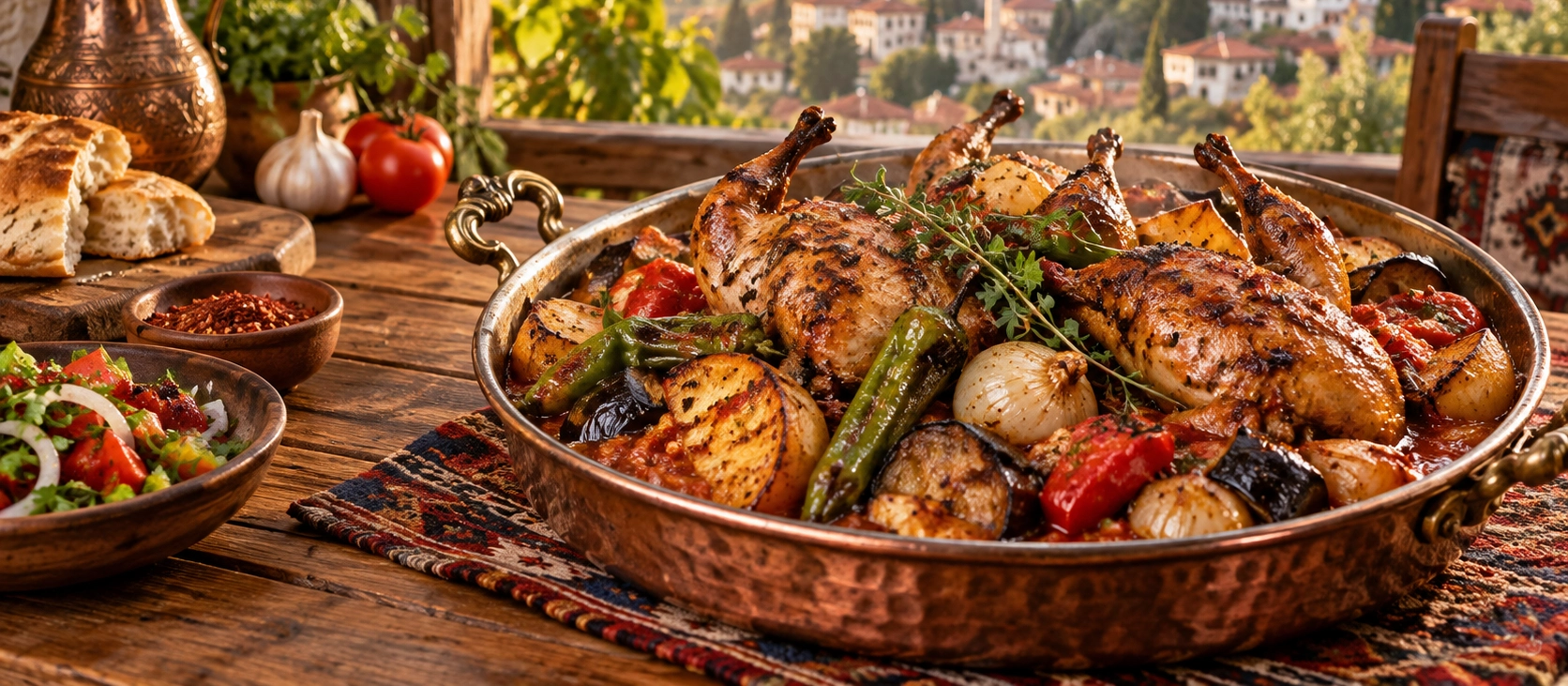
Bilecik Quail Kebab is intended to be served hot. Traditional descriptions mention arranging the finished quail and vegetables carefully on a copper plate, giving the small whole bird a visually distinctive presentation.
The dish is at its best while the butter, sauce and cooking juices remain warm.
The quail is generally presented whole rather than carved before reaching the table.
Potatoes, aubergine, peppers, onion and tomato frame the meat and form part of the main serving.
Regional recipe descriptions specifically mention careful presentation on a copper serving plate.
A little of the buttery tomato-rich liquid from the baking dish adds moisture and flavour.
The colourful presentation makes the dish particularly attractive as part of a broader regional Turkish meal.
Visitors trying whole quail for the first time should remember that it is a small bird containing proportionally small bones. Eating it is therefore different from eating a boneless chicken fillet or ordinary kebab pieces.
A quail is considerably smaller than a chicken, so portions and individual pieces of meat are naturally compact.
Eat carefully because the legs, wings, ribs and other bones are correspondingly small.
The meat has more character than very mild poultry while remaining delicate enough to pair with vegetables.
The visual appearance may be unfamiliar to travellers accustomed only to boneless meat dishes.
Try each bite together with some of the sauce or vegetables to experience the complete dish.
When dining locally, ask whether the restaurant follows the traditional Bilecik-style recipe.
Bilecik Quail Kebab is a regional speciality rather than a dish that should be assumed to appear on every restaurant menu. Availability can vary, and some establishments may prepare it only when quail is available or when ordered in advance.
Traditional Turkish restaurants and businesses specialising in Bilecik cuisine are the best places to begin asking.
Because quail may not be prepared every day, contacting a restaurant in advance can save time.
Using the Turkish name makes it easier to distinguish the dish from generic roasted or grilled quail.
Businesses serving the registered product may display the protected name and geographical-indication emblem.
A properly prepared version involves several cooking stages and may not be an instant dish.
Use the meal as part of a wider exploration of the province’s sweets, fruit products and traditional dishes.
If trying this dish is an important part of your trip, confirm availability with the restaurant before arriving.
Not every quail dish is Bilecik Bıldırcın Kebabı, so ask how the restaurant prepares it.
The butter-based sauce and vegetables are most enjoyable directly after cooking.
Whole quail contains many delicate bones, so eat slowly and carefully.
The whole quail surrounded by colourful vegetables makes one of Bilecik’s most visually distinctive food photographs.
Build a broader gastronomic route rather than stopping with a single speciality.
Speaking with restaurant staff can reveal differences in spice balance, vegetable selection and presentation.
Traditional dishes are often best enjoyed as part of a relaxed regional lunch rather than a rushed roadside stop.
Photograph the entire serving so the relationship between quail and vegetables is clearly visible.
A slightly raised angle usually captures both the whole bird and the surrounding vegetables effectively.
If served on copper, include enough of the plate to communicate the traditional presentation.
Show the glossy tomato-and-pepper coating across the surface of the quail.
Red pepper, green pepper, tomato and aubergine create strong natural contrast around the meat.
Photograph soon after serving while the dish still looks hot, moist and freshly cooked.
Bilecik Quail Kebab makes more sense when experienced as part of the province’s broader food culture. Bilecik combines meat dishes with grain-based foods, orchard produce, locally recognised agricultural products and handmade sweets.
A traditional fermented grain drink that reflects another side of Bilecik’s food heritage.
A characteristic local sweet associated with the Pazaryeri district.
A regional dough-and-lentil dish representing Bilecik’s hearty home-cooking tradition.
A celebrated agricultural product from the warmer valleys of southern Bilecik.
Quince cultivation and quince-based products connect gastronomy with Bilecik’s orchard landscape.
Another local agricultural speciality demonstrating the diversity of the province’s food production.
Discover the remarkable hop-growing landscape of Pazaryeri and one of Bilecik’s most unusual agricultural products.
Explore a traditional fermented grain drink closely associated with the district’s food culture.
Add a traditional local sweet to your Bilecik gastronomy itinerary.
Discover another savoury Bilecik speciality built around dough, lentils and home-style cooking.
Continue your journey through the distinctive agricultural products of Bilecik Province.
Explore the famous pomegranate-growing landscape of the Middle Sakarya Valley.
Taste how a celebrated local fruit is transformed into a colourful regional sweet.
Add another fruit-based Bilecik speciality to a province-wide food journey.
Explore the archaeological and cultural history of the province before or after discovering its cuisine.
Visit one of Bilecik’s important historical landmarks as part of a city-centre route.
Add a peaceful waterside and nature stop to your gastronomic day in Bilecik.
Continue toward Söğüt for a deeper introduction to the region’s early Ottoman history.
Combine food culture with twentieth-century history on a wider Bilecik and Bozüyük journey.
Ask us to combine local cuisine, historical sites, villages and countryside into a private itinerary.
Bilecik Quail Kebab is a traditional dish made from whole quail that is cooked, coated with a tomato-and-pepper paste sauce and finished in the oven with vegetables, butter and spices.
It is called Bilecik Bıldırcın Kebabı.
Yes. Bilecik Bıldırcın Kebabı was officially registered as a Turkish geographical indication on 21 January 2025.
The registration number is 1690.
It is registered as a mahreç işareti.
The geographical indication was registered by the Bilecik Chamber of Commerce and Industry.
The geographical boundary is Bilecik Province.
The registered method is primarily an oven-finished preparation. The quail is initially cooked, coated with sauce and then baked together with vegetables.
Yes. The registered preparation uses whole quail.
The registered version includes aubergine, potatoes, green peppers, red kapya pepper, tomato, onion and garlic.
A thick sauce based on tomato paste and pepper paste is seasoned with black pepper and thyme before being spread over the quail.
It does not have to be very spicy. Black pepper and thyme are standard components, while red chilli flakes and cumin are optional in the registered recipe.
Yes. Butter is used in the oven dish and contributes richness to the finished meal.
The cleaned quail is briefly cooked in water, allowed to cool and then completely coated with the prepared sauce.
Yes. Because quail cooks relatively quickly, the registered method gives the vegetables preliminary cooking before the final oven stage.
The geographical-indication specification describes baking the assembled dish at approximately 180°C.
The registered method describes approximately 25 minutes, or until the vegetables develop colour.
It is served hot, and traditional descriptions mention careful presentation on a copper plate.
Quail has a distinctive but relatively delicate poultry flavour. In this dish it is combined with butter, tomato and pepper pastes, vegetables and herbs.
Yes. Quail is a small bird and therefore contains many small bones. Diners should eat whole quail carefully.
Bilecik’s culinary culture has historical links with game-related foods, and official records also document organised quail production in the province during the Republican period.
Yes. The geographical-indication registration records state-operated quail breeding in Bilecik’s former Fidanlık area until 1980, followed by private-sector production.
No. It is a regional speciality and availability may vary, so checking with restaurants in advance is recommended.
If tasting the traditional dish is important to your visit, advance confirmation is useful because quail may not be prepared every day.
No. Generic grilled quail is a different preparation. The protected Bilecik dish uses its own sauce, vegetable combination and oven-cooking method.
You can continue with Pazaryeri Boza, Pazaryeri Halva, Bozüyük Lentil Ravioli and other regional agricultural products.
The province has distinctive products including Bilecik Hops, İnhisar Pomegranate, Çukurören Pepper, quince and other local produce.
Yes. It can be combined with Bilecik’s traditional sweets, agricultural products, markets, villages and historical attractions to create a broader regional food journey.
Yes. Its regional cuisine, geographically indicated products, agricultural landscapes and relatively little-known local dishes make Bilecik interesting for travellers looking beyond Türkiye’s most familiar culinary destinations.
The strongest images should show that this is more than simply roasted poultry. Include the whole bird, colourful vegetables, rich sauce and traditional serving details so viewers immediately understand the character of the Bilecik preparation.
Place the entire whole quail at the centre with aubergine, potatoes and peppers clearly visible around it.
Use soft directional light to reveal the gloss of the tomato-and-pepper coating.
A traditional copper plate instantly adds regional and culinary atmosphere.
Show the casserole emerging hot from the oven to communicate the cooking method.
Photograph peppers, aubergine, tomato, potatoes, garlic and herbs beside the prepared quail.
Include rustic bread, textiles or subtle regional table elements without distracting from the dish itself.
Combine Bilecik’s traditional cuisine with Ottoman heritage, village culture, local agricultural products and peaceful countryside on a private journey designed around your interests.
Custom-designed private journeys with flexible timing, private transportation and opportunities to explore regional food traditions, historical sites, agricultural landscapes and lesser-known corners of Bilecik Province.
Explore Bilecik’s local dishes, geographically indicated products, traditional sweets and agricultural heritage on a flexible private food-focused route.
Request This Tour
Combine Bilecik city, Söğüt, Bozüyük, Pazaryeri, Osmaneli or İnhisar on a private route linking history, local cuisine, landscapes and village culture.
Request This Tour