Private Bilecik Gastronomy Discovery
Explore Bilecik's regional sweets, savoury dishes, traditional restaurants, agricultural products and culinary heritage on a flexible private food-focused route.
Request This Tour





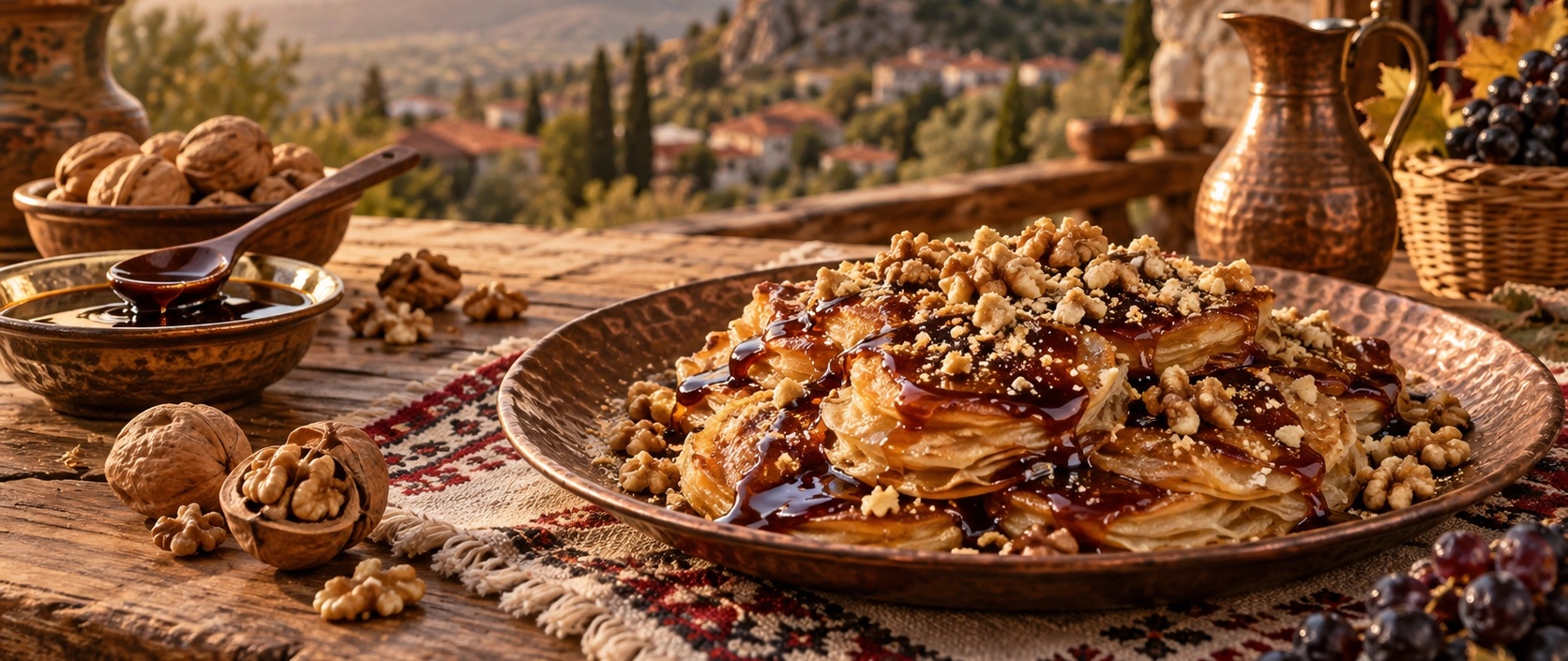
Linga Dessert is a traditional sweet associated with Bilecik Province, particularly with the province's village and household food culture.
Its basic idea is beautifully simple: a thin, pourable batter is cooked in small rounds or flat pieces, traditionally on a sac, stove or pan, and then combined with molasses and nuts.
Türkiye's Culture Portal records a version prepared with yoghurt, soda, flour and baking powder. The cooked pieces may be layered with walnuts, hazelnuts or poppy seeds, while grape or beet molasses can be poured over them.
A separate geographical-indication application filed in 2024 documents another Bilecik preparation: a thin milk-and-flour batter, optionally enriched with egg, cooked in small pieces, soaked in diluted grape molasses and served with walnuts.
Bilecik Governorship's field research brought renewed attention to Linga in 2020, recording memories of the dessert from local residents and connecting it especially with the culinary tradition of Söğüt.
What makes Linga memorable is not elaborate technique but the way modest pantry ingredients become a deeply local dessert through molasses, nuts and simple griddle cooking.
Linga belongs to the documented regional dessert tradition of Bilecik.
Grape or beet molasses gives the dessert its characteristic deep sweetness.
Walnuts are one of the best-known local accompaniments, alongside hazelnuts or poppy seeds in some versions.
The batter is traditionally cooked on a sac, kuzine stove surface or pan rather than baked like a cake.
Essential information about one of Bilecik's traditional molasses-based sweets.
Bilecik Province, northwestern Türkiye, with strong associations with Söğüt.
Open Bilecik on Google MapsA thin, pourable flour batter cooked in small rounds or flat pieces.
Molasses, especially grape or beet molasses depending on the household recipe.
Walnuts are strongly associated with Linga; hazelnuts or poppy seeds also appear in documented variations.
A modest household sweet preserved through memory, field research and renewed interest in Bilecik cuisine.
Linga Dessert belongs to the traditional food culture of Bilecik, where simple ingredients such as flour, molasses and nuts were historically transformed into economical but satisfying sweets.
In 2020, Bilecik Governorship publicised field research that had recorded Linga as a regional dessert known in some villages but in danger of fading from wider memory.
The research included the recollections of a resident of Bozüyük who explained that she had learned the dessert from her mother-in-law from Söğüt. Her account connected Linga with earlier household life, when families relied on ingredients already available at home.
Molasses played a particularly important role because it offered sweetness without requiring refined sugar. Walnuts, flour and other basic pantry ingredients made the dessert practical, economical and easy to prepare.
The Culture Portal later documented Linga within Bilecik's traditional cuisine, preserving a household-style version based on yoghurt, soda, flour, baking powder and optional nuts or poppy seeds.
In 2024, a geographical-indication application for Bilecik Linga Tatlısı was filed as a mahreç işareti application. That document describes another local standard based on a very thin batter, grape-molasses syrup and walnuts.
Together, these records show Linga not as a rigidly uniform modern pastry but as a living regional dessert with related household traditions and more than one documented method.
Linga Dessert is a traditional Bilecik sweet made from a pourable flour batter cooked on a hot surface and finished with molasses and, commonly, walnuts.
Depending on the local or household method, the batter may be prepared with yoghurt and soda or with milk and baking powder. Some versions include egg, while others remain extremely simple.
The cooked pieces may be layered and topped with molasses, or they may be briefly soaked in diluted grape molasses before serving.
The mixture is much looser than bread dough and is designed to spread quickly on a hot cooking surface.
Linga is traditionally cooked on a sac or stove surface and can also be prepared in a pan.
The dessert is sweetened with pekmez rather than relying only on refined sugar.
Walnuts give the soft dessert a contrasting crunch and a strong Bilecik identity.
Documented methods include both layered versions and pieces rested in molasses syrup.
The dessert reflects practical village cooking based on familiar household ingredients.
Pekmez provides a dark, fruity sweetness that immediately separates Linga from many sugar-syrup pastries.
The geographical-indication application highlights the thin, fluid batter as an important distinguishing feature.
The batter is cooked on a sac, kuzine or pan rather than shaped into a conventional baked pastry.
Walnuts, and in some traditions hazelnuts or poppy seeds, add flavour and texture.
Linga survives through family knowledge, village traditions and documentation projects.
The traditional idea turns basic ingredients into a satisfying sweet without complicated equipment.
Visitors researching Linga may encounter recipes that look slightly different. This is not unusual for traditional household food. Two official or institutional records currently preserve related but distinct methods.
Uses yoghurt, soda, flour and baking powder, with optional walnut, hazelnut or poppy seed and optional molasses.
Uses flour, milk and baking powder with optional egg, then finishes the cooked pieces in grape-molasses syrup with walnuts.
Both traditions depend on a relatively fluid mixture rather than a kneaded bread-like dough.
The batter is cooked directly on a hot surface, producing thin pieces with lightly browned faces.
Molasses remains one of the dessert's most recognisable flavour markers.
Walnuts are especially important in Bilecik descriptions, with other toppings appearing in household variants.
Linga's ingredient list is intentionally modest. Its identity comes from the balance between the thin cooked batter, the dark sweetness of molasses and the texture of nuts or seeds.
Provides the structure for the thin batter that forms each Linga piece.
Different documented methods use yoghurt or milk as the principal dairy component.
Leavening helps keep the cooked batter light rather than dense.
Grape or beet molasses may be used, while the GI application specifically focuses on grape molasses.
Crushed walnuts are one of the most characteristic accompaniments.
Hazelnuts, poppy seeds or egg appear in some documented versions.
Türkiye's Culture Portal lists the following ingredients for its documented Bilecik version.
The key is consistency: the mixture should remain fluid enough to spread, but slightly thicker than ayran.
The geographical-indication application filed in 2024 documents a more standardised four-portion version producing approximately 20 small pieces.
This application describes a diluted grape-molasses syrup so the cooked pieces can absorb the sweetness more easily.
The Culture Portal method follows a simple sequence of mixing, pan or sac cooking, cooling, layering and sweetening.
The geographical-indication application records a small, thin format designed to absorb grape-molasses syrup.
Pekmez is one of the ingredients that gives Linga its unmistakably Anatolian character.
The 2024 application specifically uses grape molasses and dilutes it with water before soaking the cooked batter.
The Culture Portal notes that beet molasses can also be poured over the traditional layered version.
Molasses adds caramel-like, fruity and slightly earthy notes rather than a one-dimensional sugar sweetness.
Molasses historically offered households a durable sweetener made from locally available agricultural products.
A thinner syrup can penetrate the small cooked pieces rather than remaining only on the surface.
The dark sweetness of pekmez balances naturally with the nutty richness of crushed walnuts.
Walnuts are one of the most frequently documented companions to Linga and play an important role in the dessert's texture.
Crushed walnuts provide crunch and a slightly bitter nutty note that balances the molasses.
The Culture Portal lists hazelnuts as an optional alternative in some household preparations.
Poppy seeds may also be scattered between layers, adding fine crunch and a distinctive aroma.
In the layered version, nuts or seeds can be placed between several cooked batter pieces.
In the molasses-soaked version, walnuts are used as a finishing garnish.
Bilecik Governorship specifically highlighted walnuts and molasses when presenting Linga as a local heritage food.
Linga belongs to a wider Anatolian tradition of cooking thin batters and doughs directly on heated surfaces.
The Culture Portal records the sac as one of the traditional surfaces for cooking Linga.
Regional accounts connect winter Linga preparation with the hot surface of wood-burning kitchen stoves.
A broad frying pan provides an accessible modern alternative for home cooks.
The batter should spread into relatively thin pieces so they cook quickly and absorb molasses easily.
Each piece is turned so both faces are cooked and lightly browned.
The dessert reflects household cooking that required little more than a bowl, hot surface and basic pantry ingredients.
Linga offers a very different sweetness from baklava or syrup-soaked semolina desserts. Its flavour is driven by pekmez, lightly browned batter and nuts.
The dominant sweetness is dark, fruity and slightly earthy.
Walnuts bring richness and a gentle bitterness that keeps the dessert balanced.
Cooking the batter directly on a hot surface creates subtle browned flavours.
The dessert retains the rustic character of traditional village sweets.
Yoghurt or milk gives the batter a gentle background richness depending on the recipe.
The combination of warm batter, molasses and walnuts creates a deeply familiar home-style flavour profile.
The pieces should remain relatively thin rather than becoming thick, bread-like pancakes.
When properly cooked, the interior stays tender enough to absorb molasses.
The hot sac or pan creates a delicate cooked skin on both sides.
Pekmez softens the cooked pieces and carries sweetness into the batter.
Crushed nuts add the main contrasting texture.
When stacked, several soft pieces create a multi-layered bite with nuts between them.
The 2024 geographical-indication application describes Bilecik Linga as a winter dessert traditionally prepared when household kitchen stoves were already kept hot through the colder months.
The constantly heated stove provided a practical surface for cooking thin batter pieces.
Pekmez made from the harvest could remain available as a winter sweetener.
Dried walnuts were another pantry ingredient well suited to colder-season cooking.
The simple batter and hot-surface technique made the dessert practical for household use.
Flour, molasses and walnuts create a substantial sweet from compact ingredients.
Linga preserves the connection between food, household heating and winter pantry traditions.
Several documented accounts connect Linga particularly strongly with Söğüt, one of Bilecik's most historically significant districts.
The Bilecik Governorship's 2020 field-research account records a local cook who learned the dessert from her Söğüt-born mother-in-law, while the 2024 geographical-indication application identifies Söğüt as the place where the dessert is considered to have first been produced.
The recipe survived through family teaching rather than formal cookbooks alone.
Institutional sources repeatedly associate the dessert with Söğüt's local food memory.
Linga was known in rural communities where basic pantry ingredients shaped everyday sweets.
Modern documentation aims to prevent local recipes from disappearing as food habits change.
A Linga tasting can complement a visit to Söğüt's early Ottoman heritage sites.
Söğüt, Bilecik city and nearby districts can be combined into a broader heritage-and-gastronomy journey.
Linga stands apart because its identity depends on thin hot-surface cooking and molasses rather than pastry layering, oven baking or refined-sugar syrup.
Unlike baklava, Linga does not depend on paper-thin yufka sheets and buttered pastry layers.
The dessert is cooked in separate thin pieces rather than baked as a single cake.
Molasses creates a deeper and more agricultural flavour than clear sugar syrup.
Its cooking method is closer to griddle foods than to conventional oven pastries.
Walnuts add crunch without requiring a complex nut-filled pastry structure.
The dessert's strongest meaning comes from its local history and continued connection with regional households.
Linga expresses an important side of Anatolian home cooking: the ability to create something celebratory from ingredients already present in the pantry.
The Bilecik Governorship's field research emphasised that the dessert was remembered as economical and practical, using ingredients such as flour, molasses and walnuts at a time when ready-made sweets were less common.
Linga was passed between generations through direct household teaching.
Flour, molasses and walnuts linked the dessert to agricultural life and local pantry traditions.
The dessert demonstrates how simple ingredients can create a satisfying sweet without expensive additions.
Documentation protects food knowledge that might otherwise disappear with changing lifestyles.
Recent cultural projects have helped bring Linga back into public discussion.
Linga sits alongside regional meat dishes, mantı, boza, pastries, fruit products and other local sweets.
Pour pekmez over the pieces or briefly soak them in diluted grape molasses depending on the version.
Finish with crushed walnuts for aroma and crunch.
The Culture Portal version can be stacked in several layers with nuts or seeds between them.
The GI application describes small pieces that can be portioned easily after molasses soaking.
The dessert is especially expressive when the cooked batter is still tender and the molasses aromatic.
A glass of Turkish tea makes a natural accompaniment to the sweet molasses-and-walnut profile.
Black tea cuts through the sweetness of pekmez and complements toasted walnuts.
A small unsweetened coffee provides a strong contrast to the dessert's molasses richness.
Milk offers a soft, neutral pairing for a simple home-style presentation.
Plain water lets the flavour of grape or beet molasses remain the main focus.
Pazaryeri boza can create a fully regional tasting, though both items have substantial flavour and texture.
Small portions of Linga, Cevizli Büzme and Pazaryeri halva can introduce several Bilecik sweet traditions together.
Linga remains a regional home-style speciality, so travellers should not expect every restaurant or café in Bilecik to serve it every day. Local-food events, traditional restaurants, guesthouses and advance arrangements are often the best ways to look for it.
Use the Turkish regional name when asking local restaurants, hotels or guides.
Söğüt has a particularly strong documented connection with the dessert.
Restaurants presenting regional dishes are more likely to recognise Linga.
A traditional preparation should make molasses one of the central flavours.
Local cultural and food events may feature regional sweets that are not always on restaurant menus.
For a private group, advance notice may make it easier to organise a traditional preparation.
Linga is valued for local character, not elaborate pastry-shop decoration.
Grape or beet pekmez should provide the dessert's deepest sweetness.
The batter should cook into relatively thin layers or small rounds rather than a thick pancake.
Walnuts provide one of the most strongly documented Bilecik combinations.
Household versions may differ in dairy, toppings, layering and molasses technique.
Pair the dessert with a visit to Söğüt's Ottoman heritage sites for a richer local story.
Continue with Cevizli Büzme, Pazaryeri halva, quince delight and pomegranate-based products.
Local tourism professionals may know which kitchens are currently preparing Linga.
Capture dark pekmez flowing over the freshly cooked Linga pieces.
Show crushed walnuts scattered across the glossy molasses-coated surface.
Photograph the batter as it sets and browns on a traditional hot surface.
Stack several thin cooked pieces with walnut filling visible between the layers.
Use a simple regional table setting with walnuts, molasses and tea nearby.
Frame flour, yoghurt or milk, walnuts and a bowl of pekmez before preparation begins.
Bilecik's food culture combines Ottoman-era landscapes, village agriculture, meat dishes, handmade dough foods, fermented drinks, sweets and district-specific produce.
Linga adds a distinctive molasses-based sweet tradition to that wider table and offers travellers a flavour that is very different from Türkiye's better-known pastry-shop desserts.
A syrupy walnut pastry representing a richer and more layered Bilecik dessert tradition.
A traditional sweet associated with Pazaryeri and another expression of regional confectionery.
A fermented grain drink that adds a completely different texture and flavour to a Bilecik tasting.
A characteristic agricultural product from southern Bilecik.
One of the fruit traditions that contributes to the province's broader culinary identity.
A savoury chicken-and-rice tray dish that can precede Linga in a regional meal.
Compare Linga with Bilecik's syrupy walnut-filled pastry tradition.
Discover another traditional Bilecik sweet from the Pazaryeri district.
Continue with a fermented grain drink strongly associated with Bilecik's local food culture.
Explore a modern sweet built around one of İnhisar's best-known agricultural products.
Continue your sweet journey with quince-based flavours from Osmaneli.
Add one of Bilecik's distinctive local agricultural products to your regional food research.
Try a savoury Bilecik chicken-and-rice dish before finishing with Linga.
Continue with another filling regional dish built around rice and meat.
Explore one of Söğüt's most important Ottoman heritage sites in the district most strongly linked with Linga.
Continue through the historical landscapes surrounding Söğüt.
Discover another layer of Söğüt's later Ottoman history and civic architecture.
Learn more about the province's archaeological and cultural story.
Combine gastronomy with one of Bilecik's important historical landmarks.
Add a peaceful countryside stop to a food-and-heritage itinerary.
Ask us to combine Söğüt, Bilecik cuisine, Ottoman heritage and countryside into a private itinerary.
Linga is a traditional Bilecik sweet made from thin cooked batter and commonly finished with molasses and walnuts.
It is associated with Bilecik Province, with particularly strong documented connections to Söğüt.
The batter is cooked on a hot sac, kuzine stove surface or pan, usually on both sides.
It can visually resemble a small thin pancake, but its traditional identity, molasses treatment and regional preparation make it a distinct Bilecik dessert.
Molasses is central. The Culture Portal allows grape or beet molasses, while the 2024 geographical-indication application specifically uses grape molasses.
Yes. Walnuts are one of the best-known traditional accompaniments and feature prominently in Bilecik documentation.
Yes. The Culture Portal lists walnuts, hazelnuts or poppy seeds as optional additions.
One official Culture Portal method uses yoghurt, while another documented Bilecik application recipe uses milk instead.
Not always. The 2024 geographical-indication application lists egg as optional.
Traditional documented versions are cooked on a sac, stove surface or pan rather than baked as a conventional cake or pastry.
The fluid batter spreads quickly into thin pieces, helping them cook fast and absorb molasses effectively.
In the 2024 application method, the cooked pieces are rested in diluted grape-molasses syrup. The Culture Portal version can instead be layered and topped with molasses.
The geographical-indication application describes it as a traditional winter dessert connected with household kuzine stove cooking.
A geographical-indication application for Bilecik Linga Tatlısı was filed in 2024. Visitors should check the current Türk Patent registry for the latest application or registration status.
Bilecik Governorship publicised field research about the dessert in 2020 as part of work documenting the province's cultural heritage.
No. It is a traditional home-style sweet and may require advance enquiry or a visit to a regional food event.
Turkish tea or unsweetened Turkish coffee pairs especially well with the sweetness of molasses.
Continue with Cevizli Büzme, Pazaryeri Halva, İnhisar Pomegranate Delight and Osmaneli Quince Delight.
Yes. It works especially well in a route combining Söğüt, Bilecik city, regional foods, Ottoman heritage and village landscapes.
The strongest visual sequence should show the transformation from a very simple batter into a glossy, molasses-rich regional dessert.
Arrange flour, yoghurt or milk, walnuts and a small bowl of pekmez.
Show the thin texture falling from a ladle or spoon before cooking.
Capture several small rounds beginning to brown on the hot surface.
Photograph the moment one piece is flipped to reveal its browned underside.
Show the cooked pieces absorbing dark grape-molasses syrup.
End with a close-up of crushed walnuts falling over the finished dessert.
Combine Bilecik's traditional cuisine with Ottoman heritage, village culture, local agricultural products and peaceful countryside on a private journey designed around your interests.
Custom-designed private journeys with flexible timing, private transportation and opportunities to explore regional food traditions, historical sites, agricultural landscapes and lesser-known corners of Bilecik Province.
Explore Bilecik's regional sweets, savoury dishes, traditional restaurants, agricultural products and culinary heritage on a flexible private food-focused route.
Request This Tour
Combine Söğüt, Bilecik city and surrounding districts on a private route linking Ottoman history, local cuisine, molasses traditions, landscapes and village culture.
Request This Tour