Private Sultanahmet Historical Walking Tour
Ask us about a tailor-made private route through Sultanahmet's Byzantine and Ottoman monuments with pacing, museum choices and lunch stops adapted to you.
Request a Custom Tour





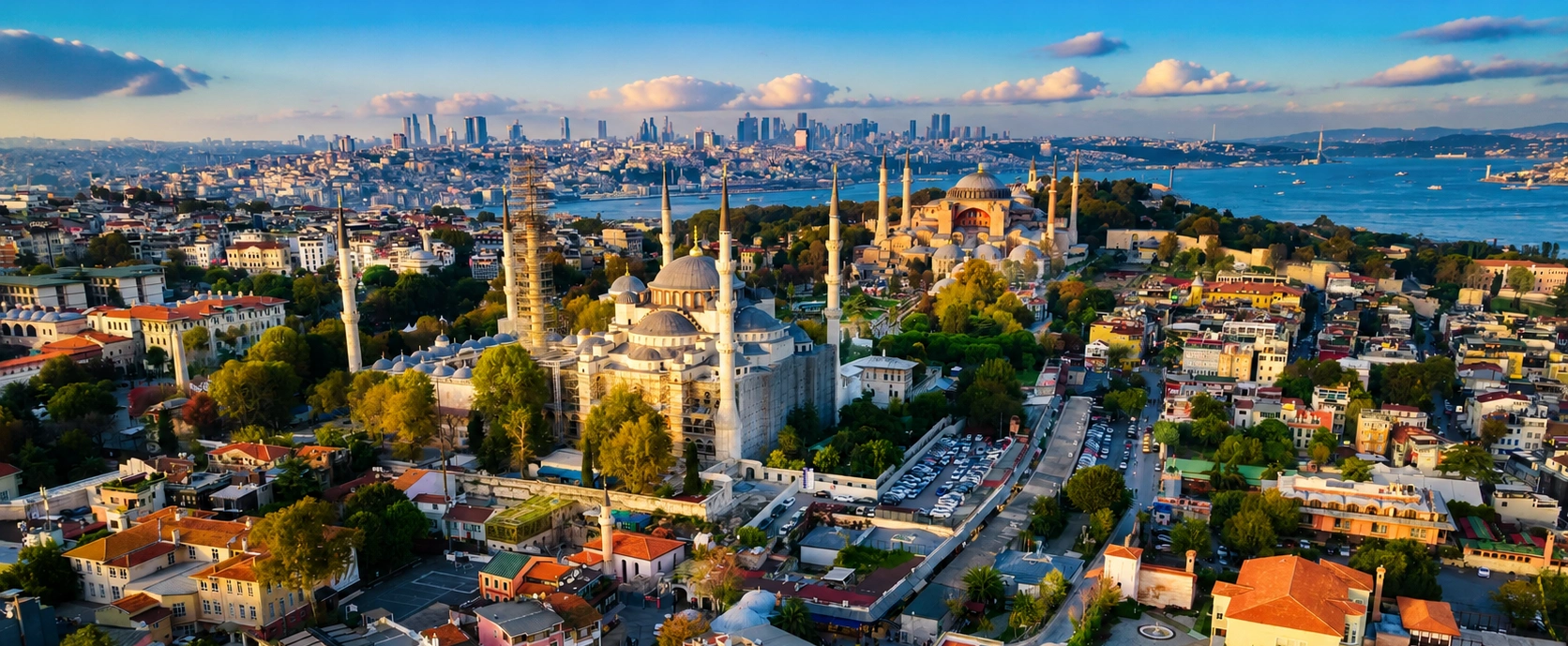
Sultanahmet is the district most visitors imagine when they first picture historic Istanbul. Located at the eastern end of the Historic Peninsula in Fatih, it contains an extraordinary concentration of monuments from the Roman, Byzantine and Ottoman periods.
Within a compact walking area, visitors can stand in the former Hippodrome of Constantinople, enter Hagia Sophia, admire the six minarets of the Blue Mosque, descend into the Basilica Cistern and continue into the courtyards of Topkapı Palace.
The area is also one of the principal components of the Historic Areas of Istanbul UNESCO World Heritage Site, inscribed in 1985. Its archaeological park preserves some of the most important surviving monuments of Constantinople together with later Ottoman masterpieces that transformed the same ceremonial landscape.
Sultanahmet is not a single attraction. It is a historic urban landscape where streets, squares, monuments, museums, gardens, fountains, archaeological remains, mosques and former imperial spaces overlap.
Allow at least half a day for the essential monuments. A full day is much better, and travelers interested in archaeology, architecture and museums can easily spend two days exploring the district and its immediate surroundings.
Sultanahmet forms the core archaeological landscape of the UNESCO-listed Historic Areas of Istanbul.
Experience monuments created when the city served first the Eastern Roman Empire and later the Ottoman Empire.
Hagia Sophia, the Blue Mosque, Hippodrome, Basilica Cistern, Topkapı Palace and major museums stand within a compact central zone.
Read the city through surviving monuments ranging from late antiquity to the final centuries of the Ottoman period.
Essential information about Istanbul's historic Sultanahmet district, its monuments, UNESCO status, walking distances and visitor experience.
Historic Peninsula, Fatih district, on the European side of Istanbul.
Ceremonial and political center of Byzantine Constantinople and later Ottoman Istanbul.
Part of the Historic Areas of Istanbul, inscribed on the UNESCO World Heritage List in 1985.
Sultanahmet Square largely follows the area of the ancient Hippodrome of Constantinople.
Hagia Sophia, Blue Mosque, Topkapı Palace, Basilica Cistern, Hagia Irene and the Hippodrome.
The T1 tram line provides the most convenient public-transport access for many visitors.
On foot, because the principal monuments are concentrated within a relatively compact historic zone.
One full day for the essentials; two days for museums, archaeology and a slower pace.
Few urban districts in the world contain so many monuments connected with two successive world empires within such a small area.
Sultanahmet matters first because it preserves the ceremonial center of Constantinople. The imperial palace, Hippodrome and Hagia Sophia formed the political, religious and public heart of the Byzantine capital. Although much of the Great Palace has disappeared below later streets and buildings, the organization of the district still reflects this imperial geography.
Its second importance comes from the Ottoman transformation of the same landscape. After the conquest of Constantinople in 1453, the Ottoman court established Topkapı Palace nearby, converted Hagia Sophia into an imperial mosque and later added major monuments including the Sultan Ahmed Mosque.
Sultanahmet is also exceptionally important for archaeology. Roman cisterns, ancient columns, palace mosaics, remnants of the Hippodrome and finds displayed in the Istanbul Archaeological Museums reveal layers that cannot always be seen at street level.
The district is therefore not simply a collection of famous buildings. It is a place where urban continuity can be studied: imperial spaces were reused, renamed, rebuilt and reinterpreted across centuries while the city around them continued to function.
For travelers, this concentration makes Sultanahmet one of the strongest introductions to Istanbul. A single walk can connect ancient Egypt, classical Greece, Roman engineering, Byzantine Christianity, Ottoman court culture and modern urban life.
The history of Sultanahmet reaches back far beyond the buildings visible today. The ancient settlement of Byzantion occupied the strategic peninsula overlooking the Bosphorus, the Golden Horn and the Sea of Marmara. Its position made the area valuable for trade, defense and imperial power.
The district changed dramatically after Emperor Constantine I refounded the city as his imperial capital in the 4th century. The city became Constantinople, and its ceremonial center developed around the Great Palace, Hippodrome and major churches.
In the 6th century, Emperor Justinian I reshaped the capital after the Nika Revolt. His rebuilding program produced monuments including the present Hagia Sophia, completed in 537, together with major works of infrastructure and religious architecture.
After the Ottoman conquest in 1453, the district remained central to imperial Istanbul. Hagia Sophia became a mosque, Topkapı Palace developed on the old acropolis area, and the surrounding streets filled with religious foundations, baths, fountains, schools, markets and administrative buildings.
The construction of the Sultan Ahmed Mosque between 1609 and 1617 gave the neighborhood its modern name, Sultanahmet. The mosque's domes and six minarets created one of Istanbul's defining silhouettes opposite Hagia Sophia.
In the modern era, archaeological excavation, conservation and museum development have revealed more of the district's buried past. Today Sultanahmet functions simultaneously as a living neighborhood, religious center, archaeological landscape and one of Türkiye's most visited cultural districts.
The strategic peninsula was occupied centuries before Constantinople became an imperial capital.
Constantine I refounded the city and expanded the imperial ceremonial center.
The present Hagia Sophia was completed under Emperor Justinian I.
The Ottoman conquest began a new imperial chapter for the district.
The Sultan Ahmed Mosque was built, eventually giving Sultanahmet its modern name.
The Historic Areas of Istanbul were inscribed on the UNESCO World Heritage List.
The easiest way to understand Sultanahmet is to imagine several historic cities occupying the same ground. The modern streets are only the latest surface of a much older landscape.
During the Byzantine period, the Great Palace of Constantinople extended across a large area between the Hippodrome, Hagia Sophia and the Sea of Marmara. Ceremonial routes linked the palace with the Hippodrome and the city's principal church.
Much of the palace disappeared, but fragments remain in archaeological sites and museums. The Great Palace Mosaic Museum preserves extraordinary mosaic pavements associated with the palace complex, while the Hippodrome's surviving monuments still mark the axis of the ancient racecourse.
The Ottoman city reused this geography rather than erasing it completely. Topkapı Palace rose nearby, Hagia Sophia remained a dominant religious monument and the Blue Mosque was constructed beside the Hippodrome, creating a new imperial ensemble layered over the Byzantine ceremonial center.
Modern Sultanahmet Square occupies much of the site of the ancient Hippodrome of Constantinople, once one of the most important public spaces in the Byzantine capital.
The Hippodrome was far more than a sports arena. It hosted chariot races, imperial ceremonies, celebrations, political demonstrations and public gatherings. The rival racing factions could become powerful social and political forces, and the Hippodrome played a major role during events such as the Nika Revolt of 532.
The ancient seating tiers and track have largely disappeared beneath the modern city, but the central barrier of the racecourse — the spina — is still suggested by the alignment of surviving monuments in today's square.
An ancient Egyptian obelisk brought to Constantinople and erected on the Hippodrome under Emperor Theodosius I in the late 4th century.
An ancient Greek victory monument originally dedicated at Delphi after the defeat of the Persian forces at Plataea in 479 BC.
A tall masonry monument at the southern end of the former Hippodrome whose present stone core reflects a much-altered medieval structure.
An ornate domed fountain associated with Kaiser Wilhelm II's visits to the Ottoman Empire and inaugurated at the beginning of the 20th century.
Walking along the square today is therefore a walk down the center of one of the most politically charged spaces in Byzantine Constantinople. The peaceful lawns conceal a place once filled with tens of thousands of spectators, imperial processions and intense public rivalry.
No visit to Sultanahmet is complete without Hagia Sophia. The present building was constructed between 532 and 537 under Emperor Justinian I after earlier churches on the site were destroyed.
Its enormous central dome, semi-domes, marble interiors and surviving mosaics made Hagia Sophia one of the most influential buildings in architectural history. For centuries it served as the principal cathedral of Constantinople and was closely connected with imperial ceremony.
After the Ottoman conquest in 1453, Hagia Sophia was converted into an imperial mosque. Minarets, calligraphic panels, a mihrab, minbar and other Ottoman additions became part of the building's long architectural story.
Because current visitor access, prayer arrangements, ticket rules and gallery circulation can change, consult the dedicated Hagia Sophia guide shortly before visiting.
Directly across the historic square from Hagia Sophia stands the Sultan Ahmed Mosque, better known internationally as the Blue Mosque.
Built between 1609 and 1617 for Sultan Ahmed I, the mosque was designed by Sedefkâr Mehmed Ağa, an architect associated with the tradition of Mimar Sinan. Its cascading domes and six minarets created one of the most recognizable compositions in Ottoman architecture.
The popular name “Blue Mosque” comes from the large number of İznik tiles decorating the interior. The building remains an active mosque, so visitor access is organized around daily prayer times.
The surrounding complex once included a wide range of charitable and educational buildings. The nearby tomb of Sultan Ahmed I also forms part of the historical ensemble.
A short walk northeast of Hagia Sophia leads into the monumental gate sequence of Topkapı Palace, the principal residence and administrative center of the Ottoman sultans for centuries.
Topkapı is best understood not as a single palace building but as a series of courtyards, pavilions, gates, gardens and specialized chambers occupying the ancient acropolis of the city.
Highlights include the Imperial Council chambers, palace kitchens, treasury collections, the Harem, ceremonial spaces and elevated terraces overlooking the Bosphorus and Sea of Marmara. A serious visit can easily require several hours.
Within the outer palace precinct stands Hagia Irene, one of the most important surviving Byzantine churches in Istanbul. Unlike Hagia Sophia, it was not converted into a mosque after the conquest and later served various military and museum functions.
Explore the political, ceremonial and domestic world of the Ottoman court through its layered courtyards and collections.
See one of the most significant Byzantine churches preserved within the former Ottoman palace grounds.
Only a few minutes from Hagia Sophia, the Basilica Cistern reveals a completely different side of Constantinople. Instead of domes and public squares, visitors descend into a vast underground water reservoir supported by hundreds of columns.
The cistern is traditionally associated with the building program of Emperor Justinian I in the 6th century. It helped supply water to the imperial center and demonstrates the enormous engineering systems required to support Constantinople's population and palaces.
The atmospheric interior is famous for its forest of columns, reflected water and two carved Medusa heads reused as column bases. These pieces are among the best-known examples of architectural spolia in Istanbul.
Sultanahmet contains several of Istanbul's most important museums, making the district much more than an outdoor monument zone. Travelers interested in archaeology, art and material culture should reserve additional time beyond the major mosque and palace visits.
A major museum complex with collections from Anatolia, Mesopotamia, the ancient Mediterranean and the Ottoman archaeological tradition.
Located beside the Hippodrome in the historic Ibrahim Pasha Palace, with carpets, manuscripts, woodwork, ceramics and Islamic decorative arts.
Preserves remarkable floor mosaics associated with the Byzantine Great Palace, including hunting, rural and mythological scenes.
The palace itself functions as a vast museum landscape containing imperial, ceremonial, religious and decorative collections.
The museums are particularly valuable because they restore context to the monuments outside. Objects recovered through excavation help visitors understand the civilizations that built, inhabited and transformed the Historic Peninsula.
One of Sultanahmet's greatest pleasures is discovering monuments that appear almost casually within the modern streets. Some predate Constantinople itself and were transported to the imperial capital as symbols of power and continuity.
Originally carved in ancient Egypt, the granite obelisk was later transported to Constantinople and erected in the Hippodrome.
A Greek victory monument from Delphi commemorating the coalition victory over Persia at the Battle of Plataea.
The masonry obelisk at the southern end of the Hippodrome preserves the core of a monument once covered with decorative material.
A surviving fragment associated with the monument from which road distances from Constantinople were traditionally measured.
These monuments remind visitors that the visible Ottoman city stands directly over the ceremonial center of the Roman and Byzantine capital. Even a short walk between major attractions can cross more than two thousand years of history.
At the northern end of Sultanahmet Square stands the elegant German Fountain, one of the district's most recognizable late Ottoman monuments.
The fountain commemorates the relationship between the Ottoman Empire and Germany during the reign of Sultan Abdülhamid II and is associated with the visits of German Emperor Wilhelm II. It was assembled in Istanbul and inaugurated in 1901.
Its octagonal form, domed canopy and gold mosaic decoration contrast sharply with the ancient monuments of the Hippodrome nearby. That contrast is part of what makes Sultanahmet so visually compelling: an Egyptian obelisk, a Greek victory monument, Byzantine architecture and a European imperial fountain all occupy the same public landscape.
Behind the Blue Mosque lies the Arasta Bazaar, a compact historic market street associated with the Sultan Ahmed Mosque complex. It is much smaller and easier to navigate than the Grand Bazaar, making it a pleasant stop between monuments.
Shops sell carpets, textiles, ceramics, souvenirs and decorative objects. As with any tourist market, compare quality and prices carefully and never feel pressured to make a purchase.
Nearby, the Great Palace Mosaic Museum preserves sections of an extraordinary Byzantine mosaic pavement uncovered in the area of the former Great Palace of Constantinople. The mosaics depict animals, hunters, rural scenes, mythological creatures and episodes of daily life.
Together, the bazaar and museum reveal Sultanahmet's layered character particularly well: Ottoman commercial architecture sits directly over one of the most important archaeological zones of the Byzantine palace district.
Most first-time visitors remain between Hagia Sophia, the Blue Mosque and Topkapı Palace. Walking south toward Küçük Ayasofya reveals a quieter side of the old city where neighborhood streets, smaller mosques and Byzantine monuments survive away from the busiest central square.
The former Church of Saints Sergius and Bacchus is an important 6th-century Byzantine building traditionally associated with the reign of Justinian.
A refined Ottoman mosque associated with Mimar Sinan and celebrated for its architecture and İznik tile decoration.
Walk through smaller lanes lined with hotels, houses, cafés, workshops and traces of the historic urban fabric.
Continue downhill for a sense of the peninsula's relationship with the ancient maritime approaches to Constantinople.
This extension is especially worthwhile for travelers who want to experience Sultanahmet as a neighborhood rather than only as a checklist of famous monuments.
One of the easiest extensions from Sultanahmet follows the historic urban axis west toward Çemberlitaş and Beyazıt. This route connects the imperial center with the commercial heart of the old city.
Begin near the Milion Stone, then continue along Divanyolu toward the Column of Constantine at Çemberlitaş. The surviving column recalls Constantine's transformation of the city into an imperial capital.
From Çemberlitaş, continue toward Nuruosmaniye Mosque and enter the Grand Bazaar through its eastern approaches. The walk is short, but historically it moves from the ceremonial center of empire toward one of Istanbul's great commercial districts.
The defining monument of Byzantine Constantinople and one of the most influential buildings in world architecture.
A 17th-century Ottoman imperial mosque famous for its six minarets, domes and İznik tile decoration.
Walk the ancient racecourse axis and see the Obelisk of Theodosius, Serpent Column and Walled Obelisk.
Explore the courtyards, ceremonial spaces and collections of the Ottoman imperial court.
Descend beneath the modern streets into one of Constantinople's most atmospheric surviving water reservoirs.
See exceptional collections that place Istanbul within the wider civilizations of Anatolia and the ancient Mediterranean.
Study carpets, manuscripts, woodwork and decorative arts in the historic Ibrahim Pasha Palace.
A major Byzantine church preserved inside the outer precinct of Topkapı Palace.
An elegant late Ottoman-era landmark decorated with a domed canopy and gold mosaics.
View surviving Byzantine palace mosaics beneath the later Ottoman urban landscape.
A small historic shopping street immediately behind the Blue Mosque.
Extend your walk south to one of the most important surviving Justinianic churches in the district.
Begin in Sultanahmet Square before the area becomes crowded. Walk the length of the Hippodrome and examine the German Fountain, Obelisk of Theodosius, Serpent Column and Walled Obelisk.
Continue to the Blue Mosque, then cross the landscaped square toward Hagia Sophia. The short distance between the two buildings creates one of Istanbul's most impressive architectural compositions.
From Hagia Sophia, visit the Basilica Cistern or continue through the Imperial Gate area toward Topkapı Palace and Hagia Irene.
Finish with the Istanbul Archaeological Museums or descend through Gülhane Park if you want a quieter end to the day.
Sultanahmet itself is a public historic district and can be walked at any time, but its individual monuments operate under different schedules and entrance systems.
The Hippodrome and Sultanahmet Square are open public spaces. Mosques such as the Blue Mosque remain active places of worship and may restrict tourist access during prayer periods.
Major attractions such as Topkapı Palace, Basilica Cistern and museum collections require separate admission. Opening days, ticket prices, temporary closures and special access rules can change, particularly during restoration projects, religious holidays and seasonal periods.
Security checks are common at major monuments. During peak months, queues can become substantial, so avoid planning several ticketed attractions too tightly together.
Sultanahmet Square and the Hippodrome monuments can be viewed without a district admission ticket.
Tourist access is organized around prayer and worship requirements.
Museums, palaces, cisterns and special galleries may each have independent admission rules.
Verify current opening hours and restoration closures on the official page of each attraction.
Morning is the best time to experience the main square before the largest tour groups arrive.
Remember that the Blue Mosque and other mosques remain active religious buildings.
Cobblestones, museum floors, courtyards and long standing periods make supportive footwear important.
Summer heat can be intense, especially when waiting outside ticketed monuments.
Topkapı Palace, Hagia Sophia and the Archaeological Museums each deserve more time than many first-time visitors expect.
Walk a few blocks away from the central square to discover quieter architecture and neighborhood life.
Check menus, prices and taxi procedures carefully in one of Istanbul's busiest visitor districts.
The illuminated silhouettes of Hagia Sophia and the Blue Mosque create a completely different atmosphere after dark.
Best for quieter streets, exterior photography and a more atmospheric walk through the Hippodrome.
Good for softer light on domes, minarets and the stone monuments of the square.
Excellent for illuminated views of Hagia Sophia and the Blue Mosque after many day visitors have left.
Mild temperatures make long walking days especially comfortable.
Often offers pleasant walking weather with less intense heat than midsummer.
Cold or wet weather is possible, but lower seasonal crowds can make major monuments more enjoyable.
Enough only for an exterior walk around Sultanahmet Square, the Hippodrome, Hagia Sophia and the Blue Mosque.
Suitable for the main square plus one or two major interiors such as Hagia Sophia and the Basilica Cistern.
The best minimum for a first visit including several major monuments and time for lunch.
Ideal for travelers who want Topkapı Palace, museums, cisterns and quieter side streets without rushing.
Excellent for architecture and archaeology enthusiasts combining Sultanahmet with the Grand Bazaar, Süleymaniye and nearby neighborhoods.
Even after a full sightseeing day, come back after dark for the illuminated skyline and quieter square.
Sultanahmet is one of Istanbul's richest areas for architectural photography because monuments from different centuries stand so close together. Wide views can include domes and minarets, while details range from ancient inscriptions to Ottoman tilework and Byzantine masonry.
For the classic composition between Hagia Sophia and the Blue Mosque, use the landscaped central area around Sultanahmet Square. Early morning gives cleaner views, while evening produces strong illuminated silhouettes.
The Hippodrome is best photographed by isolating individual monuments against the surrounding skyline. The Obelisk of Theodosius is especially interesting because its carved base preserves scenes of imperial ceremony.
Inside active religious buildings, always follow current photography restrictions and avoid photographing worshippers intrusively. Tripods and professional equipment may be restricted at museums and high-security sites.
Sultanahmet Square before the daytime crowds arrive.
Frame Hagia Sophia and the Blue Mosque from opposite sides of the central landscaped square.
Look for inscriptions, capitals, marble, tilework, fountain mosaics and reused ancient stone.
Return after sunset when the major monuments are illuminated.
The main Sultanahmet Square area is relatively compact, but the historic district contains uneven paving, curbs, slopes, security checkpoints and crowded pedestrian routes that can make movement slower for visitors with reduced mobility.
Individual monuments vary considerably. Modernized attractions may provide ramps, lifts or adapted routes, while historic mosques, palace sections and archaeological spaces can involve steps or surfaces that are difficult for wheelchairs.
Topkapı Palace is particularly extensive, so visitors with limited walking endurance should allow more time and prioritize the sections they most want to see.
For most visitors, the easiest public-transport connection is the T1 tram, which stops at Sultanahmet and connects the Historic Peninsula with areas including Eminönü, Karaköy and the wider tram network.
Visitors arriving by Marmaray can use Sirkeci as a useful connection point and continue toward Sultanahmet on foot or by tram. The walk from Sirkeci climbs gradually toward the historic core and passes close to Gülhane and the Topkapı Palace area.
From Eminönü, Sultanahmet can be reached by tram or on foot for travelers comfortable with uphill streets. From the Grand Bazaar, the walk east along Divanyolu is straightforward and passes Çemberlitaş and the Milion area.
Driving is generally less convenient because the Historic Peninsula has narrow streets, pedestrian zones, restricted access and limited parking. Taxis may also be slowed by traffic, especially during peak visitor hours.
Usually the simplest public-transport option for reaching the central Sultanahmet area.
Walk uphill through the historic peninsula or connect by tram.
Use the tram or walk uphill through the old city if you want to explore on foot.
Convenient for door-to-door travel, but traffic and restricted streets can reduce the advantage.
Start early in Sultanahmet Square and spend time with the Hippodrome monuments before the central area becomes crowded. Continue into the Blue Mosque, planning around prayer access.
Cross the square to Hagia Sophia, then continue to the Basilica Cistern for a complete contrast with the monumental architecture above ground.
After lunch, devote the largest block of time to Topkapı Palace. If energy and opening times allow, add Hagia Irene or the Istanbul Archaeological Museums.
Finish by walking downhill through Gülhane Park toward Sirkeci, or return to Sultanahmet Square after sunset to see the mosques illuminated.
Walk west through Çemberlitaş and Nuruosmaniye to one of the world's most famous historic covered markets.
A surviving monument associated with Constantine's refoundation of the city as an imperial capital.
A green route descending from the Topkapı Palace area toward Sirkeci and the old city walls near the waterfront.
A historic transport district connecting Sultanahmet with the waterfront, Marmaray and the Eminönü area.
Continue toward Eminönü for spices, sweets, tea, dried fruit and one of Istanbul's most atmospheric market districts.
Extend the walk northwest to Mimar Sinan's great imperial mosque overlooking the Golden Horn.
Sultanahmet is the historic district at the eastern end of Istanbul's Historic Peninsula, containing major Byzantine and Ottoman monuments including Hagia Sophia, the Blue Mosque, the Hippodrome and Topkapı Palace.
Sultanahmet is the best-known core of the old city, but the wider Historic Peninsula includes many additional districts such as Eminönü, Süleymaniye, Beyazıt, Fener, Balat and the areas stretching toward the land walls.
The district takes its modern name from the Sultan Ahmed Mosque, built for Sultan Ahmed I in the early 17th century and known internationally as the Blue Mosque.
Yes. Sultanahmet forms a major component of the Historic Areas of Istanbul, inscribed on the UNESCO World Heritage List in 1985.
The area formed the ceremonial heart of Constantinople, centered on the Hippodrome, Great Palace and Hagia Sophia.
The ancient seating and track are largely buried or lost, but the alignment of the racecourse survives in Sultanahmet Square together with monuments including the Obelisk of Theodosius, Serpent Column and Walled Obelisk.
Yes. The central square and surviving outdoor Hippodrome monuments can be explored as public space without a district entrance ticket.
Yes. Major ticketed sites such as Topkapı Palace, Basilica Cistern and museums operate independently and may have different admission rules.
Yes, but it is an active mosque. Tourist entry is organized around prayer times and visitors must follow current dress and behavior requirements.
A full day is a good minimum for first-time visitors. Two days are better if you want to explore Topkapı Palace, museums and smaller historic sites without rushing.
Yes, but you will need to be selective. Focus on Sultanahmet Square, the Blue Mosque, Hagia Sophia and perhaps one additional attraction such as the Basilica Cistern.
Early morning is usually best for quieter streets and exterior photography. Evening is excellent for illuminated views of Hagia Sophia and the Blue Mosque.
For many visitors, the T1 tram is the most convenient public-transport option. Sirkeci also provides useful connections through Marmaray and the wider transport network.
Yes. The major monuments are concentrated within a compact area, although historic paving, slopes and long museum visits mean comfortable shoes are strongly recommended.
Yes, especially for older children interested in palaces, underground cisterns and ancient monuments. However, queues and long museum visits can be tiring for younger children.
The central tourist zone remains active into the evening, but normal big-city precautions are sensible. Keep valuables secure and use established transport options late at night.
Sultanahmet is an excellent base for first-time visitors prioritizing historic monuments because many attractions are within walking distance. Travelers seeking nightlife may prefer districts such as Beyoğlu, Galata or Karaköy.
Yes. The route is straightforward and passes the Milion area, Divanyolu and the Column of Constantine before reaching Nuruosmaniye and the Grand Bazaar.
Strong extensions include the Grand Bazaar, Süleymaniye Mosque, Eminönü, Spice Bazaar, Sirkeci and Gülhane Park.
No. Different monuments and museums have separate ticketing systems, eligibility rules and opening schedules.
Prices vary widely. The immediate monument zone contains many tourist-oriented restaurants, so checking menus and prices before ordering is sensible.
Absolutely. The district also contains the Hippodrome, Basilica Cistern, Topkapı Palace, Hagia Irene, major museums, Great Palace mosaics, ancient monuments, Ottoman fountains, bazaars and quieter historic streets.
Remember that several famous monuments remain active mosques rather than visitor attractions alone.
Do not climb on archaeological remains, columns, barriers or historic stonework for photographs.
Follow current modest-dress requirements when entering mosques and religious spaces.
Avoid loud behavior inside religious buildings, museum galleries and quieter residential streets.
Consider small cafés, workshops and independent businesses beyond the most crowded tourist strip.
Respect barriers, archaeological zones, restoration work and areas closed for conservation or worship.
Discover Sultanahmet through a private route shaped around your interests in Byzantine history, Ottoman architecture, archaeology, religious heritage, museums and local neighborhoods — without compulsory shopping stops.
Build a private walking day around Hagia Sophia, the Blue Mosque, Hippodrome, Basilica Cistern, Topkapı Palace and the museums or smaller monuments that interest you most.
Ask us about a tailor-made private route through Sultanahmet's Byzantine and Ottoman monuments with pacing, museum choices and lunch stops adapted to you.
Request a Custom Tour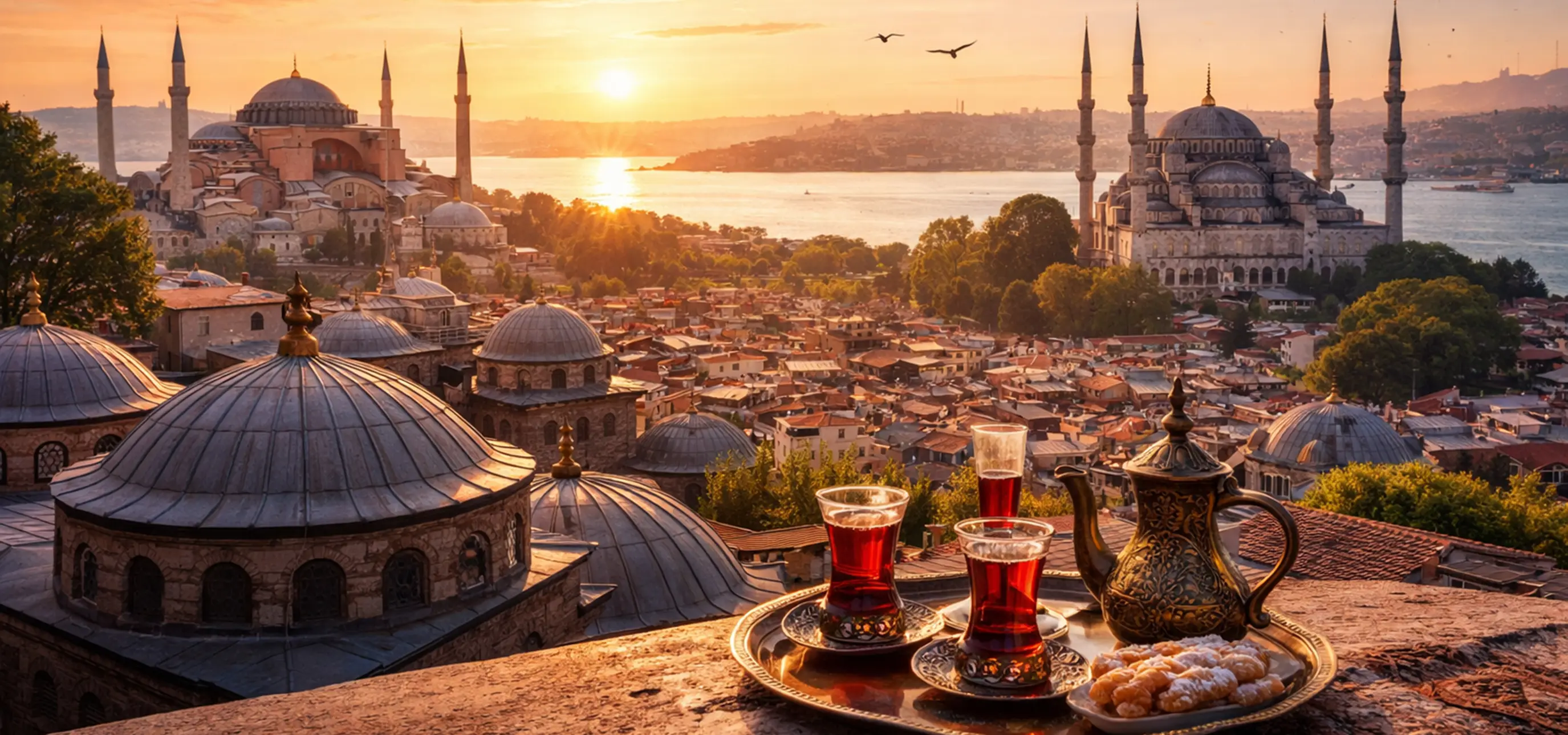
Continue planning with Istanbul's palaces, mosques, churches, museums, fortresses, bazaars, Bosphorus neighborhoods, Golden Horn attractions and archaeological sites.
Explore IstanbulExtend Sultanahmet toward the Grand Bazaar, Süleymaniye Mosque, Eminönü, Spice Bazaar, Fener, Balat or the city walls according to your interests and available time.
Create a private Istanbul itinerary around Byzantine Constantinople, Ottoman history, architecture, archaeology, museums, religious monuments and hidden neighborhoods.
View Private Istanbul Tours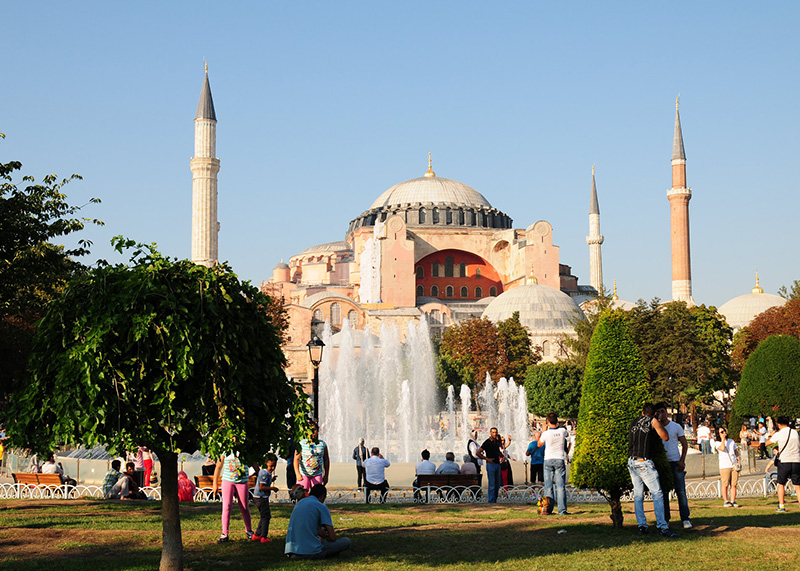
Explore the monument that best expresses Sultanahmet's transition from Byzantine Constantinople to Ottoman Istanbul and the modern city.
Explore Hagia Sophia