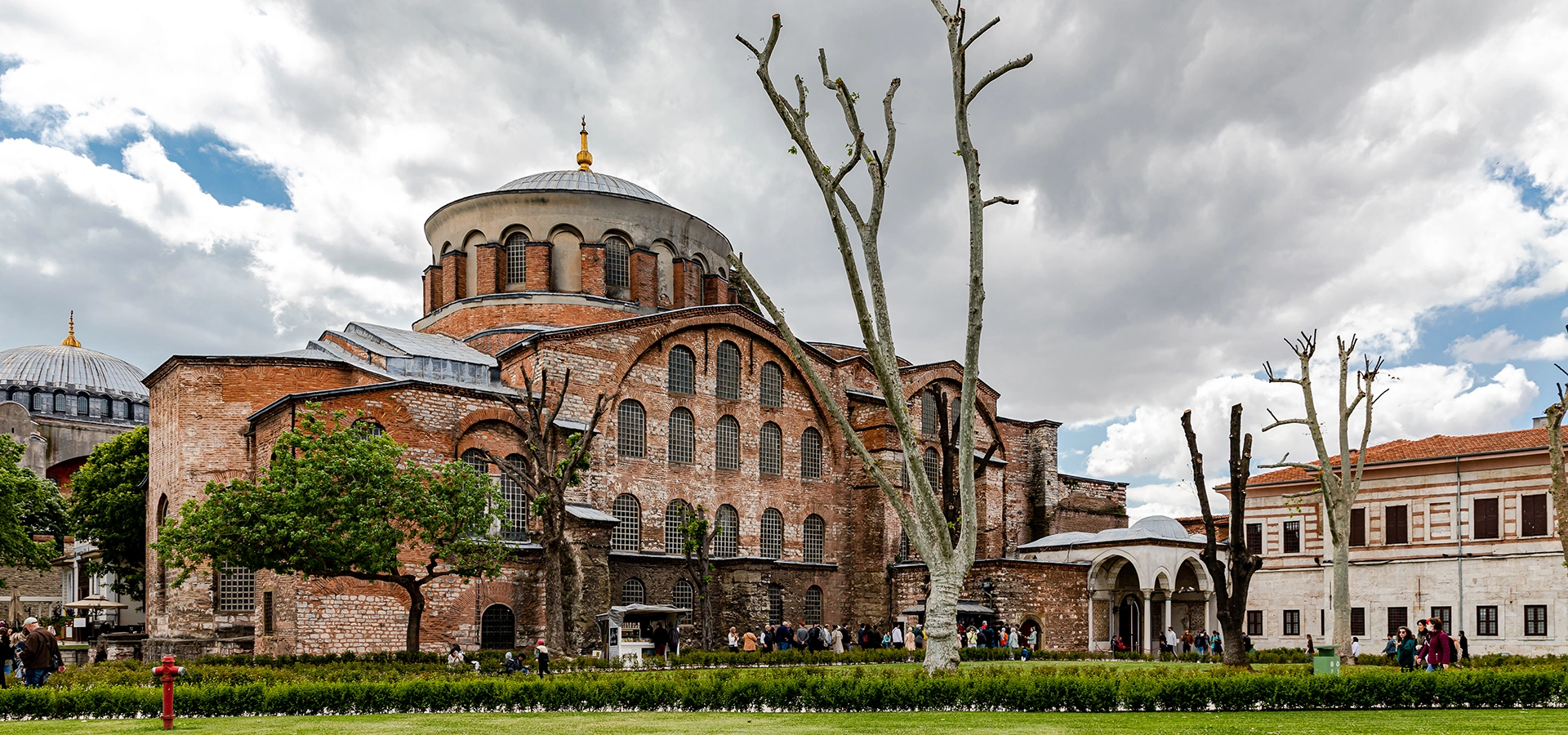
Private Hagia Irene Tour
Ask us about a tailor-made visit focused on the church's Byzantine architecture, Iconoclast cross, synthronon, Ottoman arsenal and museum history.
Request a Custom Tour





Hagia Irene, known in Turkish as Aya İrini, is one of Istanbul's most important surviving Byzantine churches. It stands in the First Courtyard of Topkapı Palace, only a short walk from Hagia Sophia, yet its restrained interior feels remarkably different from the city's more famous monuments.
Its name does not refer to a woman called Saint Irene. The Greek dedication Hagia Eirene means Holy Peace or Divine Peace. Together with Holy Wisdom—Hagia Sophia—and traditions concerning other divine attributes, the name belonged to the spiritual vocabulary of imperial Constantinople.
The first church on this site is traditionally associated with Emperor Constantine I in the 4th century. The building was destroyed during the Nika Revolt of 532 and rebuilt under Emperor Justinian I. After a powerful earthquake in 740, it was extensively repaired in the 8th century, when its present upper structure and celebrated cross mosaic in the apse took shape.
Unlike most Byzantine churches in Ottoman Istanbul, Hagia Irene was never converted into a mosque. Enclosed within the new palace grounds after 1453, it became an arsenal, a storehouse for military trophies and eventually one of the earliest museum spaces in the Ottoman Empire. Today it is a museum monument and occasional concert venue.
Learn why the church's name describes a sacred concept rather than a historical saint.
See a rare monumental non-figural mosaic created during Byzantine Iconoclasm.
Examine the tiered clergy seats preserved inside the eastern apse.
Trace the church's transformation into an armory and pioneering museum space.
Essential information for visiting Hagia Irene in the First Courtyard of Topkapı Palace.
First Courtyard of Topkapı Palace in Sultanahmet, Fatih, Istanbul.
Open on Google MapsHagia Eirene means Holy Peace; the church was dedicated to divine peace, not to a saint.
A 6th-century Justinianic church extensively rebuilt after the earthquake of 740.
The monumental mosaic cross set against a gold background in the apse.
A separate Hagia Irene ticket or a qualifying Topkapı Palace combined ticket is required.
Allow 30–45 minutes, or longer with a guide and a detailed interest in Byzantine architecture.
Few places in Istanbul preserve such a direct sequence from early imperial Christianity to Byzantine Iconoclasm and Ottoman museology.
Hagia Irene is among the oldest surviving church buildings in Istanbul and one of the finest places to study the transition from the longitudinal early Christian basilica to the domed architecture of the Byzantine capital. Its interior combines a broad nave, side aisles, galleries, a dome and an eastern apse in a form usually described as a domed basilica.
The church is especially valuable because its fabric records more than one major Byzantine construction phase. The lower portions largely belong to the rebuilding carried out under Justinian I after 532, while the dome and much of the upper structure reflect repairs following the earthquake of 740. The building therefore preserves physical evidence of both Early and Middle Byzantine design.
Its apse mosaic is one of the most significant surviving works associated with Byzantine Iconoclasm. Instead of a figure of Christ or the Virgin, a large cross dominates the gold field. This powerful non-figural image reflects a period when sacred figural imagery was officially opposed and symbolic decoration was preferred.
Hagia Irene also has an exceptional Ottoman history. Because it stood inside the protected precinct of Topkapı Palace, it escaped conversion into a mosque and was used for arms and military collections. The objects once assembled here helped form the foundations of Ottoman imperial museum practice and later museum collections in Istanbul.
Later tradition connects the first Hagia Irene with Emperor Constantine I, who refounded Byzantium as Constantinople in 330. Whatever the precise date and form of the earliest structure, the church became one of the principal sanctuaries of the new imperial capital and appears to have served as the city's cathedral before the first Hagia Sophia was completed in 360.
Hagia Irene was associated with major theological events in the 4th century, including the age of the First Council of Constantinople in 381. Fire destroyed the earlier building during the Nika Revolt in January 532, the same urban crisis that also consumed the earlier Hagia Sophia.
Emperor Justinian I rebuilt both churches as part of his extraordinary architectural program. Hagia Irene was completed before or around the middle of the 6th century, but a severe earthquake in 740 damaged it again. The subsequent reconstruction, usually linked with the reign of Constantine V, reshaped the upper church and introduced the celebrated non-figural mosaic program.
After the Ottoman conquest in 1453, Sultan Mehmed II incorporated the church into the grounds of his new palace. It served as an arsenal known as the İç Cebehane, then housed collections of historic weapons and military trophies. In the 19th century it became closely connected with the Müze-i Hümâyun, or Imperial Museum, and later with the Military Museum. It is now administered as part of the Topkapı Palace complex.
The earliest church is traditionally connected with Constantine I and the new Christian capital.
Hagia Irene is associated with the First Council of Constantinople and the city's early ecclesiastical history.
The church burns during the Nika Revolt and is rebuilt under Justinian I.
A major earthquake leads to extensive reconstruction of the dome and upper structure.
The building becomes an Ottoman palace arsenal rather than a mosque.
Hagia Irene functions as a museum monument and atmospheric cultural venue.
The Greek name Hagia Eirene translates as Holy Peace. In Turkish the monument is called Aya İrini. Although English-language descriptions sometimes use “Church of Saint Irene,” the historic dedication is not to a female saint. It refers to peace as a sacred divine quality.
This makes the name conceptually related to Hagia Sophia, meaning Holy Wisdom. Both titles expressed theological ideas rather than the names of human patrons. Understanding this distinction changes the way visitors read the two neighboring monuments: one embodied divine wisdom, the other divine peace.
The dedication may also have carried an imperial message. In a capital where religious unity and political order were closely linked, “Holy Peace” could evoke harmony within the Church, within the empire and between the Christian community and God.
Hagia Irene's architecture is the result of rebuilding, repair and adaptation rather than a single uninterrupted campaign. At ground level, the church retains the directional logic of a basilica: a long central nave leads eastward toward the sanctuary, with side aisles divided from the nave by massive supports.
Above, the building becomes more centralized. A broad dome rises over the eastern portion of the nave, while galleries and vaults create a layered interior. This combination of longitudinal and centralized planning is why Hagia Irene is commonly classified as a cross-domed or domed basilica.
The exterior is deliberately sober. Brick and stone walls, arched windows, buttressing and changing roof levels reveal the practical engineering behind the interior. The building's plain surfaces also make it easier to distinguish the different construction and repair phases that shaped it over many centuries.
A long central space preserves the processional direction of early Christian church design.
The dome creates a vertical focus and reflects the church's later reconstruction.
Lower passages flank the nave and support the upper gallery structure.
Elevated spaces overlook the nave and add spatial depth to the interior.
The sanctuary terminates in a curved apse containing the synthronon and cross mosaic.
The western forecourt preserves an exceptionally rare element of Byzantine church planning in Istanbul.
The most famous artwork inside Hagia Irene is the large mosaic cross in the half-dome of the apse. Outlined against a shimmering gold ground, the cross rises above a stepped base and dominates the sanctuary with remarkable visual simplicity.
The mosaic is generally connected with the reconstruction after the earthquake of 740, during the first period of Byzantine Iconoclasm. At that time, imperial religious policy rejected or restricted devotional images of holy figures. A cross could communicate Christian belief without using a human image of Christ, the Virgin or the saints.
This makes Hagia Irene especially important for understanding a period whose monumental decoration has rarely survived. The apse scheme is not merely “plain.” It is a carefully designed theological statement in which the cross, gold field, sanctuary architecture and inscriptions work together.
Visitors should look beyond the central cross to the mosaic inscriptions around the bema arch. Although parts have been altered or lost, they evoke the sacred character of God's house and frame the sanctuary as a place of divine presence.
Hagia Irene is not filled with museum cases or dense displays. Its greatest exhibit is the building itself. The subdued interior encourages visitors to study space, masonry, light and the surviving traces of Byzantine worship.
Stand in the nave and look east toward the monumental cross floating against the gold mosaic field.
Observe the semicircular tiers where clergy sat within the sanctuary during the Byzantine liturgy.
Notice how the long basilical space draws the eye toward the apse while the dome creates a second focus above.
Study the windows and structural transitions that illuminate the upper volume of the church.
Look upward to understand how the aisles, piers and vaults support the elevated circulation spaces.
The western entrance zone once prepared worshippers for entry into the main sacred space.
Examine the rare surviving forecourt and its relationship with the church's western façade.
Remember that the vast interior later held arms, trophies and some of Istanbul's earliest museum collections.
At the eastern end of Hagia Irene, semicircular tiers of built seating rise inside the apse. This arrangement is known as a synthronon. During the Byzantine liturgy, members of the clergy sat here around the bishop's central position.
The synthronon is one of the most unusual surviving features of the church and an exceptionally rare example in Istanbul. It makes the sanctuary easier to imagine as a functioning ceremonial space rather than simply an architectural shell.
Passages associated with the seating allowed movement within and behind the apse structure. Together with the bema, altar zone and mosaic decoration above, the synthronon formed a carefully ordered setting for worship, hierarchy and the public performance of the liturgy.
Hagia Irene survived the transformation of Constantinople into Ottoman Istanbul in a highly unusual way. Because it was enclosed within the palace precinct developed by Sultan Mehmed II, it was not needed as a neighborhood mosque and instead became part of the Ottoman military establishment.
The former church was used as an arsenal and storehouse for weapons, armor, standards and captured military trophies. Its thick walls, spacious interior and secure location inside the palace made it suitable for this purpose. Ottoman use altered the building's function while also helping preserve its basic architectural form.
In 1726, during the reign of Ahmed III, collections displayed here were reorganized under the name Dârü'l-Esliha, or House of Weapons. In 1846, Ahmed Fethi Pasha developed the presentation of military antiquities and other historical objects, connecting Hagia Irene with the beginnings of modern museum practice in the Ottoman Empire.
Its location inside Topkapı protected the building and determined its post-conquest use.
The former church became an inner arsenal for arms and military equipment.
Weapons, standards and objects associated with Ottoman campaigns were stored and displayed here.
The House of Weapons represented an early effort to organize and present a historic collection.
Ahmed Fethi Pasha arranged military antiquities and helped formalize Hagia Irene's museum role.
Its holdings contributed to the development of Istanbul's military and archaeological museums.
The vast brick interior, high vaults and relatively uncluttered surfaces give Hagia Irene a distinctive acoustic character. For decades the church has hosted selected classical music performances, festival concerts and cultural events.
The venue is particularly associated with Istanbul's international music life. When a performance is scheduled, lighting and music transform the austere interior, allowing audiences to experience the architecture through reverberation as well as sight.
Concert access is separate from normal museum visiting arrangements. Tickets, entry times, seating and photography rules depend on the organizer, so visitors hoping to attend an event should consult the official festival or venue announcement in advance.
Begin in Topkapı Palace's First Courtyard and pause outside the church before entering. The broad brick exterior, dome and changing roof heights make more sense when seen from a little distance.
Approach from the west and examine the relationship between the atrium, outer entrance and narthex. Once inside, remain near the western end for a moment and take in the full length of the nave. This is the best place to understand the building's basilical axis and the visual pull of the apse.
Walk slowly toward the center and look upward at the dome, windows, galleries and massive supports. Then focus on the eastern end: the gold-ground cross, bema arch and synthronon form the interpretive heart of the visit.
Before leaving, look back toward the western entrance and imagine the building's successive lives: a cathedral of early Constantinople, a rebuilt imperial church, an Iconoclast monument, an Ottoman arsenal, an early museum and a modern concert venue.
Hagia Irene stands inside the First Courtyard of Topkapı Palace, also called Alay Meydanı. Visitors enter the courtyard through the Imperial Gate, or Bâb-ı Hümâyun, near Hagia Sophia. Security screening and queues should be expected during busy periods.
According to the current National Palaces schedule, the Topkapı Palace complex is open from 09:00 to 17:30, with ticket offices closing at 17:00, and is closed on Tuesdays. Hours can change for holidays, restoration, ceremonies or special events, so check official information on the day of your visit.
Hagia Irene requires its own admission or inclusion in an eligible combined Topkapı Palace ticket. The standard Museum Card is not valid for Hagia Irene under the current rules. Ticket types and prices change periodically; confirm them through the official National Palaces website.
The church is a museum monument rather than an active place of worship, so mosque dress rules and shoe removal do not apply. Nevertheless, modest behavior, quiet conversation and respect for barriers are appropriate in this fragile historic interior.
Arrive near 09:00 for a quieter First Courtyard and a better chance to enjoy the church calmly.
Crowds may ease later, but do not arrive close to the ticket-office or museum closing time.
Monday, Wednesday, Thursday and Friday are often calmer than weekends; remember that Tuesday is closed.
Milder weather makes a longer walking route through Sultanahmet more comfortable.
The interior remains rewarding, but the open courtyard and approach require weather protection.
Concert rehearsals or official events can affect normal access, so verify the schedule in advance.
Enough for a quick look at the nave, dome, apse cross and synthronon.
The best choice for most visitors who want to understand the major architectural features.
Ideal for Byzantine history enthusiasts, photographers and visitors using a detailed guide.
Combine Hagia Irene with Topkapı Palace and the Istanbul Archaeological Museums.
Add Hagia Sophia, the Blue Mosque, the Hippodrome and Basilica Cistern.
Use a second day for the deeper Byzantine heritage of the city walls, Zeyrek, Fener and Balat.
Personal photography rules can change, particularly during concerts, temporary installations or official events. Follow signs and staff instructions, avoid flash when prohibited and never cross barriers for a clearer composition.
Photograph from the west to frame the long nave, dome and distant apse together.
A moderate zoom helps isolate the monumental cross without entering restricted sanctuary areas.
Use an angled view to show the curved tiers and their relationship with the apse.
Look upward for the rhythm of windows, arches and brick surfaces.
Side light can reveal masonry textures and the different levels of the historic structure.
Disable audible camera sounds where possible and avoid blocking other visitors.
The approach through Topkapı Palace's First Courtyard is largely open, but the historic setting includes stone paving, thresholds and surfaces that may be uneven. Conditions can be more difficult in rain.
The main visitor experience is on the ground level, allowing many guests with limited mobility to appreciate the nave, dome, apse and synthronon without using stairs. Some historic zones and viewpoints may remain inaccessible.
The First Courtyard is broad, though distances and uneven paving should be considered.
Historic doorways may contain changes in level or temporary access arrangements.
The principal spatial experience and eastern sanctuary can be viewed from the main floor.
Ask staff for the current accessible route before entering, as arrangements may change.
Do not rely on plentiful rest areas inside the church; use courtyard facilities when available.
A drop-off near Sultanahmet reduces walking, but vehicles cannot enter the pedestrian monument zone.
Hagia Irene is located just inside the Imperial Gate of Topkapı Palace in Sultanahmet. The historic center is heavily pedestrianized, so public transport is usually easier than driving.
Take the T1 tram to Sultanahmet or Gülhane and continue on foot toward Topkapı Palace.
Walk northeast toward the Imperial Gate; Hagia Irene stands inside the courtyard on the left.
Walk uphill beside the palace walls toward the Archaeological Museums and First Courtyard.
Use the T1 tram or walk uphill through Gülhane if you are comfortable with slopes.
Ask for Sultanahmet or Topkapı Palace; the final approach normally continues on foot.
A licensed guide can coordinate the drop-off, tickets and route with nearby monuments.
Continue through the imperial courtyards, treasury, sacred relics rooms, pavilions and Harem.
Compare Hagia Irene's restrained domed basilica with Justinian's revolutionary imperial cathedral.
See collections whose institutional history is closely connected with objects once kept in Hagia Irene.
Cross Sultanahmet Square to visit one of the great monuments of classical Ottoman architecture.
Descend into a monumental 6th-century water reservoir from the age of Justinian.
Walk through the former outer gardens of Topkapı Palace toward the historic city walls and waterfront.
Explore the ceremonial arena of Constantinople and its surviving Egyptian, Greek and Byzantine monuments.
Continue west through the Historic Peninsula to Istanbul's vast covered commercial district.
Hagia Irene is a former Byzantine church, Ottoman arsenal and historic museum monument located inside Topkapı Palace's First Courtyard.
It stands in the First Courtyard of Topkapı Palace in Sultanahmet, Fatih, close to Hagia Sophia and the Istanbul Archaeological Museums.
The Greek name Hagia Eirene means Holy Peace or Divine Peace. It is a theological dedication, not the name of a female saint.
The first church is traditionally linked with the 4th century. The present monument is principally a 6th-century Justinianic structure extensively rebuilt after the earthquake of 740.
Later historical tradition associates the original church with Constantine I, but the exact form and chronology of that earliest building remain subjects of scholarly discussion.
The earlier church burned in 532 and was rebuilt under Emperor Justinian I as part of his reconstruction of Constantinople.
The monumental mosaic cross belongs to a non-figural decorative program associated with the Byzantine Iconoclast period following the 740 earthquake.
It was a period of theological and political conflict in which the use and veneration of sacred figural images were officially opposed or restricted.
It is the semicircular arrangement of tiered clergy seating preserved in the apse at the eastern end of the church.
No. After 1453 it stood within the palace precinct and served mainly as an Ottoman arsenal and collection space.
Its large, secure interior and protected location inside Topkapı Palace made it suitable for storing weapons, armor and military trophies.
It is closely connected with the beginnings of Ottoman museology because historic weapons and antiquities were collected and displayed here before later specialist museums developed.
It no longer functions as a regular place of worship. Today it is a museum monument and occasional cultural venue.
Yes. It is normally open during Topkapı Palace museum hours, subject to closures, restoration work and special events.
Yes. Under the current National Palaces schedule, Topkapı Palace and Hagia Irene are closed to visitors on Tuesdays.
The current published schedule is 09:00–17:30, with ticket offices closing at 17:00. Always confirm seasonal, holiday and event-related changes.
Yes. Purchase a separate Hagia Irene ticket or a combined Topkapı Palace ticket that explicitly includes the church.
No. National Palaces currently lists Hagia Irene among the sections where the standard Museum Card is not valid.
Ticket products can include Hagia Irene separately or as part of a combination. Confirm the current option at the official ticket office or website.
Most visitors need 30–45 minutes. Allow about an hour for a detailed architectural or guided visit.
Personal photography is generally subject to current museum rules. Flash, tripods or photography may be restricted during events, so follow posted instructions.
Much of the main ground-level experience may be accessible, but historic paving and thresholds can create difficulties. Ask staff for the current route.
Its large vaulted brick interior produces a distinctive reverberant acoustic and an atmospheric setting for classical music.
It lies within the Archaeological Park component of the UNESCO-listed Historic Areas of Istanbul.
Yes—especially for visitors interested in Byzantine architecture, Iconoclasm, Topkapı Palace and the origins of museum culture in Istanbul.
Never touch historic surfaces, masonry, inscriptions or decorative fragments.
Restricted zones protect both visitors and vulnerable parts of the monument.
Follow current museum photography rules and avoid equipment that disturbs other visitors.
The reverberant interior amplifies sound, so quiet conversation improves everyone's visit.
Use designated courtyard areas rather than consuming food inside the historic church.
Temporary routes and closures may be necessary for conservation or special events.
Connect Hagia Irene with Topkapı Palace, Hagia Sophia and the Archaeological Museums, or create a deeper Byzantine route shaped around your interests and without compulsory shopping stops.
Choose a focused architectural visit or build a private route through the sacred and imperial heart of Constantinople.
Ask us about a tailor-made visit focused on the church's Byzantine architecture, Iconoclast cross, synthronon, Ottoman arsenal and museum history.
Request a Custom Tour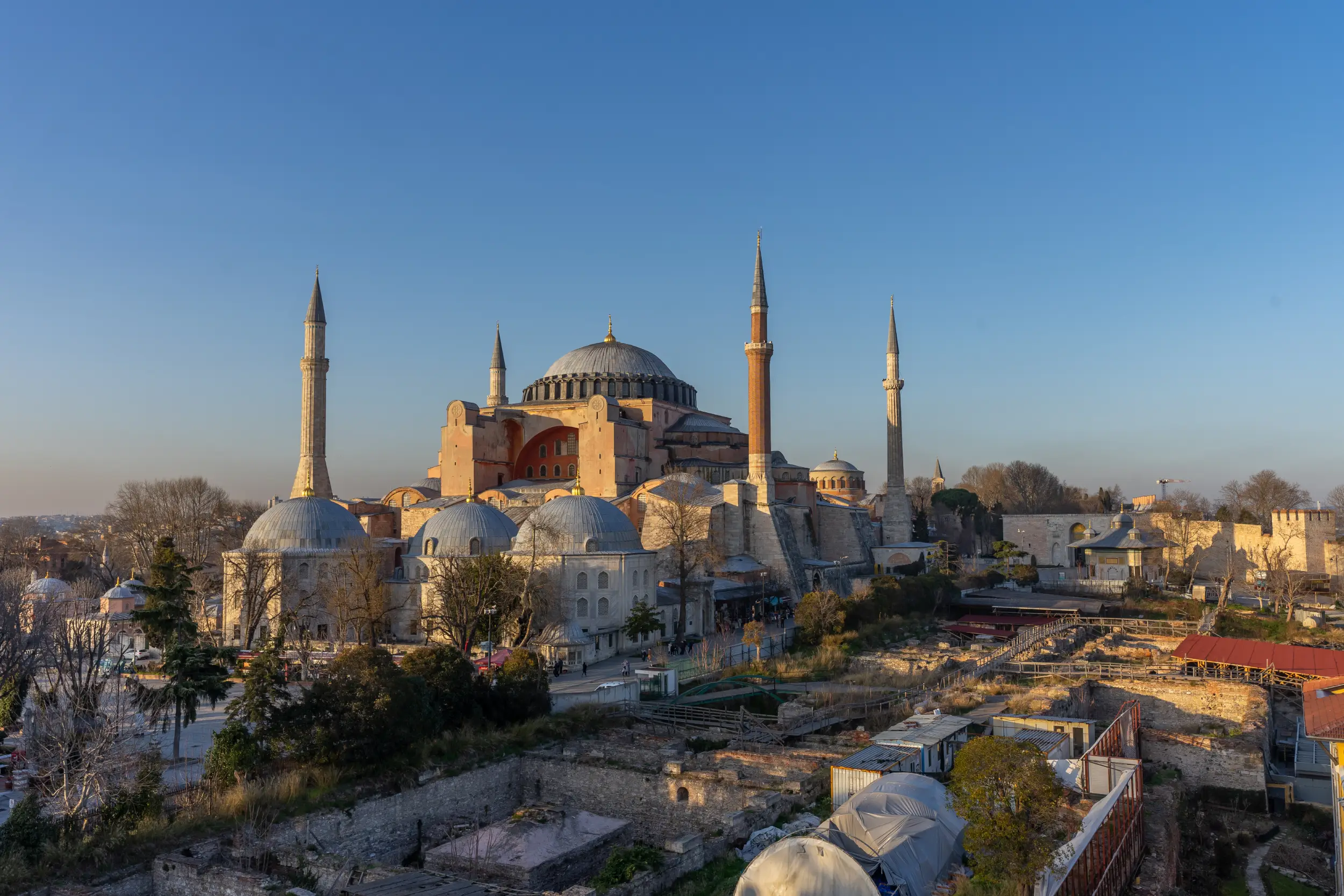
Compare Hagia Irene with Hagia Sophia and trace the development of domed architecture, imperial ritual and sacred art in Constantinople.
Explore Hagia SophiaBuild a day around the palaces, museums and sacred monuments of the Historic Peninsula.
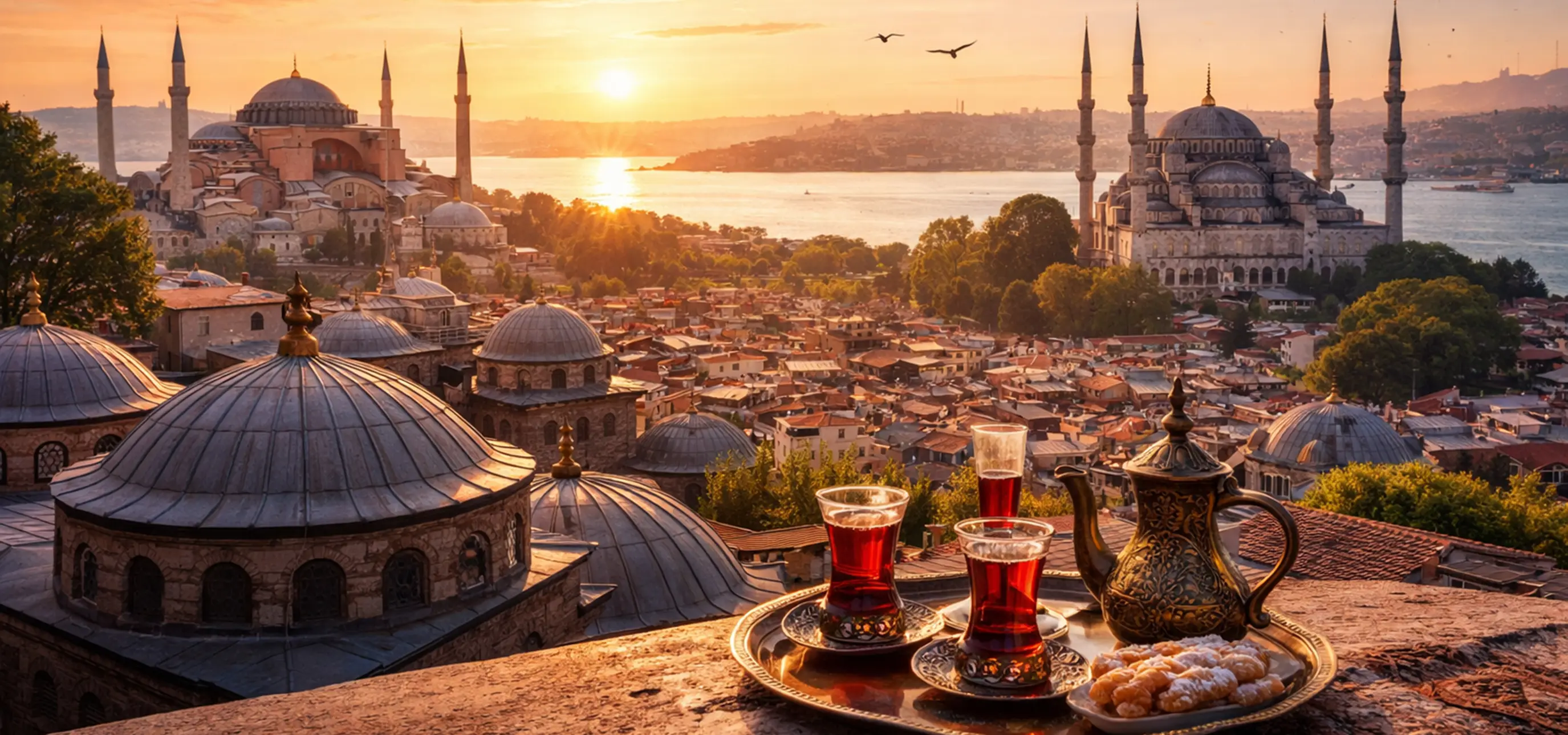
Continue through the Ottoman imperial courtyards, treasury, Harem, pavilions and Bosphorus terraces.
Explore Topkapı Palace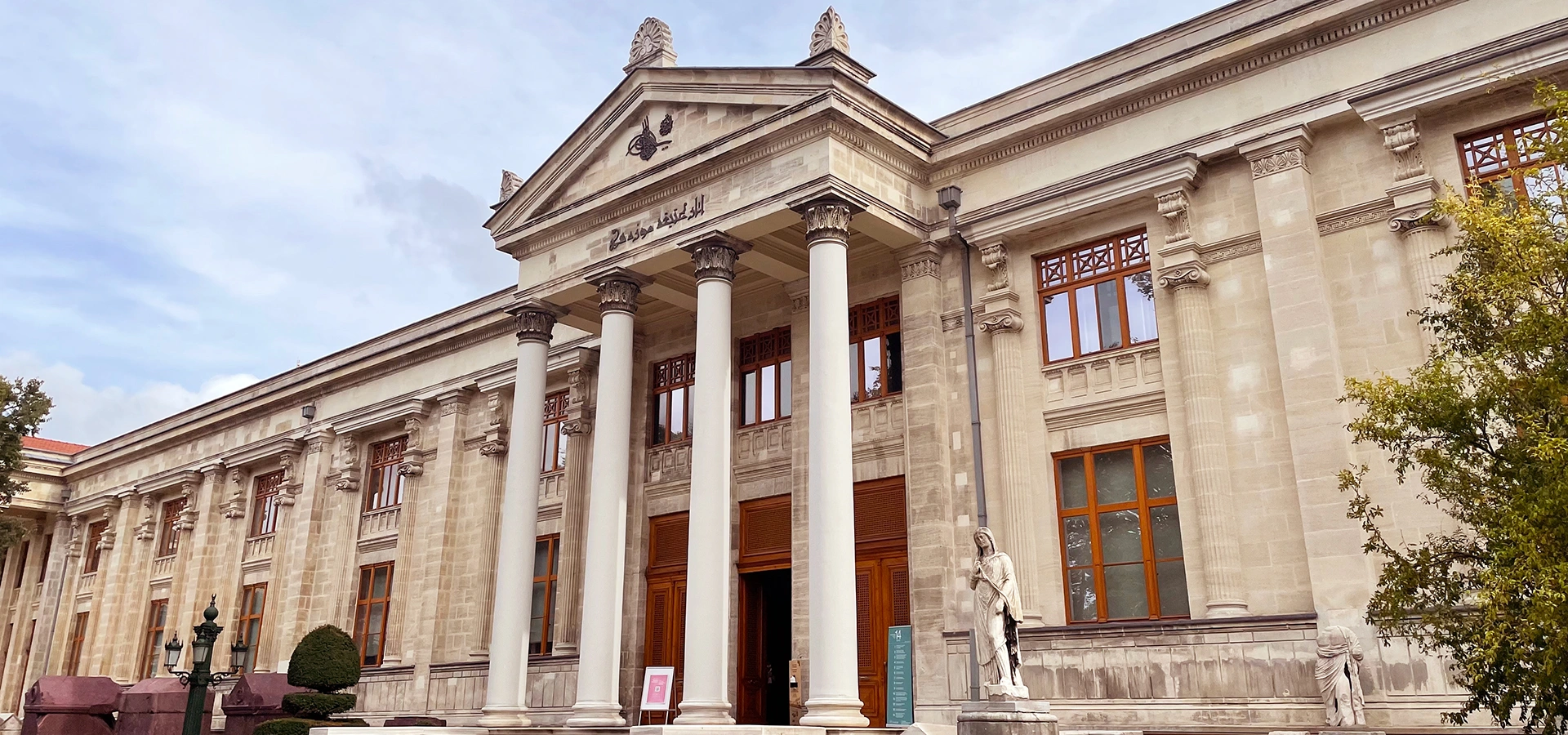
Discover collections whose institutional story grew from antiquities once assembled in Hagia Irene.
Explore the Museums
Continue to Sultanahmet, the Grand Bazaar, Süleymaniye, Fener, Balat and the city walls.
Continue Exploring Istanbul