Private Archaeology & Civilizations Experience
Ask us about a tailor-made museum visit focused on ancient Anatolia, Mesopotamia, classical sculpture, royal sarcophagi or the story of Osman Hamdi Bey.
Request a Custom Tour




The Istanbul Archaeological Museums form one of Türkiye's most important museum complexes. Hidden beside Topkapı Palace and Gülhane Park, the peaceful museum garden contains three distinct institutions: the Archaeology Museum, the Museum of the Ancient Orient and the Tiled Kiosk Museum.
Together, their collections preserve nearly one million objects connected with civilizations that once lived across Anatolia, Mesopotamia, Egypt, the Levant, the Balkans and other former Ottoman territories. Only a selection can be displayed, but even a focused visit reveals an extraordinary span of human history.
The best-known masterpiece is the Alexander Sarcophagus, discovered by Osman Hamdi Bey's team in the royal necropolis of Sidon. Other highlights include the Sarcophagus of the Mourning Women, the Treaty of Kadesh tablet, glazed brick panels from Babylon, Greek and Roman sculpture, and celebrated examples of Seljuk and Ottoman tilework.
This is not a museum to rush. Allow time for the architecture, read the object labels and plan around galleries that may be closed for restoration. A thoughtful two- to three-hour route is far more rewarding than trying to absorb every display at once.
Explore archaeology, ancient Near Eastern civilizations and historic Turkish ceramics in one complex.
See one of the world's most celebrated ancient sarcophagi, discovered at Sidon in the late 19th century.
Trace the story of the Imperial Museum and the institutional beginnings of archaeology in Türkiye.
Admire Alexander Vallaury's neoclassical museum and the 15th-century Tiled Kiosk.
Essential information for planning your visit to Istanbul's principal archaeology collection.
Osman Hamdi Bey Yokuşu, beside Topkapı Palace and Gülhane Park in Fatih.
Open on Google MapsFounded as the Müze-i Hümayun, or Imperial Museum, in 1869.
Archaeology Museum, Museum of the Ancient Orient and Tiled Kiosk Museum.
The Alexander Sarcophagus from the royal necropolis of ancient Sidon.
Ticketed entry; MüzeKart is valid for eligible Turkish citizens. Check current terms online.
Allow 2–3 hours for the principal open galleries and museum garden.
The complex unites exceptional ancient objects with the history of collecting, conservation and museology in the late Ottoman Empire.
The museums preserve material from a vast geographical and chronological world. Sculpture, sarcophagi, inscriptions, cuneiform tablets, architectural fragments, ceramics and small finds connect visitors with societies from prehistoric Anatolia to the Greek, Roman, Byzantine, Seljuk and Ottoman periods.
Their importance is also institutional. The foundation of the Imperial Museum in 1869 marked a decisive step in the development of formal museum practice in the Ottoman Empire. Under Osman Hamdi Bey, the institution expanded its collections, organized excavations, supported archaeological legislation and commissioned a purpose-built museum of international ambition.
The collections illuminate relationships between ancient cultures rather than presenting civilizations in isolation. Egyptian, Mesopotamian, Anatolian, Phoenician, Greek and Roman objects show how artistic styles, writing systems, trade networks and imperial power moved across regions over thousands of years.
For visitors following our guide to places to visit in Istanbul, the museums add depth to the monuments outside. They help explain the civilizations whose reused columns, inscriptions and sculptures still appear throughout the Historic Peninsula.
Ottoman interest in collecting antiquities can be traced back for centuries, but the institutional story begins in the 19th century. Ancient objects gathered in the church of Aya İrini formed the basis of the Müze-i Hümayun, or Imperial Museum, officially established in 1869.
When Aya İrini became inadequate, the collection moved to the Tiled Kiosk. Built in 1472 during the reign of Sultan Mehmed II, the kiosk was restored and opened as a museum in 1880. It remains the oldest building in the present complex.
The appointment of painter, archaeologist and administrator Osman Hamdi Bey as museum director in 1881 transformed the institution. He directed excavations at sites including Nemrut Dağı, Lagina and Sidon, while also shaping the legal and professional foundations of Ottoman archaeology.
The discovery of monumental sarcophagi in the royal necropolis of Sidon in 1887–1888 created an urgent need for a new building. Architect Alexander Vallaury designed the neoclassical Archaeology Museum opposite the Tiled Kiosk. Its first section opened on 13 June 1891, with later wings expanding the display space.
The building now called the Museum of the Ancient Orient had originally been designed by Vallaury in 1883 for Osman Hamdi Bey's School of Fine Arts. After the academy moved, it was assigned to the museum administration and adapted to display ancient Near Eastern collections.
The Imperial Museum was formally established, initially based in Aya İrini.
The restored Tiled Kiosk opened to visitors as a museum building.
Osman Hamdi Bey became director and began a transformative period of archaeology and museology.
The first section of Vallaury's purpose-built Archaeology Museum opened to the public.
The plural name is important: this is a complex of three museums rather than a single exhibition hall. Each building has its own architectural character and collection focus. Access to particular galleries can change during restoration, so check what is open before deciding on your route.
The grand neoclassical building houses classical sculpture, monumental sarcophagi, inscriptions and archaeological finds from Anatolia and neighboring regions.
Collections explore Mesopotamia, Egypt, Anatolia and the Levant through cuneiform tablets, reliefs, stelae, sculptures and glazed architectural decoration.
The 15th-century pavilion displays important examples of Seljuk and Ottoman tiles and ceramics within one of Istanbul's oldest surviving Ottoman secular buildings.
The shaded courtyard links the buildings and contains stone monuments, architectural fragments and views of the historic museum façades.
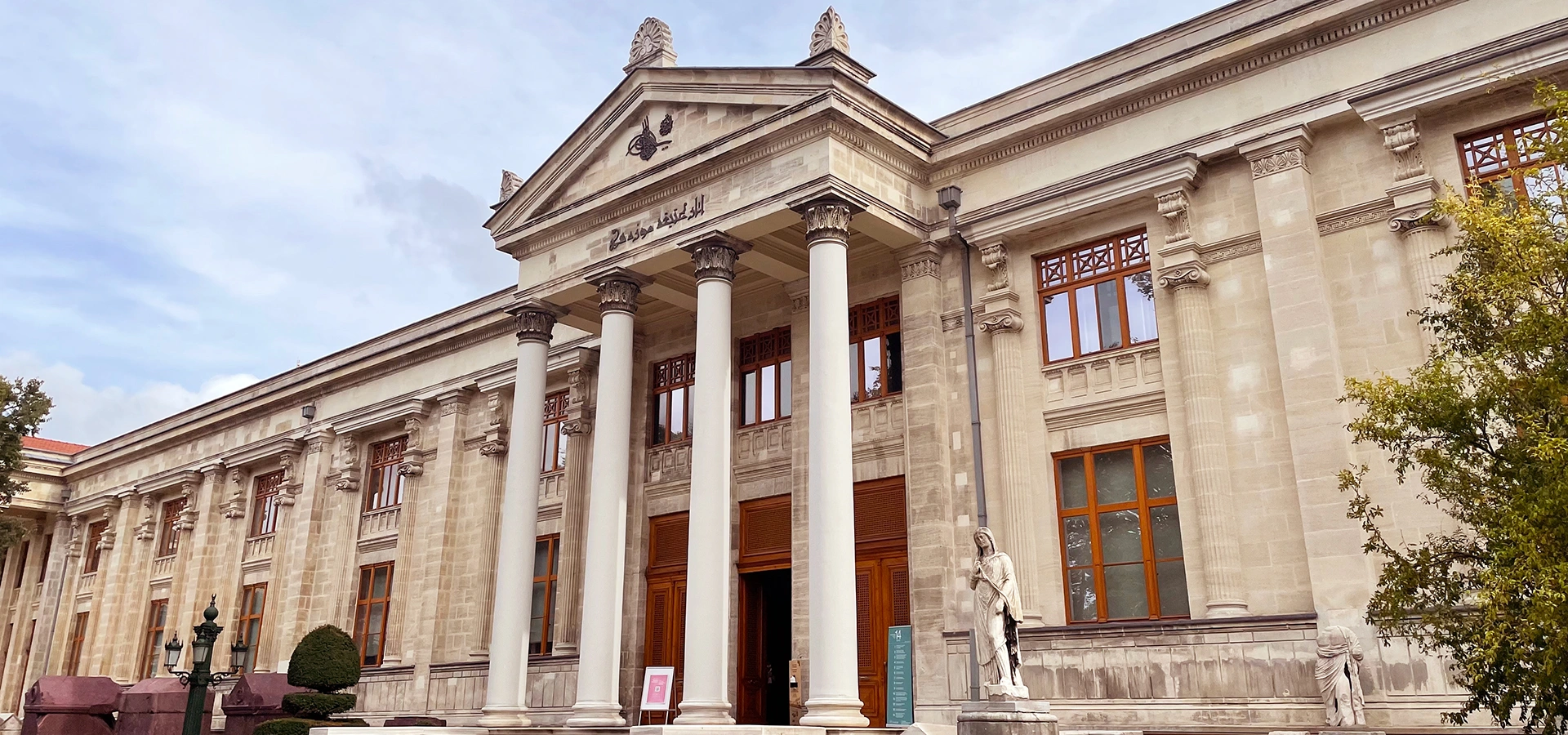
The main Archaeology Museum is one of Istanbul's finest neoclassical public buildings. Its formal façade, broad stairway, columns and pediment deliberately evoke the ancient monuments displayed inside. The Ottoman inscription above the entrance identifies it as the Asar-ı Atika Müzesi, or Museum of Antiquities, with the tughra of Sultan Abdülhamid II above.
Across the garden, the Museum of the Ancient Orient has a more restrained 19th-century academic character. Its original function as the School of Fine Arts connects the site not only with archaeology, but also with the institutional history of art education in the Ottoman capital.
The Tiled Kiosk offers a striking contrast. Its deep entrance iwan, tiled surfaces and symmetrical pavilion plan belong to the world of Mehmed II's palace complex. The building predates the other museums by more than four centuries and is itself one of the site's greatest exhibits.
Vallaury's monumental design announces the Archaeology Museum as a modern institution devoted to antiquity.
Ottoman script and Sultan Abdülhamid II's tughra record the building's late imperial identity.
The 1472 pavilion preserves the architectural language of Mehmed II's early Topkapı Palace landscape.
Trees and archaeological fragments create a calm setting between the three historic buildings.
The main building was among the relatively rare museums of its era designed specifically for displaying antiquities.
The complex brings together a 15th-century palace pavilion and late Ottoman cultural institutions.
Displays change and some galleries may be temporarily closed, but the following objects and collection groups explain why the museums deserve a place on every serious Istanbul itinerary.
Study the remarkably preserved battle and hunting scenes on this late 4th-century BC masterpiece from Sidon. Despite its name, it was not Alexander the Great's coffin.
Rows of grieving female figures create a powerful funerary monument inspired by the architecture of a Greek temple.
An Egyptian-style sarcophagus reused for the Phoenician king Tabnit preserves an important inscription and royal burial story.
Elegant reliefs combine Anatolian funerary traditions with artistic influences from the wider Greek world.
See a cuneiform version of the famous peace agreement associated with the Hittite and Egyptian empires.
Colorful lions and other motifs evoke the monumental ceremonial architecture of ancient Babylon.
Portraits, deities, funerary monuments and architectural sculpture reveal changing ideals across the classical world.
The Tiled Kiosk collection traces technical skill and decorative taste across Seljuk and Ottoman centers of production.
The Alexander Sarcophagus was discovered in 1887 during excavations led by Osman Hamdi Bey at the royal necropolis of Sidon, in present-day Lebanon. Its conventional name comes from the figure of Alexander the Great represented in its reliefs, not from the identity of the person buried inside.
Carved from marble in the late 4th century BC, the sarcophagus displays battle and royal hunting scenes with extraordinary depth, movement and anatomical detail. Traces of ancient paint remind visitors that classical sculpture was often brightly colored rather than plain white.
The monument is commonly associated with Abdalonymus, a king of Sidon, although questions of attribution and interpretation remain subjects of scholarly discussion. Its blend of Macedonian imagery, Greek sculptural skill and Phoenician royal context captures the multicultural world created by Alexander's campaigns.
The name refers to Alexander's image in the reliefs; his actual burial place remains unknown.
Osman Hamdi Bey's excavation of the royal necropolis brought the sarcophagus to Istanbul.
Surviving pigment provides rare evidence for the painted appearance of ancient marble sculpture.
The imagery reflects political and artistic encounters between Macedonia, the Greek world and Phoenicia.
Begin in the main Archaeology Museum while your attention is fresh. Prioritize the monumental sarcophagi and the principal sculpture galleries that are open, then pause in the garden before moving to the other buildings.
Continue to the Museum of the Ancient Orient for Mesopotamian, Egyptian, Hittite and Levantine material. Finish at the Tiled Kiosk, where the smaller scale, historic architecture and vivid ceramics provide a satisfying contrast to the stone monuments.
If time is limited, do not chase every room. Concentrate on one or two masterpieces in each open building and allow several minutes to examine their labels, iconography and original context.
The museums stand on Osman Hamdi Bey Yokuşu, the sloping lane between the outer grounds of Topkapı Palace and Gülhane Park. The easiest public-transport approach is usually the Gülhane stop on the T1 tram line.
The official museum listing currently gives daytime hours of 09:00–18:45 and states that the complex is open every day. It also lists an evening museum program during designated periods. Hours, ticket prices, evening access and gallery availability can change, especially during restoration or public holidays.
Admission is ticketed, and MüzeKart is accepted for eligible Turkish citizens under the current rules. International visitors should check the official ticket price and pass conditions shortly before arrival. An audio-guide service is listed as available.
The museums are an excellent year-round choice. Your experience depends more on crowd levels, gallery access and the amount of time available than on the season itself.
Arrive near opening for the quietest atmosphere around the principal sarcophagi and major display halls.
Convenient after nearby monuments, but expect more groups and slower movement around famous objects.
A useful indoor period during summer heat, though fatigue may reduce how much detail you absorb.
The covered galleries make the complex one of the Historic Peninsula's best wet-weather attractions.
Use the museum as a cool cultural pause between Topkapı Palace, Gülhane Park and Sultanahmet.
When night-museum access operates, confirm exactly which buildings and galleries are included before purchasing.
Enough for the most important open sarcophagus galleries and a brief look at the museum garden.
A practical minimum for highlights across more than one museum building.
Ideal for a first visit with the major masterpieces, Ancient Orient displays and Tiled Kiosk.
Best for archaeology enthusiasts who want to read labels carefully and compare civilizations.
Reserve most of a day and schedule a proper break; both collections are large and intellectually demanding.
Choose a short treasure hunt focused on lions, warriors, royal tombs, cuneiform writing and colorful tiles.
Personal photography may be permitted in many areas, but rules can vary by gallery, object and temporary exhibition. Always follow posted signs and staff instructions, and do not assume that flash, tripods or commercial equipment are allowed.
Photograph from several angles to reveal carving depth, surviving color and narrative movement.
The main staircase and columned entrance create a strong exterior composition from the garden.
Use the entrance iwan, turquoise tilework and framed garden views to show the pavilion's architecture.
If photography is allowed, focus carefully on the tiny wedge-shaped impressions rather than using flash.
Glass cases can create glare; change your angle and keep lenses away from display surfaces.
Never touch objects, lean over barriers or block circulation while composing a photograph.
The complex occupies several historic buildings on a sloping approach. Accessibility can differ between entrances, floors and galleries, and temporary restoration routes may affect lifts or step-free circulation. Contact the museum before visiting if you need specific access information.
Osman Hamdi Bey Yokuşu is inclined; the route from Gülhane is uphill toward Topkapı Palace.
Thresholds, stairs and changing floor levels may be present in parts of the complex.
Travel light and allow time for entrance procedures, especially during busy periods.
Keep children close, explain the no-touch rule and choose a few memorable objects rather than every room.
Use available benches and the garden to prevent museum fatigue during a longer visit.
Avoid bringing bulky luggage; current cloakroom and security rules should be confirmed in advance.
The museums are centrally located on the Historic Peninsula. Public transport and walking are normally easier than driving because the surrounding streets are busy, parking is limited and vehicle access can be restricted.
Leave at Gülhane and walk uphill through or beside the park toward Osman Hamdi Bey Yokuşu.
The museum entrance is only a short walk down the slope from the palace's outer court area.
Walk toward the Imperial Gate of Topkapı Palace, then descend along Osman Hamdi Bey Yokuşu.
Take the T1 tram to Gülhane or walk uphill through the park and historic streets.
Ask for Gülhane or the Topkapı Palace area; the closest legal drop-off can vary with traffic controls.
Driving is not recommended. Use a legal paid car park outside the most congested pedestrian zone.
The complex occupies one of the most monument-rich areas in the world. Use our complete Istanbul visitor guide to build a realistic route without overloading the day.
Explore the courtyards, treasury and ceremonial spaces of the Ottoman court immediately uphill.
Rest beneath mature trees in the former outer gardens of the Ottoman palace.
See a monument where Byzantine imperial architecture and Ottoman religious history meet.
Descend among ancient columns and reflected light in Istanbul's famous Byzantine reservoir.
Experience the elegant domes, İznik tiles and living worship traditions of Sultan Ahmed Mosque.
Continue through Gülhane Park to displays exploring scientific achievement in Islamic civilizations.
Walk through the former ceremonial arena of Byzantine Constantinople and see its surviving monuments.
Descend toward the railway station, waterfront, restaurants and transport links around Eminönü.
They are on Osman Hamdi Bey Yokuşu in the Gülhane area of Fatih, between Topkapı Palace and Gülhane Park on Istanbul's Historic Peninsula.
The complex contains three institutions: the Archaeology Museum, the Museum of the Ancient Orient and the Tiled Kiosk Museum.
The Alexander Sarcophagus is the best-known masterpiece, celebrated for its dynamic reliefs, fine carving and surviving ancient color.
No. The sarcophagus takes its name from Alexander's representation in the reliefs. It is commonly associated with Abdalonymus, a king of Sidon.
The institution developed from the Ottoman Imperial Museum established in 1869. Osman Hamdi Bey, director from 1881, played the central role in its transformation and expansion.
The official listing currently states 09:00–18:45 and indicates that the museums are open every day. Always recheck before visiting because schedules can change.
The official page currently lists the complex as open every day, including Monday. Holiday, restoration and special-program arrangements may still affect access.
Admission prices and card conditions can change. Check the official MüzeKart website for the current foreign-visitor ticket and eligibility rules before arrival.
The official listing states that MüzeKart is valid for eligible Turkish citizens. International museum-pass products and admission conditions should be checked separately.
Allow approximately 2–3 hours for a balanced first visit. Archaeology enthusiasts can easily spend half a day.
Not always. Restoration, conservation and exhibition work can close individual halls or entire sections. Consult the official museum page for current notices.
The official museum listing currently states that an audio-guide service is available. Languages, devices and fees should be confirmed at the entrance.
No, but a knowledgeable licensed guide can connect objects with their original sites, explain ancient iconography and create a focused route through a very large collection.
Yes. They are immediate neighbors, but both are extensive. Start early, include a lunch or coffee break and avoid adding too many other major museums to the same day.
Yes. The sarcophagi, lions, warriors, ancient writing and colorful tiles can be engaging, especially when the visit is kept short and interactive.
Personal photography may be allowed in many areas, but restrictions differ. Follow signs and staff instructions, avoid flash and never touch or cross barriers.
Access varies across the historic buildings and can be affected by temporary routes. Contact the museum directly for current step-free entrance, lift and gallery information.
Absolutely. Their masterpieces, broad geographical scope and historic architecture make the complex essential for anyone interested in ancient civilizations or the history of Istanbul.
Natural skin oils and physical pressure can damage ancient stone, pigment, metal, ceramics and display surfaces.
Remain behind ropes and marked lines, even when trying to see or photograph a small detail.
Follow gallery rules and protect light-sensitive material by keeping flash disabled.
Use a quiet voice, silence notifications and avoid blocking labels or narrow circulation routes.
Explain museum rules before entering and supervise children closely around open stone displays.
Treat closed galleries and restoration zones as evidence of necessary care, not simply an inconvenience.
Explore the museum's masterpieces and the monuments of the Historic Peninsula with a private route shaped around your interests and without compulsory shopping stops.
Connect ancient objects with Topkapı Palace, Hagia Sophia, the Hippodrome, the Basilica Cistern or another carefully selected historic site.
Ask us about a tailor-made museum visit focused on ancient Anatolia, Mesopotamia, classical sculpture, royal sarcophagi or the story of Osman Hamdi Bey.
Request a Custom Tour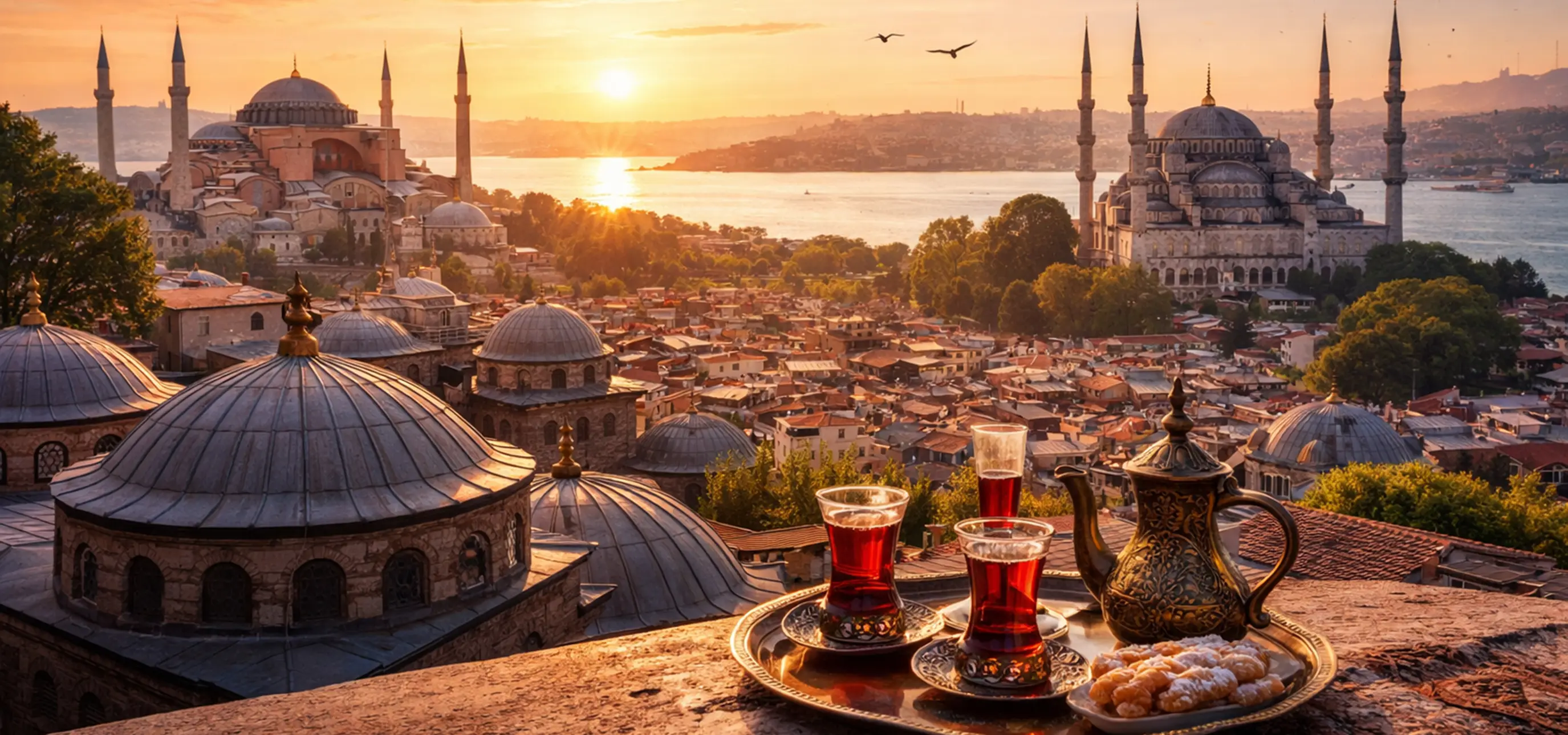
Discover archaeological museums, imperial palaces, Byzantine monuments, Ottoman mosques, historic neighborhoods and Bosphorus landscapes.
View Istanbul GuideCombine the archaeological collections with Istanbul's most important Byzantine and Ottoman monuments.
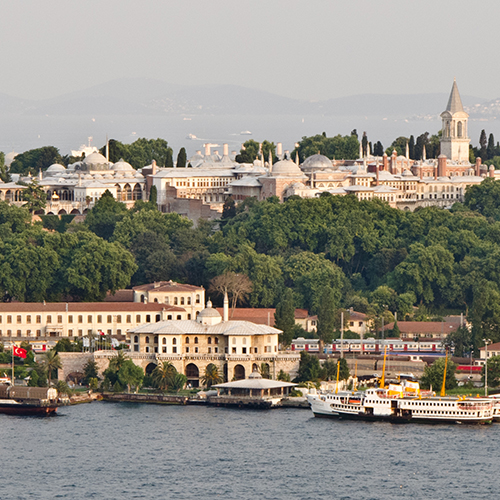
Walk through the courtyards, treasury and ceremonial spaces of the Ottoman dynasty's historic Istanbul residence.
Explore Topkapı Palace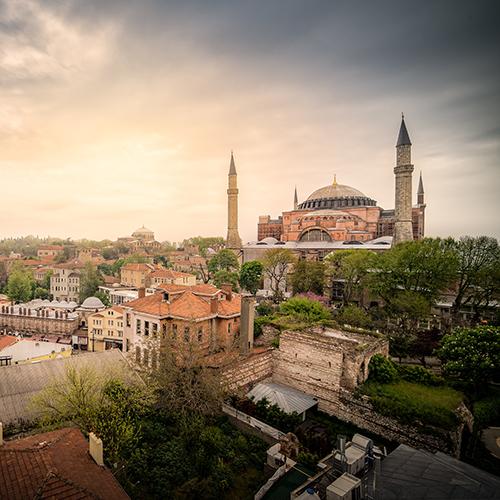
Experience one of the world's most influential monuments, where Byzantine and Ottoman history meet beneath a vast dome.
Explore Hagia Sophia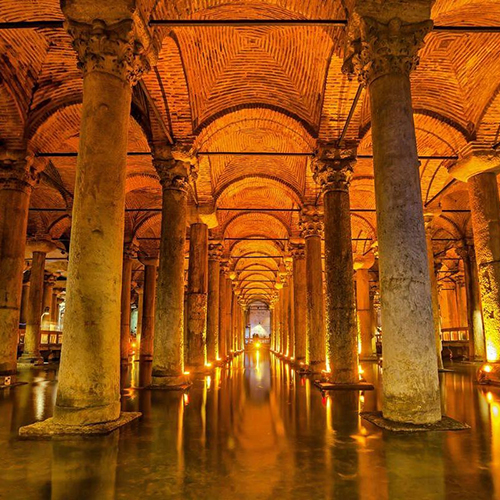
Enter Istanbul's atmospheric underground world of ancient columns, reflected light and Byzantine water engineering.
Explore the Basilica Cistern