Oval & Angular Shape
The geographical-indication application describes the fruit as having an oval yet angular appearance.
- Form: Oval and angular
- Crown: Varies by skin type
- Presentation: Large, striking fruit






İnhisar Pomegranate, locally known as İnhisar Narı, is one of the most characteristic agricultural products of İnhisar district in Bilecik Province. The fruit is associated especially with the local Deve Dişi pomegranate type, appreciated for its large arils, juicy structure, sweet character and distinctive aroma.
İnhisar lies in the Middle Sakarya Valley, where the Sakarya River, relatively low elevation, well-drained slopes and a local microclimate create favourable conditions for pomegranate growing. In the geographical-indication application, the production area is described at roughly 200–400 metres above sea level, with hot, dry summers and comparatively mild winters.
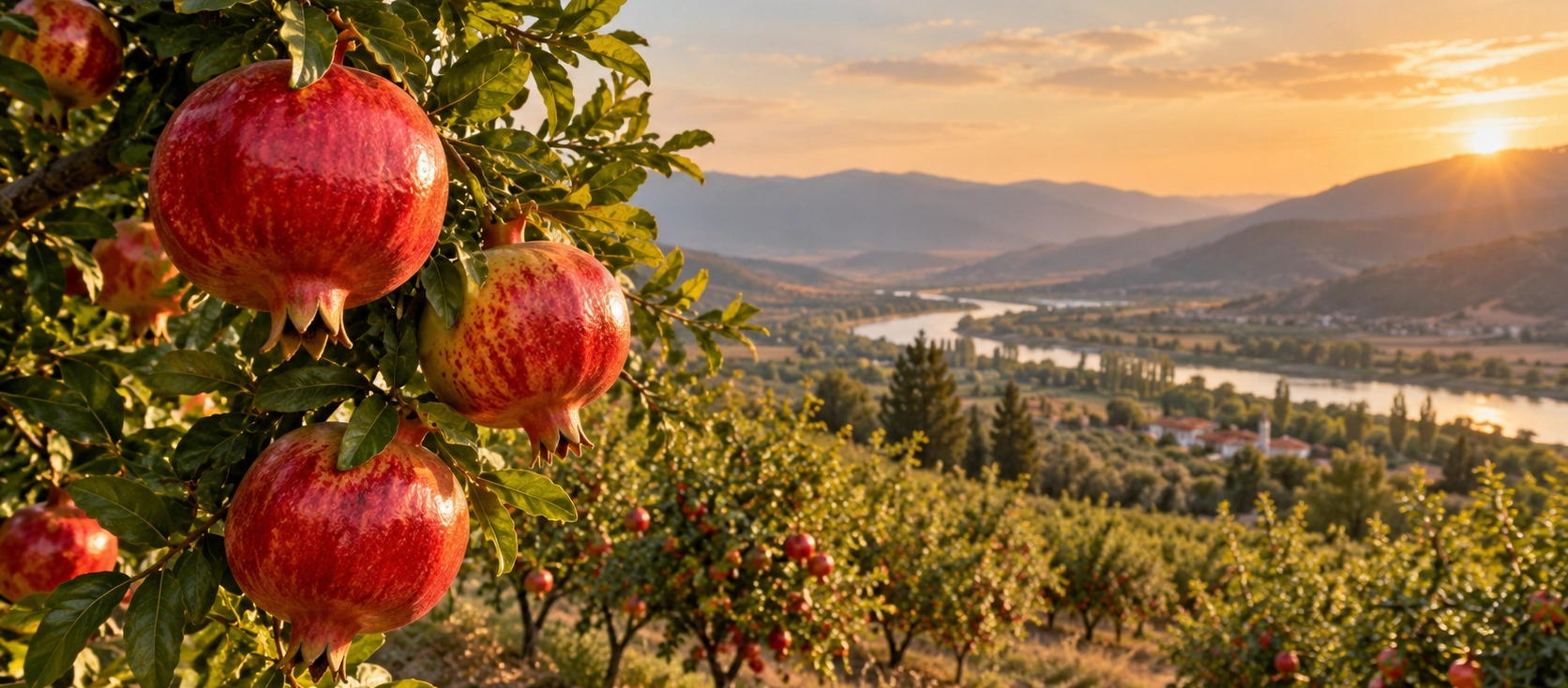
The fruit can vary in colour according to sun exposure. Pomegranates receiving more direct sunlight may develop a dark red to deep pink exterior, while less exposed areas can remain more yellowish. The fruit is described as oval and angular, with large seeds and a flavour combining sweetness, gentle tartness and a lightly astringent finish.
A Turkish geographical-indication application for İnhisar Narı was filed in December 2024 under application number C2024/000372. The application identifies the product as a proposed Menşe Adı — a designation of origin — with the geographical boundary defined as İnhisar district of Bilecik Province.
This complete guide explores İnhisar Pomegranate’s regional identity, Deve Dişi characteristics, colour, flavour, climate, soil, orchard cultivation, flowering, irrigation, harvesting, storage, local processing, pomegranate products, festival culture, buying tips, photography ideas and ways to combine a harvest-season visit with a wider Bilecik journey.
A sweet local pomegranate type especially known for its large arils and juicy fruit.
İnhisar’s river valley and microclimate are central to the fruit’s regional character.
Harvest generally begins in October and may continue into December depending on conditions.
İnhisar Narı is the subject of a Turkish designation-of-origin application filed in 2024.
Essential information about one of Bilecik Province’s best-known agricultural products.
İnhisar district, Bilecik Province, Türkiye.
Open İnhisar on Google MapsPomegranate – Punica granatum L.
Especially associated with the Deve Dişi type.
The Middle Sakarya Valley and İnhisar microclimate.
A local fruit shaped by valley agriculture, orchard knowledge and the microclimate of the Sakarya River.
İnhisar occupies a distinctive agricultural landscape in the Sakarya River valley. While much of Bilecik experiences transitional climatic conditions, the low-lying valley around İnhisar creates a warmer local environment where pomegranates, figs and other fruit crops can thrive.
Pomegranate cultivation has become one of the district’s strongest agricultural identities. The local fruit is commonly associated with the Deve Dişi type, a pomegranate valued for its sweetness, large arils and attractive red colour when well exposed to sunlight.
The relationship between the fruit and the district goes beyond orchard production. Pomegranate harvest is part of local seasonal life, while the fruit is sold fresh and also transformed into products such as juice, Turkish delight, jam, molasses-style preparations and other regional foods.
Local festivals and harvest celebrations have helped make the pomegranate one of the most recognisable symbols of İnhisar. Autumn is especially important, when orchards fill with mature fruit and freshly harvested pomegranates appear in markets and roadside sales.
The geographical-indication application filed in 2024 formalises this connection by defining İnhisar district as the proposed geographical boundary and by describing the fruit’s morphology, taste, production environment and traditional cultivation practices.
Colour, shape, seed size and flavour combine to give İnhisar Narı its recognisable regional identity.
The geographical-indication application describes the fruit as having an oval yet angular appearance.
Sun exposure plays an important role in the exterior colour of the mature fruit.
The local Deve Dişi type is especially known for large internal seeds and generous juicy arils.
The fruit is sweet, aromatic and balanced by a wine-like acidity and a light seed-derived astringency.
The application distinguishes thin-skinned and thick-skinned forms of the local Deve Dişi type.
The local trees are described as relatively dwarf and upright, with comparatively sparse branching.
A geographical-indication application for İnhisar Narı was filed with the Turkish Patent and Trademark Office in December 2024. The application seeks protection as a Menşe Adı, or designation of origin, linking the fruit’s defining characteristics and production method directly with İnhisar district.
The proposed protected name is İnhisar Narı.
The application number is C2024/000372.
The application document is dated 12 December 2024.
The application requests protection as a Menşe Adı.
Processed and unprocessed fruits, vegetables and mushrooms.
The product is identified simply as pomegranate.
The application was submitted by the Bilecik Chamber of Commerce and Industry.
The proposed geographical boundary is İnhisar district, Bilecik.
For website accuracy, it is important to distinguish an application from a completed registration. The available official document identifies İnhisar Narı as a geographical-indication application and describes the proposed production rules and defining characteristics.
İnhisar Pomegranate is a locally grown Deve Dişi-type pomegranate associated with the warm microclimate of İnhisar in Bilecik Province. It is particularly recognised for large arils, a sweet and juicy eating quality, variable red-yellow skin colouring and a flavour that combines sweetness with mild acidity and a slightly astringent finish.
Its sweet character and large juicy arils make it especially attractive for eating fresh.
It is also suitable for juice, confectionery and other pomegranate-based products.
The Sakarya River valley contributes to the warmer and more humid local growing environment.
The main harvest season begins in autumn, with picking continuing in stages as fruits ripen.
Its large seeds and organised internal membranes make the fruit visually distinctive when opened.
Pomegranate growing is closely connected with İnhisar’s identity, seasonal economy and food culture.
The pomegranate’s regional character is closely connected with the Middle Sakarya Valley. İnhisar lies at relatively low elevation and benefits from the moderating influence of the Sakarya River, creating conditions locally associated with warmer growing seasons and reduced temperature extremes.
The geographical-indication application places the production landscape roughly within this elevation range.
Summer temperatures are described as commonly reaching around 30–38°C.
Winter conditions are generally milder than higher surrounding terrain, though occasional frost remains possible.
The river helps moderate the local environment and contributes to humidity balance in the valley.
Warm and comparatively dry summer weather supports colour development and sugar accumulation.
The application describes the local climatic setting as resembling a small Mediterranean pocket.
Climate is only part of the story. The local application also connects İnhisar Pomegranate with sloping, well-drained soils and a soil chemistry suited to pomegranate cultivation.
Sloping terrain helps prevent standing water around the roots and supports healthier orchard conditions.
Lime-rich soils are described as contributing to the fruit’s characteristic aromatic and acidic profile.
The application identifies this range as favourable for healthy root development and nutrient uptake.
Local orchard management may supplement soils with well-rotted animal manure or other organic material.
Good soil permeability is important because pomegranates benefit from moisture without waterlogged roots.
The combination of slope, river influence and cultivated orchard soils shapes the district’s fruit-growing landscape.
The geographical-indication application describes two forms within the locally preferred Deve Dişi type. Both belong to the same regional pomegranate tradition, but their crown shape, skin thickness and durability differ.
Described with a more open, angular crown and a juicier, softer fruit structure.
Described with a thicker, more closed crown and a rounder, more durable structure.
Juicy thin-skinned fruit can be especially appealing when eaten soon after harvest.
Greater skin thickness can help protect fruit during handling and longer-distance transport.
Fruits receiving stronger sunlight can develop deeper red or dark pink colouring.
Not every fruit looks identical; orchard position, sunlight and maturity influence its appearance.
The orchard year follows a clear seasonal rhythm. The geographical-indication application records characteristic periods for leaf emergence, flowering and leaf fall, followed by the long autumn harvest.
The application describes pomegranate production as a sequence of soil preparation, careful planting, controlled irrigation, pruning, orchard monitoring and staged hand harvesting.
New pomegranate saplings are generally planted in spring after suitable soil preparation.
Spacing between young trees allows sunlight penetration, air movement and future canopy development.
Controlled drip irrigation can deliver water directly to the root zone during dry periods.
Weak branches, dry shoots and unnecessary suckers are removed to improve light and airflow.
Balanced pruning helps fruit receive enough light for good colour while avoiding excessive canopy congestion.
Growers observe leaves, branches and developing fruit throughout the season for signs of stress or damage.
Although pomegranate tolerates dry conditions, regular water management is important during flowering and fruit development. The local application describes drip irrigation as a preferred method because it can maintain root-zone moisture while reducing unnecessary water loss.
The main irrigation period corresponds with flowering, fruit growth and the hottest part of the year.
The application mentions irrigation at roughly 10–15 day intervals, adjusted to soil moisture and rainfall.
Too much water can damage roots and reduce fruit quality, making drainage especially important.
Water is directed toward the soil rather than sprayed onto mature fruit whenever possible.
Actual irrigation frequency depends on heat, rainfall, soil type and orchard conditions.
Consistent moisture during development helps the arils become full and juicy before harvest.
Not every fruit on a pomegranate tree ripens at exactly the same moment. In İnhisar, the harvest described in the application is selective and repeated, beginning with mature fruit in the sunniest upper parts of the tree and continuing as lower fruit catches up.
Late-season fruit development is underway and the first mature pomegranates may begin appearing.
This is one of the best months for harvest atmosphere, fresh fruit and local pomegranate events.
Harvest is still active in many orchards and freshly picked fruit remains widely available.
Later harvest rounds may continue depending on weather and fruit maturity.
Carefully stored fruit can remain available after the main orchard harvest has finished.
October and November are especially atmospheric when trees are carrying ripe red fruit.
Pomegranates are naturally durable compared with many soft fruits, but careful handling is still important. The local application describes both traditional hanging methods and cold-storage practices.
Careful cutting protects the fruit and reduces damage during handling.
A traditional method hangs pomegranates in a cool, dry environment so the skin dries while the interior remains protected.
The application notes that traditionally hung fruit can remain in good condition into the winter and, under suitable conditions, as late as March.
Commercial fruit can be stored in cool, humidity-controlled conditions after harvest.
Bruising, punctures and cracking shorten storage life, so careful packing matters.
Boxes and perforated crates help protect the fruit while allowing suitable air circulation.
İnhisar Pomegranate is known primarily as a sweet pomegranate, but its flavour is more layered than simple sugar. The geographical-indication application describes a sweet profile with wine-like acidity, aromatic notes compared with grape and blueberry, and a light astringency associated with the seed.
The Deve Dişi fruit is widely appreciated for a high-sugar, dessert-like eating character.
Large arils release plenty of juice when bitten or pressed.
A gentle tartness keeps the sweetness from tasting flat.
The application compares aspects of the flavour with grape and blueberry-like notes.
The seed can contribute a faintly drying or puckering finish.
Fully ripened fruit offers the richest combination of colour, sweetness and juice.
Fresh eating is the most direct way to appreciate the fruit, but İnhisar’s pomegranate tradition extends into a range of processed products that keep the harvest visible beyond autumn.
Cut open the fruit and eat the juicy arils directly for the clearest expression of the local variety.
Fresh pressing turns the large juicy arils into a deep red seasonal drink.
İnhisar has a local tradition of turning pomegranate flavour into lokum for visitors and regional sales.
The fruit can be cooked into sweet preserves that extend its seasonal life.
Concentrated preparations offer another way to use the fruit in local kitchens.
Local producers may create fruit leather, sauces, sweets and other seasonal pomegranate products.
One of the best-known processed products connected with İnhisar’s pomegranate culture is nar lokumu, or pomegranate Turkish delight. It allows the district’s fruit identity to continue beyond the short fresh-harvest season and has long been promoted as a regional souvenir.
The product connects traditional Turkish confectionery with İnhisar’s most recognisable orchard fruit.
Compared with carrying fresh fruit, packaged lokum can be easier for visitors to take home.
Processed pomegranate products help keep İnhisar’s harvest identity visible outside autumn.
Recipes vary by producer, so visitors with dietary restrictions should always check the label.
Local shops, festival stalls and producers are the most natural places to look for regional versions.
A small piece of pomegranate lokum works naturally as a sweet accompaniment to coffee or tea.
Pomegranate harvest is celebrated locally through autumn festival activities in İnhisar. These events turn the fruit from an agricultural product into a shared cultural symbol, bringing growers, residents and visitors together around harvest-season traditions.
Festival activities naturally coincide with the main pomegranate harvest in October and November.
Visitors can encounter growers and regional products directly during harvest celebrations.
Recent festival programmes have included playful activities such as pomegranate squeezing and stacking contests.
Festival days are a good opportunity to look for pomegranate products and other local Bilecik flavours.
The festival reflects the importance of pomegranate farming to the district’s identity and seasonal economy.
Festival dates can change each year, so travellers should verify the current programme before visiting.
When buying fresh fruit in İnhisar, do not expect every pomegranate to have exactly the same shade of red. Sun exposure influences colour, while skin thickness, crown shape and natural orchard variation can also change the appearance.
The easiest way to appreciate İnhisar Pomegranate is to eat the fresh arils on their own. Its large seeds, sweetness and high juice content make elaborate preparation unnecessary.
Make shallow cuts through the outer peel rather than slicing deeply through the arils.
Gently pull the fruit apart along its natural internal membranes.
Separate the red arils from the pale internal membrane before eating.
Try a few arils alone before using the fruit in salads, desserts or drinks.
Juicy fruit can also be pressed for a naturally sweet seasonal drink.
The local Deve Dişi type can have noticeable seeds inside its large arils.
These months offer the best chance to see active harvests and buy freshly picked fruit.
Yellowish areas can simply reflect lower sun exposure and are part of the fruit’s natural variation.
This is the local name most closely associated with İnhisar’s famous sweet pomegranate type.
Freshly pressed pomegranate juice is one of the simplest ways to experience the fruit’s sweetness and acidity.
Pomegranate Turkish delight makes a practical regional food souvenir.
If travelling specifically for the harvest festival, confirm the current year’s programme in advance.
Avoid puncturing the skin if you plan to transport or store pomegranates.
Combine the food experience with the agricultural landscapes of İnhisar and the wider Sakarya Valley.
Bilecik’s food identity reflects its position between Marmara, Central Anatolia, the Aegean and the western Black Sea transition zone. İnhisar Pomegranate represents the warmer river-valley side of this landscape, where fruit cultivation sits alongside the province’s grain dishes, sweets and distinctive local products.
Another fruit shaped by Bilecik’s river-valley agriculture and warm seasonal conditions.
A sweet regional product showing how local fruit is transformed into travel-friendly confectionery.
A fermented grain drink representing a completely different side of Bilecik’s culinary heritage.
A traditional sweet that can be explored alongside the province’s fruit-based specialities.
A savoury local dish illustrating Bilecik’s home-cooking traditions beyond fruit cultivation.
A local agricultural product reflecting the diversity of Bilecik’s rural food landscape.
A harvest-season visit to İnhisar can become part of a wider Bilecik route combining regional foods, Ottoman heritage, traditional towns and rural landscapes.
Continue a Bilecik fruit route with another product connected to the Sakarya River corridor.
Compare İnhisar’s fresh orchard fruit with a traditional fruit-based confection from Osmaneli.
Discover a traditional fermented drink from another district of Bilecik Province.
Add a classic local sweet to a broader Bilecik gastronomy journey.
Combine regional food discovery with one of Bilecik’s most important historical landmarks.
Continue to Söğüt for a deeper journey into the early Ottoman heritage of Bilecik.
İnhisar Pomegranate, or İnhisar Narı, is a locally grown pomegranate from İnhisar district in Bilecik Province, especially associated with the sweet Deve Dişi type.
İnhisar is a district of Bilecik Province in north-western Türkiye, situated in the Middle Sakarya Valley.
The local fruit is especially identified with Deve Dişi, a sweet pomegranate type with large arils.
An official geographical-indication application has been filed for İnhisar Narı. The available application is numbered C2024/000372.
The application requests protection as a Menşe Adı, or designation of origin.
The application document is dated 12 December 2024.
The proposed geographical boundary is İnhisar district in Bilecik Province.
The application describes it as oval and angular, with skin that can become dark red or deep pink in sunny areas and remain more yellowish in shaded areas.
Sun exposure influences skin colour. Fruit receiving more direct sun generally develops stronger red pigmentation.
It is mainly sweet and juicy, with gentle wine-like acidity, aromatic fruit notes and a light seed-derived astringency.
Yes. Large seeds and generous arils are among the features associated with the local fruit.
The best-known local Deve Dişi type is considered a sweet pomegranate rather than a strongly sour one.
The geographical-indication application describes the local production landscape at approximately 200–400 metres above sea level.
The Sakarya River valley creates a relatively warm microclimate with hot summers, milder winters, suitable soils and good drainage.
The application describes typical summer temperatures in the district as around 30–38°C.
The production application identifies approximately pH 6.0–7.5 as favourable.
Leaf emergence is described as occurring around 15–30 April.
The application places male flowering around the first week of June and female flowering around the second week.
Harvest generally begins in early October and can continue in stages toward mid-December depending on weather and maturity.
Fruit on different parts of the tree ripens at different speeds, so growers may make three or four selective harvest passes.
They are carefully cut by hand from the tree, usually with the stem attached, to protect the skin and storage quality.
Yes. Pomegranates can be kept in suitable cold storage, and the local application also describes a traditional cool, dry hanging method.
The application notes that carefully hung fruit may retain quality into winter and, under suitable conditions, potentially until March.
October and November are excellent choices because they coincide with the heart of the harvest season.
Yes. İnhisar holds autumn pomegranate festival activities celebrating the local harvest, though exact dates should be confirmed each year.
The fruit is eaten fresh and used for products including juice, Turkish delight, jam, syrup-style preparations and other local foods.
It is a local Turkish delight flavoured with or inspired by İnhisar’s pomegranate, promoted as a regional souvenir.
During harvest season, local markets, growers and roadside sellers can be good places to look for freshly harvested fruit.
No. Sun exposure varies, so some parts of the peel may be dark red while shaded areas can remain yellowish.
Osmaneli Watermelon, Osmaneli Quince Delight, Pazaryeri Boza, Pazaryeri Halva and other regional foods make useful additions to a Bilecik gastronomy route.
The strongest images show the relationship between fruit and landscape: red pomegranates hanging on trees, hands cutting ripe fruit, opened arils glowing in natural light and the Sakarya Valley behind the orchards.
Photograph ripe pomegranates while they are still surrounded by leaves and orchard branches.
Capture the careful hand-cutting of a mature fruit from the branch.
Use soft natural light to reveal the large red arils and pale internal membranes.
Show how one fruit can carry both deep red and more yellowish tones.
A wider composition helps connect the fruit with İnhisar’s agricultural valley landscape.
Autumn stalls, fruit towers and baskets can communicate the scale of the seasonal harvest.
Combine İnhisar’s pomegranate orchards, regional foods, Ottoman heritage and rural landscapes on a private journey designed around your interests.
Custom-designed private journeys with flexible timing, private transportation and opportunities to discover İnhisar Pomegranate, local fruit products, village flavours, Söğüt, Bilecik’s early Ottoman heritage and seasonal rural landscapes.
Explore İnhisar during pomegranate season with orchard landscapes, fresh fruit tasting, local products and a flexible route through the Sakarya Valley.
Request This Tour
Combine İnhisar’s pomegranate culture with Bilecik, Söğüt, Osmaneli or Pazaryeri for a private journey linking regional food with the province’s historical heritage.
Request This Tour