Private Bilecik Gastronomy Discovery
Explore Bilecik’s local dishes, geographically indicated products, traditional sweets and agricultural heritage on a flexible private food-focused route.
Request This Tour





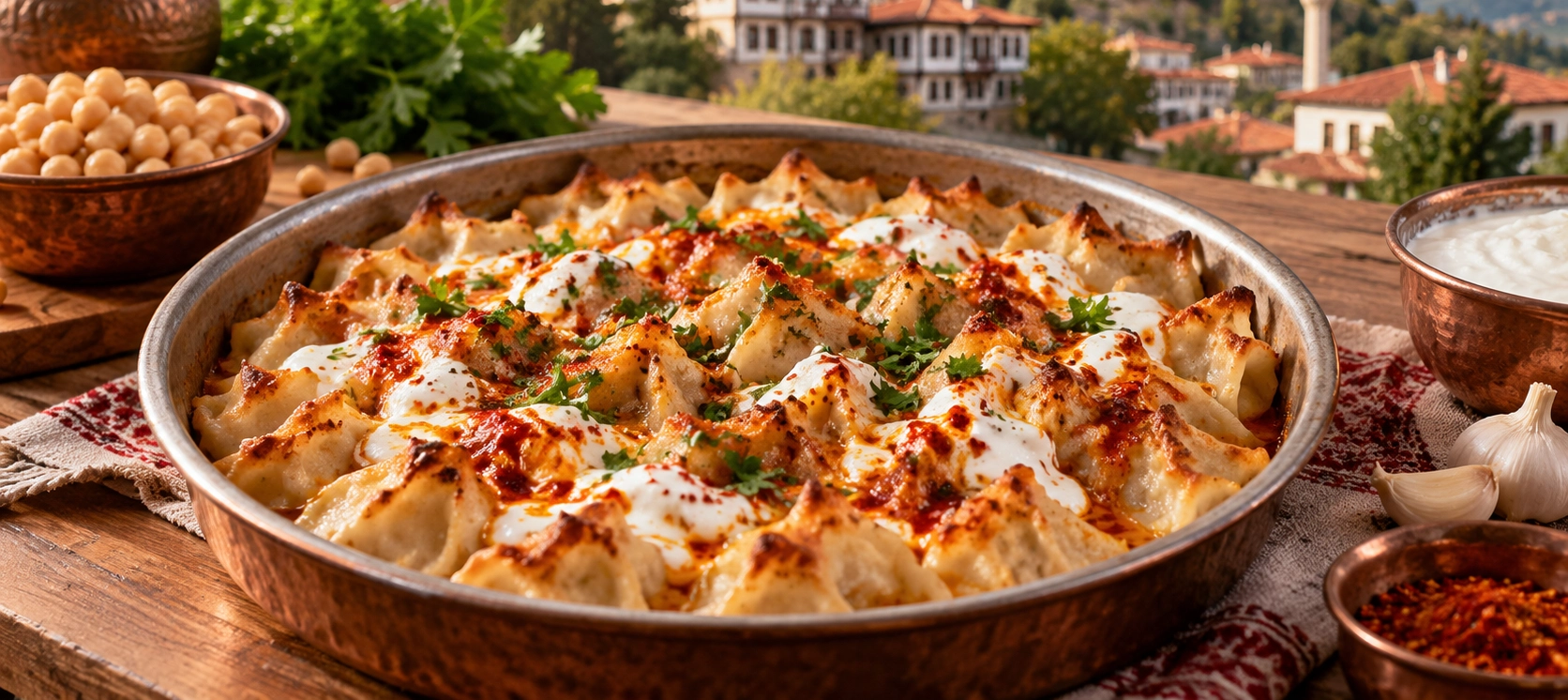
Bilecik Nohutlu Mantı, known in Turkish as Bilecik Nohutlu Mantısı, is one of the most distinctive dough dishes of Bilecik Province in northwestern Türkiye. Instead of the minced-meat filling associated with many better-known forms of mantı, this regional version is filled with boiled chickpeas seasoned with salt and black pepper.
Its preparation is equally distinctive. Thinly rolled dough is cut into small squares, filled with chickpea mixture and folded by hand into small bohça, or bundle-like, shapes. The mantı is then arranged on a tray and baked rather than boiled in water.
After the first baking, hot chicken broth and/or meat broth is poured over the tray and the mantı returns to the oven so that the dough can absorb the liquid. It is finished with a butter-and-paste sauce, garlic yogurt and, optionally, parsley.
The dish received official Turkish geographical-indication protection in 2025. Its registration recognises the connection between the recipe, the preparation skills required to make it and the culinary traditions of Bilecik Province.
This complete guide explores the history of Bilecik Nohutlu Mantı, its geographical-indication status, ingredients, dough, chickpea filling, hand-folding technique, oven cooking, broth stage, sauces, flavour, texture, serving traditions, visitor tips and its place within the wider gastronomy of Bilecik.
Bilecik Nohutlu Mantısı has been a registered Turkish geographical indication since March 2025.
The traditional filling is made from boiled chickpeas seasoned simply with salt and black pepper.
The registered preparation is baked in the oven rather than cooked by boiling in water.
After baking, broth is added before the mantı is finished with garlic yogurt and a savoury butter-based sauce.
Essential information about one of Bilecik Province’s best-known traditional dough dishes.
Bilecik Province, northwestern Türkiye.
Open Bilecik on Google MapsBoiled chickpeas seasoned with salt and black pepper.
Bilecik Nohutlu Mantısı – geographical indication registration no. 1709.
Tray-baked, moistened with broth and returned to the oven before serving.
A handmade mantı tradition shaped by Bilecik’s grain-based cuisine, legumes and shared family tables.
Traditional Bilecik cuisine gives an important place to flour-based dishes, homemade dough, grains and legumes. Mantı, noodles, tarhana, kuskus and other foods prepared by hand have long formed part of the province’s domestic food culture.
Bilecik Nohutlu Mantı reflects that tradition in a particularly distinctive way. Its filling replaces minced meat with boiled chickpeas, while the cooking method relies on oven baking and a later broth stage rather than boiling the parcels directly in water.
The official geographical-indication registration describes the dish as having an established place in the culinary culture of Bilecik. It is eaten in everyday meals but is also associated with gatherings and important occasions.
Weddings, religious holidays, festivals, military send-offs and guest hospitality are among the occasions specifically connected with the dish in the registered description. Preparing a large tray also lends itself naturally to communal cooking and shared tables.
The dish’s long-standing reputation, handwork and local preparation method led to its registration as a Turkish geographical indication in 2025, giving official recognition to one of Bilecik’s characteristic regional foods.
Bilecik Nohutlu Mantısı is a regional mantı made from thinly rolled wheat-flour dough filled with seasoned boiled chickpeas. The filled squares are folded by hand into small bundles, arranged on a greased tray and baked until lightly browned.
The baked mantı is then moistened with chicken broth and/or meat broth and returned to the oven. After it absorbs enough liquid, it is served hot with a cooked butter-and-paste sauce and garlic yogurt.
Flour, water, eggs and salt are kneaded into a smooth dough and rolled thinly with a rolling pin or oklava.
Boiled chickpeas are mixed with salt and black pepper to create the traditional filling.
The rolled dough is cut into small squares before filling.
Opposite corners are brought together to create the bundle-like form described in the registered method.
The mantı is baked on trays rather than boiled directly in water.
Broth, savoury sauce and garlic yogurt give the finished dish its characteristic flavour and texture.
The regional identity of Bilecik Nohutlu Mantı was formally recognised when Bilecik Nohutlu Mantısı received Turkish geographical-indication registration on 5 March 2025.
The registration links the dish with Bilecik through its long-standing local reputation, ingredients, preparation method and the hand skills required to roll, cut, fill, fold and bake the mantı correctly.
The registered specification also requires the production stages associated with the protected Bilecik Nohutlu Mantısı to take place within Bilecik Province.
The filling is based on boiled chickpeas, salt and black pepper, giving the dish a clearly different identity from many meat-filled mantı varieties.
The registered method specifically distinguishes the dish by baking it rather than boiling it in water.
Each small square is filled and pinched into a bundle shape by hand.
Chicken broth and/or meat broth is added after the first baking so that the mantı absorbs flavour and moisture.
A generous garlic-yogurt finish provides cool creaminess against the warm baked dough and chickpea filling.
Butter, tomato and/or pepper paste and red pepper form the warm sauce poured over the mantı.
The protected specification uses a relatively simple ingredient list, but the finished dish develops complexity through its different preparation stages. The dough, filling, broth, yogurt and cooked sauce each contribute a separate layer.
Special-purpose wheat flour forms the structure of the mantı dough.
Eggs enrich the dough and help create an elastic texture suitable for rolling thinly.
Water is incorporated gradually while kneading until the dough becomes smooth and cohesive.
Boiled chickpeas form the defining filling of Bilecik Nohutlu Mantı.
Black pepper seasons the chickpea filling and adds gentle warmth.
Hot broth is poured over the baked mantı before the tray returns to the oven.
Garlic yogurt is spooned over the finished mantı immediately before serving.
Butter forms the rich base of the finishing sauce.
Paste brings colour, savoury depth and a concentrated Turkish flavour to the sauce.
Ground red pepper and/or chilli flakes add colour and gentle warmth.
Salt seasons both the dough and chickpea filling.
Fresh parsley may be added as an optional garnish when serving.
The registered production method is a multi-stage process. What makes the dish especially interesting is that baking, broth absorption and saucing happen separately, allowing the dough to develop roasted flavour before it softens.
The dough must be strong enough to hold the chickpea filling but flexible enough to roll into thin sheets without tearing. The registered method therefore emphasises careful kneading and resting.
The finished dough should be smooth, homogeneous and elastic rather than sticky or crumbly.
Water is added little by little during kneading so the consistency can be controlled.
Resting relaxes the dough and makes the later rolling stage easier.
The dough portions are rolled into thin yufka-like sheets before cutting.
Uniform cutting helps the pieces cook at a similar rate and creates an orderly tray.
Rolling, cutting and folding without tearing the dough are skills specifically associated with the dish.
The filling is intentionally simple: boiled chickpeas, salt and black pepper. That simplicity keeps the taste of chickpea at the centre of the dish while allowing the broth, yogurt and sauce to build flavour later.
Soft cooked chickpeas provide the substance of the filling.
The ingredients are mixed until the filling becomes soft and cohesive enough to portion easily.
Black pepper gives the otherwise mild chickpea filling a warm aromatic note.
The registered filling does not depend on a long spice list; chickpea remains the dominant flavour.
Approximately 2 g of filling is used for each square in the registered method.
The amount must be enough to taste clearly but small enough for the corners to close securely.
The characteristic form is made by bringing opposing corners of the filled dough square together and pinching them so that the filling is enclosed. The registered description refers to this as a bohça, meaning a small bundle or parcel.
The chickpea mixture is placed in the middle so the corners remain clean enough to seal.
The corners are brought toward the centre to create the compact parcel form.
A good seal helps keep the filling inside during baking and broth absorption.
Thin dough must be handled carefully so that the square does not split during folding.
Similar-sized pieces create a neater tray and more even baking.
The repeated folding process gives the finished tray its distinctive handmade appearance.
Unlike boiled mantı, the registered Bilecik method develops colour in the oven before any broth is added. The parcels are spread across a sufficiently large greased tray so that they are not compressed tightly against one another.
The tray is lightly greased before the folded mantı is arranged.
Leaving room around the pieces helps them keep their shape and bake more evenly.
The registered specification gives this oven-temperature range for the first baking.
The initial baking continues for approximately half an hour.
The first stage is complete when the baked mantı develops a light-brown appearance.
Browning creates a flavour and texture profile very different from mantı cooked only in boiling water.
Once the mantı has browned, the tray is removed from the oven and chicken broth and/or meat broth is poured over it. This second stage softens the baked dough while preserving the flavour developed during the first baking.
Broth adds moisture and savoury depth to the baked parcels.
The registered method allows chicken broth, meat broth or a combination.
After broth is added, the tray returns to the oven.
The mantı is baked for roughly ten additional minutes.
The goal is for the mantı to take in sufficient broth rather than remain submerged like soup.
This method creates tender dough while retaining some of the character of the oven-baked surface.
The finishing sauce is prepared separately by combining butter, water, tomato and/or pepper paste and ground or flaked red pepper. It is cooked until the ingredients come together into a rich, colourful sauce.
Butter gives the sauce richness and helps carry the flavour of the paste and pepper.
Tomato paste can contribute sweetness, acidity and deep red colour.
Pepper paste may be used for a deeper savoury and distinctly Anatolian flavour.
Ground red pepper and/or chilli flakes add colour and gentle warmth.
A small amount of water helps loosen the sauce so that it can spread across the tray.
The sauce is poured so that it reaches the mantı across the tray rather than remaining in one area.
Garlic yogurt is an essential part of the serving style described in the registered recipe. Its cool, tangy creaminess balances the warm chickpea filling, buttery sauce and broth-softened dough.
Thick yogurt creates a creamy coating across the warm mantı.
Garlic adds a sharp aromatic note that cuts through the richness of butter and broth.
The yogurt is added when the mantı is ready to be served rather than before baking.
If the cooked mantı will not be eaten immediately, the registered guidance says not to add the sauce or garlic yogurt yet.
The temperature contrast is one of the pleasures of serving the dish freshly prepared.
Fresh parsley may be scattered over the top as an optional finishing touch.
Bilecik Nohutlu Mantı combines the earthy, mild flavour of chickpeas with the roasted character of baked dough, savoury broth, rich butter, concentrated tomato or pepper paste and cool garlic yogurt.
The filling has a gently nutty, earthy flavour that remains recognisable beneath the toppings.
The oven stage adds toasted notes not normally found in purely boiled mantı.
Chicken or meat broth adds depth and seasons the dough from within.
The warm finishing sauce brings richness and a smooth mouthfeel.
Garlic yogurt adds freshness, acidity and creaminess.
Black pepper in the filling and red pepper in the sauce add warmth without overpowering the chickpea.
After absorbing broth, the baked dough becomes tender while retaining the character developed in the oven.
The boiled chickpea mixture gives the centre a soft, substantial texture.
Correct folding and tray spacing help each mantı retain its individual bundle shape.
Garlic yogurt coats the warm parcels with a cool, smooth layer.
The cooked sauce spreads across the yogurt and dough without hiding the shape of the mantı.
The broth is largely absorbed during the second oven stage rather than remaining as a large amount of liquid.
Travellers familiar with tiny minced-meat mantı served with garlic yogurt may be surprised by the Bilecik version. The two belong to the same broad Turkish dumpling tradition, but the filling, size, shaping and cooking technique are notably different.
Bilecik’s protected version uses boiled chickpeas instead of minced meat.
The parcels are browned in the oven rather than dropped directly into boiling water.
Broth is introduced only after the first oven stage.
The square pieces are shaped into visible bundles rather than extremely tiny dumplings.
The filling produces a milder, earthier centre that works especially well with yogurt and sauce.
The protected recipe is specifically connected with Bilecik Province.
Bilecik’s traditional food culture is strongly associated with grains, handmade dough dishes, legumes, soups, cereals and foods prepared at home for both everyday meals and communal occasions.
Handmade dough dishes occupy an important place in the traditional cuisine of the province.
Chickpeas provide a filling, practical ingredient that fits naturally into rural Anatolian cooking.
Rolling, cutting, filling and folding many small pieces is well suited to communal preparation.
The dish is associated with weddings, holidays, festivals, military send-offs and guest hospitality.
Despite its connection with celebrations, it is also part of ordinary local meals.
The geographical indication now provides an official reference for preserving the dish’s regional identity.
Chickpea-filled dumplings or baked mantı may appear in different home recipes, but the protected Bilecik dish is identified by a specific combination of dough, filling, hand-folding, oven baking, broth absorption and serving style.
Wheat-flour dough, boiled chickpea filling, oven baking, broth, sauce and garlic yogurt define the registered method.
A version cooked entirely in water uses a different preparation method.
Minced-meat mantı belongs to another widespread family of Turkish recipes.
Other regions may use open, boat-shaped, triangular or tiny closed mantı forms.
The post-baking broth stage is an important part of the Bilecik preparation.
The combination of garlic yogurt and cooked butter-paste sauce completes the regional dish.
Bilecik Nohutlu Mantı is recommended to be served hot. Once the baked parcels have absorbed enough broth, they are transferred to a serving plate or served from the tray, then topped with sauce and garlic yogurt.
The dish is at its best while the broth-softened dough and butter sauce are still warm.
Yogurt is added directly before serving for the freshest texture.
The butter, paste and pepper sauce adds colour and richness across the top.
Fresh parsley can be used as a simple garnish.
A full tray makes an especially attractive presentation for family meals and group dining.
Serving promptly preserves the contrast between warm mantı, sauce and cool yogurt.
Bilecik Nohutlu Mantı is a regional speciality and should not be assumed to appear on every restaurant menu. Traditional restaurants, local food businesses, special events and establishments focusing on Bilecik cuisine are the best places to ask.
Using the Turkish name makes it easier to distinguish the dish from standard meat-filled mantı.
Because handmade mantı requires preparation time, availability may vary from day to day.
Restaurants promoting local dishes are more likely to know the regional preparation.
The protected Bilecik style should be baked rather than simply boiled in water.
The traditional protected filling is based on boiled chickpeas, salt and black pepper.
Use the meal as part of a wider exploration of Bilecik’s sweets, fruit products, agricultural specialities and other regional dishes.
The dish is most enjoyable when the broth, sauce and yogurt are added close to serving time.
Ask whether the mantı is the chickpea-filled, oven-baked Bilecik style.
The registered serving recommendation is to enjoy the mantı hot.
The small bundle shape reflects the handwork involved in the traditional preparation.
Take each bite with chickpea filling, yogurt and sauce to experience the complete flavour profile.
A full tray of neatly arranged mantı parcels is one of the most characteristic visual elements of the dish.
Continue with boza, halva, lentil ravioli, quail kebab and local fruit products.
Handmade regional dishes are best enjoyed as part of a relaxed meal rather than a rushed stop.
Photograph the whole tray from above to show the repeated handmade bundle shapes.
Use a macro-style close-up to reveal the pinched corners and hand-folded structure.
Open one piece carefully so the unusual chickpea centre is clearly visible.
White yogurt and red butter-paste sauce create strong natural visual contrast.
Hands, an oklava and a floured work surface communicate the craftsmanship behind the dish.
Capture broth being poured over the browned tray to explain the unusual two-stage cooking method.
Bilecik Nohutlu Mantı belongs to a culinary landscape where handmade dough dishes sit beside meat dishes, fermented grain drinks, traditional sweets, orchard produce and distinctive agricultural products.
A geographically indicated oven-finished quail dish prepared with vegetables, butter and a rich savoury sauce.
A traditional fermented grain drink closely associated with the Pazaryeri district.
A regional sweet representing another important part of Bilecik’s food heritage.
Another dough-and-legume speciality showing how important pulses are in local home cooking.
A celebrated fruit from the warmer valleys of southern Bilecik.
Quince-growing traditions connect Bilecik gastronomy with the province’s orchard landscapes.
Discover another geographically indicated dish from Bilecik, prepared with whole quail, vegetables and a rich oven-finished sauce.
Explore the remarkable hop-growing landscape of Pazaryeri and one of Bilecik’s most unusual agricultural products.
Explore a traditional fermented grain drink closely associated with the district’s food culture.
Add a traditional local sweet to your Bilecik gastronomy itinerary.
Compare another Bilecik dough dish built around legumes and home-style cooking.
Continue your journey through the distinctive agricultural products of Bilecik Province.
Explore the famous pomegranate-growing landscape of the Middle Sakarya Valley.
Add another fruit-based Bilecik speciality to a province-wide food journey.
Explore the archaeological and cultural history of the province before or after discovering its cuisine.
Visit one of Bilecik’s important historical landmarks as part of a city-centre route.
Add a peaceful waterside and nature stop to your gastronomic day in Bilecik.
Continue toward Söğüt for a deeper introduction to the region’s early Ottoman history.
Combine food culture with twentieth-century history on a wider Bilecik and Bozüyük journey.
Ask us to combine local cuisine, historical sites, villages and countryside into a private itinerary.
Bilecik Nohutlu Mantı is a traditional Bilecik dish made from thinly rolled dough filled with seasoned boiled chickpeas, folded by hand, baked in the oven, moistened with broth and served with sauce and garlic yogurt.
Its protected Turkish name is Bilecik Nohutlu Mantısı.
Yes. Bilecik Nohutlu Mantısı was officially registered as a Turkish geographical indication on 5 March 2025.
The registration number is 1709.
It is registered as a mahreç işareti.
The registration holder is the Bilecik Chamber of Commerce and Industry.
The geographical boundary of the protected dish is Bilecik Province.
The registered filling uses boiled chickpeas, salt and black pepper.
The defining protected filling is chickpea-based rather than minced meat.
No. The registered preparation specifically uses oven baking rather than boiling the mantı in water.
The registered method specifies approximately 180–200°C for the first oven stage.
The mantı is baked for approximately 30 minutes, until it develops a light-brown colour.
Chicken broth and/or meat broth softens and flavours the baked parcels while allowing them to absorb savoury liquid.
The tray returns to the oven for approximately 10 minutes.
The filled square is closed by bringing opposing corners together into a bundle-like form known as a bohça.
The registered production method describes approximately 2 g of chickpea filling per square.
Yes. Garlic yogurt is added to the finished mantı at serving time.
A cooked sauce made from butter, water, tomato and/or pepper paste and red pepper is poured over the mantı.
Parsley is optional and may be added as a garnish during service.
Yes. The registered guidance recommends serving and eating it hot.
It is eaten in everyday meals and is also associated with weddings, holidays, festivals, military send-offs and guest hospitality.
The registered guidance says that if the mantı will not be consumed immediately, the sauce and garlic yogurt should not yet be added.
Yes. The registered method allows the prepared pieces to be frozen under cold-chain conditions at -18°C or below when they are not cooked immediately.
No. It is a regional speciality and menu availability can vary, so checking in advance is useful.
You can continue with Bilecik Quail Kebab, Pazaryeri Boza, Pazaryeri Halva and Bozüyük Lentil Ravioli.
The province has distinctive products including Bilecik Hops, İnhisar Pomegranate, Çukurören Pepper, quince and other local produce.
Yes. It can be combined with Bilecik’s geographically indicated foods, markets, agricultural products, villages and historical attractions to create a broader regional food journey.
Bilecik offers a varied regional table of handmade dough dishes, protected foods, traditional sweets and local agricultural products alongside important historical sites and countryside.
The strongest images should communicate the handmade process as clearly as the finished plate. The folded parcels, oven tray, chickpea filling, broth stage, garlic yogurt and red sauce all help distinguish this dish visually from ordinary mantı.
Show a generous tray of mantı topped with garlic yogurt, butter sauce and a light parsley garnish.
A close-up of fingers bringing the dough corners together communicates the craftsmanship behind the dish.
Photograph the seasoned chickpea mixture beside cut dough squares before folding.
Capture the tray just after the first bake, before broth is added, to show the light-brown colour.
Show hot broth being poured over the browned mantı to explain the dish’s unusual preparation method.
Use a slightly raised angle to capture the contrast between white garlic yogurt and red butter-paste sauce.
Combine Bilecik’s traditional cuisine with Ottoman heritage, village culture, local agricultural products and peaceful countryside on a private journey designed around your interests.
Custom-designed private journeys with flexible timing, private transportation and opportunities to explore regional food traditions, historical sites, agricultural landscapes and lesser-known corners of Bilecik Province.
Explore Bilecik’s local dishes, geographically indicated products, traditional sweets and agricultural heritage on a flexible private food-focused route.
Request This Tour
Combine Bilecik city, Söğüt, Bozüyük, Pazaryeri, Osmaneli or İnhisar on a private route linking history, local cuisine, landscapes and village culture.
Request This Tour