Lamb Ingredients
The registered product is prepared using intestinal parts and internal fats obtained from lambs.






Balıkesir Göbel Kuzu Kokoreci, also registered under the name Balıkesir Kuzu Kokoreci, is one of the most distinctive meat specialities of Balıkesir in western Türkiye. Its reputation is particularly connected with Göbel, a neighbourhood of Susurluk where this style of kokoreç became widely produced and strongly identified with local food culture.
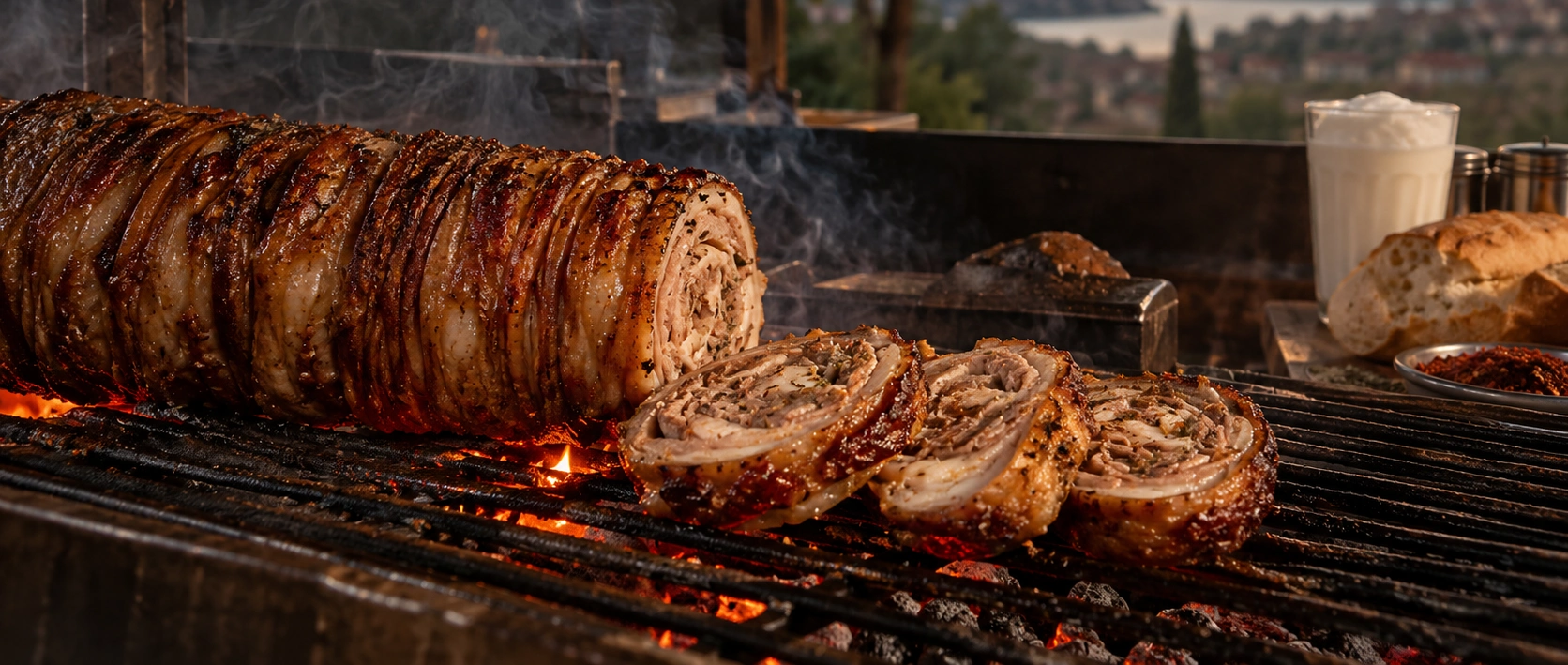
Unlike a simple chopped offal dish, Göbel kokoreç begins with carefully prepared lamb intestines and internal lamb fat arranged in layers around a skewer. The centre is formed from fat and large intestine, while cleaned small intestine is tightly wrapped around the outside. The resulting roll is heat-treated, rested and traditionally prepared for later cooking over a suitable grill.
The importance of the tradition is formally recognised through Turkish geographical-indication protection. Balıkesir Göbel Kuzu Kokoreci / Balıkesir Kuzu Kokoreci is registered as a Mahreç İşareti, protecting a production method and reputation associated with Balıkesir.
The product takes its familiar name from Göbel in Susurluk, the locality most closely associated with its historical reputation.
Large intestine and lamb fat form the centre while small intestine is carefully wrapped around the outside.
Balıkesir Göbel Kuzu Kokoreci is officially registered in Türkiye as a Mahreç İşareti geographical indication.
The prepared kokoreç is cooked until hot and browned, then sliced and finished on a grill or pan before serving.
Essential information about one of Balıkesir's most characteristic meat specialities.
Göbel, in Susurluk district of Balıkesir Province.
Open Göbel on Google MapsA rolled lamb kokoreç made with carefully prepared intestines and internal lamb fat.
Cooked thoroughly, sliced and commonly finished over a grill or in a pan before being served hot.
TÜRKPATENT geographical-indication registration number 1406, registered as a Mahreç İşareti.
Göbel kokoreç reflects the livestock traditions, butchery skills and fire-based cooking culture that have long shaped the food of inland Balıkesir.
Balıkesir has a particularly strong relationship with livestock farming and lamb. Across the province, meat, dairy products and traditional methods of using different parts of an animal have contributed to a remarkably varied regional cuisine.
Göbel kokoreç belongs to this practical culinary tradition. Its preparation turns carefully cleaned lamb intestines and internal fat into a compact roll that can be cooked gradually and then sliced into individual portions.
The official geographical-indication registration specifically connects the product's historical reputation with Göbel Mahallesi in Susurluk. Its widespread production there caused the food to become known among consumers as Göbel Kuzu Kokoreci, even though the protected geographical boundary covers Balıkesir Province.
The technique requires much more than simply placing ingredients on a skewer. Selecting and cleaning the intestines, arranging the centre, wrapping the outer layers evenly, controlling the initial heating and preparing the product for storage all demand experience.
Today, Göbel kokoreç is an important part of Balıkesir's growing gastronomic identity and a particularly interesting food for travellers exploring Susurluk beyond its famous ayran and toast.
Its identity comes from its lamb ingredients, layered construction, tightly controlled preparation and the craftsmanship involved in forming an even kokoreç roll.
The registered product is prepared using intestinal parts and internal fats obtained from lambs.
Internal lamb fat and large intestine are wrapped together to form the central part of the kokoreç roll.
Small intestine is then wrapped around the centre until the inner section is completely covered.
The ingredients are carefully formed around food-safe skewers to produce the familiar cylindrical roll.
An initial heat-treatment stage helps prepare the assembled kokoreç before cooling and subsequent storage.
An even outer layer is important because the wrapping influences both cooking and the texture of each finished slice.
After final cooking, individual slices can be browned further so that their exposed surfaces develop additional colour and texture.
Chilli, cumin, thyme and salt may be added according to the diner's preference rather than overpowering the lamb itself.
Göbel Kuzu Kokoreci is a traditional rolled lamb kokoreç associated especially with Göbel in the Susurluk district of Balıkesir. The registered name is Balıkesir Göbel Kuzu Kokoreci / Balıkesir Kuzu Kokoreci.
At its core, it is made by organising cleaned lamb intestines and internal fat into a layered cylindrical form. Rather than treating every component as a chopped filling from the beginning, the Göbel method creates a structured roll whose layers remain visible when the finished kokoreç is sliced.
Kokoreç belongs to Türkiye's offal tradition and uses carefully cleaned intestinal components rather than conventional cuts such as chops or steaks.
The identity of Göbel kokoreç begins with the construction of a wrapped roll before the product reaches its final serving stage.
The inner fat and large intestine are surrounded by an outer wrapping of small intestine.
Uniform wrapping, careful cleaning, temperature control and correct final cooking are central to the registered method.
For a visitor encountering it for the first time, the easiest way to understand Göbel kokoreç is as a carefully layered lamb speciality designed for grilling and slicing. The preparation process is as important to its identity as the ingredients themselves.
Balıkesir Göbel Kuzu Kokoreci / Balıkesir Kuzu Kokoreci is registered by the Turkish Patent and Trademark Office as a Mahreç İşareti, formally recognising the product's reputation and production tradition in Balıkesir.
Balıkesir Göbel Kuzu Kokoreci / Balıkesir Kuzu Kokoreci
TÜRKPATENT geographical-indication registration number 1406.
The geographical-indication application number is C2022/000445.
The application was submitted on 14 December 2022.
The product was registered on 10 July 2023.
The registration holder is Balıkesir Metropolitan Municipality.
The registered geographical boundary is Balıkesir Province. The registration explains that the product's particularly strong connection with Göbel comes from its historical production and reputation there.
An important detail is that preparation stages other than the final cooking and service must take place within the defined geographical boundary. This connects the registered product not simply to a recipe, but to a production tradition carried out within Balıkesir.
The geographical-indication specification gives a straightforward ingredient list for an approximately three-kilogram kokoreç roll. What makes the product distinctive is the way these components are selected, cleaned and assembled.
The registered formula uses approximately 1–1.5 kg of lamb small intestine, primarily for wrapping the exterior of the roll.
Approximately 1 kg of lamb large intestine, also known locally as bumbar, forms part of the central structure.
Internal lamb fat known locally as çöz yağı may be used to create richness and form part of the inner core.
Caul fat, known as gömlek yağı, can also be used in the registered preparation together with or instead of part of the çöz yağı quantity.
The registered identity depends primarily on the lamb components and production technique rather than a complicated marinade.
Chilli, cumin, thyme and salt may be added later according to preference.
The quantities can be increased or reduced proportionally when producers prepare different-sized rolls, provided the registered relationship between the components is maintained.
The wrapping method is one of the most important features of Göbel kokoreç. The roll is constructed from the inside outward, producing a compact centre surrounded by multiple turns of lamb small intestine.
When the kokoreç is later sliced across the roll, this layered construction produces the characteristic ring-like cross-section that makes Göbel-style kokoreç particularly recognisable.
The official method describes a carefully controlled sequence covering cleaning, wrapping, heat treatment, cooling, chilling and freezing before the final cooking stage.
A particularly interesting part of the Göbel method is that the newly wrapped roll undergoes an initial heat-treatment stage before it is cooled and frozen.
According to the registered specification, the assembled rolls are placed so that they do not touch each other and are exposed to approximately 250–260°C for around 30 minutes.
Heating helps stabilise the carefully wrapped structure before the kokoreç moves into cooling and storage.
This initial heating is specifically included within the registered preparation method.
After this stage, the kokoreç is left to cool before further refrigeration and freezing.
The registered product still requires suitable final cooking before it is eaten.
Freezing is an integral part of the registered production sequence. Following the initial heating and cooling stages, the prepared kokoreç is chilled and then frozen or quick-frozen according to the producer's facilities.
The final cooking stage transforms the firm prepared roll into the richly browned kokoreç served at the table. Once safely thawed, it may be placed back on skewers as a complete roll or cooked in sliced form.
The geographical-indication specification recommends suitable kokoreç grills and notes a preference for wood or charcoal fire.
Frozen kokoreç should be thawed while observing appropriate food-hygiene requirements.
The product may be grilled as a roll or divided into slices depending on the serving method.
The registered description particularly mentions wood or charcoal fire as preferred cooking options.
The cooked roll can be divided into portions of the desired thickness.
The inner surfaces of the slices can be cooked for approximately five additional minutes on a grill or pan.
The registered specification recommends enjoying the finished kokoreç while hot.
Göbel kokoreç has a rich lamb character created by the combination of intestine, internal fat and intense grilling. The flavour is savoury and full-bodied, while browning over the grill adds roasted notes to the exterior.
The final experience depends heavily on cooking. Properly prepared slices contrast a browned exterior with a softer, richer centre, while optional herbs and spices can add warmth without hiding the flavour of the lamb.
Internal lamb fat gives the kokoreç its characteristic richness and carries flavour through the layered roll.
This is a deeply meat-forward speciality rather than a dish based primarily on sauce or marinade.
Direct grilling creates browned surfaces and pronounced roasted aromas.
The product's identity remains closely tied to the characteristic flavour of lamb.
Chilli, cumin, thyme and salt can modify the final profile according to personal preference.
The contrast of rendered fat, browned surfaces and tender inner layers is at its most expressive immediately after cooking.
Texture is one of the main pleasures of properly cooked kokoreç. Because Göbel kokoreç is constructed in layers rather than as a homogeneous mixture, a single slice can offer several different sensations.
The outer intestine becomes increasingly browned as it cooks close to the heat.
The centre remains richer and softer because it contains the large intestine and internal fat.
Cross-cut slices reveal the wrapped structure of the kokoreç rather than appearing completely uniform.
Heat gradually renders part of the internal fat, contributing moisture and richness.
Searing individual slices increases the contrast between browned surfaces and the inner layers.
The characteristic texture is easiest to appreciate while the portion is still hot.
Göbel kokoreç does not need an elaborate spice mixture. The official registration lists several seasonings that may be added according to the preference of the person eating it.
Chilli or red pepper can add heat and complement the richness of the lamb fat.
Cumin brings an earthy aroma commonly associated with grilled meat and offal dishes in Türkiye.
Thyme contributes a herbal note that works particularly well with lamb.
Salt can be adjusted at the service stage rather than dominating the preparation itself.
For a first tasting, keeping the seasoning relatively restrained is a good way to understand the flavour of the Göbel-style roll itself before adding extra spice.
The name Göbel is essential to the story. Göbel Mahallesi lies within Susurluk district, and the official registration specifically notes that this particular kokoreç became widely produced there during its historical development.
Over time, that connection became strong enough for consumers to recognise the food as Göbel Kuzu Kokoreci. The locality therefore became part of the product's identity even though the protected production area covers the wider province of Balıkesir.
Göbel belongs administratively to Susurluk, one of Balıkesir's best-known food destinations.
Repeated production in Göbel helped establish the product's familiar name among consumers.
The character of the food depends on accumulated knowledge of cleaning, wrapping, heat treatment and cooking.
Göbel kokoreç has become another reason for food travellers to explore inland Balıkesir rather than focusing only on the coast.
Susurluk is already one of Türkiye's most recognisable roadside food stops, particularly because of Susurluk ayranı and Susurluk toast. Göbel kokoreç adds a very different side to the district's culinary identity.
Where ayran is cool and refreshing and the district's toast is quick and familiar, Göbel kokoreç represents specialist meat preparation, butchery knowledge and controlled grilling.
Discover the district behind Göbel, including its road-trip food culture, local history and convenient location between Balıkesir and the Marmara region.
The district's famous foamy ayran makes a refreshing companion to rich grilled foods.
The well-known toasted sandwich represents another completely different branch of Susurluk's roadside culinary culture.
The kokoreç tradition reveals the district's deeper relationship with lamb, livestock and specialist food craftsmanship.
Kokoreç is prepared in different styles across Türkiye, and individual restaurants may also develop their own approaches. What distinguishes the protected Balıkesir version is not merely the fact that it is kokoreç, but its registered combination of ingredients and production steps.
These characteristics make it more useful to think of Göbel kokoreç as a specific regional production tradition rather than simply another name for every kokoreç served in Türkiye.
The registered recommendation is wonderfully straightforward: serve it hot. This allows the rendered fat, grilled exterior and soft inner layers to be experienced together.
Eat the kokoreç soon after its final cooking rather than allowing the rendered fat to cool and firm.
A sliced portion makes it easy to see and taste the layered structure characteristic of the Göbel method.
Taste a bite before adding substantial chilli, cumin or thyme so the lamb character remains clear.
Fresh bread can provide a simple contrast to the rich, intensely savoury filling.
Cool ayran is a particularly natural companion to a hot, rich grilled speciality in Susurluk.
Temperature makes a major difference to both texture and aroma, so this is not a dish designed to sit for a long time after cooking.
For travellers exploring Susurluk food culture, pairing Göbel kokoreç with a cold glass of ayran is an especially satisfying combination.
The contrast is simple: kokoreç is hot, rich and intensely savoury, while ayran is cold, lightly tangy and refreshing. Together they represent two very different expressions of the livestock and dairy traditions of the same district.
The temperature contrast makes the pairing immediately refreshing.
The acidity of yoghurt-based ayran provides a clean counterpoint to rendered lamb fat.
Both foods are strongly associated with Susurluk's identity as a place to stop, eat and continue a road journey.
Visitors interested in regional cuisine can use Göbel and Susurluk as a small gastronomic destination rather than merely a refuelling stop.
A protected regional food is easiest to understand when you know what to look for. The official registered name and geographical-indication emblem are particularly useful when purchasing a packaged product.
Registered products may use the wording Balıkesir Göbel Kuzu Kokoreci / Balıkesir Kuzu Kokoreci.
The Mahreç İşareti emblem should accompany the protected name according to the conditions of registration.
If ordering in a restaurant, ask whether the kokoreç is served as slices, in bread or in another local presentation.
Frozen packaged kokoreç should be kept under the storage conditions stated on its label.
Once a frozen product has been thawed, follow the producer's instructions and do not freeze it again.
Because kokoreç is an offal product, careful sourcing, cleaning, refrigeration and thorough cooking are especially important.
Commercial frozen Göbel kokoreç is a temperature-sensitive meat product and should be handled according to the storage instructions provided by the producer.
The strongest sense of place comes from tasting the speciality in the district with which its reputation developed.
Kokoreç is at its best immediately after grilling, while the outside remains browned and the inner fat is still hot.
Look at the cross-section before eating; the visible rings help explain how the Göbel preparation is constructed.
Try the natural flavour first and add chilli, cumin or thyme afterward if you prefer a stronger seasoning profile.
Cold ayran provides an excellent contrast to the richness of grilled lamb kokoreç.
Presentation can vary, so ask whether the establishment serves ring slices, a plated portion or kokoreç in bread.
A well-established kokoreç restaurant with regular turnover can be a useful choice when trying the dish for the first time.
Combine kokoreç with Susurluk ayranı, regional cheeses, höşmerim and other protected foods to understand the province's remarkable culinary diversity.
Balıkesir's cuisine is unusually broad. The province stretches between Marmara and the North Aegean and includes fertile agricultural plains, important livestock districts, olive-growing areas, fishing communities and strong dairy traditions.
Göbel kokoreç represents the livestock and meat side of that story. Its careful use of several lamb components reflects a traditional culinary culture in which knowledge of the whole animal mattered just as much as knowledge of prime cuts.
The speciality belongs to a province with longstanding livestock and lamb-producing traditions.
The preparation depends on understanding different intestinal and fat components rather than treating them as interchangeable ingredients.
Grilling adds another layer of craft, transforming the wrapped roll into a browned, aromatic final dish.
Kokoreç demonstrates a traditional approach in which valuable edible parts beyond conventional muscle cuts are carefully prepared.
Geographical-indication registration formally recognises the reputation connecting this production method with Balıkesir.
Göbel kokoreç remains something people actively cook, order and travel to taste rather than a recipe preserved only in historical records.
Göbel kokoreç reveals just one part of a province with an exceptionally varied food identity. A Balıkesir tasting journey can move from grilled lamb and dairy products to olive oil and traditional desserts within the same region.
Finish a savoury meal with Balıkesir's protected fresh-cheese dessert made with curd, sugar, semolina and egg yolk.
Explore another side of the province's livestock heritage through its exceptionally rich buffalo-milk kaymak.
Pair the richness of kokoreç with the cool, refreshing dairy drink most famously associated with Susurluk.
Try another famous Susurluk speciality and compare a simple roadside classic with the specialist craftsmanship of Göbel kokoreç.
Travel west toward the North Aegean and discover an entirely different expression of Balıkesir's agricultural landscape.
Explore another regional food shaped by local ingredients, traditional processing and geographical identity.
Göbel's position in Susurluk makes it easy to include a kokoreç stop within a broader journey between central Balıkesir, Bandırma and the Marmara region.
Explore the district centre, discover its famous food culture and make Göbel part of a dedicated regional tasting route.
Continue toward central Balıkesir and discover one of the city's best-known historic landmarks.
See surviving examples of traditional urban architecture while exploring the provincial capital.
Add woodland scenery and a relaxing countryside stop to a food-focused journey through central Balıkesir.
Continue north toward the Marmara coast and explore the archaeology of one of Balıkesir's major regional centres.
Discover a historic settlement near Bandırma known for its traditional architecture and agricultural landscape.
It is a traditional Balıkesir lamb kokoreç made from carefully prepared lamb intestines and internal fat wrapped into a layered roll before controlled heat treatment and final cooking.
Its reputation is particularly associated with Göbel Mahallesi in Susurluk district, Balıkesir Province.
Yes. Göbel is a neighbourhood within the Susurluk district of Balıkesir.
The geographical indication is registered as Balıkesir Göbel Kuzu Kokoreci / Balıkesir Kuzu Kokoreci.
Yes. It is registered by the Turkish Patent and Trademark Office as a Mahreç İşareti geographical indication.
The TÜRKPATENT registration number is 1406.
The geographical indication was registered on 10 July 2023.
The application was submitted on 14 December 2022 under application number C2022/000445.
The registration holder is Balıkesir Metropolitan Municipality.
The registered geographical boundary is Balıkesir Province.
The official registration explains that the product historically became widely produced in Göbel Mahallesi of Susurluk, causing consumers to recognise it by the Göbel name.
Yes. The registered preparation uses intestinal components and internal fats obtained from lambs.
The registered method uses small intestine, large intestine and internal fats known as çöz yağı and/or gömlek yağı.
In the geographical-indication document, the term bumbar is used as a common name for the large intestine employed in the preparation.
Gömlek yağı is internal caul fat from the lamb and can form part of the rich centre of the kokoreç.
Çöz yağı is another type of internal lamb fat specifically listed in the registered Göbel kokoreç preparation.
The fat and large intestine are wrapped around a skewer to form the centre. Small intestine is then wound around this roll until the inner section is completely covered.
The registered production description gives an approximately three-kilogram roll as its reference quantity, although the ingredients may be adjusted proportionally for other sizes.
Yes. The registered method describes an initial heat-treatment stage at approximately 250–260°C for around 30 minutes.
No. The product is subsequently cooled and frozen and is intended to undergo final cooking before being served.
Frozen or quick-frozen production forms part of the registered preparation and distribution method.
The registered specification requires the cold chain to keep the frozen product at temperatures no warmer than -18°C.
No. The geographical-indication specification requires packaged frozen products to state that they should not be frozen again after thawing.
After appropriate thawing, it can be placed on skewers and cooked as a roll or grilled in sliced form on equipment suitable for kokoreç.
The official preparation specifically mentions wood or charcoal fire as preferred methods for the final cooking stage.
After slicing, their exposed inner surfaces can be cooked for approximately five minutes on a grill or pan, adding browning and ensuring the portion is served thoroughly cooked.
The registered description lists red pepper, cumin, thyme and salt as optional seasonings according to the consumer's preference.
It does not have to be. Spices can be adjusted at the serving stage, allowing the diner to choose a mild or more strongly seasoned portion.
Expect a rich, intensely savoury lamb flavour with roasted notes from grilling and additional warmth if chilli, cumin or thyme is added.
When properly cooked, the layered roll combines browned exterior surfaces with richer and softer inner sections.
Yes. The geographical-indication specification specifically recommends serving and consuming it hot.
Restaurants can vary in their final presentation. Some diners prefer sliced plated kokoreç while others enjoy kokoreç with bread.
Cold ayran is an excellent pairing and is particularly appropriate in Susurluk, a district nationally associated with its famous ayran.
No. Kokoreç has multiple regional and restaurant styles. The protected Balıkesir product is defined by its particular ingredients, layered construction and registered production method.
No. The geographical boundary is Balıkesir Province. However, the product's historical reputation is especially associated with Göbel in Susurluk.
According to the registration, production stages other than final cooking and service must take place within the registered geographical boundary.
Selecting and cleaning the intestines, forming an even roll, controlling temperatures and preparing the product for freezing all require specialised practical knowledge.
Göbel and the wider Susurluk area are the most meaningful places to look for this regional speciality because of their direct connection with its reputation and history.
Try the district's famous ayran and toast, then continue exploring Balıkesir cuisine through höşmerim, buffalo kaymak, regional cheeses and other local products.
It represents the province's livestock traditions, specialist food craftsmanship and distinctive regional approach to lamb, while its geographical-indication status formally protects that reputation.
Göbel kokoreç is exceptionally photogenic when the images reveal both the craftsmanship of the roll and the transformation that takes place over the grill.
Photograph the cylindrical roll on the grill to immediately communicate how the product differs from ordinary cuts of meat.
A close-up of a freshly cut slice reveals the distinctive rings formed by the inner ingredients and outer intestine wrapping.
Use the glow of the grill and a small amount of natural smoke to show the importance of heat in the final cooking process.
Capture individual slices browning on the grill so viewers can almost imagine the crisp surface and sizzling fat.
A plated portion beside a foamy glass of Susurluk ayranı tells a much stronger regional story than photographing either product alone.
Include subtle village, roadside or local restaurant details to connect the food visually with the place from which its reputation developed.
Discover Göbel kokoreç alongside Susurluk's famous food traditions, Balıkesir's protected regional products, historic towns and beautiful countryside.
Custom-designed private programs can combine Göbel and Susurluk food stops with regional markets, historic centres, countryside landscapes and other Balıkesir culinary traditions according to season and availability.
Discover Göbel's protected lamb kokoreç tradition together with Susurluk ayranı, local roadside food culture and the agricultural landscapes of inland Balıkesir.
Request This Experience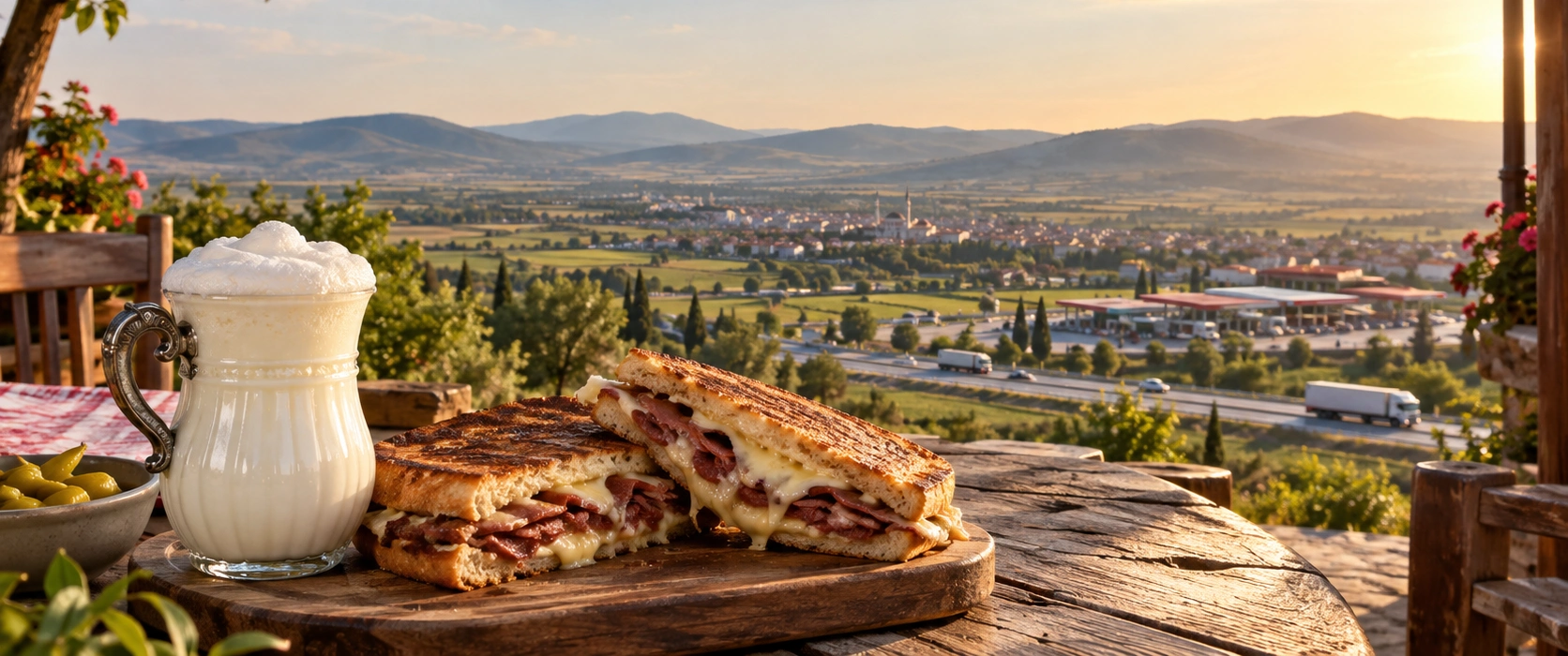
Build a private culinary journey around kokoreç, Susurluk ayranı, höşmerim, buffalo cream, regional cheeses and other distinctive foods of Balıkesir.
Request This Tour