Tarhana-Based Starter
The sourdough starter contains tarhana and yogurt together with flour, olive oil, sugar and water.






Savaştepe Sarıbeyler Seferberlik Çöreği, which can be translated as the Sarıbeyler Mobilization Bun, is one of Balıkesir's most historically meaningful breads. It comes from the Savaştepe district and is closely associated with Sarıbeyler, where local memory connects the bread with the difficult years of the Çanakkale campaigns and the Turkish War of Independence.
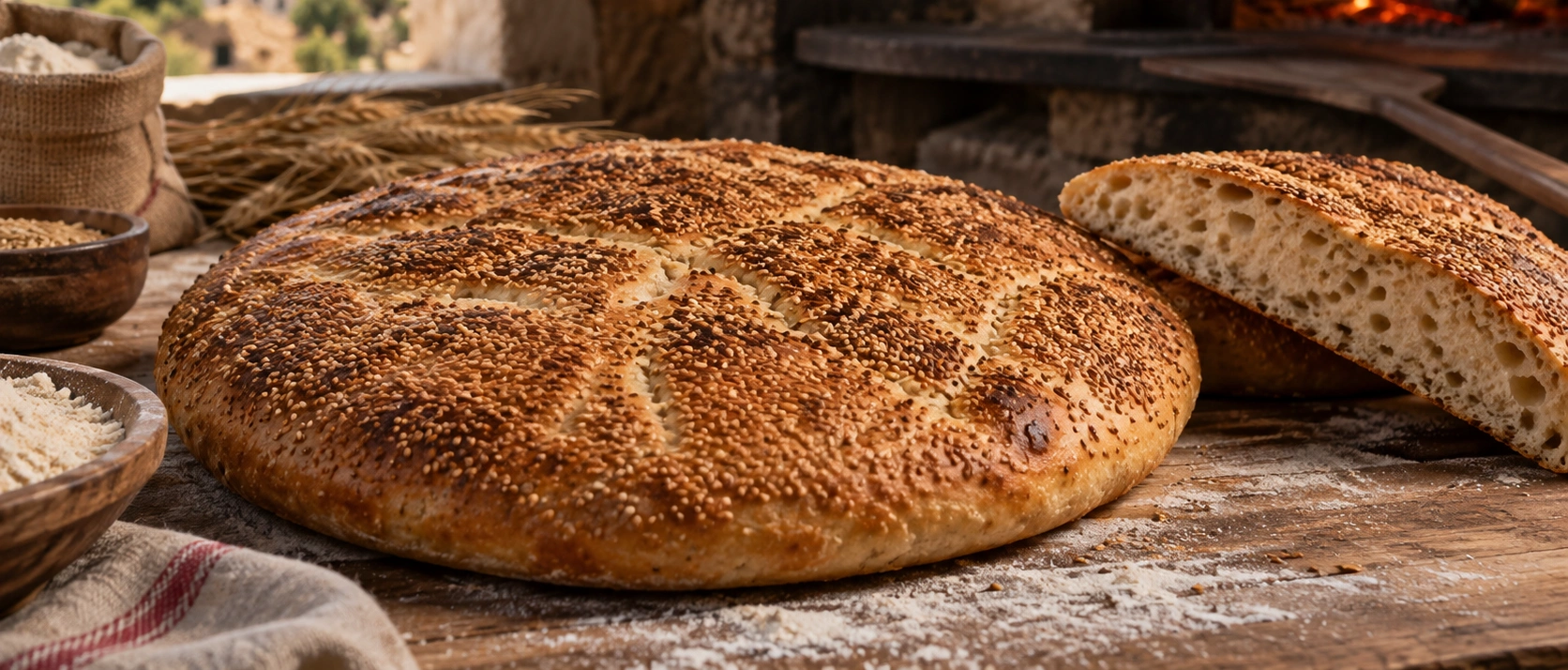
This is not a sweet bakery bun in the modern sense. It is a substantial, round sourdough bread coated generously with sesame, traditionally baked in a wood-fired stone oven. Its distinctive starter is prepared with tarhana, yogurt, wheat flour, sugar, olive oil and water, creating a lightly sour aroma and helping the bread keep well.
The product is officially protected in Türkiye as a Mahreç İşareti geographical indication. Its registration documents not only the ingredients and dimensions of the bread, but also the preparation of its tarhana-based starter, its sesame coating, its wood-fired baking method and its long cultural connection with Savaştepe.
The name “Seferberlik” — mobilisation — recalls the bread's association with food prepared for soldiers during years of war.
Its unusual starter combines yogurt, tarhana, flour, olive oil, sugar and water for a distinctive fermentation.
Both surfaces are traditionally pressed into sesame before the bread enters the stone oven.
Savaştepe Sarıbeyler Seferberlik Çöreği is registered in Türkiye as geographical indication No. 1219.
Essential information about one of Savaştepe's most distinctive traditional foods.
Savaştepe district, especially Sarıbeyler, in Balıkesir Province, northwestern Türkiye.
Open Sarıbeyler on Google MapsA round sesame-coated sourdough bread traditionally baked in a wood-fired stone oven.
A tarhana-and-yogurt sourdough starter gives the bread its distinctive aroma and keeping quality.
TÜRKPATENT geographical-indication registration No. 1219, registered as a Mahreç İşareti.
A durable village bread became a symbol of provision, cooperation and remembrance.
The word seferberlik means mobilisation. In the official geographical-indication record, the name is linked with the bread's role as one of the foods associated with soldiers during the long years of the Çanakkale campaigns and the Turkish War of Independence.
In rural communities, a food intended for travel or military supply needed to be filling, portable and capable of keeping for far longer than soft everyday bread. Sarıbeyler's solution was a dense sourdough loaf whose acidity, thorough baking and later drying made it especially suitable for storage.
Local accounts also emphasise the work of village women. Flour and other household ingredients were transformed through collective labour into food that could be carried over distance. In this sense, the bread preserves a story not only of soldiers but also of the families and communities supporting them from home.
The tradition did not disappear when wartime conditions ended. Instead, Seferberlik Çöreği became woven into the social life of Savaştepe, appearing at weddings, religious holidays and special invitation meals.
In 2022, the name Savaştepe Sarıbeyler Seferberlik Çöreği received geographical-indication protection, formally documenting a bread that local families had already kept alive through practice and memory.
Sourdough acidity, sesame, stone-oven heat and a carefully preserved village method define the traditional bread.
The sourdough starter contains tarhana and yogurt together with flour, olive oil, sugar and water.
The shaped dough is pressed into sesame so that the upper and lower surfaces receive a generous coating.
The registered method specifies baking in a stone oven heated with wood fire.
The finished bread is approximately 26 cm across and around 2 cm thick.
A finished traditional loaf is approximately 450–480 g.
Tarhana and fermented yogurt contribute a mild acidity that distinguishes it from ordinary white bread.
Fresh bread has a limited shelf life, but traditionally dried loaves can be stored for much longer.
The bread's reputation, technique and social role are closely connected with Savaştepe and Sarıbeyler.
Savaştepe Sarıbeyler Seferberlik Çöreği is a traditional sesame-coated sourdough bread produced in the Savaştepe district of Balıkesir. Although the Turkish word çörek is often translated as bun or pastry, this particular product is much closer in character to a sturdy artisan bread than to a soft sweet bun.
Its base dough uses bread wheat flour, sourdough starter, water and salt. What makes it unusual is the starter: rather than a simple flour-and-water culture alone, it is prepared with tarhana, yogurt, flour, sugar, olive oil and water.
Despite the English translation “bun,” the finished product is fundamentally a savoury fermented bread.
Fermentation gives the dough flavour, structure and part of the keeping quality for which it became known.
Tarhana contributes acidity and a subtle fermented character to the bread.
Sesame is not a token garnish; it is one of the most visible features of the finished loaf.
For a first-time visitor, the easiest way to understand it is as a historic travel bread: robust enough to carry, distinctive enough to remember and deeply connected with the social history of the village where it developed.
The bread is registered by the Turkish Patent and Trademark Office as a Mahreç İşareti geographical indication. The registration protects the recognised name and establishes a documented production method associated with Savaştepe.
Savaştepe Sarıbeyler Seferberlik Çöreği
TÜRKPATENT geographical-indication registration number 1219.
The geographical-indication application number is C2022/000001.
The application was submitted on 4 January 2022.
The product was registered on 12 September 2022.
The registration holder is Balıkesir Metropolitan Municipality.
The registered geographical boundary is the Savaştepe district of Balıkesir. The specification also states that all stages of production are to take place within that geographical boundary because the product's reputation and distinctive method are tied to the area.
The historical meaning of this bread is contained in its name. Seferberlik refers to mobilisation — the period when communities were called upon to support prolonged military campaigns with people, transport, supplies and food.
The official registration connects the name with the years of the Çanakkale campaigns and the War of Independence, when durable foods were needed for soldiers. Local reporting from Sarıbeyler preserves the same memory: families prepared this bread because it was nourishing and could remain usable for a long time when properly dried.
A round, relatively flat bread was practical to wrap, stack and carry.
Wheat flour, fermented starter, olive oil and sesame make it considerably more substantial than a thin flatbread.
Drying transformed the bread into a durable food suitable for storage beyond the life of ordinary fresh bread.
The tradition is remembered through village cooperation as much as through the recipe itself.
The story of Seferberlik Çöreği is inseparable from the labour of rural households. During periods when men were away at war, food production, farming and household survival depended heavily on the people who remained in the villages.
Local accounts from Sarıbeyler describe women preparing the bread collectively for soldiers and later continuing the same skills for community celebrations. That pattern of shared work — neighbours helping one another with large batches of dough, ovens and preparation — is part of the bread's cultural meaning.
Large quantities of bread are naturally easier to produce when neighbours divide mixing, shaping, sesame coating and baking.
Fermentation timing, dough feel and oven management are skills learned through repetition rather than recipe cards alone.
A bread associated with wartime provisioning later became part of weddings, holidays and special meals.
The tradition survives because people still make, serve and teach the bread rather than simply remembering its name.
The final dough itself is remarkably simple: bread wheat flour, sourdough starter, water and salt. The complexity is hidden inside the fermented starter and in the sesame preparation.
The main structure of the bread comes from wheat flour suitable for bread production.
The distinctive local starter brings together yogurt, tarhana, flour, olive oil, sugar and water.
Water hydrates both the starter and the main bread dough.
Salt seasons the dough and contributes to the familiar savoury bread character.
Yellow sesame prepared traditionally or commercially hulled white sesame can be used for the coating.
Olive oil appears in the sourdough starter rather than as a finishing glaze.
One of the most fascinating details in the registered recipe is the sourdough. The starter is made with yogurt, water, olive oil, bread wheat flour, white sugar and tarhana that has first been soaked in water.
The specification explains that acidity from the yogurt and tarhana creates a favourable fermentation environment. It also contributes to the bread's slower staling and gives the finished loaf a mild sour aroma.
Yogurt contributes acidity and fermented dairy character.
Tarhana deepens the fermented flavour and forms a distinctive part of the local method.
A measured amount of olive oil enriches the starter.
A small quantity of white sugar forms part of the registered sourdough preparation.
Wheat flour gives the starter body and provides material for fermentation.
The prepared starter is traditionally rested at room temperature before being mixed into the main dough.
Tarhana is itself a traditional fermented preparation. In the registered Sarıbeyler method, the tarhana used for the starter is made from wheat flour, yogurt, chickpeas and water.
Before it enters the sourdough starter, the dried tarhana is soaked so that it can blend evenly into the mixture. This creates an unusual layered fermentation: tarhana contributes its own acidity and flavour before becoming part of the bread starter.
The tarhana already carries a fermented character before it enters the bread-making process.
The registered tarhana preparation includes cooked chickpeas together with flour and yogurt.
The tarhana contributes the slightly tangy aroma associated with the finished bread.
This starter system is one of the features that makes the registered product more than an ordinary sesame loaf.
Sesame gives Seferberlik Çöreği one of its most recognisable visual features. After shaping, the dough is pressed into sesame so that both surfaces become coated before the final rest and baking.
The geographical-indication specification records a traditional way of preparing yellow sesame: the seeds can be mixed with oak ash, soaked in hot water and sieved so the hulls separate and the colour becomes pale. Commercially prepared white sesame may also be used.
Stone-oven heat toasts the sesame and releases a warm roasted fragrance.
The sesame is part of the bread's exterior identity rather than a light sprinkle on top.
Older methods included processing yellow sesame with oak ash and hot water before use.
A well-coated round loaf is immediately recognisable even before it is cut.
The production process is a sequence of fermentation, resting, hand shaping, sesame coating and fast high-temperature baking.
The registered method specifies a wood-fired stone oven heated to approximately 250°C. The high heat allows the broad, relatively thin loaf to bake quickly while setting the crust and toasting the sesame.
The hot stone transfers heat directly into the broad base of the loaf.
High oven temperatures develop the aroma of the sesame coating.
The official method gives an approximate baking time of 10–15 minutes.
The oven is part of the registered method and therefore part of what defines the local product.
Sarıbeyler Seferberlik Çöreği has a recognisable physical form. The registered finished product is approximately 26 cm in diameter, 2 cm thick and 450–480 g in weight.
The bread is shaped as a broad circle rather than a tall loaf.
Its diameter gives it the appearance of a large, flat village bread.
It is flatter than a conventional pan loaf but more substantial than paper-thin flatbread.
The loaf is substantial enough to serve several people depending on how it is used.
Keeping quality is central to the bread's story. The official specification distinguishes between the fresh product and bread that has been deliberately dried for longer storage.
At approximately 18–24°C, the registered fresh product has a maximum stated shelf life of 7 days.
Loaves can be dried by leaving them in sunlight for approximately 2–3 days.
An alternative method dries the bread by heating it at approximately 50–70°C for 20 minutes.
Properly dried bread can be stored for up to 6 months under the registered specification.
After cooling, bread can also be frozen at -18°C in vacuum packaging for up to 6 months.
That durability helps explain why this type of bread became associated with journeys and wartime provisioning.
The flavour is primarily savoury and bread-like, with a light fermented sourness from the tarhana-and-yogurt starter and a generous roasted sesame character from the crust.
It is not intended to taste like a sugary pastry. Although sugar and olive oil are present in the starter, they support fermentation and richness rather than turning the finished bread into a dessert.
Tarhana and yogurt give the bread a gentle fermented acidity.
The heavy sesame coating gives a roasted, nut-like aroma and flavour.
The final impression is bread-like rather than sweet.
Stone-oven baking develops a warm baked crust character.
The sourdough process contributes more depth than a rapidly yeasted white loaf.
Its interest comes from method, fermentation and sesame rather than a long list of fillings.
Texture changes significantly depending on whether the bread is eaten fresh or preserved by drying. Fresh from the oven, it has a baked crust, abundant sesame and a firm but still bread-like interior. Once dried, it becomes much harder and more suitable for storage.
The outside is firm and strongly scented with toasted sesame.
The bread is more substantial than a fluffy commercial bun.
Traditional preservation removes moisture and makes the loaf significantly firmer.
Local practice includes moistening and reheating dried bread to soften it again before eating.
There is no single modern restaurant-style presentation. Traditionally, this is a bread to be shared — broken or sliced at the table, served during gatherings, or carried as a durable food.
Warm bread offers the fullest sesame aroma and the softest interior.
Its savoury character works naturally beside cheese, olives, tomatoes and tea.
Fermented dairy drinks and dishes complement the bread's tangy, toasted profile.
Its sturdy texture makes it suitable alongside warm savoury dishes.
The bread retains an important place at weddings, holidays and special invitations.
Long-stored bread can be softened and warmed rather than eaten completely dry.
One of the most striking parts of the tradition is the change in context. A bread remembered for necessity and endurance later became associated with hospitality and celebration.
The geographical-indication record specifically notes its place at weddings, bayrams and special invitation meals. This shift is a powerful example of how food traditions survive: rather than remaining frozen in a difficult past, they acquire new roles in everyday community life.
Holiday gatherings keep the bread connected with family and neighbourhood hospitality.
Large communal celebrations provide a natural setting for bread prepared in batches.
The loaf can signal that a meal is more than an ordinary daily table.
Serving the bread gives younger generations a direct way to encounter the community's history.
Regional foods become especially meaningful when their preparation carries a story that could otherwise disappear. Seferberlik Çöreği links Savaştepe's culinary heritage with memories of war, agricultural life, women's labour, neighbourhood cooperation and the importance of preserving food before modern refrigeration.
The name keeps the mobilisation period visible in everyday food culture.
Fermentation, drying and oven management reflect practical knowledge developed over generations.
The bread gives Sarıbeyler and Savaştepe a distinctive culinary story within Balıkesir.
Geographical-indication status records the method and helps distinguish the recognised product from generic sesame bread.
The Turkish name is the one most likely to be recognised locally.
The English word “bun” can be misleading; this is a savoury, sourdough-style sesame bread.
Fresh bread best reveals the toasted sesame aroma and fermented flavour.
The tarhana-based sourdough is one of the most interesting parts of the local method.
A traditional loaf is sesame-coated on more than just the top surface.
The bread makes more sense when experienced as part of the district's rural history rather than as an isolated snack.
This is a local speciality rather than a guaranteed everyday item in every bakery, so ask locally when you arrive.
Its long association with travel makes it an especially fitting food to carry onward through Balıkesir.
Although the finished loaf looks simple, the traditional starter contains more than flour and water. Travellers with allergies or dietary restrictions should be aware of the fermented dairy and sesame components.
The bread is made primarily from wheat flour and therefore contains gluten.
Traditional tarhana and sourdough preparation include yogurt.
Sesame is a major exterior ingredient and should be considered by anyone with a sesame allergy.
Olive oil forms part of the registered sourdough starter.
White sugar appears in the starter, although the bread itself is savoury rather than dessert-like.
Individual producers may handle ingredients differently, so confirm details directly when allergies are medically important.
At first glance, a sesame-covered round loaf can look familiar. The difference lies in the fermentation, preparation method, cultural role and preservation tradition.
Seferberlik Çöreği uses a distinctive starter containing tarhana and yogurt rather than a simple commercial yeast dough.
The coating is unusually generous and traditionally covers both surfaces.
The registered bread has a broad, relatively flat circular form.
A wood-fired stone oven is part of the protected preparation method.
The bread has a deliberate drying tradition that allows it to be kept far longer than ordinary fresh bread.
Its identity is tied to mobilisation history, village cooperation and Savaştepe's local culture.
A home baker can imitate some of the style by preparing a sourdough bread enriched with a tarhana-and-yogurt starter, shaping it into a broad round, coating it heavily with sesame and baking it on a hot stone or baking steel.
However, the protected name refers to the registered Savaştepe tradition. The original method includes locally established preparation practices and a wood-fired stone oven, so a home version should be understood as Seferberlik-style rather than identical to the protected product.
A strong wheat flour gives the dough enough structure for the broad loaf.
Tarhana and yogurt are essential if you want to approach the character of the traditional starter.
Press the dough into sesame rather than scattering only a few seeds over the top.
A very hot baking surface helps imitate some of the effect of the traditional stone oven.
Balıkesir's food culture is remarkably varied because the province stretches between inland farming areas, the Marmara coast and the North Aegean. Seferberlik Çöreği represents a particularly inland story: grain, fermented dairy, tarhana, sesame, village ovens and the practical need to make food last.
Wheat flour forms the foundation of a food designed to be filling and transportable.
Yogurt appears both through the tarhana and through the sourdough starter.
A familiar Anatolian preserved food becomes part of another preserved food.
The abundant coating provides aroma, texture and visual identity.
Village oven culture remains central to the bread's protected production method.
The loaf demonstrates how a practical survival food can become a symbol of community history.
For travellers interested in regional food history, this is one of the most meaningful tastes in inland Balıkesir. Its appeal is not based on elaborate presentation. The value lies in tasting a bread whose fermentation, preservation method and name all carry a story.
Sourdough, stone-oven baking and sesame give it far more character than a generic packaged loaf.
Few breads make the connection between food preservation and wartime memory so explicit.
The place, the story and the food belong together.
Learning about the starter and oven often makes the tasting more interesting than the bread alone.
Savaştepe's historic bread can be the beginning of a much wider Balıkesir food journey, from protected dairy products and desserts to olive oil and famous roadside specialities.
Discover the province's famous cheese-based dessert and one of its best-known protected specialities.
Explore the rich dairy tradition behind Balıkesir's manda kaymağı.
Continue through inland Balıkesir with a distinctive lamb speciality associated with the Göbel area.
Try Balıkesir's famous intensely foamy yogurt drink and its classic roadside food culture.
Head west toward the Gulf of Edremit and one of Türkiye's great olive-oil landscapes.
Finish on the North Aegean coast with olive oil, seafood and historic bakery traditions.
Sarıbeyler sits within the quieter inland landscape of Balıkesir. Travellers interested in the bread can combine the experience with Savaştepe itself and other inland districts before continuing toward the Marmara or Aegean coasts.
Explore the district behind the bread and learn more about its rural landscape and local history.
Continue north for the famous toast-and-ayran tradition and another strong Balıkesir food identity.
Discover an inland district shaped by mining heritage, village landscapes and a different side of Balıkesir.
Combine rural food heritage with thermal landscapes, weaving traditions and mountain scenery.
Move toward the Marmara coast for seaside towns, villages and a completely different landscape.
End on the North Aegean with historic streets, islands, olive oil and coastal cuisine.
It is a traditional round sesame-coated sourdough bread from Savaştepe in Balıkesir, prepared with a distinctive tarhana-and-yogurt starter and baked in a wood-fired stone oven.
It can be translated as “Mobilization Bun” or “Mobilization Bread.” In texture and use, the product is closer to a substantial savoury bread than to a soft sweet bun.
Its recognised geographical origin is the Savaştepe district of Balıkesir, with the tradition particularly associated with Sarıbeyler.
The name refers to mobilisation and is linked in the official registration with its use as a durable food during the Çanakkale and War of Independence years.
Yes. It is registered in Türkiye as a Mahreç İşareti geographical indication.
The TÜRKPATENT registration number is 1219.
Savaştepe Sarıbeyler Seferberlik Çöreği was registered on 12 September 2022.
The geographical-indication application number is C2022/000001.
The registration holder is Balıkesir Metropolitan Municipality.
The registered geographical boundary is the Savaştepe district of Balıkesir Province.
The main dough uses bread wheat flour, sourdough starter, water and salt, and the shaped loaf is coated with sesame.
The starter contains yogurt, water, olive oil, wheat flour, white sugar and soaked tarhana.
The registered tarhana preparation uses water, wheat flour, yogurt and chickpeas.
No. Tarhana is used as part of the starter, giving the bread a mild fermented sourness rather than the full flavour of prepared tarhana soup.
No. It is a savoury bread. A small quantity of sugar is used in the starter, but the finished flavour is not dessert-like.
Sesame is part of the traditional exterior and gives the loaf its characteristic appearance, roasted aroma and nutty flavour.
No. The registered method describes coating both surfaces of the shaped dough with sesame.
The specification allows traditionally prepared yellow sesame or commercially obtained hulled white sesame.
It can be mixed with oak ash, soaked in hot water and sieved to remove the hulls, turning the seeds from yellow toward white.
The registered finished loaf is approximately 26 cm in diameter and about 2 cm thick.
A finished loaf is approximately 450–480 g.
It is traditionally baked in a wood-fired stone oven at approximately 250°C for around 10–15 minutes.
The registered method includes several stages: the main dough rests for about one hour, divided pieces rest for about 20 minutes, and the shaped sesame-coated loaves rest for about another hour before baking.
The registered specification gives a maximum shelf life of 7 days for the fresh product at approximately 18–24°C.
The bread can be dried in sunlight for 2–3 days or heat-dried at approximately 50–70°C for 20 minutes.
The official specification states that properly dried loaves can be stored for up to 6 months.
Yes. After baking and cooling, the bread can be frozen at -18°C in vacuum packaging for up to 6 months under the registered method.
Local practice includes lightly moistening and reheating dried bread so that it becomes softer before eating.
It is savoury, lightly tangy from fermentation, nutty from sesame and strongly bread-like rather than sweet.
Fresh bread is firm and substantial with a sesame crust; dried bread becomes much harder so that it can be stored for a long period.
No. Both can contain sesame, but Seferberlik Çöreği has a different dough, starter, broad round form, stone-oven method and cultural history.
No. Its tarhana-and-yogurt starter, sesame coating, defined dimensions and Savaştepe production method distinguish it from generic sourdough bread.
Yes. Traditional preparation uses yogurt in both the tarhana and the sourdough starter.
No. The registered traditional method includes yogurt.
Yes. Wheat flour is the principal ingredient.
Yes. Sesame is a major ingredient used to coat the bread.
It has an established place at weddings, religious holidays and special invitation meals in the local culture.
The official geographical-indication record states that the “seferberlik” name comes from the bread's association with soldiers' food during the Çanakkale and War of Independence years.
Its ingredients made it filling, and drying allowed it to remain usable far longer than ordinary fresh bread.
You can imitate the style with a tarhana-and-yogurt sourdough starter, sesame coating and a very hot baking surface, but the protected regional product follows the registered Savaştepe method.
Savaştepe, especially in connection with Sarıbeyler, is the most meaningful place because the bread's name, history and technique are rooted there.
Availability can vary because this is a local traditional product rather than a standard item in every bakery. Ask locally, especially around markets and special occasions.
It can be enjoyed with cheese, olives, tomatoes, yogurt, ayran, soups or savoury dishes, depending on the meal.
Look for höşmerim, buffalo cream, Göbel lamb kokoreç, Susurluk Ayranı, Edremit olive oil and the seafood and meze traditions of Ayvalık.
It turns a practical bread-making technique into a living record of Savaştepe's wartime memory, rural food knowledge and community traditions.
Seferberlik Çöreği is most interesting visually when the photographs show not only the finished loaf but also the making process that explains its identity.
Photograph the crust at an angle that shows how densely the loaf is coated with sesame.
An overhead image clearly shows the broad circular shape associated with the registered product.
Capture the bread entering or leaving the oven to connect the finished food with its traditional production.
Close-ups of shaping and sesame coating communicate the labour behind the bread.
A torn or sliced loaf reveals the crumb and makes the product feel more tactile than a perfectly untouched bread.
Include village context whenever possible so the food remains connected with the place that gives it meaning.
Discover the story of Seferberlik Çöreği together with Savaştepe's rural landscapes and the wider culinary heritage of Balıkesir.
Custom-designed private programs can combine Savaştepe, Sarıbeyler food heritage, regional tastings, historic towns and other parts of Balıkesir according to your route and travel dates.
Discover Savaştepe's local history and food traditions with a special focus on the story, ingredients and cultural meaning of Sarıbeyler Seferberlik Çöreği.
Request This Experience
Build a private route through inland Balıkesir combining traditional food, rural landscapes, local history and lesser-visited districts before continuing toward the Marmara or Aegean coast.
Request This Tour