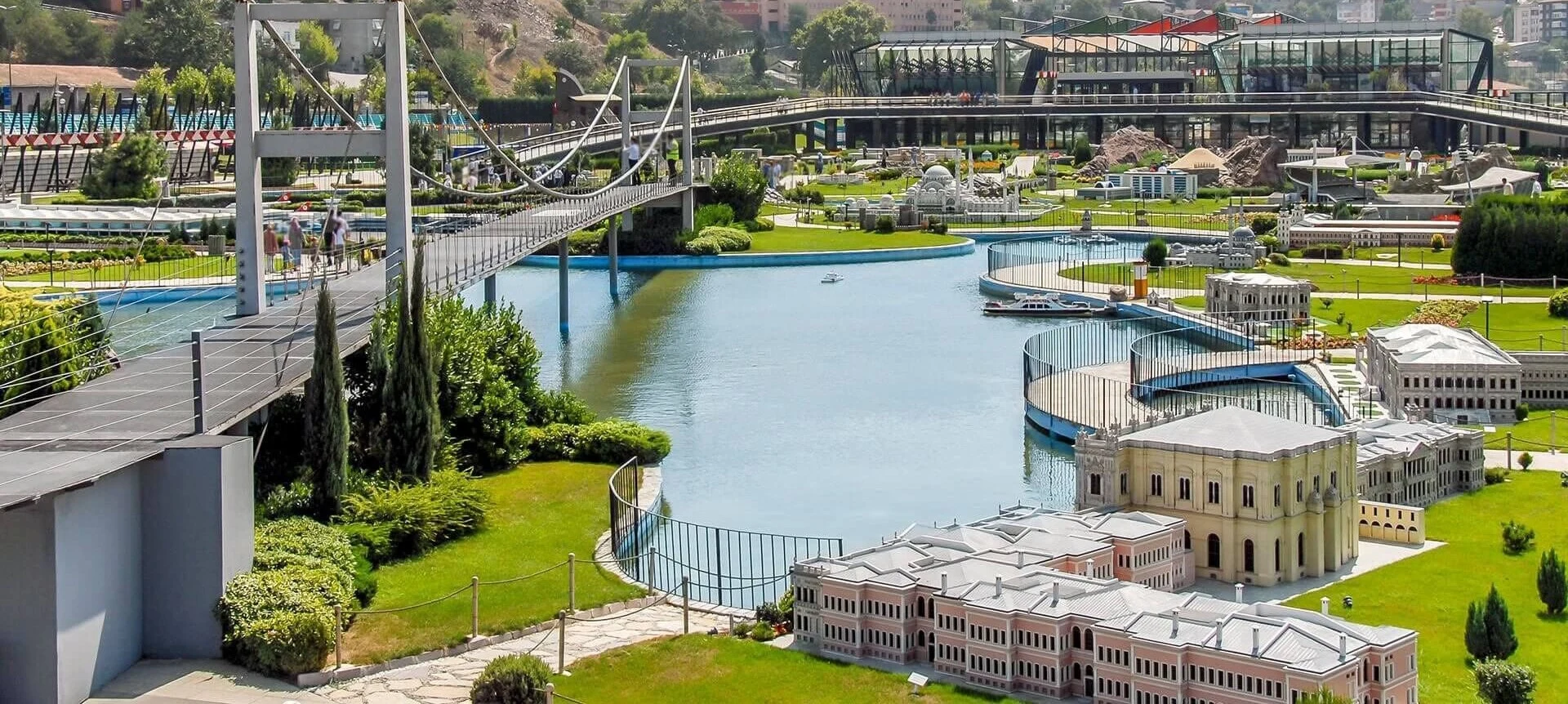
Private Miniatürk & Golden Horn Experience
Ask us about a tailor-made Istanbul day combining Miniatürk with the Golden Horn, family-friendly museums, Eyüp, Fener, Balat or panoramic viewpoints.
Request a Custom Tour





Located in Sütlüce on the northern shore of Istanbul's Golden Horn, Miniatürk is one of the city's most distinctive open-air attractions. Instead of focusing on a single historical period, it brings together miniature representations of monuments from ancient civilizations, Byzantine Constantinople, the Seljuk world, the Ottoman Empire and modern Türkiye.
Miniatürk opened on 2 May 2003 as a project of Istanbul Metropolitan Municipality Culture Inc. Its guiding idea was simple but ambitious: create a place where visitors could experience the architectural diversity of a vast geography without traveling thousands of kilometers.
The park covers approximately 60,000 square meters, with around 15,000 square meters devoted to the miniature-model area. The models are produced at a consistent 1:25 scale, allowing buildings of very different periods and regions to be compared within one coherent landscape.
The official Miniatürk website currently promotes a collection of 139+ works. They include landmarks from Istanbul and Anatolia together with monuments from territories beyond today's borders of Türkiye that formed part of the wider Ottoman historical geography.
Among the models are internationally known monuments such as Hagia Sophia, Topkapı Palace, Dolmabahçe Palace, the Maiden's Tower, Rumeli Fortress, Anıtkabir, Selimiye Mosque, Mount Nemrut, Safranbolu houses, Aspendos and the Mostar Bridge.
Allow approximately 2–3 hours for a comfortable first visit. Families using the playgrounds and interactive attractions can easily spend longer.
Compare monuments from completely different centuries and regions through a consistent miniature scale.
Explore a broad collection representing Istanbul, Anatolia and the wider historical geography of the Ottoman world.
Walk through a large landscaped site beside the Golden Horn with model areas, family attractions, cafés and visitor facilities.
Move from Istanbul to Cappadocia, Mount Nemrut, Ephesus, Edirne, Safranbolu and beyond without leaving the city.
Essential information about Miniatürk, its miniature collection, Golden Horn location and visitor experience.
Sütlüce, Beyoğlu, on the northern shore of the Golden Horn in Istanbul.
2 May 2003.
Miniature monuments are presented at 1:25 of their real dimensions.
Approximately 60,000 m².
Approximately 15,000 m² devoted to the miniature collection.
The official website currently promotes more than 139 miniature works.
A Miniatürk mobile audio-guide application is available in nine languages.
Approximately 2–3 hours; longer for families using the additional attractions.
Miniatürk is important because it turns an enormous architectural history into a single walkable landscape, allowing visitors to compare monuments that are normally separated by hundreds of kilometers and many centuries.
The first value of Miniatürk is geographical. Türkiye contains one of the world's richest concentrations of ancient, Byzantine, Seljuk, Ottoman and Republican architecture, but these monuments are scattered across a vast country. Miniatürk brings representative examples together in one place.
Its second value is comparative. At normal scale it is difficult to compare the massing of a mosque in Edirne, a Roman theater in Antalya, a palace on the Bosphorus and a monumental tomb in Ankara. At Miniatürk, the common 1:25 scale makes differences in form, plan, towers, domes, minarets, courtyards and landscape immediately visible.
Its third value is educational. For children and first-time visitors to Türkiye, the park acts as a visual introduction to places they may later encounter on a longer journey. A miniature can make an unfamiliar name memorable before the real monument is visited.
Miniatürk is also a record of historical geography. The collection is not limited to monuments inside the modern borders of Türkiye. It includes selected works from the Balkans, Middle East and other regions connected with Ottoman history, emphasizing that architecture often belongs to cultural networks extending beyond present-day national borders.
Finally, the park preserves miniature representations of monuments that have changed, been reconstructed or in some cases disappeared. This gives the collection a documentary dimension beyond simple entertainment.
Miniatürk was created by Istanbul Metropolitan Municipality Culture Inc. and opened to visitors on 2 May 2003. The project was conceived as a large open-air cultural park where the architectural inheritance of Türkiye and the wider Ottoman geography could be understood through scale models.
Its slogan, often translated as “A Small Model of a Big Country”, summarizes the concept. The park does not attempt to reproduce every major monument. Instead, it creates a curated architectural panorama representing different regions, civilizations and historical periods.
The location on the Golden Horn is especially appropriate. For centuries the Golden Horn was one of Istanbul's great maritime and industrial landscapes, and its redevelopment has added museums, parks, universities and cultural institutions to former industrial districts. Miniatürk became one of the major attractions in this changing waterfront environment.
The collection has developed over time as new models and visitor experiences have been added. For that reason, the precise number of works can change and visitors may encounter additions or revised displays during future visits.
Miniatürk opens to visitors as a major cultural project of Istanbul Metropolitan Municipality.
A common scale allows monuments from different periods and regions to be visually compared.
The open-air park occupies a large waterfront site in Sütlüce, Beyoğlu.
New or revised miniature works have expanded the visitor experience over time.
Miniatürk covers approximately 60,000 square meters in total. Around 15,000 square meters are devoted specifically to the miniature-model landscape.
The scale of the overall site matters because Miniatürk is not an indoor model room. It is a large landscaped open-air park with pathways, lawns, water features, bridges and carefully arranged miniature environments.
The standard 1:25 scale means that one meter on a real monument becomes approximately four centimeters in the model. A 50-meter tower, for example, would stand around two meters high in miniature. This is large enough to preserve architectural detail while small enough to place many monuments in one park.
The result feels more like walking through an architectural map than visiting a conventional museum. Visitors look down on palaces, mosques, bridges, theaters and entire complexes from viewpoints that would be impossible at the real monuments.
The collection can be understood through three broad geographical groups: works of Istanbul, works of Anatolia and works from territories outside present-day Türkiye connected with Ottoman history.
Palaces, mosques, churches, fortifications, towers, schools, transport landmarks and structures associated with the Bosphorus and historic peninsula.
Ancient cities, Seljuk monuments, Ottoman masterpieces, archaeological sites, memorials and regional architecture from across Türkiye.
Selected monuments in the Balkans, Middle East and elsewhere that reflect the former reach and cultural networks of the Ottoman world.
This structure turns the park into a condensed architectural journey. Within a short walk, visitors can move from a Byzantine church in Istanbul to a Roman theater in southern Anatolia, then to a bridge in Bosnia or an Ottoman monument in Jerusalem.
For visitors beginning or ending an Istanbul trip, the Istanbul section can feel like a visual checklist of the city. Many of the monuments reproduced here can also be visited at full scale during a normal stay.
Study the mass of the great dome, supporting semi-domes and minarets from an elevated viewpoint impossible to achieve at street level.
See how the palace functions as a sequence of courtyards and pavilions rather than a single monumental block.
Compare the long ceremonial waterfront façade with the more inward-looking layout of Topkapı Palace.
The tower's vertical profile becomes especially striking when seen among lower-scale urban monuments.
The miniature version recreates one of the Bosphorus's most recognizable landmarks within a waterside setting.
Its irregular plan and massive towers are easier to understand when viewed from above.
Compare the earlier Ottoman stronghold with the much larger Rumeli Fortress built across the Bosphorus before 1453.
A delicate Bosphorus pavilion whose compact scale makes its decorative façade particularly suited to miniature reproduction.
See Mimar Sinan's great imperial complex as an architectural composition rising above the historic city.
The miniature defenses help visitors understand the relationship between towers, gates and long fortified lines.
The Anatolian section expands the experience far beyond Istanbul. It introduces the extraordinary variety of Türkiye's archaeological and architectural landscape, from classical antiquity to the Republic.
The monumental mausoleum complex in Ankara represents Republican Türkiye and provides a strong contrast with ancient and Ottoman works nearby.
Mimar Sinan's masterpiece in Edirne demonstrates the clarity of a great central dome and four exceptionally slender minarets.
The model presents the famous monumental heads and sanctuary landscape of the Commagene kingdom.
The Roman theater in Antalya becomes especially easy to understand when its complete semicircular seating plan is viewed from above.
A miniature urban ensemble shows the relationship between traditional Ottoman houses, streets and topography.
A reconstruction of one of the celebrated monuments of ancient Ephesus evokes a building that survives only fragmentarily today.
The great medieval stone arch demonstrates the engineering traditions of southeastern Anatolia.
Seljuk mosques, Ottoman complexes and early Christian monuments reveal the many cultural layers of Anatolia.
One of Miniatürk's most interesting features is that the collection does not stop at the modern borders of Türkiye. Selected models represent monuments in regions that were historically connected with the Ottoman Empire.
The famous single-arch bridge in Bosnia and Herzegovina represents one of the best-known monuments of Ottoman Balkan architecture.
A monument connected with the Battle of Kosovo and the memory of Sultan Murad I.
The small domed tomb recalls the Ottoman period in Hungary and the enduring memory of the Bektashi dervish Gül Baba.
Models include important structures associated with Jerusalem and Ottoman restoration or construction in the city.
The monumental mosque in Cairo demonstrates the architectural reach of the 19th-century Ottoman-Egyptian world.
The model connects the collection to the birthplace of Mustafa Kemal Atatürk in modern Greece.
These works make Miniatürk more than a miniature map of Türkiye. They present architecture as evidence of a shared and overlapping regional history across the Balkans, Mediterranean and Middle East.
Miniature parks are often treated simply as entertainment, but they can also preserve visual memory. Some works represented at Miniatürk have changed significantly, been reconstructed or no longer survive in their earlier form.
The Temple of Artemis at Ephesus, for example, survives today only through archaeological remains and scholarly reconstruction. A miniature model can therefore communicate the scale and architectural idea of a monument that cannot be experienced intact at the original site.
The collection also includes examples from the former Ottoman world whose modern histories include destruction, rebuilding or major transformation. This adds an unexpected documentary quality to the park.
At real monuments, visitors usually experience architecture from ground level. Walls block courtyards, roofs hide plans and neighboring buildings limit perspective. Miniatürk changes that relationship completely.
From above, visitors can understand how Topkapı Palace unfolds through multiple courtyards, how a fortress responds to irregular terrain, how a mosque's dome relates to its supporting volumes or how a bridge connects two sides of a valley.
This makes the park particularly valuable for travelers interested in architecture, urban history and photography. It can also help visitors recognize monuments later during journeys around Türkiye.
For children, the effect is even more immediate. Instead of reading an abstract description of a palace, temple or theater, they can see the complete building at once and physically walk around it.
Miniatürk provides a mobile audio-guide application designed to explain the works displayed throughout the park. The official site currently lists support for nine languages: Turkish, English, French, German, Russian, Arabic, Persian, Japanese and Spanish.
The application also helps visitors identify the real-world location of monuments and follow suggested routes through the collection. This can be especially useful because the number of models is large and many visitors will not recognize every building immediately.
İBB Wi-Fi is available along the visitor route, but the museum recommends downloading the application before arrival in case of connectivity problems.
Yes. Miniatürk is one of Istanbul's easiest major cultural attractions to enjoy with children because the core experience is visual, outdoors and constantly changing.
The park combines the miniature collection with family-oriented facilities and attractions such as a children's playground, tour train, remote-controlled boats, ferry-themed elements, Mini Stadium, chess and labyrinth areas. Availability and separate charges for individual activities can change.
Children who might become tired inside a traditional museum can move freely between models, look for familiar buildings and compare towers, bridges, ships and stadiums.
The educational potential is strong as well. Parents can turn the visit into a game: find Istanbul's Maiden's Tower, identify the largest dome, look for a Roman theater, compare two fortresses or choose which real monument the family would most like to visit next.
Large, detailed models make architecture easier to understand than long text panels alone.
The open-air layout gives children more freedom than many indoor museums.
Additional play and activity areas can extend the visit well beyond the model route.
Ask children to find a bridge, fortress, palace, theater and mosque to keep the visit engaging.
One of the best models for understanding the building's massive dome and layered exterior form.
Study the palace as a complete complex of courtyards, gates and pavilions.
A photogenic miniature surrounded by water that recreates the atmosphere of the Bosphorus landmark.
See the full irregular defensive plan and understand how its towers dominate the Bosphorus shoreline.
One of the park's major representations of modern Republican architecture.
Look for the miniature monumental heads of the Commagene sanctuary.
View the complete Roman theater plan from a bird's-eye perspective.
See traditional Ottoman houses as part of a miniature urban environment rather than as isolated buildings.
A celebrated Ottoman Balkan landmark represented within the overseas collection.
Miniature water landscapes produce some of the park's most attractive photographs.
Ships, ferries and other transport-related works broaden the collection beyond monumental architecture.
Do not focus only on the models; the wider waterfront landscape is part of the experience.
Begin by orienting yourself to the overall park rather than stopping at the first model for too long. The collection is large, and the visit becomes easier once you understand the direction of the main route.
Spend your first section on Istanbul monuments. Recognizable landmarks such as Hagia Sophia, the Bosphorus fortresses, palaces and towers help establish the 1:25 scale in your mind.
Continue into the Anatolian works, where the architectural variety becomes much greater. This is where ancient theaters, archaeological reconstructions, Seljuk monuments, Ottoman masterpieces and Republican architecture can be compared directly.
Finish with the works from outside Türkiye and then return to any models you want to photograph in better light or study more carefully.
Miniatürk is located at Örnektepe Mahallesi, İmrahor Caddesi No:7, Sütlüce, Beyoğlu, Istanbul.
The current official schedule lists Miniatürk as open Tuesday through Sunday from 10:00 to 18:00 and closed on Mondays.
For the current summer program, the official visitor page states that between 26 June and 13 September, Miniatürk remains open until 22:00 on Fridays and Saturdays. Seasonal hours can change from year to year.
At the time of writing, the official ticket page lists ₺330 full admission, ₺90 discounted admission for eligible categories such as students, teachers, soldiers and police, and ₺900 for foreign visitors.
The official visitor rules also state that Museum Pass / MüzeKart is not valid. Payment is accepted by credit/debit card and Istanbulkart at the ticket office; cash and foreign currency are not accepted.
Tickets are valid only for the day of purchase and re-entry after leaving is not normally permitted with the same ticket. Because prices, hours and ticket conditions can change, verify the official Miniatürk information shortly before your visit.
Miniatürk is currently closed on Mondays.
The park is much larger than a simple model exhibition and rewards a slow route.
Install the audio-guide application before arrival, especially if you want interpretation in one of its nine languages.
Personal headphones make the mobile audio guide easier to use throughout the open-air route.
You will spend most of the visit walking and standing outdoors.
Shade can be limited along parts of the model route, especially around midday in summer.
First enjoy the route, then return to favorite models after you understand the best angles.
Some family activities or adjacent experiences may have separate schedules or charges.
Usually the most comfortable choice in warm weather and a good time for families with younger children.
Softer light can improve photography by reducing harsh reflections and deep shadows on the models.
One of the best seasons for walking through the landscaped outdoor park in mild temperatures.
Comfortable weather and lower heat make the long open-air route easier.
Visit early or use seasonal evening opening hours when available to avoid the strongest midday heat.
The park remains interesting, but cold wind and rain can affect an attraction that is largely outdoors.
Enough only for a quick highlights circuit; most visitors will feel rushed.
Possible for a selective visit focusing on the most famous models.
A good minimum for a first-time adult visitor who wants to see the collection without reading every description.
Ideal for most visitors who enjoy architecture, photography and the audio guide.
Better for families planning to use playgrounds or additional attractions.
Combine Miniatürk with lunch and another Golden Horn attraction nearby.
Miniatürk is extremely photogenic because the models can be photographed from angles that would be impossible at the original buildings. A slight change in camera height can make a miniature look like a full-scale monument.
For realistic-looking images, lower the camera toward the level of the model and keep distracting real-world buildings out of the background. For educational images, do the opposite: shoot from above so the entire architectural plan is visible.
Water features create attractive reflections around models such as towers, palaces and bridges. Morning and late-afternoon light generally gives more texture than strong overhead sun.
Photography rules for tripods, commercial filming and organized professional shoots can change. Follow current signs and staff instructions.
Lower the camera close to model height and simplify the background.
Use an elevated angle to reveal plans, courtyards, roofs and surrounding landscape.
Morning and late afternoon usually provide softer shadows across detailed façades.
Use people intentionally for scale so the miniature size becomes immediately obvious.
Miniatürk is a modern landscaped attraction with broad visitor routes rather than a historic monument with steep ancient stairs. That generally makes the main experience easier to navigate than many archaeological sites and old buildings in Istanbul.
However, the park is extensive. Visitors with limited walking endurance should remember that a complete circuit covers a substantial outdoor area and may require frequent rest stops.
Wheelchair users or visitors who require guaranteed step-free access, accessible toilets or specific assistance should confirm current arrangements with Miniatürk before arrival.
Miniatürk is in Sütlüce, Beyoğlu, on the northern side of the Golden Horn. It is outside the main Sultanahmet walking zone, so most visitors will use a bus, taxi, private transfer or a combination of public transport connections.
The official transport information lists several İETT bus connections serving the Miniatürk area from central districts. Routes can change, so check current İETT information on the day of travel rather than relying on an old route number.
Visitors using the Metrobus can travel to Halıcıoğlu and continue toward Miniatürk by local bus or minibus connection.
A taxi is often the simplest option for families, small groups or travelers combining Miniatürk with the Rahmi M. Koç Museum, Eyüp or other Golden Horn attractions. Travel time depends heavily on Istanbul traffic.
For visitors arriving by car, the official site lists parking capacity for approximately 300 vehicles.
Public transport requires a connection; a taxi or private transfer is often simpler for families and groups.
Use a current İETT connection toward Sütlüce or travel by taxi depending on traffic.
Use Halıcıoğlu as the main transfer point, then continue by local bus or minibus toward Miniatürk.
On-site parking is available; the official site currently lists capacity for around 300 vehicles.
Begin at Miniatürk in the morning and allow approximately 2–3 hours for the miniature collection. Families may want to stay longer for the playground and additional activities.
After Miniatürk, continue along the Golden Horn toward the Rahmi M. Koç Museum, one of Istanbul's best museums for transport, engineering and industrial history. The combination works particularly well for families because both attractions are highly visual.
Later in the day, continue toward Eyüp Sultan and the Pierre Loti Hill area for a completely different atmosphere and elevated views over the Golden Horn.
Travelers interested in historic neighborhoods can instead continue toward Fener and Balat, where churches, synagogues, mosques, schools and colorful residential streets reveal the social history of the Golden Horn at full scale.
A major museum of transport, industry, engineering and technology housed in historic industrial buildings on the Golden Horn.
One of Istanbul's most important Islamic pilgrimage and devotional sites, surrounded by historic cemeteries and Ottoman monuments.
A popular viewpoint overlooking the Golden Horn and the historic districts below.
Explore steep streets, historic Greek Orthodox heritage and the monumental Phanar Greek Orthodox College.
Discover a layered neighborhood known for traditional houses, synagogues, churches, cafés and Ottoman-era streets.
Use the shoreline to connect museums, parks, neighborhoods and viewpoints across one of Istanbul's most historic waterways.
Miniatürk is a large open-air miniature park in Istanbul displaying 1:25-scale models of major architectural and historical landmarks from Istanbul, Anatolia and the wider Ottoman historical geography.
It is located in Sütlüce, Beyoğlu, on the northern shore of the Golden Horn in Istanbul.
Miniatürk opened to visitors on 2 May 2003.
The total complex covers approximately 60,000 m², including around 15,000 m² devoted to the miniature-model area.
The models are presented at a consistent 1:25 scale.
The official Miniatürk website currently promotes a collection of 139+ works. The collection can change as models are added or revised.
The collection includes mosques, churches, palaces, fortresses, bridges, theaters, archaeological reconstructions, memorials, schools, towers, transport structures and traditional architecture.
Yes. Miniatürk includes selected monuments from the Balkans, Middle East and other regions associated with Ottoman history.
Yes. Hagia Sophia is among the Istanbul works represented in the collection.
Yes. The miniature is particularly useful for understanding Topkapı Palace as a multi-courtyard complex rather than a single building.
Yes. The official Miniatürk mobile application currently provides audio-guide content in nine languages.
Miniatürk currently operates Tuesday–Sunday from 10:00 to 18:00, with seasonal extended hours on selected summer evenings.
Miniatürk is currently closed on Mondays.
At the time of writing, official prices are listed as ₺330 full, ₺90 discounted for eligible categories and ₺900 for foreign visitors. Check current prices before travel.
No. The official visitor information currently states that MüzeKart is not valid.
The current official rules state that the ticket office accepts credit/debit cards and Istanbulkart, while cash and foreign currency are not accepted.
Allow approximately 2–3 hours for a comfortable first visit. Families using additional attractions may want 3–4 hours or more.
Yes. The outdoor miniature landscape, playground areas and family-oriented activities make it one of Istanbul's more child-friendly cultural attractions.
The main miniature collection is primarily an open-air experience, so weather conditions matter more than at a conventional indoor museum.
Yes, especially if you enjoy architecture. Miniatürk provides bird's-eye views and complete plans that cannot usually be seen at the real monuments.
Yes. It can work as a visual introduction before a longer trip, helping you recognize monuments in places such as Edirne, Ankara, Antalya, southeastern Türkiye and the Aegean region.
For many visitors, a taxi or private transfer is simplest. Public transport is also possible through İETT bus routes or a Metrobus connection via Halıcıoğlu.
Yes. The official Miniatürk information currently lists parking for approximately 300 vehicles.
Strong combinations include the Rahmi M. Koç Museum, Eyüp Sultan, Pierre Loti Hill, Fener and Balat for a wider Golden Horn day.
Spring and autumn are especially comfortable because the main attraction is outdoors. In summer, morning or seasonal evening hours are preferable.
No. The park is also popular with Istanbul residents, school groups and families because it combines architecture, history and recreation in one setting.
Architectural miniatures contain delicate surfaces and details that can be damaged easily.
Do not step into planted or model areas to improve a photograph.
The park is designed for families, but younger children should be kept away from fragile displays and water edges.
Listen to the mobile audio guide without adding unnecessary noise to the shared environment.
Respect current restrictions concerning commercial equipment, tripods or organized filming.
During busy periods, avoid blocking narrow viewpoints while taking repeated photographs.
Connect Miniatürk with the Golden Horn, the Rahmi M. Koç Museum, Eyüp, Fener, Balat or Istanbul's great Byzantine and Ottoman monuments through a private route shaped around your interests and without compulsory shopping stops.
Choose a private Istanbul route focused on architecture, family-friendly museums, the Golden Horn and the real monuments represented in miniature throughout the park.
Ask us about a tailor-made Istanbul day combining Miniatürk with the Golden Horn, family-friendly museums, Eyüp, Fener, Balat or panoramic viewpoints.
Request a Custom Tour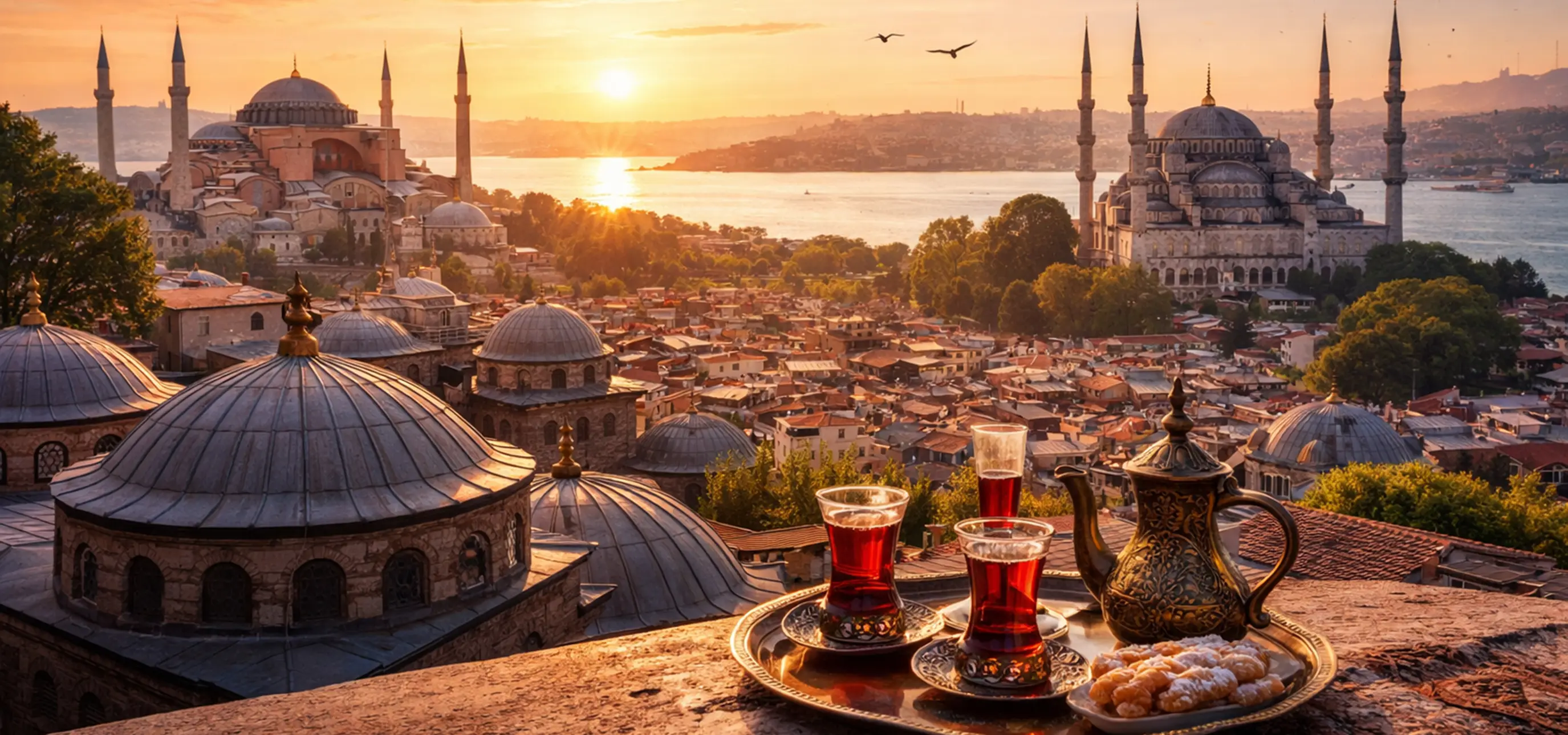
Continue planning with Istanbul's palaces, mosques, churches, museums, fortresses, bazaars, Bosphorus neighborhoods, Golden Horn attractions and archaeological sites.
Explore IstanbulUse Miniatürk as an architectural introduction, then continue to selected full-scale monuments such as Hagia Sophia, Topkapı Palace, Süleymaniye Mosque, the city walls or Bosphorus palaces according to your interests.
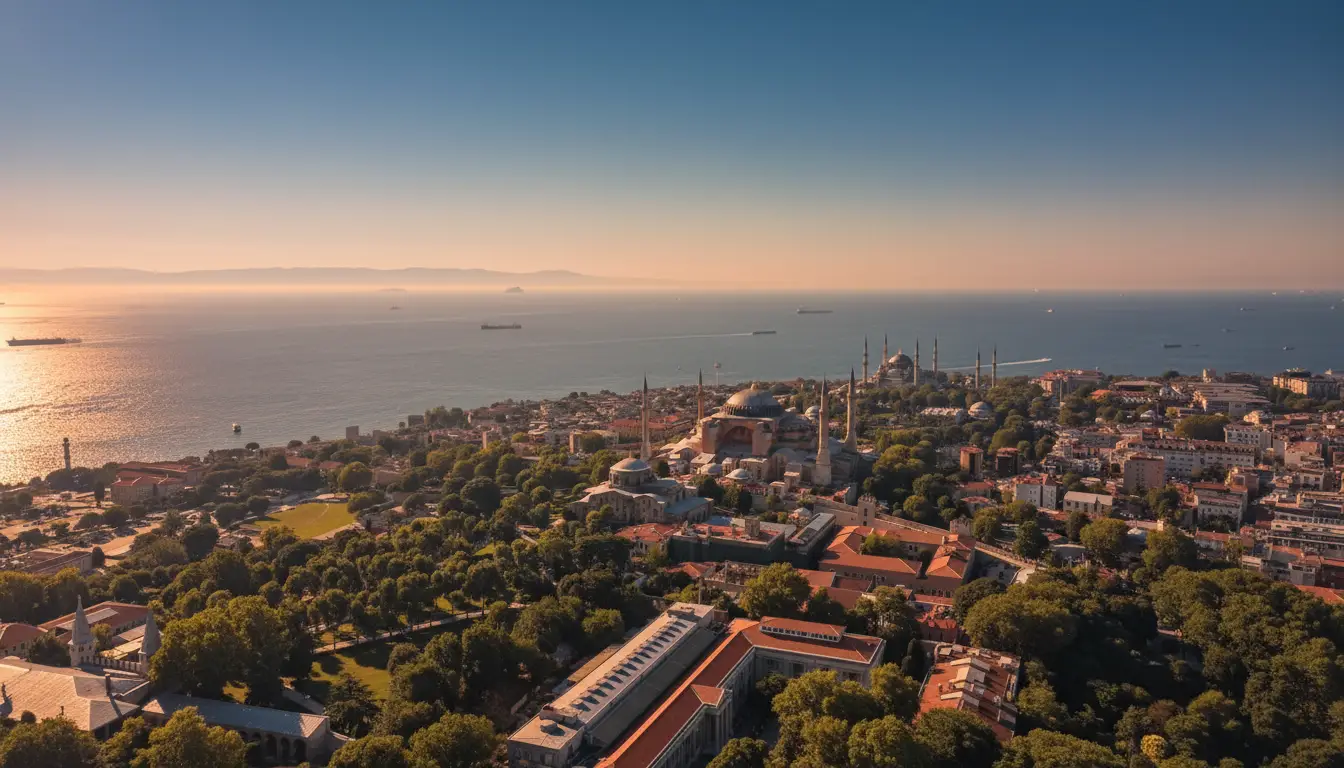
Create a private Istanbul itinerary around Byzantine Constantinople, Ottoman history, architecture, archaeology, museums, religious monuments and hidden neighborhoods.
View Private Istanbul Tours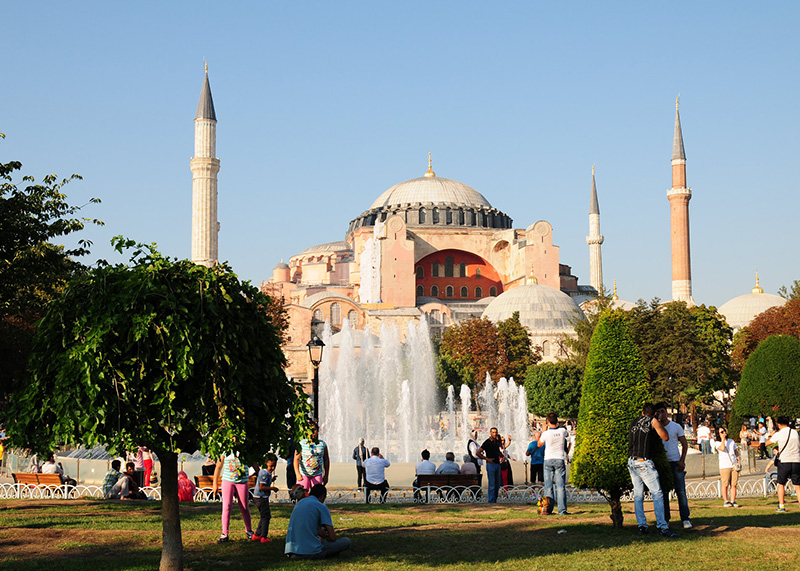
After studying Istanbul in miniature, continue to the full-scale buildings that shaped the city's skyline and imperial history.
Explore Hagia Sophia