Private Söğüt Ottoman Heritage Experience
Ask us about a tailor-made route combining Kaymakam Sait Bey Fountain, Çelebi Mehmet Mosque, Söğüt Museum, Hamidiye Mosque, Hamidiye İdadisi, Kuyulu Mescit and Ertuğrul Gazi Tomb.
Request a Custom Tour





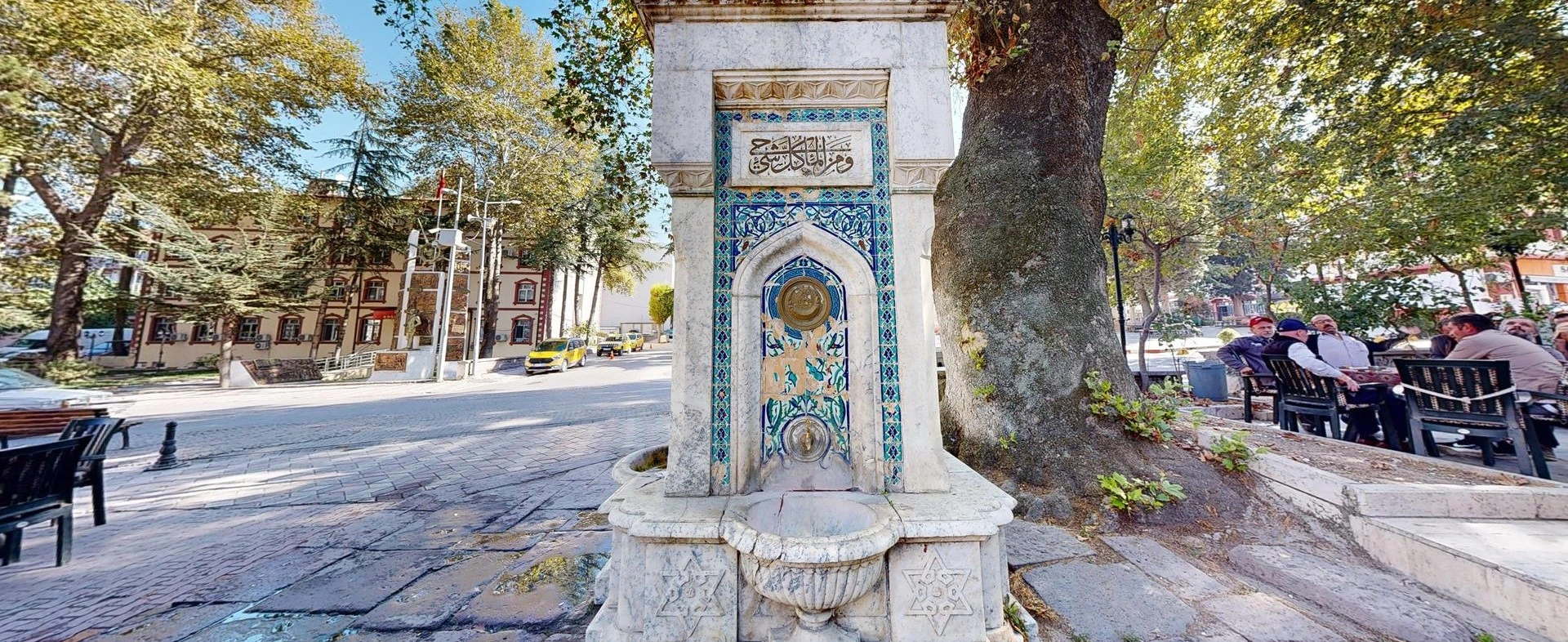
Kaymakam Sait Bey Fountain, also known simply as Kaymakam Çeşmesi, stands in the historic centre of Söğüt, Bilecik Province, close to Çelebi Mehmet Mosque. Official heritage documentation dates the monument to 1919 and records that it was commissioned by the district governor, Kaymakam Sait Bey.
The fountain belongs to the final phase of Ottoman public architecture. Its design is described as Neo-Classical, but the monument is far from plain: its square, four-faced marble body is enriched with pointed-arch niches, bright turquoise and cobalt-blue tilework, floral ornament, calligraphic panels, crescent-and-star medallions and an elaborate carved crown.
One of the fountain’s most memorable characteristics is its use of Kütahya tiles. The tiled surfaces include stylized tulips, carnations, peonies, palmettes and rumi motifs, creating a vivid contrast with the pale marble structure. Academic architectural research has also documented the name of a tile craftsman on the monument, linking the decoration directly with the late Ottoman Kütahya ceramic tradition.
The fountain has four façades but water basins on only three sides. A Bilecik educational publication explains that the south side was intentionally left without a basin and tap so that people drinking water or performing ablutions would not stand with their backs toward the qibla. Whether approached for its architecture, tile art, inscriptions or urban history, the monument rewards a slow close look.
Because it stands in the centre of Söğüt, the fountain is easy to combine with Çelebi Mehmet Mosque, Söğüt Ertuğrul Gazi Museum, Hamidiye Mosque, Hamidiye İdadisi, Ertuğrul Gazi Kuyulu Mescit and Ertuğrul Gazi Tomb.
Official heritage records date the fountain to 1919, during the final years of the Ottoman Empire.
The square-prismatic monument is designed to be seen from every side in the town centre.
Turquoise, cobalt blue and floral tilework turns the fountain into a small open-air gallery of ceramic decoration.
Carved marble, pointed arches, religious inscriptions and medallions give the monument its ceremonial character.
Essential information about Söğüt’s 1919 marble-and-tile Ottoman fountain.
Central Söğüt, in the historic square near Çelebi Mehmet Mosque, Bilecik Province.
Open on Google MapsFreestanding monumental public fountain.
1919.
Kaymakam Sait Bey, the district governor associated with the fountain’s construction.
Late Ottoman Neo-Classical fountain architecture.
Marble.
Colored Kütahya tiles with floral, geometric and rumi-inspired motifs.
Four-sided square-prismatic design.
Three façades have basins and fountain fittings; the south side is intentionally different.
Official cultural inventory records a heritage registration decision dated 10 September 1977.
The fountain compresses architecture, public service, ceramic art, calligraphy and late Ottoman urban culture into a single compact monument.
Söğüt is usually associated with the early centuries of Ottoman history, especially Ertuğrul Gazi and the dynasty’s remembered beginnings. Kaymakam Sait Bey Fountain tells a very different part of the town’s story. Built in 1919, it belongs to the Ottoman state’s final historical phase, more than six centuries after the foundation traditions that made Söğüt famous.
That contrast makes the fountain particularly valuable. It demonstrates that Söğüt was not simply a landscape of medieval memory; it remained a living Ottoman district centre in which public works continued to be commissioned, decorated and integrated into daily life in the early twentieth century.
Architecturally, the fountain is notable for the richness of its surface treatment. Marble construction, Kütahya tilework, pointed arches, floral motifs, calligraphy and carved ornament are concentrated on a structure only a few metres high. This makes it one of the best monuments in Söğüt for studying decorative detail at close range.
It is equally important as an example of the Ottoman tradition of public water architecture. Fountains were practical civic structures, but they could also express patronage, charity, religious sensibility and artistic taste. Kaymakam Sait Bey Fountain brings all of those ideas together in a prominent town-square setting.
The year 1919 places Kaymakam Sait Bey Fountain in one of the most difficult periods in late Ottoman history. The First World War had ended only months earlier, and the empire was entering a period of political uncertainty, military occupation and profound social change.
Against that background, the construction of a carefully designed public fountain in Söğüt is significant. It shows that local administration and civic life continued even during a period of national crisis. Public water structures still mattered to the everyday functioning and visual identity of towns.
Söğüt’s symbolic status added another layer. As the town most closely associated with Ertuğrul Gazi and early Ottoman memory, new public architecture was automatically set within a landscape filled with dynastic meaning. The fountain therefore belongs simultaneously to ordinary urban life and the historic identity of Söğüt.
Official heritage sources identify Kaymakam Sait Bey as the district governor responsible for having the fountain built in 1919. The monument has preserved his name so strongly that it is still commonly called either Kaymakam Sait Bey Çeşmesi or simply Kaymakam Çeşmesi.
For visitors, the important point is the type of patronage represented here. A kaymakam was the district-level representative of the state, and the fountain therefore reflects local government involvement in public infrastructure and urban improvement.
The surviving monument says more about Sait Bey’s public role than most short modern biographies do. Rather than inventing details that are not securely documented, it is safest to understand him through the fountain itself: a district administrator associated with a highly visible public work in the centre of Söğüt.
The official cultural inventory describes the monument as a square-prismatic freestanding fountain built entirely of marble. Unlike a wall fountain attached to another building, it stands independently in the urban space and presents a designed façade in every direction.
Its four-sided form is organized through repeated pointed-arch blind niches. These niches frame the tiled surfaces, medallions, inscriptions, taps and water basins, creating a strong vertical composition on each face.
Academic documentation records the fountain at approximately 2.5 metres high without the crown and about 4 metres high including the upper crown, with an overall width of about 2 metres. Although compact, the vertical crown and richly patterned façades give it a much more monumental presence than its footprint suggests.
The corners are chamfered, and a row of muqarnas-like transitional ornament separates the main body from the carved vegetal crest above. The result is a carefully layered silhouette that changes as you walk around the structure.
A compact four-sided layout allows the fountain to function as a true town-square monument.
The pale stone gives the tile decoration maximum visual contrast.
Each façade is organized around a tall pointed-arch composition.
Cut-back corners soften the transition between the four principal faces.
A sculpted transitional band separates the main fountain body from the crown.
Vegetal stone ornament gives the monument a distinctive skyline beneath the trees.
At first glance, the fountain appears highly symmetrical. A closer inspection reveals that the north, east, west and south façades are not identical. Each side uses its own combination of tiles, inscriptions, medallions and water elements.
The north, east and west sides contain the principal fountain functions with marble basins and tap zones. The south side differs deliberately and does not include the same basin-and-tap arrangement.
This makes a complete circuit essential. Visitors who photograph only one face miss much of the monument’s meaning. The east and west sides are especially useful for seeing the crescent-and-star medallions, while the north side preserves another inscription and decorative scheme.
The varying tile patterns also demonstrate the sophistication of the design. The fountain was not decorated by simply repeating a single panel four times; its surfaces were composed individually within a shared architectural framework.
The fountain has four architectural faces, but only three sides were equipped as active water fronts. The south façade was designed differently and does not carry the same basin and tap arrangement as the other sides.
A publication prepared by Bilecik’s provincial education authorities explains this choice through religious etiquette: the south-facing side was left without a fountain so that someone drinking water or performing ablutions would not need to stand with their back toward the qibla.
A 2022 academic architectural study offers a closely related explanation, noting that the south side faces the mosque and was left without a basin or tap stone so users would not stand with their backs toward the mosque. Together, these sources preserve an important interpretation of how the fountain’s function was shaped by local religious sensitivity.
This detail is one of the best examples in Söğüt of how practical design, urban context and cultural values can intersect in a very small architectural decision.
On three sides of the fountain, the water troughs are among the most distinctive sculptural features. Official descriptions characterize them as fluted, vase-shaped basins set directly in front of the fountain faces.
Rather than using plain rectangular troughs, the designer treated the basins almost like large decorative bowls. Their articulated exterior surfaces create rhythm and shadow at the base of the monument.
Relief and gilded motifs are recorded beside the basin areas, further emphasizing the water points as decorative compositions rather than purely utilitarian plumbing fixtures.
Because these elements sit at hand height, they are particularly vulnerable to wear. Visitors should avoid sitting on the basins, placing bags on them or touching decorated surfaces unnecessarily.
The fountain’s most immediately recognizable decoration is its Kütahya tilework. Turquoise, cobalt blue, white, green and brown tones are arranged in borders, floral panels and medallion surrounds, transforming each façade into a richly patterned surface.
Academic analysis identifies a broad repertoire of motifs, including tulips, carnations, peonies, palmettes, rumi forms, folded branches and geometric arrangements. These motifs link the fountain to the long decorative vocabulary of Ottoman ceramic art while presenting them in an early twentieth-century context.
The tiles are especially effective because of the building material. The white-grey marble acts as a calm frame, allowing the saturated blues and turquoise tones to dominate the composition without making the monument visually heavy.
Historical photographs studied by conservation researchers show that some tile surfaces have suffered loss, cracking, discoloration and weathering over time. That makes the surviving original decorative fabric particularly important.
Deep blue borders and branches give the compositions their strongest visual lines.
Turquoise tiles brighten the geometric borders and medallion surrounds.
Classic Ottoman floral motifs appear in the decorative panels.
Larger flower forms create focal points within several tile compositions.
Stylized scrolling forms connect the fountain to established Ottoman ornamental traditions.
Repeating tile units frame the niches and visually organize each façade.
One of the most valuable details recorded by architectural researchers appears on the west façade. A tile inscription identifies a craftsman named Mehmed Emin and associates him with Mehmed Hilmi, a figure connected with Kütahya tile production.
A study discussing earlier research by İbrahim Hakkı Konyalı likewise records that the fountain’s tiles were made by Mehmed Emin Bey, a pupil of Kütahyalı Mehmed Hilmi. This transforms the tilework from anonymous decoration into evidence of a specific craft tradition and workshop lineage.
For visitors, this detail is easy to miss because attention naturally goes first to the larger blue panels and medallions. Look carefully at the west-side framing elements, but do not touch or trace the historic surface with your fingers.
Above the pointed niches, the fountain carries rectangular inscription panels. The official cultural inventory records these as religious texts written in calligraphy, adding a spiritual layer to a monument whose practical purpose was the provision of water.
Academic study identifies the north-façade inscription with a Qur’anic verse referring to a pure drink offered by God. The east and west sides are associated with the well-known Qur’anic statement that every living thing was made from water.
These choices are especially appropriate for a fountain. The inscriptions turn water from a purely physical necessity into a theological symbol of life, purity and divine provision.
Visitors do not need to read Ottoman calligraphy to understand the visual hierarchy. Look at how the inscription panels sit above the water niches: text, tilework and flowing-water function are deliberately layered into a single vertical composition.
Circular relief medallions form important focal points within the pointed-arch compositions. The official heritage inventory records crescent-and-star motifs and the construction date on the monument.
The east façade is especially important because research identifies a date rendered as 1335 in the Rumi calendar, corresponding to 1919. This supports the official inventory dating and helps resolve the conflicting nineteenth-century date repeated on some tourism pages.
The crescent-and-star imagery gives the fountain a distinctly late Ottoman civic identity. Together with the inscriptions and tilework, it shows how a small public utility could also communicate belonging, patronage and historical moment.
The upper part of Kaymakam Sait Bey Fountain is not finished with a simple flat slab. A decorative transition leads from the square marble body into an ornamental carved crown.
The cultural inventory notes a muqarnas row forming a boundary between the main body and the vegetal carved crest. This creates shadow and depth just below the highest part of the monument.
Above it, openwork-like vegetal stone forms create a distinctive silhouette. Seen beneath Söğüt’s mature trees, the crown is one of the visual details that makes the fountain recognizable even from a distance.
When photographing the monument, do not crop the crown too tightly. The upper ornament is essential to understanding the fountain’s proportions and its Neo-Classical-era decorative richness.
A 2022 conservation study compared historical photographs with the fountain’s modern condition and found that the basic plan and façades had not undergone a radical structural transformation. That continuity is important because the monument still reads clearly as the fountain designed in the early twentieth century.
At the same time, the researchers documented deterioration in the decorative materials, including tile loss, cracks, glazing damage, discoloration, surface wear and moisture-related effects. Some decorative areas visible in older photographs had changed or disappeared by the time of the study.
The study proposed conservation interventions designed to respect the original materials and patterns, including careful repair of cracks and reconstruction of missing tile units using compatible forms. The monument therefore represents not only late Ottoman art but also a continuing conservation challenge.
Visitors can help simply by treating the fountain as fragile heritage: avoid leaning on the structure, touching tiles, placing objects on basins or using abrasive contact against the marble.
Some historic ceramic surfaces have been lost or weakened over time.
Fine cracking is among the deterioration types documented by conservation research.
Areas around former or active water points can show discoloration and biological growth.
Old images are valuable for understanding missing tiles and earlier façade conditions.
Reducing unnecessary contact helps protect both marble and glazed surfaces.
The fountain is an excellent case study for preserving small but highly decorative urban monuments.
Visitors should not assume that the fountain will always be flowing. The official cultural inventory records the structure’s original and present use as a fountain, but the same inventory entry also lists “water: none” at the time of documentation.
Water supply can change with municipal maintenance, seasonal conditions, conservation work or plumbing decisions. For that reason, this guide treats the monument primarily as historic architectural heritage rather than promising a functioning drinking-water source.
Do not rely on the fountain for potable water during a visit. Carry your own drinking water, especially in summer, and follow any current municipal signage around the monument.
Kaymakam Sait Bey Fountain is one of Söğüt’s most photogenic small monuments because the decorative contrast is immediate: white marble, turquoise tile, cobalt blue ornament, calligraphy and leafy shade.
Begin with a full-height composition that includes the crown and basins. Then move closer for the pointed niches, medallions, inscriptions and floral tile patterns. A complete set of photographs should ideally include all four façades because their decorative schemes differ.
The mature trees around the square can create patchy midday light. Morning or late-afternoon light is often easier for the marble, while overcast weather can be excellent for recording tile color without harsh glare.
A wider photograph that also includes Çelebi Mehmet Mosque helps explain the fountain’s urban setting and the relationship between public water architecture and the historic religious centre of Söğüt.
Leave space above the crown and below the basins so the proportions remain clear.
Best for crescent-and-star medallions, tile detail and the construction-date context.
Look for tulips, carnations, peonies, rumi forms and alternating geometric borders.
Include both the inscription panel and the niche below it to preserve architectural context.
Photograph the different façade treatment to document the side without a normal basin-and-tap arrangement.
Step back to include the square, trees and Çelebi Mehmet Mosque surroundings.
The fountain stands in Söğüt district centre, in the historic square close to Çelebi Mehmet Mosque. Its central position makes it one of the easiest monuments to include in a walking tour of the town.
There is no conventional interior to enter. The monument is appreciated entirely from the surrounding public space, which means the main architectural experience is available whenever the square itself is accessible.
For a focused visit, 15–20 minutes is usually sufficient to walk around all four sides, study the tiles and inscriptions and take photographs. Visitors with a special interest in Ottoman ceramics or conservation may easily spend longer.
The fountain is open to view in public space, but its historic tiles and marble surfaces are vulnerable. Respectful behaviour helps preserve details that have already survived more than a century of weather and urban use.
Glazed ceramic surfaces can be weakened by age, cracks and previous losses.
The carved marble troughs are historic architectural elements, not benches.
Keep bags, tripods and body weight away from the fountain structure.
The crown and upper stonework are decorative heritage, not accessible platforms.
Be considerate of local residents using the surrounding pedestrian space and tea-garden area.
Çelebi Mehmet Mosque is nearby; avoid intrusive photography of people entering or leaving prayer.
Never clean, wet or rub tile and marble surfaces for photography.
If temporary conservation barriers are installed, remain outside them even if they obstruct a preferred photo angle.
Because the fountain stands outdoors in central Söğüt, it can generally be viewed without entering a historic building, climbing a tower or navigating an interior staircase. This makes it easier to appreciate than many monuments with restricted internal circulation.
However, the immediate square may include curbs, paving changes, steps, tree roots, café furniture or temporary obstacles that affect wheelchair and mobility access. Conditions can change over time with landscaping and municipal works.
The most important architectural features — the marble body, tile panels, crown and general form — can be appreciated from a short distance. Visitors who need a completely step-free approach should assess the current paving route on arrival.
Kaymakam Sait Bey Fountain is located in central Söğüt, Bilecik Province, in the historic urban area immediately associated with Çelebi Mehmet Mosque. Official heritage sources describe it as being in front of the mosque.
For navigation, search for “Kaymakam Sait Bey Çeşmesi, Söğüt” or “Kaymakam Çeşmesi, Söğüt, Bilecik.” Because the monument sits in the town centre, it works very well as part of a walking route rather than as an isolated car stop.
Travelers exploring the wider province will find private car, taxi or private driver most convenient for combining Söğüt with Bilecik city, Metristepe, Bozüyük and other regional sites.
Search “Kaymakam Sait Bey Çeşmesi, Söğüt, Bilecik.”
Ideal once you are already in Söğüt’s historic centre.
Best for combining Söğüt with other Bilecik Province attractions.
Useful for short local transfers when you do not want to walk from outer parts of the town.
A comfortable option for a full-day Söğüt and Bilecik heritage itinerary.
Çelebi Mehmet Mosque is the easiest major historic reference point beside the fountain.
For a quick look and one or two photographs, 5–10 minutes may be enough. However, that approach misses many of the differences between the four façades.
Allow around 15–20 minutes for a complete circuit, close inspection of the Kütahya tiles, medallions, inscriptions, basins and carved crown.
A half day in Söğüt allows you to combine the fountain comfortably with Çelebi Mehmet Mosque, Söğüt Museum, Kuyulu Mescit, Hamidiye Mosque, Hamidiye İdadisi and Ertuğrul Gazi Tomb.
A full day works well if you also plan to continue into Bilecik city or explore further Ottoman and War of Independence heritage across the province.
Quick exterior view and basic photographs.
Best for a complete four-façade circuit and decorative details.
Combine the fountain with Söğüt’s principal historic monuments.
Add Bilecik city and other attractions throughout the province.
Begin by standing far enough away to see the monument as a whole. Notice the square form, marble body and carved upper crown before moving closer to individual decorative details.
Walk a complete circle around the fountain. Compare the three sides with basins against the south façade without the normal fountain arrangement. This is the easiest way to understand the relationship between architecture and orientation.
Next, move closer to the east and west sides to examine the crescent-and-star medallions, construction date and tile patterns. Then inspect the inscription panels and floral motifs without touching the surfaces.
After the fountain, continue immediately to Çelebi Mehmet Mosque. The pairing is useful because the fountain’s south-side design is traditionally explained through its relationship with the mosque and qibla orientation.
From there, continue through the historic centre toward Söğüt Ertuğrul Gazi Museum, Hamidiye Mosque, Hamidiye İdadisi and Ertuğrul Gazi Kuyulu Mescit before finishing at Ertuğrul Gazi Tomb.
Because the fountain stands in central Söğüt, it can be combined easily with several of the town’s most important monuments. Together, these sites create a journey from early Ottoman foundation traditions to the richly commemorative architecture of the late empire.
Visit the historic mosque beside the fountain and understand the urban and religious context of the square.
Explore local ethnography, material culture and the historical identity of Söğüt.
Compare the 1919 fountain with Abdülhamid II’s monumental red-stone mosque from the late imperial period.
See how late Ottoman education and civic architecture transformed Söğüt in the early twentieth century.
Move from late Ottoman decorative architecture toward Söğüt’s much older foundation traditions.
Finish at Söğüt’s principal memorial associated with Ertuğrul Gazi and the remembered beginnings of the Ottoman dynasty.
Continue into Bilecik Province for Ottoman monuments, museums, War of Independence sites and natural attractions.
Most travelers arrive in Söğüt looking for the world of Ertuğrul Gazi and the beginnings of the Ottoman dynasty. Kaymakam Sait Bey Fountain reminds us that the town’s Ottoman history did not end in the thirteenth or fourteenth century.
The fountain dates to 1919, placing it near the opposite end of the Ottoman timeline. That means a short walk through Söğüt can connect the dynasty’s remembered origins with a public monument built more than six centuries later.
This chronological span is one of Söğüt’s greatest strengths as a heritage destination. Early foundation memory, classical Ottoman religious architecture, Abdülhamid-era civic projects and the 1919 fountain all survive within the same relatively compact town.
Seen in that sequence, Kaymakam Sait Bey Fountain becomes more than a decorative object. It becomes a marker of continuity — evidence that Söğüt remained an active Ottoman town until the empire’s final years.
It is a freestanding late Ottoman public fountain in central Söğüt, notable for its marble construction, Kütahya tiles, calligraphy and four-sided design.
It stands in Söğüt district centre, Bilecik Province, in the historic square beside Çelebi Mehmet Mosque.
The official Bilecik cultural authorities and cultural inventory date the monument to 1919.
Official heritage sources state that it was commissioned by Kaymakam Sait Bey, the district governor associated with the monument.
Some tourism texts repeat a broader “late nineteenth century” description, but the official dated inventory records 1919. This guide follows the official inventory.
It is described by official cultural authorities as Neo-Classical and an important example of late Ottoman fountain architecture.
The main structure is marble, enriched with extensive colored Kütahya tile decoration.
It has four façades arranged around a square-prismatic body.
Bilecik educational and academic sources explain that the south side was left without the normal basin-and-tap arrangement so users would not stand with their backs toward the qibla or the nearby mosque.
The monument is decorated with Kütahya tiles, especially in turquoise, cobalt blue and related colors.
Research records tulips, carnations, peonies, palmettes, rumi forms, branches and geometric borders.
Research records the name Mehmed Emin on the west façade and associates him with Kütahyalı Mehmed Hilmi’s craft tradition.
The basins are described as fluted vase-shaped or large bowl-like troughs placed on three sides of the monument.
Academic research identifies Qur’anic references connected with pure drink and the creation of living things from water.
Yes. Crescent-and-star relief medallions form important decorative focal points on the fountain.
Research identifies a date equivalent to 1919 on the east façade, expressed according to the Rumi calendar.
A decorative muqarnas-like band and carved vegetal marble crown complete the upper part of the structure.
A 2022 architectural study records approximately 2.5 metres without the crown and about 4 metres including the crown.
Do not assume so. The official inventory records the structure as a fountain but also listed no water at the time of documentation. Current conditions may vary.
There is normally no ticketed entrance to view the fountain from the public square.
The monument is outdoors in a public central area, but practical access can be affected by local events, municipal work or temporary conservation barriers.
Allow around 15–20 minutes to walk around all four sides and study the principal decorative details.
Yes, especially for travelers interested in Ottoman architecture, Kütahya ceramics, calligraphy, decorative arts and Söğüt history.
Start with Çelebi Mehmet Mosque, which stands in the same historic area and helps explain the fountain’s orientation.
Add Söğüt Ertuğrul Gazi Museum, Hamidiye Mosque, Hamidiye İdadisi, Kuyulu Mescit and Ertuğrul Gazi Tomb.
Search for “Kaymakam Sait Bey Çeşmesi, Söğüt, Bilecik” or “Kaymakam Çeşmesi Söğüt.”
Do not touch, rub or lean objects against the historic Kütahya ceramic surfaces.
Avoid sitting on basins, climbing the base or placing bags on carved surfaces.
Do not trace lettering with fingers, chalk, water or any other material.
Never throw litter, coins, food or liquids into the historic basins.
The fountain stands beside an active religious monument; be considerate of worshippers and local routines.
Keep tripod legs away from tile surfaces, pedestrian routes and the marble base.
Temporary restrictions may protect fragile materials even when no active work is visible.
Spend time in Söğüt’s historic centre and appreciate the fountain as part of a living town rather than an isolated photo stop.
Combine Kaymakam Sait Bey Fountain with Söğüt’s early Ottoman monuments, late imperial architecture and Bilecik’s wider heritage through a private itinerary designed around your interests and travel pace.
Explore the fountain’s Kütahya tiles and 1919 history before continuing through centuries of Ottoman memory across Söğüt.
Ask us about a tailor-made route combining Kaymakam Sait Bey Fountain, Çelebi Mehmet Mosque, Söğüt Museum, Hamidiye Mosque, Hamidiye İdadisi, Kuyulu Mescit and Ertuğrul Gazi Tomb.
Request a Custom Tour
Discover early Ottoman monuments, Söğüt, historic towns, museums, War of Independence landscapes and natural attractions throughout Bilecik Province.
View Bilecik GuideMove from the 1919 fountain to monuments that represent the town’s early foundation traditions and late imperial transformation.
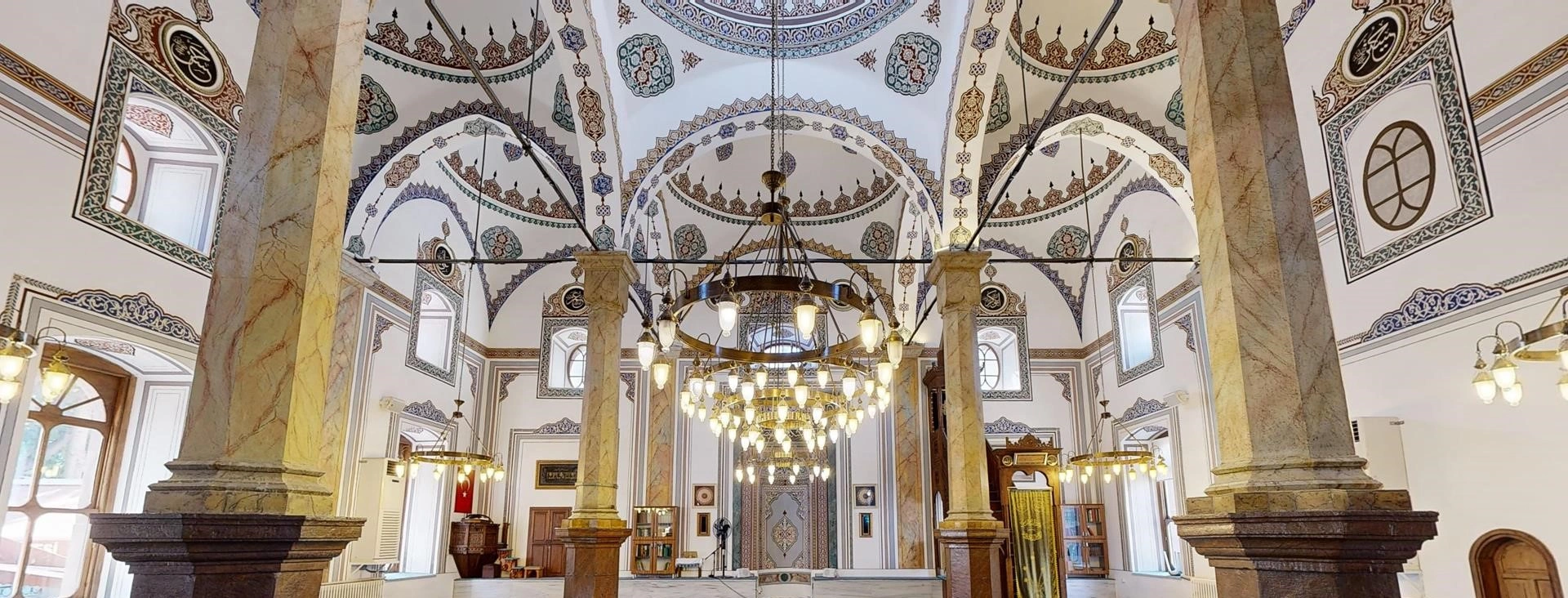
Visit the historic mosque directly associated with the fountain’s town-centre setting and understand the orientation of its four façades.
Explore Çelebi Mehmet Mosque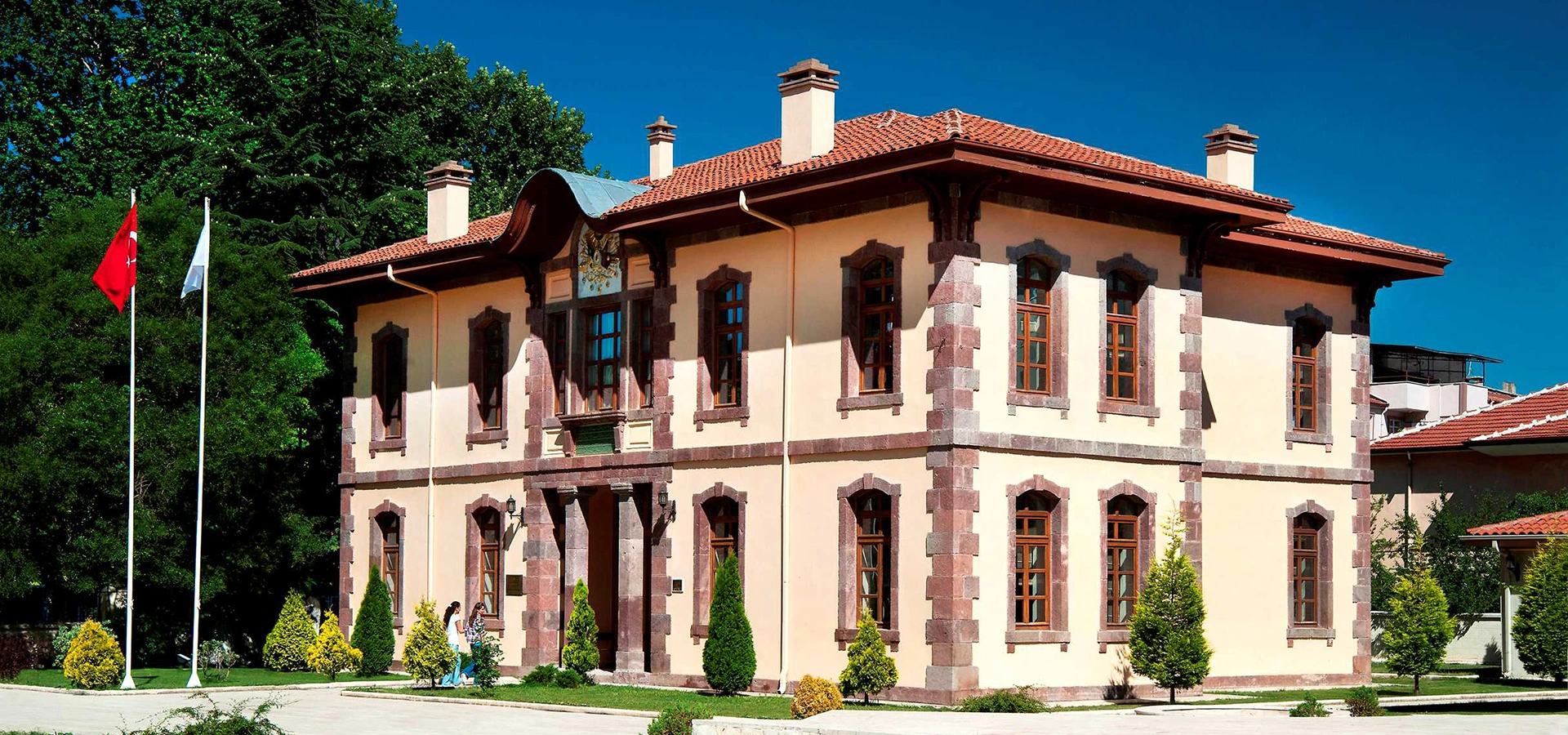
Compare the fountain with another important late Ottoman civic monument created only fourteen years earlier in Söğüt.
Explore Hamidiye İdadisi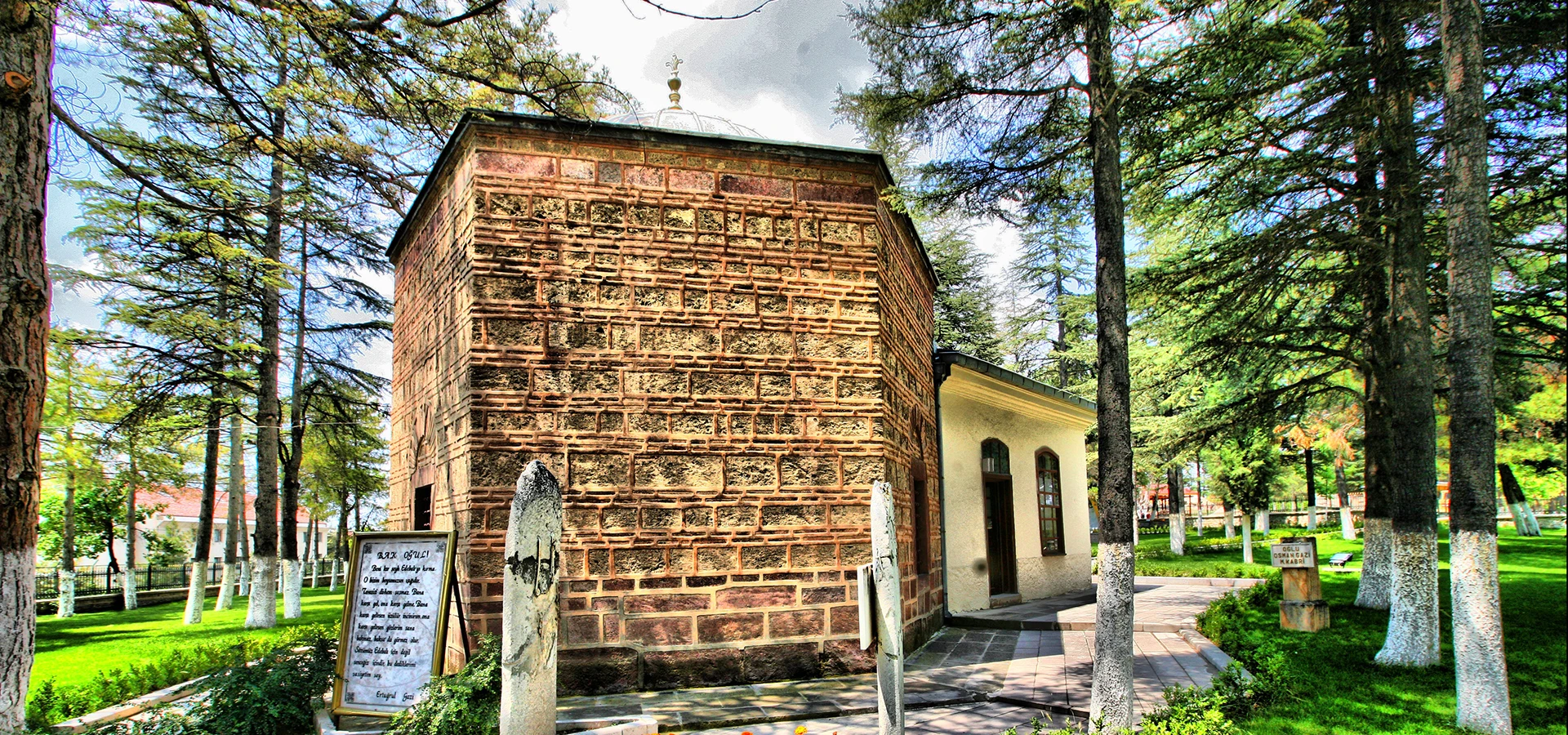
Continue from the Ottoman Empire’s final decades back toward Söğüt’s most important memorial of the dynasty’s remembered beginnings.
Explore Ertuğrul Gazi Tomb