
Discover Buldan Town
Explore the town’s weaving heritage, historic houses and local culture.
Explore Buldan





In the hills of Denizli Province, Buldan is one of Türkiye's best-known traditional textile centres. Its shopfronts display woven scarves, peştamals, dresses, table linens and home textiles, while skilled craftspeople continue an important regional weaving tradition that links the town's past to its present.
The most distinctive fabric is Buldan Bezi, also associated with the names bürümcük and bükülü bez. Its fine, tightly twisted yarns form a lightly puckered texture when finished, producing a textile valued for its comfortable feel and breathability. Buldan Bezi is a registered Turkish geographical indication, with registration number 194, dated 14 March 2016.
Yet the town offers more than fabric shopping. A walk through Dokuma Pazarı Caddesi, conversations with makers when available, and the surrounding historic Buldan houses reveal how textiles became part of local architecture, domestic life, commerce and cultural identity.
This in-depth guide explains Buldan cloth, its historical roots, how the fabric is made, traditional weaving looms, patterns, dyes, products to buy, workshop etiquette, responsible shopping and suggested visits from Denizli or Pamukkale. No textile purchase is required to appreciate this heritage.
Discover the protected woven cloth with its characteristic textured surface.
Understand the traditional tools and skills behind the fabric.
Stroll through Dokuma Pazarı Caddesi and browse regional products.
Meet the stories of artisans preserving weaving across generations.
A practical introduction to the cloth, its protected identity and Buldan's craft district.
Buldan, Denizli Province, southwestern Türkiye.
Buldan Bezi, a fine woven cloth known for its crinkled bürümcük texture.
Turkish registration no. 194, officially registered on 14 March 2016.
Yarn preparation, weaving, finishing, pattern design and embroidery.
Dokuma Pazarı Caddesi and other textile shops in Buldan town.
Peştamals, scarves, shirts, blouses, table linens and household textiles.
About 1–2 hours for a market stroll; half a day for deeper cultural exploration.
Around 45 km from Denizli city according to the provincial tourism directorate.
Buldan is not just a place where textiles are sold; weaving has long been an economic and cultural foundation of the town. Traditional home-based work, specialist artisans, small workshops and contemporary manufacturers all form part of its textile landscape.
For travellers, the experience is wonderfully tangible: bundles of cotton yarn, the rhythmic action of a shuttle, patterned lengths of cloth and finished linens in the shop windows. Many pieces make practical souvenirs because they are designed to be used, worn and washed rather than simply displayed.
Buldan's story also connects with the wider textile history of Denizli, Babadağ and Kızılcabölük. Each centre has its own traditions, so the words 'Denizli textile' and 'Buldan Bezi' should not be treated as perfect synonyms.
Textile making remains part of Buldan’s contemporary commercial life.
Fine yarn and finishing help create the signature wrinkled texture.
Shops provide an inviting introduction to the town’s craft identity.
Traditional handloom knowledge depends on personal expertise and training.
Wearable textiles and household linens are common product categories.
Browse, learn and meet artisans respectfully without an obligation to purchase.
Weaving has deep roots in western Anatolia, with textile traditions developing through successive ancient and medieval societies. The Buldan district's local weaving history became particularly prominent in the Turkish and Ottoman periods, when production and textile trade were closely linked to household livelihoods.
Buldan's district authorities and chamber of commerce connect the craft with the fourteenth-century travel writer Ibn Battuta and describe fine cotton fabrics associated with the settlement. These accounts are part of the area's documented cultural narrative, although popular retellings often compress several centuries into one seamless story.
Local histories also connect Buldan fabrics to Ottoman court demand. Stories assigning specific garments to named historical figures should be understood as traditional heritage accounts unless the surviving object and attribution can be individually verified.
Mechanisation later expanded production. Accounts held by local authorities record the adoption of improved shuttle looms and the use of motor-driven looms by the mid-twentieth century. Today's Buldan combines hand weaving and modern textile manufacturing rather than relying exclusively on one historical technique.
Weaving was part of the wider Anatolian material culture long before Buldan’s present townscape.
Local authorities associate Buldan’s fine fabrics with medieval travel accounts.
Regional textile production supplied wider trade networks and consumers.
Developments in loom technology changed output and weaving speed.
Motor-driven weaving became part of the local production story.
Artisan workshops, families and industrial producers coexist.
Buldan Bezi is registered with the Turkish Patent and Trademark Office (TÜRKPATENT) as a mahreç işareti—a geographical indication comparable to a protected indication of origin in a general sense, but distinct from the Turkish menşe adı category.
The official registry identifies registration number 194, an application date of 27 January 2010 and a registration date of 14 March 2016. The registering organisation is the Buldan Chamber of Commerce.
The specification describes the fabric's fine, strongly twisted yarn, its distinctive appearance and traditional processing. The registration is an important indicator of regional textile identity, not a blanket guarantee that every item sold in town is handmade, organic or produced on a wooden loom.
When purchasing, ask the seller exactly what the item is made from, where and how it was woven, and whether its packaging or labelling supports any claimed registered-product status.
Buldan Bezi.
194.
14 March 2016.
Mahreç işareti (Turkish geographical indication).
Buldan Chamber of Commerce.
TÜRKPATENT’s online geographical-indication register.
The classic Buldan fabric is associated with a softly puckered or crinkled surface. Rather than a printed imitation of texture, authentic bürümcük-style cloth develops its character through the structure of the yarn and the fabric's finishing process.
The highly twisted threads store energy during yarn preparation. After weaving, traditional washing and finishing allow the fabric to contract and create its distinctive three-dimensional effect. Official Turkish tourism descriptions specifically note finishing in warm soapy water.
The resulting texture reduces the amount of smooth fabric pressed flat against the skin and creates small air spaces, helping explain why Buldan-type cloth has long been appreciated for comfortable garments. The exact feel still depends on fibre, weave density, yarn and the way the product was finished.
Not everything called a 'Buldan textile' uses exactly the same weave. Modern shops also sell smooth linens, patterned towels and other fabrics that belong to the district's broader textile trade.
The distinctive crinkled or puckered surface.
A Turkish term referring to twisted-yarn cloth.
An important factor in the finished textile’s structure.
Washing and relaxation help form the characteristic texture.
Lightweight construction can be comfortable in warm weather.
Clothing and home textiles are both common applications.
Cotton is central to Buldan's textile identity and is widely used in traditional and modern fabrics. The registered Buldan Bezi specification also discusses other materials, including linen, wool and silk, although products vary and silk has historically been less common because of cost.
Fibre content matters. A cotton peştamal may feel different from a cotton-linen scarf, and a blended garment may drape differently from a strongly twisted cotton bürümcük cloth. Always check the precise item rather than assuming that every product sold in Buldan has the same composition.
Descriptions such as organic, natural dyed or 100% cotton are product-specific claims. Ask for fibre labels and supporting certifications where these characteristics are especially important to you.
Widely used for clothing, towels and everyday woven textiles.
Valued for a crisp handle and lighter summer fabrics.
Historically present in finer fabrics; less common than cotton in everyday production.
Appears in the wider range of historically documented fibres.
Modern combinations produce varied textures and price points.
Fibre content and care instructions are more reliable than assumptions.
A woven fabric begins before the first pass of the shuttle. Threads must be selected, prepared and placed under appropriate tension. To understand the craft, watch how each stage affects the cloth's strength, pattern, width and texture.
First, makers prepare and sometimes dye the yarn. The warp threads—the lengthwise threads on the loom—are arranged in order, while the weft crosses them as the shuttle passes. The weaver's rhythm and the loom's mechanism determine how the fabric is built, thread by thread.
For characteristic Buldan bürümcük, twist and finishing are crucial. Once the woven cloth comes off the loom, washing and other finishing steps allow it to reach the desired hand-feel and puckered appearance. Some pieces then receive hemming, embroidery or decorative fringe.
A single visit may show only part of this sequence. An operating workshop might demonstrate weaving but perform washing, dyeing or finishing elsewhere, so ask what you are actually seeing.
Choose fibres and yarn counts appropriate for the textile.
Dye yarn where the design calls for coloured threads.
Arrange lengthwise yarns at the loom.
Pass crosswise yarn to create the cloth.
Wash, relax and complete the textile’s desired structure.
Hem, fringe, embellish and inspect the finished piece.
Traditional Buldan weaving is closely associated with wooden handlooms, the movement of the shuttle and the careful interaction of pedals, heddles and warp threads. On a handloom, the weaver personally manages much of the rhythm and pattern control.
Local records discuss kamçılı, or pull-cord, shuttle looms as an important advance: the shuttle can be propelled by pulling a mechanism rather than thrown directly by hand. Over time, motor-driven and automated systems expanded manufacturing capacity.
There is cultural value in both continuity and adaptation, but the distinctions matter. Handloom-woven, semi-mechanised and industrially woven are not interchangeable descriptions. Visitors who want a piece made on a wooden loom should ask to see the process or learn about the named maker's practice.
Be mindful of working machinery. Looms contain rapidly moving components and tightly tensioned yarn; stand where the craftsperson asks you to stand.
A craftsperson directly operates the loom’s movements.
Carries weft yarn across the warp.
Lengthwise threads held under tension.
Threads passed across the fabric width.
Historic pull-cord shuttle technology documented locally.
Important in today’s production, but distinct from hand weaving.
Buldan textile design extends beyond the familiar crinkled surface. The Turkish official sources describe geometric, botanical and striped patterns, alongside decorative approaches used in embroidery and fringed finishes.
Traditional plant motifs include flowers and branches, while local accounts mention prominent reds, yellows and whites as well as other historic colour families. Different garments and households developed their own combinations and preferences over time.
Today's Buldan textiles include muted naturals, bright contemporary palettes, checked fabrics and fine border stripes. An old design can be reinterpreted with modern yarns, and a contemporary colour does not by itself make a fabric less authentic to the town's evolving craft culture.
Look carefully at whether a motif is woven into the cloth, embroidered after weaving or printed onto the surface. The techniques have different labour requirements and produce different visual results.
A recognisable element in towels, wraps and clothing.
Checks and geometric repetitions in traditional and modern pieces.
Flowers, branches and stylised vegetation in the wider tradition.
Decorative needlework sometimes applied after weaving.
A practical and decorative finish on selected textiles.
Modern workshops adapt traditional ideas to new products.
Historic records describe the use of plant-based dyes and locally available resources, including walnut leaves, pomegranate skins, oak-related materials and other plant sources. The colouring of yarn was an essential part of making patterned cloth.
Today, industrial dyes are also widely used in textile production. A fabric sold in Buldan should not automatically be described as naturally dyed merely because its design is traditional or the shop displays wooden looms.
Ask whether the maker dyes the yarn locally, which materials are used, and what care advice applies to the colours. Dark or strongly coloured pieces may require special first-wash attention depending on the dye process.
Colour is also part of Buldan's visual appeal: the rows of folded towels, suspended scarves and patterned cloths provide a lively contrast to the town's older stone and timber buildings.
Documented in regional accounts of traditional colouring.
One of the plant materials cited in historic dye traditions.
Acorns and oak-related products appear in dye descriptions.
Common in contemporary production; check individual items.
Request care guidance for strong colours or delicate finishes.
Ask whether the yarn was dyed before or after weaving.
Buldan shops offer much more than a single bolt of fabric. Peştamals—light woven cloths commonly used as towels, wraps and bathing textiles—are especially recognisable. Many visitors also choose scarves, comfortable cotton clothing, tablecloths and embroidered home accessories.
The town's craft background extends to bedcovers, curtains, fabric lengths, decorative cloths and contemporary fashion products. Not every item is made by the same producer or technique, so comparing labels and workmanship is worthwhile.
A smaller, well-chosen piece can be a meaningful souvenir: a scarf with a clearly explained weave, for example, communicates more about the craft than buying a generic item solely because the shop is located in Buldan.
Lightweight woven towel, wrap or multi-use cloth.
Portable textile souvenirs in many colours and weights.
Relaxed garments, sometimes made from textured Buldan cloth.
Runners, cloths, napkins and decorative household sets.
Selected towels, bedcovers and related home textiles.
An option for travellers planning their own sewing project.
Dokuma Pazarı Caddesi is a natural starting point for a weaving-focused walk. The Turkish Ministry of Education's outdoor-learning directory describes the street as a centre for textile shops and cultural discovery, with displays of regional cloth, peştamals, shawls and home textiles.
For visitors, the best experience is to walk slowly and browse several shops. Notice how raw cloth, garments, handmade decorations and more commercially produced pieces share the same streets. Questions about patterns and fabric preparation often lead to better conversations than bargaining immediately.
The street itself is a public place; individual shops operate their own hours. Directory opening times should not be treated as a guarantee that every business is open, especially during holidays, weekends or special local events.
Combine the visit with nearby historic streets for a wider impression of Buldan town. If you would like to observe weaving rather than only shop for it, arrange a specific workshop appointment in advance.
Textile display and shopping in the town’s historic commercial area.
Walk, compare products and spend time with the craft stories.
Buldan cloth, peştamals, scarves and household linens.
Do not assume all shops have a working demonstration loom.
Check individual merchants rather than relying on one street timetable.
Find the Buldan textile market district.
It can be possible to encounter operating handlooms and weaving demonstrations in Buldan, but availability varies by artisan, workshop and day. Some weaving takes place in working premises rather than spaces permanently open for tourists.
A respectful visit begins with an introduction. Ask whether observing is convenient, whether photographs are welcome and whether the weaver has time to explain the loom. Working craft is skilled labour, not automatically a free performance.
If you hope to see a loom actively producing cloth, contact a local craftsperson or arrange a specific visit in advance. A retailer may sell locally made textiles without weaving in the sales room.
Choose any private artisan visit for its educational value. A responsible cultural tour leaves you free to decide whether to purchase anything.
Workshop entry and demonstrations require the maker’s consent.
Busy retail or production periods may not suit visits.
Moving parts and tensioned yarn can be hazardous.
Ask before photographing workers or proprietary designs.
Buy a fairly priced piece if you genuinely want one.
Cultural learning should never require a sales demonstration.
Every textile tradition relies on people who know how to select yarn, plan a warp, set a pattern, operate a loom and judge the quality of a finished piece. These skills are transmitted through families, apprenticeships and the teaching of experienced makers.
Buldan weaver Selahattin Kaçanoğlu received recognition through Türkiye's Living Human Treasures programme in 2024, reflecting the continuing importance of traditional hand weaving. His story has also been discussed in published research on Buldan's weaving knowledge.
The recognition should not be understood as a public promise that a named artist's workshop is open, that they can personally receive tourist groups or that a particular demonstration can be booked without permission.
The most meaningful way to support Buldan's weaving heritage is to value the time, knowledge and skilled labour behind locally made products—not just the souvenir price.
Weaving knowledge builds through years of experience.
Master–apprentice learning helps carry traditional methods forward.
Selahattin Kaçanoğlu received a Living Human Treasures distinction.
Researchers record looms, design methods and weaving skills.
Artisans set their own visiting and photography rules.
Younger makers and education are vital to continuity.
Start by asking the seller to explain the fibre content, weaving method, finishing and maker. A good shop should be able to distinguish a handwoven textile from a piece produced on a motorised or automatic loom without implying that the latter is necessarily poor quality.
Check that the weave feels consistent for the intended design, that borders and seams are finished appropriately, and that the item includes suitable washing instructions. Handmade textiles may have natural small variations; distinguish these from damaged threads, poor joins or hidden flaws.
If a product is advertised as Buldan Bezi with geographical-indication status, ask about traceability and proper labelling. Do not treat 'from Buldan,' 'Buldan-style,' 'handloom' and 'organic' as equivalent quality assurances.
Prices depend on fibre, size, pattern complexity, handwork and seller. As there is no single official retail price for every item, this guide avoids inventing price ranges that may become misleading.
Seek a clear answer about the manufacturer or weaver.
Cotton, linen, silk and blends feel and wash differently.
Look at hems, selvedges, fringes and joins.
Handmade, organic and protected are separate product claims.
Two similarly sized items may involve very different labour.
Useful for product questions and care guidance.
There is no single care method for every Buldan textile. A highly twisted cotton cloth, a silk-blend scarf and an embroidered table runner may each need different treatment. The product's own label and maker's instructions are the best place to begin.
For delicate pieces, a gentle wash, avoiding harsh bleaching agents and testing colour fastness are common sensible precautions. Some crinkled fabrics are intended to retain their natural texture rather than be ironed completely flat.
Ask about first-wash shrinkage before purchasing fabric by the metre or fitted bedding. If the item has elaborate fringe or embroidery, find out whether handwashing or a protective laundry bag is recommended.
Storing textiles clean and completely dry helps protect them between trips, while keeping receipts and care notes makes long-term use easier.
Follow the maker’s specific fibre and wash guidance.
Strong dyes may need special attention on early washes.
Do not automatically iron textured bürümcük fabric flat.
Especially important for clothing and fabric lengths.
Decorative details may be more delicate than the base cloth.
Avoid damp storage and direct prolonged sun exposure.
Buldan’s weaving heritage is inseparable from its streets and buildings. The old town contains examples of timber-fronted houses, projecting bays and traditional domestic architecture, although the condition and access of individual buildings varies.
Historically, domestic spaces and small-scale work supported household textile production. Today's market and older residential lanes still convey the close relationship between homes, local commerce and the everyday life of the craft.
Take time to appreciate the setting rather than treating the old houses as interchangeable photo props. Many are private dwellings; do not enter courtyards or doorways without permission.
Our dedicated Buldan town guide explores the architecture, streets, local foods and nearby landscapes beyond textile shopping.
Older local buildings with woodwork and projecting forms.
Commercial lanes and residential quarters have different rhythms.
Weaving has historically been linked to family livelihoods.
Respect private property and residents.
Combine cloth shopping with an old-town walk.
History, food and attractions in Buldan.
Buldan's Dokuma, Kültür ve El Sanatları Festivali is associated with the town's longstanding weaving identity. Such events may bring crafts, exhibitions, community activities and demonstrations into a shared cultural programme.
Festival dates are not fixed guarantees. A local 2026 report recorded the postponement of the dates originally planned for 26–28 June 2026 because of forecast adverse weather. Travellers should therefore avoid relying on an older annual calendar or a previous year's announcement.
Before arranging a festival-specific visit, check the current Buldan Municipality announcements and ask whether public weaving events, live demonstrations and workshop admissions have actually been confirmed for your travel dates.
The town's textile identity is worth exploring outside festival periods, when browsing shops may also feel more relaxed.
Weaving culture, local identity and handicrafts.
Dates differ year by year and may change.
Previously announced June dates were reported postponed.
Verify demonstrations and exhibits with organisers.
The textile market and town remain points of interest.
Consult the municipality for up-to-date event information.
Unlike a flower festival or harvest event, Buldan's textile culture is not confined to a single season. Shops and production businesses operate across the year, although individual opening days, holiday closures and workshop schedules vary.
Spring and autumn often suit a combined town walk and textile-market visit, with comfortable conditions for exploring historic streets. Summer can be lively but warm; winter visits may be quieter and require planning around rain and shop hours.
For an artisan appointment, the most important factor is not the season but the weaver's actual availability. Ask in advance if you hope to watch a specific technique rather than relying on a chance encounter.
Pleasant for combining old-town walks and textile browsing.
A good season for shopping, but plan around heat.
Comfortable for cultural touring and photography.
A quieter experience is possible; check local business hours.
Confirm the year’s actual event announcement.
Workshop visits should be arranged directly when possible.
Buldan lies approximately 45 km from Denizli city according to the provincial Culture and Tourism Directorate. It is part of the wider Denizli region and can be explored in a separate cultural excursion or combined with nearby heritage stops.
The simplest way to visit a textile market and several nearby attractions is with private transport. Public transport services may connect Buldan and Denizli, but actual stops, connections and frequencies should be checked locally before relying on a particular departure.
If travelling from Pamukkale, allow sufficient time to reach Buldan, browse the market and return or continue to your next attraction. A short detour does not leave much time for a meaningful artisan conversation.
Ask your driver to navigate to the specific shopping area or agreed workshop, not merely to the wider Buldan district.
About 45 km from Buldan in official tourism descriptions.
Usually visit by road, allowing time for transfers and shopping.
Useful for combining town streets with rural or archaeological sites.
Verify services, stops and current schedules locally.
Use Buldan’s textile market or exact workshop address.
Confirm parking and the nearest suitable drop-off point.
Buldan has several related but distinct attractions. The main textile shopping streets, individual workshops, historic residential areas and nearby archaeological sites do not share one entrance or parking point.
Use the independent map searches below as planning aids. Confirm the actual address and visitor arrangements directly when travelling to a particular artisan, workshop or private property.
Locate the weaving town and district centre. Open the map search.
Find the main textile shopping area. Open the map search.
Explore nearby Roman archaeological heritage. Open the map search.
Plan a separate nature stop near Buldan. Open the map search.
Search for traditional architecture and old streets. Open the map search.
Locate the wider district’s waterfall excursion. Open the map search.
Buldan weaving is a town-wide living tradition, not a single ticketed museum. Streets may be visited as public spaces, while individual shops and workshops follow their own opening hours and commercial practices.
Some local educational directories publish visiting times for the textile street, but those timings do not guarantee that every merchant is open. Similarly, a workshop demonstration is not necessarily available on demand, and any guided session or private artisan visit may have its own arrangements.
There is no single official 'Buldan weaving entrance ticket' or universal 2026 shop price. Ask about workshop demonstrations, photography, possible fees and textile costs before making a special journey.
The old town contains slopes and uneven streets. Visitors with limited mobility should plan the actual walking route and accessible drop-off based on their group.
A textile-market stroll is not a ticketed attraction.
Opening hours differ by seller and holidays.
Access and demonstrations require current confirmation.
Ask directly; do not assume either free or paid access.
Products vary widely by material, labour, size and finish.
Old-town slopes and shops may have steps or narrow thresholds.
Buldan offers photographic subjects on several scales: a close-up of interlacing yarn, a loom shuttle in motion, folded peştamals in repeating colours or an entire textile-lined market street.
When photographing a person at work, request permission first and avoid disturbing their concentration. Do not reach into moving looms to stage a photograph, and avoid using strong flashes where the worker objects.
The texture of Buldan bürümcük is particularly well suited to soft angled light, which reveals the raised weave without overwhelming the colour. A photograph of the cloth alongside its maker or context tells a richer story than a generic souvenir shot.
For architectural photography, pair textile shops with old house details while respecting residents' privacy.
Show the warp, weft and texture at work.
Use repeated stripes and layered fabric for composition.
Capture shopfronts and historic everyday life.
Always obtain the weaver’s consent.
Try side lighting to reveal bürümcük structure.
Include the character of Buldan’s older streets.
Short visit (1–2 hours): begin at Dokuma Pazarı Caddesi, walk among the textile displays, compare traditional and modern fabrics, and allow a leisurely café pause if one is open. This is enough for an introduction, but not necessarily for a full artisan demonstration.
Half-day heritage visit: add a planned conversation or loom-viewing appointment, if available, followed by a walk through Buldan's historic residential streets. Make time to hear how weaving, trade and family life are connected.
Full-day Buldan excursion: combine the town with Tripolis Ancient City or Süleymanlı Yayla Lake, subject to access, your interests and the distance between stops. Avoid trying to do every nearby destination in one rushed visit.
Buldan sits in a region where textile heritage, ancient trade routes, small towns and varied landscapes can be combined in a thoughtful itinerary. These suggestions are separate destinations, not places within a short walk of Dokuma Pazarı Caddesi.
For archaeology, Tripolis provides a natural historical pairing. For natural scenery, the upland lake near Süleymanlı and other Denizli landscapes offer a contrast to the weaving district.
Explore historic houses, local food and town highlights.
Discover a major ancient city and its regional trade connections.
Visit an upland landscape associated with Buldan district.
Discover a separate waterfall and countryside attraction.
Compare the historic commercial traditions of Denizli city.
Extend your visit to the region’s travertines and ancient city.
Discover the wider cultural history of the province.
Use our regional guide to plan a longer heritage journey.
The timeline below separates historical traditions from documented modern milestones. Precise dates for early weaving practices are not always independently established, but the district's important place in the later textile history of the region is well recognised.
Fine textile traditions became associated with the region and its trade routes.
Buldan developed an important identity as a weaving and textile centre.
Loom methods and textile products continued to evolve.
Local accounts describe improvements to shuttle-loom technology.
Motor-driven looms became a documented part of Buldan production.
Application date for Buldan Bezi’s geographical indication.
Official TÜRKPATENT registration date, no. 194.
Traditional weaver Selahattin Kaçanoğlu recognised as a Living Human Treasure.
Hand weaving, regional textile shops and modern manufacturing coexist.
Buldan is a district and town in Denizli Province in southwestern Türkiye, approximately 45 km from Denizli city according to regional tourism information.
Buldan is famous for traditional weaving, particularly Buldan Bezi, and for its textile market and historic townscape.
A traditionally woven cloth known for a soft crinkled bürümcük texture created through highly twisted yarn and finishing.
It refers to the characteristic crinkled or puckered fabric appearance associated with twisted-yarn woven cloth.
Yes. TÜRKPATENT records Buldan Bezi as a registered mahreç işareti, number 194, dated 14 March 2016.
No. The geographical indication should not be confused with a universal handloom certification. Ask about how the individual product was made.
No such blanket claim is justified. Check each item’s fibre label and any organic certification.
Its fine yarn, distinctive textured finish and use in light clothing and household textiles make it recognisable.
Strongly twisted threads and subsequent washing and finishing allow the cloth to contract into a characteristic puckered structure.
Cotton is common, but registered and regional descriptions also mention materials such as linen, silk and wool. Individual products vary.
It may be possible at workshops or demonstrations, but access is not guaranteed. Contact a maker in advance if seeing a live loom is important.
Dokuma Pazarı Caddesi and other shops in Buldan town are familiar places to browse.
Popular choices include peştamals, scarves, tablecloths, garments and other woven home textiles.
Ask about the maker, the exact loom and the production process; do not rely on a generic handmade sign alone.
No. Historical dye traditions include plant materials, but modern dyes are also used today.
Some crinkled fabrics are designed to retain their texture, but care instructions depend on the specific product and fibre.
The street is a public space; purchases, private demonstrations or special activities have separate conditions.
Shops set their own schedules. Confirm with individual businesses, especially on weekends and public holidays.
Allow about 1–2 hours for an introduction to the market and roughly half a day if you want a deeper cultural visit.
Yes, the town has a weaving, culture and handicrafts festival tradition, but dates are subject to announcements and changes.
Local reporting documented postponement of the event initially planned for 26–28 June 2026. Check the municipality for any replacement dates.
Yes, a planned day around Buldan and Tripolis can combine textiles and archaeology if current site access and transport work.
Buldan is a separate Denizli destination reached by road. Allow a meaningful journey and browsing time rather than treating it as a very brief stop.
Accessibility varies by individual shop, street and workshop; older buildings may have stairs or narrow entrances. Confirm in advance.
Only with permission. Never touch or interfere with equipment, and follow any photography restrictions.
We can tailor private Denizli sightseeing around Buldan, nearby heritage sites and your interests, subject to arrangements and availability, with no compulsory shopping stops.
Buldan weaving is living labour and living heritage. The sound of a loom, the arrangement of yarn and the patterns in the cloth come from time, materials and expertise. Treat makers as professionals rather than props for a shopping excursion.
If a private workshop is not open, respect the boundary. Ask before photographing people or designs, never interfere with machines and avoid forcing conversations during busy production periods.
Consider supporting locally made products when you genuinely want them. Equally, respect the right of visitors to enjoy historic streets and learn about weaving without being pressured into a purchase.
When describing the craft online, distinguish traditional examples from modern items, and avoid unsupported blanket labels such as 'all handmade', 'all organic' or 'entirely naturally dyed'.
Value their work and ask before entering workshop spaces.
Request permission for photography and demonstrations.
Stay clear of moving looms and electrical machinery.
Ask about fibres, maker and production methods.
Historic town houses are often private properties.
Present Buldan heritage thoughtfully and without exaggeration.
Explore Buldan's craft traditions, ancient cities, market streets and the landscapes of Denizli with a flexible private itinerary and no compulsory shopping stops.
Combine living craft traditions with archaeology and the natural scenery of Buldan.
Explore the town’s weaving heritage, historic houses and local culture.
Explore Buldan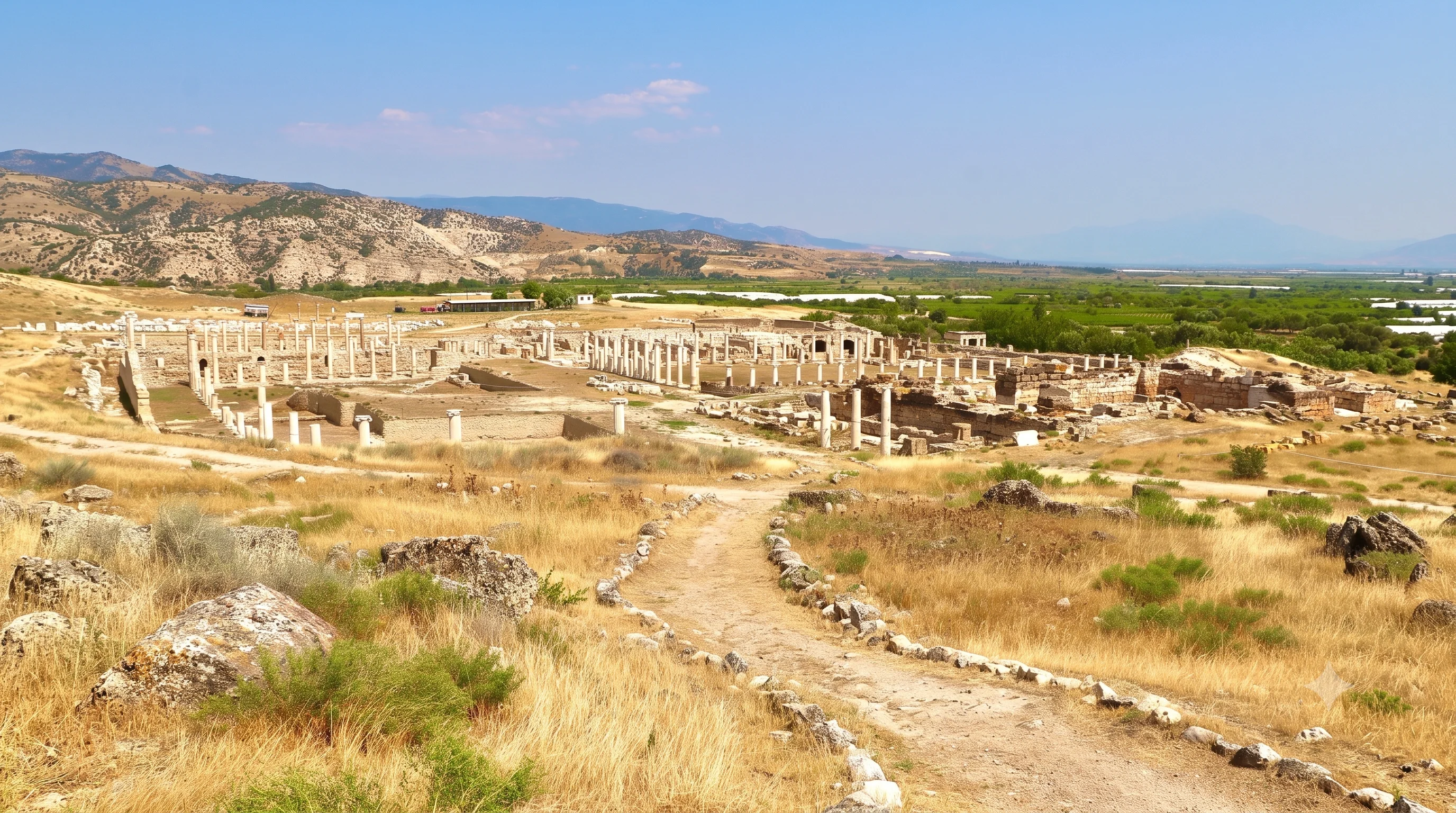
Follow the region’s ancient trade story through impressive archaeological remains.
Discover Tripolis
Enjoy an upland nature escape associated with the Buldan district.
Explore the LakeBuild a wider cultural day with markets, archaeology and UNESCO-listed landscapes.
Discover another side of the region’s trading culture and market heritage.
Explore Kaleiçi
Discover the famous travertines and the Roman city at a comfortable pace.
Explore Private Tour
Plan more historical, natural and cultural stops across Denizli Province.
Explore the Region