
Private Pamukkale & Hierapolis Tour
Discover ancient Hierapolis, the archaeology museum and Pamukkale’s mineral terraces with a flexible private itinerary.
Explore the Private Tour





Hierapolis Archaeology Museum (Hierapolis Arkeoloji Müzesi) is one of the most rewarding cultural stops inside the Hierapolis–Pamukkale archaeological site near Denizli, Türkiye. Its home is extraordinary: a restored Roman bath complex where ancient vaulted rooms now display sculpture, elaborate marble coffins, inscriptions and everyday objects recovered across the region.
Opened as a museum on 1 February 1984 and reopened after major restoration on 24 April 2000, it presents archaeological discoveries in three main indoor halls: the Hall of Sarcophagi and Statues, the Hall of Small Finds and the Hall of Hierapolis Theatre Finds. Outdoor stone exhibits extend the visit into the historic complex.
From the carved Maximilian sarcophagus and sculpture associated with Tyche, Dionysus and Asklepios to the theatrical stories of Marsyas, Niobe, Persephone and Heracles, the museum connects artefacts with the beliefs, artistry and public life of the ancient Lycos Valley. Finds also come from Laodicea, Tripolis, Colossae and other archaeological locations.
This complete guide covers history, the Roman bath architecture, all three galleries, special sculptures and reliefs, opening hours, entrance fees, passes, accessibility, photography, travel tips and private guided itineraries. Visitor logistics reflect official information checked in October 2026 and should be reconfirmed before travelling.
Opened as an archaeological museum.
Statues, small finds and theatre reliefs.
Exhibits inside ancient vaulted spaces.
Within the Hierapolis–Pamukkale site.
Everything you need to know before exploring the ancient sculpture and Roman bath galleries.
Inside Hierapolis–Pamukkale, Denizli.
Open on Google MapsRestored Roman bath, gymnasium and library complex.
Three principal indoor galleries and outdoor exhibits.
1 February 1984; renewed in 2000.
08:00–17:00, 14 Sep 2026–1 May 2027 (provincial schedule).
Museum itself listed free; Pamukkale site ticket €30 for foreign visitors.
Sarcophagi, classical statues, theatre reliefs and ancient coins.
About 45–75 minutes, plus time for the wider site.
Unlike a conventional museum built centuries after its collection, Hierapolis Archaeology Museum occupies part of ancient Hierapolis itself. The stone-vaulted rooms belong to a large Roman bath complex, so the architecture is as meaningful as the objects on display.
Inside, you can examine marble sarcophagi, statues of deities, funeral monuments, coins and objects of daily life, then see sculpted relief panels that once decorated the stage building of the spectacular Hierapolis theatre.
The museum is particularly worthwhile for guests who want to go beyond photographing Pamukkale’s white travertines and understand the beliefs, craftsmanship, prosperity and theatrical culture of the people who lived in the ancient city.
Original Roman bath architecture.
Gods, goddesses and civic patrons.
Ornately carved Roman sarcophagi.
Dramatic theatre relief panels.
Finds from the Lycos Valley.
Part of a wider Hierapolis visit.
The museum stands inside the Hierapolis archaeological site in Pamukkale, in the province of Denizli, southwestern Türkiye. It is not a separate city-centre museum in Denizli.
The building occupies the ancient Great Roman Bath area of Hierapolis, near the portion of the archaeological plateau overlooking Pamukkale’s terraces. The official site address is simply Pamukkale Örenyeri.
For navigation, search “Hierapolis Arkeoloji Müzesi” or “Hierapolis Archaeology Museum,” then choose a working Pamukkale archaeological-site entrance according to your walking route and transport arrangements.
Denizli, Türkiye.
Pamukkale.
Hierapolis ancient city.
Great Roman Bath complex.
Through archaeological-site access.
Search museum name, not central Denizli.
The museum’s story begins with a monumental Roman bathing complex built for the city in antiquity. Turkish Museums dates the beginning of work on the southern / great bath to the reign of Hadrian (AD 117–138), with completion during the Severan period.
In the 1970s, the historic bath spaces were restored for cultural use. Archaeological objects from Hierapolis and other sites were arranged for exhibition, and the Hierapolis Archaeology Museum officially opened on 1 February 1984.
After further restoration and exhibition improvements beginning in 1999, the institution reopened on 24 April 2000. The museum now brings excavated artefacts back into the landscape that produced them.
Roman bath construction.
Early construction phase.
Bath restoration.
Museum opened.
Further restoration and re-display.
A major stop within Hierapolis.
The museum occupies the surviving spaces of the large Roman bath complex, historically associated with a gymnasium and library. The museum’s official presentation describes an approximately 14,000 m² historic complex; this should not be confused with the floor area of its three exhibition rooms.
The galleries are housed within massive vaulted chambers built with travertine stone blocks. Their high ceilings and substantial masonry show the technical ambition of Roman public architecture and create an evocative setting for sculpture.
Bath complexes were important places for washing, exercise, conversation and social life, not merely buildings for taking a bath. Today, the setting offers a direct connection between the exhibits and the infrastructure of the city around them.
Roman public bathing.
Gymnasium and library.
Large blocks of travertine stone.
Impressive vaulted halls.
Approx. 14,000 m² per ministry profile.
Adaptive reuse of ancient buildings.
Hierapolis developed beside mineral-rich thermal springs, the same waters responsible for Pamukkale’s white calcite terraces. Ancient bathing and healing traditions helped shape the city’s identity.
The Turkish Museums account explains that, after ancient Hierapolis declined, deposits carried by the water gradually accumulated in and around the bath structure, raising its floor by approximately five metres. This striking detail reveals the long-term influence of water on buildings and archaeology.
When you look at the museum’s heavy stone construction, remember that it belonged to a much larger civic landscape connected with public health, social routines and the thermal resources of the plateau.
Mineral-rich thermal water.
Deposited calcium carbonate.
Bathing and civic life.
Deposits accumulated after abandonment.
Approx. 5 metres in museum account.
Pamukkale terraces.
The museum’s collection is organised into three principal indoor galleries. Together they connect monumental marble art with the smaller objects used, exchanged and dedicated by ancient people.
The Sarcophagi and Statues Hall presents funerary sculpture, statues, inscriptions and architectural fragments. The Small Finds Hall spans multiple periods and includes pottery, jewellery, lamps and coins. The Hierapolis Theatre Finds Hall displays reliefs associated with the ancient theatre.
You will also encounter outdoor stone objects in the museum grounds. Following the gallery sequence makes it easier to move from individual objects to the larger city visible outside.
Sarcophagi and Statues.
Small Finds.
Hierapolis Theatre Finds.
Stone and marble objects.
Prehistory through later eras.
Hierapolis and surrounding ancient sites.
This is the museum’s most visually dramatic collection. It brings together Roman sarcophagi, statues, inscriptions, tombstones, columns and architectural capitals recovered especially from Hierapolis and nearby Laodicea.
The museum’s official culture guide identifies statues of Tyche, Dionysus, Pan, Asklepios, Demeter and an Isis priestess among the gallery’s classical material. Such figures illuminate religion, civic prosperity, medicine and funerary beliefs in the Greco-Roman world.
Pause to examine the carved clothing, facial expressions, relief panels and inscriptions. These are not merely decorative objects: each can communicate family status, mythological identity or the values of the people who commissioned it.
Statues and decorated sarcophagi.
Hierapolis and Laodicea.
Tyche, Dionysus and others.
Remembrance and social status.
Columns, capitals and inscriptions.
Sculpture and Roman history.
One notable piece mentioned in the Ministry of Culture’s collection account is the sarcophagus of Maximilian (sometimes rendered Maximillan in museum-related translations). Its associated inscription is part of what makes the monument especially informative.
Sarcophagi were carved stone coffins, often commissioned by families able to pay for elaborate funerary art. Relief ornament, figure groupings and epitaphs could express personal identity, inherited status and hopes for remembrance.
In this gallery, compare the design of the Maximilian sarcophagus with other examples rather than assuming all Roman burials followed a single form. The location and current arrangement of individual exhibits can change during conservation work.
Inscribed Roman sarcophagus.
Sarcophagi and Statues Hall.
Personal inscription.
Carved stone / marble tradition.
Death, family and commemoration.
Read the object label carefully.
The official Turkish culture guide highlights a Sidemara-type sarcophagus excavated at Laodicea among the museum’s exceptional works. The name refers to an elaborate style of Roman-period coffin associated with rich sculptural decoration.
Such monuments were designed to be encountered as impressive works of art. Figures and architectural framing could turn a coffin into a miniature stone façade, using imagery to express ideals of status and cultural refinement.
Its presence at Hierapolis demonstrates why the museum is best understood as a regional archaeological collection, not simply a storehouse of discoveries from one city.
Laodicea ancient city.
Sidemara-style sarcophagus.
Roman imperial art.
Rich figurative carving.
Lycos Valley cities.
Laodicea archaeological site.
The sculptures documented in the official collection include divine figures such as Tyche (fortune and civic well-being), Dionysus (wine, performance and ecstatic worship), Pan (pastoral landscapes) and Asklepios (healing).
Demeter recalls agriculture and fertility, while an Isis priestess reflects the wider religious exchanges of the Roman Mediterranean. These identities help visitors understand the cosmopolitan beliefs found in ancient Anatolian cities.
Interpret attributes such as a staff, vessel, animal, wreath or costume with the aid of a museum label or licensed guide. Broken statues may lack the identifying features that once made their subjects unmistakable.
Fortune and the city.
Wine, drama and celebration.
Rural and pastoral myth.
Healing traditions.
Grain and fertility.
Cross-cultural religious life.
The museum’s collection includes reliefs showing gladiatorial combats and bull-related spectacles, documented in connection with excavations on the Tripolis Street area of Hierapolis.
These carved scenes offer glimpses of the public entertainments and competitive imagery familiar to communities of the Roman world. Together with inscriptions, they shed light on how people represented civic events, patronage and public prestige.
They also remind us that archaeological evidence comes from streets, buildings and reused blocks as well as formal tombs. The original setting of a relief is important when interpreting what it meant.
Gladiatorial and bull contests.
Tripolis Street in Hierapolis.
Stone relief carvings.
Roman public entertainments.
Inscriptions and civic texts.
Look for movement and costume.
The Small Finds Hall presents the portable objects that archaeologists use to reconstruct daily habits and long-term cultural change. The catalogue includes material extending back to the fourth millennium BCE.
Exhibits described by the ministry include terracotta vessels, figurines or idols, oil lamps, glass containers, necklaces and metal ornaments, as well as objects linked with several ancient cultures.
The museum arranges many of these finds chronologically, letting you compare form, material and technique over time. Tiny domestic objects are often just as informative as giant statues for understanding life in the past.
From the fourth millennium BCE.
Jugs, vessels and lamps.
Necklaces and metal ornaments.
Roman and later glassware.
Chronological interpretation.
Everyday ancient history.
An important component of the museum comes from Beycesultan Höyük, an archaeological mound near Çivril in Denizli province. The ministry records excavations conducted there between 1954 and 1959 by the British Institute of Archaeology.
Among the associated finds are pottery, figurines and stone objects. These artefacts widen the story of the museum beyond the Roman city to the earlier communities of inland western Anatolia.
For visitors interested in archaeology, Beycesultan is a useful reminder that a museum can bring together artefacts from several landscapes, allowing comparisons across time, settlement types and cultures.
Beycesultan Höyük.
Near Çivril, Denizli.
1954–1959 noted by ministry.
Pottery, idols and stone finds.
Prehistoric and Bronze Age heritage.
Small Finds.
Coins are particularly useful archaeological evidence because their images, inscriptions, metals and minting traditions illuminate political authority and economic exchange.
The ministry describes collections including gold, silver and bronze coins from classical antiquity through the Hellenistic, Roman, Byzantine, Seljuk and Ottoman periods, presented in chronological order.
As you look at the coins, consider how rulers used portraits and symbols to communicate power. Even small pieces of metal can help archaeologists date sites and reconstruct trading networks across the region.
Gold, silver and bronze.
Greek and Hellenistic minting.
Imperial portraits and issues.
Byzantine, Seljuk and Ottoman.
Small Finds.
Dating, politics and commerce.
The museum’s collection extends across the ancient Lycos (Çürüksu) Valley. The official culture guide names Hierapolis, Laodicea, Tripolis, Colossae and Attuda as places represented in the wider archaeology of the collection.
This is especially useful for visitors exploring more than one archaeological site. Sculptures, tombstones, inscriptions and domestic finds reveal cultural connections between prosperous neighbouring settlements.
Continue your discovery with our guides to Laodicea Ancient City, Tripolis and Colossae. The museum adds context to what survives in the open landscape.
Museum’s home city.
Funerary and sculptural material.
Related valley archaeology.
Ancient Lycos Valley settlement.
Another regional ancient site.
Additional Carian, Pisidian and Lydian finds.
The Theatre Finds Hall contains some of the museum’s most famous works: relief panels associated with the stage building of Hierapolis Theatre. The sculptures translate myth, imperial themes and civic identity into monumental images.
The official museum list includes the procession of Dionysus, the crowning or personification of Hierapolis, the myths of Niobe, Marsyas, Heracles and Antaeus, the birth of Apollo and Artemis and the abduction of Persephone. The museum also describes imperial and theatre-council subjects.
Some decorative elements remain at the theatre, while the official guide notes that copies of certain removed reliefs have been placed in their original stage positions. Visiting both the hall and the theatre makes the relationship clear.
Hierapolis Theatre stage building.
Mythology and civic imagery.
Processions and performance.
Several connected myths.
Images of imperial authority.
See the theatre afterwards.
One of the best-known relief narratives shows the myth of Marsyas, a satyr who challenged the god Apollo to a musical competition.
In the official museum description, Marsyas is depicted bound to a tree while a figure prepares for his punishment. Apollo then appears victorious, crowned with laurel by accompanying figures. The myth warns against challenging divine power while also celebrating music as a powerful form of cultural expression.
The sculpture becomes more vivid when you look at it as a sequence of episodes, rather than one frozen instant. Ask your guide to identify the figures and the transitions between scenes.
Marsyas vs. Apollo.
Music and hubris.
Marsyas, Apollo and attendants.
The defeated Marsyas.
Theatre relief sculpture.
Follow the narrative from panel to panel.
The theatre relief programme includes scenes related to Niobe, a figure of Greek mythology whose pride in her children led to conflict with the divine children Apollo and Artemis.
The theme allowed ancient artists to explore grief, punishment, human pride and the limits of power. Because some stage sculpture is fragmentary, museum interpretation can help explain which surviving characters belong to the original narrative.
Niobe belongs to a larger programme of theatrical imagery in which familiar myths could be understood by a Roman audience viewing performance and ceremonial events at Hierapolis.
Myth of Niobe.
Apollo and Artemis.
Pride, punishment and grief.
Theatre Finds.
Stage decoration.
Compare narrative scenes nearby.
Another subject named in the museum catalogue is the abduction of Persephone by Hades. In ancient Greek mythology, this story explains the movement between the world of the living and the underworld, connecting the divine family with seasonal change.
The image would have carried meanings related to loss, return and the cycles of nature, themes that ancient viewers might encounter in mythological storytelling and art.
Viewed inside an ancient Roman bath, the panel offers a fascinating contrast between the everyday architecture surrounding you and the supernatural narratives once displayed in a public theatre.
Hades and Persephone.
The underworld.
Loss, renewal and seasons.
Theatre stage decoration.
Hierapolis Theatre Finds.
Niobe and Marsyas.
The museum lists a relief telling the story of Heracles (Hercules) and Antaeus, the giant whose power was associated with contact with the earth.
In the traditional myth, Heracles defeats Antaeus by lifting him away from the ground, preventing him from drawing strength from the earth. Such scenes allowed sculptors to portray movement, muscular tension and heroic struggle.
Together with the other mythological reliefs, it shows how the Hierapolis theatre functioned as a monumental setting for stories recognised across the Greco-Roman Mediterranean.
Heracles and Antaeus.
Strength and strategy.
Theatre architectural sculpture.
Dynamic carved human figures.
Roman monumental tradition.
Theatre Finds.
Not all the theatre decoration narrates a contest between heroes. The museum also records the procession of Dionysus, imagery associated with the god closely linked to theatrical performance and festivity.
Other panels are identified with the crowning of Hierapolis and ceremonies involving Emperor Septimius Severus. These subjects connected mythological celebration with local identity and the political world of Rome.
Inscriptions linked to the theatre council or civic decisions add a documentary dimension. They remind us that a theatre was also an urban institution used and maintained by a living community.
Procession and celebration.
City personification / coronation.
Septimius Severus.
Theatre-related inscriptions.
Religion, civic pride and power.
Museum and ancient theatre.
The museum’s collections are not limited to its three vaulted interior halls. The official culture guide notes that additional marble and stone artefacts are displayed outdoors in the museum grounds.
Open-air pieces allow you to see stonework in the natural light, making it easier to appreciate tool marks, scale, weathering and carved details. These displays also reinforce the relationship between portable collections and the ruins of Hierapolis.
Because outdoor arrangements can change with conservation projects, follow the designated visitor route and never climb on or touch ancient stone blocks.
Museum grounds.
Stone and marble fragments.
Natural daylight.
Exhibits may be rearranged.
Do not climb or handle artefacts.
Check current site rules.
Hierapolis developed as a settlement associated with the kings of Pergamon in the late second century BCE. Its location by mineral springs made the city an important centre for thermal bathing and later religious activity.
Much of the standing monumental fabric dates to Roman rebuilding after major earthquakes, particularly the earthquake of AD 60 mentioned in the official archaeological-site history. The city continued to play an important role in the Byzantine period.
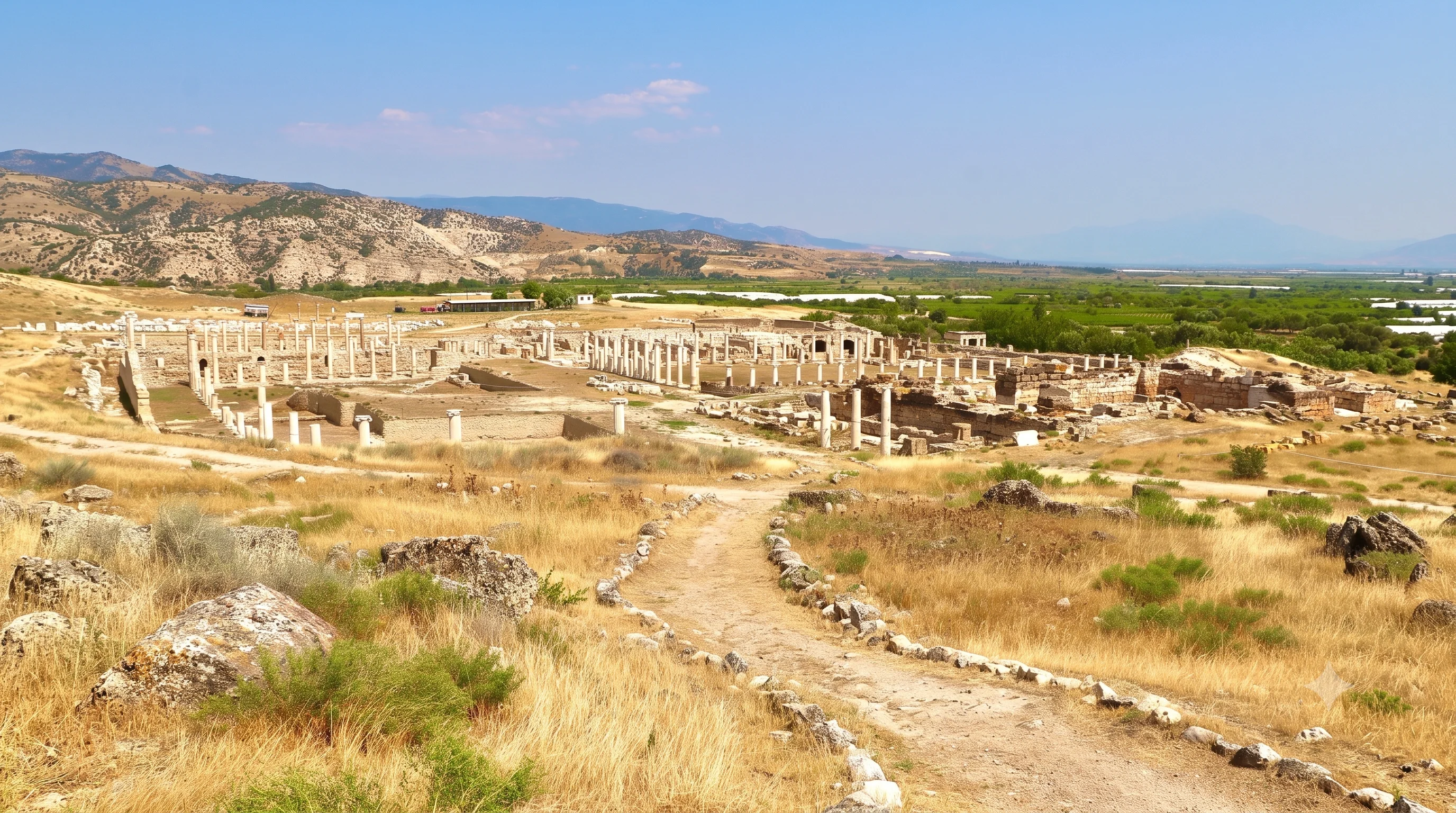
Its monuments include the theatre, extensive necropolis, colonnaded streets, gates, temples and churches. The museum makes these places more understandable by preserving the sculptures and objects connected with the city’s residents.
Late 2nd century BCE context.
Thermal springs and travertines.
Substantial urban rebuilding.
Major Christian monuments.
Finds from city excavations.
Hierapolis–Pamukkale.
Hierapolis–Pamukkale was added to the UNESCO World Heritage List in 1988 as a combined cultural and natural property. The designation recognises the exceptional relationship between the ancient spa city and its celebrated calcite terraces.
The archaeology museum lies within this World Heritage setting; it does not have a separate standalone UNESCO inscription. Its collection helps explain how Romans, earlier communities and later populations experienced the landscape.
A careful visit respects both dimensions of the site: archaeological conservation in the museum and ruins, and environmental protection on the travertine slopes and designated walkways.
1988.
Hierapolis–Pamukkale.
Cultural and natural.
Located inside the property.
Travertine terraces.
Stay on permitted routes.
Begin with the sculpted sarcophagi and the figures of ancient deities. Their scale and fine detail are among the most memorable features of the museum and make excellent subjects for a guided discussion of Roman funerary customs.
Next, look at the Beycesultan objects and chronological coin displays to appreciate how far the collections extend beyond Hierapolis and beyond classical antiquity.
Finish with the theatre reliefs, especially Marsyas and Apollo, Persephone and Hades, and the Dionysian procession. After leaving, continue to the theatre to see the architectural setting from which the sculptures came.
Roman sculpted sarcophagi.
Classical gods and goddesses.
Beycesultan prehistoric finds.
Ancient coins and jewellery.
Marsyas theatre relief.
Outdoor stone exhibits.
Allow approximately 45–75 minutes for a comfortable first visit to the three indoor halls and open-air displays. This is an editorial planning estimate, not an official fixed tour duration.
Visitors particularly interested in classical sculpture, mythology, numismatics or archaeology may prefer 90 minutes or more, especially if they read interpretive labels in detail.
Crucially, the museum duration does not include the time needed for the vast Hierapolis ruins, walking between entrances, or seeing Pamukkale’s terraces. Reserve several additional hours for a complete visit to the wider area.
Around 30–45 minutes.
Around 45–75 minutes.
90 minutes or longer.
Additional time required.
Plan separately.
Allow time between monuments.
The Denizli Provincial Directorate of Culture and Tourism lists Hierapolis Archaeology Museum open 08:00–17:00 under the seasonal schedule valid from 14 September 2026 to 1 May 2027.
The museum’s general official profile shows 08:00–17:30, with ticket office closing at 17:00, and describes the museum as open every day. These official pages are not perfectly identical; for an October 2026 visit, use the more specific provincial schedule and avoid arriving late.
The North and South archaeological-site gates may operate on different schedules from the museum, as may the pedestrian entrance. Summer evening access to the broader site does not automatically mean the museum galleries are open at night.
14 Sep 2026 – 1 May 2027.
08:00–17:00 (provincial).
08:00–17:30.
General ministry page says open daily.
Hours differ by entrance.
Arrive well before 17:00.
The official national museum-fee list marks Hierapolis Archaeology Museum itself as free of an additional museum entrance charge. However, it is located inside the ticketed Hierapolis–Pamukkale archaeological site.
For foreign visitors, the same official schedule lists the main Hierapolis–Pamukkale archaeological-site ticket at €30 at the time of this October 2026 review. In normal sightseeing arrangements you must first enter the ticketed site to reach the museum; “free museum” does not mean that an international visitor can enter the entire archaeological park without paying.
Special activities such as use of the Antique Pool, when available, have separate rules and charges. Always check the latest ticketing notice before travel, as seasonal fees, age eligibility and facilities can change.
Listed as free.
€30 foreign entry (official list).
Within paid archaeological zone.
Müzekart rules apply.
Separate rules and charge.
Recheck near travel date.
The official museum and archaeological-site listings confirm that Müzekart is accepted for eligible Turkish citizens at the Hierapolis–Pamukkale site. This domestic card should not be confused with every product advertised to international travellers as MuseumPass.
The official Turkish Museums platform also advertises Museum Pass The Mediterranean, covering eligible museums and sites in several southern provinces, including Denizli. Check the currently sold pass, exact venue coverage, entry restrictions and validity before making your booking.
Night museum programmes may not be included in ordinary MuseumPass products. Because ticket policies change, a pass should never be treated as proof of access to a special activity, swimming facility or after-hours programme.
For eligible Turkish citizens.
Verify the specific MuseumPass.
Museum Pass The Mediterranean.
May require separate admission.
Not assumed to be included.
Use ministry ticket platforms.
From Pamukkale village, guests typically enter the archaeological area by an open authorised entrance and follow signs toward the Roman Bath / Archaeology Museum. From Denizli city centre, use local road transport or a private transfer to the archaeological-site entrances.
The archaeological plateau is extensive, with North, South and pedestrian access arrangements. The best entry depends on whether you plan to start with the museum, terraces or theatre, and on current gate-opening rules.
Guests arriving from another city or Denizli Çardak Airport should factor in road transfer, ticket checks and walking between monuments. Do not assume a taxi can drive directly to the museum doorway inside the protected site.
Use the active archaeological entrance.
Road transport to Pamukkale.
North, South and pedestrian.
Follow museum signs.
Use authorised drop-off points.
Check gates and walking route.
The museum is housed in ancient Roman structures, while the surrounding site includes outdoor archaeological paths, uneven surfaces, slopes and long distances. It is important not to assume that every route is step-free.
If you use a wheelchair, stroller or mobility aid, confirm the current accessible site entrance, museum thresholds, hall routes, seating and restroom facilities with the managing authorities before visiting.
A private transfer can help with choosing a practical gate and minimising unnecessary walking, but transport alone cannot remove the limitations of the archaeological environment. We can customise the overall route around your needs.
Ancient vaulted stone rooms.
Some uneven or historic surfaces.
Possible across Hierapolis.
Confirm directly before visiting.
Ask about current provision.
Choose the suitable entrance.
The carved animals, mythological figures and giant marble coffins can make the museum memorable for school-age children. A short explanation of the stories of Heracles, Apollo and Persephone often makes sculpture much easier to enjoy.
Turn the visit into a small treasure hunt: find an ancient oil lamp, a coin, a god or goddess, a decorative carved column and a sarcophagus. Ask children what each object tells them about ancient life.
For younger children, keep the museum visit shorter and plan breaks on the larger archaeological-site itinerary. Supervise children closely around fragile exhibits, thresholds and the outdoor stone displays.
Myths and recognisable figures.
Oil lamps and coins.
Sarcophagi and statues.
Roman daily life and mythology.
Short sessions with breaks.
No touching or climbing.
The vaulted Roman rooms are superb subjects for architectural photography, while detailed marble reliefs reward closer views. Photograph the relationship between the objects and the original historic stone interior.
Check current signs before photographing individual exhibits. Flash, tripods, video equipment, drones and commercial shoots may be restricted or subject to special permission. Do not assume a tourist ticket includes commercial filming rights.
For the exterior museum spaces and the wider UNESCO property, protect the archaeological fabric: stay behind barriers, respect walkways and avoid touching exhibits in pursuit of a better camera angle.
Vaulted Roman interior.
Relief details and drapery.
Adapt to indoor conditions.
Obey museum rules.
Ask about permission.
Avoid blocking other visitors.
The museum lies within a larger archaeological visitor complex, where services may be distributed between site entrances and visitor areas rather than available in every individual gallery.
Before arriving with luggage or specialised equipment, ask about toilets, lockers, drinking water, seating, access assistance and any available interpretation material. Facility arrangements can change seasonally and during conservation work.
Bring water, comfortable shoes and sun protection for your outdoor time at Hierapolis; the museum itself offers a useful change of pace from the open-air ruins.
Confirm closest visitor facility.
Ask before arriving with luggage.
Bring for outdoor walking.
Confirm availability.
Read labels / use private guide.
Plan services across the route.
The Ministry of Culture and Tourism’s dedicated museum profile publishes +90 258 272 20 34 and denizlimü[email protected] for museum contact.
For a useful enquiry, give your intended date and approximate arrival time, then ask about the museum’s actual closing time, accessibility arrangements, permitted photography and any gallery work.
When arranging a larger visit, use both the museum profile and the provincial 2026–27 visiting-hours notice. General directory hours may lag behind seasonal changes.
+90 258 272 20 34.
denizlimü[email protected].
Pamukkale Örenyeri.
Provincial culture directorate.
Official national fee list.
Verify the active gate.
Spring and autumn are pleasant seasons for combining indoor galleries with the outdoor monuments of Hierapolis. In summer, the exposed plateau can be hot, so schedule extended outdoor walking for a cooler part of the day.
For an efficient visit, aim to reach the museum comfortably before its scheduled closing time. The museum may shut earlier than the wider archaeological-site gates and cannot be assumed to participate in evening opening programmes.
On a short Pamukkale day trip, prioritise the museum alongside the theatre and travertine terraces. Guests with a particular interest in archaeology should leave extra time for the necropolis, monumental gates and historic streets.
Comfortable outdoor walking.
Plan around midday heat.
Excellent for archaeology.
Check seasonal hours and weather.
Earlier than closing time.
Theatre, terraces and necropolis.
The museum sits within walking reach of major landmarks of ancient Hierapolis, including the Roman theatre, the expansive necropolis, ancient gates and surviving street architecture. Distances and route accessibility depend on the entrance used.
Just beyond the ruins, the iconic Pamukkale travertines illustrate the mineral-water landscape that supported the ancient city. The Antique Pool, when operating, follows its own access and pricing conditions.
For a second archaeological destination, consider Laodicea; for a deeper regional route, add Tripolis or Tabae on another day.
Home of the original stage reliefs.
Monumental burial landscape.
Urban planning and gates.
Pamukkale’s natural wonder.
Separate access conditions.
Laodicea or Tripolis.
The ancient theatre is a large standing architectural monument on the hillside, while the museum gallery houses important sculptural material associated with its stage decoration.
The official culture guide explains that some reliefs remain at the theatre and that replicas of others have been placed in their original stage positions, while significant original material is displayed in the museum.
Visiting the two in sequence is unusually rewarding: see the mythological details at close range in the museum, then understand how the entire sculptural programme related to the scale of Roman public performance.
Ancient performance building.
Close-up display of reliefs.
Preserved in museum.
Still in place or represented by copies.
Visit both.
Architecture and sculptural storytelling.
Hierapolis Archaeology Museum concentrates on excavated objects, classical sculpture and ancient history. It makes the most sense as part of a day at the UNESCO-listed archaeological site.
The separate Denizli City Museum, in central Denizli, tells the much broader story of the province’s people, crafts, textile industry, folk music and modern cultural identity.
Laodicea Ancient City is an extensive open-air site rather than the same museum. It offers the chance to experience Roman streets, religious monuments and urban archaeology alongside the sculptural context provided by Hierapolis.
Archaeological collections.
Regional culture and everyday life.
Open-air urban archaeology.
Natural travertine landscapes.
Hierapolis sculptural halls.
Combine two or more sites.
A licensed private guide can make the museum particularly engaging by connecting its sarcophagi, religious statues, theatre myths and chronological artefacts with the surviving architecture outside.
For archaeology enthusiasts, a guide can explain the differences between an original artefact, a restored ancient building, an in-situ fragment and a modern replica. These distinctions add real depth to a Hierapolis visit.
Wow Cappadocia / Venere Travel can arrange a tailored private Pamukkale and Hierapolis experience with guiding and transfers, subject to arrangements. Our private heritage routes have no compulsory shopping stops.
Licensed professional guide.
Roman history and mythology.
Three galleries and outdoor displays.
Theatre, streets and travertines.
Private options on request.
Flexible, without shopping stops.
Begin with a visit to the Hierapolis Archaeology Museum while the galleries are open. Allow time to discover the sarcophagi and theatre reliefs, especially the scenes associated with Apollo, Dionysus and Persephone.
Continue to the Hierapolis Theatre for the architectural setting of the stage sculptures. With sufficient time, explore selected ruins—such as the ancient streets, necropolis or religious monuments—before moving to the travertine terraces.
This is an illustrative route, not a timetable or promise of access. The ideal order depends on heat, walking ability, live gate schedules and where you enter the site. A private guide can reverse or shorten the route to suit your priorities.
Museum’s three galleries.
Hierapolis Theatre.
Choose monuments to suit your pace.
Pamukkale travertines.
Allow time for refreshments.
Customised, no shopping stops.
Wear comfortable walking shoes with good grip. Even though the museum is indoors, the wider visit often requires walking on ancient stone surfaces, outdoor paths and sloping ground.
Carry drinking water, sun protection and a lightweight layer suited to the season. Consider a small bag rather than large luggage, and check any restrictions at the gallery entrance.
Keep your site ticket or valid pass ready during the visit, and bring a camera without assuming that flash or professional equipment is allowed.
Comfortable and stable.
Hat and sunscreen.
Essential for the open-air site.
Weather-appropriate layers.
Keep valid entry proof.
Respect signs and barriers.
The most reliable historical and collection details come from the Ministry of Culture and Tourism museum profile and its official culture portal. The former provides the museum’s 1984 opening, 2000 reopening and three-hall catalogue.
The Denizli Provincial Directorate of Culture and Tourism publishes the season-specific museum opening hours, while the Ministry’s national tariff lists the museum itself as free and the ticketed Pamukkale site as €30 for foreign visitors at the time of this review.
Finally, the UNESCO World Heritage Centre explains the global significance of Hierapolis–Pamukkale. Check all practical details again near your visit date, especially changes affecting entry gates, visitor facilities or temporary exhibit closures.
National museum profile.
Official Culture Portal.
Provincial culture authority.
National fee table.
UNESCO listing.
October 2026.
Quick answers on the collection, archaeology, opening times and admission. Prices and hours are based on the October 2026 review of the official sources.
Inside the Hierapolis–Pamukkale archaeological site in Denizli province, not in central Denizli.
Yes. It stands within the same archaeological site as the white travertines and ancient city.
The official museum page lists it as open daily. The provincial October 2026 schedule gives visiting hours of 08:00–17:00; reconfirm before travelling.
08:00–17:00 in the provincial schedule valid from 14 September 2026 to 1 May 2027. The general museum profile lists 08:00–17:30.
The dedicated ministry profile says it is open every day; verify any exceptional holiday or maintenance closure.
The official tariff lists the museum itself as free of an additional charge, but visitors normally need a paid ticket to enter the enclosing Hierapolis–Pamukkale site.
The official national fee list shows €30 for foreign visitors at the time of the October 2026 review.
The museum is inside the ticketed site and its separate museum fee is listed as free. Confirm current entry rules at the gate.
The Antique Pool has its own operating and admission conditions. Verify status and charges separately.
The official site profile indicates Müzekart is accepted for eligible Turkish citizens.
Check the exact tourist-pass product and the included sites before travel; not all passes or special experiences have identical rules.
It opened on 1 February 1984 after restoration of the Roman bath complex.
Yes. Further restoration and exhibition work culminated in reopening on 24 April 2000.
Historic Roman bath rooms within a larger complex associated with a gymnasium and library.
Three principal indoor galleries, plus open-air stone exhibits.
The Sarcophagi and Statues Hall, the Small Finds Hall and the Hierapolis Theatre Finds Hall.
Roman sarcophagi, statues, inscriptions, tombstones, capitals and other stonework.
Yes. The official guide names Tyche, Dionysus, Pan, Asklepios and Demeter, among others.
Yes. The official Culture Portal highlights its inscribed sarcophagus among notable monuments.
A richly ornamented Roman sarcophagus style; an example found at Laodicea is highlighted in the museum catalogue.
Primarily Hierapolis and the Lycos Valley, including Laodicea, Tripolis, Colossae and Attuda, plus other regional sites.
Yes. The Small Finds Hall includes discoveries from Beycesultan Höyük near Çivril.
Yes. The small-finds collection includes gold, silver and bronze coins from different historical periods.
Stage-building reliefs illustrating Greek myths, processions, Roman imperial imagery and inscriptions.
In Greek mythology, Marsyas challenged Apollo to a music contest and suffered a severe punishment after losing.
Yes. The museum lists a theatre relief depicting Hades carrying off Persephone.
The museum catalogue lists Heracles fighting Antaeus among the theatre relief subjects.
Significant sculptures are displayed in the museum; the official guide notes that copies of some removed pieces occupy their former positions at the theatre.
It lies within the UNESCO-listed Hierapolis–Pamukkale property, inscribed in 1988; the museum has no separate individual inscription.
About 45–75 minutes for the museum is a reasonable estimate, with more time for the ancient city and terraces.
Yes, and it is an excellent combination because the museum preserves stage reliefs from the ancient theatre.
Yes. Large sculptures, lamps, coins and mythology are good starting points; supervise children near the exhibits.
Historic thresholds and the wider archaeological landscape require advance checking; contact the museum for current accessible routes.
Follow current gallery signs and ask about flash, tripods and commercial photography.
Check the closest visitor services with site staff; facilities may be elsewhere in the wider archaeological complex.
Travel to an operating Pamukkale–Hierapolis entrance, then follow the museum route within the site.
Yes. Wow Cappadocia / Venere Travel can arrange a private Pamukkale and Hierapolis itinerary subject to availability.
No. Our private heritage itineraries can be organised without compulsory shopping stops.
+90 258 272 20 34 on the Ministry of Culture and Tourism museum profile.
Call 112 in an emergency.
Explore archaeology, classical art and extraordinary landscapes with licensed guides, private transportation and no compulsory shopping stops.
Make the archaeology museum part of a thoughtful private heritage day.
Discover ancient Hierapolis, the archaeology museum and Pamukkale’s mineral terraces with a flexible private itinerary.
Explore the Private Tour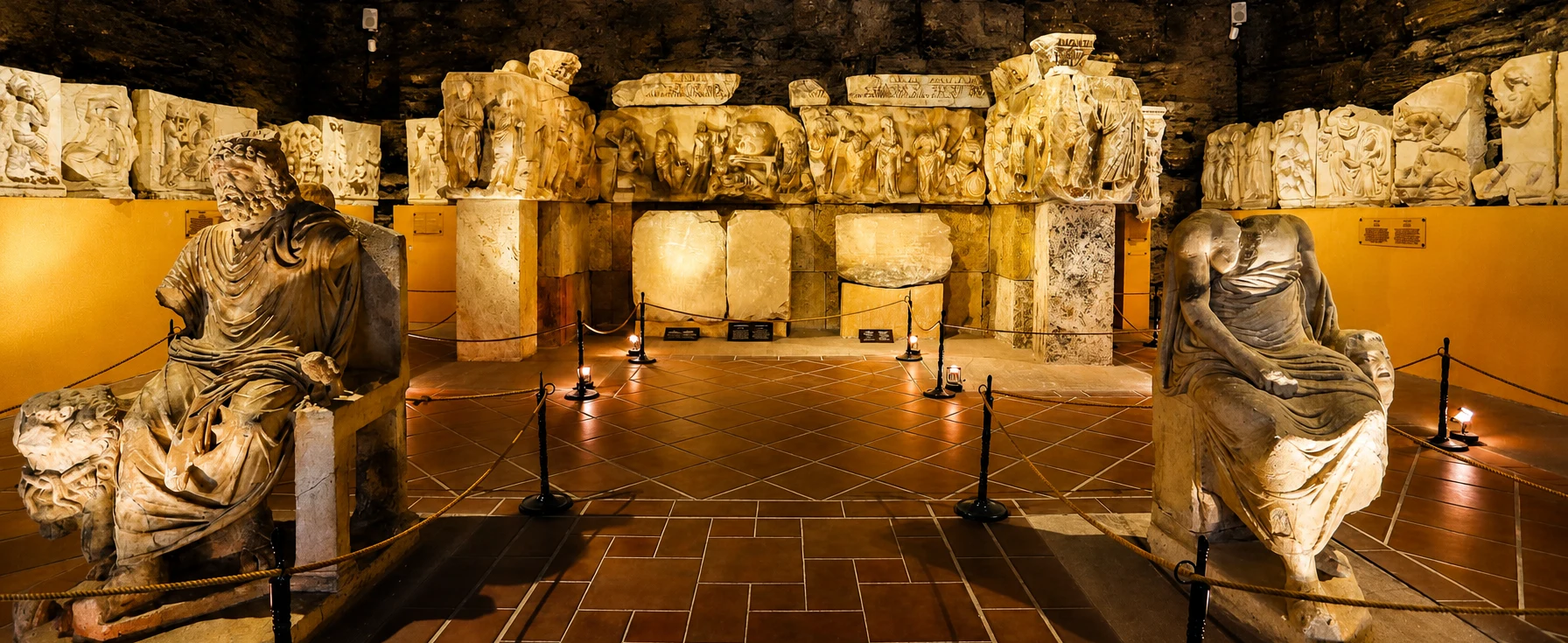
Focus on the three galleries, mythology, sculpture and inscriptions with a licensed specialist guide.
Request a Private Visit
See another important Lycos Valley city whose excavated objects are represented in Hierapolis Museum.
Explore LaodiceaContinue your journey through the wider history of the region.
Explore the monumental remains of another remarkable settlement in the Lycos Valley.
Discover Tripolis
Learn about one of the region’s important ancient cities and its historical significance.
Explore Colossae
Discover the later story of the province through textiles, music, crafts and urban culture.
Explore the City Museum