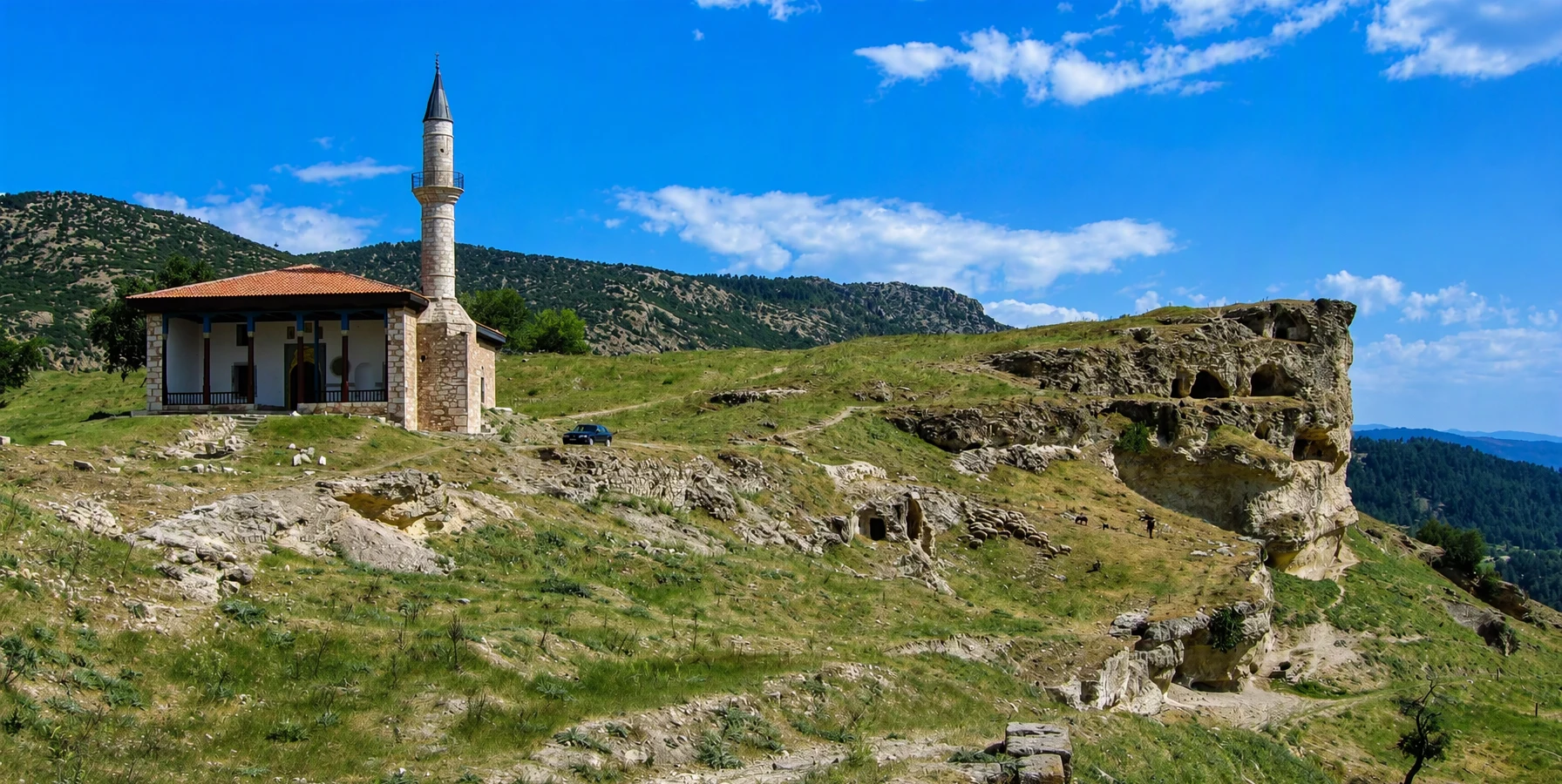
Custom Tabae Ancient City Experience
Explore the natural acropolis, ancient remains and layered history of Old Kale on a private visit, subject to site access.
Request a Custom Visit





Tabae Ancient City (Tabae Antik Kenti), also spelled Tabea in some official publications, stands on a striking rocky plateau beside Kale in Denizli Province, southwestern Türkiye. Official Turkish heritage sources describe a settlement that developed in the Hellenistic period and retained importance through Roman, medieval Turkish and Ottoman times. The dramatic high ground explains why the ancient city has long been compared to a natural fortress.
Unlike an archaeological site known for a single restored theatre or temple, Tabae tells its story through rock-cut chambers and dwellings, a Roman-period niche structure and cistern, surviving religious monuments, architectural fragments and the remains of Eski Kale. One of its most unusual chapters is recent history: the old settlement remained occupied until 1957, when the local population moved to the present town area.
The site also preserves a distinctive 19th-century Cevherpaşa Mosque, together with references in official inventories to a separate historic minaret and a Roman bridge. It is a fascinating place to study the overlap of classical archaeology, vernacular rock architecture and Ottoman history without assuming that every structure is open for entry.
This guide covers where Tabae is, the city’s origins, ancient coinage, rock-carved houses, Roman monuments, Ottoman architecture, the relocation of Old Kale, excavations, practical visiting information, safety, photography, nearby places and private itinerary ideas. Admission arrangements and on-site access should be checked locally.
A dramatic rock-top stronghold above Kale.
Hellenistic, Roman, Seljuk and Ottoman heritage.
Rooms cut directly into the edge of the plateau.
The old town survived into the modern era.
Essential visitor information for Tabae / Tabea at Kale, Denizli.
Approximately 1 km southwest of central Kale, Denizli.
Open on Google MapsHellenistic origins; later Roman, medieval and Ottoman use.
Cliff-edged rocky plateau resembling a natural fortress.
Single-room chambers shaped into the natural rock.
19th-century Cevherpaşa Mosque within the site.
Subterranean vaulted water-storage structure.
Eski Kale settlement continued here until 1957.
Roughly 60–120 minutes, subject to access and interest.
Tabae is unusual because ancient architecture and a much more recent abandoned settlement share the same landscape. Its rocky hilltop feels different from major excavated cities such as Hierapolis or Laodicea. Here, visitors encounter architectural traces in the rock itself and Ottoman-era structures amid the remains of a community that moved only in the twentieth century.
The most memorable features include cliff-edge rock-cut rooms, the Roman niche building, archaeological fragments, a documented subterranean cistern and the historic Cevherpaşa Mosque. These places help visitors imagine how successive generations adapted the same defensible ridge.
Come for the long continuity of settlement, not the expectation of a completely restored classical metropolis. Tabae rewards unhurried observation, contextual guiding and sensitivity to active archaeological or conservation restrictions.
The cliff-edged acropolis dominates the setting.
Multiple civilizations reused the plateau.
Chambers carved into the limestone.
Cistern, architectural remains and a niche building.
Cevherpaşa Mosque and Old Kale history.
A rewarding alternative to heavily visited sites.
Tabae is in Kale district of Denizli Province, close to the Denizli–Muğla highway in southwestern Türkiye. The Denizli Provincial Directorate of Culture and Tourism places the ancient site roughly 1 km southwest of modern Kale, near the reference point of the highway’s 78th kilometre.
The Culture Portal gives a practical approach: reach Kale town on the Denizli–Muğla road, continue about 1 km in the Muğla direction and follow the western approach toward the Tabae ruins. This is an official descriptive route rather than a live navigation instruction.
Because the archaeological plateau is separate from Kale’s modern centre, search specifically for “Tabae Antik Kenti” or “Tabea Örenyeri” in your map application rather than simply choosing the town of Kale.
Denizli, southwestern Türkiye.
Kale.
Approximately 1 km southwest of modern Kale.
Denizli–Muğla highway.
Tabae Antik Kenti / Tabea Örenyeri.
Elevated, rocky plateau above the surrounding area.
Official provincial heritage descriptions trace Tabae’s history to the Hellenistic period after Alexander the Great, portraying it as one of the city-states that emerged in Anatolia in that era. This does not establish an exact foundation year or demonstrate that Alexander personally built the city.
Tabae later became part of the Roman world, as represented by its monumental remains and infrastructure. Its occupation continued in the medieval period and under Turkish dynasties, followed by a substantial Ottoman chapter as the town known by forms of the name Kale / Kale-i Tavas / Davas.
The present site is remarkable for its recent past. The older hilltop settlement survived until the mid-twentieth century; official Culture Portal information dates the move to the present Kale settlement to 1957. Different historical phases remain visible side by side rather than in neatly separated archaeological zones.
Earliest period emphasised in official city histories.
Cistern, building remains and other infrastructure.
The hilltop continued to be inhabited and reused.
Mosques and the old Kale settlement.
Residents moved from Old Kale to the present town.
An archaeological landscape with layered heritage.
Visitors will notice that heritage sources use both Tabae and Tabea. Both point to the same ancient settlement near modern Kale. Turkish descriptions also mention Tabas, Davas, Tavas and Kale-i Tavas in discussions of the wider area’s historical names.
Local historical accounts associate the older place-name with the rocky topography and explain that the settlement came to be called Kale, meaning “castle” or “fortress” in Turkish. These linguistic traditions are useful local context, but the precise ancient etymology should not be presented as beyond scholarly debate.
For travel planning, use Tabae Ancient City / Tabae Antik Kenti as the attraction name and Kale, Denizli as its modern district. Do not confuse the ancient settlement with the nearby town of Tavas, a separate modern administrative location.
Common English and Turkish site spelling.
Alternative spelling in official publications.
Older historical name mentioned in local records.
Modern district and Turkish word for fortress.
Historical name associated with Old Kale.
Tavas and Kale are separate present-day districts.
The ancient site occupies a rocky high point with steep sides, offering natural protection and long views over the surrounding landscape. Provincial descriptions explicitly compare its appearance to a fortress, reflecting the close relationship between topography and settlement.
Steep rock edges limited direct access, while the plateau provided surfaces on which generations could construct houses and civic buildings. Some inhabitants also cut rooms directly into exposed rock, making the geology part of the architecture.
Today those same features make the site visually distinctive, but cliff edges, eroded paths and uneven terrain call for a cautious visit. Explore only authorised visitor areas, and do not assume a vantage point visible from afar is safe to reach.
Steep-sided high ground limited approach routes.
Natural stone became building material and living space.
Elevated setting with broad landscape views.
The same defensible place supported later settlement.
Potential hazards beside ancient rooms.
Remain on permitted paths and established viewpoints.
Hellenistic Tabae forms the opening chapter of the city history described by the Turkish Ministry of Culture and Tourism. Official accounts connect its political emergence with the period after Alexander the Great, when western Anatolia’s cities operated within changing regional kingdoms and alliances.
Ancient civic identity is attested by the city’s own coinage. Such issues reflect local institutions, economic activity and the way a community presented itself to neighbours and trading partners.
Precise claims about the site’s original street plan, an identifiable Hellenistic palace or a complete inventory of temples cannot be substantiated from the primary visitor sources reviewed. Interpretation should distinguish documented history from reconstructions that await archaeological publication.
The post-Alexander Hellenistic world.
An Anatolian city with its own civic identity.
Official accounts describe silver and later bronze issues.
Part of a wider network of inland western Anatolia.
The preserved landscape contains later periods too.
No securely verified exact foundation year.
The Turkish Culture Portal and Denizli Provincial Directorate report that Tabae issued coins in its own name. Their site-specific archaeological summaries describe silver coinage followed by bronze issues, showing that coin production belongs to the ancient city’s historical record.
Coinage offers evidence of the city’s civic identity, commercial interactions and political visibility. The imagery and inscriptions on a particular coin must be checked against a numismatic catalogue rather than inferred from the modern name.
Other local general-history pages mention gold coinage, a detail that differs from the more specific Culture Portal summary. To avoid implying a settled metallurgical sequence where official accounts differ, this guide uses the silver-and-bronze sequence in the specialised site descriptions.
Tabae is recorded as issuing its own coins.
Reported in specialist regional visitor sources.
Described as later in the local sequence.
Coins carry information about civic history.
Exact types require numismatic evidence.
Gold is mentioned in some general local histories.
Roman-period Tabae left evidence of substantial masonry, carved architectural elements and hydraulic infrastructure. Regional heritage texts mention a Roman bath and identify a distinctive structure with niches cut into the rock.
An especially significant surviving monument is the Roman-period cistern, registered in the official cultural inventory. Water storage was essential to communities occupying rocky, elevated terrain, although the exact original water-supply system is not fully explained in the visitor literature.
The Roman landscape also includes an officially referenced bridge. These features show a functioning urban settlement, but access to specific remains may be limited by excavation, maintenance or safety restrictions. Do not expect every listed structure to be signposted as a fully restored attraction.
Roman-period structure on the northeastern acropolis.
Documented subterranean vaulted reservoir.
Mentioned in provincial descriptions.
A Roman-period bridge is noted in the Culture Portal.
Architectural remains help interpret the settlement.
Some structures may not be safely accessible.
One of Tabae’s best documented archaeological structures is the kayaya oyulmuş nişli bina, a building with niches carved into natural rock. Official descriptions place it in the northeastern part of the acropolis. Its plan is rectangular and broadly aligned north–south.
The eastern inner wall contains four cut niches, whereas the western wall lacks matching niches. Nearby finds mentioned in official descriptions include an architrave fragment, altar and columns. On architectural grounds, the structure is assigned to the Roman period.
The same official history states that the building continued to be used during Seljuk and Ottoman times. Its original ritual or civic purpose should not be claimed with certainty solely from the presence of niches, an altar or architectural fragments.
Northeastern acropolis.
Rectangular; broadly north–south.
Four rock-carved niches.
No equivalent row of niches reported.
Architrave, altar and columns.
Reuse in Seljuk and Ottoman periods.
Tabae’s single-room rock-cut houses are among the site’s most evocative features. Official archaeological descriptions explain that rooms were shaped by carving the natural rock, often in the steep and cliff-edged sections of the plateau.
The entrances preserve door recesses and pivot or fitting sockets suggesting that wooden doors once closed the chambers. Niches inside the rooms provide clues to the way their occupants organised domestic space. These are interpreted as dwellings, although the individual history and date of every chamber may vary.
Do not enter dark or unstable cavities or attempt to climb down to rooms visible from a cliff. The value lies in observing how architecture and geology combine, not in accessing every carved chamber.
Single rooms cut into natural rock.
Recesses and sockets suggest wooden doors.
Small built-in recesses inside chambers.
Many lie along steep plateau margins.
Interpreted in official accounts as dwellings.
No general guarantee of safe entry.
The official Culture Portal inventories a Roman cistern in the Çukur area of Tabae, within the first-degree archaeological protected zone. The structure was built entirely below ground and illustrates how a hilltop settlement stored water.
The inventory describes two barrel-vaulted compartments, divided by rounded arches standing on four square-section supports. It records a floor area of approximately 135 m² and a height of 6.85 metres. The monument is described as substantially intact, although parts of its internal plaster have deteriorated.
These are published architectural measurements, not indications that visitors may enter the cistern. Since it is underground and within a protected archaeological area, check with local authorities before assuming that any access, lighting or organised interior visit is available.
Roman period.
Çukur area, within Tabae ruins.
Two barrel-vaulted compartments.
Rounded arches on four square-section piers.
Approximately 135 m².
6.85 m; public entry not confirmed.
Local government and Culture Ministry descriptions mention a Roman bath among Tabae’s surviving archaeological traces. Baths were important public institutions in Roman settlements, though the information reviewed does not establish a complete restored bathing complex for modern touring.
The Türkiye Culture Portal also refers to a Roman-period bridge at the ancient site. A bridge is evidence of infrastructure and connectivity, but travellers should not presume a visitor bridge remains structurally suitable for crossing without current site signage.
As with many smaller archaeological sites, these remains are best appreciated within a guided interpretation of the wider city. Specific claims about exact construction dates, mosaics, opening routes or excavation access should be confirmed through current research.
Listed in local official descriptions.
Mentioned in Culture Portal accounts.
Public and transport infrastructure.
Not all parts have full modern visitor interpretation.
Crossing or entering is not presumed permitted.
Consult archaeological inventories for details.
The site’s documented occupation did not end with Rome. Its continuing settlement history connects ancient Tabae with the medieval landscape of western Anatolia. The old Kale area maintained strategic and local importance as political control changed over time.
Kale Municipality discusses the name Tabae in connection with late Byzantine ecclesiastical lists, indicating that the site belongs to a historical landscape where Christian communities and institutions formed part of the region’s past. That reference alone does not establish the location of a presently accessible Byzantine cathedral at Tabae.
As Turkish principalities developed across southwest Anatolia, the fortress settlement took on further roles. Official accounts note that at least one ancient building continued to be reused through Seljuk and Ottoman periods, illustrating how new inhabitants adapted inherited architecture.
Part of the region’s long medieval occupation.
The name appears in ecclesiastical-history discussions.
The site later became part of a changing political landscape.
Ancient fabric retained new functions.
Settlement continued rather than vanishing after Rome.
Avoid assigning undocumented churches or bishops to ruins.
One of the most distinctive features of Tabae is that it was also the site of Eski Kale, a later town developed on and around the ancient remains. Local histories connect Kale-i Tavas with the medieval Turkish principalities and the Ottoman administration of the wider area.
Historical descriptions attributed to Evliya Çelebi recount a populated fortified town, with houses, mosques and other facilities. The structures mentioned in a seventeenth-century account should not automatically be equated with every visible ruin today.
The surviving Cevherpaşa Mosque provides particularly tangible evidence of Ottoman religious and artistic life. Together with traces of domestic structures and former streets, it reveals how the ancient acropolis remained a living neighbourhood long after antiquity.
Old settlement built on the archaeological plateau.
Historical town name.
Associations with local Turkish dynasties.
Houses, mosques and town infrastructure.
Important surviving 19th-century monument.
Evliya Çelebi described the fortified town.
Cevherpaşa Camii stands within the Tabae archaeological site and is one of its most important later monuments. The Turkish Culture Portal describes it as a 19th-century Ottoman wooden-supported mosque with painted decoration associated with the period’s changing artistic styles.
The building follows a rectangular plan and has a northern entrance or last-congregation area, while its minaret rises from the northwest. Inside, wooden support columns divide the prayer hall, and decorative panels feature floral, geometric and calligraphic designs. The mihrab includes a painted curtain motif and a set of scales.
A dated inscription above the entrance records Hijri 1235 (approximately 1819–1820 CE). Older provincial accounts discuss historical roof deterioration, which should not be assumed to describe the building’s exact current condition. Interior entry and restoration status must be confirmed on site.
19th-century Ottoman.
Rectangular with northern porch or entrance area.
At the northwest side of the mosque.
Timber supports and hand-painted decoration.
Curtain and scales motif.
Hijri 1235 above the entrance.
One of the most photographed views at Tabae includes a standing minaret amid the remains of an older building. Official heritage descriptions list a “Tabea Tek Minare” (Tabae Single Minaret) as a separate site feature, while also describing the minaret belonging to Cevherpaşa Mosque.
It is useful to distinguish these references: a solitary minaret among ruins should not automatically be identified as the Cevherpaşa minaret. The site contains more than one period of religious architecture, and a careful visit can explain their context.
The surviving vertical landmark gives a vivid sense of the later town’s history. Please keep clear of fragile masonry, even where a partial wall or stone platform appears easy to climb.
A freestanding minaret survives among ruins.
Tabea Tek Minare.
Do not conflate it with Cevherpaşa Mosque.
Part of the site’s later settlement heritage.
Capture the landmark in its hilltop context.
Never climb walls or unsupported masonry.
The old Kale settlement remained inhabited into the twentieth century, making Tabae more than a classical ruin. The Turkish Culture Portal explicitly records that the inhabitants of the old site moved to the current Kale settlement in 1957.
Provincial historical descriptions also mention concerns about the terrain, including landslide-related reasons for moving away from the old hilltop area during the 1950s. The important point for visitors is that the departure was part of modern settlement history, not the ancient destruction of Tabae.
Today, the juxtaposition of archaeological foundations and later village or town traces allows travellers to reflect on two millennia of reuse. Treat surviving house walls and rock-cut spaces as historic material rather than abandoned structures available for exploration.
Move documented in 1957.
Eski Kale continued over ancient Tabae.
Local accounts mention landslide or unstable-ground issues.
Population shifted to the modern town.
Ancient and twentieth-century stories overlap.
Unstable structures may remain hazardous.
Tabae has been the subject of archaeological investigation and conservation work. Provincial history pages refer to excavation programmes beginning in the 2000s, while public university coverage describes later work involving Denizli Museum and Pamukkale University researchers.
Work at an archaeological site can reveal walls, architectural pieces and earlier floors that were previously hidden. It can also temporarily limit visitor access to particular areas. Do not assume a historic photograph shows the same exposed structures as today.
Older official descriptions name excavation institutions and seasonal work periods that may no longer reflect the current project organisation. Before presenting the site as an active excavation or promising access to a trench, check the latest announcements from museum and archaeological authorities.
Work recorded from the 2000s onward.
Denizli Museum has been involved in published work.
Pamukkale University coverage documents investigations.
New discoveries can alter the presentation.
Excavations may be fenced or temporarily restricted.
Check the latest authorised site notices.
Yes. The official Tabae Roman Cistern inventory identifies the location as lying inside a first-degree archaeological protected area (birinci derece arkeolojik sit alanı). Other local records describe conservation decisions for Old Kale.
Protection is not merely a label: it means archaeological deposits, walls, carvings and historic monuments must be respected. Visitors should not scratch stone, remove ceramic fragments, dig, move loose-looking masonry or walk into trenches.
Protection boundaries and management rules may be updated by later administrative decisions. Use current signage and directions from authorised site personnel to determine which parts of Tabae can be visited.
The cistern inventory places it in a first-degree archaeological site.
Leave pottery, stones and artefacts where found.
Excavation requires legal authorisation.
Historic walls and roofless structures are fragile.
Respect fences and research areas.
Current local decisions take priority.
Allow approximately 60–120 minutes for a careful visit if the principal visitor areas are open. This is an editorial planning estimate, not an officially published minimum or fixed tour duration.
A shorter visit can focus on the rocky acropolis, external views of historic structures and landscape. An archaeology enthusiast may want longer to study the different periods, inscriptions and architectural features, where access is authorised.
Allow extra time for travel from your hotel, seasonal heat and uneven ground. A self-guided stop can be worthwhile, but an informed licensed guide helps connect Tabae’s Hellenistic, Roman and Ottoman histories.
A shorter external-view visit.
Roughly 60–120 minutes on site.
Allow more time for detailed explanation.
Add time for wide views and architectural details.
Be prepared for uneven outdoor terrain.
Driving time is additional.
The Turkish Ministry of National Education’s outdoor-learning directory lists 09:00–17:00 on Monday through Sunday for Tabae Ancient City. These are published directory hours, and should not be treated as a live guarantee that all gates, excavated areas or historic interiors are accessible on a chosen date.
The Denizli Provincial Directorate’s 14 September 2026–1 May 2027 operating-hours list names several museums and major archaeological sites, but does not include a separate Tabae schedule. Therefore the Education Ministry listing should be confirmed before travel.
For the most straightforward visit, plan for daylight and verify local access, conservation works and any restrictions affecting the monuments you hope to see.
No dependable 2026 official admission tariff specifically for Tabae could be confirmed from the primary visitor sources reviewed for this guide. Accordingly, we do not state that admission is definitely free or publish an invented ticket amount.
If access involves a gate, conservation work or locally arranged viewing, visitors should ask whether there is a site fee, parking charge, guide fee or separately managed entrance to an historic building. These arrangements may vary independently.
MuseumPass Türkiye coverage should not be assumed without an official listing. If requesting a private archaeological excursion, clarify in advance which fees and services are included in the quotation.
Tabae is a rocky archaeological hilltop, not a level modern museum gallery. Uneven stone, loose soil, abrupt changes of height and exposed cliff edges can create hazards, particularly near rock-cut rooms and partially standing walls.
Stay on marked and authorised paths. Do not climb onto old masonry, pass under unstable arches, cross excavation barriers or enter dark chambers and underground spaces without explicit permission and a safe organised route.
Children should remain close to supervising adults. After rain, surfaces may be slippery, and in summer the plateau can offer limited shade. Sensible footwear and a conservative choice of viewpoints make the visit much more comfortable.
Stay back from steep drops.
Do not lean on or climb walls.
No entering unsupported spaces.
Wear shoes with reliable grip.
Never bypass restricted areas.
Rain, wind and summer heat change conditions.
Tabae’s natural rocky plateau and archaeological remains are likely to present challenges for wheelchair users, mobility-aid users and families with strollers. The general education directory includes accessibility-related fields, but this does not establish a continuous, step-free path to every feature.
Before visiting, ask about the current vehicle drop-off point, parking surface, gradients, steps, handrails, accessible toilets and distance to the nearest viewpoint. A person may be able to enjoy an external view without undertaking a longer uneven route.
The condition and accessibility of historical interiors such as the mosque or cistern should be checked separately. For custom tours, please share mobility needs before the route is confirmed.
Not verified across the archaeological site.
Check the permitted arrival point.
Natural rock and uneven terrain.
Accessible entry is not guaranteed.
Current accessible facilities need checking.
Ask for a realistic route based on individual needs.
Tabae can be a rewarding educational visit for older children interested in ancient coins, rock-cut houses, fortresses and the way towns change through history. The unusual overlap of antiquity and Old Kale provides an accessible story: people lived on the same hill for many generations.
The site is not a playground. Cliff edges, cavities and fragile building remains require continuous supervision. Do not let children run toward rock-cut entrances or pick up ancient-looking objects.
Choose a visit length appropriate to the weather, bring water and protect against the sun. A short stop with a clear story about the site’s Hellenistic beginnings and 1957 move may be better than an extended circuit over rough ground.
Discuss how cities expressed identity.
Imagine daily life in carved rooms.
A memorable modern-history connection.
Keep children near adults.
Objects must remain at the archaeological site.
Adapt the pace to age and weather.
Tabae’s strongest photographic subjects are the rock-carved rooms, surviving minarets, ruins against open skies and broad views across the plateau. The contrast between ancient masonry and later mosque architecture gives a distinctive sense of historical layering.
In the early or later parts of the day, lower-angle sunlight can reveal texture in carved limestone, while broader compositions convey the dramatic hilltop location. Photograph buildings from safe public viewpoints; never step onto an unsupported ledge for a better angle.
Where religious structures are accessible, observe local etiquette, seek any required photography permissions and do not disturb worshippers or restoration teams. Drone flights require appropriate airspace and heritage permissions and may be restricted.
Framing carved entrances and niches.
Contrast heritage monuments with open skies.
Show the natural fortress setting.
Useful for carved stone texture.
Follow posted rules around mosques.
Check all relevant authorisations.
Public official sources identify the location of Tabae and a road approach from Kale, but the current provision of a staffed visitor centre, ticket counter, restaurant, accessible restroom or on-site café was not reliably established for October 2026.
Travellers should plan conservatively: bring water, use facilities in modern Kale town when needed, and ask locally about the safest legal parking location. The site is close to an active district centre, but this does not mean every service is available on the ancient plateau.
For a longer day trip, a meal in Kale can provide an opportunity to explore regional food. Do not rely on a café inside the archaeological enclosure without current confirmation.
Verify the correct visitor access point.
On-site availability not independently confirmed.
Plan around facilities in Kale town.
Carry a refillable drinking bottle.
Limited in exposed plateau sections.
Confirm any staffed facilities locally.
The official Culture Portal describes the approach via the Denizli–Muğla highway. Reach Kale district centre, proceed around 1 kilometre toward Muğla, then take the local western approach signed or mapped to Tabae / Tabea Örenyeri. Follow current signs over older written directions.
From Denizli city, provincial descriptions place the ancient city around the 78-km point on the Denizli–Muğla road. This is a highway reference and should not be confused with the exact distance from every hotel in Denizli or Pamukkale.
The Culture Portal states that bus and minibus services link Denizli and Kale, but a reliable 2026 timetable or direct onward shuttle to the ruins was not confirmed. A private vehicle or pre-arranged transport gives more flexibility.
Head toward Kale on the Denizli–Muğla road.
Continue toward Muğla and follow Tabae signs.
Approximately the 78th kilometre in official descriptions.
Services to Kale mentioned; verify current timetables.
Check walking distance or local onward transport.
Convenient for combined regional sightseeing.
The approach to Tabae is close to the main Denizli–Muğla transport corridor, but the final site access may involve local roads and a distinct entry point to the old plateau. Use current navigation, road signs and any site staff instructions.
Do not drive across unmarked archaeological ground or assume that a track leading toward visible ruins is a permitted vehicle route. Park only in designated or clearly lawful spaces without blocking farm access, emergency passage or local residents.
If visiting in wet weather or late in the day, consider a more conservative plan. A safe return route matters more than reaching a remote viewpoint.
Denizli–Muğla highway connection.
Follow current Tabae visitor signs.
Use authorised roadside or visitor spaces only.
Do not enter excavation or protected ground.
Allow extra time and caution.
Prefer arrival with sufficient light.
Spring and autumn can be attractive for outdoor archaeological exploration, with milder daytime temperatures than the height of summer. Light changes the appearance of the ruins, rock faces and surrounding hills.
Summer brings long days but also potentially strong heat and limited shade. Bring drinking water, sun protection and sufficient time for breaks. Winter may be cooler and wetter, increasing the need to inspect paths and avoid slippery edges.
There is no evidence that all monuments are independently staffed throughout every season. Check current visitor access and any excavation or conservation notices rather than assuming uniform year-round conditions.
Often pleasant for outdoor exploration.
Start earlier and prepare for sun and heat.
Often suitable for walking and photography.
Check wet stone and weather exposure.
Flexible daylight and potentially gentler temperatures.
Extra caution on rock and soil surfaces.
Choose comfortable closed-toe shoes with a solid tread. The archaeological plateau includes exposed rock, loose gravel and uneven paths. A sun hat, drinking water and suitable clothing for wind or seasonal rain are sensible throughout much of the year.
Carry a charged phone and an offline map if you are exploring the wider Kale region. A small notebook or guidebook can help distinguish Hellenistic, Roman and Ottoman features, particularly when interpretive signs are limited.
Please protect the site: take only photographs, avoid moving stones or ancient-looking fragments, and carry all litter away. Tell your guide in advance if someone in your party has difficulty with uneven terrain.
Good grip for rock and loose gravel.
Useful where site facilities are uncertain.
Hat and sunscreen for open ground.
Wind or rain protection when appropriate.
Navigation and emergency contact.
Never remove stones or artefacts.
Modern Kale lies a short distance from the ancient settlement and provides a contrast with the abandoned hilltop of Eski Kale. For many travellers, the most interesting story is understanding why the modern town and the archaeological ridge are related but distinct locations.
A short town visit may allow time for refreshments and seeing regional everyday life. The district’s Kale pepper is an important local agricultural product and a recognised geographical indication, especially associated with the surrounding valley settlements.
Aim for a relaxed schedule rather than treating the town only as a parking stop. If you want to purchase local food, use established vendors; do not assume any particular market stall will be open on your travel date.
District centre serving visitors and residents.
Historic hilltop predecessor.
Names and settlement patterns spanning centuries.
Protected regional agricultural product.
Check local café and restaurant opening.
An inland Denizli district with its own identity.
One especially distinctive food connection is Kale Biberi, a locally grown pepper protected by a geographical indication. Kale Municipality describes thick-fleshed peppers associated with the district’s particular agricultural conditions.
The national Culture Portal notes that this pepper may be eaten fresh, grilled or fried and used for pepper paste, dried pepper and spice products. The local culture of drying peppers is a memorable part of the region’s food landscape.
For a broader Denizli meal, ask local establishments what seasonal dishes they prepare. Availability varies and the best option may be a simple freshly cooked lunch rather than a fixed tourist menu.
Geographically indicated local pepper.
Common in local cooking.
Traditional regional preservation.
One of the product’s established uses.
Availability depends on harvest and vendor.
Arrange a suitable stop in modern Kale.
The most natural companion to an archaeological visit is modern Kale town, where travellers can learn about the district and its food traditions. Another compelling regional destination is İnceğiz Canyon, a dramatic landscape associated with the district, although activities and boat-trip availability need current confirmation.
For a larger Denizli heritage itinerary, it is possible to add places such as Laodicea, Pamukkale–Hierapolis and other ancient cities if the total journey and visiting hours allow. These are separate destinations and should not be described as a short walk from Tabae.
If you are planning a full day, select two compatible experiences rather than packing several far-flung sites into a schedule with little time for exploration.
Modern settlement, everyday life and local food.
Dramatic canyon scenery in Kale district.
Agricultural villages and local food heritage.
Major ancient city nearer Denizli.
Thermal travertines and classical remains.
More archaeology available with driving time.
Tabae is best understood as a multi-period natural-fortress settlement, where rock-carved domestic spaces, ancient remains and Ottoman buildings all share a relatively compact plateau.
Hierapolis is famous for its major Roman monuments and neighbouring Pamukkale travertines, while Laodicea is known for monumental streets, extensive excavations and its important early Christian heritage. Neither offers precisely the same Old Kale story.
Visitors with a special interest in archaeological landscapes, urban continuity and vernacular rock architecture may find Tabae a valuable complement. Allow separate travel time and check each site’s individual access and ticket rules.
Tabae works especially well as a focused historical stop during a journey through Kale or on the Denizli–Muğla corridor. These are illustrative private itinerary ideas, not fixed departures or guarantees of entry.
For a half-day, pair an unhurried exploration of the site with a visit to modern Kale and lunch. For a longer programme, add İnceğiz Canyon only after checking its current access and travel logistics.
Ancient-city enthusiasts can integrate Tabae into a multi-day Denizli itinerary with Pamukkale, Hierapolis, Laodicea and other heritage sites. Avoid promising several long-distance attractions within an unrealistically short day.
Wow Cappadocia / Venere Travel can discuss a private, flexible excursion to Tabae based on your interests, accommodation, travel date and available time. The area can suit guests interested in classical archaeology, ancient settlement patterns, Ottoman art and scenic landscapes.
If you would like a licensed guide, specify whether your priority is Hellenistic–Roman history, the rock-cut architecture, the Cevherpaşa Mosque or the story of Old Kale. We will plan the best possible route subject to site access, guide availability and realistic driving distances.
Our private itineraries prioritise genuine sightseeing without compulsory shopping stops. Transport, guiding, admission arrangements, meals and any extra services will be clarified in a custom quotation.
Pickup and return tailored to your route.
Subject to availability and language.
Hellenistic, Roman and Ottoman context.
Visit length based on your interests.
Optional Kale and İnceğiz Canyon planning.
Time dedicated to exploration.
It is approximately 1 km southwest of Kale town in Denizli Province, southwestern Türkiye.
Both spellings are used in official sources for the ancient site near Kale.
Tabae Antik Kenti or Tabea Örenyeri.
The archaeological site is the former hilltop settlement; modern Kale is the present nearby district centre.
Official references locate it around the 78th kilometre of the Denizli–Muğla highway; calculate the road route from your exact starting point.
Roughly 1 km southwest, according to the Denizli tourism authority.
Official visitor sources associate its emergence with the post-Alexander Hellenistic period; a precise foundation year is not established here.
The official material links the city to the era after Alexander; it does not securely establish that Alexander personally founded it.
Hellenistic, Roman, medieval Turkish and Ottoman heritage, followed by Old Kale’s twentieth-century history.
Yes. The specialised Culture Portal description reports silver and later bronze coinage.
Single-room chambers shaped into the natural rock, interpreted as dwellings in official descriptions.
Do not assume entry is permitted or safe; follow current barriers and official directions.
Yes. An officially registered underground, two-compartment cistern dates to the Roman period.
Interior public access was not verified; obtain specific permission and confirm safe arrangements.
Regional tourism sources list Roman bath remains, without guaranteeing a restored visitor interior.
The Türkiye Culture Portal mentions a Roman-period bridge at Tabae.
A rectangular Roman-era structure on the northeastern acropolis with four carved niches in its eastern wall.
A 19th-century Ottoman mosque within the archaeological site, known for wooden supports and painted decoration.
Its current interior access and restoration status should be confirmed locally.
Official heritage descriptions list a separate historic feature called Tabea Tek Minare.
Yes. Official heritage sources date the relocation of the old settlement to 1957.
Regional histories mention terrain concerns, including landslides, in connection with the 1950s move.
Yes. The official cistern inventory locates it in a first-degree archaeological protected area.
Excavation and research are documented, but any current work and access restrictions require local confirmation.
It is listed as a visitor attraction, but confirm live entry conditions and monument access for your travel day.
An Education Ministry directory lists 09:00–17:00 daily, but it is not a live admission guarantee.
A dependable, current 2026 official tariff was not independently verified.
Coverage has not been confirmed; check with the relevant authority.
Approximately 60–120 minutes is a flexible editorial planning estimate.
It can be educational, but cliff edges, ruins and uneven terrain require close supervision.
A continuous step-free route to the principal remains was not verified; ask about current drop-off and paths.
Closed shoes with good grip are best for rocky and uneven surfaces.
Check applicable airspace and archaeological-site permissions before flying.
Check current authorised visitor parking and local access signs.
On-site services are not reliably confirmed; plan to use facilities in modern Kale.
Official sources mention buses and minibuses between Denizli and Kale, but confirm current schedules and the final link to the ruins.
Kale Biberi, a geographically indicated pepper grown in the district.
Modern Kale and İnceğiz Canyon are useful regional companions, with separate travel planning.
Yes, on an appropriately planned private day or longer trip with enough driving and visiting time.
Contact us with your date, hotel, group size and interests to discuss a custom itinerary.
Dial 112 for emergencies.
This guide draws primarily on the Türkiye Culture Portal, Denizli Provincial Directorate of Culture and Tourism, Kale Municipality and the Ministry of National Education’s outdoor-learning directory. An official monument inventory provides the Roman cistern’s architectural measurements, while university reporting supplies research context.
Different government pages sometimes spell the city Tabae or Tabea and provide differing descriptions of ancient coin metals. The specialised site description is preferred for the silver-and-bronze summary. Publication of a monument in an official inventory does not confirm interior access, live opening hours or ticket prices.
Editorial review: October 2026. Local circumstances and archaeological restrictions should always be checked shortly before a visit.
Main site description, rock-cut houses, coinage, history and approach.
Monument descriptions and the city’s historical background.
Architectural plan, 135 m² area and protected status.
Ottoman building, minaret, timber supports and painted decoration.
Published visiting-hour reference, access notes and contact details.
Provincial list used to distinguish Tabae from sites with published schedules.
Local history and archaeological setting.
Research and excavation background.
Discover remarkable ancient ruins, Ottoman heritage, traditional towns and dramatic landscapes in a personalised private itinerary—with no compulsory shopping stops.
Build a relaxed day around Tabae and the heritage of the district.
Explore the natural acropolis, ancient remains and layered history of Old Kale on a private visit, subject to site access.
Request a Custom Visit
Combine archaeology with dramatic canyon scenery if road, access and seasonal activity conditions permit.
Customise Your DayMonumental archaeology and the world-famous travertine landscape.

Explore the famous white travertines and outstanding remains of the Roman spa city.
View Private Tour
Discover monumental streets and the archaeology of this important Roman and early Christian city.
Explore Laodicea
Design an itinerary around Kale, Tabae, Pamukkale, archaeological cities and local experiences.
Explore Regional Tours