
Custom Colossae & Biblical Heritage Tour
Explore the Colossian community, Epaphras, Paul’s letters and regional history with an itinerary tailored to your interests.
Request a Custom Itinerary





Colossae (Kolossai, Colossai or Colossea) is one of the most historically compelling ancient cities of southwestern Türkiye. Located in Honaz district of Denizli Province, approximately 25 kilometres east of Denizli, it developed beside the Aksu watercourse in the upper Lycus (Lykos) Valley, beneath Mount Honaz, the ancient Mount Cadmus.
The city was famous in the Persian and Classical periods, when important east–west routes linked inland Anatolia with the Aegean. Ancient writers described its prosperity, and its sheep and textiles later helped sustain economic life. Most modern visitors, however, know Colossae through the New Testament Letter to the Colossians and the early Christian community associated with Epaphras, Philemon, Onesimus and Archippus.
Unlike the extensively excavated Laodicea or Hierapolis, Colossae has long been a quiet archaeological landscape of a prominent mound, scattered remains and rock-cut burials. That is now changing: following surveys begun in 2021, Pamukkale University launched the city's first systematic excavation season in 2025, documenting important discoveries in the North Necropolis.
Colossae is especially rewarding for visitors interested in early Christianity, biblical geography, Phrygian and Roman history, archaeology and the historic connections among Colossae, Laodicea and Hierapolis. It is not yet a restored monumental city: its appeal lies in understanding an extraordinary place whose historical importance is far greater than the ruins presently visible.
Discover the setting of the Letter to the Colossians and the early Christian community.
Follow a city described by Herodotus and Xenophon during the Persian period.
Learn about the first systematic dig and 76 documented rock-cut burials in 2025.
Connect Colossae with Laodicea, Hierapolis and the landscape of Mount Honaz.
Essential context for a historically important but lightly developed archaeological site.
Near Honaz, approximately 25 km east of Denizli city centre.
Open on Google MapsGreater Phrygia; eastern Lycus Valley, at the foot of Mount Cadmus (Honaz).
The New Testament Letter to the Colossians; Epaphras and the Colossian church.
Scientific surveys from 2021; first systematic excavation season in 2025.
76 rock-cut trough graves in the North Necropolis, according to the excavators.
A large ancient mound and landscape; visible remains vary with research and access.
No reliable, independently confirmed 2026 public entrance fee; check locally.
About 30–60 minutes for an authorised landscape-focused stop, excluding travel.
Colossae brings together several layers of Anatolian history. It was a prosperous Phrygian city on a major inland route, a settlement known to Greek historians, a producer of high-value wool and textiles, and a centre with an early Christian congregation in the first century CE. The later migration of settlement and religious activity toward Chonai, today's Honaz, adds an important Byzantine chapter.
For Christian visitors, the remarkable fact is that an actual ancient city lies behind the people and concerns addressed in the Letter to the Colossians. Reading the epistle while looking across this broad valley gives the text a geographical and social setting.
For archaeologists, Colossae matters because the city was comparatively little excavated until 2025. The newly documented burials and related finds offer fresh evidence for the people, funerary customs and chronology of this influential settlement.
Ancient Greek writers recorded Colossae as a prosperous city on the Persian campaign routes.
The city’s early Christian community figures in Colossians and the wider Pauline correspondence.
The neighbouring cities of Laodicea and Hierapolis provide vital historical context.
Scientific excavation can now test and refine long-standing ideas about ancient Colossae.
Mount Honaz, ancient routes and river geography explain why this site mattered.
The experience is reflective and interpretive rather than a tour of reconstructed monuments.
Colossae stands on the northern side of Mount Honaz (ancient Cadmus), at the eastern end of the Lycus Valley. The ancient settlement developed near the Aksu Stream, with fertile agricultural land below the mountain slopes. The Denizli Provincial Directorate of Culture and Tourism places the site approximately 25 km east of Denizli and 2 km north of Honaz; some recent archaeological descriptions use a distance of roughly 4 km from the modern district centre, depending on the reference point.
This was a strategic location rather than an isolated hill town. Routes connected the inland cities of Phrygia with Ephesus and other Aegean centres, and roads extended toward Apameia (Dinar), the Anatolian plateau and Sardis. Water, transport links and productive land contributed to the city's prosperity.
Herodotus described the River Lycus disappearing into a chasm and re-emerging farther away. Archaeological researchers continue to study how the local geology, stream courses, travertine and seismic activity influenced the settlement.
The earliest unambiguous literary references establish that Colossae was far more important in antiquity than the modest visible ruins might suggest. Herodotus mentions the city in his account of King Xerxes' march in 480 BCE, describing it as a major settlement of Phrygia and recording its striking river geography.
Xenophon refers to Colossae during the campaign of Cyrus the Younger in 401 BCE. In the Anabasis, he describes a large, flourishing city where the army remained for several days. These sources provide evidence of a strategically located, prosperous urban centre during Achaemenid Persian rule.
The area's older settlement history is an active field of study. Archaeologists have discussed a possible connection with names found in second-millennium BCE Hittite records, but that identification remains a hypothesis, not a conclusively demonstrated origin for the city.
Colossae, Xerxes and the extraordinary river that disappeared beneath the ground.
An army encampment that demonstrates Colossae’s role on a major Anatolian route.
An era in which the city appears to have enjoyed considerable regional importance.
Descriptions from ancient authors illuminate the city, but they are not excavated architectural plans.
Colossae's history spans many centuries. Its position was favourable for farming, travel and trade, even as changing political powers and other rising cities transformed its fortunes.
The Letter to the Colossians is the reason Colossae is recognised around the world. The New Testament addresses a Christian community in this city and discusses Christ's significance, spiritual life, communal conduct and the challenges facing the congregation. The letter is traditionally attributed to the Apostle Paul, although modern scholars debate aspects of its authorship and dating.
The text mentions people who give the city a human dimension: Epaphras, presented as an important teacher and coworker; Onesimus, described as someone from the community; and Archippus, who receives a personal exhortation. It also links the believers in Colossae with those in neighbouring Laodicea.
The most important geographical distinction is this: Paul's letter does not prove he personally visited Colossae. The conventional historical reading is that the community grew through the ministry of associates, especially Epaphras, and that Paul had not personally met many of the believers at the time of writing (compare Colossians 2:1).
The greeting and thanksgiving acknowledge the community’s faith and Epaphras’s role.
A significant passage when asking whether Paul personally knew the Colossian believers.
Onesimus is named as someone belonging to the local community.
Epaphras is associated with Colossae, Laodicea and Hierapolis.
The closing greetings highlight neighbouring churches and mention Archippus.
The letter is to be read in Laodicea as well as Colossae, showing exchange between congregations.
Colossae is especially interesting when the people named in the letters are considered as members of a connected network rather than isolated biblical figures. Epaphras is strongly associated with the community and appears to have played a crucial role in establishing or teaching the local church.
The Letter to Philemon, traditionally associated with Paul, provides another window into the relationships of this early Christian network. Philemon, Onesimus and Archippus are connected through the correspondence. Philemon's residence in Colossae is widely inferred from the link with Onesimus and the other letters, rather than explicitly located in a named house by the text of Philemon itself.
These connections are important to biblical tours: Colossae, Laodicea and Hierapolis were neighbouring communities in the same valley, not distant and unrelated places.
A central early Christian figure associated with teaching the believers of Colossae.
The recipient of a short New Testament letter, commonly associated with the Colossian church.
Named in both Philemon and Colossians; a key link between the letters.
Mentioned in Colossians and Philemon, though the exact character of his service is not specified.
Named in the closing greetings associated with the church community in Laodicea.
Traditionally regarded as author of Colossians, but not securely attested as a visitor to Colossae.
Ancient Colossae becomes easier to understand when viewed alongside Laodicea and Hierapolis. All three belonged to the broader Lycus Valley environment, and they were connected through commerce, roads, urban competition and early Christian networks.
Laodicea later became a major, prosperous Roman centre and is one of the Seven Churches of Revelation. Hierapolis, near today's Pamukkale, is celebrated for its thermal landscape, monumental Roman remains and Christian heritage associated with Philip. Colossae is best known for its earlier Phrygian prominence and the New Testament epistle addressed to its community.
Colossae's ancient reputation was not based on religion alone. Its position on the trade routes and the fertile resources of the valley gave it important economic advantages. The region supported agriculture and animal husbandry, while wool and textile production became especially notable.
Strabo refers to fine, dark-coloured sheep and wool in the Lycus Valley. Pliny the Elder links the name colossinus with a distinctive colour associated with the city. Ancient references to colour, livestock and textile quality help explain how Colossae participated in regional commerce alongside Laodicea.
Visitors should not expect to find a reconstructed textile workshop on a public route: these economic activities are understood through ancient texts, landscape study and ongoing archaeology, rather than through an extensive museum-style presentation on the mound.
Watered fields and rich valley soils supported everyday life and trade.
Sheep and their wool formed part of the region’s economic identity.
Wool processing and cloth production linked the area with wider Roman markets.
Commercial movement connected inland Phrygia to the Aegean and beyond.
Other cities gained prominence, changing Colossae’s relative regional position.
Future discoveries may clarify workshops, settlements and commercial activity.
Accounts of Colossae frequently mention a major earthquake around 60 CE, during the reign of the emperor Nero, which affected the Lycus Valley, including neighbouring cities. The region sits in an active tectonic environment, so destructive earthquakes were a recurring historical reality.
It would be misleading, however, to say simply that one earthquake instantly erased Colossae. Later activity and occupation are part of the site's historical record, and the newer excavations are helping archaeologists establish a more precise sequence of settlement and change.
Colossae's long-term decline was influenced by changing trade patterns, the growing importance of Laodicea and Hierapolis, natural hazards and the later shift toward more defensible Byzantine locations. These developments unfolded across centuries.
In the early medieval centuries, the centre of local settlement gradually shifted away from exposed sections of the Lycus Valley toward the more defensible slopes near the site of modern Honaz. The successor town became known as Chonai (Khonai), whose history preserves links to Colossae while representing a different settlement location.
The region also developed an important Byzantine tradition surrounding the Archangel Michael. A famous miracle story describes water being diverted into a chasm to protect a sanctuary, connecting sacred memory to the distinctive river geography already noticed by Herodotus. In religious history, this narrative is significant as a devotional tradition, not a directly verified archaeological account of a supernatural event.
Written sources refer to a distinguished sanctuary of Saint Michael associated with Chonai. However, visitors should not expect a complete surviving Church of Saint Michael at the Colossae mound. The precise topography of the early sanctuary and the relationship between Colossae and Chonai remain areas of scholarly interpretation.
The later Byzantine settlement associated with today’s Honaz.
An influential pilgrimage and miracle tradition tied to the Lycus Valley.
A figure in later sacred narratives; distinguish hagiography from the first-century New Testament reference.
Streams, fissures and rock formations connect religious memory with local geography.
For generations, Colossae was described as an important biblical city that had never undergone a large systematic excavation. This description needs updating. Pamukkale University started scientific archaeological surveys in 2021 and began the first systematic excavation season on 7 July 2025, with fieldwork continuing through 30 December 2025.
The project is led by Dr Barış Yener under the permissions and supervision required by the Republic of Türkiye Ministry of Culture and Tourism. Its goals include documenting the archaeological landscape, identifying chronological phases, assessing ancient roads and settlement, studying finds and protecting the area from damage and illicit digging.
Because some sectors had been disturbed by earlier looting, the team prioritised the North Necropolis, approximately 800 metres from the acropolis mound. This protected working area should not be confused with a permanently open tourist exhibition.
The first excavation season brought substantial new knowledge to Colossae. According to the excavation team's detailed official report, archaeological work across approximately 550 square metres documented 76 rock-cut trough graves. Their close and irregular placement reflects the form of the local travertine bedrock.
Researchers also identified three libation pits, a platform and small burial-related features. Near the western edge of the area, they uncovered the perimeter of a tumulus approximately 12 metres across and documented its antechamber and burial chamber, including an L-shaped funerary couch (kline).
Finds recorded in excavated burial contexts included lamps, small bottles for oils or perfumes, jewellery, amulets, coins and metal objects. These objects help archaeologists reconstruct funerary rituals, personal beliefs and aspects of daily life. Some ancient tombs were damaged by earlier illicit digging, which is one reason protection was central to the excavation programme.
The completed official season account documents 76 graves; earlier news stories reported 60 during excavation.
A funerary mound with a roughly 12-metre travertine perimeter wall.
An interior chamber containing an L-shaped funerary couch.
Objects connected to burial customs and ritual practice.
Personal belongings that enrich our picture of the buried population.
Fencing, protective works and recording are essential to safeguard these finds.
Research source: Pamukkale University – North Necropolis Excavations (2025 season).
Colossae requires a different mindset from a city with complete streets, reconstructed gateways or a restored theatre. The large archaeological mound is the most immediately recognisable part of the site, with farmland, river scenery and scattered ancient material in the surrounding landscape. Some rock-cut funerary remains have long been noted in official site descriptions.
Research continues, and not every archaeological sector is open to visitors. The excavated North Necropolis is specifically secured and should not be included as a walk-in stop unless researchers or the responsible authorities grant access.
The ancient settlement mound that marks the principal core of Colossae.
A striking natural background that situates the city beneath ancient Cadmus.
Agricultural land and valley corridors that explain the ancient city’s setting.
Where visible and accessible, limited architectural fragments offer clues to older occupation.
Rock-cut burial traditions are documented, but certain areas are protected or restricted.
The local river system helps explain descriptions in ancient literature.
Consider reading Colossians and passages from Herodotus and Xenophon during the visit.
Learn what the latest work is finding, without entering active or fenced research zones.
Colossae is listed by the Turkish Ministry of Culture and Tourism as an archaeological place to visit, but a dependable current public admission price and a complete staffed opening schedule could not be independently established for October 2026.
A Ministry of National Education outdoor-learning entry displays 09:00–17:00 from Monday to Friday while also including a conflicting note that the site is open around the clock. Given this discrepancy and the protected nature of the new excavations, do not assume any particular hour or unrestricted access is guaranteed. Check with the relevant local authority before a dedicated trip.
No verified 2026 ticket charge for the general Colossae landscape was located in the official sources reviewed. Do not assume that the archaeological mound requires the same ticket as Laodicea, Hierapolis or another museum, or that a Museum Pass covers a separately managed area.
Colossae is located between the Denizli industrial-zone corridor and Honaz town. The provincial tourism authority explains that the road linking the organised industrial area with Honaz passes through the area of the ancient settlement.
For independent travellers, the simplest approach is generally by private vehicle, taxi or a pre-arranged private tour. Public transport reaches Honaz from Denizli, but schedules and the final approach to the correct archaeological viewpoint must be confirmed.
Drive toward Honaz and follow current navigation to Colossae Antik Kenti; the site is about 25 km east of Denizli.
The mound lies a short distance north of the town, but do not assume every route is an authorised visitor entrance.
Plan a regional drive through Denizli; pairing with Laodicea can make historical sense.
Agree on waiting time and the return journey, since transport may not be waiting beside the mound.
Local services connect Denizli and Honaz; a separate onward arrangement may be required.
A knowledgeable guide can relate the less-visible ruins to ancient texts and the wider Lycus Valley.
Colossae is most valuable when the day's schedule allows time for historical context. Choose a short stop focused on the ancient mound or connect it with sites that reveal other chapters of the Lycus Valley story.
Explore related pages about Laodicea, Pamukkale and Kaklık Cave when choosing a route.
Unlike a roofed museum or shaded archaeological gallery, the Colossae mound is part of an exposed valley landscape. Comfort depends on the weather, season and legal visitor access.
Milder sightseeing conditions and often a pleasant agricultural landscape.
Hot, sunny conditions are common; plan a shorter stop, carry water and avoid peak heat.
Often suitable for archaeology-focused excursions and combining more than one city.
Rain and mud may make uneven terrain less comfortable; check local conditions.
Usually convenient for a full sightseeing day with Laodicea and Pamukkale.
Warm light can illuminate the hill and valley, but only visit when access permits.
Colossae is best photographed as a place where landscape, archaeology and ancient history intersect. Wide photographs of the mound beneath Mount Honaz convey its character better than expecting spectacular restored building facades.
Use a broad view to place the settlement within its natural setting.
Include fields, river corridors and terrain to explain why the site developed here.
Photograph visible ancient stones only from permitted paths and viewpoints.
Pair site photography with short, accurate descriptions of the New Testament setting.
Never cross fences or gates to obtain images of research trenches.
Do not fly drones without checking archaeological, aviation and local authorisations.
Colossae is not known for a continuous, fully prepared accessible archaeological circuit. Natural ground, uneven surfaces and changes in slope can affect visitors' mobility. The excavated North Necropolis is fenced for protection and safety, and should not be approached as an informal walking route.
Wear closed, stable walking shoes suitable for dirt and uneven ground.
Carry drinking water and sun protection; there may be little shade.
Observe archaeological fences, locked gates, warning signs and staff instructions.
Do not assume a step-free path across the mound; verify an appropriate viewpoint.
Keep children with the group and away from exposed archaeological ground or open cuts.
Never remove pottery fragments, stones, metal objects or any potential artefacts.
The surrounding region allows visitors to explore both biblical history and the natural scenery of southwestern Türkiye. Choose stops according to distance, available time and your interests.
Major excavated Roman city with monumental streets and important Christian heritage.
World-famous white mineral terraces and an extraordinary thermal landscape.
Theatre, necropolis, Roman ruins and early Christian history beside Pamukkale.
An active cave with white mineral deposits, water and unusual underground scenery.
Explore the setting of the later Byzantine settlement of Chonai.
A protected mountain landscape; check routes and park access before visiting.
A further Roman archaeological destination near Yenicekent and Buldan.
Discover more archaeological sites, local food and personalised tour ideas.
It is near Honaz in Denizli Province, about 25 km east of Denizli, in the ancient Lycus Valley.
It is commonly called Kolossai Antik Kenti or Colossae Antik Kenti; alternative spellings include Colossea.
Yes. The New Testament includes the Letter to the Colossians, addressed to an early Christian community associated with the city.
A personal visit is not securely documented. The text of Colossians suggests Paul had not met many local believers when the letter was written.
Epaphras is commonly understood to have played an important role in establishing or teaching the early community.
An early Christian teacher and associate of Paul linked in Colossians with Colossae, Laodicea and Hierapolis.
He is commonly associated with the Colossian community through the relationship of Philemon and Colossians, although the short letter itself does not explicitly name the city as his home.
Onesimus appears in Philemon and in Colossians 4:9; the letters are important sources for discussions of his relationship with Philemon and the early church.
No. Nearby Laodicea is one of the Seven Churches. Colossae is especially known from the Letter to the Colossians.
No conclusively identified, preserved first-century church building is available as a standard visitor monument at Colossae.
No. They are separate ancient cities in the wider Lycus Valley and have very different levels of excavation and visible monuments.
He described the city during Xerxes’ route through Phrygia and reported the River Lycus disappearing into a chasm.
Its strategic routes, Phrygian and Persian history, fertile landscape, sheep and wool/textile economy, and later early Christian community.
A major regional earthquake around 60 CE affected the area, but the city’s later history means it should not be described as disappearing immediately.
Yes. Scientific surveys began in 2021, and the first systematic excavation season ran in 2025 under Pamukkale University.
The university’s completed season report documents 76 rock-cut trough graves in the North Necropolis. Some earlier news reports used the interim number 60.
Do not assume so. The university reports that the North Necropolis is enclosed with controlled access and locked gates.
A mound associated with a burial. At Colossae, archaeologists documented a funerary tumulus about 12 metres in diameter.
The main archaeological mound, broad ancient landscape and some limited remains from authorised positions; access and visibility vary.
Colossae does not presently offer a major restored monumental visitor circuit comparable to Laodicea or Hierapolis.
A trustworthy current official public ticket price could not be independently confirmed. Check with local authorities before visiting.
An official education listing shows weekday hours but also contains a contradictory around-the-clock note. Confirm permitted access for your date.
Do not assume a Museum Pass is required, accepted or valid; the admission arrangements were not independently confirmed.
Plan around 30–60 minutes for a permitted overview, or longer when including biblical interpretation and transport.
Yes. It is especially meaningful when paired with Laodicea and a discussion of the Letter to the Colossians.
Later Byzantine devotional traditions about Archangel Michael and Chonai are rooted in the same Lycus Valley region.
No. Chonai refers to a later settlement centre associated with modern Honaz; it is historically connected but geographically distinct.
Yes, with transport and enough time for the far larger Pamukkale–Hierapolis archaeological complex.
Do not assume a continuous step-free route. Much of the landscape is uneven; ask about accessible viewing options in advance.
Yes for visitors interested in biblical studies, ancient history and archaeology; those seeking large standing monuments should prioritise Laodicea and Hierapolis as well.
Keep out of research areas without specific permission.
Even small pottery fragments are part of the archaeological record.
Avoid trampling fragile deposits, field edges and potential archaeological layers.
Never enter tombs or archaeological cuts unless expressly authorised.
Many parts of the valley are actively used for farming; avoid trespassing.
Distinguish documented discoveries, biblical traditions and historical hypotheses.
This guide uses primary public institutions and the excavation team's reporting. Because Colossae is an active research landscape, details of excavation results and access can change with each field season.
Government overview of Colossae, its history, location and visible remains.
Pamukkale University’s overview of the research programme from surveys to excavation.
Detailed official report on the 2025 season, 76 burials and the tumulus.
University research on Persian, Roman and later historical phases.
University discussion of biblical history and the Archangel Michael tradition.
Government cultural site entry for the Colossae archaeological landscape.
Explore the Lycus Valley at a relaxed pace with private transportation, personalised historical interpretation and licensed guiding where requested. Our private tours have no compulsory shopping stops.
Combine Colossae with the sites and themes that interest you most.
Explore the Colossian community, Epaphras, Paul’s letters and regional history with an itinerary tailored to your interests.
Request a Custom Itinerary
Discover flexible routes combining archaeological sites, regional culture and the world-famous Pamukkale landscape.
Explore Regional Private ToursFrom the early Christian Lycus Valley to monumental Roman cities and thermal landscapes.

See the excavated Roman city and explore its connections with early Christianity and Revelation.
Explore Laodicea
Visit the travertines and the grand Roman spa city with its remarkable archaeological heritage.
View Private Tour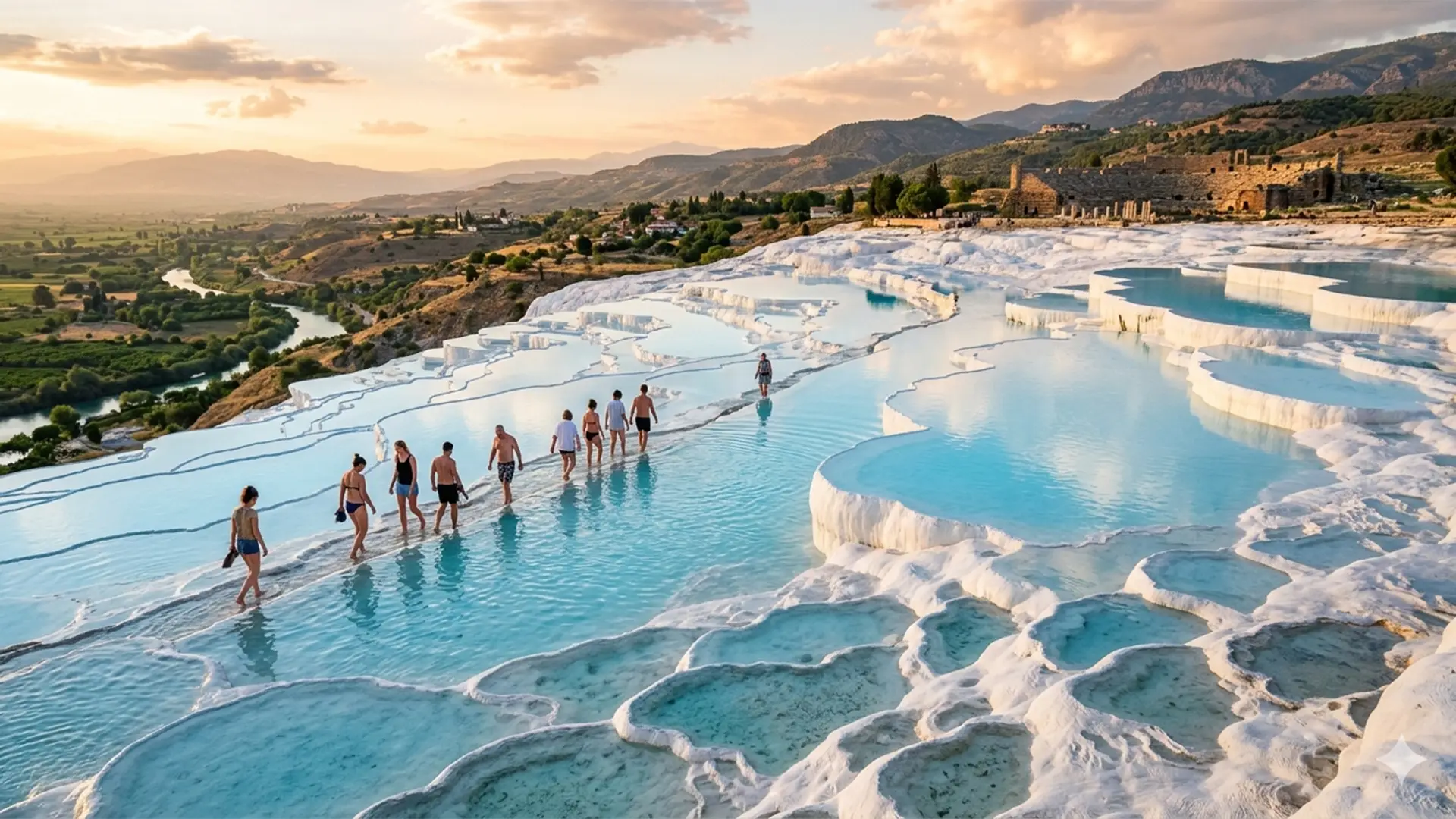
Find ancient sites, caves, mountain landscapes and more discoveries across the Denizli region.
View Regional Guide