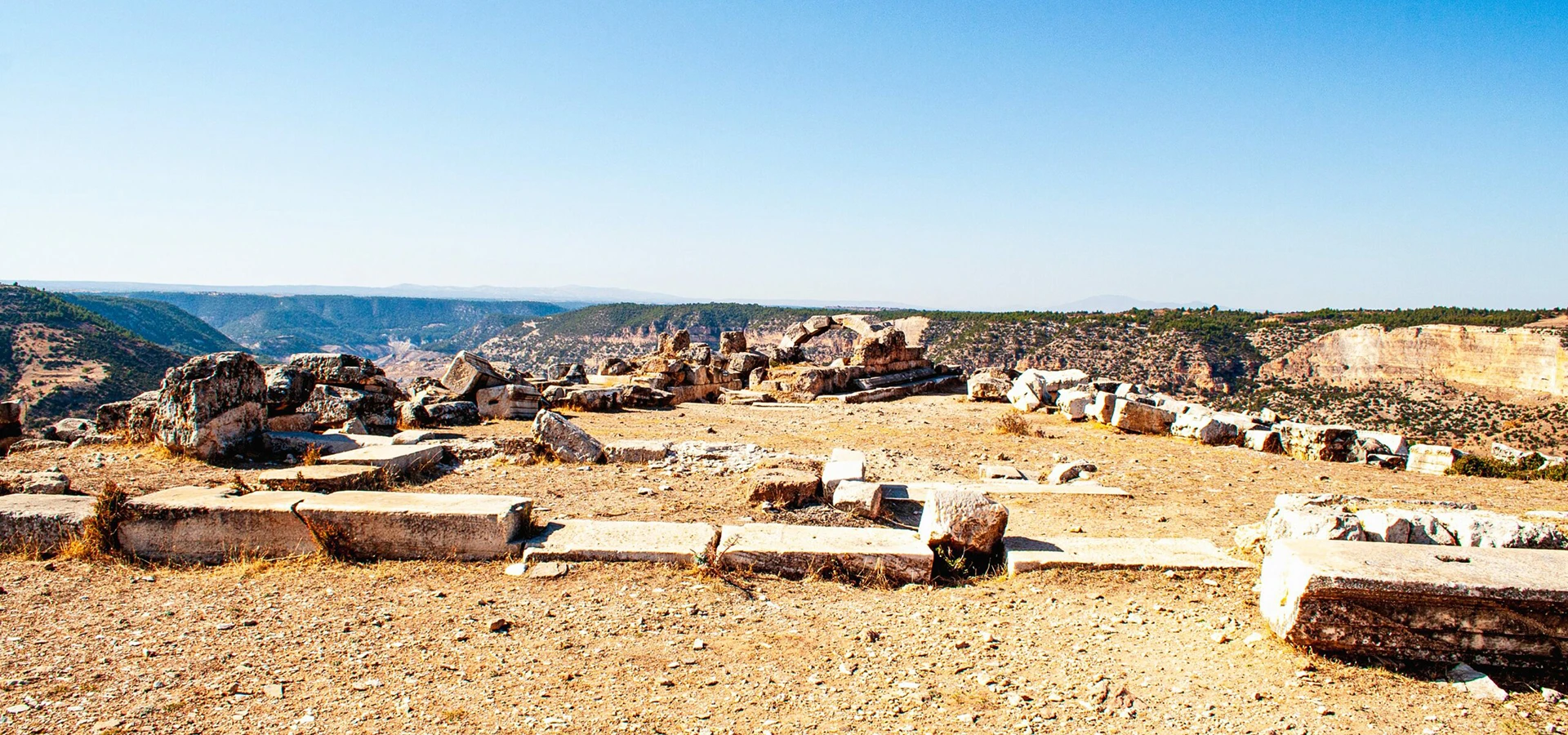
Apollon Lairbenos Sanctuary
A regional sacred hill whose inscriptions connect communities of ancient Phrygia.
Explore the Sanctuary





Close to Ortaköy in the Çal district of Denizli, the ancient city of Dionysopolis occupied part of the historical landscape of Phrygia. Türkiye’s official heritage authorities place the site in the Ortaköy area, with the Culture Portal specifying the countryside between Ortaköy and Develler. The city is traditionally associated with Dionysus, the god of wine and the vine.
Official accounts connect the establishment of Dionysopolis with the Seleucid period, followed by the rule of the Kingdom of Pergamon. Later, in the Roman era, its inhabitants issued distinctive bronze coins. Images of Dionysus, grapes, the thyrsus, Silenus and the Maeander river god survive even where the ancient city’s streets and buildings do not.
This is not a fully excavated archaeological park: only limited physical remains have been reported. Our guide explains what is historically known, what the coins reveal, how to distinguish this city from places with the same name, and how to plan a realistic visit without assuming that formal visitor facilities exist.
A small city in the upper Maeander cultural landscape.
Seleucid foundation tradition and later Pergamene rule.
Roman bronze types preserve the city’s ancient identity.
Little visible today; local access must be checked.
The city’s identity, history, archaeological visibility and practical location in one place.
Ortaköy–Develler area, Çal district, Denizli, Türkiye.
Phrygia; Roman provincial administration associated with Asia.
Dionysus, Greek god of wine, vines and ecstatic ritual.
Founded in the Seleucid period, according to official accounts.
Subsequently part of the Kingdom of Pergamon.
Civic bronze coinage from the 1st–3rd centuries AD.
Dionysus, grapes, ivy, thyrsus, Silenus and Pan.
The Maeander (Maiandros) appears on a Trajanic coin.
Reported to be sparse; no intact classical city centre.
Ortaköy is the main locality for navigation.
No site-specific public ticket schedule independently verified.
Denizli Culture Directorate, Türkiye Culture Portal and RPC.
Dionysopolis interests travellers who want to understand the less-visible cities of ancient Anatolia. Rather than competing with the monumental theatres and streets of Laodicea or Hierapolis, its story emerges through geographical records, regional history and a particularly revealing collection of ancient coins.
Images stamped on bronze coins portray the god after whom the city was named, along with grapes, ritual staffs, mythological companions and the river personifying the Maeander. Those small surviving objects provide unusually vivid evidence of how the citizens wished to be represented.
Visitors should approach the area as a quiet cultural landscape with limited visible archaeology. Without verified access arrangements, this is best considered a specialist research stop or a thoughtfully planned addition to a wider Çal heritage route.
Away from the busy archaeology circuits.
A civic name devoted to Dionysus.
Symbols and legends preserve local culture.
Connected with Seleucid and Pergamene rulers.
Experience the broader Çal countryside.
Few ancient structures remain identifiable.
Dionysopolis is in Denizli Province, western Türkiye, near Ortaköy in the Çal district. The Türkiye Culture Portal states that the ancient settlement lies between Ortaköy and Develler, a more useful archaeological description than assuming its remains are directly in the centre of one modern village.
Two government references give different approximate figures: the Denizli Provincial Directorate describes the city as around 8 km northwest of Çal, while the Culture Portal describes the Ortaköy approach as about 15 km. These may reflect different endpoints and routes; neither should be treated as precise door-to-door navigation to visible ruins.
Before departing, verify the exact legal approach and local landmark with the Çal authorities or knowledgeable local guide. Searching simply for “Dionysopolis” can also produce results for a completely different ancient city outside Türkiye.
Denizli.
Çal.
Ortaköy.
Develler.
Historic Phrygia and Maeander basin.
Confirm the precise site, not only a village pin.
The Greek name Dionysopolis is conventionally understood as “city of Dionysus”. It joins the name of Dionysus with the word polis, meaning city. In Turkish the destination may appear as Dionysopolis Antik Kenti or sometimes Dionisopolis.
Dionysus was linked to vines, wine, fertility, theatre and transformation in the wider Greek religious world. These associations are especially appropriate to the Çal basin, a region remembered for grape cultivation; nevertheless, a meaningful city name is not proof of a particular excavated vineyard or winery inside the ancient settlement.
Roman coin types make the association much more than a modern guess: the local civic legend accompanies figures of Dionysus holding grapes and a thyrsus. They show how imagery and public identity could reinforce each other.
Dionysos: the deity.
Polis: city.
City of Dionysus.
Dionysopolis Antik Kenti.
Wine, vines and festival culture.
Coins issued in the citizens’ name.
Dionysus was a major deity of the Greek-speaking Mediterranean. He was associated not only with wine but with grape cultivation, ecstatic worship, processions, performance and the crossing of ordinary social boundaries. His cult had many regional expressions rather than one fixed form.
Artists often represented him with ivy, bunches of grapes, a drinking cup called a kantharos and a thyrsus, a staff linked to his followers. Satyrs and the elderly Silenus also belong to the god’s mythological circle.
The coins of Dionysopolis provide material evidence for some of these motifs. They do not by themselves establish the layout of a local temple, the annual calendar of festivals or the precise rituals performed in the city.
Vines and wine.
Ivy wreath.
Thyrsus staff.
Grapes and drinking cup.
Silenus.
Coin images do not map a lost temple.
Türkiye’s official culture authorities place the foundation of Dionysopolis in the Seleucid era, the Hellenistic period following the conquests of Alexander the Great. The Seleucid dynasty governed extensive territories in western Asia at different moments, including lands contested by other Hellenistic rulers.
The same official account records that the city later came under the Kingdom of Pergamon. That broad political sequence places Dionysopolis in the changing frontier world of Hellenistic Anatolia, where power could move between competing dynasties and regional centres.
The surviving summary does not identify a specific Seleucid founder, a proven foundation year or an excavated royal inscription. A responsible guide distinguishes this historically reported origin from exact details that are not securely documented.
Seleucid era.
Hellenistic kingdoms.
Kingdom of Pergamon.
Western inland Anatolia.
Precise founding year.
Political sequence is better known than city plan.
After Hellenistic domination, Dionysopolis formed part of the Roman-period urban world of Phrygia. The specialist Roman Provincial Coinage catalogue assigns its civic issues to the province of Asia, in the conventus of Apamea—a Roman administrative/judicial district—not to a modern administrative province.
Coins catalogued under Augustus, Tiberius, Trajan and Hadrian, and continuing into later imperial reigns, reveal that the city’s name remained a recognised civic identity across several generations. This is especially valuable because extensive standing monuments have not survived.
Roman coin legends are evidence of civic self-representation and the period of those issues. They do not prove an uninterrupted economic boom, a monumental building programme or exact population figures.
Asia.
Phrygia.
Conventus of Apamea.
Augustus and Tiberius.
Trajan, Hadrian and subsequent rulers.
No dependable city population available.
Because the archaeological city is poorly visible, Roman bronze coins are among the clearest surviving witnesses to Dionysopolis. Researchers record their portraits, Greek legends, symbols and issuing officials, often linking pieces now held by different collections.
A typical reverse inscription reads ΔΙΟΝΥΣΟΠΟΛΕΙΤΩΝ, conventionally translated “of the Dionysopolitans”. The inscription identifies the community credited with the issue. The images on the other side might honour an emperor, portray a deity or present a symbol meaningful to the city.
The searchable Roman Provincial Coinage research database at the University of Oxford and its partner institutions allows visitors to examine actual documented coin types, instead of inventing reconstructions of long-lost buildings.
Mostly copper-alloy civic coinage.
Of the Dionysopolitans.
Name and public imagery.
Emperors and local divinities.
Roman Provincial Coinage (RPC).
Museum collections, not a guaranteed on-site exhibit.
Bronze types listed for the reign of Tiberius show Dionysus with grapes and a thyrsus. Another issue associated with Hadrian and Sabina shows the god holding a kantharos and the ritual staff.
Such depictions join two messages. The Greek civic legend identifies the issuing community, while the figure of the deity reinforces the city’s distinctive name and religious associations. Together they create a small but powerful declaration of local identity.
The image of grapes also resonates with agricultural traditions of the Çal region. It is sensible to see this as a cultural connection; it is not direct archaeological proof of particular ancient commercial wine exports, wine presses or storage buildings at Dionysopolis.
Dionysus with grapes and thyrsus.
Dionysus with cup and staff.
Kantharos.
Name of the Dionysopolitans.
Vines and festive identity.
No confirmed winery complex from these images.
One especially memorable coin type, catalogued under Hadrian, shows the head of Silenus crowned with ivy leaves and berries. Silenus is an important figure in the mythological company of Dionysus, and ivy is a characteristic Dionysiac plant.
On the reverse appears a cista mystica, a ritual container with a partly open lid from which a serpent emerges, accompanied by a thyrsus. The image belongs to a broader visual language associated with mystery cults and Dionysiac symbolism.
Coins reveal the symbolism chosen for their design. They do not establish the location of a particular initiation chamber, sanctuary or festival that modern travellers could visit in the Ortaköy countryside.
Silenus.
Ivy leaves and berries.
Cista mystica.
Serpent.
Thyrsus.
Documented on Hadrianic civic issues.
Roman Provincial Coinage also records a type bearing an ivy-crowned Dionysus on one side and Pan advancing with grapes and a curved shepherd’s staff on the other. The issue is catalogued with an uncertain reign, so it should not be given a precise year without further evidence.
Pan belongs to the wider mythological world of countryside, music and nature; his appearance beside grapes fits the recurring symbols found on the city’s currency. Such combinations demonstrate how deeply Dionysiac imagery could permeate the city’s public visual culture.
For travellers, these coins offer an engaging way to imagine the lost artistic atmosphere of the ancient community without pretending that these sculptures or ritual scenes survive as monuments at the site.
Ivy-crowned Dionysus.
Pan.
Curved shepherd’s staff.
Bunch of grapes.
Uncertain in the cited RPC type.
Civic mythological imagery.
An issue struck under Trajan depicts the river god Maiandros (Maeander) reclining with a reed and cornucopia beside a vessel from which water flows. The Greek reverse legend identifies both the Dionysopolitans and the river.
This is particularly important for locating the city in a broader regional imagination. The Büyük Menderes River and its valleys shaped the environment, agricultural connections and place identities of western Anatolia.
The personification should not be read as a precise ancient map of the settlement or proof that the visible archaeological remains stand immediately on the present-day riverbank. It is a symbolic depiction of a river landscape.
Trajan (AD 98–117).
Maiandros river god.
Reed.
Cornucopia.
Water flowing from a vessel.
Büyük Menderes / Maeander.
The name Dionysopolis points strongly toward Dionysus, but its coinage did not display only one god. A type of Augustus depicts Zeus holding an eagle and sceptre, and a striking issue of the early 3rd century includes Dionysus between Zeus and Asclepius.
The combination suggests that local public religious imagery drew from a wider pantheon. Asclepius, often shown with his serpent-entwined staff, was linked to healing; Zeus represented supreme divine authority in Greek religious iconography.
Without a securely identified excavated sanctuary, it would be premature to claim that visitors can see temples dedicated to each deity in the countryside near Ortaköy. The coin types document images, not the survival of specific buildings.
Eagle and sceptre.
Healing deity with serpent staff.
Civic namesake.
Zeus on an Augustan coin.
Three deities on an early 3rd-century type.
Coin art does not prove excavated temples.
Some issues preserve not only the city’s name but the names of local issuing officials. The RPC catalogue lists, for example, Aristos, son of Aristos, on coins attributed to the Tiberian period, while another issue records Potamon, son of Apollodotos.
One legend specifies that Potamon held office for the fourth time. Such details are useful clues to the existence of civic institutions, local notables and procedures for recording public authority.
They do not give us a complete constitution, council chamber or a known city-hall location. As with other smaller cities of Roman Asia, names on coinage supply fragments of political history rather than a full administrative narrative.
Aristos.
Potamon.
Apollodotos, Potamon’s father.
Fourth tenure noted on a type.
Greek civic coin legends.
Exact location of civic buildings.
The Denizli Provincial Directorate’s official ancient-city overview, reproduced in its regional archaeological publication, explicitly notes that very few remains of Dionysopolis survive today. This is an important distinction from partially reconstructed destinations with standing gateways, colonnades and monumental theatres.
A traveller should therefore not expect a clearly signposted circuit of temples, streets, an agora, baths or a theatre. Ancient building traces may be difficult to recognise without professional identification, and some reported locations in the area may refer to separate archaeological features.
Although historical coin evidence proves the ancient civic name, it cannot reveal the present state of all buried remains. Protect agricultural land and archaeological deposits; do not excavate, remove objects or enter private property without permission.
Very limited surviving remains.
Not established as a tourist attraction.
Do not assume intact public monuments.
Heritage summaries and documented coinage.
Not independently confirmed.
No collecting or unauthorised digging.
For many ancient cities, carefully excavated walls, streets and building inscriptions allow archaeologists to reconstruct a site plan. In the case of Dionysopolis near Çal, widely available official descriptions are much more limited. The standard tourism sources do not provide a verified map of excavated civic monuments.
That means common features of ancient towns—an agora, civic assembly buildings, sanctuaries or bath complexes—should remain general historical possibilities, not advertised visible highlights. The same restraint applies to a supposed Dionysus temple at the site.
A more meaningful account concentrates on what can actually be supported: the location near Ortaköy–Develler, Hellenistic political history, the city name and coin evidence across several Roman centuries.
Ortaköy–Develler identification.
Ancient civic coinage.
An intact agora.
A visible Dionysus temple.
A complete theatre.
Separate evidence from reconstruction.
The modern Çal basin is widely associated with grape growing, and local heritage descriptions often describe Dionysopolis in connection with the god of wine. As a cultural pairing, the city’s name and the region’s vineyards are immediately appealing.
Ancient Dionysiac coins provide primary evidence for grapes and wine-related iconography. They should not be stretched into unsupported claims about the quantity of wine made at the ancient city, a specific historic grape variety, or export routes that have not been demonstrated archaeologically.
On a private outing, a discussion of rural livelihoods and mythology can complement a visit to the district. Any optional modern vineyard or food stop should be arranged separately, with no suggestion that it is a preserved Dionysopolis workshop.
Grape cultivation in Çal.
Dionysus and the vine.
Grapes on civic coin types.
Countryside and local food.
Excavated ancient wine factories.
Optional experiences; no shopping obligation.
The Roman Provincial Coinage project categorises Dionysopolis within Phrygia, a historic region of inland western Anatolia. Phrygia included major towns and smaller settlements joined through routes, local markets, religious institutions and political relationships.
The city’s setting is linked to the upper Maeander and to the wider network of ancient communities across Denizli. Phrygian is a regional and historical designation here; it does not mean that all surviving Roman-period coins were inscribed in the Phrygian language.
The civic legends studied in RPC are Greek, as was common on provincial coins in Roman Asia. This layered cultural setting—Anatolian geography, Greek-language public culture and Roman administration—is central to understanding Dionysopolis.
Phrygia.
Roman Asia.
Maeander basin.
Greek.
Local, Hellenistic and Roman influences.
Regions and provinces are not the same thing.
There was another ancient Dionysopolis in Moesia, at modern Balchik on Bulgaria’s Black Sea coast. Because both places appear in classical scholarship and coin catalogues, searching without a regional qualifier can bring up the wrong site.
The destination described here is Dionysopolis of Phrygia, near Ortaköy in Çal, Denizli, Türkiye. Coins in the RPC catalogue are labelled with their region, and in some cases scholarly cataloguing has corrected older attributions between places with identical names.
For research, photographs and navigation, add “Phrygia,” “Çal,” “Ortaköy,” or “Denizli” to searches. A Black Sea harbour or Balchik archaeological image should never be represented as an authentic view of the ruins near Çal.
Dionysopolis of Phrygia.
Çal, Denizli, Türkiye.
Dionysopolis of Moesia.
Balchik, Bulgaria.
Dionysopolis Phrygia.
Do not mix images of distinct cities.
Denizli’s published ancient-sites overview also describes Gavurevleri or Gavurdamları, a sacred, settlement and necropolis locality near Develler. The description places it roughly 200 m north of the settlement at a place known as Kesdanboğazı.
The reported remains include twelve rock-cut niches or altars, alongside stone features interpreted as part of the area’s historical activity. The official overview discusses a sacred tradition extending back toward the Phrygian period.
This is a separately described archaeological locality; do not merge it automatically with the urban remains of Dionysopolis or assume the two have a confirmed single excavation plan. Check whether access is authorised before visiting any rock-cut features.
Develler.
Kesdanboğazı.
Gavurevleri / Gavurdamları.
Twelve rock-cut niches.
Sacred and settlement landscape.
Not automatically the Dionysopolis city centre.
The Sanctuary of Apollon Lairbenos at Asartepe near Bahadınlar, Çal belongs to the wider sacred landscape of the Maeander area. Official accounts of that sanctuary refer to worshippers connected with several ancient cities, including Dionysopolis.
Ancient dedicatory inscriptions published in epigraphic collections help illustrate connections between civic origins, families and regional sanctuaries. A person identifying as a citizen of Dionysopolis could participate in religious practices beyond the city’s own presumed urban centre.
The sanctuary at Asartepe is not the same archaeological site as Dionysopolis near Ortaköy–Develler. They can be discussed together historically, but a combined on-the-ground visit depends on separate confirmation of road conditions and visitor permission.
Apollon Lairbenos.
Asartepe, Bahadınlar.
Maeander region worshippers.
Greek dedicatory inscriptions.
Separate from Dionysopolis.
Subject to safe confirmed access.
Expect the setting of a rural Anatolian ancient locality, not a visitor complex with a reconstructed city gate and guided route. Official publications caution that the amount of visible archaeological material is very small.
The reward for a prepared visitor is place-based historical understanding: standing in the district from which the ancient city is known, imagining the Roman community behind the coins, and placing its story within the wider geography of Çal and Phrygia.
For travellers primarily seeking large photogenic ruins, paved walkways, toilets or extensive interpretive panels, the better choice may be a managed archaeological site such as Laodicea or Pamukkale–Hierapolis.
Specialist archaeological landscape.
Very few easily identifiable remains.
Useful to read about coins first.
Do not assume toilets or ticket desk.
Terrain and access need checking.
Curious, well-prepared history enthusiasts.
The government’s Türkiye Culture Portal describes the route from Denizli toward Kaklık, turning north for Çal and continuing toward Ortaköy. Its published approximate route figures are about 30 km to the Kaklık junction, another 30 km toward Çal, and roughly 15 km from Çal to Ortaköy. These are indicative road descriptions, not live routing measurements.
The same source locates the archaeological site in the Ortaköy–Develler area. A modern navigation pin for the village may not reach the actual ancient locality, and the condition and legal status of the last approach should be verified with a local authority or specialist guide.
A pre-arranged driver familiar with rural Çal makes more sense than expecting an on-site visitor centre, public car park or signed archaeological entrance. Allow flexibility for road and weather conditions.
Head toward Kaklık.
Continue north toward Çal.
Proceed to Ortaköy.
Between Ortaköy and Develler.
Confirm locally.
Private vehicle with verified last-mile access.
The Türkiye Culture Portal lists minibus links from Denizli to Çal and from Çal to Ortaköy in its published route description. That provides a possible framework for reaching the general district without a car.
However, the listing does not establish a verified 2026 timetable, an onward public service to the precise remains, or a guaranteed same-day connection for your return. Transport service, stops and frequency can change.
Check departures and return times directly with local transport operators before setting out. Travellers who cannot arrange the final segment reliably should consider a private excursion or a better-serviced archaeological destination instead.
Minibus described by official portal.
Local minibus described.
No verified archaeological shuttle.
Not confirmed for 2026.
Check before departure.
Arrange private transport.
No independent, site-specific 2026 admission price or official daily visiting schedule could be confirmed from the government sources reviewed for Dionysopolis. The existence of an ancient-site entry in a tourism directory does not by itself mean there is a permanently operating ticket gate.
Nor does the absence of a published fee establish a right of unrestricted access. Some archaeological land may be protected, under conservation controls, privately owned or otherwise unsuitable for independent entry.
Before travelling, ask the Denizli Provincial Directorate of Culture and Tourism or relevant Çal authorities for current access rules. If access is permitted, plan for daylight only and avoid expecting facilities or staff on-site.
Not officially verified.
Not officially verified.
Do not assume.
No regular visitor gate confirmed.
Local heritage authorities.
Daylight if access is authorised.
Rural archaeological ground can include loose stones, cultivated fields, slopes, uneven tracks and unmarked boundaries. Bring drinking water, a hat, sun protection, a charged mobile phone and suitable closed shoes. Never assume there will be a cafe, restroom or a maintained accessible pathway.
No published evidence reviewed for this guide establishes step-free access, wheelchair facilities, stroller-friendly routes or a staffed security presence at the exact archaeological locality. Visitors with mobility requirements should obtain site-specific information before attempting a visit.
Do not collect pottery or coins, move stones, open trenches, trespass, damage vegetation or make inscription rubbings. Drone use may require permission under both heritage and aviation rules. Respect residents and agricultural work in nearby villages.
Sturdy closed shoes.
Carry your own.
Heat, rain and exposed ground.
Accessible route not confirmed.
Respect private property and restrictions.
Never disturb or remove finds.
Spring and autumn generally provide more comfortable conditions for sightseeing around inland Denizli than the hottest part of summer. In the cooler seasons the agricultural countryside may also be visually appealing, although access to fields and tracks must still be respected.
Summer trips need extra attention to sun, heat and water, and wet winter or spring weather can alter unsurfaced routes. Without a confirmed visitor path, avoid beginning late in the day or walking into poorly known terrain near dusk.
The objective is an informed and safe visit, not a dramatic sunset photograph at any cost. Check conditions for Çal and Ortaköy before departure, as the rural district may differ from weather at Pamukkale.
Often comfortable for rural sightseeing.
Strong heat and sun possible.
Pleasant light and harvest landscapes.
Rain and difficult tracks possible.
Use daylight and authorised areas.
Verify weather and access.
Dionysopolis is an especially important example of why authentic location photography matters. The archaeological city is sparsely preserved, and photographs of a magnificent standing temple or grand theatre from another ancient city would create false visitor expectations.
For this page the expected asset is assets/images/dionysopolis-ancient-city-denizli.webp. If a genuine licensed photo of the archaeological locality is not available, consider an accurately labelled regional landscape image from Çal or Ortaköy rather than inventing ruined structures.
Compose the key subject near the horizontal centre of the hero so it remains visible on mobile screens. Do not present coins from unrelated cities, the Bulgarian Dionysopolis or a modern artistic illustration as a documentary photo of the Denizli site.
dionysopolis-ancient-city-denizli.webp
Authentic Çal / Ortaköy landscape.
Clearly identified regional view.
Keep main subject centred.
Owned or properly licensed.
Ruins from unrelated cities.
A trip focused on ancient Phrygia can also consider the Sanctuary of Apollon Lairbenos near Bahadınlar, a separate sacred site known especially for inscriptions. Access to remote sites should always be confirmed individually.
For travellers seeking larger excavated monuments, Laodicea, Hierapolis Archaeology Museum and the Pamukkale–Hierapolis area provide a very different sightseeing experience.
Other regional subjects include Güney Waterfall and Attuda Ancient City. These destinations are not all next-door stops; realistic route planning should consider driving distances, the time available and site accessibility.
Sanctuary near Bahadınlar.
Extensive urban ruins.
Museum and ancient city.
Natural landscape.
Another lesser-known ancient city.
Plan regional distances carefully.
Option 1 – Çal’s ancient landscape: arrange a cultural drive through Çal and Ortaköy with a conditional stop at the Dionysopolis locality if legal access, navigation and ground conditions have been verified. The focus is on regional history, Dionysus imagery and the valley landscape—not a promised tour of standing monuments.
Option 2 – An ancient religion theme: discuss Dionysopolis alongside the Apollon Lairbenos Sanctuary and other appropriate historical contexts. A physical stop at either remote locality should remain conditional on permissions, road suitability and sufficient daylight.
Option 3 – Monumental ancient cities: choose Laodicea and Pamukkale–Hierapolis when accessible paths, clearly excavated ruins and a more conventional sightseeing day matter more. Wow Cappadocia can discuss private transport and licensed cultural guiding with no compulsory shopping stops.
Ortaköy landscape and Dionysopolis history.
Optional Asartepe context.
Laodicea and Hierapolis.
Licensed guide on request.
Private vehicle with confirmed route.
Flexible sightseeing; no shopping stops.
Near Ortaköy in Çal district, Denizli Province, Türkiye. The Türkiye Culture Portal places the archaeological locality between Ortaköy and Develler.
This guide covers Dionysopolis of Phrygia in Denizli, Türkiye. Another ancient city with the same name was located at modern Balchik, Bulgaria.
It means the “city of Dionysus,” referring to the Greek deity of wine and vines.
Official guides give differing approximate figures: around 8 km for the city locality and around 15 km on a route to Ortaköy. Confirm your exact destination and route.
Official visitor information describes it near Ortaköy and specifically between Ortaköy and Develler. The village centre and archaeological remains should not be assumed to be identical.
Denizli’s culture authority attributes the foundation to the Seleucid period but does not identify a securely established individual founder or exact year in its short public description.
Yes. Official regional heritage descriptions record later Pergamene rule following the Seleucid period.
Its provincial coinage is well documented under Roman emperors from Augustus and Tiberius onward; the specialist catalogue places the city in Phrygia within Roman Asia.
Very few physical remains are reported today. Visitors should not expect a reconstructed theatre, city gate or extensive excavated streets.
A surviving visitor-ready temple has not been established in the official sources consulted. Images of Dionysus on coins do not prove such a building remains visible.
Dionysus was the god of wine and vines. Civic coins from Dionysopolis depict him with grapes and related symbols.
A ceremonial staff associated with Dionysus and his followers, shown on some coins issued by Dionysopolis.
A ritual container shown with a serpent emerging from a partly open lid; it appears on a Hadrianic civic coin type beside a thyrsus.
A mythological companion of Dionysus whose ivy-wreathed head appears on a documented local coin type.
The Roman Provincial Coinage catalogue documents civic bronze issues bearing the city’s name and Greek legends.
The Greek civic legend means “of the Dionysopolitans,” identifying the issuing community.
Catalogued issues include those under Augustus, Tiberius, Trajan, Hadrian and later imperial rulers.
A coin under Trajan depicts the personified river god Maiandros, reflecting the city’s regional association with the Maeander landscape.
Yes. An Augustan type depicts Zeus, while an early 3rd-century type combines Dionysus, Zeus and Asclepius.
The documented civic coin legends are in Greek.
Do not assume so. Many recorded specimens belong to museum, library or private research collections rather than a guaranteed on-site display.
No definitive equivalence is established. Gavurevleri / Gavurdamları is described separately near Develler and should not be automatically merged with the city centre.
It is a separate sanctuary near Bahadınlar in the wider region. Inscriptions indicate historical connections with citizens of surrounding ancient communities.
A current official site-specific admission price could not be verified. Ask local heritage authorities before travelling.
No verified fixed public visiting hours were identified for the exact archaeological locality. Confirm authorised access and plan any visit in daylight.
Official visitor material describes Denizli–Çal and Çal–Ortaköy minibus links, but no 2026 timetable or direct service to the ruins is verified.
A suitable step-free visitor route is not documented in the sources consulted; check with local authorities before planning.
Potentially as a rural heritage outing only if access is authorised and conditions are suitable; close supervision is needed on uneven ground.
Spring and autumn are often more comfortable for rural sightseeing, provided weather and access conditions are appropriate.
No. Leave all archaeological material undisturbed and comply with heritage protection and property rules.
We can discuss a tailored Denizli heritage itinerary with a licensed guide and no compulsory shopping stops, subject to confirmed access and suitable roads.
The location, Seleucid and Pergamene historical sequence and practical Ortaköy–Develler identification follow Denizli’s Provincial Directorate of Culture and Tourism and Türkiye’s Culture Portal. The evidence for actual civic coin imagery, reigns and Greek legends is taken from the scholarly Roman Provincial Coinage (RPC) database.
Note on evidence: Official descriptions disagree about approximate distances from Çal, and their published transport directions do not establish today’s access status or operating hours. Limited surviving remains should not be confused with a complete excavated city. Research and visit planning should distinguish Phrygian Dionysopolis in Türkiye from the namesake ancient city in Bulgaria.
Official identification near Ortaköy, Seleucid foundation and Pergamene history.
English-language government summary of the ancient city.
Ortaköy–Develler location, historical summary and published travel route.
Early Roman civic coin bearing the Greek Dionysopolitans legend.
Tiberian coin with the thyrsus and a named local official.
Trajanic issue portraying the river personification.
Hadrianic civic type displaying Dionysiac ritual imagery.
Early 3rd-century issue with three divine figures.
From remote historic landscapes to the region’s great excavated ancient cities, explore with flexible private guiding and no compulsory shopping stops. Visits to small archaeological localities depend on confirmed access.
Read the wider ancient history of the Maeander and Lycus valleys.
A regional sacred hill whose inscriptions connect communities of ancient Phrygia.
Explore the Sanctuary
Monumental Roman urban archaeology and striking restored public spaces.
Explore Laodicea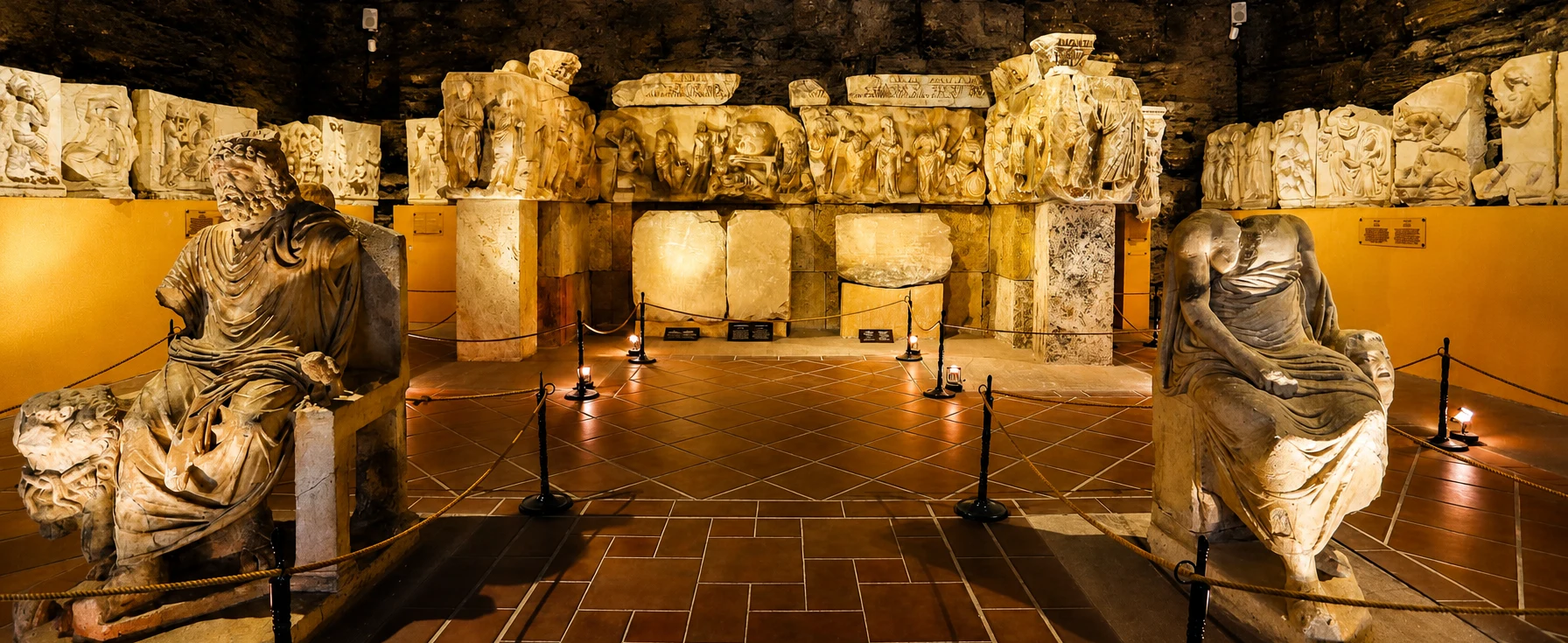
Discover art and artefacts from one of the region’s great ancient cities.
Explore HierapolisRegional nature and heritage for carefully planned itineraries.

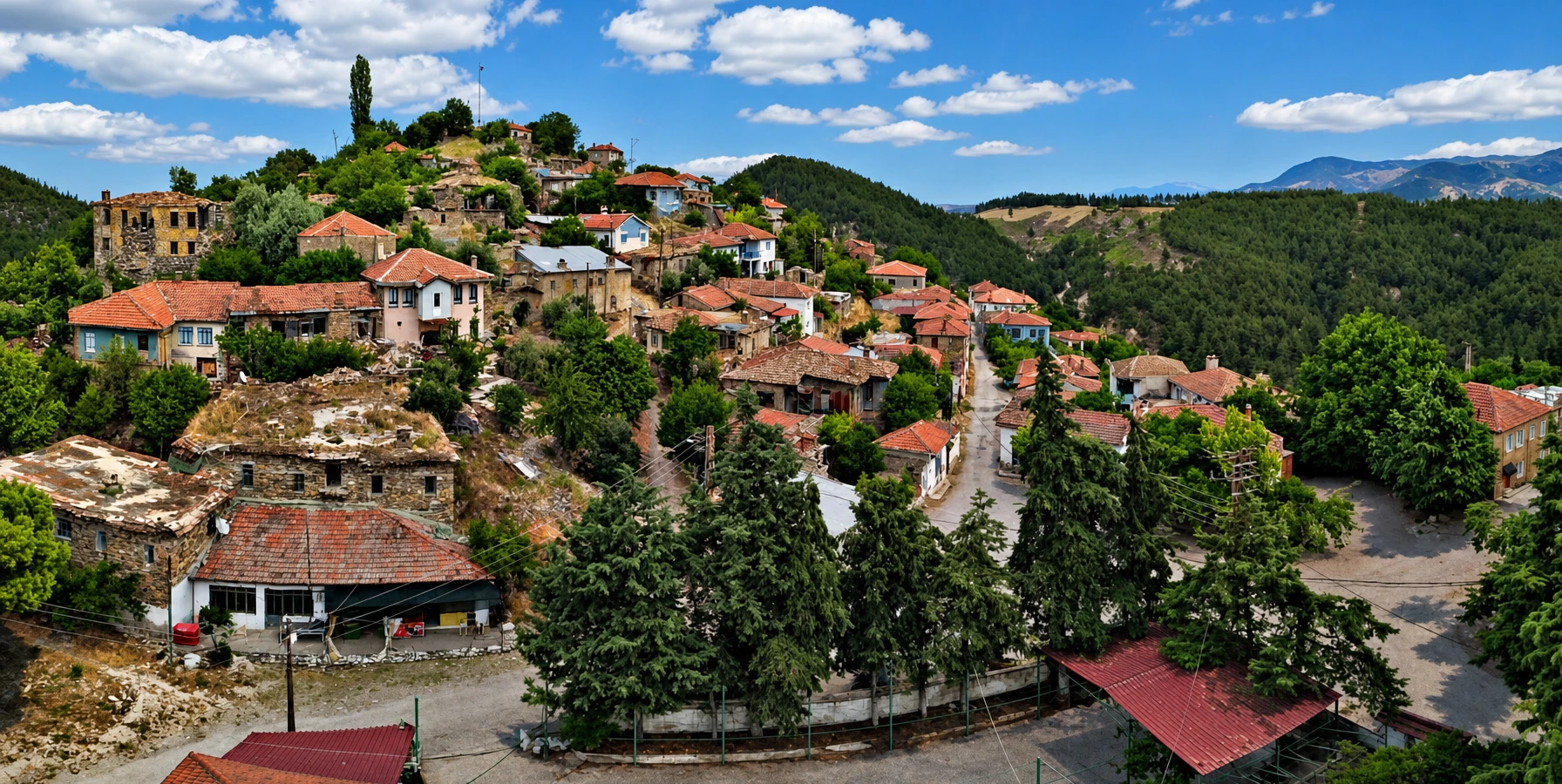

Choose a comfortable private journey through the region’s most celebrated archaeological attractions.
Explore the Private Tour