Whitish-Grey Mature Rind
The fruit becomes a distinctive dark whitish-grey as it reaches maturity.
- Developing fruit: Green-grey
- Mature fruit: Dark whitish-grey
- Surface: Bright to slightly glossy






Adapazarı Beyaz Kestane Kabağı, usually translated as Adapazarı White Chestnut Pumpkin or White Chestnut Squash, is one of Sakarya Province’s most distinctive agricultural products. This large winter squash develops a pale whitish-grey exterior, deep natural segments and thick orange flesh, creating a striking contrast between its understated rind and richly coloured interior.
Its identity is inseparable from Sakarya. The protected pumpkin is cultivated within Sakarya Province, including agricultural lands extending along the Sakarya River, where fertile alluvial soils, humidity, rainfall and the province’s transitional climate create favourable growing conditions.
The pumpkin received geographical-indication protection as a Menşe Adı, or denomination of origin, under registration number 501. This is especially significant because every stage that gives the protected product its identity is connected with its defined geographical area.
Adapazarı White Chestnut Pumpkin is also the essential ingredient of another protected local speciality: Adapazarı Kabak Tatlısı. Its dense flesh holds its shape well during cooking, making it particularly suitable for the substantial, glossy pieces used in Sakarya’s famous pumpkin dessert.
This complete guide explores the pumpkin’s geographical indication, appearance, size, flavour, Sakarya growing conditions, field cultivation, planting season, flowering, harvest, storage, culinary uses, traditional pumpkin dessert, shopping tips and places to combine with a food-focused journey through Adapazarı and Sakarya.
Adapazarı Beyaz Kestane Kabağı is registered as geographical indication number 501.
Mature fruits typically weigh around 10–25 kg and reach approximately 30–35 cm in diameter.
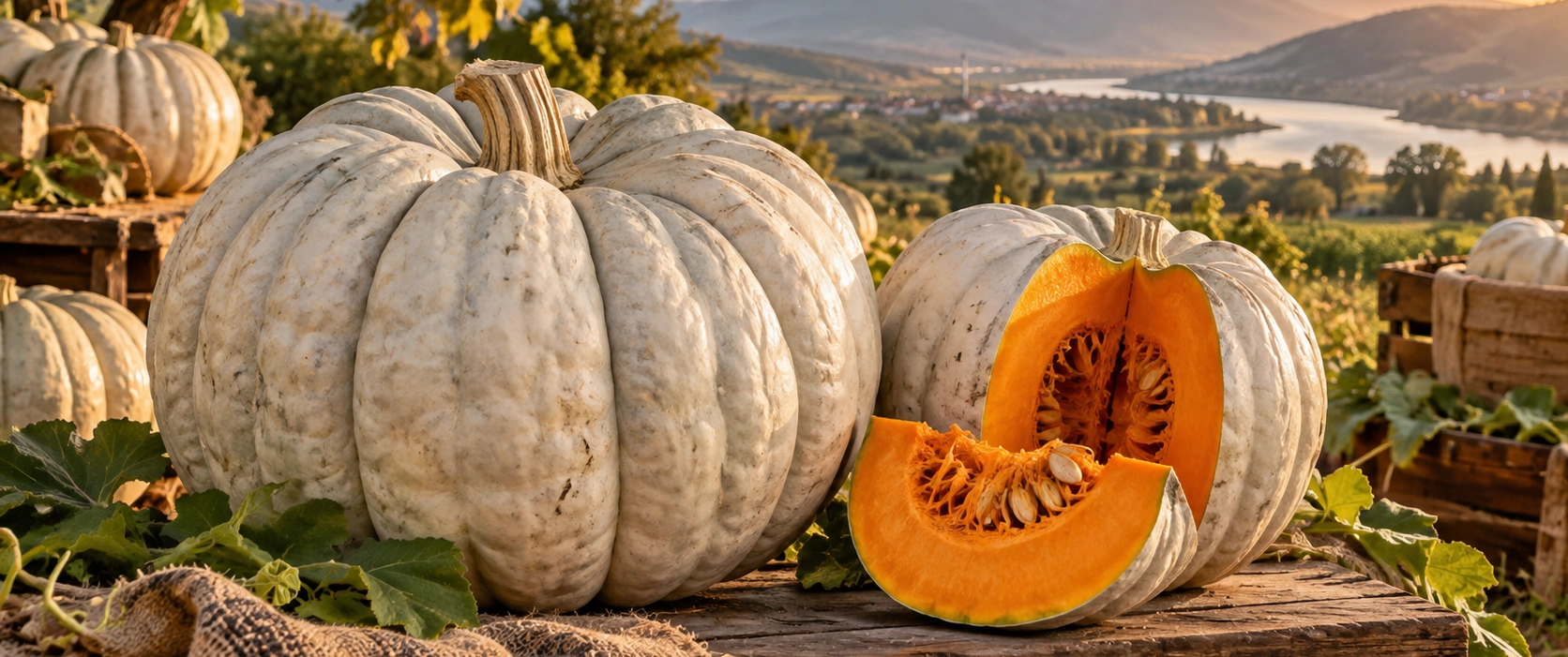
The broad, flattened fruit is strongly segmented, one of its most recognisable physical characteristics.
Its thick rind and firm flesh allow properly stored pumpkins to be kept for months after harvest.
Essential information about Sakarya’s protected white chestnut pumpkin.
Sakarya Province, Türkiye.
Open Adapazarı on Google MapsA winter chestnut squash belonging to the Cucurbita maxima group.
Approximately 10–25 kg per mature fruit.
Registered as a Menşe Adı with registration number 501.
The pumpkin’s identity comes from a long agricultural tradition and a strong connection with Sakarya’s local ecology.
Adapazarı and the wider Sakarya region are known for fertile agricultural land. Across the plains and river-connected farmland, local communities have cultivated Adapazarı Beyaz Kestane Kabağı for generations, selecting and reusing seed from a pumpkin well adapted to the area’s environmental conditions.
The protected crop develops in a province where the humid influence of the Black Sea meets conditions associated with the Marmara region. Regular rainfall, morning moisture and fertile soils help explain why the pumpkin became so closely associated with Sakarya.
Unlike smaller decorative pumpkins, the Adapazarı White Chestnut Pumpkin is a substantial food crop. Mature fruits can weigh many kilograms, while the flesh is thick, orange and firm. This combination makes the pumpkin useful both for fresh cooking and for storage after the harvest season.
Its culinary importance is most visible in Adapazarı Kabak Tatlısı. The protected local dessert specifically requires this geographically indicated pumpkin, creating a direct link between Sakarya agriculture and Sakarya gastronomy.
Registration as a denomination of origin formalised what local growers already understood: this is not simply a generic pumpkin with an Adapazarı name. Its protected identity depends on production inside Sakarya and on characteristics connected to the region.
The protected specification describes a large, strongly segmented winter pumpkin with a pale mature rind and thick orange flesh.
The fruit becomes a distinctive dark whitish-grey as it reaches maturity.
The pumpkin is wide and relatively flattened rather than tall and round.
Pronounced ribs are among the easiest visual clues when identifying the protected pumpkin.
Adapazarı White Chestnut Pumpkins are substantially larger than many everyday market squash varieties.
Cutting through the pale rind reveals dense orange flesh that is well suited to cooking.
The thick rind and firm flesh help the mature pumpkin remain usable well beyond harvest.
Adapazarı Beyaz Kestane Kabağı is officially registered by the Turkish Patent and Trademark Office as a geographical indication protecting its connection with Sakarya.
The official protected name is Adapazarı Beyaz Kestane Kabağı.
The pumpkin carries geographical-indication registration number 501.
The registration date is 26 June 2020.
The application was filed on 20 March 2017.
The official application file number is C2017/015.
It is registered as a Menşe Adı, or denomination of origin.
The registration holder is the Sakarya Commodity Exchange (Sakarya Ticaret Borsası).
The protected geographical boundary is Sakarya Province.
The Menşe Adı classification is important. It expresses a particularly strong relationship between the product and its place of origin. For the protected product, the defining production stages and characteristics are tied to Sakarya rather than simply to a recipe or reputation that could be reproduced anywhere.
Adapazarı Beyaz Kestane Kabağı is a winter chestnut squash within the Cucurbitaceae family and the Cucurbita maxima group. In English, “beyaz kestane kabağı” may be rendered as white chestnut pumpkin or white chestnut squash.
It is harvested when fully mature, giving it firmer flesh and better keeping qualities than tender summer squash.
The protected specification places the crop within the Cucurbita maxima group.
The word “white” refers to the mature exterior. Inside, the edible flesh is a rich orange colour.
“Kestane kabağı” is a Turkish term used for dense winter squash traditionally valued for sweetness and texture.
Seeds from the fruit can be retained and used for future production, helping preserve the local agricultural line.
It is especially associated with dessert preparation but can also be used wherever dense winter squash is appropriate.
The protected pumpkin is grown in Sakarya and in agricultural areas extending along the Sakarya River. Its registration specifically connects the crop with the province’s soil, rainfall, humidity, elevation and climate transition.
Large parts of Sakarya’s productive farmland lie roughly 30–60 metres above sea level and have a broad plain-like character.
Farmland in the Sakarya River basin is commonly fertile and alluvial, supporting intensive crop production.
The registered description identifies clay-loam soils with strong organic-matter content as characteristic of the growing area.
Average relative humidity is high, and morning dew is noted as an important environmental factor for the crop.
Annual rainfall is around 800 mm in the registered description, with distribution generally favourable to agriculture.
Sakarya lies in a transition zone influenced by Black Sea and Marmara-Mediterranean climatic characteristics.
Sakarya’s soil is an essential part of the protected product story. The official specification describes farmland that is generally fertile, organically rich and well supplied with minerals important to pumpkin growth.
Many growing areas belong to the Sakarya River basin and contain productive alluvial soils.
The clay-loam soil structure is described as rich in organic matter.
Salt levels are generally low in the soils highlighted by the protected specification.
Low lime levels form another part of the registered soil description.
The soil reaction class is described as slightly alkaline.
Available phosphorus, potassium, calcium and magnesium are identified as being suitable for the crop’s nutritional needs.
The plant is vigorous and creeping. Long runners spread across the field while broad leaves, tendrils and large flowers support the development of just a few very substantial fruits.
The plant body is described at approximately 70–80 cm before its long creeping runners are considered.
Strong branching can produce vines extending roughly 3–10 metres across the ground.
Leaf blades are broad, dark green, prominently veined and only lightly divided.
The plant develops tendrils along its green stems as part of its vigorous spreading growth.
Separate male and female flowers appear on the plant and depend on pollinating insects for successful fruit set.
A plant commonly carries only two or three fruits, allowing each to develop to a substantial mature size.
The crop follows a long warm-season cycle. Seeds are sown after frost risk falls, vines spread through spring and summer, and the heavy fruits reach maturity from late summer into autumn.
Sowing generally begins from late March into early or mid-April depending on field and weather conditions.
Seed germination requires soil to have warmed sufficiently; the protected specification gives about 11°C as the minimum for normal germination.
Flowering begins approximately 50–60 days after sowing.
First maturity comes after a long development period, approximately 140–150 days after the first flowering stage.
Collection can begin in August and continue through September and even into October.
Fully mature pumpkins are removed from the field and brought into storage before damaging cold conditions arrive.
Traditional field production allows the vines considerable space. The crop is sown directly into prepared ground in widely separated planting stations so the vigorous runners can spread.
One reason Sakarya suits the crop is its relatively humid environment and regular rainfall. The registered production method describes cultivation that can often proceed without routine irrigation, although dry seasons may require supplemental watering.
Under favourable Sakarya conditions, the crop can be grown without regular irrigation.
Extended dryness and high temperatures can stress the plant and reduce performance.
In dry seasons, growers may irrigate after fruits appear and repeat watering after an interval if necessary.
Additional water can increase fruit size and overall yield when conditions are dry.
The protected description notes that lower-yield dry cultivation can produce stronger flavour concentration.
Sakarya’s humidity and frequent morning dew are identified as favourable environmental factors.
Although each individual vine generally carries only a small number of pumpkins, the remarkable size of each fruit can create substantial yields across a field.
The protected agricultural description gives approximately two or three fruits on each established plant.
At 10–25 kg each, even a few mature pumpkins represent significant crop weight.
The registration describes yields in the broad range of approximately 2,500–5,000 kg per decare.
Relatively low plant density reflects the space required by long runners and large fruit.
The registered description gives approximately 14–16% soluble dry matter, contributing to the pumpkin’s dense culinary character.
Seeds from mature pumpkins can be retained for subsequent local production.
Harvest is deliberately late. Growers wait until the plants have dried and the fruits are fully mature, because winter squash develops its strongest keeping quality only after reaching maturity.
One of the crop’s most useful characteristics is its storage life. The mature fruit has a thick rind and firm flesh, allowing it to remain usable for months when kept in appropriate conditions.
The registered storage description recommends keeping the environment below approximately 10°C.
Moderate humidity helps maintain the fruit without creating excessively damp conditions.
Air movement around stored pumpkins is important for long-term keeping quality.
The traditional recommendation is to arrange pumpkins in a single layer rather than piling them deeply.
Under the specified conditions, sound mature pumpkins can be preserved for approximately six months.
Long storage means the autumn harvest can continue supplying kitchens through much of the colder season.
The appeal of the pumpkin lies in its dense orange flesh and naturally sweet winter-squash character. Its firmness is especially important: the flesh can soften during cooking while still holding recognisable pieces.
Mature fruit has a rounded sweetness that makes it especially suitable for traditional Turkish pumpkin dessert.
The flesh feels substantial rather than watery, giving cooked pieces more body.
The deep orange interior creates a dramatic visual contrast with the pale mature rind.
Firm flesh helps substantial pieces survive gentle cooking without immediately collapsing.
Its best-known local use is Adapazarı Kabak Tatlısı, where the pumpkin remains the central flavour.
Its storage ability extends the period in which local households and food businesses can use the crop.
The strongest culinary connection is with Adapazarı Kabak Tatlısı, Sakarya’s geographically indicated pumpkin dessert. The protected dessert specification requires Adapazarı Beyaz Kestane Kabağı, meaning the two geographical indications are directly connected.
Authentic protected Adapazarı Kabak Tatlısı is made specifically from Adapazarı Beyaz Kestane Kabağı.
The dense flesh is cut into substantial pieces rather than being mashed into a purée.
Prepared pieces rest with sugar before the registered dessert is cooked.
The flesh must become tender while remaining intact, one reason the protected pumpkin is so important to the recipe.
These classic accompaniments add nutty, creamy and crunchy contrasts to the sweet orange pumpkin.
The crop is GI no. 501, while Adapazarı Kabak Tatlısı is separately registered as GI no. 747.
The geographical-indication specification includes a simple nutritional note for the raw pumpkin. As with all foods, exact composition can vary with growing conditions, maturity and preparation.
The protected specification lists approximately 26 calories per 100 grams of the pumpkin.
The official product description states that the pumpkin contains no cholesterol.
The registered description also states that the pumpkin itself contains no saturated fat.
Sugar, tahini, kaymak, walnuts and other additions can substantially change the nutritional profile of a finished recipe.
Visitors interested in the protected crop should look beyond the generic word “pumpkin.” Ask specifically for Adapazarı Beyaz Kestane Kabağı and compare the fruit with the mature characteristics described in the registration.
Fields are planted from late March into April as temperatures become suitable for germination.
Vines expand rapidly and flowers begin appearing approximately 50–60 days after sowing.
Large green-grey fruits develop beneath the spreading leaves while the vines continue to grow.
This is the principal harvest period and the most atmospheric time to see mature pumpkins entering local markets.
Freshly harvested mature pumpkins are at their most visible in produce markets and food businesses.
Because the fruit stores well, properly kept pumpkins can remain available long after the fields have been cleared.
“Adapazarı Beyaz Kestane Kabağı” is the most useful phrase if you want to find the protected crop locally.
Late summer and autumn offer the best chance to see mature pumpkins in markets and agricultural settings.
A mature pumpkin can weigh 10–25 kg, so seeing one whole gives a much better sense of the crop than seeing only dessert slices.
The pale whitish-grey exterior is one of the easiest ways to distinguish it from bright-orange pumpkin varieties.
Adapazarı Kabak Tatlısı is the most direct way for travellers to experience the pumpkin’s culinary importance.
These classic toppings make an excellent introduction to the Sakarya dessert tradition built around the pumpkin.
Islama köftesi and dartılı keşkek turn a pumpkin tasting into a broader Adapazarı gastronomy route.
Agricultural fields are private workplaces; arrange visits through local contacts rather than entering active fields without permission.
Adapazarı Beyaz Kestane Kabağı is part of a much wider food landscape shaped by Sakarya’s agriculture, migration history and local culinary traditions. A food-focused journey can connect the pumpkin with protected dishes, fruits, preserves and regional sweets across the province.
The protected pumpkin is the required raw material for Sakarya’s geographically indicated pumpkin dessert.
Grilled meatballs and broth-moistened bread form another signature protected speciality of the city.
A hearty wheat-and-chicken dish finished with local dartı reflects another side of Adapazarı’s food heritage.
Southern Sakarya’s fruit-growing landscape is especially associated with quince.
A protected walnut-based sweet represents another traditional agricultural product transformed into a local speciality.
Persimmons are slowly reduced into a dark regional molasses in another corner of Sakarya Province.
A food stop focused on Adapazarı’s protected pumpkin can easily become part of a wider central Sakarya day combining gastronomy, urban landmarks and nearby nature.
Taste the protected dessert made specifically with Adapazarı Beyaz Kestane Kabağı.
Pair the pumpkin story with one of the city’s most famous savoury protected dishes.
Continue your local food route with another important geographically indicated Adapazarı speciality.
Walk through one of central Adapazarı’s best-known urban streets during a city food itinerary.
Add a historic landmark associated with the river system that also shapes the province’s agricultural geography.
Combine regional food culture with one of Sakarya Province’s most famous natural landscapes.
It is a large winter chestnut squash belonging to the Cucurbita maxima group and traditionally cultivated in Sakarya Province.
The name can be translated as Adapazarı White Chestnut Pumpkin or Adapazarı White Chestnut Squash.
Yes. It is officially registered as a geographical indication in Türkiye.
The geographical-indication registration number is 501.
The registration date is 26 June 2020.
The application date is 20 March 2017.
The file number is C2017/015.
It is registered as a Menşe Adı, equivalent to a denomination of origin.
The registration holder is the Sakarya Commodity Exchange (Sakarya Ticaret Borsası).
The protected geographical boundary is Sakarya Province.
The registered description places it within the Cucurbitaceae family, Cucurbita genus and maxima group.
Developing fruits are green-grey, while mature fruits become a dark whitish-grey on the outside. The flesh is orange.
The name refers to the pale whitish-grey mature rind, not the colour of the edible flesh.
A mature fruit is approximately 30–35 cm in diameter and 20–27 cm high.
Mature fruits typically weigh approximately 10–25 kg.
The mature fruit normally has approximately 8–12 pronounced segments.
The registered morphological description gives an approximate flesh thickness of 4.8–6.5 cm.
The edible flesh is orange.
The agricultural description gives approximately 2–3 fruits per plant.
The vigorous creeping plant can develop runners extending approximately 3–10 metres.
Sowing generally takes place from late March into early or mid-April, once soil has warmed and serious frost risk has passed.
The registered production description gives approximately 11°C as the minimum soil temperature for normal germination.
Flowering begins approximately 50–60 days after sowing.
Harvest can begin in August and continue through September and even October.
The fruit is allowed to reach full maturity, and harvest takes place once the vines have dried back and the mature pumpkins are clearly exposed.
It can often be grown under Sakarya’s natural rainfall, but supplemental irrigation may be used during dry periods.
Yes. Its thick rind and firm flesh make it particularly suitable for winter storage.
Under the registered storage conditions, sound pumpkins can be kept for approximately six months.
The specification describes a ventilated environment below approximately 10°C with relative humidity around 60–70%.
Yes. The protected Adapazarı pumpkin dessert specifically requires geographically indicated Adapazarı Beyaz Kestane Kabağı.
Yes. The dessert has its own separate geographical-indication registration, number 747.
Adapazarı Islama Köftesi and Adapazarı Dartılı Keşkek are excellent local specialities to combine with pumpkin dessert.
The most effective photographs reveal what makes the crop immediately recognisable: enormous scale, a pale segmented rind, orange flesh and its relationship with Sakarya’s agricultural landscape.
Photograph a mature fruit among drying vines to show both its size and its agricultural context.
A carefully composed low view can emphasise how massive a 10–25 kg pumpkin appears at ground level.
Use side lighting to reveal the 8–12 deep ribs and the pale whitish-grey texture of the mature rind.
Show the contrast between the muted exterior and the thick, vivid orange flesh inside.
Autumn produce stalls can communicate the pumpkin’s role in everyday Sakarya food culture.
Photograph the whole protected pumpkin beside a plate of Adapazarı Kabak Tatlısı to connect agriculture with gastronomy.
Combine Adapazarı’s protected foods, local agricultural traditions, central Sakarya highlights and selected countryside stops on a private journey designed around your interests.
Custom-designed private journeys with flexible timing, private transportation and opportunities to discover regional cuisine, city landmarks, nature and traditional food culture across Sakarya Province.
Explore Adapazarı’s culinary identity through white chestnut pumpkin, kabak tatlısı, islama köftesi, dartılı keşkek and selected local flavours.
Request This Tour
Build a flexible route around Adapazarı’s protected foods and regional flavours from Geyve, Pamukova, Taraklı, Karapürçek, Kocaali and Sapanca.
Request This Tour