Private Yalova Gastronomy & Heritage Experience
Ask us about a tailor-made cultural route combining the Yogurt Museum, Yalova City Museum, the Balkan House, local food and other heritage attractions.
Request a Custom Tour





Inside the Yalova Chamber of Commerce and Industry (YTSO), one of Türkiye’s most unusual gastronomy museums tells the story of a food so familiar that most travellers rarely stop to think about its history: yogurt.
The Muzaffer Ahmet Turna Yogurt Museum was registered with the approval of the Ministry of Culture and Tourism on 4 January 2024 and officially opened to the public on 24 May 2024. Yalova Municipality describes it as Türkiye’s first yogurt museum and one of only a small number of museums in the world dedicated specifically to yogurt culture.
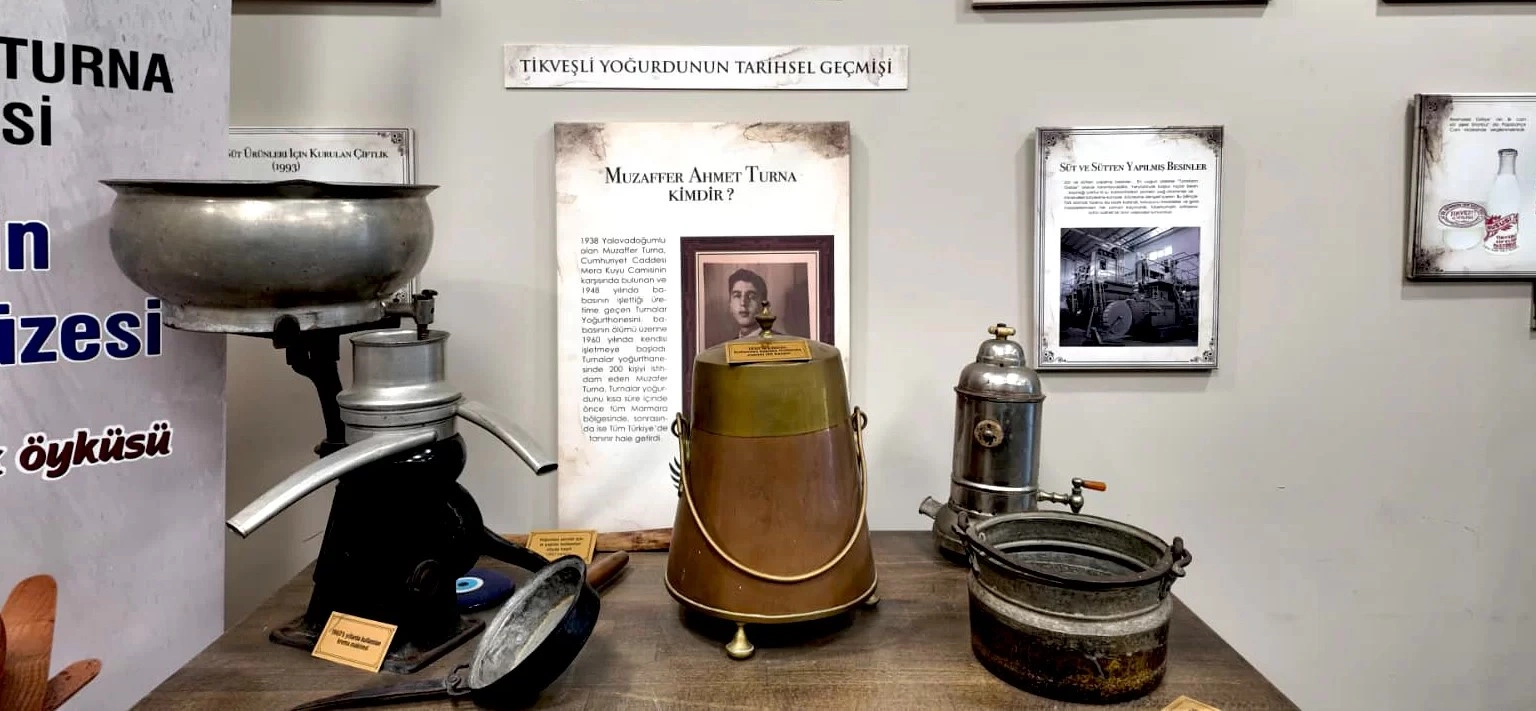
The museum commemorates Muzaffer Ahmet Turna, the Yalova dairy producer whose name became closely associated with Turnalar Yoğurt. Its displays bring together historic milk containers, traditional yogurt-making equipment, copper vessels, production tools, visual interpretation and the commercial memory of a local food brand.
But this is more than a company-history collection. The museum connects family migration, food craftsmanship, fermentation, local entrepreneurship and cultural memory. For travellers who enjoy small specialist museums, traditional food or places that reveal an unexpected side of a city, it is one of Yalova’s most distinctive indoor stops.
The museum is officially promoted in Yalova as the first museum in Türkiye devoted specifically to yogurt culture.
Historic milk cans, copper vessels, cream equipment and other objects show how yogurt production changed over the twentieth century.
The collection preserves the memory of Muzaffer Ahmet Turna and the local Turnalar yogurt tradition.
The museum connects an everyday food with migration, craftsmanship, language, fermentation and contemporary heritage work.
Essential visitor information for Türkiye’s first museum dedicated to yogurt.
Inside the Yalova Chamber of Commerce and Industry (YTSO), Yalova Merkez.
Open in Google MapsPrivate specialist museum focusing on yogurt, dairy production, food heritage and local commercial history.
Official Yalova sources describe it as Türkiye’s first yogurt museum.
Approved and registered by the Ministry of Culture and Tourism on 4 January 2024.
The public opening ceremony took place at YTSO on 24 May 2024.
Historic yogurt-making and dairy objects, including milk cans, copper vessels, cream equipment and production tools.
Muzaffer Ahmet Turna, the Yalova producer associated with Turnalar Yoğurt and decades of local dairy production.
Current official and recent reporting describe the museum as free to visit.
Yalova Municipality currently lists the museum as open to visitors.
Allow around 30–60 minutes for a comfortable visit, depending on your interest in food history and the displays.
The museum turns one of Türkiye’s most familiar foods into a story about family, craftsmanship, memory and cultural continuity.
Yogurt is so deeply integrated into daily eating across Türkiye that it can seem almost too ordinary to need a museum. That is exactly what makes this collection interesting. It asks visitors to look again at an everyday food and consider the tools, knowledge, labour and family traditions behind it.
The museum also gives a local dimension to a much wider food history. Rather than attempting to tell the complete global story of fermented milk, it uses Yalova’s own dairy heritage and the Turnalar family experience as an entry point into the subject.
Historic containers, production equipment and visual displays help explain how yogurt moved from small-scale preparation toward more organised commercial production. For travellers interested in industrial heritage, the museum is therefore as much about changing food production as it is about taste.
It is also unusually relevant in 2026. UNESCO currently lists “Traditional techniques of yogurt making and related social practices” as a multinational nomination under process for the 2026 Representative List, submitted by Bulgaria, Türkiye and Romania. That nomination concerns traditional knowledge and social practices rather than this museum itself, but it provides a timely international context for the subject the museum preserves.
The Muzaffer Ahmet Turna Yogurt Museum is located inside the Yalova Chamber of Commerce and Industry (YTSO) service building in Yalova Merkez. This makes it very different from a purpose-built museum complex: visitors are entering an active institutional building that also houses the chamber’s offices and services.
YTSO currently gives its address as Kazım Karabekir Mahallesi, Termal Yolu Caddesi No:3, 77200 Yalova. Because online map databases can sometimes format the street number differently, using the full institution name “Yalova Ticaret ve Sanayi Odası” is usually the easiest way to navigate to the building.
The urban location means the museum can be combined conveniently with central Yalova sightseeing, the city’s other museums and the road toward Termal. It is particularly easy to include as a short cultural stop rather than planning an entire day around it.
Muzaffer Ahmet Turna was born in Yalova in 1938 and became one of the local names most closely associated with yogurt production. Local reporting credits him with spending 62 years developing and producing Turnalar yogurt and helping turn it into a recognised Yalova food brand.
He died on 20 January 2024 at the age of 86, shortly after the museum had received official approval and several months before its public opening ceremony. The museum therefore became both a food-history project and a memorial to a long working life.
His daughter, Ayşen Turna Tüzünataç, developed the museum after years of research with the aim of preserving not only her father’s memory but also the tools, production knowledge and family stories associated with yogurt making.
That personal foundation gives the museum a distinctive character. Visitors are not simply looking at anonymous dairy equipment: many of the objects belong to a family and commercial story rooted in Yalova.
Yalova Municipality dates the beginning of Turnalar Yoğurt production to 1948. Over the following decades, the name became associated with Yalova’s dairy trade and with Muzaffer Ahmet Turna’s long career in yogurt production.
Family accounts presented during the museum project connect this food tradition with earlier Balkan migration stories. Ayşen Turna Tüzünataç has described the museum as preserving the experience of the Turna and Vardarlı families, whose family history includes migration from the Balkans to Türkiye.
This makes the collection especially interesting beside Yalova’s other migration-related heritage. Food traditions often travel with families: recipes, fermentation knowledge, tools and preferred textures can survive even when people leave the places where previous generations lived.
The museum therefore allows visitors to see food production as cultural transmission. A milk can or copper vessel is not only an old tool; it can also represent knowledge passed between generations, adapted to a new city and eventually transformed into commercial production.
Ayşen Turna Tüzünataç has explained that the idea of creating a yogurt museum developed through several years of research. The project brought together historic dairy equipment, family material, visual interpretation and the commercial history of Turnalar yogurt.
The museum received approval from the Ministry of Culture and Tourism’s cultural-heritage and museum authorities on 4 January 2024. The Ministry’s current private-museums list records the Muzaffer Ahmet Turna Yogurt Museum in Yalova under the responsibility of the Yalova Museum Directorate.
The official opening was held on 24 May 2024 inside the YTSO service building. YTSO described Turnalar yogurt as part of Yalova’s commercial heritage and presented the museum as a way of protecting that local memory.
Since then, the museum has continued to appear in food-heritage, museum and documentary projects, including work linking the collection with wider discussion of traditional yogurt-making culture.
The museum received official Ministry approval and registration.
The public opening ceremony took place in the YTSO service building.
Ayşen Turna Tüzünataç created the museum around family memory and yogurt-making heritage.
The collection focuses tightly on yogurt, dairy tools, production history and Yalova’s commercial food heritage.
The collection contains historic objects connected with milk handling and yogurt production, many dating from the twentieth century. Recent reporting has specifically identified milk cans, cream-processing equipment, copper vessels and tools used in earlier production systems.
Visitors should be aware that published collection counts differ by date. A March 2024 report, before the formal public opening, referred to 36 pieces. Yalova Municipality’s current museum page lists 38 works, while 2025 reporting based on interviews with the founder referred to around 40 types of material. This likely reflects different counting methods or an evolving display rather than a contradiction in the museum’s basic story.
What matters most is not the exact number. The objects collectively show how yogurt production depended on containers, heat, fermentation, handling and storage long before today’s industrial stainless-steel systems and supermarket packaging.
Metal milk containers illustrate the movement and handling of milk before fermentation.
Traditional metal vessels connect the collection with earlier preparation and serving practices.
Older cream-processing machinery shows that the museum covers dairy production more broadly than yogurt cups alone.
Historic implements help explain the physical work required before modern automated dairy processing.
Brand material and later yogurt containers help visitors compare traditional production with commercial presentation.
Drawings, video and modern visual storytelling explain how yogurt was made in earlier periods and how production changed.
At its simplest, yogurt is made by fermenting milk with lactic-acid bacteria. But museum objects help reveal how much practical knowledge sits behind that apparently simple idea: choosing and handling the milk, heating it, cooling it to a suitable temperature, adding starter, keeping the vessel warm and judging when fermentation is complete.
Ayşen Turna Tüzünataç has described displays concerning older production in which milk was heated in coal-fired boilers, then fermented and transferred into traditional vessels. The museum also uses images and video to compare earlier methods with more recent production.
For visitors, this is one of the most useful ways to read the collection. Instead of seeing a row of old containers as separate antiques, try to imagine each object as one stage in a production chain from fresh milk to finished yogurt.
Traditional yogurt making is also social knowledge. Starter cultures, timing, temperature and desired texture were often learned within families or workplaces, making the process part of intangible heritage as well as material history.
Fermented milk is much older than modern national borders. Archaeological and food-history research connects dairy fermentation with the long history of animal domestication across Southwest Asia, Central Asia and neighbouring regions. The precise first place or moment when yogurt emerged cannot be proven with certainty.
What is much clearer is the linguistic story. The international word “yogurt” comes from Turkish, and medieval Turkic texts record the word centuries before it entered modern European languages. That linguistic history helps explain why yogurt occupies such a prominent place in Turkish food culture.
Across Türkiye, yogurt appears not only as a side dish but also in soups, sauces, cold dishes, drinks such as ayran and regional preparations. It can be eaten fresh, strained, diluted or transformed into longer-lasting dairy products.
The Yalova museum does not need to prove that one modern nation “invented” every form of fermented milk to be meaningful. Its stronger contribution is showing how yogurt became embedded in local life, family knowledge and twentieth-century food production.
Yogurt heritage is currently receiving international attention. UNESCO’s official Intangible Cultural Heritage website lists “Traditional techniques of yogurt making and related social practices” as a 2026 nomination under process for the Representative List of the Intangible Cultural Heritage of Humanity.
The file is a multinational nomination by Bulgaria, Türkiye and Romania. UNESCO’s current file page identifies it as not yet inscribed while the 2026 process is continuing. This distinction matters because some local coverage uses phrases that can sound as if the heritage has already been formally listed.
Local reporting has connected the Muzaffer Ahmet Turna Yogurt Museum and its documentary work with Türkiye’s presentation of yogurt heritage. That makes the museum a useful place to understand the subject, but visitors should not describe the museum itself as a UNESCO World Heritage Site or as an independently UNESCO-inscribed museum.
The museum’s family story adds another layer to Yalova’s wider migration history. Ayşen Turna Tüzünataç has connected the Turna and Vardarlı family story with migration from the Balkans to Türkiye during the early twentieth century.
This does not mean that yogurt belongs to only one migration route or community. Fermented milk traditions are widespread across the Balkans, Anatolia and much of Eurasia. The more useful point is that migration carries practical food knowledge: how milk is treated, what texture is preferred, which vessels are used, how starter is preserved and how food becomes part of a family’s identity.
For travellers who have already visited Yalova’s Balkan House, the yogurt museum offers an interesting companion story. One focuses directly on migrant community memory; the other shows how food and commercial production can preserve migration-linked traditions in a very different format.
Because the collection is closely linked with Turnalar Yoğurt and the Turna family, it would be easy to treat the site simply as a corporate-history display. But the museum is more interesting when viewed in a broader way.
Its objects document the transformation of small-scale food production into organised commercial production. They show how local producers worked, what equipment they relied on, how dairy products were handled and how a familiar food gradually entered a modern consumer market.
That makes the museum part of industrial and commercial heritage as well as gastronomy heritage. A twentieth-century cream machine or milk can can tell us as much about changing work and technology as a workshop tool in a craft museum.
The personal story is therefore a strength: it anchors a large subject in one family, one city and one recognisable product.
Compare the shapes, sizes and materials used to transport and handle milk before modern dairy systems.
Traditional vessels help connect yogurt production with older kitchen and dairy practices.
Look for machinery showing that dairy production involved separation and processing beyond fermentation alone.
Use the equipment to reconstruct the sequence from heating milk to fermentation and serving.
Packaging, commercial material and family interpretation reveal the local business story behind the collection.
Local reporting describes artwork illustrating how yogurt was made during the 1960s.
Modern interpretation compares older yogurt-making processes with later production methods.
Notice how the museum links food production with family movement, memory and generational continuity.
This is a small specialist museum, so the best approach is not to rush through looking for a large number of rooms. Instead, treat the collection as a sequence: milk, equipment, fermentation, production, packaging, brand and memory.
Understanding Muzaffer Ahmet Turna and the Turnalar tradition gives the objects a clear local context.
Look at the cans and vessels first and imagine how milk moved through the production process.
Ask what each tool did and how much manual labour earlier production required.
Use packaging and visual material to see how yogurt shifted from traditional preparation toward modern retail production.
Think about how food knowledge can survive relocation and become part of a new city’s identity.
Leave with yogurt in mind as cultural heritage rather than simply a supermarket product.
Enough for a quick look at the principal objects and the Turnalar story.
A comfortable visit with time to examine tools, read interpretation and follow the yogurt-making process.
Best for visitors especially interested in food history, industrial heritage or family migration stories.
Combine the museum with Yalova City Museum, the Balkan House and another central cultural attraction.
These timings are editorial estimates rather than official museum guidance. The collection is compact, and the length of your visit will depend mainly on how much time you spend reading and studying the individual objects.
Because the museum is indoors, it works well throughout the year. It is especially convenient in wet winter weather, during very hot summer afternoons or when you want a short cultural stop between larger attractions.
The museum is inside an active chamber-of-commerce building, so weekdays are the most practical time to plan a visit.
A morning visit fits easily before central Yalova sightseeing or a trip toward Termal.
The indoor collection is a useful addition when outdoor attractions are less comfortable.
Confirm current access with YTSO if the museum is your main reason for travelling to the area.
Yalova Municipality currently lists the museum as open to visitors and describes admission as free. Recent reporting also states that the museum can be visited without an entrance charge.
A separate detailed museum timetable is not clearly published on the current municipal museum page. The museum is located inside the YTSO service building, and YTSO currently publishes institutional working hours of 08:30–12:30 and 13:30–17:30. Those are chamber working hours, not a separately confirmed museum timetable.
For that reason, visitors should treat the YTSO schedule as useful planning context rather than a guaranteed museum-opening promise and confirm access before making a special journey, especially around public holidays, weekends or institutional events.
The collection offers unusual subjects for photography, especially historic milk cans, metal containers, old equipment, packaging and the museum’s distinctive yogurt-focused signage.
Use diagonal angles or repeated shapes to turn practical dairy equipment into a strong visual composition.
Close photographs can reveal wear, handles, lids and surface texture that show how objects were actually used.
Older packaging and Turnalar identity elements help tell the commercial side of the story.
Photograph wider views first, then details, so the relationship between objects and their explanation remains clear.
Glass cases and polished metal can create glare, so change position rather than relying on flash.
Because the museum is inside a working institutional building, check before photographing staff, offices or restricted areas.
The museum is located inside the modern YTSO service building, which may make access easier than at many historic houses or archaeological sites. However, the museum’s official visitor information does not currently provide a detailed accessibility statement.
Travellers who require step-free access, accessible parking, lift information or adapted toilets should therefore contact YTSO before visiting rather than assuming that every route through the building and museum area is accessible.
The collection itself is relatively compact, so once inside, the physical distances are likely to be much shorter than at a large multi-gallery museum.
The museum is inside YTSO in Yalova Merkez and can be reached by a short urban road journey from the city centre.
Ask for “Yalova Ticaret ve Sanayi Odası” rather than only the museum name, as the collection is inside the chamber building.
Navigate to YTSO on Termal Yolu Caddesi and allow time for city traffic and parking arrangements.
The location makes the museum easy to combine with a later visit to Yalova Termal and the Termal Atatürk Mansion.
For online navigation, the most reliable search phrase is generally “Yalova Ticaret ve Sanayi Odası”. The museum itself is inside that building, so arriving at YTSO is the key step.
This route works especially well because all three museums approach modern Yalova from different angles: food production, migration and city history.
Together, these stops create a varied day built around gastronomy, urban history, thermal culture and modern Turkish heritage.
The museum is inside the Chamber of Commerce and Industry building, so use the institution name for navigation.
A separate detailed museum timetable is not clearly published; confirm before a special trip.
Current official municipal information describes the museum as free to visit.
This is a focused specialist collection whose value lies in the story and the unusual subject.
Try to understand what each object did rather than viewing the collection as a simple row of antiques.
Published object counts vary from 36 to 40 because descriptions were made at different stages of the museum project.
The yogurt-making tradition has a 2026 multinational UNESCO nomination under process; it is not the same as the museum being UNESCO-listed.
The museum is best paired with another central Yalova attraction or a trip toward Termal.
Continue the migration theme through family memory, Balkan textiles, food culture and community heritage.
Place the Turnalar story within the wider development of Yalova and its modern urban identity.
Move from food heritage to printing, handmade paper and one of Yalova’s most unusual cultural museums.
Continue along the Termal road to Yalova’s historic spa district, thermal pools and landscaped setting.
Add an important early Republican heritage site associated with Atatürk’s stays in Yalova.
Plan a wider journey through the province’s museums, historic houses, wetlands, waterfalls, forests and thermal landscapes.
It is a specialist museum in Yalova dedicated to yogurt-making heritage, historic dairy equipment, the Turnalar Yoğurt story and the memory of Muzaffer Ahmet Turna.
Yes. Yalova Municipality and YTSO officially describe it as Türkiye’s first yogurt museum.
The museum founder and several local reports describe it as the world’s second yogurt museum. Yalova Municipality uses the more cautious wording that it is one of the world’s few yogurt museums.
It is inside the Yalova Chamber of Commerce and Industry (YTSO) service building in Yalova Merkez.
YTSO lists its address as Kazım Karabekir Mahallesi, Termal Yolu Caddesi No:3, 77200 Yalova. Searching for “Yalova Ticaret ve Sanayi Odası” is usually the easiest navigation method.
It was officially registered on 4 January 2024 and the public opening ceremony took place on 24 May 2024.
He was a Yalova dairy producer, born in 1938, who became closely associated with Turnalar Yoğurt and decades of local yogurt production.
The museum was created by Ayşen Turna Tüzünataç, Muzaffer Ahmet Turna’s daughter, to preserve family memory and yogurt-making heritage.
Displays include historic milk cans, copper vessels, cream equipment, dairy-production tools, brand material and visual explanations of yogurt making.
Published counts differ by date. A pre-opening 2024 report mentioned 36 pieces, Yalova Municipality currently lists 38 works, and 2025 reporting described around 40 types of material.
The reports were published at different stages of the museum’s development and may also count individual objects and categories differently. The variation should not be treated as a major historical contradiction.
Current municipal information and recent reporting describe the museum as free to visit.
A separate detailed museum timetable is not clearly published. YTSO currently lists institutional working hours of 08:30–12:30 and 13:30–17:30, but visitors should confirm museum access directly before a special journey.
Around 30–60 minutes is enough for most visitors. Food-history enthusiasts may want longer.
Yes. The collection includes objects and visual interpretation connected with heating milk, fermentation, traditional equipment and changing production methods.
Fermented milk traditions are certainly ancient, but the exact place and date of the first yogurt cannot be established with certainty. The museum and local reporting use a 6,000-year historical narrative, while academic research more broadly places fermented dairy deep in prehistoric pastoral history.
Yes. The international word yogurt / yoghurt derives from Turkish, and related forms are recorded in medieval Turkic sources.
No. The museum itself should not be described as a UNESCO World Heritage Site or independently UNESCO-inscribed museum.
UNESCO currently lists “Traditional techniques of yogurt making and related social practices” as a 2026 multinational nomination under process from Bulgaria, Türkiye and Romania. Local reporting has connected the museum and related documentary work with Türkiye’s yogurt-heritage presentation.
Not yet according to UNESCO’s current file page. It is shown as a 2026 nomination under process rather than an already inscribed element.
Yes, especially for children interested in food, how everyday products are made and old tools. The compact size also makes it easier than a very large museum.
A detailed public accessibility statement is not currently published. Visitors with specific mobility requirements should confirm access with YTSO in advance.
Photography rules are not clearly published in the current museum information. Ask staff if you are unsure, especially because the collection is inside a working institutional building.
Good cultural combinations include Balkan House & Migration Museum, Yalova City Museum, İbrahim Müteferrika Paper Museum and the attractions of Yalova Termal.
It is particularly worthwhile for travellers interested in Turkish food culture, gastronomy museums, local business history, migration, traditional production and unusual small museums.
A private Yalova itinerary can combine the Yogurt Museum with migration heritage, city museums, traditional food, Atatürk sites and the thermal district.
Tell us whether your priority is gastronomy, food history, migration, museums, Atatürk heritage, thermal culture, photography or a broader introduction to Yalova, and we can shape the route around your available time.
Ask us about a tailor-made cultural route combining the Yogurt Museum, Yalova City Museum, the Balkan House, local food and other heritage attractions.
Request a Custom Tour
Continue discovering Yalova through gastronomy, migration heritage, Atatürk sites, Ottoman monuments, thermal springs, museums, forests and the Marmara coast.
View Yalova Guide