Dark Purple Skin
The onion's outer skin has the unusually deep purple colour from which Kapıdağ Mor Soğanı takes its name.




Kapıdağ Mor Soğanı, or Kapıdağ Purple Onion, is one of the most distinctive agricultural products of the Kapıdağ Peninsula in Balıkesir Province. Beneath its remarkably dark purple outer skin lies deep reddish flesh with a character traditionally described as sweet and juicy.
Its identity is inseparable from the peninsula itself. Local seed, fertile valley soils, the geography of Kapıdağ and generations of cultivation knowledge come together to produce an onion that differs visibly and gastronomically from many ordinary red onions.
Kapıdağ Mor Soğanı has been protected as a Turkish geographical indication since 2018. It is registered as a Menşe Adı under TÜRKPATENT registration No. 362, meaning its protected identity is exceptionally closely connected with the Kapıdağ Peninsula.
Kapıdağ Mor Soğanı is registered by TÜRKPATENT as geographical indication No. 362.
The bulb has unusually dark purple skin with deep reddish flesh.
The registered specification describes the onion as having a sweet, juicy character.
The protected geographical boundary is the Kapıdağ Peninsula in Erdek, Balıkesir.
Essential information about one of the Kapıdağ Peninsula's most distinctive traditional crops.
The Kapıdağ Peninsula in Erdek district, Balıkesir Province.
Open Kapıdağ on Google MapsKapıdağ Mor Soğanı belongs to the cultivated onion species Allium cepa.
TÜRKPATENT Menşe Adı registration No. 362.
The protected production system relies on seed reproduced within the Kapıdağ Peninsula.
Kapıdağ's purple onion represents a relationship between seed, soil, geography and generations of local farming knowledge.
Purple onions have been cultivated on the Kapıdağ Peninsula for generations. Over time, farmers maintained their own seed and adapted cultivation to the peninsula's fertile valley floors, seasonal conditions and local agricultural landscape.
The official geographical-indication specification describes the local seed as having been maintained within the peninsula for approximately a century. Its continued reproduction within the defined geographical area is an essential part of the protected production system.
This agricultural continuity helped create a product recognisable not only by name but also by appearance. The skin is markedly darker than that of many conventional red onions, while the interior is characterised by a deep reddish colour.
Formal geographical-indication registration in 2018 recognised the relationship between the onion's distinguishing characteristics and the natural and human conditions of the Kapıdağ Peninsula.
Colour, sweetness, moisture, bulb structure and local seed all contribute to the protected onion's distinctive identity.
The onion's outer skin has the unusually deep purple colour from which Kapıdağ Mor Soğanı takes its name.
The registered specification describes the flesh itself as dark red rather than simply white with coloured outer layers.
Sweetness is one of the sensory characteristics recorded in the protected product specification.
The onion is traditionally valued for a moist, succulent texture that works especially well in fresh preparations.
The protected production description characterises mature bulbs as having a layered internal structure.
Seed used for protected production is reproduced within the Kapıdağ Peninsula.
The traditional harvest period begins around the end of June and continues into early July.
After drying, some bulbs are tied into three- or five-onion braids for hanging and storage.
Kapıdağ Mor Soğanı is a locally maintained form of Allium cepa cultivated within the Kapıdağ Peninsula of Erdek in Balıkesir Province. It is recognised for its particularly dark purple exterior, dark reddish interior, sweet flavour and juicy structure.
Its protected identity does not refer simply to any purple or red onion sold in the region. The name is connected with a specific geographical area, local seed reproduction and a documented agricultural method carried out within Kapıdağ.
Kapıdağ Mor Soğanı is sold and used as an agricultural food product rather than as a processed onion speciality.
Its striking colour forms part of the protected physical description of the product.
Maintaining and reproducing the seed within Kapıdağ is fundamental to the registered production system.
The Menşe Adı protection links every stage of the protected product directly with the peninsula.
Kapıdağ Mor Soğanı is registered by the Turkish Patent and Trademark Office as a Menşe Adı. The official specification documents its geographical area, seed system, physical characteristics, cultivation method, harvest, curing and storage.
Kapıdağ Mor Soğanı
The geographical-indication registration number is 362.
The application number is C2018/057.
The official application date is 1 March 2018.
The geographical indication was registered on 2 July 2018.
The registration holder is the Erdek Chamber of Commerce.
It belongs to the processed and unprocessed fruit, vegetable and mushroom product group.
The protected geographical area is the Kapıdağ Peninsula.
A Turkish Menşe Adı is an origin designation used where the essential qualities or characteristics of a product are strongly linked with the natural and human conditions of a defined geographical area.
For a Menşe Adı product, the relevant production, processing and other stages must take place within the specified geographical boundary. Kapıdağ Mor Soğanı therefore has a particularly strong legal and agricultural connection with the Kapıdağ Peninsula.
The protected origin is the Kapıdağ Peninsula rather than Balıkesir Province in general.
The traditional seed is reproduced within the peninsula for protected cultivation.
Sowing, transplanting, cultivation, harvesting and post-harvest handling are documented.
Colour, flavour and physical measurements help distinguish the registered product.
The most immediately recognisable feature of Kapıdağ Mor Soğanı is its exceptionally dark colour. The geographical-indication specification links this appearance with the peninsula's soil, climatic and geographical characteristics.
Compared with many conventional red onions, Kapıdağ's onion develops an especially dark purple outer skin and strongly coloured inner flesh. The traditional colour is so intense that the dry skin can leave reddish pigment on hands or even mark white paper.
The external layers have the dark purple colour represented in the product's name.
Colour continues through the fleshy bulb rather than being limited only to the papery outer skin.
The dry skins can visibly transfer reddish pigment when handled.
The registered specification associates the colour with the environment of the Kapıdağ Peninsula.
Kapıdağ is a distinctive peninsula projecting into the southern Marmara Sea. Its geology includes granite, gneiss, quartzite and mica schist, while its agricultural areas include sandy, well-drained soils and highly productive alluvial deposits.
Kapıdağ Mor Soğanı is particularly associated with alluvial soils on valley floors. These fertile areas, combined with the peninsula's maritime position and varied microclimates, form the environmental setting in which the local onion has traditionally been cultivated.
Protected cultivation is especially associated with the peninsula's fertile valley-bottom agricultural areas.
Productive alluvial ground plays an important role in the agricultural landscape.
The wider geographical area is characterised in the registration by generally sandy-loamy soils.
Kapıdağ is surrounded by the Marmara Sea, creating a distinctive peninsula environment.
One of the most important parts of the protected production system is the onion's locally maintained seed. The geographical-indication specification states that the seed has been preserved and used within Kapıdağ for approximately a century.
Seed is multiplied within the Kapıdağ Peninsula and then used for agricultural production inside the same geographical boundary. Maintaining this local seed population helps preserve the combination of colour, flavour and other characteristics associated with the protected onion.
Seed intended for protected Kapıdağ Mor Soğanı production is multiplied within the peninsula.
The official specification describes approximately a century of local seed use.
Seed-production areas are managed to avoid unwanted cross-pollination with other onion varieties.
Seed selection and cultivation depend heavily on agricultural knowledge transmitted between local growers.
The geographical-indication registration does more than describe colour and flavour. It also records measurable characteristics of representative Kapıdağ Mor Soğanı bulbs.
Traditional Kapıdağ Mor Soğanı production follows a seasonal cycle beginning long before the summer harvest. Seed is first raised in seedbeds, young plants are transplanted to their permanent growing areas and the crop is managed through spring until the bulbs mature.
The traditional growing cycle begins in October, when seed is planted into seedbeds. Rather than placing the final crop directly at its permanent spacing, farmers first raise compact young seedlings.
During March and April, the seedlings are transplanted into their main cultivation beds. This two-stage system allows growers to establish young plants before the stronger spring growing season begins.
Local seed is sown into prepared seedbeds.
The young plants develop in the seedbed before spring transplantation.
Seedlings are moved to their permanent cultivation areas.
Regular field care continues as the bulbs expand toward the summer harvest.
The geographical-indication specification emphasises not only natural conditions but also the knowledge and experience of local farmers. Once transplanted, the onion beds require repeated attention during the growing season.
Traditional cultivation includes hoeing, irrigation and removal of weeds. The precise timing of these tasks responds to seasonal conditions, soil moisture and the development of the plants.
Soil around the developing crop is worked as part of regular field maintenance.
Water management supports bulb development through the spring growing period.
Competing vegetation is removed so the onion crop can develop properly.
Generations of practical farming knowledge remain an important part of the production tradition.
The geographical-indication specification identifies the ideal harvest period as approximately the end of June and the beginning of July.
By this point the bulbs have reached their characteristic size and colour. Harvest means carefully lifting the onions from the soil before the essential curing stage begins.
The first part of the traditional harvest window begins toward the end of June.
Harvest traditionally continues into the beginning of July.
Mature onions are removed from the ground rather than immediately packed for sale.
The harvested crop must dry before longer storage and traditional braiding.
Harvest does not mark the end of production. Once lifted, Kapıdağ Mor Soğanı traditionally remains in the field for approximately 7–10 days so the bulbs and outer layers can dry.
This curing period prepares the onion for handling and storage. Properly dried outer skins protect the bulb while the neck and foliage become suitable for braiding or hanging.
The registered method gives approximately one week to ten days for field drying.
Curing helps establish the protective papery skin around the bulb.
A properly cured onion is better suited to the months following harvest.
Dried leaves can be used when selected onions are assembled into traditional hanging groups.
One of the most photogenic stages of Kapıdağ Mor Soğanı production takes place after curing. The official specification records that some onions are traditionally assembled into three- or five-bulb braids and suspended.
Braiding is both practical and visually connected with village food traditions. Hanging the onions keeps individual bulbs organised while allowing air to circulate around them during storage.
Small traditional bunches may be prepared from groups of three bulbs.
Larger hanging groups may contain five bulbs.
Hanging onions helps keep the bulbs exposed to moving air rather than trapped against damp surfaces.
The braided form has become one of the recognisable visual expressions of Kapıdağ's onion harvest.
The protected specification gives Kapıdağ Mor Soğanı a storage period of approximately four to five months under suitable conditions.
The onions should be kept in a cool, dry environment without excessive humidity. Traditional hanging and braiding practices can help maintain ventilation around the bulbs.
The registered specification records a storage life of approximately four to five months.
Humidity encourages deterioration and should be avoided during longer storage.
A cool location is more appropriate than a hot enclosed kitchen space.
Good ventilation helps support traditional storage of cured onion bulbs.
Despite its dramatic dark colour, Kapıdağ Mor Soğanı is officially characterised by a sweet taste. The mature bulb is also described as juicy, giving it a fresh quality particularly noticeable when the onion is eaten raw.
Its sweetness does not mean that it lacks onion character. Rather, the balance between aromatic pungency, moisture and natural sweetness makes the product especially versatile at the table.
Sweetness is explicitly included among the protected sensory characteristics.
The flesh has a moist quality that is particularly apparent when freshly sliced.
It retains the recognisable savoury character expected from a fresh onion.
Its colour and fresh texture make uncooked preparations one of the simplest ways to appreciate it.
The simplest way to understand Kapıdağ Mor Soğanı is to taste it raw. Thin slices immediately reveal both its remarkable colour and the sweet, juicy quality for which the onion is known.
It fits naturally into the cuisine of the Marmara coast, where onions accompany seafood, salads, grilled dishes, legumes and generous village-style tables. Cooking softens its structure further and brings forward its natural sweetness.
Thinly sliced onion brings colour, crunch and sweetness to seasonal salads.
Fresh onion is a natural companion to the seafood culture of Erdek and the Marmara coast.
Piyaz-style bean salads offer another traditional context for crisp raw onion.
Heat softens the bulb while concentrating its naturally sweet character.
Finely sliced or gently softened onion can provide colour and depth to vegetable-based dishes.
Village tables may pair fresh onion with tomatoes, cheese, olives and bread during the harvest season.
For travellers who want to encounter the onion close to harvest, late June and July are the most meaningful months. This is when mature bulbs are being lifted, cured and prepared for sale or storage.
Because properly cured Kapıdağ Mor Soğanı may be kept for several months, the product can remain available after the harvest season. Nevertheless, early summer offers the strongest connection with the farming cycle itself.
The traditional harvest period begins toward the end of the month.
Freshly harvested onions and post-harvest work are especially visible around the peninsula.
Local markets and producers are natural places to look for freshly cured onions.
Proper storage allows the seasonal crop to remain usable well beyond harvest.
Although the geographical indication covers the Kapıdağ Peninsula, Ballıpınar is especially associated with the purple-onion tradition and remains one of the places most closely connected with its cultivation and harvest.
Here, onion production forms part of a wider agricultural landscape that survives alongside Kapıdağ's coastal life. Fields, village gardens and post-harvest onion work reveal a side of the peninsula very different from its beaches and summer resorts.
Ballıpınar retains a strong connection with farming despite its position close to the Marmara coast.
The village is particularly well known locally for Kapıdağ Mor Soğanı cultivation.
Summer brings visible drying, handling and preparation of the onion crop.
Continue into the villages, forests, coastal landscapes and traditional settlements of the peninsula.
Kapıdağ Mor Soğanı belongs to a larger food landscape shaped by small-scale agriculture, fishing, seasonal produce and village traditions around the southern Marmara Sea.
Its cultural importance becomes especially clear during harvest. Growing the crop involves far more than simply planting and lifting bulbs: local seed must be preserved, seedlings raised, fields maintained, onions cured and selected bulbs prepared for storage.
The crop begins with locally maintained seed passed through generations of cultivation.
The production year stretches from autumn seed sowing to the following summer's harvest.
The onion fits naturally alongside fish, vegetables and other ingredients typical of the Marmara coast.
Its story helps visitors understand that Kapıdağ is an agricultural landscape as well as a seaside destination.
Not every red or purple onion is Kapıdağ Mor Soğanı. The protected name belongs to onions produced according to the registered system within the geographical boundary of the Kapıdağ Peninsula.
The protected designation should appear as Kapıdağ Mor Soğanı.
The skin should display the unusually dark purple appearance associated with the variety.
The interior should show strong dark-red colouring rather than being predominantly white.
The protected product must originate from the Kapıdağ Peninsula.
Local markets and direct producers can provide useful information about where the onions were grown.
Commercially marketed protected products should follow the geographical-indication labelling requirements.
When buying Kapıdağ Mor Soğanı, look for bulbs that feel firm and dry, with intact outer skins and no obvious signs of excessive moisture or deterioration.
During the harvest period, local markets, village producers and food shops around Erdek and Kapıdağ offer the best opportunity to ask directly about provenance and production.
A sound onion should feel solid rather than soft when gently handled.
Properly cured outer layers should feel dry and papery.
Excess moisture can shorten the onion's storage life.
Protected Kapıdağ Mor Soğanı should come from within the Kapıdağ Peninsula.
Summer gives visitors the best chance to encounter onions close to harvest.
Traditional hanging bunches can provide one of the most characteristic presentations of the crop.
Late June and July connect your visit most closely with the traditional harvest season.
The agricultural story makes much more sense once you leave the resort areas and travel through rural Kapıdağ.
When shopping in Erdek or the peninsula villages, ask specifically for Kapıdağ-grown purple onion.
A fresh slice is the easiest way to appreciate its colour, sweetness and juicy texture.
The onion works particularly naturally with the fish-centred cuisine of the Marmara coast.
Compare its dark outer skin and reddish interior with ordinary supermarket red onions.
The post-harvest braids provide an excellent visual connection with traditional storage practices.
Kapıdağ is best understood by exploring its agriculture together with forests, villages and coastline.
For travellers interested in regional Turkish food, Kapıdağ Mor Soğanı is particularly rewarding because it demonstrates how even an everyday ingredient can develop a powerful geographical identity.
Its significance lies not in elaborate preparation but in the relationship between a local seed population, a clearly defined landscape and generations of agricultural knowledge. Tasting it fresh is therefore a simple way to experience the food heritage of the peninsula.
The intensely pigmented skin and flesh are immediately distinctive.
Its sweet, juicy character makes it especially approachable when eaten raw.
The geographical indication explicitly connects its qualities with the environment of Kapıdağ.
The crop reflects long-established seed preservation and farming practices.
The onion is only one part of Kapıdağ's story. The peninsula combines fishing villages, forested hills, agricultural valleys, Marmara beaches and historic settlements within a surprisingly compact landscape.
Explore the peninsula's forests, rural settlements, hidden bays and agricultural landscapes.
Discover the main gateway to Kapıdağ, with beaches, seafood and a long Marmara coastal history.
Continue across the Marmara Sea to one of the region's quieter island landscapes.
Explore another historic settlement in the Bandırma–Erdek region with its own agricultural traditions.
Add archaeological context to a journey through the southern Marmara region.
Complete the experience by tasting the onion alongside fresh fish and seasonal coastal dishes.
The colour alone can make Kapıdağ Mor Soğanı resemble other red or purple onions, but the protected designation represents much more than appearance.
Protected Kapıdağ Mor Soğanı must originate within the Kapıdağ Peninsula.
The registered production method requires locally reproduced seed associated with Kapıdağ.
The onion is recognised for colour that is particularly deep even compared with many other red varieties.
Its strong reddish pigmentation extends into the edible bulb.
These characteristics form part of the official product description.
The cultivation and post-harvest method is documented and subject to geographical-indication controls.
Kapıdağ Mor Soğanı is a protected purple onion cultivated on the Kapıdağ Peninsula in Erdek, Balıkesir.
The name can be translated as Kapıdağ Purple Onion.
Its protected geographical area is the Kapıdağ Peninsula in Erdek district of Balıkesir Province.
Yes. It is a registered Turkish geographical indication.
Kapıdağ Mor Soğanı is registered as a Menşe Adı, or protected designation of origin.
The TÜRKPATENT registration number is 362.
It was registered on 2 July 2018.
The official application number is C2018/057.
The application was filed on 1 March 2018.
The registration holder is the Erdek Chamber of Commerce.
It belongs to the cultivated onion species Allium cepa.
The skin is dark purple and the flesh is described in the registration as dark red.
The geographical-indication specification associates its distinctive colour and other characteristics with the soil, climate and geography of the Kapıdağ Peninsula.
Yes. Sweetness is one of the sensory characteristics listed in the official product specification.
Yes. The protected production description characterises mature bulbs as sweet and juicy.
The technical profile gives an average width of approximately 78.6 mm and an average height of approximately 61.7 mm, with natural variation between bulbs.
The registered technical profile records total sugar at approximately 7.90 ± 0.27%.
Seed used for protected production is reproduced within the Kapıdağ Peninsula.
The geographical-indication specification describes the local seed as having been maintained in the region for approximately a century.
Seed is traditionally sown into seedbeds during October.
Seedlings are traditionally moved to their permanent growing beds during March and April.
The registered method gives approximately 5–10 cm between plants and 10–15 cm between rows.
The onions are particularly associated with alluvial valley soils within a wider geographical area characterised by sandy-loamy ground.
The optimum traditional harvest period is approximately late June to early July.
The onions are traditionally left in the field for approximately 7–10 days to dry before further handling or storage.
Yes. The official production method records that some onions are prepared in three- or five-bulb braids and hung.
The official specification gives a storage period of approximately four to five months.
It should be kept in a cool, dry place protected from excessive humidity.
Yes. Its colour, juicy texture and sweet character make raw tasting one of the best ways to appreciate it.
Yes. It can be grilled, roasted, sautéed or incorporated into a wide range of savoury dishes.
It pairs naturally with salads, seafood, grilled foods, beans, meze and other dishes of the Marmara coastal kitchen.
No. Although it belongs to the same onion species, the protected product has its own geographical origin, local seed system, production method and registered physical characteristics.
No. The protected Menşe Adı is specifically connected with the defined geographical boundary of the Kapıdağ Peninsula.
It indicates that the product's essential identity is closely linked to its geographical origin and that the protected production stages take place within that area.
Local producers, village markets and food shops in Erdek and around the Kapıdağ Peninsula are natural places to look for it, particularly during and after the summer harvest.
Kapıdağ is a peninsula on the southern shore of the Marmara Sea within Erdek district of Balıkesir Province.
Ballıpınar is one of the communities most closely associated with the cultivation and harvest of the protected onion.
Visitors travelling during late June and July may encounter harvest and post-harvest activity, although agricultural work takes place on private working land and should always be approached respectfully.
Its unusually dark colour, sweet and juicy character, locally maintained seed, defined production method and strong geographical connection with Kapıdağ combine to create its protected identity.
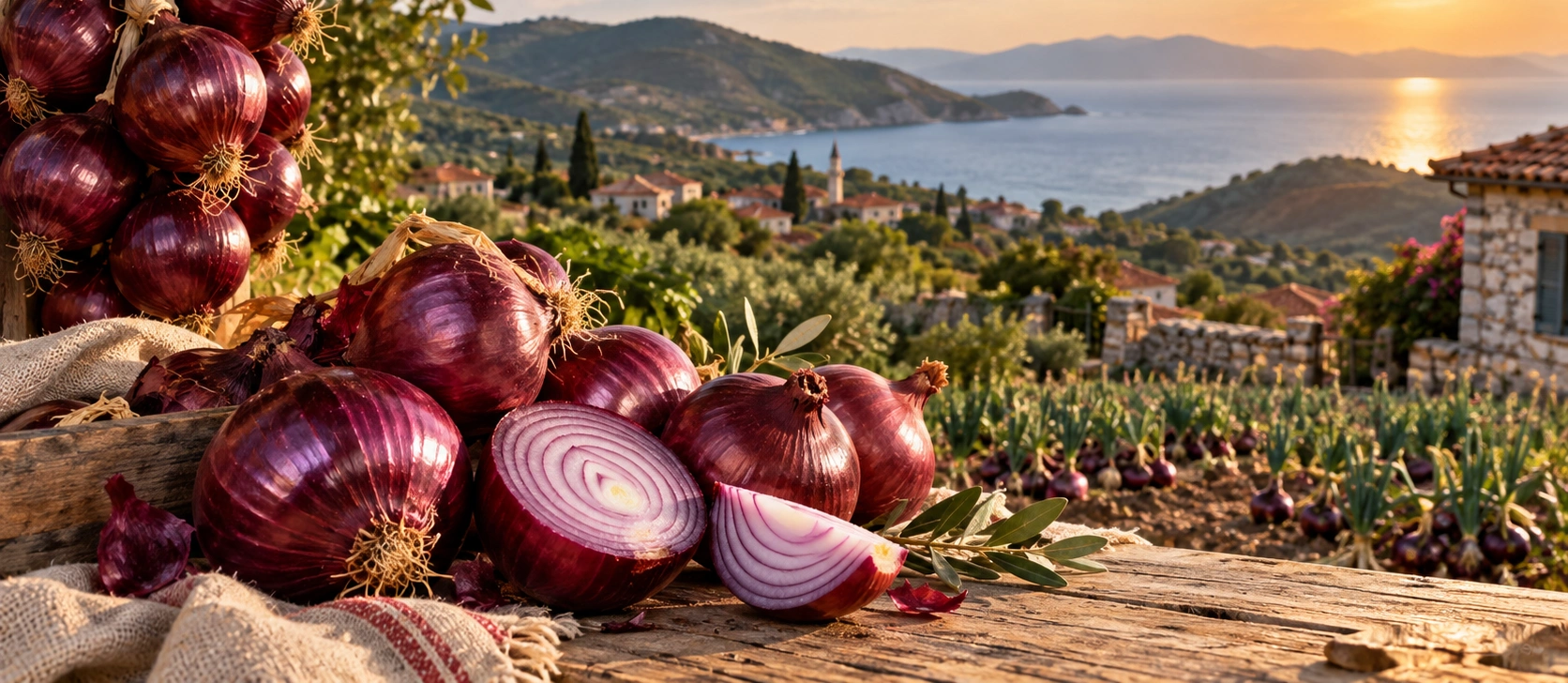
The strongest photographs should make the onion's extraordinarily deep purple colour immediately visible while connecting the crop with the fields, villages and summer agricultural landscape of Kapıdağ.
Photograph several freshly cured onions together, using soft side light to reveal the purple skin and natural texture.
Slice one bulb open so the dark reddish internal rings can be seen clearly.
Traditional hanging groups communicate both the colour of the crop and its post-harvest storage culture.
Rows of freshly lifted onions create a strong sense of season and agricultural place.
Hands sorting or braiding onions provide human context without turning the image into generic food photography.
Combine the crop with village fields, green hills or glimpses of the Marmara Sea to establish geographical context.
Discover Kapıdağ Mor Soğanı together with rural villages, local producers, forest landscapes, coastal scenery and the traditional flavours of the southern Marmara region.
Custom-designed private programs can combine Erdek, Kapıdağ villages, seasonal agricultural traditions, local food, nature and the Marmara coastline according to your travel dates and interests.
Explore Kapıdağ through its purple onion tradition, village agriculture, seasonal produce, local food, coastal communities and spectacular peninsula landscapes.
Request This Experience
Combine Erdek with Kapıdağ's forests, traditional villages, panoramic coastal roads, agricultural landscapes and regional food heritage.
Request This Tour