Sultan Murad I, Two-Storey Mosque & Madrasa, Royal Tomb, Imaret, Historic Hamam, Çekirge Thermal District & UNESCO Heritage

Hüdavendigar Murad I Complex Bursa – Complete Visitor Guide

Explore one of Bursa’s most unusual early Ottoman monuments,
where a mosque, madrasa, royal tomb and charitable complex overlook historic Çekirge.

Explore Hüdavendigar Complex

Discover Sultan Murad I’s Extraordinary Complex in Çekirge

Standing on a hillside overlooking the Bursa Plain, the Hüdavendigar Complex—also known as the Murad I Complex or Sultan I. Murad Hüdavendigar Külliyesi—is one of the most distinctive monuments of early Ottoman Bursa. Its story begins in the 1360s, when Sultan Murad I established a new religious, educational and charitable centre west of the existing city.

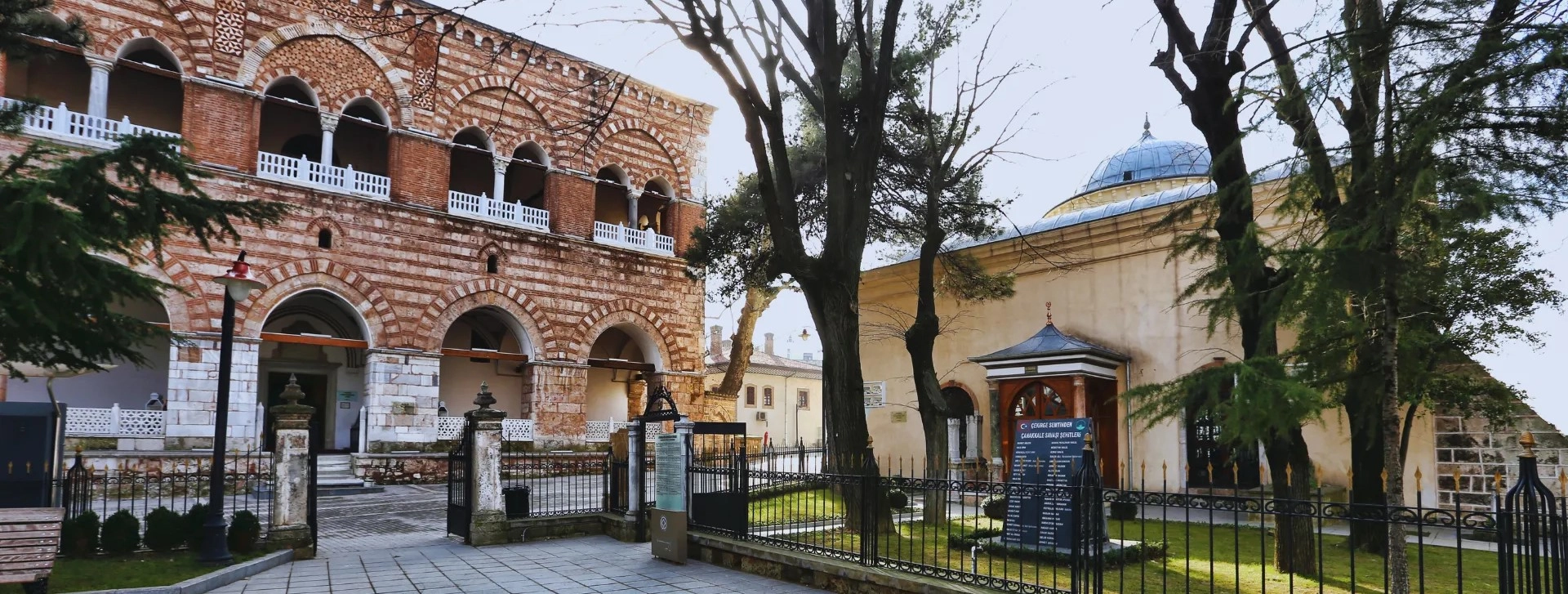
The complex is especially remarkable because its mosque and madrasa were combined within a single two-storey building. The lower level served worshippers and guests, while teaching rooms and student cells occupied the floor above. Around it developed a royal tomb, imaret or public kitchen, fountain and bath facilities, creating the kind of multifunctional külliye that would become one of the defining features of Ottoman urban life.

Today Hüdavendigar remains far more than an architectural monument. The mosque continues to function as a place of worship, the tomb preserves the memory of Sultan Murad I, and the surrounding Çekirge district connects the complex with Bursa’s centuries-old culture of thermal springs and historic baths.

This complete visitor guide explores the history of the complex, its unusual mosque-madrasa architecture, the tomb of Murad I, the imaret and hamam, UNESCO significance, visitor etiquette, access information, photography opportunities and the best way to combine Hüdavendigar with other historic places in Bursa.

Mosque & Madrasa Together

See one of Ottoman architecture’s most unusual designs, with the mosque below and madrasa rooms on the upper floor.

Tomb of Murad I

Visit the Bursa burial place of the Ottoman sultan who died following the Battle of Kosovo in 1389.

Early Ottoman Architecture

Study alternating stone and brick masonry, pointed arches, reused Byzantine elements and a distinctive double-storey façade.

UNESCO World Heritage

Explore one of the imperial külliyes included within “Bursa and Cumalıkızık: the Birth of the Ottoman Empire.”

Plan Your Visit

Hüdavendigar Murad I Complex – Quick Facts

Essential information for exploring one of Bursa’s most important early Ottoman complexes.

📍

Location

Çekirge, Osmangazi, on a historic hillside west of central Bursa.

Open on Google Maps
🕌

Founded

The mosque and madrasa were built principally around 1363–1366 during the reign of Sultan Murad I.

⏱

Visit Duration

Allow approximately 60–90 minutes for the mosque, tomb, exterior architecture and complex grounds.

🎟

Visitor Access

The mosque and tomb are generally visited without an admission ticket, while access to other buildings can vary.


A New Ottoman Centre West of Bursa

History of the Hüdavendigar Murad I Complex

Discover how Sultan Murad I used architecture, education, charity and religion to expand the early Ottoman capital.

The Hüdavendigar Complex was founded by Sultan Murad I, the third Ottoman ruler, who reigned from 1362 until his death in 1389. Construction of the principal mosque and madrasa is generally dated to 1363–1366, although other parts of the wider foundation developed during the following decades.

Its location was highly significant. Rather than placing the complex within Bursa’s already established commercial centre, Murad I chose a prominent hillside to the west, overlooking the plain and close to the thermal springs of Çekirge. The new foundation became an urban focus around which settlement gradually developed.

This followed an important early Ottoman pattern. Sultans established külliyes containing religious, educational, charitable and social institutions on strategic sites outside or around the existing city. Houses, streets and neighbourhoods then grew around those foundations, allowing Bursa to expand organically across the lower slopes of Uludağ.

Hüdavendigar was particularly ambitious because the mosque and madrasa were not constructed as separate buildings. Instead, they were combined vertically: the mosque occupied the ground floor, while madrasa rooms occupied the upper level. This unusual solution gave the building an appearance unlike almost any other early Ottoman mosque.

The wider complex included an imaret providing charitable food, a bath, fountain and other service structures. After Sultan Murad I died in 1389 following the Battle of Kosovo, his son Yıldırım Bayezid had a royal tomb constructed for him beside the complex.

Earthquakes and centuries of continuous use altered several buildings. The catastrophic 1855 Bursa earthquake severely damaged the complex and destroyed the earlier form of Murad I’s tomb. Sultan Abdülaziz ordered the mausoleum rebuilt on its historic foundations in 1863. The imaret was also repaired extensively during the reign of Sultan Abdülhamid II in the early twentieth century.

Hüdavendigar continues to function as a religious and cultural landmark today. In 2014 it became one of the component areas of the UNESCO World Heritage property “Bursa and Cumalıkızık: the Birth of the Ottoman Empire.”

What to See

Top Highlights of the Hüdavendigar Complex

Look closely at the unusual architecture, royal history and surviving institutions that make this complex unique.

Two-Storey Mosque & Madrasa

Hüdavendigar’s defining feature is the combination of mosque and madrasa inside one monumental building. Worship takes place below while educational spaces occupy the upper storey.

  • Lower floor: Mosque, central hall, iwans and side rooms
  • Upper floor: Madrasa cells and teaching spaces
  • Importance: An exceptional solution in Ottoman architecture

The Double-Storey Façade

Rows of arches, columns, brick and stone masonry create an exterior that looks very different from later classical Ottoman mosques. The upper gallery reveals the educational level behind the façade.

  • Material: Alternating stone and brick masonry
  • Feature: Two levels of arcaded frontage
  • Best view: From the garden and approach in front of the mosque

Central Domed Hall

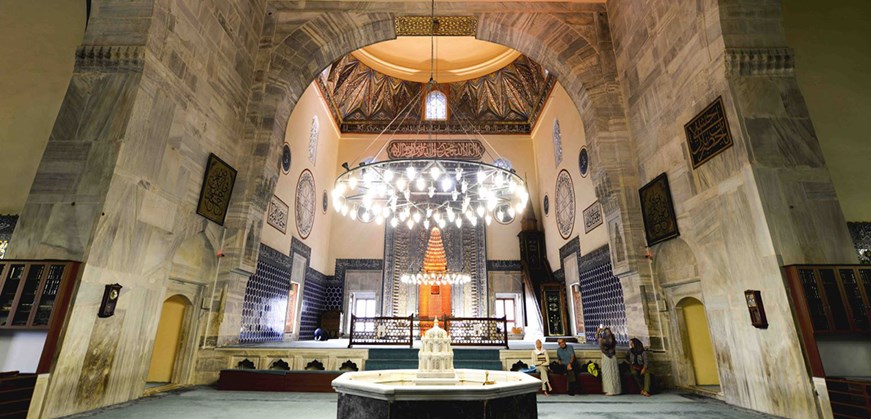
The mosque belongs to the early Ottoman family of multi-functional zaviye or tabhane mosques. A central domed space connects the prayer area with vaulted iwans and adjoining rooms.

  • Plan: Reverse-T or cross-axial arrangement
  • Central element: Domed hall
  • Side spaces: Vaulted iwans and rooms

Byzantine Architectural Elements

Columns, capitals and other architectural pieces originating from earlier Byzantine buildings were reused in the complex. Byzantine craftsmen are also associated with parts of its construction.

  • Look for: Marble columns and capitals
  • Technique: Decorative stone-and-brick masonry
  • Context: A fascinating meeting of Anatolian, Byzantine and early Ottoman building traditions

Murad I Hüdavendigar Tomb

The royal mausoleum commemorates Sultan Murad I, whose body was brought back to Bursa following his death after the Battle of Kosovo in 1389.

  • Original patron: Yıldırım Bayezid
  • Rebuilt: 1863 after earthquake destruction
  • Inside: Murad I and other Ottoman dynastic burials

Hüdavendigar Imaret

The public kitchen represented the charitable purpose of the complex, helping provide food and hospitality through the Ottoman waqf system.

  • Function: Charitable kitchen and social institution
  • Major repair: Early twentieth century
  • Today: Adapted for social and cultural use

Cık Cık – Gir Çık Hamam

A relatively small bath stands within the Hüdavendigar component area. Its modest dimensions reflect the presence of larger thermal bathing facilities nearby in Çekirge.

  • Type: Historic Ottoman bath
  • Location: East of the mosque
  • Context: Connected with Çekirge’s famous thermal culture

Historic Plane Trees & Grounds

Mature trees, gardens and the elevated position soften the monumental architecture and preserve some of the atmosphere of the old Çekirge neighbourhood.

  • Setting: Hillside overlooking Bursa
  • Landscape: Historic plane trees and garden areas
  • Best experience: Quiet weekday mornings

Architecture of the Hüdavendigar Mosque

The central mosque-madrasa building immediately differs from the monumental imperial mosques visitors may know from Istanbul. Instead of a single monumental prayer space dominated by one enormous dome, Hüdavendigar preserves the experimental character of fourteenth-century Ottoman architecture.

Reverse-T Plan

The ground floor belongs to the early Ottoman zaviye or tabhane tradition, organised around a central hall and projecting iwans.

Two Storeys

The mosque occupies the lower level while the madrasa is arranged above, combining worship and formal education vertically.

Stone & Brick

Alternating masonry produces strong horizontal patterns and gives the exterior much of its distinctive visual character.

Arcaded Façade

The monumental front is organised through arches, columns and an upper gallery rather than the courtyard arrangement of later imperial mosques.

Reused Materials

Marble columns and capitals originating from Byzantine-period buildings were incorporated into the new Ottoman structure.

Single Minaret

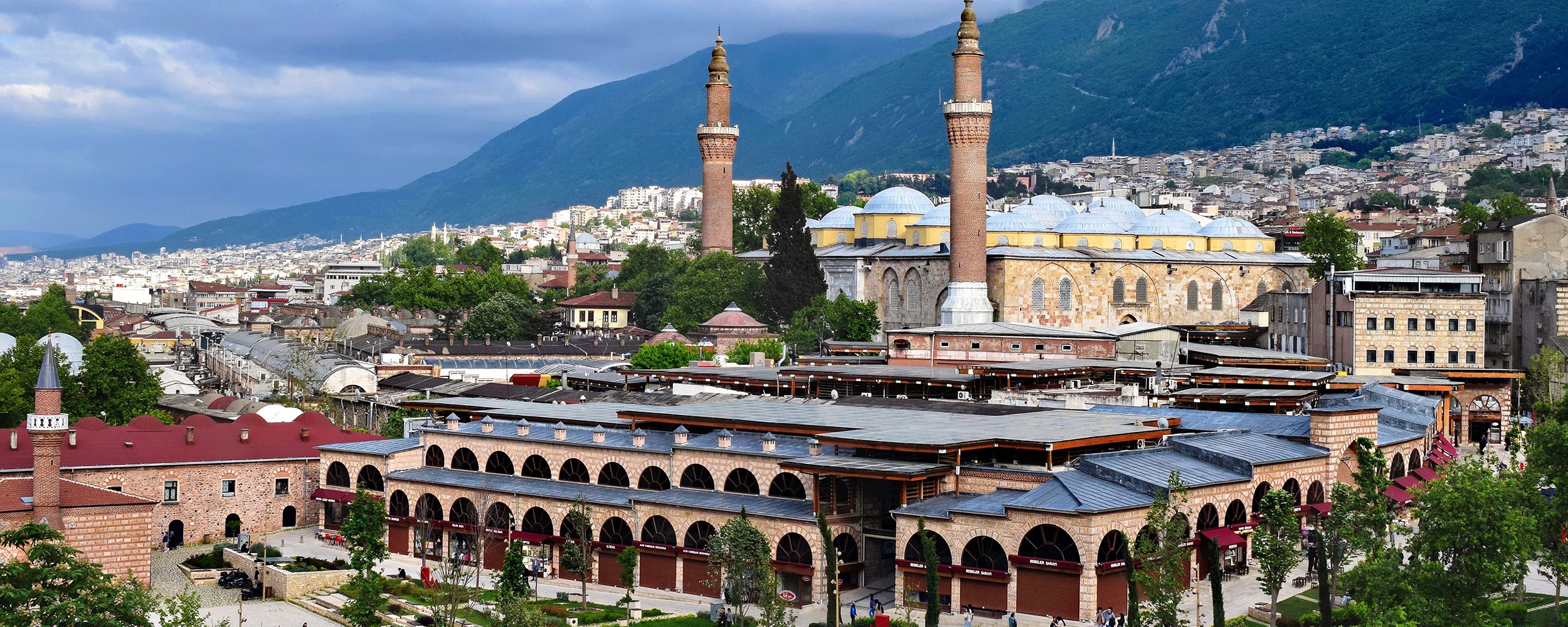
A slender brick minaret rises beside the building and reinforces the vertical rhythm of the otherwise broad façade.


The result is a structure that cannot easily be understood from photographs alone. Walk around the building before entering. From outside, the upper arcade clearly reveals the madrasa; from inside, the central hall, prayer iwan and adjoining spaces show how the building belongs to the experimental architectural world of the first Ottoman capital.

The Upper-Floor Madrasa

The placement of a madrasa directly above a functioning mosque is the feature for which Hüdavendigar is most famous. Instead of building a separate school around its own courtyard, the architects created teaching rooms and student cells on the second floor.

Student Cells

Individual rooms opened from corridors around the upper level and provided accommodation and study space for madrasa students.

Teaching Rooms

Additional spaces were provided for the müderris, or professor, and other members of the madrasa establishment.

Internal Staircases

Stairs close to the mosque entrance connect the lower religious level with the educational floor above.

Historic Scholars

Later Ottoman tradition connects important scholars including Molla Gürânî, Zenbilli Ali Efendi and Tâcîzâde Cafer Çelebi with teaching at the madrasa.


The arrangement physically united two central elements of Ottoman religious culture: communal worship and scholarship. Access to every part of the historic upper floor should not be assumed during an ordinary visit, so follow any signs or instructions from site staff.

Tomb of Sultan Murad I Hüdavendigar

A short distance from the mosque stands the mausoleum of Sultan Murad I. Its story connects Bursa directly with one of the best-known events of fourteenth-century Balkan history.

Murad I died in 1389 in connection with the Battle of Kosovo. According to established Ottoman tradition, his internal organs were buried near the battlefield in Kosovo, while his body was transported back to Bursa and interred within his own Hüdavendigar foundation. His son and successor, Yıldırım Bayezid I, had a tomb constructed over the Bursa burial place.

Two Memorial Places

Murad I is commemorated both at his Bursa mausoleum and at the Meşhed-i Hüdavendigar site in Kosovo.

Earthquake Destruction

The earlier Bursa mausoleum was severely damaged and effectively destroyed during the great 1855 earthquake.

1863 Reconstruction

Sultan Abdülaziz ordered the tomb reconstructed on its historic foundations during the nineteenth-century restoration of Bursa’s monuments.

Dynastic Burials

Several additional Ottoman princes and family members are represented by sarcophagi inside the mausoleum.


Murad I’s sarcophagus occupies the central position and is enclosed by a brass railing. Among the other burials are Şehzade Yakup, Emir Süleyman, members of the Çelebi generation and later Ottoman princes. Some of the remaining sarcophagi have not been securely identified.

Remember that this is both a historical monument and a place of remembrance. Visitors should keep voices low, avoid touching the sarcophagi or railings and allow space for people who have come to pray.

The Hüdavendigar Imaret

An Ottoman külliye was designed to serve society as well as provide a place for worship. The imaret, or public kitchen, embodied this charitable purpose by providing meals and hospitality through revenues assigned to the foundation.

Waqf Institution

The imaret formed part of the charitable endowment supporting the religious, educational and social functions of Murad I’s foundation.

Community Service

Such kitchens traditionally helped feed students, staff, travellers, guests and people in need.

Earthquake Damage

The building suffered during the nineteenth century and required substantial reconstruction and repair.

1906 Restoration

An inscription records major work during the reign of Sultan Abdülhamid II; the restored building survives today.


The imaret is especially valuable for understanding Hüdavendigar not simply as “an old mosque,” but as an organised social foundation whose buildings collectively supported an entire neighbourhood.

Cık Cık Hamam and Historic Çekirge

Hüdavendigar stands in Çekirge, the district most closely associated with Bursa’s thermal waters. Bathing was therefore already an important part of the landscape in which Murad I established his complex.

Cık Cık Hamam

The small historic bath associated with the külliye is also referred to in sources as the Gir Çık Hamam.

Compact Design

Its modest scale makes sense in a district where larger thermal bathing establishments were already available nearby.

Eski Kaplıca

The celebrated Old Thermal Bath lies close to Hüdavendigar and forms a separate UNESCO component connected with the historic district.

Thermal Neighbourhood

Çekirge developed for centuries around hot springs, baths, religious monuments, gardens and accommodation for visitors.


Combining Hüdavendigar with a walk around Çekirge therefore reveals two sides of Bursa’s history: the city of imperial foundations and the city of healing thermal waters.

Was Hüdavendigar Mosque Originally a Byzantine Building?

The unusual appearance of Hüdavendigar fascinated travellers for centuries. Because of its two-storey arcades, Byzantine columns and architectural details, some early visitors claimed that the building had originally been a Byzantine palace or church that was later converted into a mosque.

Byzantine Materials

Earlier marble columns, capitals and other spolia were genuinely incorporated into the Ottoman building.

Byzantine Craftsmen

Historical and architectural studies associate Byzantine craftsmen with aspects of the complex’s construction.

Purpose-Built Ottoman Monument

The prevailing scholarly interpretation is that the building itself was constructed for Murad I rather than converted wholesale from a Byzantine church or palace.

A Hybrid Visual Language

Its unusual character reflects the cultural and technical environment of fourteenth-century north-western Anatolia.


This makes Hüdavendigar more interesting, not less. It demonstrates how early Ottoman builders could incorporate existing materials, local craftsmen and familiar architectural forms while creating a building for distinctly Ottoman religious and educational functions.

Why Hüdavendigar Complex Is So Important

The importance of Hüdavendigar extends far beyond the biography of Sultan Murad I. It helps explain how the early Ottoman state used architecture to shape cities, organise education, support charity and establish new urban communities.

Expansion of Bursa

The complex acted as a new focal point west of the earlier city and helped encourage Bursa’s expansion toward Çekirge.

Architectural Experiment

Its combined mosque-madrasa arrangement represents one of the boldest design experiments of the early Ottoman period.

Worship & Education

Religious practice and formal scholarship were physically connected within the same monumental structure.

Social Welfare

The imaret, bath and related services demonstrate the wider charitable role of an Ottoman imperial foundation.

Dynastic Memory

Murad I’s mausoleum transformed the complex into an important place of Ottoman royal commemoration.

Living Heritage

The mosque remains active, allowing visitors to experience the site as a continuing religious institution rather than only as a museum.

Hüdavendigar Complex and UNESCO

In 2014, UNESCO inscribed “Bursa and Cumalıkızık: the Birth of the Ottoman Empire” on the World Heritage List. Hüdavendigar is not merely close to the UNESCO area: it is one of the actual component sites forming the serial World Heritage property.

Hüdavendigar Component

The Murad I külliye forms its own nominated component within the UNESCO serial property.

Imperial Külliyes

UNESCO recognises the network of early Ottoman royal foundations established by successive sultans around Bursa.

Urban Planning

The complexes became neighbourhood centres and helped determine how the early Ottoman capital expanded across the landscape.

Eski Kaplıca

The historic Old Thermal Bath immediately associated with the Çekirge landscape is recorded as a separate component of the Hüdavendigar area.


Other major Bursa components include the historic Khans Area, the Yıldırım Complex, Green Complex, Muradiye Complex and the Ottoman village of Cumalıkızık. Together they explain how architecture, charitable foundations, trade and settlement shaped the first Ottoman capital.

Who Was Sultan Murad I Hüdavendigar?

Murad I ruled the Ottoman state from 1362 to 1389. He inherited the expanding principality created by Osman Gazi and Orhan Gazi and presided over a period in which Ottoman power grew dramatically in both Anatolia and the Balkans.

Third Ottoman Ruler

Murad I succeeded his father Orhan and continued the transformation of the Ottoman principality into a larger regional power.

Hüdavendigar

The title associated with Murad means approximately “sovereign” or “lord” and became permanently linked with his Bursa foundation.

Balkan Expansion

His reign saw major Ottoman advances into southeastern Europe and the consolidation of territories in Rumelia.

Death in 1389

Murad died in connection with the Battle of Kosovo, after which his son Bayezid I succeeded him.


The Hüdavendigar Complex therefore belongs to a decisive generation in Ottoman history: a moment when Bursa was still central to the dynasty but Ottoman political geography was rapidly expanding far beyond north-western Anatolia.

Hüdavendigar Complex Entrance Fee

The Hüdavendigar Mosque and Murad I Tomb are religious monuments rather than conventional ticketed archaeological sites. Visitors can generally explore the principal religious areas without purchasing an admission ticket.

Mosque Entry

General respectful entry is normally free, subject to prayer times and temporary religious restrictions.

Murad I Tomb

The mausoleum is normally visited without a separate entrance ticket when open.

Madrasa & Imaret

Access can depend on current institutional use, cultural events, restoration work or local management arrangements.

Historic Baths

Any functioning bath or thermal service operates separately and may charge for bathing or other services.


Because different buildings within the historic complex may be administered or used differently, check current arrangements locally if access to a particular interior is essential to your visit.

Hüdavendigar Complex Opening Hours

There is no single tourist timetable that reliably describes every part of Hüdavendigar. The mosque remains an active place of worship, while the tomb, former madrasa, imaret and bath can have different access arrangements.

Hüdavendigar Mosque Generally accessible during the day, with visitor access restricted around congregational prayers
Murad I Tomb Normally accessible during daytime visitor hours, subject to local management and religious use
Upper Madrasa Do not assume every historic room is continuously open to casual visitors
Friday Avoid the period around Friday noon prayer if visiting primarily for architecture and photography
Ramadan & Religious Days Expect larger congregations and possible temporary changes to cultural visitor access

Published schedules can vary by season and by individual building. For the smoothest visit, arrive during normal daytime hours and remain flexible around prayer times, maintenance and special events.

Dress Code and Visitor Etiquette

Hüdavendigar is living religious heritage. The mosque and mausoleum welcome respectful cultural visitors, but worship and religious use always take priority.

Remove Shoes

Take off footwear before entering the carpeted prayer area and use any designated bags or storage spaces.

Dress Modestly

Shoulders and knees should be covered and very revealing clothing avoided.

Head Covering

Women should carry a scarf for mosque entry rather than relying entirely on loan coverings.

Keep Voices Low

Avoid loud conversations, phone calls and lengthy explanations while people are praying.

Photography

Non-flash photography may be possible, but never photograph worshippers closely without permission.

Inside the Tomb

Do not touch sarcophagi or religious objects and give priority to people who are praying or paying respects.

How to Get to Hüdavendigar Complex

The complex stands in the historic Çekirge district of Osmangazi, west of Bursa’s central Khans Area and on the lower slopes leading toward Uludağ.

By Public Transport

Municipal buses and local services travelling toward Çekirge provide access from central Bursa.

By Taxi

Ask for “Hüdavendigar Külliyesi” or “I. Murad Camii, Çekirge.” The monument is well known locally.

By Car

Road access is straightforward, but parking availability can vary because the monument stands inside an established residential district.

By Private Tour

Private transportation is convenient when combining Hüdavendigar with Muradiye, Tophane, the historic centre and Cumalıkızık.


Hüdavendigar is several kilometres west of Ulu Camii and Koza Han, so it is better treated as part of a wider Bursa route rather than simply as an extension of the central bazaar walking circuit.

Best Route for Visiting Hüdavendigar Complex

A visit to Hüdavendigar works especially well as the beginning of a west-to-east journey through Bursa’s imperial neighbourhoods.

1. Hüdavendigar Mosque & Madrasa Begin with the two-storey façade, central prayer hall, historic architectural details and surrounding grounds
2. Murad I Hüdavendigar Tomb Visit the Sultan’s Bursa burial place and learn about its connection with the Battle of Kosovo
3. Eski Kaplıca & Çekirge Explore the thermal heritage that has defined this part of Bursa for centuries
4. Muradiye Complex Continue east to the later imperial complex of Murad II and its extraordinary Ottoman dynastic tombs
5. Tophane See Bursa’s citadel hill, panoramic views and the tombs of Osman Gazi and Orhan Gazi
6. Ulu Camii & Koza Han Finish among Bursa’s monumental mosque, historic silk market, covered bazaars and UNESCO-listed commercial centre

With private transportation this route can comfortably form the historical core of a full Bursa sightseeing day. Visitors relying entirely on walking should divide it into sections because Çekirge and the commercial centre are separated by several kilometres.

Hüdavendigar Complex Visitor Tips

Start Outside

The façade explains the unusual two-storey design better than the interior alone. Study the two levels before entering.

Look for Reused Columns

Notice the marble columns and capitals incorporated into the arcades and compare them with the surrounding Ottoman masonry.

Check Prayer Times

Plan architectural sightseeing between prayer periods and avoid Friday midday if possible.

Bring a Scarf

A lightweight scarf is useful for women visiting several Bursa mosques during the same day.

Do Not Rush the Tomb

The Murad I mausoleum tells a different story from the mosque and deserves a separate quiet visit.

Explore Çekirge

The surrounding thermal district helps explain why the complex developed in this particular location.

Upper-Floor Access Can Vary

The historic madrasa is one of the building’s most interesting features, but not every part should be assumed open at all times.

Combine Imperial Complexes

Hüdavendigar becomes far more meaningful when compared with Muradiye, Yeşil and Yıldırım.

Accessibility at Hüdavendigar Complex

The historic site occupies a hillside and contains buildings from different periods, so accessibility varies considerably between the mosque, upper madrasa, tomb and surrounding streets.

Mosque Ground Floor

The principal religious level is easier to reach than the madrasa, although thresholds, shoe removal and carpets may require assistance.

Upper Madrasa

The madrasa level is reached by historic staircases and should not be considered step-free.

Tomb Access

Paths around the mausoleum are relatively compact, but entrance thresholds and temporary barriers can affect wheelchair access.

Hillside Streets

Some approaches around Çekirge include slopes. Taxi or private vehicle drop-off can be helpful for visitors with limited mobility.


Visitors requiring step-free access should confirm current arrangements before travelling, as temporary restoration work, religious services and local access controls can alter the easiest route.

Frequently Asked Questions About Hüdavendigar Murad I Complex

What is the Hüdavendigar Complex in Bursa?

Hüdavendigar is a fourteenth-century Ottoman imperial complex founded by Sultan Murad I in Çekirge. It includes a mosque and madrasa, royal tomb, imaret, bath, fountain and associated historic structures.

Who built Hüdavendigar Complex?

The complex was commissioned by Sultan Murad I Hüdavendigar, the third Ottoman ruler. The principal mosque-madrasa building was established during the 1360s.

When was Hüdavendigar Mosque built?

The mosque and madrasa are generally dated to approximately 1363–1366. Other buildings within the wider complex were constructed or developed during subsequent years.

Why is Hüdavendigar Mosque unique?

Its most important feature is the combination of a mosque and madrasa inside one two-storey building, with worship spaces below and educational rooms above.

Is the madrasa really above the mosque?

Yes. Student cells, teaching rooms and corridors occupy the upper level of the same monumental structure used as a mosque below. It is one of the most unusual arrangements in Ottoman religious architecture.

What does Hüdavendigar mean?

Hüdavendigar was one of the titles associated with Sultan Murad I and can broadly be understood as “sovereign” or “lord.” The name later became associated with the complex, neighbourhood and wider Bursa region.

Is Hüdavendigar Complex a UNESCO World Heritage Site?

Yes. The Murad I Hüdavendigar Külliye is one of the component areas of “Bursa and Cumalıkızık: the Birth of the Ottoman Empire,” inscribed on the UNESCO World Heritage List in 2014.

Where is Sultan Murad I buried?

Murad I’s body is buried in his mausoleum within the Hüdavendigar Complex in Bursa. A second memorial tomb in Kosovo marks the area where his internal organs were buried following his death in 1389.

Why does Murad I have a tomb in both Bursa and Kosovo?

After Murad I died following the Battle of Kosovo, his internal organs were buried near the battlefield. His body was transported to Bursa and buried beside the complex he had founded.

Is Murad I’s Bursa tomb original?

The first mausoleum was commissioned by his son Bayezid I. It was destroyed during the great Bursa earthquake of 1855 and rebuilt on its historic foundations under Sultan Abdülaziz in 1863.

Was Hüdavendigar Mosque originally a Byzantine church?

Older travellers sometimes claimed that it had been a Byzantine church or palace because of its unusual appearance. However, the prevailing scholarly interpretation regards it as a purpose-built Ottoman monument commissioned by Murad I, although Byzantine materials and craftsmen were involved.

Why are there Byzantine columns in the mosque?

Early Ottoman builders frequently reused architectural elements from older buildings. Hüdavendigar contains marble columns and capitals originating from the Byzantine period alongside new Ottoman masonry.

What was the Hüdavendigar Imaret?

The imaret was the charitable public kitchen of the complex. Supported through the Ottoman waqf system, such institutions provided food and hospitality to members of the community, students and travellers.

What is Cık Cık Hamam?

Cık Cık, also known historically as Gir Çık Hamam, is the small bath associated with Hüdavendigar. Its modest size reflects the presence of larger thermal baths nearby in Çekirge.

Is there an entrance fee for Hüdavendigar Complex?

The mosque and Murad I mausoleum are generally visited without an entrance ticket. Other parts of the complex may have different access arrangements depending on their present use.

What are Hüdavendigar Complex opening hours?

The mosque generally operates according to its religious function rather than a conventional museum timetable. Other buildings can follow separate schedules, so daytime visits outside congregational prayer periods are usually the safest choice.

Can non-Muslims enter Hüdavendigar Mosque?

Respectful non-Muslim visitors are normally welcome outside restricted prayer periods, provided they follow mosque dress requirements and visitor etiquette.

Can visitors enter the upper madrasa?

Access can vary according to current use, restoration work and site management. Do not assume that every historic madrasa room will be open during an ordinary mosque visit.

How long should I spend at Hüdavendigar Complex?

Allow around 60–90 minutes to appreciate the mosque, façade, Murad I Tomb and surrounding grounds. Architecture enthusiasts may wish to spend longer.

When is the best time to visit?

Weekday mornings are excellent for quieter conditions and softer light. Avoid Friday midday and major prayer periods if your main purpose is historical sightseeing or photography.

Can I take photographs?

Respectful non-flash photography is generally possible where not otherwise restricted. Do not photograph people closely during worship or interrupt prayer for photographs.

What should I visit near Hüdavendigar?

Eski Kaplıca, Çekirge’s historic thermal district, Muradiye Complex, Tophane, the tombs of Osman Gazi and Orhan Gazi, Ulu Camii and Koza Han all combine naturally with Hüdavendigar.

Is Hüdavendigar Complex worth visiting?

Absolutely. Its two-storey mosque and madrasa, Murad I’s royal tomb, unusual Byzantine-influenced architectural details, UNESCO status and hillside setting make it one of Bursa’s most distinctive early Ottoman monuments.

Best Photo Spots at Hüdavendigar Complex

Hüdavendigar rewards architectural photography because its exterior reveals the unusual relationship between mosque, madrasa, arcades and landscape more clearly than almost any other early Ottoman monument.

Main Two-Storey Façade

Stand far enough back to include both levels of arches and show how the madrasa rises directly above the mosque.

Arcades & Columns

Use tighter compositions to capture alternating masonry, pointed arches, marble columns and reused Byzantine capitals.

Courtyard Approach

Frame the mosque through trees or the entrance gate to show the monument within its peaceful historic setting.

Murad I Tomb

Photograph the mausoleum respectfully from the garden, particularly when trees and soft light frame the building.

Brick Minaret

Use the vertical minaret against the broader horizontal façade to emphasise the complex’s contrasting architectural forms.

Çekirge Streets

Include neighbourhood streets and mature trees to communicate that Hüdavendigar remains embedded within a living Bursa district.


Morning and late-afternoon light usually reveals the alternating stone-and-brick masonry better than harsh midday sun. Inside the mosque, avoid flash and never position yourself where photography interferes with worship.

Private Bursa Tours Including Hüdavendigar Complex

Hüdavendigar can be included in private Bursa itineraries focusing on Ottoman history, UNESCO heritage, architecture, thermal culture and the city’s imperial foundations.

Private Bursa Heritage Experiences

Flexible private routes with transportation and professionally licensed guiding.

Longer Türkiye Heritage Journeys

Connect Bursa with other Ottoman capitals, UNESCO monuments and the cultural landscapes of Türkiye.