Eski Kaplıca
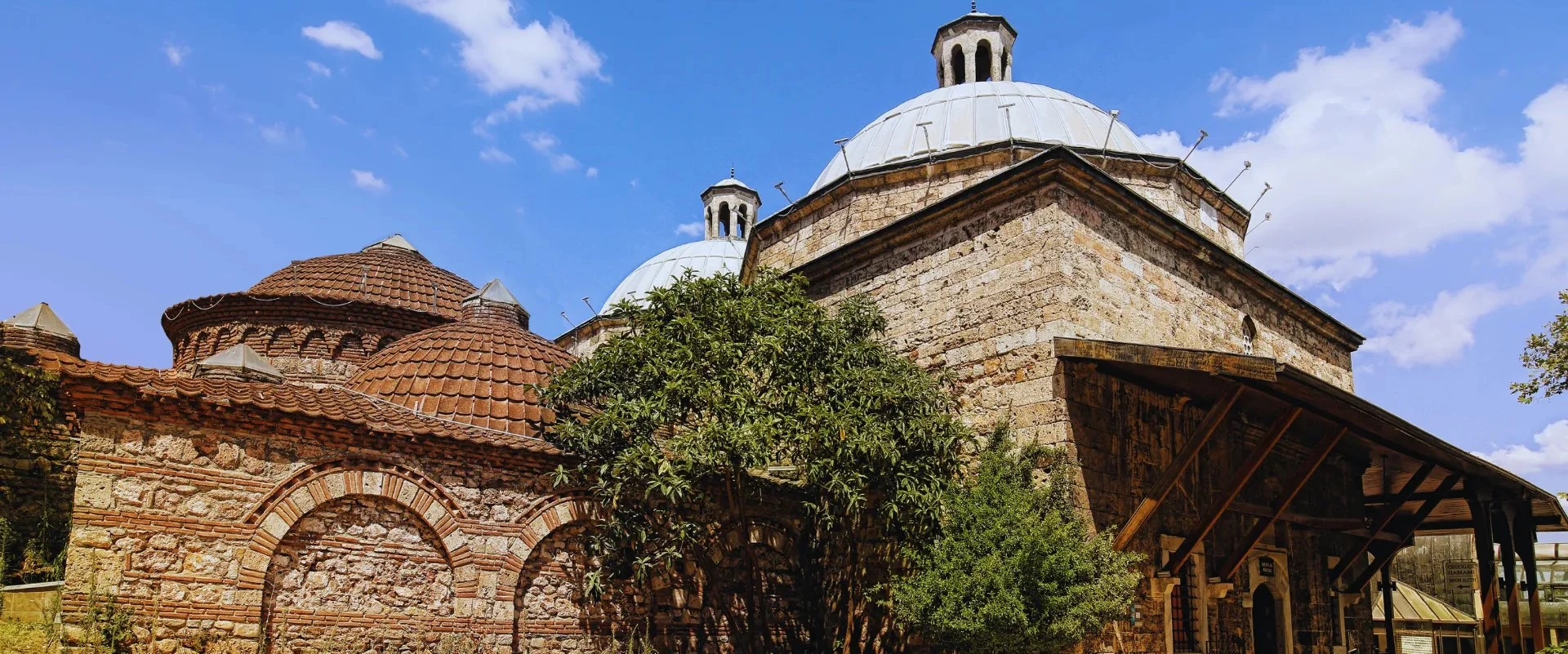
Bursa's most important early Ottoman thermal monument, also known as Armutlu Hamamı, with an impressive columned bathing hall and large circular pool.
- Period: Murad I era
- Date: c. 1385
- Status: UNESCO World Heritage component






Bursa is famous for its mosques, tombs, bazaars and early Ottoman monuments, but another tradition has shaped the city for just as long: its hot mineral waters.
Along the western side of historic Bursa, at the foot of Uludağ, the districts of Çekirge and Kükürtlü developed around natural thermal springs used for bathing, rest and traditional balneotherapy for centuries.
The surviving bathhouses form one of Türkiye's most remarkable concentrations of historic thermal architecture.
Here you can encounter the monumental Eski Kaplıca, a core component of Bursa's UNESCO World Heritage property; the elegant sixteenth-century Yeni Kaplıca; the intimate Kara Mustafa Paşa Kaplıcası; the historic Kaynarca and Kükürtlü baths; and several smaller thermal establishments that preserve different chapters of Bursa's bathing culture.
These are not simply decorative monuments. Several continue to function as real bathing and thermal facilities, which means a visit can combine architecture, history and a living cultural tradition.
The most important experience is to understand how Bursa transformed naturally hot water into an urban institution. Baths were connected with waqf foundations, royal complexes, medical traditions, hospitality and neighbourhood life.
In Çekirge, water shaped architecture. Architecture shaped social life. And that relationship is still visible today.
See one of Bursa's greatest early Ottoman thermal monuments, built under Sultan Murad I and included within the city's World Heritage property.
Several historic baths still operate, allowing visitors to experience thermal bathing inside centuries-old architectural settings.
Discover how older bathing traditions and reused Byzantine architectural elements became part of Bursa's developing Ottoman identity.
Explore a grand sixteenth-century bath associated with Rüstem Paşa and the reign of Süleyman the Magnificent.
Learn how naturally heated mineral water from the Çekirge and Bademlibahçe source areas supplied baths, hotels and therapeutic institutions.
Combine the baths with Hüdavendigar Mosque, Muradiye, the Atatürk Mansion and central Bursa in a half-day or full-day heritage route.
Essential information for understanding Bursa's historic thermal district and choosing which bathhouses to see or experience.
Çekirge and Kükürtlü, immediately west of Bursa's historic centre in Osmangazi district.
Open on Google MapsHistoric Ottoman thermal baths supplied by naturally heated mineral-water sources beneath the Uludağ foothills.
Eski Kaplıca, also known as Armutlu Hamamı, with its monumental early Ottoman bathing halls and large thermal pool.
Eski Kaplıca forms a separate core component of the UNESCO-listed Bursa and Cumalıkızık World Heritage property.
The surviving monumental tradition begins especially strongly under Sultan Murad I during the second half of the 14th century.
Eski Kaplıca, Kükürtlü, Kara Mustafa Paşa, Yeni Kaplıca, Kaynarca and smaller historic thermal establishments.
There is no single schedule for the district. Each operating bath or hotel maintains its own hours and access conditions.
Prices vary according to public hamam entry, private bath, family room, massage or hotel-spa use.
Allow 2–3 hours for a heritage walk, or longer if you plan to use one of the operating thermal baths.
Some facilities offer communal hamams, private bathing rooms, family sections, kese and massage services.
Çekirge reveals a side of Bursa that cannot be understood through mosques and bazaars alone.
Bursa grew on the northern slopes of Uludağ in a landscape rich in springs, streams and thermal water.
Long before modern spa hotels appeared, these hot waters attracted communities who developed bathing places around them.
By the early Ottoman period, thermal bathing had become deeply connected with the city's social and architectural development.
The importance of Çekirge becomes especially clear during the reign of Sultan Murad I.
His monumental Hüdavendigar Complex helped extend Bursa westward, and the nearby thermal zone became part of that expanding urban landscape.
The relationship was so strong that the small bath inside the Hüdavendigar complex could remain modest because the great Eski Kaplıca was close at hand.
Later Ottoman patrons continued investing in the area.
Baths were repaired, enlarged, endowed and newly constructed.
By the sixteenth century, Bursa had developed a sophisticated thermal culture in which monumental architecture surrounded the natural hot-water sources.
What makes the district unusual today is its continuity of function.
Several historic structures are still associated with bathing rather than having been converted entirely into museums, shops or event halls.
That continuity gives Çekirge a rare quality: you are not only looking at the architecture of an old hamam. You are entering a neighbourhood where the relationship between water, bathing and urban life has survived for centuries.
The historic thermal district is not one single bathhouse but a concentration of different monuments and bathing traditions.
Bursa's most important early Ottoman thermal monument, also known as Armutlu Hamamı, with an impressive columned bathing hall and large circular pool.
A historic thermal complex associated with Murad I, Bayezid II and later Ottoman additions, traditionally divided into men's and women's sections.
A smaller historic bath rebuilt or established under Kara Mustafa Paşa in 1490, preserving a more intimate scale than the great monumental spas.
One of Bursa's greatest sixteenth-century thermal monuments, associated with Grand Vizier Rüstem Paşa and the reign of Süleyman the Magnificent.
A historic thermal bath beside Yeni Kaplıca, supplied from the same Bademlibahçe source area and known for its smaller historic pool.
A lesser-known historic bath in the Çekirge thermal landscape, associated in local bath histories with an early charitable foundation tradition.
A small historic thermal establishment whose origins are not securely dated, associated with the Zeyni Nine spring and an older bathing tradition.
A twentieth-century continuation of Bursa's thermal identity, developed in the 1930s and associated with the modernisation of the city's spa culture.
Çekirge is a historic neighbourhood immediately west of the old centre of Bursa, positioned on the lower northern slopes of Uludağ.
Today it is a dense urban district filled with hotels, hospitals, residences, restaurants and busy roads.
Beneath that modern cityscape, however, lies the reason Çekirge became famous: naturally heated mineral water.
The thermal landscape is broader than the modern administrative boundaries suggested by the name Çekirge.
Several of the most important historic baths stand in neighbouring Kükürtlü, which historically formed part of the same spa environment between central Bursa and Çekirge.
For travellers, it is therefore better to think of Çekirge–Kükürtlü as one historic thermal zone.
Within a relatively compact area you can trace the development of Bursa's bathing culture from early Ottoman monumental architecture through sixteenth-century expansion and into twentieth-century thermal hotels.
The traditional name most travellers associate with Bursa's hot springs and historic thermal hotels.
The neighbouring district containing Eski Kaplıca, Kükürtlü baths, Yeni Kaplıca, Kara Mustafa and Kaynarca.
The geological setting beneath Bursa's mountain slope helps explain the presence of naturally heated mineral water.
Thermal use developed here long before the appearance of modern spa hotels and wellness centres.
These monuments survive inside an active modern neighbourhood rather than an isolated archaeological zone.
Modern accommodation continues the neighbourhood's centuries-old identity as a destination for bathing and rest.
The use of hot springs around Bursa did not begin with the Ottoman dynasty.
Ancient Prusa lay within a region already known for warm and mineral-rich waters, and bathing formed an important part of Roman and Byzantine urban culture.
Later Ottoman sources and architectural traditions repeatedly preserved memories of older baths in the Çekirge landscape.
The exact relationship between every modern bathhouse and its Byzantine predecessor is not always archaeologically certain.
That distinction matters.
It is safer to understand Çekirge as a long-lived thermal landscape than to assume that every surviving Ottoman structure directly preserves a complete Roman or Byzantine bath underneath it.
The clearest physical reminder of continuity can be seen at Eski Kaplıca, where Byzantine-period columns and capitals were reused within the early Ottoman building.
This reuse is more than recycling stone.
It visually connects the new Ottoman thermal architecture of Bursa with the much older monumental traditions of the city and its surroundings.
Other baths, including Kara Mustafa Paşa Kaplıcası, are also associated in local historical sources with bathing activity predating their surviving Ottoman fabric.
After Bursa became the first major Ottoman capital, the city's rulers invested heavily in külliyes, mosques, markets, bridges, water systems and baths.
Bathing was not treated as an isolated recreational activity.
Hamams belonged to a much wider urban system.
They provided hygiene, social interaction, ritual preparation and revenue for charitable foundations.
Thermal baths added another dimension because they were tied to a natural hot-water resource that could not simply be relocated anywhere in the city.
The result was the growth of a specialised spa district west of central Bursa.
Sultan Murad I's investment in the area was decisive.
His Hüdavendigar Complex created a major religious and social centre in Çekirge, while the nearby Eski Kaplıca provided monumental thermal bathing.
Later patrons continued this pattern.
Kara Mustafa Paşa was associated with a bath in 1490.
During the sixteenth century, Rüstem Paşa sponsored the great Yeni Kaplıca, representing a later and more elaborate stage of Ottoman thermal architecture.
By then, Bursa's reputation as a city of baths was firmly established.
If you see only one historic thermal bath in Bursa, make it Eski Kaplıca.
Also known as Armutlu Hamamı, it is one of the most important surviving monuments of early Ottoman bath architecture.
The principal bath structure belongs to the reign of Sultan Murad I and is commonly dated to around 1385.
Historical traditions connect the site with an earlier Byzantine bathing complex, and the present building includes reused Byzantine architectural elements.
During the reign of Sultan Bayezid II, a monumental changing or cool-room section was added, expanding the complex and giving it much of the spatial sequence experienced today.
The most memorable space lies deeper inside.
A large domed hall is organised around a circular thermal pool approximately seven metres in diameter.
Eight columns support arches beneath the dome, creating an architectural rhythm that feels very different from the smaller private cells of many conventional Ottoman hamams.
The building remains associated with active thermal bathing and is integrated with the modern Kervansaray Termal complex.
Most importantly for heritage travellers, Eski Kaplıca is not simply near Bursa's UNESCO monuments.
It is itself one of the designated components of the Bursa and Cumalıkızık: The Birth of the Ottoman Empire World Heritage property.
Eski Kaplıca is especially valuable because its plan differs from the image many travellers have of a typical Ottoman hamam.
The bath is organised as a sequence of changing, warm and hot spaces, but the hot-water experience is dominated by a substantial central pool.
In the warm section, round arches connect a group of columns that carry the dome above.
Deeper inside, another monumental domed space develops around the principal pool.
The use of eight columns around the thermal hall creates an almost ceremonial quality.
Several columns and capitals are reused Byzantine pieces, known in architectural history as spolia.
These elements make the building particularly important for understanding the mixed architectural vocabulary of early Ottoman Bursa.
Light enters the domed spaces from above, softening the heavy stone and brick architecture and reflecting across steam and water.
The result is not only functional.
It is carefully theatrical.
The architecture turns a natural hot spring into a controlled sequence of temperature, movement, sound, light and water.
Large domes define the principal changing, warm and bathing spaces.
Column-supported arches create the architectural framework around key thermal spaces.
Reused columns and capitals physically preserve material from Bursa's pre-Ottoman architectural world.
The circular thermal pool is one of the most memorable features of the monument.
The later entrance section enlarged the bath during the Bayezid II period.
The building remains associated with bathing rather than surviving only as an empty historic shell.
To understand Eski Kaplıca properly, look beyond the bathhouse itself.
A short distance away stands the Hüdavendigar Complex of Sultan Murad I, one of the most important early Ottoman foundations in Bursa.
The complex includes a mosque-madrasah building, tomb, imaret tradition and a small bath.
The bath within the külliye is unusually modest.
Heritage studies explain this partly through the existence of the nearby Eski Kaplıca, which could provide substantial bathing facilities for the wider area.
This relationship is important because it shows how early Ottoman planning worked at a neighbourhood scale.
Not every function needed to be monumental inside the walls of one religious complex if a major facility already existed nearby.
For travellers, the two monuments should therefore be visited together whenever possible.
One represents the religious, educational and dynastic centre of Murad I's western Bursa expansion.
The other demonstrates the thermal infrastructure that helped make that district attractive and functional.
The Kükürtlü Baths form another major element of Bursa's historic thermal landscape.
Traditionally, the complex was divided into Büyük Kükürtlü and Küçük Kükürtlü, corresponding with men's and women's bathing sections.
Historical accounts connect the complex with Sultan Murad I, while later additions and interventions are associated with Sultan Bayezid II and the period of Süleyman the Magnificent.
The baths are supplied from the Bademlibahçe thermal source system, which also feeds several of the nearby historic establishments.
This shared water network helps explain why Yeni Kaplıca, Kaynarca, Kara Mustafa and Kükürtlü developed so close together.
Unlike Eski Kaplıca, Kükürtlü should not be approached simply as a conventional tourist hamam.
The complex has long been associated with rehabilitation and institutional thermal use, and access can differ from a normal public bathhouse.
For heritage travellers, its importance lies in demonstrating that Bursa's thermal culture continued far beyond leisure bathing and became connected with organised treatment and rehabilitation traditions.
The larger historic section traditionally associated with male bathing.
The smaller section traditionally associated with female bathing.
Kükürtlü belongs to the same important thermal source area as several neighbouring baths.
Its history is connected with several Ottoman reigns rather than one single construction phase.
The site became strongly associated with rehabilitation and organised therapeutic use.
Do not assume that every part functions as an ordinary walk-in tourist hamam.
Beside the Yeni Kaplıca group stands the historic Kara Mustafa Paşa Kaplıcası.
The surviving Ottoman bath is associated with Kara Mustafa Paşa and the date 1490.
Local historical traditions suggest that bathing activity on or near the site may be older, possibly extending into the Byzantine period.
Architecturally, Kara Mustafa is more intimate than Eski Kaplıca or Yeni Kaplıca.
A rectangular cool-room area connects with smaller cells and a hot section reached through a corridor.
The structure is particularly noted for its marble fountain and pool.
Its smaller scale is useful because it reveals another side of Ottoman thermal culture.
Not every hot-spring bath was conceived as a monumental dynastic statement.
Some functioned as compact, practical bathing institutions embedded directly into the neighbourhood.
The Kara Mustafa complex continues to offer thermal bathing and accommodation services, including public and private bathing arrangements depending on the section.
The name Yeni Kaplıca means “New Thermal Bath,” but the monument is itself nearly five centuries old.
It represents a later stage in the evolution of Bursa's thermal architecture than Eski Kaplıca.
The bath was commissioned during the reign of Süleyman the Magnificent by his powerful grand vizier and son-in-law Rüstem Paşa.
Official heritage sources generally date the bath to 1552, although some local tourism material gives a slightly later date.
The building is one of the most impressive Ottoman thermal monuments in Bursa.
Its changing section is covered by large domes, while the transition into warmer and hotter spaces creates a carefully controlled sequence of temperature and privacy.
The hot section develops around an octagonal star-like plan with side spaces opening toward the centre.
Natural light filters through small glass-covered openings in the dome, producing the soft illumination characteristic of traditional hamam architecture.
Decoration once included rich tile and mosaic work, and the monument remains particularly important for the relationship between architecture, water and Ottoman decorative art.
Unlike many historic bathhouses elsewhere, Yeni Kaplıca continues to operate as a thermal facility.
The bath is associated with one of the most powerful statesmen of Süleyman the Magnificent's reign.
The date most commonly given by official cultural-heritage sources for the construction of Yeni Kaplıca.
Large domed spaces create a much more monumental interior than the bath's exterior initially suggests.
The geometry of the bathing section is one of the most distinctive elements of the plan.
Ceramic and mosaic decoration contribute to the bath's importance within Ottoman architectural history.
Public and private thermal-bathing services allow the historic building to retain its original function.
Kaynarca Kaplıcası stands within the same historic thermal cluster as Yeni Kaplıca and Kara Mustafa.
It is supplied from the same broad Bademlibahçe source system and therefore forms part of one interconnected thermal landscape.
The identity of its original patron is not securely known.
Historical evidence indicates that the bath had been constructed by 1680.
Compared with the monumental scale of Yeni Kaplıca, Kaynarca is more modest.
Its historic pool and bathing spaces preserve the atmosphere of a smaller neighbourhood thermal establishment.
Today, the complex is particularly associated with a women's hamam and accommodation facilities.
For travellers studying Bursa's architectural history, Kaynarca is valuable because it shows how multiple bathhouses could develop around one productive thermal source area, each serving different users and functions.
Eski Kaplıca, Kükürtlü, Kara Mustafa, Yeni Kaplıca and Kaynarca form the core of most historic thermal itineraries, but the wider Çekirge area contains additional baths worth knowing about.
Çekirge Sultan Kaplıcası is associated in local bath histories with a very early charitable bathing foundation.
The documentary tradition surrounding its earliest phase is complex, so it should be approached as part of Çekirge's long-lived local thermal culture rather than reduced to one simple construction date.
Hüsnü Güzel Kaplıcası is another small historic bath whose exact foundation date is uncertain.
Ottoman court registers from the sixteenth century mention an Akçe Hamam in the vicinity, and some researchers have suggested a relationship with the present bath.
The building includes a rectangular cool room, an octagonal hot section and an attached bathing cell.
Its water is associated with the Zeyni Nine spring.
These smaller baths matter because they remind visitors that the thermal district was not created by two or three monumental buildings alone.
It was a network of springs, baths, accommodation and neighbourhood institutions.
The historic baths of Bursa exist because naturally heated mineral water rises through geological systems beneath the Uludağ foothills.
Historically, different baths were associated with different spring groups.
One of the most important is the Bademlibahçe source area, which supplies or historically supplied several baths in the Kükürtlü–Yeni Kaplıca cluster.
These include Yeni Kaplıca, Kaynarca, Kara Mustafa and Kükürtlü.
Other Çekirge facilities draw from different thermal sources within the same wider geological landscape.
Temperatures can vary significantly between sources and facilities.
The water you experience in a bathing pool may also be cooled, mixed or regulated before use.
For that reason, travellers should not assume that a published source temperature is the same as the temperature of the bathing pool.
Mineral composition also varies.
Historic sources often describe Bursa waters with terms such as sulphurous, iron-bearing or mineral-rich, but modern medical use should always rely on current hydrochemical analysis and professional advice rather than historic reputation alone.
The water reaches the surface already heated by geological processes rather than by a conventional boiler.
Çekirge is a thermal district with several spring systems, not one single pipe feeding every bath.
This historic source group is particularly important for the Yeni Kaplıca, Kaynarca, Kara Mustafa and Kükürtlü cluster.
Source temperatures and actual bathing temperatures should never be assumed to be identical.
The chemistry of Bursa's thermal waters helped create the city's long reputation as a spa destination.
Historic spring routes now interact with modern hotels, pools, rehabilitation facilities and regulated thermal systems.
A traditional Ottoman bath is designed as a progression through temperature.
The exact layout differs from building to building, but several architectural ideas appear repeatedly.
The soğukluk or changing section is the coolest and most social part of the bath.
Historically, visitors undressed, rested and drank refreshments here.
The ılıklık or warm room provides a transition between the entrance and the hottest bathing spaces.
The sıcaklık is the principal hot section.
In a conventional hamam, it often contains marble basins, private cells and a heated central stone platform known as the göbek taşı.
Thermal baths can differ because naturally hot water allows larger pools to become central architectural features.
That is particularly striking at Eski Kaplıca.
Water commonly enters through carved spouts, sometimes shaped as lion heads, a visual motif seen in Bursa's historic thermal architecture.
Above, domes are pierced with small glazed openings that bring daylight into the humid interior without compromising privacy.
Visiting a functioning bath is different from entering a museum.
You are entering a space with its own etiquette, privacy rules, changing areas and bathing routines.
Facilities differ, so always ask what your admission includes.
A simple entrance may provide access to communal bathing and thermal pools.
Other options can include private baths, family rooms, kese exfoliation, soap massage or additional spa services.
Some historic sections are gender-separated.
Other facilities operate private family rooms that can be reserved by couples or families.
Towels, slippers and bathing garments may be included, rented or sold depending on the establishment.
The pace should be slow.
A traditional thermal visit is not about swimming laps.
It is about warming gradually, resting, washing, using the thermal water responsibly and allowing time to cool afterward.
Confirm whether the section is communal, private, male-only, female-only or suitable for families.
Enter gradually and follow local guidance because thermal water can feel much hotter than an ordinary swimming pool.
A traditional exfoliating scrub may be offered as an optional service.
Some operating baths offer foam or soap massage in addition to basic entry.
Private thermal rooms can be a comfortable option for travellers unfamiliar with communal hamam culture.
Allow time to cool, rehydrate and sit quietly rather than rushing directly back into sightseeing.
In 2014, UNESCO inscribed Bursa and Cumalıkızık: The Birth of the Ottoman Empire on the World Heritage List.
The property is serial, meaning it consists of several separate components rather than one continuous historic centre.
Among them are the early Ottoman khans district, royal külliyes, Cumalıkızık village and the Hüdavendigar complex.
Eski Kaplıca appears as a separate core component connected with Hüdavendigar.
This is significant.
UNESCO recognition is not based only on beautiful architecture.
The Bursa property explains how the early Ottoman capital developed through an integrated system of religious foundations, commercial institutions, public services, settlements and social infrastructure.
The thermal bath contributes directly to that story.
It demonstrates that bathing, water management and public welfare formed part of the same urban environment that produced Bursa's mosques, markets and charitable complexes.
Bursa's thermal identity did not end with the Ottoman Empire.
During the early Turkish Republic, the city sought to modernise its spa tradition and present Bursa as a contemporary health, leisure and hospitality destination.
One of the symbols of that transformation was Çelik Palas.
The hotel and thermal complex was developed with the support of Mustafa Kemal Atatürk and completed in 1935.
Its design is associated with architects Giulio Mongeri and Hüsnü Tümer.
The building occupies a prominent position on Çekirge Caddesi near the Atatürk Mansion, overlooking the Bursa plain.
Çelik Palas represents an important change in the history of Bursa's thermal culture.
The traditional hamam did not disappear.
Instead, it became one part of a broader modern spa experience involving hotels, medical facilities, thermal pools, wellness services and tourism.
Walking through Çekirge today, you can still see both worlds existing side by side.
There is no single opening schedule or admission ticket for the historic baths of Çekirge.
Each operating bath, thermal hotel or rehabilitation facility manages its own access, prices and services.
The current operator of the Yeni Kaplıca–Kaynarca–Kara Mustafa complex publishes the following schedule.
Important: Schedules, prices, section arrangements, maintenance closures and private-bath availability can change. Eski Kaplıca operates within the Kervansaray Termal complex, while Kükürtlü has institutional rehabilitation use. Always contact the specific facility shortly before travelling if bathing access is important to your plans.
Çekirge lies immediately west of central Bursa and is much easier to reach than outlying attractions such as Gölyazı or Aktopraklık.
From the historic centre around Ulu Cami, Koza Han and Tophane, the thermal district is only a few kilometres away.
The easiest option for visitors who want to see several baths is a taxi, private vehicle or private guided tour.
Public buses also run frequently along the main corridors connecting central Bursa with Çekirge, Kükürtlü and the western districts.
BursaRay metro stations such as Kültürpark can also be useful for reaching the lower Kükürtlü area, although individual baths may still require a walk or short taxi ride.
The historic baths are not all located on one pedestrian street.
Eski Kaplıca and the Hüdavendigar complex lie farther uphill toward Çekirge, while Yeni Kaplıca, Kaynarca, Kara Mustafa and Kükürtlü form a second cluster closer to the city centre.
Çekirge is only a short drive west of the historic bazaar district.
The simplest option if you want to move quickly between Eski Kaplıca and the Yeni Kaplıca cluster.
Numerous city services use the Çekirge corridor; check BURULAŞ for the best current route from your location.
Kültürpark is useful for the lower thermal district, but not every bath stands directly beside the station.
Walking is possible between several monuments, but Çekirge is hilly and traffic can make some roads less pleasant.
A private route can connect the thermal baths with Hüdavendigar, Muradiye, Tophane and the historic centre efficiently.
Çekirge is built on the lower slopes of Uludağ, so the neighbourhood includes inclines, steps and uneven historic approaches.
The baths themselves were not originally designed for modern accessibility standards.
Historic thresholds, wet marble floors, changes in level and narrow passages may create difficulties for visitors with limited mobility.
Some modern hotel sections provide lifts, ramps or accessible changing facilities, but these do not necessarily extend into every protected historic room.
If step-free access is essential, contact the specific bath before travelling.
For ordinary sightseeing, comfortable shoes are useful even if you are not bathing.
If you plan to use the hamam, bring a small waterproof bag for personal items and avoid carrying valuables unnecessarily.
Wet marble is naturally slippery, so move slowly inside the bathing areas.
Çekirge is not flat; walking routes can involve noticeable uphill and downhill sections.
Protected architecture can include steps and level changes that cannot be removed easily.
Move carefully around pools, basins and changing areas.
Modern hotel facilities may be accessible even when the historic bath itself is more difficult.
Avoid carrying unnecessary valuables into communal bathing areas.
The experience is more enjoyable when you do not need to rush through changing, bathing and cooling down.
A functioning historic bath is a private social environment, not only an architectural attraction.
Photography may be inappropriate or completely prohibited inside changing and bathing areas.
Always ask staff before taking photographs.
Respect gender-separated sections and local instructions about swimwear, peştemal use and private rooms.
Keep voices moderate and remember that many local visitors are there to relax rather than to sightsee.
If you book a kese or massage, confirm the price beforehand and ask whether the service is included in your entrance fee.
Do not bring glass bottles into wet areas.
Shower before entering shared thermal pools when instructed.
Most importantly, allow the historic building to remain a bathhouse.
The best visitor behaviour is one that preserves the privacy and comfort of the people who continue using the monument for its original purpose.
Bursa's thermal waters have been associated with health and balneotherapy for centuries, but historic reputation should not be treated as a substitute for modern medical advice.
Hot-water immersion affects circulation, heart rate and body temperature.
Visitors with cardiovascular conditions, blood-pressure problems, pregnancy, recent surgery or other medical concerns should ask an appropriate healthcare professional whether thermal bathing is suitable for them.
Even healthy visitors should avoid staying in very hot water for too long.
Enter gradually, take breaks, drink water and leave the pool if you feel dizzy, weak, nauseous or unusually uncomfortable.
Alcohol and very hot bathing are a poor combination.
Children require close supervision, and age restrictions can differ between facilities.
Never drink thermal water unless the specific facility clearly identifies a source as suitable for drinking and provides current guidance.
Give your body time to adjust to the temperature before immersing fully.
Warm, humid environments can contribute to dehydration more quickly than expected.
Shorter repeated sessions are safer and more comfortable than forcing yourself to remain in very hot water.
Ask a healthcare professional if you have a medical condition that could be affected by heat or immersion.
Hot thermal pools are not equivalent to ordinary swimming pools.
Current staff guidance should always take priority over historic traditions or online travel advice.
Unlike an outdoor archaeological park, Bursa's historic thermal baths can be enjoyable in every season.
Winter is particularly atmospheric.
Moving from cold Bursa streets into a warm domed hamam creates exactly the contrast that made thermal bathing so appealing for centuries.
Autumn and spring are excellent for combining the baths with walking visits around Hüdavendigar, Muradiye and central Bursa.
Summer remains possible, but some travellers may prefer an early-morning or evening bath rather than spending long periods in very warm water during the hottest part of the day.
Weekday mornings are often a good choice if you prefer a quieter atmosphere.
Weekends and public holidays can be busier, especially at operating family baths and hotel spas.
The most atmospheric season for experiencing the contrast between cold weather and hot thermal water.
Excellent for combining a bath with walking through Çekirge and Bursa's nearby heritage areas.
Choose cooler parts of the day if you are sensitive to heat.
Mild weather makes a combined thermal and cultural itinerary especially comfortable.
Often the calmest time for travellers who want a relaxed bathing experience.
Expect greater local demand for family baths, private rooms and spa services.
The thermal district sits between Bursa's historic centre and the greener western slopes of the city, so it combines naturally with several important monuments.
Sultan Murad I's extraordinary mosque-madrasah, tomb and charitable complex stands at the heart of Çekirge's early Ottoman history.
The historic mansion above Çekirge provides context for Bursa's Republican-era history and the development of modern thermal tourism.
A remarkable Ottoman necropolis with the tombs of princes, princesses, royal women and Sultan Murad II.
Discover Bursa's connection with the traditional Turkish shadow theatre of Karagöz and Hacivat.
Continue the city's much longer story through prehistoric, Bithynian, Roman and Byzantine collections.
Ulu Cami, Koza Han, Tophane and the UNESCO khans district are only a short drive east.
For the strongest historical connection, combine the thermal baths with our Hüdavendigar Murad I Complex guide.
Travellers interested in the city's older history can continue to the Bursa Archaeology Museum.
For Ottoman art and collections, see the Bursa Turkish & Islamic Arts Museum.
To understand the conquest and birth of Ottoman Bursa, visit the Panorama 1326 Bursa Conquest Museum.
For a complete overview, see our Bursa travel guide.
A half-day route can connect the major thermal monuments with the royal foundation that helped transform western Bursa.
Allow approximately 4–5 hours if you want to explore the architecture slowly, stop for tea and enter one operating bath.
Travellers who do not plan to bathe can complete the route more quickly and continue east toward Muradiye, Tophane and the historic bazaar district.
It is the architectural key to understanding the entire historic thermal district.
The bath and the Murad I complex explain one another and belong to the same early Ottoman urban story.
Each operating bath or thermal facility has its own access rules, prices and services.
Some historic sections are male-only or female-only while others provide private family baths.
Popular private rooms can fill quickly on weekends and holidays.
Photography inside active bathing areas may violate privacy even when the architecture is historically important.
Small glazed openings, arches and changing dome profiles are essential features of the hamam experience.
Lion-head and other carved spouts turn the arrival of thermal water into an architectural event.
Eski and Yeni Kaplıca are monumental; Kara Mustafa and Kaynarca reveal more intimate thermal traditions.
Drink ordinary water before and after bathing, especially if you spend time in very warm rooms.
Allow time for changing, warming, bathing, cooling and resting.
A historic hamam is easier to enjoy when you are not worrying about unnecessary belongings.
Wet marble and stone require slow, careful movement.
Operating schedules can change for maintenance, holidays or different sections of the same bath.
These buildings are part of Bursa's social, religious, medical and architectural history—not only wellness facilities.
The main concentration lies in Çekirge and neighbouring Kükürtlü in Osmangazi, a few kilometres west of Bursa's historic centre.
Çekirge is famous for its natural hot springs, historic Ottoman thermal baths and modern thermal hotels at the foot of Uludağ.
Eski Kaplıca is the most important for architectural and heritage history because of its early Ottoman fabric, Byzantine spolia and UNESCO World Heritage status.
Yes. Eski Kaplıca is a separate core component of the UNESCO property Bursa and Cumalıkızık: The Birth of the Ottoman Empire.
The principal Ottoman bath belongs to the reign of Sultan Murad I and is commonly dated to around 1385.
Yes. Reused Byzantine columns and capitals are incorporated into the early Ottoman architecture. Historical traditions also connect the site with an earlier bathing place.
Yes. The historic bath remains associated with active thermal use within the Kervansaray Termal complex, with separate historic bathing areas.
Yeni Kaplıca was commissioned in the sixteenth century by Grand Vizier Rüstem Paşa during the reign of Süleyman the Magnificent.
Official cultural-heritage sources generally date the bath to 1552, although some local publications give a slightly later date.
Yes. It continues to operate as a thermal facility with a men's hamam and private family-bath options. Always confirm current hours before visiting.
It is a smaller historic thermal bath associated with Kara Mustafa Paşa and the year 1490, located beside the Yeni Kaplıca thermal complex.
Kaynarca is a historic Ottoman thermal bath beside Yeni Kaplıca, known to have been built before 1680 and supplied from the same broader Bademlibahçe source area.
Kükürtlü is a historic thermal complex traditionally divided into Büyük Kükürtlü and Küçük Kükürtlü, with a long history of Ottoman patronage and later rehabilitation use.
No. Access differs from building to building. Some operate as public hamams, some offer private baths, some are integrated with hotels, and others have institutional or rehabilitation functions.
Often yes, but arrangements differ. Some historic sections are gender-separated, while other facilities provide private family bathing rooms.
In some facilities, yes. Couples should look for a private or family bath rather than assuming the communal historic hamam is mixed-gender.
Basic communal entry may not always require advance booking, but private baths, family rooms and massage services are safer to reserve ahead, especially at weekends.
Allow approximately 2–3 hours for a heritage-focused visit, or 4–5 hours if you combine sightseeing with a full thermal-bath experience.
Yes. The district lies only a few kilometres west of Ulu Cami, Koza Han and Tophane, so it is easy to include in a Bursa itinerary.
Absolutely. They are historically connected and form one of the best thematic combinations in Bursa, linking Murad I's royal complex with the thermal infrastructure of early Ottoman Çekirge.
Yes. Winter is one of the most atmospheric seasons because the contrast between cold outdoor weather and warm thermal interiors is especially enjoyable.
Bursa's waters have a long history of balneotherapy and are used in modern thermal and rehabilitation settings, but historic claims should not replace individual medical advice. Anyone with relevant health concerns should consult an appropriate healthcare professional before hot-water bathing.
Do not assume so. Active hamams are private bathing environments. Ask staff before taking any photographs, especially in changing rooms, communal baths or thermal pools.
Eski Kaplıca is the essential choice for early Ottoman architecture, while Yeni Kaplıca is excellent for understanding the grander sixteenth-century phase of Bursa's thermal tradition.
Yes. The district is important for Ottoman architecture, UNESCO heritage, urban history, water culture and the development of Bursa as a thermal city.
Look for the reused Byzantine columns and capitals incorporated into the early Ottoman structure.
Small glazed openings bring daylight into humid bathing spaces while maintaining privacy.
Compare the monumental pool tradition of Eski Kaplıca with the smaller pools of other thermal baths.
Carved water outlets transform the arrival of hot water into a decorative focal point.
Marble basins reveal how washing took place independently from immersion in the thermal pool.
The coolest spaces are often architecturally impressive and historically important social areas.
Notice how doorways and smaller chambers control movement between different temperature zones.
Yeni Kaplıca preserves the memory of a much richer decorative programme than a simple utilitarian bath would require.
Move from monumental baths to smaller neighbourhood establishments to understand the variety of Ottoman thermal architecture.
Many baths now connect directly with hotels or later additions; try to identify where the protected historic core begins and ends.
Çekirge's steep topography influenced entrances, road levels and the way bath buildings sit within the neighbourhood.
The central lesson is simple: every dome, basin, pool and chamber ultimately exists because of the thermal spring beneath the city.
Çekirge's thermal baths can be incorporated into private Bursa journeys exploring early Ottoman architecture, UNESCO heritage, historic hamams, royal complexes, traditional bathing culture, Bursa cuisine, museums and the remarkable relationship between Uludağ's waters and the city below.
Flexible private journeys with transportation and professionally licensed guiding.
Explore Bursa's extraordinary thermal heritage through Eski Kaplıca, the Hüdavendigar district, Yeni Kaplıca, Kara Mustafa, Kaynarca and the story of Ottoman hamam architecture, natural hot springs and living bathing traditions.
Request This Tour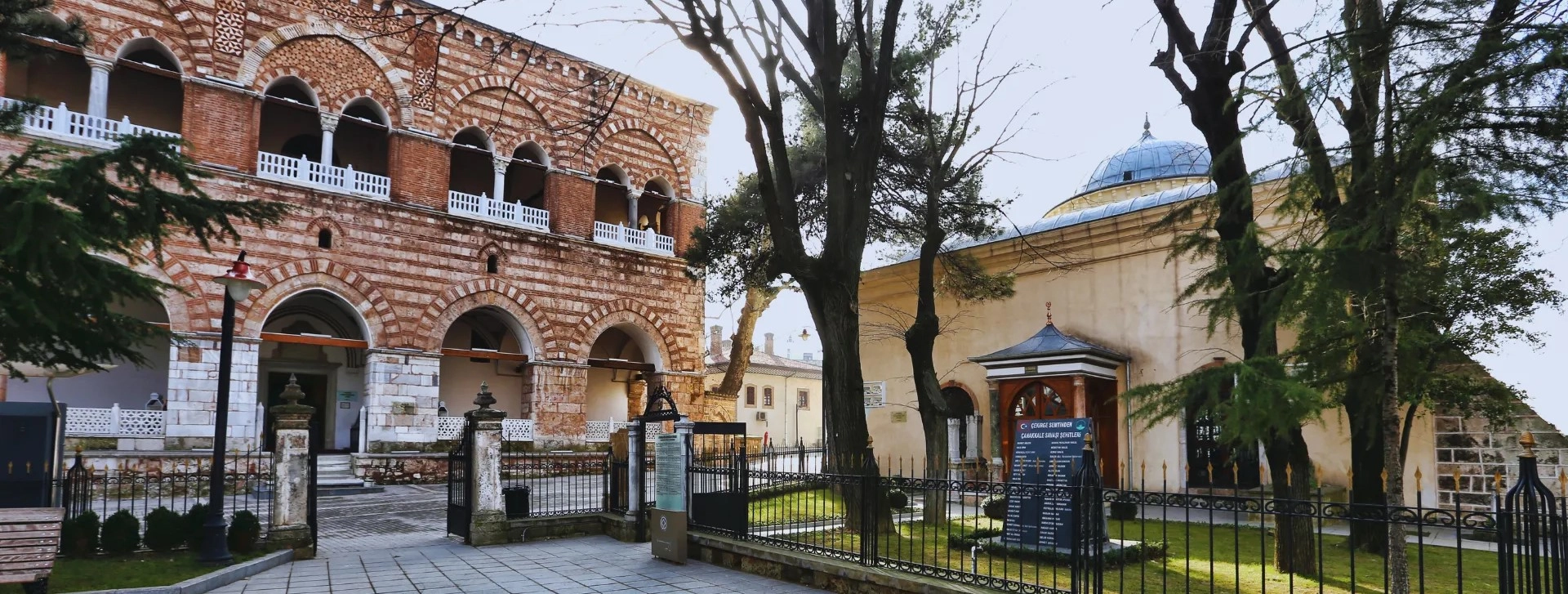
Follow the western expansion of early Ottoman Bursa through Sultan Murad I's extraordinary mosque-madrasah and tomb, then continue to the UNESCO-listed Eski Kaplıca to understand how royal foundations, neighbourhood planning and thermal water shaped the city together.
Design Your JourneyConnect Bursa's thermal traditions with the city's UNESCO monuments and the great cultural landscapes of Türkiye.
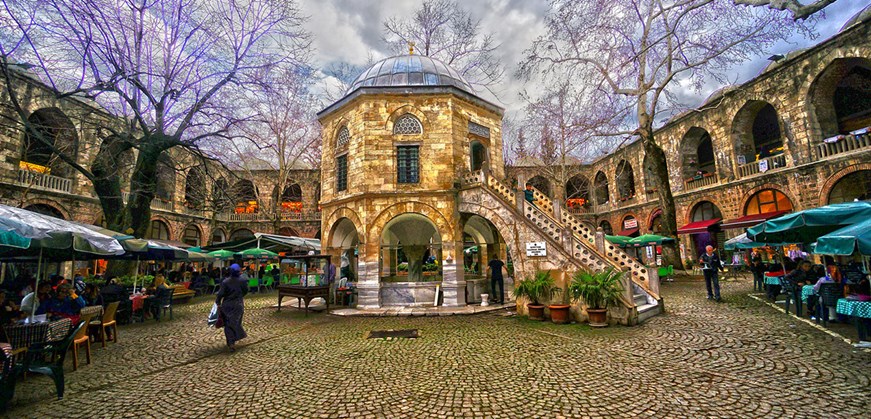
Discover Türkiye's remarkable cultural story from Istanbul and UNESCO-listed Bursa to Cappadocia, Ephesus, Pamukkale, Troy and the extraordinary archaeological and architectural landscapes beyond.
View Tour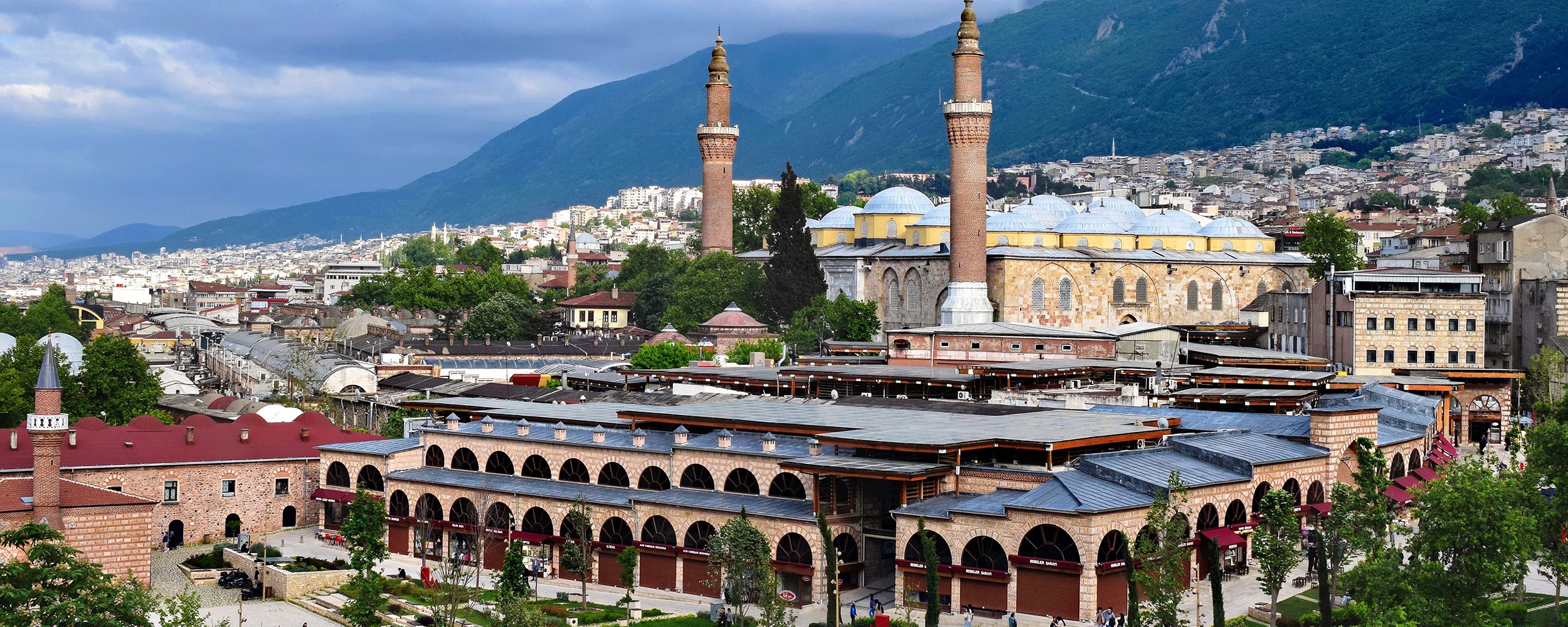
Create a private Bursa itinerary connecting Çekirge's historic thermal baths, Hüdavendigar, Muradiye, Tophane, the UNESCO khans district, museums, traditional cuisine, Cumalıkızık and the many historical layers of Türkiye's first Ottoman capital.
Design Your Journey