The Full 360° Panorama
Stand at the centre of a dome-shaped scene in which the painting rises around and above the visitor without an obvious visual boundary.
- Theme: Bursa on 6 April 1326
- Format: Full panorama
- Experience: 360-degree immersion






Few museums in Bursa create a sense of historical immersion as immediately as Panorama 1326 Bursa Conquest Museum – Panorama 1326 Bursa Fetih Müzesi.
The museum is dedicated to the Ottoman conquest of Bursa on 6 April 1326 and to the formative decades in which a frontier principality developed into an organised state centred on important urban settlements.
Its great attraction is the full 360-degree panoramic painting inside a monumental dome. Rather than looking at a conventional picture from a distance, visitors stand on a central viewing platform surrounded by painting, three-dimensional scenery, landscape details and a carefully designed sound environment.
The official museum interpretation deliberately presents the conquest as a moment of transition between two communities rather than a panorama dominated by battle. Byzantine and Ottoman figures share the wider scene, while flowing water, bird calls, horse sounds and traditional music reinforce the atmosphere of a spring day beneath Uludağ.
The panorama contains more than 10,000 human and animal figures and combines approximately 2,450 m² of painted surface with 700 m² of three-dimensional scenery. The result is a visual field of roughly 3,150 m².
Yet Panorama 1326 is not simply one enormous painting.
The museum also contains a chronological exhibition on the foundation of the Ottoman state, 16 historical paintings, replicas, İznik-inspired tile panels, a documentary presentation, temporary exhibition areas, a library, event spaces, conference halls, a café and a gift shop.
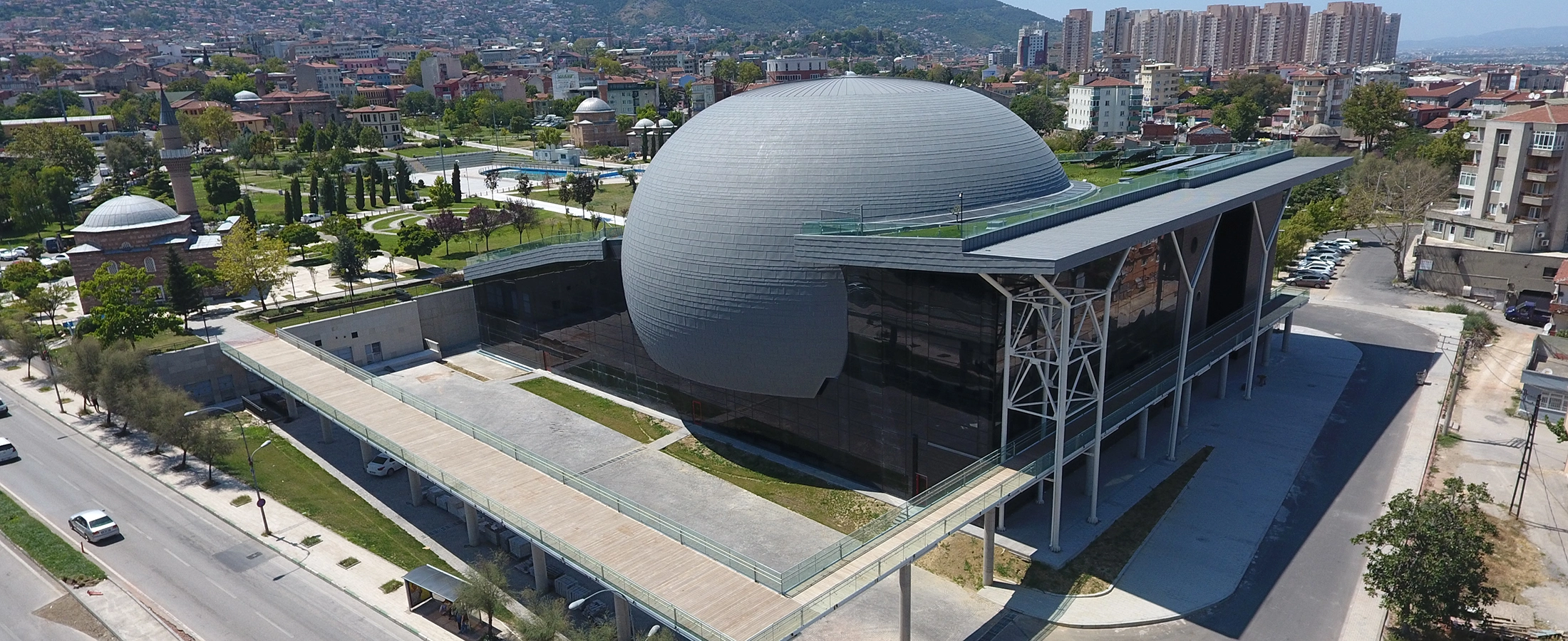
The building is also part of the experience. Designed according to a green-building concept, it combines a 42-metre dome, a planted roof, energy-saving systems, solar panels, accessible circulation and contemporary museum architecture.
For travellers exploring Osman Gazi, Orhan Gazi, the early Ottoman külliyes, Bursa Castle, Ulu Cami, Koza Han, Yeşil and Muradiye, this museum provides an excellent narrative bridge between the conquest itself and the monuments that followed it.
Enter a fully immersive panorama recreating Bursa on the traditional conquest date of 6 April 1326.
Study thousands of people, horses, animals and daily-life details spread across the painted and three-dimensional landscape.
Follow the transition from Ertuğrul Gazi and Osman Gazi through Orhan Gazi and the early rulers who transformed Bursa.
See a conquest scene designed around transition, coexistence and the meeting of Byzantine and Ottoman communities.
Explore a modern building with a 42-metre dome, green roof, energy-efficient systems and solar panels.
Discover contemporary tile compositions inspired by Bursa masterpieces such as the Green Tomb and Şehzade Mustafa Tomb.
Essential information for visiting Bursa's immersive museum of the 1326 conquest and the foundation period of the Ottoman state.
Ebu İshak Mahallesi, Osmangazi, Bursa, approximately five minutes on foot from Gökdere Metro Station.
Open on Google MapsThe museum began welcoming visitors in 2018; its official opening ceremony followed in 2019.
Tuesday–Sunday, 09:00–17:30. Closed Monday.
Adult 30 TL; student, teacher and military personnel 15 TL; ages 0–14 free. Current museum information states payment is cash only.
42-metre dome with approximately 2,450 m² of painted surface and a 700 m² three-dimensional foreground.
Allow approximately 45–60 minutes; history enthusiasts may prefer 1.5 hours or more.
The museum turns one of the decisive moments in Bursa's history into a spatial experience rather than a conventional sequence of display cases.
The conquest of Bursa is fundamental to understanding the rise of the Ottoman state.
After the city passed into Ottoman hands in 1326, Bursa developed into the first great urban centre of the dynasty and became the setting for royal tombs, mosques, madrasas, imarets, hamams, markets and charitable foundations that shaped early Ottoman urban culture.
Panorama 1326 helps visitors understand the moment immediately before that transformation.
Instead of beginning with the finished monuments of imperial Bursa, it asks visitors to imagine the fortified Byzantine city, the Ottoman frontier world, the long pressure surrounding Bursa and the transfer of the city into a new political order.
The panorama itself is unusually effective because the viewing platform removes the conventional frame around a painting.
Sky, landscape, figures, three-dimensional objects and sound merge into a single circular composition. This creates the impression that the visitor is standing inside an enormous historical landscape rather than merely observing one.
The surrounding galleries then widen the story through Ertuğrul Gazi, Şeyh Edebali, Osman Gazi, the Battle of Bapheus, the Battle of Dimbos, Orhan Gazi, Murad I, Bayezid I, Emir Sultan, Mehmed I and Murad II.
For first-time visitors to Bursa, this makes Panorama 1326 especially useful before exploring the city's earliest Ottoman monuments.
The museum combines immersive visual storytelling with chronological history, architecture, decorative arts and modern museum technology.
Stand at the centre of a dome-shaped scene in which the painting rises around and above the visitor without an obvious visual boundary.
Physical objects extend outward from the painted landscape so the boundary between real scenery and painted space becomes difficult to identify.
Look for Ottoman and Byzantine figures, horses, animals, tents, movement and small scenes of daily life spread throughout the composition.
Follow 16 historical paintings and related replicas explaining the foundation period of the Ottoman state and Bursa's early rulers.
Study contemporary tile compositions inspired by the decorative traditions of the Green Tomb, Yeni Kaplıca and Şehzade Mustafa Tomb.
Notice how the building itself becomes part of the museum concept through its planted roof, energy-saving systems and monumental 42-metre dome.
An introductory documentary provides a wider narrative of the dynasty's development from frontier principality toward empire.
Unlike panoramas built primarily around battlefield drama, Panorama 1326 emphasizes the meeting and transition of Byzantine and Ottoman communities.
The idea of creating a major museum devoted to Bursa's conquest developed long before the building opened.
According to Osmangazi Municipality, the project concept began to take shape in 2009.
In 2011, the internationally respected Ottoman historian Prof. Dr. Halil İnalcık became chief historical adviser to the project.
The museum was designed not simply to commemorate a date, but to reconstruct the wider political, social and geographical world of early Ottoman Bursa.
The idea for a large conquest museum devoted to Bursa's early Ottoman history begins to develop.
Historian Prof. Dr. Halil İnalcık assumes a leading advisory role in the historical development of the project.
Construction of the Panorama 1326 project begins under Osmangazi Municipality.
The museum is completed and begins receiving visitors.
The museum receives its official opening ceremony and becomes one of Bursa's major new cultural attractions.
Panorama 1326 functions as both a museum and a cultural venue hosting exhibitions, talks, programmes and public events.
The panorama and associated historical scenes were developed through research involving historians, artists, architects and specialist advisers.
The municipality identifies a historical and artistic advisory structure that included Halil İnalcık, Metin Sözen and Yusuf Oğuzoğlu, while the artistic work was coordinated by Haşim Vatandaş with chief painter Yaşar Zeynalov and a wider team of artists.
The resulting museum is therefore best understood as a combination of historical interpretation, monumental painting, set design, architecture and immersive exhibition technology.
Before its Ottoman conquest, Bursa was a fortified Byzantine city known as Prusa, standing beneath the slopes of Mount Olympus – modern Uludağ.
Its location gave it enormous strategic value.
Bursa's defensive walls protected an important urban centre overlooking the surrounding plain.
The rich agricultural landscape surrounding the city could support a growing population and urban economy.
Bursa's hot springs had made the area important since antiquity and continued to shape the city's identity.
The city stood within regional networks connecting northwestern Anatolia, the Sea of Marmara and inland routes.
Capturing a substantial walled city represented a major step beyond the rural frontier environment of the early Ottoman polity.
After 1326 Bursa became the first great urban centre of the Ottoman dynasty and a foundation for future expansion.
The conquest therefore represented far more than territorial expansion.
It gave the early Ottomans access to an established city, commercial infrastructure, craft traditions, agricultural wealth, religious institutions and a powerful symbolic centre.
The capture of Bursa was not the result of a single dramatic assault.
The official museum interpretation emphasizes a long process of pressure and siege lasting roughly twenty-three years, during which the Ottoman frontier gradually tightened around the city.
This is important for understanding the panorama.
Visitors should not expect a scene designed only around clashing armies and siege engines. The historical narrative is instead connected with patience, encirclement, political negotiation and eventual transfer of control.
The story of Bursa lies at the transition between the generations of Osman Gazi and Orhan Gazi.
Osman established the dynasty and led the expansion that surrounded important Byzantine settlements in northwestern Anatolia.
Orhan completed the conquest of Bursa and then transformed the city into an Ottoman political, commercial and religious centre.
The dynasty's founder created the political momentum and frontier network that made the conquest of Bursa possible.
Osman's son completed the capture of Bursa and oversaw its early development as an Ottoman urban centre.
Bursa later became the burial place associated with both Osman Gazi and Orhan Gazi at Tophane.
Ottoman development soon extended beyond the old fortified city through new commercial, religious and charitable foundations.
For travellers, this connection makes Panorama 1326 an ideal companion to the Osman Gazi and Orhan Gazi Tombs.
The museum presents the historical transition; Tophane preserves the dynastic memory created around it.
The central panorama represents the day Bursa passed into Ottoman hands.
Its artistic concept is deliberately broader than a battlefield reconstruction.
The scene imagines a spring landscape in which the fortified city, Ottoman groups, Byzantine inhabitants, animals, tents, vegetation, movement and everyday detail create the impression of a historical world continuing beyond the visitor platform.
The fortified city forms the essential historical backdrop to the conquest story.
Warriors, families, attendants and other figures represent the expanding frontier society surrounding Bursa.
The panorama includes the Byzantine inhabitants of Bursa as part of the transfer and coexistence narrative.
The mountain environment anchors the scene unmistakably within Bursa's geography.
A monumental plane tree evokes one of the most powerful symbolic images associated with the growth of the Ottoman dynasty.
The erguvan – Judas tree – recalls a flower deeply associated with Bursa's spring landscape and historic celebrations.
The official museum description characterises the panorama as peace-themed. That choice makes the work particularly interesting because it presents conquest through political transition, meeting and urban continuity rather than solely through violence.
A conventional panorama surrounds the viewer horizontally. A full panorama goes further.
At Panorama 1326, the painted scene rises from the outer edge of the three-dimensional foreground, continues beyond the horizon and curves upward into the dome.
Because the image surrounds the visitor in every direction, the eye has difficulty locating a beginning, an end or even a conventional canvas edge.
Visitors observe the panorama from a central viewing platform approximately 12 metres in diameter.
Physical scenery sits between the viewer and the painted surface, disguising where reality ends and painting begins.
The image continues upward around the dome so the painted sky appears to close above the visitor.
Lighting is designed to preserve the illusion rather than reveal the technical structure behind the panorama.
Sound from several points reinforces specific parts of the visual composition and deepens the sense of place.
The work must be explored by slowly turning through the entire 360-degree field.
Before or after entering the panorama, spend time with the museum's chronological exhibition.
This section helps visitors place the conquest within a much larger story extending from the frontier generation before Osman Gazi to the rulers who created Bursa's great early Ottoman monuments.
The dynastic memory of the generation preceding Osman Gazi introduces the frontier background of the early Ottomans.
The influential spiritual figure is presented within the traditional foundation narratives surrounding Osman Gazi.
The founder of the Ottoman dynasty forms the central political figure of the museum's early narrative.
The 1302 battle – also identified with Yalakova – marks a major stage in Ottoman expansion against Byzantine forces.
The 1303 conflict belongs to the sequence of events tightening Ottoman control around Bursa's hinterland.
Dynastic memory and the traditional transition from Osman to Orhan are represented within the foundation story.
The dervish figure reflects the spiritual and frontier traditions associated with early Ottoman settlement in the Bursa region.
The conqueror of Bursa becomes the key figure linking the frontier principality with a permanent urban capital.
The scholar represents the intellectual institutions that became increasingly important in early Ottoman urban life.
Murad I expanded the state dramatically and left an important architectural legacy in Bursa.
Bayezid I continued Bursa's monumental development and commissioned the great Ulu Cami.
The Grand Mosque represents the extraordinary architectural transformation that followed the conquest era.
The celebrated religious figure reflects Bursa's growing spiritual importance in the Ottoman world.
Mehmed I restored Ottoman political unity and created the Green Complex, one of Bursa's great artistic ensembles.
The Yeşil Türbe demonstrates the artistic and dynastic sophistication Bursa achieved within a century of the conquest.
Murad II's reign and Muradiye Complex conclude the museum's broad survey of Bursa's early Ottoman dynastic landscape.
Panorama 1326 also introduces visitors to one of the artistic traditions most closely associated with Bursa and nearby İznik: çini – architectural tile decoration.
The museum's tile panels were designed by artists Turgut Tuna and Şebnem Tuna and reinterpret historic Bursa examples through traditional methods.
One panel draws upon the extraordinary coloured-glaze tile traditions associated with the Green Mosque and Green Tomb.
Another composition reflects the floral vocabulary and ceramic decoration associated with Bursa's celebrated Ottoman thermal complex.
A further panel takes inspiration from the refined 16th-century floral tile tradition of the Muradiye dynastic cemetery.
The panels connect a contemporary museum building with ceramic methods and motifs rooted in historic Ottoman Bursa.
These panels are easy to overlook beside the enormous panorama, but they create an important connection between the history represented inside the museum and the surviving monuments outside it.
Panorama 1326 was conceived as more than a container for an exhibition.
Its architecture reflects the challenge of housing an enormous immersive artwork while creating an environmentally conscious public building.
The vast reinforced-concrete and steel-supported dome creates the uninterrupted volume required for the full panorama.
The roof is extensively landscaped, reducing the visual mass of the building and supporting the museum's ecological concept.
The dome uses a titanium-zinc exterior covering that gives the museum its distinctive contemporary profile.
Special façade treatments help reduce energy consumption while maintaining natural light in public areas.
Heating and cooling are integrated into the building's floor system as part of its energy-conscious design.
The building uses photovoltaic panels to generate part of its electricity from solar energy.
Electronic monitoring and control systems manage important building functions and environmental conditions.
The museum was designed so visitors with disabilities can access the full building and principal exhibition areas.
The panorama is not intended to be experienced visually alone.
A layered sound environment accompanies the 1326 landscape, helping visitors imagine the panorama as an inhabited space.
The sound of water connects the immersive scene with Bursa's streams, springs and famously green landscape.
Hoofbeats and movement reinforce the frontier character of the Ottoman groups represented in the panorama.
Traditional musical sound contributes to the cultural atmosphere rather than turning the panorama into a purely military spectacle.
Bird calls strengthen the sense that the conquest day is being presented within a living spring landscape.
The official museum description notes that sound is delivered from several points so that it corresponds with different parts of the visual composition.
No modern reconstruction can reproduce a medieval city with complete certainty.
Panorama 1326 nevertheless made historical research a central part of its development.
The project used historical sources, academic advisers, 360-degree photography, topographical information and a dedicated History and Art Board to shape the setting, figures and visual narrative.
The eminent Ottoman historian served as a leading adviser during the development of the museum project.
Specialists in history, architecture and cultural heritage reviewed the historical content presented in the panorama and galleries.
Geographical and visual research helped anchor the imagined 1326 scene within the real landscape of Bursa.
Where evidence cannot provide every detail, historical research is translated through the interpretive choices of artists and designers.
Visitors should therefore approach the work as a carefully researched historical interpretation, not as a literal photographic record of 1326.
The plane tree evokes the famous symbolic image of the Ottoman dynasty growing from modest beginnings into an immense state.
The Judas tree connects the scene with Bursa's spring landscape and the historic Erguvan traditions associated with the city.
Bursa's walls represent the established Byzantine urban world that the Ottomans were entering rather than an empty landscape awaiting settlement.
Byzantine and Ottoman figures appearing within the same visual field reinforce the museum's emphasis on political transition and social continuity.
Vegetation, water and birds prevent the conquest from being presented only through military imagery.
Figures moving through the landscape suggest a city becoming connected to new political and commercial networks.
The historical importance of 1326 becomes clearer when visitors consider what happened next.
Bursa did not remain simply a captured fortress.
Under Orhan Gazi and later rulers, the city expanded into a network of religious, commercial, charitable and residential centres.
This is why Panorama 1326 works best as the beginning of a wider exploration.
The museum shows the moment of transition; Bursa itself shows the city created during the centuries that followed.
Yes.
The museum can work particularly well for children and teenagers because its central exhibit is visual, spatial and easy to experience without reading long historical labels.
The scale of the 360-degree environment creates an immediate sense of discovery for younger visitors.
Children can search for horses, tents, people, trees and small scenes across the enormous image.
A typical 45–60 minute visit is long enough to feel substantial without requiring an entire day.
The early Ottoman story can help school-age visitors connect names, events and monuments with a clear timeline.
The museum regularly functions as a cultural venue with exhibitions, educational activities and public programmes.
Current official visitor information lists admission for children aged 0–14 as free.
The museum's official architectural information states that the entire building is designed for disabled access.
Accessible circulation is incorporated into the contemporary museum design.
The central attraction is designed to be reachable as part of the museum's accessible visitor route.
As a purpose-built museum, Panorama 1326 provides a more accessible environment than many historic monuments in Bursa.
Visitors with specific mobility or assistance requirements should contact the museum in advance for the most current arrangements.
Changing exhibitions allow the museum to host additional historical, artistic and cultural themes.
A library supports the museum's broader educational and cultural role.
The museum includes event spaces used for talks, performances, screenings and public programmes.
Conference facilities allow Panorama 1326 to host academic and cultural events beyond normal museum visits.
Visitors can take a break within the museum complex before continuing into central Bursa.
A museum shop offers souvenirs and Bursa-related items.
The museum complex includes parking, although public transport can be more convenient in central Bursa.
The museum also promotes a mobile virtual-guide experience that can be activated at selected points through QR-based interaction.
Prices, opening hours, holiday schedules, events and payment arrangements can change. Visitors travelling specifically for Panorama 1326 should check the official museum information shortly before arrival.
Current museum visitor information allows personal photography and video inside the museum.
Visitors may photograph the museum for personal use under the current visitor rules.
Short personal videos are also currently permitted.
Professional or organised filming requires prior permission from the museum.
Wide-angle photographs can show scale, but spend time experiencing the panorama directly rather than only through a screen.
The museum is located in Ebu İshak Mahallesi in Osmangazi, close to Gökdere and within easy reach of Bursa's historic centre.
The official museum information describes it as approximately five minutes on foot from Gökdere Metro Station.
Use Gökdere Metro Station and continue on foot for approximately five minutes.
Travellers exploring Setbaşı, Irgandı Bridge and the eastern historic centre can incorporate the museum into a longer walking route.
Ask for “Panorama 1326 Bursa Fetih Müzesi” in Ebu İshak, Osmangazi.
The museum complex includes parking, making it convenient for private Bursa itineraries.
Because Panorama 1326 lies east of the core Ulu Cami–Koza Han district, it can work particularly well as the first stop of a day that gradually moves westward through historic Bursa.
Enough for visitors focusing mainly on the central panorama and a rapid look at the surrounding displays.
The museum's own guidance identifies this as the average duration for a normal visit.
Better for travellers who want to study the chronological gallery, tiles, architecture and small panorama details carefully.
Combine the museum with Irgandı Bridge, the Green Mosque and Tomb, Setbaşı and nearby historic neighbourhoods.
For most travellers, about one hour is ideal. The panorama is visually dense, so rushing through the central platform can mean missing many of its most interesting details.
This order makes the panorama easier to understand because the historical framework comes before the immersive spectacle.
The route creates a clear historical sequence: conquest first, then the monuments and urban landscape built by the dynasty that made Bursa its early capital.
Cross one of Bursa's most distinctive historic bridges, famous for the shops built along its span.
Explore a lively historic district linking Gökdere with the Green Complex and central Bursa.
Visit the celebrated early 15th-century mosque commissioned by Mehmed I and admire its architecture and decoration.
See the dynastic mausoleum of Mehmed I, famous for its brilliant tile decoration and commanding position above the district.
Continue eastward to one of Bursa's most important religious and pilgrimage landmarks.
Compare the museum's foundation narrative with Bursa's monumental Grand Mosque commissioned by Bayezid I.
Explore the silk caravanserai that represents Bursa's later rise as one of the great commercial cities of the Ottoman world.
Visit the old citadel zone, city viewpoint and the tombs associated with Osman Gazi and Orhan Gazi.
Continue the story beyond 1326 with a broader museum devoted to Bursa's ancient, Ottoman, social, cultural and industrial history.
Continue with our Bursa destination guide for imperial monuments, bazaars, museums, villages, cuisine and surrounding landscapes.
Spend time in the chronological gallery before entering the panorama so the 1326 scene has clearer historical meaning.
Use your first 360-degree turn for the overall effect and your second for small figures, symbols and landscape details.
The water, birds, horses and music are part of the immersive design rather than background decoration.
The museum's current official information states that admission payments are cash only.
Panorama 1326 is operated by Osmangazi Municipality and the national Museum Pass is not valid.
Public events, exhibitions and performances can add another dimension to a normal museum visit.
Use the museum as the beginning of a route to Yeşil, Ulu Cami, Koza Han and Tophane rather than an isolated stop.
Before leaving, notice the dome, planted roof, tile panels and modern sustainable design of the museum itself.
It is a museum in Osmangazi, Bursa dedicated to the conquest of Bursa on 6 April 1326 and the foundation period of the Ottoman state. Its main attraction is a vast full 360-degree panoramic reconstruction.
Its Turkish name is Panorama 1326 Bursa Fetih Müzesi.
The museum is located in Ebu İshak Mahallesi, Osmangazi, Bursa, close to Gökdere and approximately five minutes on foot from Gökdere Metro Station.
The central panorama recreates the traditional conquest date of 6 April 1326, when Bursa passed from Byzantine to Ottoman control.
The final conquest is associated with Orhan Gazi, son of Osman Gazi, after a long period of Ottoman pressure around the city.
The museum and Osmangazi Municipality describe the conquest as the result of a roughly 23-year siege and encirclement process.
Not in the conventional sense. The museum emphasizes transition, coexistence and a peace-centred interpretation rather than presenting only violent battlefield action.
Official museum information gives approximately 2,450 m² of painted surface and 700 m² of three-dimensional scenery, creating a combined visual area of about 3,150 m².
The museum dome has a diameter of approximately 42 metres.
The official museum description states that the panorama contains more than 10,000 human and animal figures.
The museum includes a chronological exhibition, 16 historical paintings, replicas, İznik-inspired tile panels, a documentary presentation, temporary exhibitions, a library, event areas, conference halls, a café and a gift shop.
The project was developed with specialist historical advisers, including the renowned Ottoman historian Prof. Dr. Halil İnalcık.
Osmangazi Municipality identifies Haşim Vatandaş as project art coordinator and Yaşar Zeynalov as chief painter, working with a wider team of artists over several years.
They connect the modern museum with Bursa's great Ottoman decorative traditions. The panels reinterpret motifs associated with monuments including the Green Tomb, Yeni Kaplıca and Şehzade Mustafa Tomb.
Yes. Its architecture incorporates a planted roof, energy-efficient materials, smart-building systems, solar panels and other environmentally conscious features.
The regular schedule is Tuesday through Sunday from 09:00 to 17:30.
No. The museum is normally closed on Mondays.
Current official museum information lists 30 TL for adults and 15 TL for students, teachers and military personnel. Children aged 0–14 are listed as free.
No. The museum states that Museum Pass is not valid because Panorama 1326 is operated as a municipal museum under Osmangazi Municipality.
The museum's current official visitor information states that admission payments are cash only. Because payment policies can change, check again shortly before your visit.
The official average is approximately 45 minutes to one hour. Visitors studying the displays in detail can easily spend longer.
Yes. Personal photography and video are currently permitted, while professional shooting requires advance permission.
Yes. The museum states that guided visits can be arranged for groups with advance reservation.
Yes. The enormous visual panorama, three-dimensional scenery, sound environment and manageable visit length make Panorama 1326 particularly accessible for families.
The museum's official architectural information states that the entire building is designed for disabled access.
Yes. The museum lists both a café and souvenir shop among its visitor facilities.
Yes. Parking is included among the museum complex facilities.
Yes. Panorama 1326 regularly hosts exhibitions, talks, film screenings, workshops, festivals and cultural programmes.
The museum's current FAQ notes free Sunday mehter performances. Because event programming changes, confirm the current schedule before planning a visit specifically around the performance.
Yes. The museum can be combined with Irgandı Bridge, Setbaşı, the Green Mosque and Green Tomb, Ulu Cami, Koza Han and Tophane as part of a longer historic Bursa day.
For first-time visitors, yes. The museum explains the conquest first, while Tophane connects that history with the tombs and dynastic memory of Osman Gazi and Orhan Gazi.
Yes, especially for travellers interested in Ottoman origins, Bursa's conquest, immersive museums, historical painting and the transformation of Bursa into an early Ottoman capital.
Try to identify the exact point where three-dimensional scenery becomes painted surface; the illusion is designed to make this difficult.
Look upward and notice how the painted world continues into the dome instead of ending at a normal horizon line.
Notice how both communities occupy the same panorama and how this supports the museum's peace-centred interpretation.
Find the monumental tree symbolically connected with the expansion and endurance of the Ottoman dynasty.
Look for the Judas tree associated with Bursa's spring landscape and historic urban memory.
Use the mountain as a geographical anchor and compare the historical reconstruction with the real Bursa landscape outside.
Move slowly around the platform and notice how water, horses, birds and music seem connected with different visual zones.
Do not leave after the panorama without studying the contemporary interpretations of Bursa's historic çini traditions.
From outside, notice how the planted architecture reduces the visual weight of the large museum volume.
Compare the museum's paintings of rulers and events with the actual monuments you can visit across Bursa afterward.
Panorama 1326 can be incorporated into private Bursa itineraries combining Ottoman foundation history, imperial monuments, bazaars, dynastic tombs, traditional neighbourhoods, cuisine and the UNESCO-listed cultural landscape of the city.
Flexible private journeys with transportation and professionally licensed guiding.
Begin with the conquest story inside Panorama 1326, then continue through the real historical landscape with Irgandı Bridge, the Green Mosque and Tomb, Ulu Cami, Koza Han, Tophane and the tombs of Osman Gazi and Orhan Gazi.
Request This Tour
Explore Bursa's extraordinary transformation from Byzantine fortress to Ottoman capital through Panorama 1326, imperial külliyes, dynastic tombs, historic hans, silk heritage, local cuisine and panoramic viewpoints.
Design Your JourneyConnect Bursa with the great archaeological, cultural and historic destinations of Türkiye.
Travel through Istanbul, Bursa, Safranbolu, Hattusha, Cappadocia, Mount Nemrut, Şanlıurfa, Ephesus, Pamukkale, Pergamon, Troy and Gallipoli.
View Tour
Create a private itinerary combining Panorama 1326, Bursa's imperial külliyes, historic bazaars, Cumalıkızık, traditional neighbourhoods, local cuisine, Uludağ and the wider cultural landscape surrounding the first Ottoman capital.
Design Your Journey