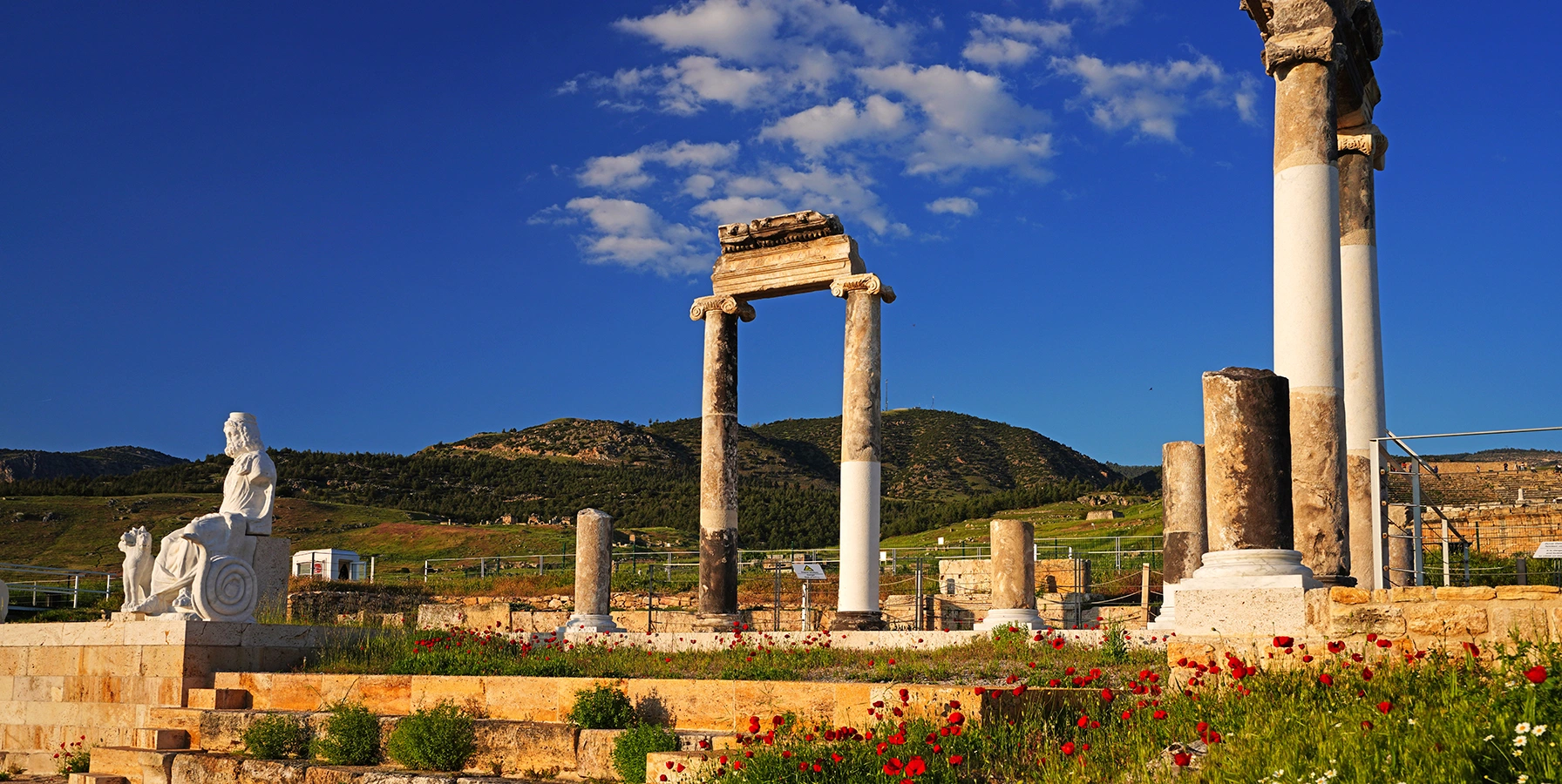
Private Pamukkale & Hierapolis Tour
Visit the Plutonium, Apollo sanctuary, Roman Theatre and white travertines on a personalized guided route.
Explore Private Tour





At the heart of Hierapolis Ancient City, near the celebrated white terraces of Pamukkale, Türkiye, stand two of the most intriguing religious monuments in Roman Anatolia: the Plutonium (Ploutonion), also known as Pluto's Gate or the Gate to Hell, and the nearby Sanctuary and Temple of Apollo. Both were shaped by the same remarkable environment of thermal water, active geological fractures and mysterious gases emerging from underground.
For ancient worshippers, the dangerous opening of the Plutonium marked a boundary between the living world and the realm of Pluto (Hades) and Kore (Persephone). Greek and Roman writers described animals dying when exposed to its vapours, while priests performed rituals around the cave. Modern scientific research has identified extraordinarily high concentrations of carbon dioxide, offering a geological explanation for the historical accounts.
Nearby, the Temple of Apollo occupied a major sacred precinct associated with the city's principal deity, whose local traditions absorbed earlier Anatolian religious ideas. This is not simply a story about a single temple or a cave: it is a story about how the inhabitants of Hierapolis interpreted earthquakes, sacred springs, prophecy, healing and the underworld.
Part of the Hierapolis–Pamukkale UNESCO World Heritage Site, inscribed in 1988, this guide explores the ancient cults, the archaeological discoveries, the genuine science behind the poisonous vapours, what remains visible today and how to combine these monuments with the Roman Theatre, archaeology museum and travertine terraces.
Discover the cave sanctuary ancient visitors regarded as a passage to the underworld.
Explore the remains of the city's principal sacred precinct and its complex history.
Understand the carbon dioxide emissions that inspired terrifying accounts.
See two remarkable monuments within the wider Hierapolis–Pamukkale landscape.
The essential details for seeing Hierapolis's ancient sacred centre.
Inside Hierapolis–Pamukkale archaeological site, near the Roman Theatre, Pamukkale, Denizli.
Pluto/Hades and Kore/Persephone at the Plutonium; Apollo and local religious traditions in the adjoining sanctuary.
Carbon dioxide emerges along geological fractures linked with the active thermal landscape.
Strabo and other authors described lethal vapours and ceremonies associated with the cave.
Excavations south of Apollo’s sanctuary and a 2012 dedication helped identify the Plutonium.
Normally included in the general Hierapolis–Pamukkale archaeological-site ticket; no separate temple or Plutonium ticket.
Allow about 25–45 minutes to appreciate both monuments; longer if reading archaeological displays.
Observe the Plutonium from designated visitor areas only. Gas-emitting cavities must never be entered.
Hierapolis is often remembered as a Roman spa city. Yet its name, sacred landscape and ancient monuments reveal that religion and healing were closely intertwined. Springs rose through fractures in the earth, earthquakes repeatedly transformed the site and gases emerged from underground. Ancient people gave these striking phenomena meaning through cult practice.
The Plutonium made the invisible underworld seem physically present. It was a place where worshippers could observe deadly emissions and ritual performances associated with Pluto and Kore. The neighbouring Sanctuary of Apollo brought the city's most prominent god into the same dramatic geological setting, uniting Greek religious language with older local beliefs.
The juxtaposition is especially important: above ground lay terraces, columned precincts, temples and the impressive Roman city; beneath them were warm water, fissures and gas. This relationship between archaeology, religion and nature is one of the features emphasized in UNESCO's description of Hierapolis–Pamukkale.
Unlike monuments dedicated solely to civic prestige, this sacred area helps explain why Hierapolis developed here in the first place. The same geological system that produced the beautiful travertine terraces also helped produce the city's reputation for divine and otherworldly activity.
The Plutonium, more precisely Ploutonion in Greek, was a sanctuary dedicated to the ruler of the underworld, called Plouton or Hades by Greeks and Pluto by Romans. The sanctuary also honoured Kore, a name for Persephone, the goddess whose myth connected the upper world with the kingdom of the dead.
At its centre was an opening in the ground associated with warm water and naturally escaping gases. To ancient observers, the lethal atmosphere appeared to come from the world below. The shrine was therefore regarded as an exceptional place of contact between humanity and chthonic divinities—gods connected with the earth and the underworld.
Ancient accounts describe animals brought toward the cave and overcome by the fumes. They also discuss priests who took part in the ceremonies. The ruins are far more than an exotic “gate to hell”: they belong to a formal religious complex with architectural terraces, ritual space and features designed for observation and ceremony.
Excavations in the area south of the Sanctuary of Apollo uncovered an important monumental complex. An inscription identifying Pluto and Kore, discovered in 2012, was decisive for associating this sanctuary with the Plutonium known from ancient literature. Many popular accounts describe its public rediscovery in 2013.
An opening along the fault zone released warm, carbon-dioxide-rich gases into the sanctuary.
The dedication linked the shrine to the rulers of the underworld in Greek and Roman religion.
Built terraces and open areas made the dangerous cave a place of ritual activity and public attention.
Literary and archaeological evidence suggests spaces where ritual events could be watched.
Natural hot-water flows were part of the same fracture system that released gas.
Visitor barriers and controlled routes separate the public from hazardous openings.
The Temple of Apollo formed part of a larger sacred complex at Hierapolis. Apollo was an especially important deity for the city, linked to divine protection and to traditions of revelation and prophecy. In this part of ancient Phrygia, his cult interacted with local Anatolian beliefs and deities, so the sanctuary was not simply a copy of a famous Greek temple.
The monumental precinct stood on terraced ground, with architectural platforms and marble stairs connecting different levels. Excavation has revealed a complicated sequence of buildings, remodelling and re-identification. Some structures once described as a temple have subsequently been interpreted by researchers as parts of a prophetic or sacred complex.
The major Apollo temple is understood from foundations and architectural material; scholarship reconstructs an Ionic-style temple, reflected in depictions on Hierapolis coinage. Surviving remains do not offer an intact columned temple. Visitors must read the foundations, steps and fragments together with archaeological interpretation to visualize the original sanctuary.
The site was repeatedly altered during the Roman Imperial period, particularly between the 1st and 3rd centuries AD. The relationship between the temple buildings, spring sources and adjacent Plutonium is a vivid example of how sacred architecture adapted to the extraordinary conditions of Hierapolis.
The god’s cult at Hierapolis carried Greek associations as well as older regional traditions.
Different levels and connecting stairs shaped movement through the precinct.
The original superstructure has largely disappeared, but the surviving plan can still be studied.
Architectural remains and coin images are used by scholars to understand the principal temple.
Parts of the complex are associated with ancient oracular or ritual activity, although details remain debated.
The sanctuary changed over centuries rather than remaining a single unchanged Hellenistic monument.
The scientific explanation begins with the active geological fault system beneath Hierapolis. Carbon dioxide from geological sources travels through fractures and emerges around openings and spring areas. It is this natural phenomenon, not an invented stage effect, that underlies the ancient Plutonium accounts.
Carbon dioxide (CO₂) is invisible and has no reliable warning smell. In high concentrations it reduces breathable oxygen and can cause rapid loss of consciousness or death. Under calm conditions it may accumulate in low-lying hollows, especially around a sheltered grotto. The concentrations change with location, airflow, weather, time of day and height above the ground.
A published field investigation of the Hierapolis Plutonium reported CO₂ concentrations of up to 91% inside the grotto and high but variable concentrations outside its mouth. Those results explain why ancient writers described deaths among animals brought into the area. The figures refer to scientific measurements at specific times and places; they must not be interpreted as readings for today's visitor platforms.
One suggested explanation for priests surviving while animals died is the effect of height and the distribution of gas: a person's breathing zone may be above a concentrated layer near the floor, whereas smaller animals breathe much lower. Knowledge of safer positions, wind and ritual timing could also have mattered. This is a plausible scientific interpretation, not proof of every detail of an ancient ceremony.
Fractures provide pathways for gases and hot water emerging from below the surface.
CO₂ does not need to be visibly steaming to present a serious hazard.
The gas can collect in depressions and grottoes when ventilation is limited.
Wind, temperature, gas flow and the hour of the day affect local concentrations.
A modern study recorded extremely high CO₂ within the Plutonium grotto.
Never step down into cavities, lean over openings or approach fenced areas to test whether gas is present.
The Greek geographer Strabo, writing around the turn of the 1st century AD, provided one of the most influential descriptions of the Plutonium at Hierapolis. He described an opening filled with a dense, suffocating atmosphere and noted that animals entering the area died. His account helped give the place an enduring identity in the history of ancient religion.
Later authors, including Cassius Dio, also mentioned the site and its dramatic qualities. Ancient testimony is valuable because it shows that the danger was known long before modern geology could explain carbon dioxide emissions. It also reveals that the cave's frightening reputation formed part of the site's religious appeal.
The ceremonies were associated in ancient accounts with eunuch priests called Galli, linked to the worship of the Anatolian mother goddess Cybele. Their reported ability to approach the deadly place without succumbing contributed to the aura of supernatural power. It is important to distinguish what ancient observers reported from the precise ritual procedures, which archaeology cannot always reconstruct.
The Plutonium's mythological world also included Persephone/Kore, whose periodic movement between the worlds of the living and dead symbolized a powerful cycle of disappearance and return. For worshippers, the physical gas-emitting cave must have seemed a striking embodiment of such stories.
The geographer’s description is central to the Plutonium’s identification and historical reputation.
The Roman historian contributed later testimony about the sanctuary and its presentation.
Priests associated with Cybele were said to participate in remarkable demonstrations.
Different Greek and Roman names refer to the deity who ruled the underworld.
The goddess associated with the underworld was named alongside Pluto in the excavated dedication.
Real lethal gases gave the cult a powerful physical setting, while myths explained its meaning.
Early investigators knew ancient writers had placed a dangerous underworld sanctuary at Hierapolis, but determining which surviving opening corresponded to their descriptions was not straightforward. For decades, a gas-emitting cavity beside the Temple of Apollo was commonly labelled the Plutonium in guidebooks and site interpretations.
Research by the Italian Archaeological Mission at Hierapolis, under archaeologist Francesco D’Andria, transformed the discussion. Excavation south of Apollo’s sanctuary revealed a much larger complex. Most importantly, a 2012 dedicatory inscription naming Pluto and Kore provided a direct link between the archaeological remains and the underworld cult described by ancient authors.
The discoveries, widely reported in 2013, have led scholars to distinguish an older, traditionally identified cavity from the excavated Ploutonion further to the south. Archaeological work, documentation and conservation have made the architectural arrangement and original function easier to understand.
Restoration and visitor-route developments have improved the presentation of the sanctuary, but the ancient cave itself is not an accessible attraction. Research continues to refine how the several religious installations functioned, how they were used in different periods and how they related to Apollo’s precinct.
Unlike the grand Roman Theatre, the Plutonium requires visitors to examine the shape of the ground, reconstructed features and archaeological context. The most memorable sight is the juxtaposition of formal Roman religious architecture with an actual geological opening.
At the Plutonium, look for the mouth of the sacred cave, the enclosing walls, a series of stepped areas, the controlled viewing route and any interpretive reconstruction present during your visit. Displays representing Hades/Pluto and Cerberus, the mythical guardian of the underworld, help communicate the ancient mythology. Such display elements should not be mistaken for intact, original Roman statues.
At the nearby Temple of Apollo, notice the terraces, steps, stone foundations and relationships with surrounding buildings. A guide can explain the architectural phases and why the sanctuary was built precisely in an area of thermal and seismic activity.
The most symbolically important point: an actual natural opening connected with an underworld sanctuary.
Terraced constructions illustrate how ceremonies may have been presented and observed.
Look for interpretive or reconstructed figures representing the god and the three-headed guardian.
Learn how an inscription changed the identification of the sanctuary; the original piece may not be visible in situ.
Trace the footprint of the sanctuary’s principal temple from its surviving stonework.
Different levels show how the precinct was organized on difficult terrain.
Look at the fractured and mineral-rich landscape that shaped both the cult and the city.
Continue to the impressive theatre to compare sacred ritual space with large-scale civic entertainment.
The religious landscape of Hierapolis is older and more complex than any single monument now visible. Its cults evolved as Hellenistic, Anatolian and Roman ideas interacted, while earthquakes and changing beliefs transformed the buildings.
Hierapolis grows under the kings of Pergamon, consolidating a thermal and religious settlement.
Sacred buildings, local cults and the gas-emitting places attract attention in the Roman world.
Strabo’s testimony records the remarkable reputation of the Plutonium.
The city undergoes rebuilding after a severe earthquake, with major urban and sacred changes.
Roman Hierapolis flourishes, with significant architectural development and remodelling.
Christian institutions become prominent as earlier pagan religious traditions decline.
Hierapolis–Pamukkale becomes a UNESCO World Heritage Site.
The Pluto-and-Kore dedication and excavations identify the celebrated underworld shrine.
In antiquity, one sacred place could hold multiple layers of belief. At Hierapolis, Apollo’s cult did not erase the importance of earth, spring and underworld divinities. Instead, the area developed into a landscape where different ritual traditions coexisted and changed over time.
Apollo was associated with prophecy, protection and divine revelation. In local Anatolian worship, his identity could overlap with regional solar and healing traditions. Cybele, the great mother goddess, belonged to the older religious world of Anatolia, and her priests appear in the ancient Plutonium narratives.
Pluto and Kore expressed the realm below, making the cave a meaningful threshold between life and death. The dramatic geological danger helped make these associations tangible. For visitors interested in iconography and the history of religion, this is a striking case of syncretism: divine names and rituals from different cultures interacting at one site.
Later, Hierapolis gained a distinct Christian identity and became an important pilgrimage centre connected with St Philip. The pagan sanctuary and the Christian monuments are separate phases of the city’s exceptionally long religious history; one should not be confused with the other.
A convenient plan is to visit the Plutonium and Apollo sanctuary while exploring central Hierapolis, rather than making them an isolated excursion. The sanctuary sits within the larger archaeological complex, so your approach will depend on which entrance you use and which paths are available.
Start with the Roman Theatre if approaching from the eastern side of the ancient city, then descend toward the sacred area. Explore Apollo’s temple foundations and the interpreted Plutonium viewing area. Continue toward the Hierapolis Archaeology Museum and the famous Pamukkale terraces. If time permits, add the Frontinus Street area and the Northern Necropolis.
Travellers interested in Christian architecture can include the Martyrium of St Philip, which requires additional walking and elevation gain. The walking order can be reversed depending on site gate, weather, mobility and current conservation restrictions.
The Temple of Apollo and Plutonium are inside the Hierapolis–Pamukkale archaeological site. They are generally visited with the ordinary site admission ticket, rather than through a separate ticket desk for the individual monuments. The official Turkish Museums listing is the best place to confirm up-to-date admission and entry arrangements.
When this guide was prepared in October 2026, the official museum listing showed 08:00–18:00 daily for the Hierapolis–Pamukkale archaeological site, with ticket office closure at 17:00. It also warned that entrance arrangements differ between the north and south gates and the pedestrian entrance. Seasonal schedules can change, and the actual accessible route to the Plutonium may follow additional safety or conservation restrictions.
The official listing should be checked shortly before travel. An admission fee of €30 was displayed in the previously checked October 2026 site information, but admission categories and prices are subject to revision. The Archaeology Museum, Antique Pool and other managed facilities may operate on different timetables or require separate arrangements.
Access to the cave itself is not permitted. The historic gas emissions remain the primary reason for strict safety boundaries. Visit only the areas explicitly opened by the archaeological-site management.
Moderate temperatures often make it pleasant to combine the sacred precinct with longer archaeological walks.
A rewarding season for exploring open-air architecture without peak summer heat.
Prefer an early visit for cooler temperatures and calmer conditions in the exposed ruins.
Angled sunshine can reveal stonework and terrace levels; observe last-entry restrictions.
The site can be quieter, but rain, wind and wet paving require extra caution.
Never approach a gas-emitting cavity to observe vapour. Conditions may change independently of the weather.
A brief look from the permitted Plutonium viewpoints if you are already nearby.
A satisfying combined visit to the Plutonium and Apollo temple precinct.
Add a more careful examination of the surrounding architecture and archaeological explanations.
Combine the sacred area with the Roman Theatre and the archaeology museum, allowing for walking.
Add central Hierapolis and part of the Pamukkale travertine area.
Explore the wider UNESCO site, with necropolis, theatre, museum, St Philip monuments and terraces as access permits.
The unusual combination of archaeological ruins, terraces and a natural sacred opening provides excellent opportunities for documentary and travel photography. The strongest pictures communicate the setting and its scale, rather than trying to photograph inside a prohibited space.
Include the stepped construction and the cave area in a single contextual composition.
Use low directional light to reveal platforms, steps and carved architectural fragments.
Frame the terraces and visitor route to explain how the ancient complex is arranged.
If present, photograph the Hades and Cerberus interpretive displays while distinguishing modern reconstructions.
Include the surrounding fractured and mineral-rich terrain that explains the sanctuary’s location.
No climbing, entering fenced zones, leaning into the cave or flying drones without appropriate authorization.
The ancient sacred area contains uneven paving, excavated remains and changes in level. Some viewpoints may be reached using managed walkways, but the full route through Hierapolis is not uniformly step-free. Visitors with mobility concerns should confirm access arrangements with the archaeological site before arrival.
Expect historic paving, steps, slopes and rough archaeological surfaces.
Use only official paths and any protective walkways provided around the Plutonium.
Fences and restrictions are safety measures, not optional archaeological suggestions.
Keep children close and away from walls, openings and roped-off areas.
Carry drinking water, sun protection and sturdy shoes for the wider site.
Leave architectural fragments in place and do not climb or touch fragile ancient masonry.
The sacred complex is within Hierapolis, not at an independent roadside entrance. Most visitors first travel to one of the official Pamukkale–Hierapolis access gates, then continue on foot along the archaeological site's designated paths.
Use the official archaeological-site pedestrian entrance if it fits your route and operating hours.
Travel by local bus, taxi or private transfer to a managed Hierapolis–Pamukkale entrance.
Enter the archaeological park and plan time to walk toward the theatre and sacred precinct.
A longer archaeological route can incorporate the necropolis and central city before reaching the sanctuary.
A guide can connect the Plutonium and Apollo temple with the theatre, museum and terraces at a relaxed pace.
Follow onsite signs and open paths toward the Theatre, Apollo Sanctuary and Plutonium; routes can change.
These nearby monuments reveal different aspects of the extraordinary history of Hierapolis—from sacred space and Roman spectacle to Christian pilgrimage and the geological formation of Pamukkale.
See the white calcium terraces and the ancient thermal city that gave the sanctuary its remarkable setting.
Explore sculpture, architectural fragments and archaeological finds associated with Hierapolis and the Lycus Valley.
Visit the monumental Christian pilgrimage complex that illustrates a later chapter in Hierapolis’s religious history.
Walk among ancient sarcophagi and family mausoleums lining the Roman approach to the city.
Discover a major neighbouring Roman city and one of the Seven Churches of Revelation.
Explore another important ancient settlement in the wider Lycus and Maeander valley region.
Plan natural, archaeological and cultural discoveries across the Pamukkale–Denizli region.
Arrange a flexible licensed-guide experience covering the sacred monuments and Pamukkale’s major highlights.
It is an ancient sanctuary dedicated to Pluto/Hades and Kore, built around a naturally gas-emitting cave associated with the underworld.
Ploutonion is a Greek term for a sanctuary of Plouton. Plutonium is a common Latinized spelling used for the Hierapolis monument.
Yes. Both are popular names for the Hierapolis Plutonium, once believed to open toward the realm of the dead.
Within the Hierapolis–Pamukkale archaeological site in Denizli Province, south of the Sanctuary of Apollo and near the Roman Theatre.
It is the principal ancient temple and sacred precinct associated with Apollo, containing surviving foundations, terraces and architectural remains.
No. They are neighbouring religious complexes with interconnected history and geology, but different dedicatory cults and archaeological features.
Ancient people observed deadly natural emissions from the ground and understood the phenomenon through myths about the realm of Pluto and Kore.
The principal dangerous gas documented in scientific studies is carbon dioxide (CO₂) escaping through geological fractures.
Yes. At high concentrations, carbon dioxide can produce rapid asphyxiation; measured concentrations at the Plutonium explain ancient reports of animal deaths.
Yes. Dangerous natural gas emissions have been scientifically documented. Never enter or approach fenced cavities; follow official safety instructions.
No. The cave itself should be viewed only from permitted public areas, subject to current onsite access arrangements.
Strabo was an ancient Greek geographer who described suffocating vapours at Hierapolis and animals dying near the opening.
One scientific interpretation is that carbon dioxide accumulated low to the ground while a standing person could sometimes breathe less contaminated air. Exact historical ritual practices remain uncertain.
The excavated dedication identifies Pluto and Kore. Ancient texts also connect ceremonies in the area with priests associated with Cybele.
Cerberus is the multi-headed hound of Greek mythology that guarded the entrance to the underworld; images of him are often used to explain the Plutonium.
The famous sanctuary was securely identified through modern excavations and a 2012 dedication to Pluto and Kore; the discovery was widely reported in 2013.
An older gas-emitting opening by Apollo’s sanctuary had traditionally been called the Plutonium. New excavation evidence identified a separate sanctuary south of it.
The sanctuary is associated with a geologically active zone, where fissures, spring water and gas emissions shaped ancient religious interpretations.
No. The sanctuary near Çal is a separate archaeological site several dozen kilometres from Hierapolis.
No. The temple survives mainly as foundations and fragments within a larger multi-period sacred precinct.
Some figures visible at the Plutonium are reconstructions or modern interpretive displays; do not assume they are intact ancient statues.
Normally no. It is within the ticketed Hierapolis–Pamukkale archaeological park; always verify present admission conditions.
The official Turkish Museums portal listed 08:00–18:00 with ticket sales closing at 17:00 in October 2026. Check the official page before visiting because hours can change.
Around 25–45 minutes is useful for both the Plutonium and Apollo sanctuary once you reach them; allow extra walking time.
Yes. Both belong to the central monumental zone of Hierapolis and are often visited on the same archaeological route.
Yes. The sanctuary, Roman city and travertine terraces lie within the same UNESCO-listed archaeological and natural complex.
Access varies. Ancient paths, steps and uneven stonework can pose difficulties, so confirm the currently accessible route with site management.
Especially for visitors interested in Greek and Roman religion, mythology, ancient archaeology and natural science. The actual geology behind the stories makes it distinctive.
The gas hazard is real; do not enter fenced or closed areas even for photographs.
Never lean into an opening, approach animal remains or attempt to feel or smell emissions.
Avoid touching fragile carvings, walking on reconstructed walls or moving stones.
Conservation and safety rules may change during fieldwork or site maintenance.
Recognize that these ruins preserve meaningful ancient religious practices and beliefs.
Take litter away and help protect the UNESCO landscape for future visitors.
For visitors who would like to explore the history behind the site in greater depth, these sources provide official heritage context, excavation evidence and scientific research:
The World Heritage description of the city, Apollo sanctuary and its remarkable natural setting.
Official archaeological information on the Apollo sacred area and other major monuments.
Chiabrando, D’Andria, Sammartano and Spanò (2018), including the Ploutonion dedication and sanctuary documentation.
Pfanz and colleagues, research on the carbon dioxide emissions that explain the ancient accounts.
Explore Apollo’s temple, the extraordinary underworld sanctuary and the wider Roman city with a licensed guide. Our private tours are personalized, thoughtfully paced and include no compulsory shopping stops.
Choose an archaeological exploration or combine ancient mythology with the travertine terraces.
Visit the Plutonium, Apollo sanctuary, Roman Theatre and white travertines on a personalized guided route.
Explore Private Tour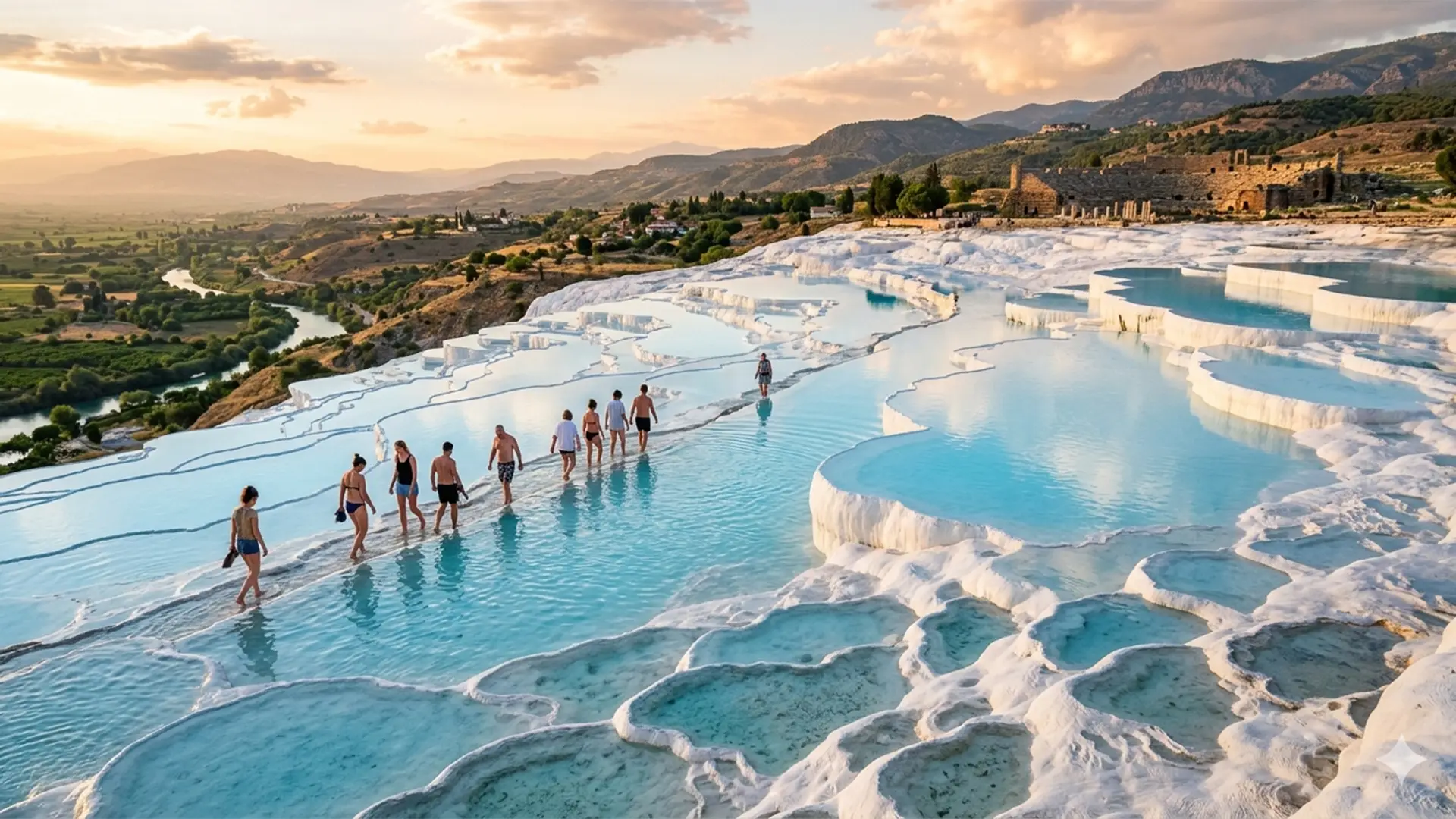
Browse guided experiences that combine Pamukkale’s natural beauty with the historic centre of Hierapolis.
View Daily Tours
Find ancient cities, sacred monuments, nature and heritage places across this remarkable region.
Explore the RegionDiscover Roman culture, remarkable archaeology and the changing religious history of the area.
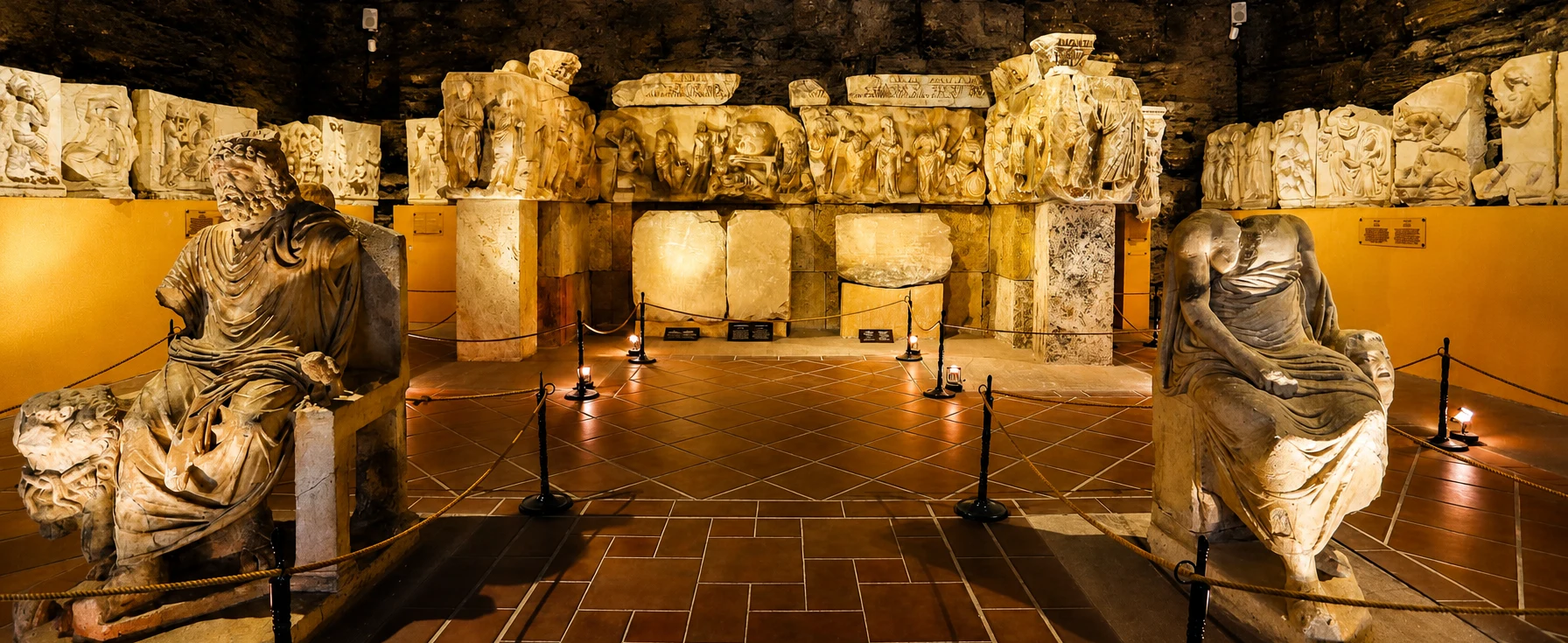
Understand the sculpture, material culture and religious life of ancient Hierapolis.
Visit the Museum Guide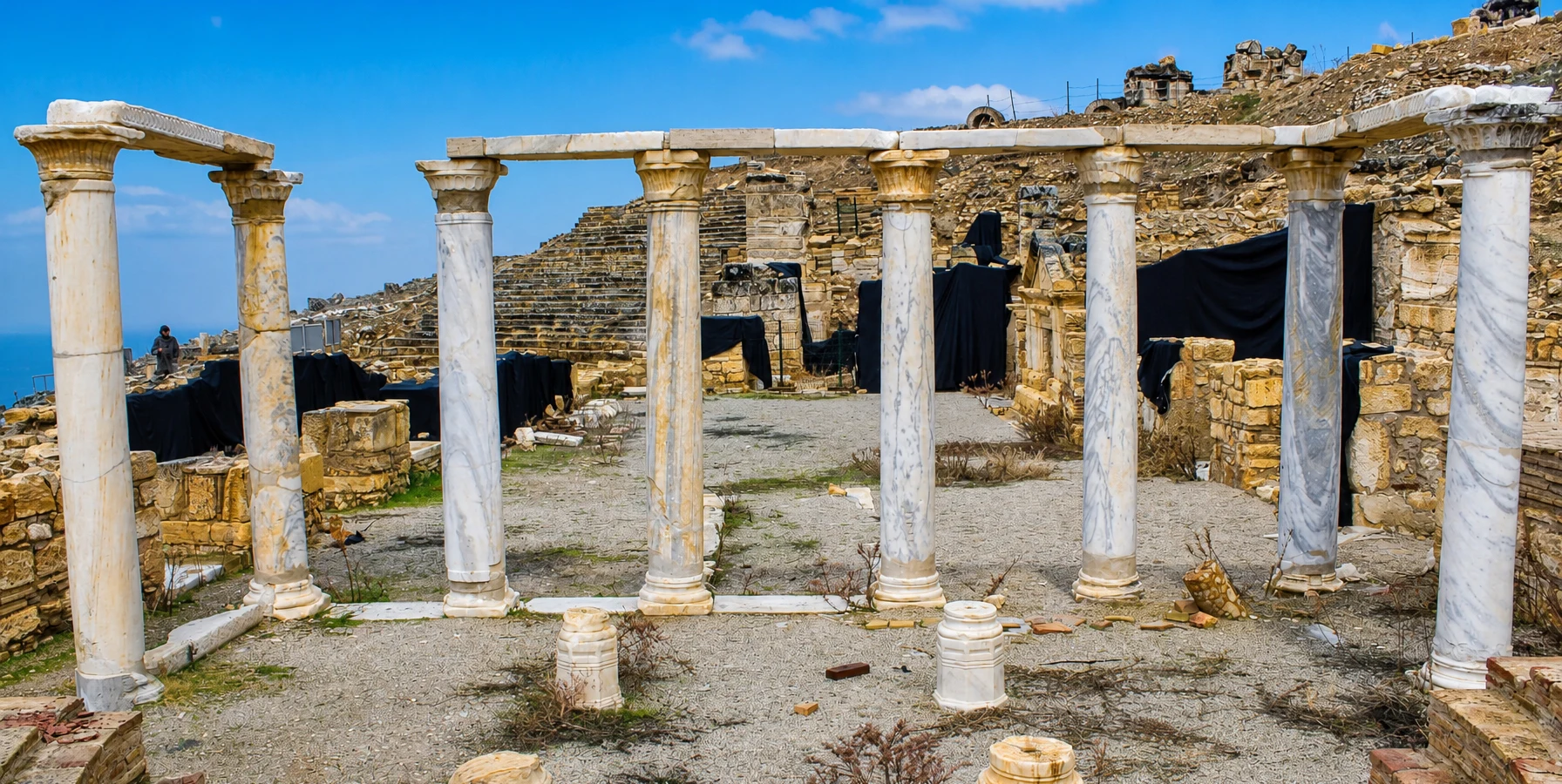
Explore a major Christian pilgrimage centre that followed the city’s earlier sacred traditions.
Explore the Martyrium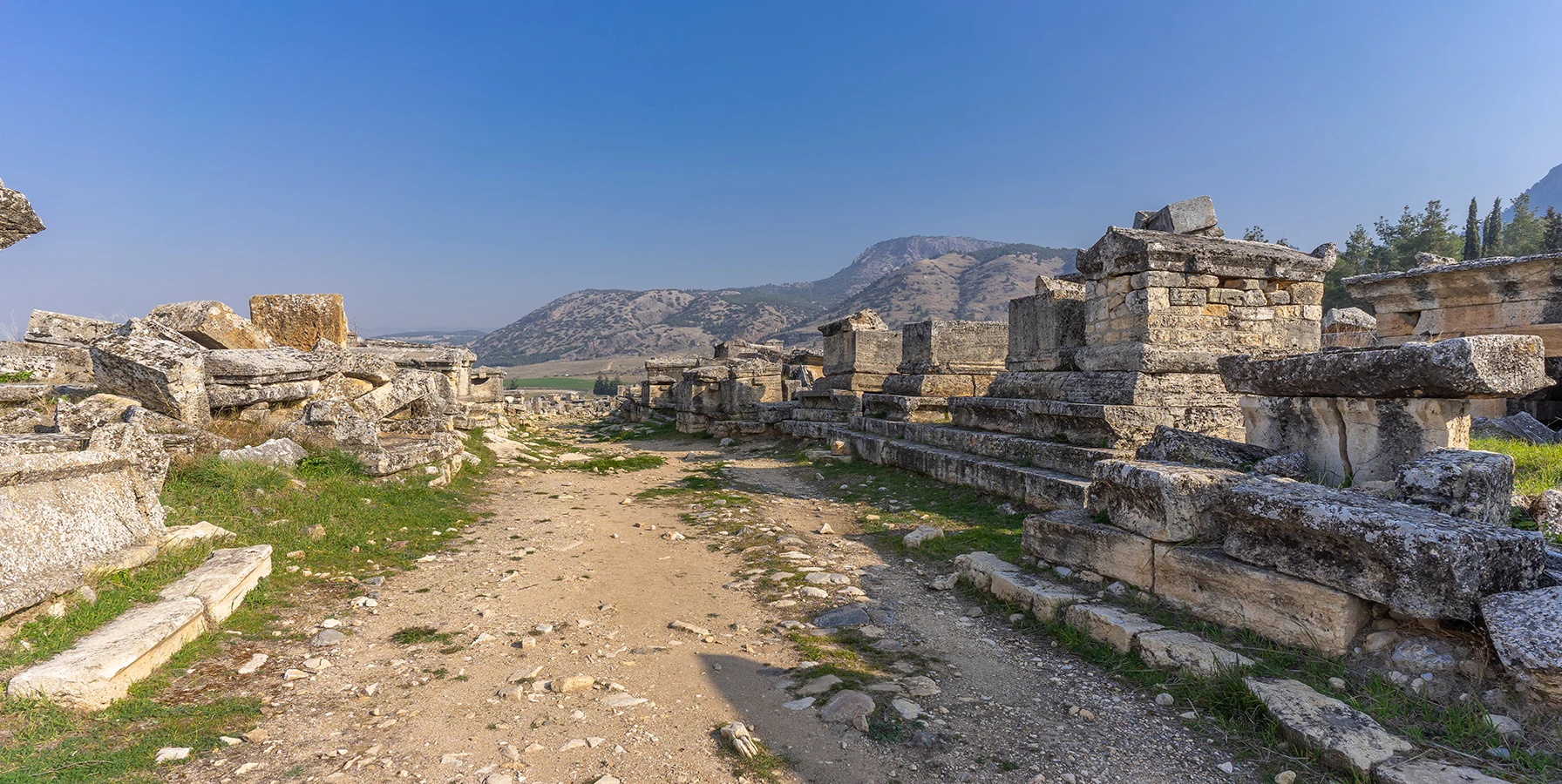
Walk the ancient burial road, studying sarcophagi and the lives recorded in their inscriptions.
Discover the Necropolis