Private Pamukkale & Hierapolis Tour
Enjoy a flexible private guided visit covering the necropolis, Roman Theatre, historic streets and the magnificent travertine terraces.
Explore Private Tour





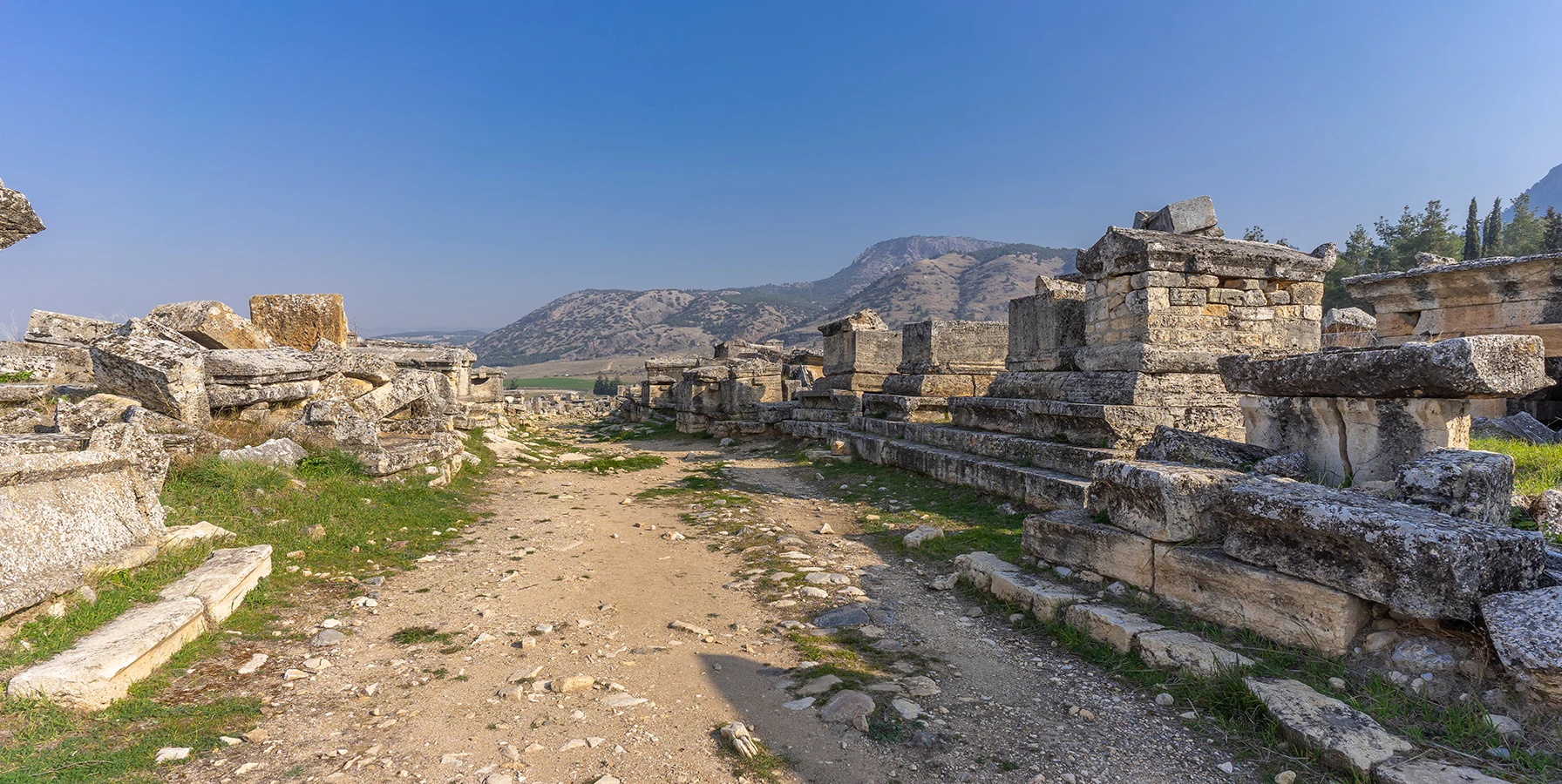
The Hierapolis Necropolis is one of the most remarkable surviving burial landscapes of the ancient world. Beyond the streets of Hierapolis Ancient City, near the white terraces of Pamukkale in Denizli Province, hundreds of visible sarcophagi, family mausoleums, tumulus mounds and house-shaped tombs line the approaches to the former Greco-Roman spa city.
The most impressive section is the Northern Necropolis, extending for roughly two kilometres along the ancient road toward Tripolis and Sardis. Other burial areas lay south and east of Hierapolis, reflecting a widespread ancient custom of placing graves outside the inhabited city. In the north, the unusual variety of monuments allows visitors to compare different centuries, architectural traditions and social groups in a single walk.
Hierapolis flourished through its thermal springs, commerce and religious importance. Its tomb inscriptions reveal merchants, families, professions, journeys and concerns about the protection of ancestral graves. One especially memorable epitaph belongs to Flavius Zeuxis, who recorded making seventy-two sea voyages around Cape Malea toward Italy.
The necropolis belongs to the Hierapolis–Pamukkale UNESCO World Heritage Site, inscribed in 1988. This guide explains the history, tomb types, major monuments, walking route, access arrangements, photography and how to combine the cemetery with Pamukkale’s terraces, theatre and archaeology museum.
Explore the burial grounds of the UNESCO-listed Hierapolis–Pamukkale landscape.
Compare sarcophagi, circular tumuli, chamber tombs and monumental family tombs.
Read about real merchants, families and communities recorded in Greek inscriptions.
Follow the old northern road toward the Gate of Domitian and the city centre.
Key details for exploring the ancient cemetery at Hierapolis in Pamukkale.
Inside the Hierapolis–Pamukkale archaeological site, north of the ancient city centre, Denizli, Türkiye.
Open on Google MapsLate Hellenistic, Roman and early Christian/Byzantine periods; burial monuments span many centuries.
The celebrated Northern Necropolis extends for approximately 2 km beside an ancient road.
Stone sarcophagi, earthen tumuli, chamber tombs and house- or temple-like family mausoleums.
Part of the ticketed Hierapolis–Pamukkale archaeological site; no separate necropolis ticket normally required.
Allow 45–75 minutes for a focused visit, or 90 minutes and more for a slower archaeological walk.
The necropolis is not merely a field of ruins: it is one of the best places in Anatolia to understand how ancient communities expressed memory, identity, wealth and family relationships.
In Greek, nekropolis means “city of the dead.” At Hierapolis, the cemeteries were intentionally placed beside the roads by which merchants, pilgrims and visitors approached the city. Monumental tomb façades therefore formed a visible introduction to the wealth and status of its inhabitants.
The huge northern burial zone preserves an exceptional range of funerary architecture. Low mounds recall older Anatolian and Hellenistic customs; decorated stone coffins reflect Roman taste; and elaborate tombs designed like miniature houses or temples show how families transformed burial plots into enduring monuments.
Equally important are the inscriptions. They can identify a deceased person, name relatives, record ownership of a tomb, threaten legal penalties for unauthorized burials and occasionally describe a career or journey. The grave of Flavius Zeuxis is a powerful reminder that Hierapolis was linked to maritime trade reaching the wider Mediterranean.
UNESCO specifically recognizes the necropolis as part of the exceptional Greco-Roman cultural landscape of Hierapolis and Pamukkale. Its more than two-kilometre spread provides a broad overview of ancient funerary traditions rather than one isolated monument.
Hierapolis developed as a thermal settlement under the Attalid rulers of Pergamon in the late 2nd century BC. Its healing springs and religious associations attracted residents and visitors, while roads connected the city with neighbouring centres across the Lycus Valley and western Anatolia. As the population and commercial life expanded, burial grounds spread along the routes beyond the settlement.
The earthquake of AD 60 devastated the city, which was substantially rebuilt under Roman rule. During the prosperous 2nd and 3rd centuries AD, local families commissioned sarcophagi, monumental façades and tomb compounds. Marble and limestone funerary architecture became part of the visual landscape around the northern approach.
Inscriptions were usually written in Greek, the predominant language of civic life in this part of Roman Asia Minor. A number of graves also preserve evidence associated with Jewish inhabitants. With the growth of Christianity, the city developed churches, episcopal buildings and distinctive pilgrimage traditions, yet the funerary landscape retained monuments from many earlier generations.
Earthquakes, stone reuse, burial disturbances and centuries of weathering changed the ancient cemetery. Modern archaeological study has documented individual monuments, inscriptions and tomb architecture, while conservation efforts seek to protect exposed masonry from further loss.
Hierapolis develops under Pergamene rule; burial areas begin expanding beyond the settlement.
Roman trade links appear in family inscriptions, including the famous account of Flavius Zeuxis.
A major earthquake damages Hierapolis; the Roman city is subsequently rebuilt.
Many richly built sarcophagi and monumental family tombs belong to the city’s flourishing Roman phase.
Christian Hierapolis develops its churches and burial traditions alongside earlier monuments.
Hierapolis–Pamukkale is added to the UNESCO World Heritage List as a combined cultural and natural property.
There is no single “typical” Hierapolis tomb. Differences in shape, material, size and decoration reflect changing customs and the resources of the families who commissioned them. The Northern Necropolis is especially rewarding because several building traditions survive close together.
The most conspicuous monuments are rectangular sarcophagi, or stone coffins, often crowned by heavy lids resembling pitched roofs. Some stand on high bases or within family enclosures. Others were placed near larger masonry structures, occasionally with carved ornament and inscriptions identifying their owners.
House tombs and temple-like mausoleums imitate living architecture. Doorways, pediments, pilasters, mouldings and occasionally multiple interior spaces give the impression of small permanent residences for the dead. Tumuli, by contrast, consist of burial chambers covered by rounded mounds of earth and stone, an older form that creates a very different silhouette in the landscape.
Heavy stone coffins, sometimes with pitched lids, carved inscriptions and a raised base.
Monumental burial chambers with façades resembling small dwellings, complete with doorways and architectural mouldings.
Elaborate family memorials using pediments, columns or other forms borrowed from sacred and civic architecture.
Mounded burials with stone retaining walls and chambers reached through a short entrance passage.
Burial spaces cut partly into natural rock, sometimes combined with masonry above ground.
Related burials grouped behind walls or around a larger monument, illustrating long-term family ownership.
Ancient Hierapolis had burial grounds beyond several edges of its inhabited centre, except for the famous western travertine slope. The Northern Necropolis is the best-known and most extensive public walking area; the southern and eastern zones complete the picture of a city surrounded by monuments to the dead.
The principal visitor route, lining the historic road toward Tripolis and Sardis and preserving tumuli, sarcophagi and monumental family tombs.
Tombs along the roads leading toward Laodicea and Colossae, reflecting connections with the wider Lycus Valley.
Additional graves and funerary remains around the ancient settlement, generally less prominent in standard visitor itineraries.
The northern approach on which travellers saw tomb monuments before reaching the Roman city’s gates.
The location of the cemeteries beyond the urban core reflects ancient civic and funerary customs.
Scattered monuments, surviving road alignments and open terrain make it easier to imagine ancient arrivals and departures.
The experience is most rewarding when you compare different monuments rather than simply photographing the largest one. Many individual structures are catalogued by archaeological tomb numbers, but signs and access to particular tombs can vary over time.
Follow the former approach to Hierapolis, with tomb monuments standing on both sides of the route.
Look for low circular burial mounds that contrast with the tall, rectangular Roman funerary buildings.
Study stone doorways, gables and cornices that give the tombs the appearance of small houses.
Near the northern monumental gate, discover the epitaph recalling an extraordinary series of Mediterranean voyages.
Search for surviving Greek lettering that records family names, tomb ownership and penalties for interference.
Some documented burial monuments preserve menorah or other Jewish symbols, evidence of the city’s diverse communities.
An often-discussed, temple-shaped burial monument whose raised form shows the ambition of elite funerary design.
Continue into the city through the monumental Roman gate, connecting the cemetery with the great urban street.
Unlike grand theatres and temples, a cemetery often preserves the names of people otherwise absent from history books. The inscriptions of Hierapolis are therefore essential evidence for its economy, family life, religion and social structure.
Titus Flavius Zeuxis, whose tomb stands near the northern gateway, recorded sailing around Cape Malea seventy-two times on voyages connected with Italy. His epitaph gives an unusually vivid impression of the dangerous journeys and trading networks that tied an inland Anatolian city to Mediterranean ports.
Other epitaphs describe family ownership or warn against reopening a grave. Some threaten a fine, invoke punishment or state who may be buried inside. Those texts reveal that a tomb was both a sacred memorial and a piece of property whose rights people wanted future generations to respect.
Several monuments and inscriptions also document Jewish life in Roman Hierapolis. Menorah motifs and related symbols are particularly important for understanding the religious diversity of the ancient city. Later Christian use of the urban landscape belongs to the next chapter of Hierapolis’s history, visible in churches and the sanctuary of St Philip.
The voyages of Flavius Zeuxis reveal an individual career linked to international trade.
Greek inscriptions often identify spouses, children, descendants and the people allowed to share a tomb.
Warnings and financial penalties express concern about unauthorized burials or disturbance.
Documented menorah carvings and inscriptions contribute to the history of Jewish communities in Roman Asia Minor.
Some inscriptions disclose what a person did in life, not merely when or where they were buried.
Conserved finds and inscription studies help interpret details too eroded to read on site today.
The necropolis is an extensive open-air archaeological landscape, not a compact museum courtyard. Its long paths, exposed stretches and uneven ground make footwear, water and realistic timing particularly important.
If the gate is operating, enter from the north and encounter the burial road before the busy central ruins.
Expect limited shade and a long walk between the main groups of monuments.
Ancient paving, loose stones, dry soil and uneven ground are easier with stable walking footwear.
Morning and later-afternoon light is gentler for both walking and photography; check final entry times.
Spend time examining shape, decoration, inscriptions and orientation instead of rushing along the road.
Fragile sarcophagi, chambers and tomb walls are not safe to climb or enter.
The theatre, monumental gate, museum and terraces are separate highlights requiring additional walking.
Approaches can be sloped and rough; a private transfer cannot necessarily enter the protected monumental zone.
If the modern North Entrance is open, begin there and follow the northern burial road southward. The varied tumuli, sarcophagi and family mausoleums become the introduction to ancient Hierapolis, much as they would have been for visitors approaching the Roman city.
Pause at particularly well-preserved house tombs and at the monument of Flavius Zeuxis, then reach the impressive Gate of Domitian. Beyond it, Frontinus Street and the surviving colonnades lead toward other Roman and Byzantine monuments. A nearby bath building, converted into a Christian basilica in Late Antiquity, illustrates the city’s changing religious life.
Continue toward the Roman Theatre, the Hierapolis Archaeology Museum and the Pamukkale travertine terraces. Travellers especially interested in early Christianity can add the Martyrium of St Philip, allowing extra time for its uphill approach and possible route restrictions.
The necropolis lies inside the Hierapolis–Pamukkale archaeological site and is generally included in the overall admission ticket rather than sold as a separate attraction. The official Turkish Museums visitor listing should be your primary source for current prices, opening hours and entrance arrangements.
At the time this guide was prepared in October 2026, the official visitor portal listed the Hierapolis–Pamukkale site as open daily from 08:00 to 20:00, with the ticket office closing at 18:00, and displayed a standard admission price of €30. These details may be revised, especially seasonally; confirm them before publication updates or travel.
The archaeology museum and any other managed facilities inside the complex can follow different hours or ticket arrangements. A separate official listing gives the Hierapolis Archaeology Museum its own opening and closing schedule. Access to some tomb interiors, conservation zones or individual paths may be restricted regardless of general site hours.
Most of the burial ground is exposed to the elements. The ideal time depends on the season, site opening times and the route you want to walk.
Greenery and moderate temperatures make the cemetery especially atmospheric for walking and photography.
Often comfortable for exploring monuments without the strongest summer heat.
Start early; exposed limestone, dry paths and limited shade can make midday tiring.
Warm side light reveals carvings and tomb façades, but leave time before the site’s closing restrictions.
Enjoy a quieter landscape, but expect possible rain, mud, wind and slippery stone.
Relief details can be more visible, while unpaved paths may require extra care.
A brief look at accessible tomb monuments near the southern end of the Northern Necropolis.
A satisfying introduction to the major tomb types and the ancient burial road.
A more thoughtful walk with time for photographs, inscriptions and selected monuments.
Explore much more of the two-kilometre northern route at a measured pace.
Combine the necropolis with Frontinus Street, the Gate of Domitian and central Hierapolis.
Add the Roman Theatre, Hierapolis Archaeology Museum, Martyrium of St Philip and Pamukkale terraces.
With its freestanding mausoleums, scattered sarcophagi and rolling hills, the necropolis offers a different visual experience from Pamukkale’s famous white terraces. Photograph slowly and avoid touching or climbing the ancient stone.
Use the line of the ancient road to reveal how tombs once greeted travellers arriving at Hierapolis.
Low rounded mounds make strong compositions against the hills beyond.
Photograph doorway carving, pediments, mouldings and carefully laid masonry.
Use oblique light to pick out letters; never rub, chalk or wet an inscription to make it clearer.
Seasonal vegetation creates gentle contrasts with weathered limestone and marble.
Do not enter tomb chambers, move stones or cross protective barriers for a camera angle.
The Northern Necropolis is a historic open-air route with irregular paving, dirt sections, stones and occasional changes in level. Some visitors can appreciate tombs from more accessible stretches, but the entire route should not be assumed to be wheelchair-friendly or step-free.
Uneven stones and historic paving can be difficult for mobility aids and visitors with balance concerns.
The main burial road is roughly two kilometres; consider a shorter out-and-back visit.
Strong sun, wind and wet stone add to fatigue and slipping risks.
Accessible entry and permitted vehicle or shuttle services may change; confirm with site management.
Large wheels are preferable to small compact wheels on irregular ground; some sections may remain impractical.
Plan breaks near managed visitor areas because seating and shade are not continuous along the burial road.
The necropolis is not a separate roadside museum: it is a section of the extensive Hierapolis archaeological park. Choose an entrance that fits your route and consider the distances within the protected site before you arrive.
Follow the local access routes to the main archaeological-site entrances; the most convenient gate depends on your starting point.
Usually the most natural starting point if the Northern Necropolis is your first priority and that gate is open.
You can visit central Hierapolis first, then continue north past the Gate of Domitian toward the burial monuments.
Travel by local transport, taxi or private transfer to the official Hierapolis–Pamukkale entrance of your choice.
A guide can structure the walk around tombs, inscriptions, the theatre, the museum and travertine terraces.
The protected monumental area is primarily explored on foot; check whether any internal shuttle service is operating.
The necropolis is best visited as part of a wider exploration of the ancient city and the natural formations that made Pamukkale famous. These nearby sites are complementary rather than duplicates: each reveals a different dimension of Hierapolis.
Walk the permitted sections of the extraordinary white calcium terraces that formed beside the ancient spa city.
Explore sculpture, inscriptions and objects recovered from the ancient city and surrounding region.
Discover the octagonal pilgrimage sanctuary associated with one of early Christianity’s most important local traditions.
Combine the tombs, monuments and travertines in a private experience tailored to your interests.
Continue across the Lycus Valley to another major Roman and early Christian city.
Follow the regional history of the roads leading north from Hierapolis.
Find more archaeology, natural landscapes and cultural experiences around Denizli.
Explore regional history and the wider cultural setting of the ancient landscape.
It is the extensive ancient cemetery of Hierapolis, with sarcophagi, burial mounds and monumental tombs dating from the Hellenistic, Roman and early Christian periods.
The best-known Northern Necropolis lies inside the Hierapolis–Pamukkale archaeological site, north of the ancient city centre in Denizli Province, Türkiye.
Necropolis comes from Greek and literally means “city of the dead.” It describes a large cemetery or burial area with many graves and monuments.
Hierapolis was an important, long-lived thermal, religious and commercial city. Its burial grounds developed over centuries along major roads, serving residents and different communities.
Descriptions commonly refer to more than a thousand visible or recorded tombs, while broader counts of the necropolises run higher. The exact number depends on the area and type of burial counted.
The main northern burial area extends for approximately two kilometres along the ancient road toward Tripolis and Sardis.
Look for stone sarcophagi, circular tumuli, rock-cut or chamber tombs and monumental family mausoleums resembling houses or small temples.
Burial monuments represent several centuries from the late Hellenistic era through Roman times and into the early Christian period.
He was a Hierapolis merchant remembered by a Greek inscription recording seventy-two voyages around Cape Malea in the direction of Italy.
Its monument is associated with the northern gateway area. Check current signage and visitor access, as conservation work may affect individual paths.
Yes. Archaeologists have documented funerary inscriptions and tomb decorations with Jewish symbols, including menorahs, which illuminate the city’s religious diversity.
Hierapolis became an important early Christian pilgrimage centre associated with St Philip. The Martyrium of St Philip is a separate monument within the wider archaeological site, not one of the ordinary necropolis tombs.
It is a Roman funerary relief associated with Marcus Aurelius Ammianos showing a water-driven stone-sawing mechanism. Ask the archaeology museum whether the surviving piece is currently displayed.
Yes. It is part of the combined Hierapolis–Pamukkale UNESCO World Heritage Site, inscribed in 1988.
Normally no. The necropolis is included in the ticketed Hierapolis–Pamukkale archaeological area; check the official ticket site for current arrangements.
The necropolis follows archaeological-site access arrangements. The official visitor portal listed 08:00–20:00 with ticket office closure at 18:00 when this guide was prepared in October 2026; confirm before travelling.
The modern North Entrance is usually convenient for a north-to-south visit, provided it is operating. The ancient Gate of Domitian is farther along the walking route.
Plan 45–75 minutes for selected monuments, or longer if you want to walk the full northern burial road and examine inscriptions in detail.
Do not enter burial chambers unless explicitly authorized. Many are fragile, unstable or closed for conservation even when they appear open.
Accessibility is uneven. Ancient paving, slopes, loose stones and long walking distances make the full route challenging; contact the site in advance for the best accessible options.
Yes for families comfortable with walking and with appropriate supervision. Keep children on designated paths and away from unstable stone structures.
Yes. The necropolis, Roman city and travertine terraces form part of the same large visitor area. Allow several hours and plan the order to suit the entrance you use.
Spring and autumn are generally pleasant for an outdoor archaeological walk; early mornings are preferable during hot summer weather.
Absolutely for travellers interested in archaeology, Roman society, inscriptions and the history behind Pamukkale. The human stories and variety of tombs make it one of the city’s most distinctive sights.
Avoid stepping across low walls, fragile foundations or areas fenced off for conservation.
Sarcophagus lids, pediments and ancient masonry can shift or break under weight.
Respect closures and avoid penetrating burial spaces that may be unsafe or archaeologically sensitive.
Never rub, trace, wet, chalk or touch carved letters and symbols.
Do not move stones, pick up pottery fragments or remove anything from the site.
Treat the cemetery as a burial landscape, not merely as a dramatic backdrop for photographs.
Explore the northern burial road, the monumental gates and the ancient spa city with a licensed guide. Our private tours are designed around your interests and include no compulsory shopping stops.
Choose an in-depth archaeological visit or combine the most important ruins with Pamukkale’s famous natural landscape.
Enjoy a flexible private guided visit covering the necropolis, Roman Theatre, historic streets and the magnificent travertine terraces.
Explore Private Tour
Compare guided daily experiences and practical options for exploring Hierapolis and the famous white terraces.
View Daily Tours
Find ancient cities, thermal landscapes, museums and lesser-known places to enrich your visit to the region.
Explore the RegionGo beyond the tombs to discover Roman urban life, Christian pilgrimage and nearby ancient cities.
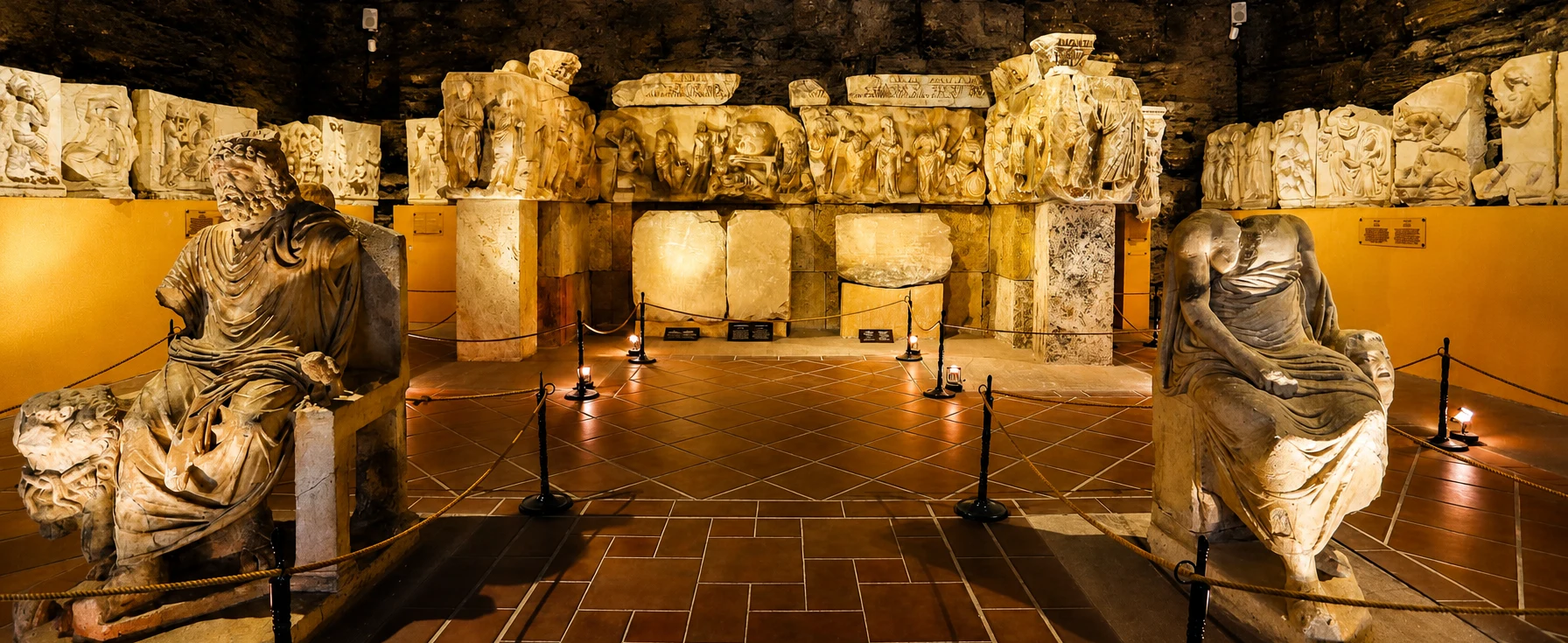
Learn about the people of Hierapolis through sculpture, inscriptions and objects recovered from the ancient city.
Visit the Museum Guide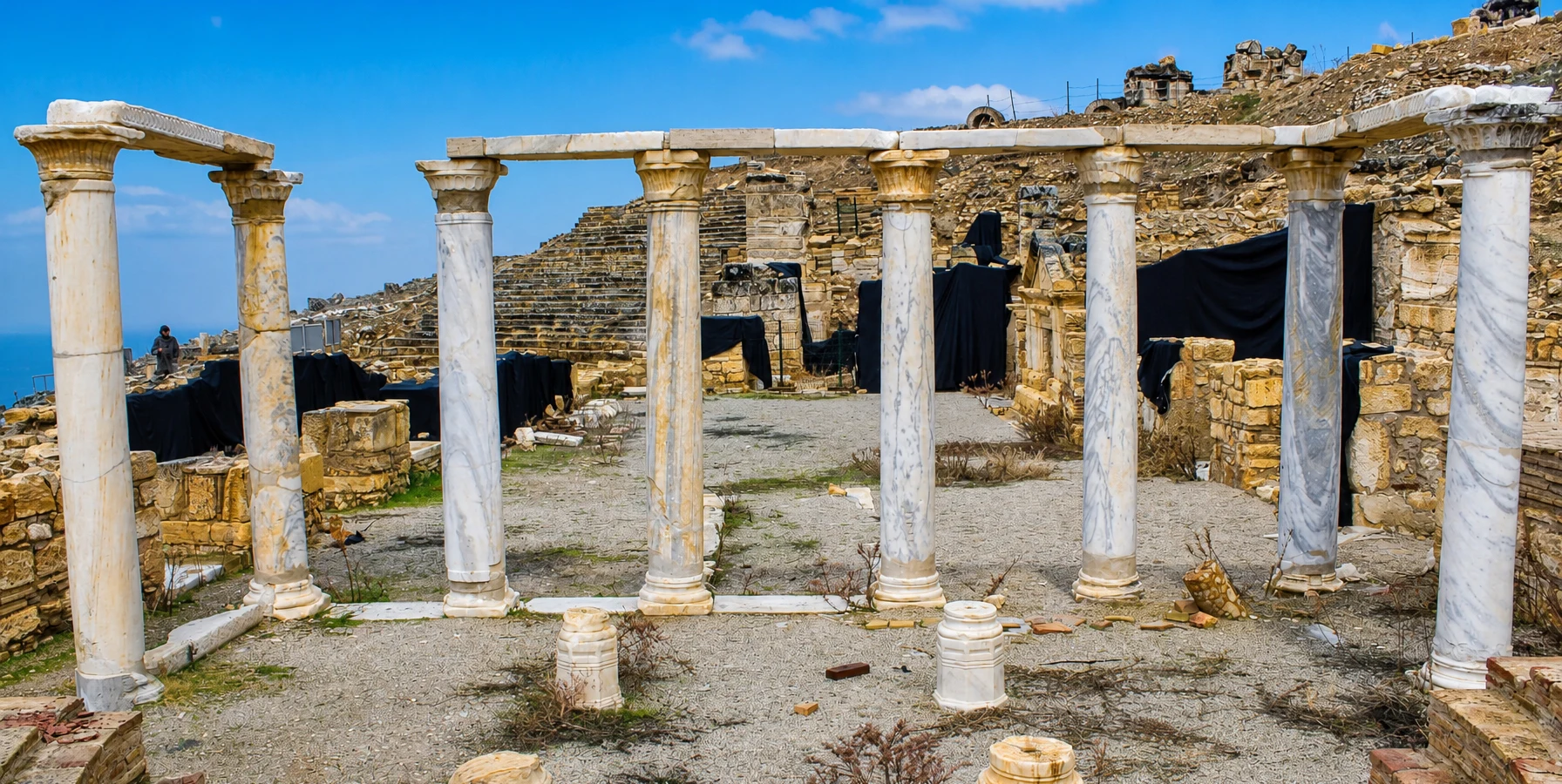
Discover the remarkable early Christian sanctuary and pilgrimage history above the ancient city.
Explore the Martyrium
Explore monumental streets, theatres and early Christian history at another important city of the Lycus Valley.
Discover Laodicea