
Private Pamukkale & Hierapolis Tour
Visit the Martyrium, ancient theatre and Pamukkale terraces at a comfortable pace.
Request a Private Tour





St. Philip Martyrium (also spelled Martyrion of St. Philip or Aziz Philippus Martyrionu) is one of the most extraordinary Early Byzantine monuments at Hierapolis–Pamukkale in Denizli province, Türkiye. Its surviving walls form a monumental octagon surrounded by chapels, halls and rooms on a hillside overlooking the ancient city.
Christian tradition links Hierapolis to Philip the Apostle, one of the Twelve. The fifth-century Martyrium commemorated the place associated with his martyrdom and became the ceremonial destination of pilgrims. It is not the same building as the nearby three-aisled tomb church, where excavations in 2011 revealed a revered first-century Roman tomb interpreted by researchers as the long-sought burial place associated with Philip.
The wider sanctuary once included a city gate, bridge, monumental stairway, bathing complex, sacred fountain, burial church and octagonal shrine. The landscape tells a story of worship, pilgrimage, healing traditions, architectural symbolism and the transformation of a Roman spa city into a Christian centre.
This carefully researched guide explains who Philip was, how the buildings differed, what archaeologists discovered, the eight-sided architecture, the ancient pilgrim route, visiting hours, tickets, walking conditions and how to include the ruins in a private Hierapolis itinerary. Practical details were reviewed in October 2026 and should be checked before travel.
The octagonal Martyrium was built.
An exceptional geometric sanctuary.
The tomb church discovery.
Part of Hierapolis–Pamukkale.
Essential history and practical details for the archaeological sanctuary at Hierapolis.
Hillside in the Hierapolis archaeological site, Denizli.
Open on Google MapsEarly fifth-century Byzantine sanctuary.
St. Philip the Apostle (by tradition).
Central octagon with surrounding chapels and rooms.
Nearby tomb church built around a Roman tomb.
Within the UNESCO Hierapolis–Pamukkale property.
Pamukkale site ticket: €30 for foreign visitors in Oct 2026.
Uphill paths, uneven stone and exposed terrain.
About 45–90 minutes for this area, depending on access.
Many guests arrive at Pamukkale to see white travertines and the great Roman theatre, yet the St. Philip complex reveals another identity of Hierapolis: a Christian city of pilgrimage. The ruins preserve the layout of a carefully designed sacred landscape rather than a single isolated chapel.
The octagonal monument is remarkable for its geometry. Nearby, the 2011 tomb-church discovery changed the understanding of where the saint’s burial was venerated. The two monuments can be studied together without confusing a commemoration of martyrdom with a place of burial.
Visit for apostolic history, Early Byzantine architecture, Christian symbols, panoramic scenery and archaeological storytelling. Its hillside setting feels markedly different from the busiest areas of Pamukkale.
Associated with an apostle.
Rare octagonal sanctuary.
A significant 2011 discovery.
An ancient ritual route.
Quiet elevated ruins.
Martyrium and tomb church.
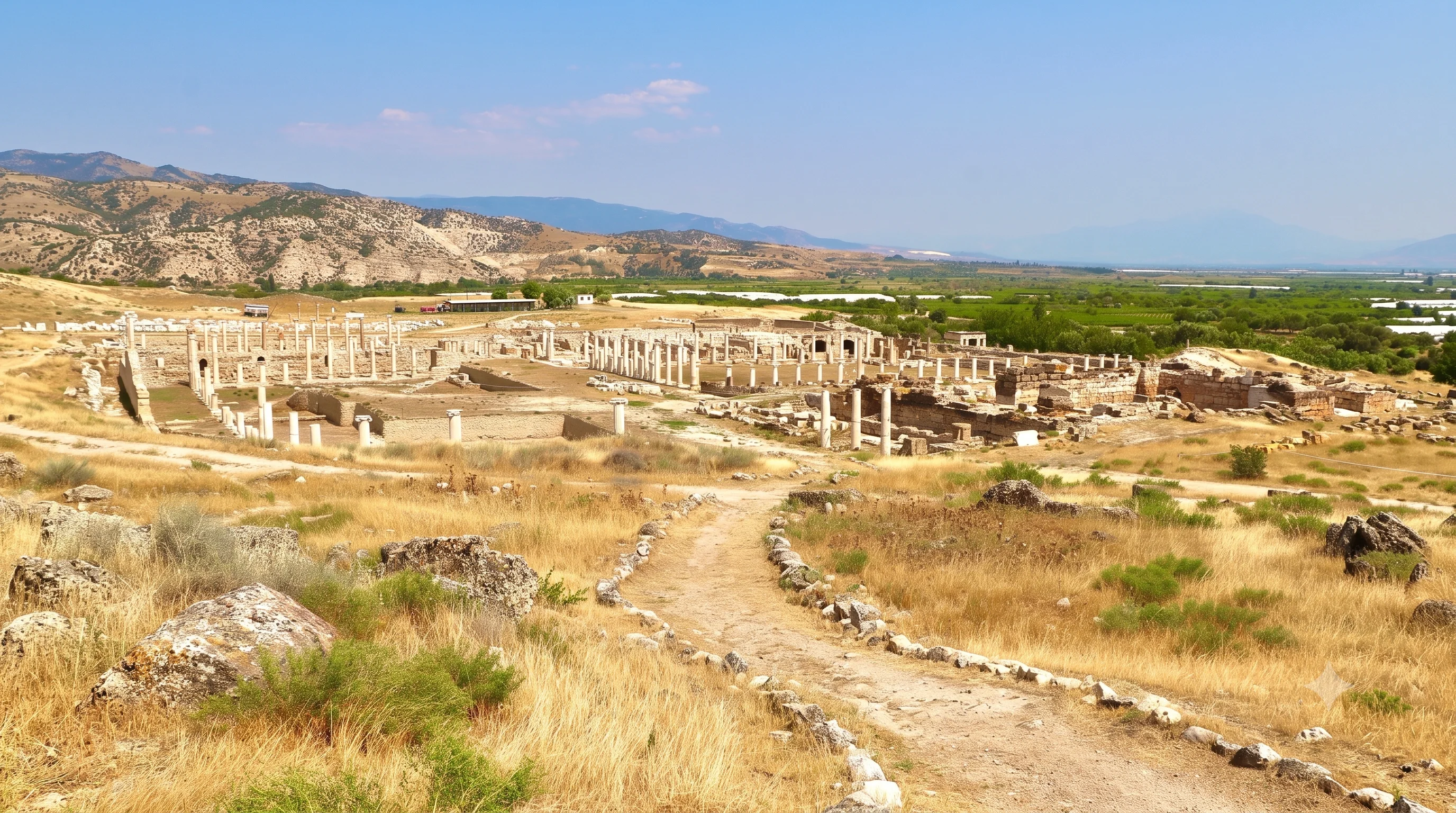
The Martyrium stands on a hill on the eastern side of Hierapolis, within the extensive archaeological landscape of Pamukkale, Denizli province. It is an open-air ancient monument, not a functioning modern parish church or a museum in Denizli city centre.
The pilgrimage sanctuary developed on terraces beyond the Byzantine city wall. In antiquity visitors approached the hill along a ceremonial route with a gate, bridge and staircase. Today guests should follow signed and permitted archaeological paths, as routes can change during conservation.
Use the map search “St Philip Martyrium Hierapolis” or “Aziz Philippus Martyrionu” for orientation; choose your actual site entrance with the staff or guide rather than expecting a separate road entrance to the Martyrium.
Denizli, Türkiye.
Hierapolis–Pamukkale.
Eastern hillside.
Open-air archaeology.
Walk within the site.
Reach an official Pamukkale gate.
Philip is listed among Jesus’s Twelve Apostles in the New Testament. The Gospel of John gives him a distinct voice: Jesus calls him (John 1:43–46), questions him before the feeding of the crowd (John 6:5–7), and answers his request to see the Father (John 14:8–9).
Later Christian traditions describe Philip preaching far beyond Galilee and eventually reaching Hierapolis in Phrygia. His connection with the city is preserved by early Christian authors and became central to local religious identity.
The Gospel episodes are biblical texts; details of Philip’s later travels and martyrdom come from historical Christian tradition rather than a continuous contemporary biography. Distinguishing these kinds of evidence adds depth to a guided visit.
One of the Twelve Apostles.
Especially prominent in John.
John 1:43–46.
John 6:5–7.
John 14:8–9.
Connected with Hierapolis.
Readers sometimes encounter Philip the Apostle and Philip the Evangelist as if they were automatically the same person. The New Testament distinguishes Philip of the Twelve from the figure known in Acts as Philip the Evangelist, one of the Seven (Acts 6; Acts 8; Acts 21:8–9).
In Acts 21, Philip the Evangelist is said to have four daughters who prophesied. Some later traditions and discussions of women associated with Philip at Hierapolis have contributed to confusion between the two figures.
The sanctuary in Hierapolis is traditionally dedicated to Philip the Apostle. Its identification rests on a long history of devotion and historical interpretations, not a claim that every biblical reference to “Philip” must describe the same man.
Apostle in the Gospels.
Evangelist in Acts.
Describes the Evangelist’s daughters.
Sometimes overlap.
Traditionally the Apostle.
Separate the historical sources.
According to the Christian tradition associated with Hierapolis, Philip preached in the city and was martyred, with accounts commonly describing crucifixion. UNESCO and the Turkish cultural authorities place the traditional event in the late first century AD, often around AD 80.
Some later versions of the story add dramatic details about the manner of crucifixion, confrontations with local religious practice, or miraculous events. These stories should be presented as hagiographical tradition, not proven archaeological facts.
The fifth-century monument was built centuries later to honour the remembered place of his death. That distinction explains why the site’s historical importance does not depend on our ability to reconstruct every detail of the first-century event.
Christian martyrdom tradition.
Late first century AD.
Death by crucifixion.
Tradition and later authors.
Early fifth century.
Avoid treating legend as proof.
One of the earliest influential references comes from Polycrates, bishop of Ephesus, writing near the end of the second century AD. In a discussion of church traditions, he refers to Philip, one of the Twelve, as having “fallen asleep” in Hierapolis.
The church historian Eusebius of Caesarea, writing in the early fourth century, preserved accounts associated with Polycrates and other early Christian witnesses. These texts matter because the Hierapolis link was remembered long before the great Byzantine monument was built.
Ancient references to Philip and his daughters also illustrate the complexity of apostolic traditions. They are valuable historical testimony to a local cult of memory, but by themselves do not independently establish how or exactly where the apostle died.
Bishop of Ephesus.
Late second century.
Hierapolis.
Early fourth-century historian.
Early testimony to veneration.
Text is not physical identification.
Hierapolis first became famous for its mineral springs and monumental urban architecture. Following the growth of Christianity and the religious transformations of the fourth century, the city developed an important network of churches and ecclesiastical buildings.
Within this changing landscape, the hill of St. Philip emerged as a major focus of pilgrimage. The route, tomb church, ceremonial shrine and water-related features combined remembrance of a saint with ritual movement across a city.
UNESCO recognises the fourth- to sixth-century Christian monuments of Hierapolis as an exceptional group. Visiting the Martyrium alongside the ancient theatre and Roman streets helps explain a city that continued to change after the classical period.
Thermal resort and civic monuments.
Fourth century onward.
New churches and shrines.
Pilgrimage destination.
St. Philip Martyrium.
Recognises Christian architecture.
The hill had been used for Roman funerary monuments before its transformation into a Christian sanctuary. Following major changes to Hierapolis in Late Antiquity, monumental religious building took place from the late fourth to early fifth century.
The octagonal Martyrium dates to the early fifth century AD, with associated buildings, stairs and pilgrimage facilities developing around the sacred route. The hill remained significant in later Byzantine centuries, even as earthquakes and changes in settlement damaged structures.
Modern excavation by the Italian Archaeological Mission at Hierapolis deepened knowledge of the ensemble. In 2011 researchers brought to light the tomb church associated with a revered Roman tomb, reshaping interpretations of the site.
Necropolis on the hillside.
Christian urban rebuilding.
Octagonal Martyrium.
Pilgrimage and alterations.
Tomb church identified.
Protected archaeological remains.
In 2011, archaeological work directed by Francesco D’Andria revealed a three-aisled church on a terrace below the famous octagonal Martyrium. Its arrangement centred on a surviving Roman funerary chamber dating to the first century AD.
The discovery was significant because archaeologists had long expected the burial associated with Philip to lie beneath the central octagonal monument. Excavation and investigations there had not demonstrated such a tomb; the newly discovered burial church offered a stronger architectural explanation for where later pilgrims venerated the saint’s grave.
The Roman tomb is identified by archaeological interpretation and local Christian tradition as the one revered as Philip’s. The discovery does not amount to scientific verification of the apostle’s individual remains, and visitors should not confuse the tomb church with the Martyrium itself.
2011.
Italian archaeological mission.
Francesco D’Andria.
Three-aisled burial church.
Earlier Roman tomb.
Revised shrine interpretation.
The Martyrium is the large octagonal commemorative building at the top of the hillside. Archaeologists interpret it as honouring the place traditionally associated with Philip’s martyrdom.
The tomb church, on a nearby terrace, is a basilica built around a Roman burial venerated by Christian pilgrims. Its position and construction suggest a focus on the place where the saint was believed to rest.
Some older visitor descriptions say Philip’s grave was at the centre of the octagonal building. The detailed official excavation account describes why this older hypothesis changed after the 2011 research. For accurate storytelling, regard these as two connected but distinct monuments.
Commemorates martyrdom.
Octagonal complex.
Commemorates burial.
Three-aisled basilica.
Neighbouring terraces.
2011 excavations.
The complex is built around a large central octagon, from which spaces open outward in a carefully organised composition. Eight rectangular chambers, polygonal chapels and triangular connecting spaces turn the centre into a complex geometric whole.
A surrounding square overall layout and peripheral rooms framed the shrine. Archaeological plans reveal the relationships between passageways, ceremonial spaces and rooms intended to accommodate visitors or support sanctuary activities.
UNESCO specifically highlights this octagonal organisation as one of the defining achievements of Hierapolis’s Early Christian monuments. Although upper structures have disappeared, the surviving foundations still make its spatial design legible.
Central octagon.
Rectangular rooms.
Polygonal forms.
Triangular chambers.
Square enclosure.
Rare Early Byzantine design.
The number eight is fundamental to the shrine’s geometry: an eight-sided core is joined to a sequence of surrounding spaces. The design may look almost like an architectural diagram when viewed from above.
In Christian symbolism, the eighth day could evoke Resurrection, renewal and the life beyond the ordinary seven-day week. Octagonal structures occur in Early Christian baptisteries and commemorative buildings for this reason.
At Hierapolis the architecture offers a possible theological reading, but exact choices made by the original designer cannot be recovered with certainty. The interpretation is most valuable when paired with the physical remains and the wider practice of Christian pilgrimage.
Eight.
Octagon.
Resurrection and renewal.
Early Christian baptisteries.
Martyr commemoration.
Symbolic reading, not inscription.
The octagonal core communicated with eight surrounding rooms, through arched arrangements carried by columns. Other angular spaces, subsidiary chapels and corridors filled the plan within its square outer boundary.
The peripheral rooms probably had several functions connected with the sanctuary: movement, gathering, prayer, hospitality and—in interpretations of the excavators—healing-related devotional practices. A single function should not be imposed on every surviving room.
When you walk among the low walls, notice how the plan channels attention inward toward the central sacred space while still allowing people to circulate around it.
One monumental octagon.
Eight direct chambers.
Chapels and passages.
Rooms for sanctuary activity.
Multiple circulation routes.
Foundations and masonry.
The original shrine was far richer than its present low walls suggest. The official descriptions discuss marble columns with carved capitals, arched openings and paved floors with different finishes across the complex.
Archaeological interpretations describe the central space as covered, with a roof or dome structure, while adjacent areas included mosaic and travertine surfaces. The exact original upper appearance is reconstructed from surviving evidence rather than preserved intact.
Look for column bases, changes in paving, stone joints and surviving architectural fragments. Avoid assuming every block still lies in its original position, because ruins have experienced earthquakes, reuse and conservation.
Marble structural elements.
Decorative carved stone.
Arcades and passages.
Marble, mosaic and stone.
No longer standing.
Based on archaeology.
In the Early Byzantine period, a visit to St. Philip’s sanctuary involved more than entering one church. Pilgrims moved from the city through a dedicated gate, across a bridge and uphill along a monumental stairway, passing facilities associated with washing and preparation.
Nearer the upper terrace, a sacred fountain marked another stage of approach. The tomb church and the octagonal Martyrium occupied successive parts of the hillside complex, creating a striking sequence of places and viewpoints.
This design helped turn movement itself into a devotional experience. Modern paths need not duplicate the ancient ritual route exactly; follow the presently marked access and do not attempt to cross restricted archaeological features.
Approach from the city.
Dedicated pilgrimage access.
Ancient bridge.
Monumental staircase.
Bath and fountain.
Church and Martyrium.
The St. Philip Gate formed part of Hierapolis’s Late Antique fortification system. The official sanctuary description connects it with the wall built around the period of Emperor Theodosius at the end of the fourth century.
Flanking towers emphasised the importance of this access point. From here pilgrims moved beyond the fortified city toward the sacred complex on the higher ground.
The gate demonstrates the integration of religious travel into the new urban geography of Christian Hierapolis; the sanctuary was linked to the city but stood beyond its late Roman wall.
St. Philip Gate.
Late Antique city wall.
Late fourth century.
Gate with flanking towers.
Pilgrimage access.
Ancient bridge.
Visitors in antiquity needed to cross a small valley cut by seasonal water before reaching the hillside shrine. An ancient bridge, dated in the archaeological account to around the late fourth or fifth century, carried the ceremonial route across this obstacle.
The surviving remains are fragmentary, but the evidence suggests a substantial masonry crossing. Modern conservation and visitor infrastructure should not be mistaken for the bridge’s original complete form.
This crossing is a reminder that a major sacred destination required practical engineering as well as beautiful buildings: without safe access, the pilgrimage route could not function.
Pilgrimage bridge.
Cross the valley.
Late fourth to fifth century.
Monumental stonework.
Partial archaeological remains.
Use designated crossings.
Archaeologists have documented an impressive stairway about 70 metres long and roughly four metres wide in its earlier phase. It climbed the hillside along a supported terrace and helped pilgrims overcome a substantial change in elevation.
The stairs were built using travertine stone, linking the sacred route to the geology and building traditions of Hierapolis. Changes and later construction affected the original width and appearance.
The ancient staircase illustrates the physical commitment involved in pilgrimage. Modern visitors should prepare for uphill walking and irregular ground without assuming that every ancient step remains open for use.
Approx. 70 metres.
Approx. 4 metres.
Travertine.
Terraced hillside.
Narrowing and modifications.
Follow current site paths.
A second octagonal building existed lower on the pilgrimage route. Unlike the hilltop Martyrium, this was a bath structure, described by archaeologists as a place where travellers could wash before proceeding to the sacred precinct.
Excavated spaces include features interpreted as changing areas and bathing rooms, as well as evidence for heated floors and water installations. This makes it possible to distinguish an octagonal bath from the completely different octagonal commemorative church.
The complex belongs to a long story of bathing in Hierapolis: the famous thermal city’s relationship with water continued in a new Christian pilgrimage context.
Octagonal bath.
Lower pilgrimage route.
Washing and preparation.
Bathing and changing spaces.
Ancient heating system.
Not the hilltop Martyrium.
The official archaeological account identifies a fountain, or ayazma, near a small open gathering area on the way to the upper shrine. Pilgrims could approach water before continuing toward the tomb church and Martyrium.
The fountain was part of the sanctuary’s carefully sequenced experience. Water connected the physical preparation of travellers with ideas of cleansing, healing and sacred approach.
The surviving features should be treated as archaeological evidence; they do not guarantee a working water source for today’s visitors. Carry your own drinking water for the walk.
Ayazma – sacred fountain.
Open area on pilgrim route.
Washing / preparation.
Near tomb church access.
Ancient hydraulic network.
Archaeological feature, not service.
The tomb church excavated in 2011 was built around an earlier burial monument within a Roman funerary zone. Excavation studies describe a three-aisled basilica, approximately 35 metres long and 20 metres wide.
Its plan included a western entrance area, aisles divided by supports and a liturgical eastern end. The official description explains how pilgrims approached the burial chamber and the platform associated with it.
Rather than being a separate minor chapel, the building formed a carefully composed destination in its own right. Its discovery provides crucial evidence for the devotion focused on a particular Roman tomb.
Three-aisled basilica.
Approx. 35 × 20 metres.
Narthex and access route.
Earlier Roman tomb.
Excavations in 2011.
Burial veneration.
Inside the burial church was a Roman-period tomb with a façade and chamber, built of travertine blocks and dated in the official excavation account to the first century AD. It stood at the centre of later Christian attention.
The chamber had funerary installations along its sides. Researchers also documented graffiti and holes in the façade associated with later votive activity, showing that the tomb was not merely an architectural relic; it was a place where people expressed devotion.
The identification as St. Philip’s tomb rests on the convergence of the shrine’s historical tradition, the building around it and archaeological interpretation. It is accurate to call it the tomb venerated as Philip’s, rather than a scientifically proven identification of the apostle’s remains.
First century AD (tomb).
Travertine blocks.
Funerary chamber.
Graffiti and votive traces.
Christian pilgrimage.
Historical / archaeological inference.
The detailed archaeological account highlights a sixth-century bronze seal found at Hierapolis that represents Philip between two structures: the dome-associated Martyrium and a church with a pitched roof.
The image is important because it reflects the sanctuary as a complex of linked sacred buildings rather than one single monument. It also helps researchers interpret the relationship between the burial church and the ceremonial octagon.
Ancient objects can clarify architecture, but symbolic representations should not be treated as exact engineering drawings. A guide can help explain how the imagery relates to what remains visible on the hillside.
Bronze seal.
Sixth century.
St. Philip.
Martyrium and church.
Evidence of two monuments.
Symbolic, not measured plan.
The sanctuary was more than a memorial. The official excavation presentation discusses healing-related practices associated with pilgrims’ veneration of the saint, water installations and spaces where travellers could spend time.
Researchers also compare the complex with other Byzantine healing sanctuaries where incubation—sleeping in a sacred place in hope of help, a dream or healing—formed part of devotional practice. This is a historical account of belief and ritual, not a modern medical claim.
The combination of bath, fountain, burial church and Martyrium makes the site a fascinating study of how spiritual expectation and the city’s older association with thermal water could intersect.
Veneration of St. Philip.
Washing and sacred fountains.
Documented devotional tradition.
Sacred sleep interpretation.
Early Byzantine Christianity.
Not a health treatment.
Hierapolis lies in an earthquake-prone region. The archaeological narrative describes major changes after destructive events, including damage affecting pilgrimage buildings and alterations to the ancient circulation route.
Parts of the complex were modified or reused during Middle Byzantine centuries. Archaeological evidence indicates that religious significance and use did not disappear all at once when monumental structures were damaged.
What survives today is therefore the product of construction, disaster, repair, adaptation and modern archaeological research. The walls are evidence of a long history, not a single frozen moment in the fifth century.
Earthquakes.
Baths, stairs and shrine.
Middle Byzantine reuse.
Altered pathways.
Excavation and conservation.
Several chronological layers.
Even when a monument has lost its upper walls, careful observation reveals its character. At St. Philip, look for the octagonal centre, column supports, traces of paving, adjoining chapels and the overall geometric order.
Christian architecture often communicates through orientation, procession, sacred centres and imagery as much as through surviving statues or paintings. The layout helped distinguish spaces for gathering, movement and devotion.
You may encounter reconstructed interpretations of crosses, architectural decoration and liturgical furnishings. Use site labels and archaeological evidence rather than assuming that every loose carved block belongs exactly where it now lies.
Eight-sided central room.
Bases and capitals.
Paving and mosaics.
Entrances and corridors.
Liturgical / memorial spaces.
Walk with a specialist guide.
St. Philip appears in many Byzantine and later Christian images, often within compositions of the Twelve Apostles. Paintings and icons may distinguish him by an inscription, attributes or his position within a larger scene.
Later Western paintings sometimes focus on the traditional martyrdom of Philip. The detailed Turkish cultural overview traces this subject through medieval and Renaissance imagery as well as later European works.
Those paintings were created long after the events they depict. They tell us about the ongoing devotional interpretation of Philip, while the stone ruins at Hierapolis preserve the city’s Early Christian commemoration.
Icons of the Twelve.
Martyrdom scenes.
Saintly identity and memory.
Art made over many centuries.
Architectural commemoration.
Separate imagery from evidence.
Hierapolis–Pamukkale entered the UNESCO World Heritage List in 1988 as a property with both cultural and natural significance. The Martyrium lies inside this wider inscription; it has no separate individual World Heritage listing.
UNESCO singles out the shrine’s exceptional octagonal design when discussing the Christian monuments of Hierapolis. These ruins represent a vital chapter after the city’s Roman prosperity and complement the famous travertine landscape.
Protect the heritage by staying on marked walkways, respecting barriers and avoiding contact with carved stones or unstable walls. Archaeological accessibility and permitted paths may change as conservation continues.
Hierapolis–Pamukkale.
1988.
Early Christian buildings.
Octagonal Martyrium.
Travertine terraces.
Respect protected archaeology.
First, stand where the outline of the central octagon can be understood. Compare it with the outer rectangular spaces and try to visualise the once-covered gathering area and arcades.
Next, explore the interpretive route to the tomb church if that area is open to visitors. Its earlier burial chamber and three-aisled church are central to the story of the 2011 archaeological discovery.
Finally, notice the hillside approach, ancient stairway, fountain and views of Hierapolis. Together these features explain why the site was designed as an entire devotional landscape.
Central octagon.
Chambers and chapels.
Tomb church.
Staircase and crossing.
Ayazma / bath remains.
Views of Hierapolis.
For a reasonably thorough visit of the Martyrium and neighbouring sanctuary features, allow around 45–90 minutes as a flexible planning estimate. Walking speed, heat, path closures and the time spent reading archaeology panels can all change this.
The sanctuary lies uphill within the large Hierapolis site, so this estimate does not include every approach from the entry gates or a visit to the travertines, museum and theatre.
History enthusiasts and guests focusing on early Christianity may prefer to devote more than an hour here, with additional time for the other churches of Hierapolis.
Approximately 30–45 minutes.
Approximately 45–90 minutes.
Approach from site gates.
Possible slower walking.
Summer heat.
Keep a flexible schedule.
The Martyrium is located inside the ticketed Hierapolis–Pamukkale archaeological site rather than operating as a separately timed museum. Public access depends on site entry-gate hours and whether the specific hilltop paths are open. There is no independently verified daily timetable for the Martyrium itself.
The Denizli Provincial Directorate publishes seasonal information for 14 September 2026 – 1 May 2027: 08:00 is the start of visiting at the north and south gates, and the Pamukkale–Hierapolis pedestrian route is listed as 08:00–17:00. The same page specifies 18:00 as the end of daytime ticket sales at the main gates; this should not be confused with guaranteed access to every monument until that time.
A general site webpage may show different, broader or night-museum hours. Night access to parts of Hierapolis does not establish that the St. Philip hill route is open at night. Check directly with staff before making the climb.
14 Sep 2026 – 1 May 2027.
08:00 (provincial listing).
08:00–17:00 (provincial).
Until 18:00 at main gates.
No separate verified timetable.
Check site staff on arrival.
The St. Philip Martyrium has no separately verified ticket price in the official fee information reviewed. Visitors normally access it using their Hierapolis–Pamukkale archaeological-site admission, subject to the route being open.
The Ministry’s official ticket listing gives €30 for foreign visitors for the Hierapolis archaeological site and Pamukkale travertines at the time of the October 2026 review. Charges can change, and optional experiences such as the Antique Pool may be governed by separate pricing.
Eligible Turkish citizens should consult the Müzekart rules. Foreign visitors should confirm whether their particular MuseumPass covers this site before purchase; do not assume every special attraction is included.
No separate listed price.
Hierapolis site ticket.
€30 in Oct 2026.
Check Müzekart eligibility.
Confirm exact pass coverage.
Verify before travel.
Travel first to an official operating entrance of Hierapolis–Pamukkale. Guests staying in Pamukkale village can use local transport or a suitable entrance route; those staying in Denizli generally travel north toward Pamukkale by road.
Once inside, ask staff for the current walking route to “Aziz Philippus Martyrionu”. The ruins stand on an elevated part of the archaeological plateau, and reaching them may require a meaningful uphill walk.
For a private guided visit, your entry gate and attraction order can be planned around opening arrangements, weather, available time and walking ability. Do not drive directly to the ancient hillside ruins unless an authorised route is explicitly provided by site staff.
Travel to Pamukkale.
Choose a working site gate.
Follow approved route.
Uphill and uneven.
Search Aziz Philippus Martyrionu.
Customised access planning.
The historic hillside, slopes, stone paths and archaeological stairs make this monument challenging for many visitors with mobility limitations. It would be misleading to promise full step-free or wheelchair access to the shrine.
Some larger areas of Hierapolis may have different accessibility arrangements, but the route to the Martyrium needs specific advance verification. Conditions and conservation barriers can change.
If you need an accessible itinerary, contact the site before your visit and ask exactly which entrance, vehicle arrangements if any, and permitted paths are suitable. A guided programme can instead prioritise less strenuous monuments if necessary.
Elevated hillside.
Stone and uneven soil.
Potential barriers.
Do not assume full access.
Check official staff.
Adjust itinerary to needs.
The ruins are exposed to the weather and can be hot during summer afternoons. If access arrangements allow, visit in the morning when walking can be more comfortable and light often reveals the surviving masonry clearly.
Spring and autumn generally provide more pleasant conditions for historical exploration. In winter, rain and cold may make the elevated paths slippery, while summer calls for extra water and sun protection.
Light is beautiful across the archaeological plateau, but opening hours and route restrictions matter more than photography plans. Prioritise a safe daytime visit.
Prefer cooler hours.
Often comfortable walking.
Good for archaeology.
Watch wet / slippery paths.
Limited shelter.
Use daylight and safe viewpoints.
Children interested in history may enjoy spotting the eight-sided plan and imagining how people climbed to the sanctuary more than 1,500 years ago. This can be a rewarding place to discuss Roman cities and Early Christianity in an accessible way.
The surrounding landscape involves uneven paths, exposed stones and potentially steep areas, so children should remain close to adults. It is not a playground and the historic masonry should not be climbed.
Pack water, hats and comfortable shoes, and keep the visit short if younger travellers become tired in the heat.
Early Christian Hierapolis.
Eight-sided design.
Stay with children.
Difficult on rough ground.
Bring enough for everyone.
Explain the pilgrimage journey.
For documentary photographs, capture the overall octagonal shape from a permitted elevated viewpoint, then make closer compositions of stone courses, column foundations and connecting passages.
Wide views can communicate the relationship between the sanctuary and the surrounding Hierapolis landscape. More intimate images of the Roman tomb area, where accessible, help explain why the 2011 discovery matters.
Do not fly a drone, set up commercial equipment or enter closed excavation zones without the relevant permission. Obey posted archaeological site photography rules and avoid standing on unstable remains.
Octagonal layout.
Masonry and arches.
Tomb church terraces.
Hierapolis plateau.
Check tripod / drone rules.
Stay behind barriers.
The Hierapolis Theatre is an excellent companion to the sanctuary: its Roman monumental architecture provides a clear contrast with the later Christian buildings. The Hierapolis Archaeology Museum adds sculpture, theatre reliefs and regional context.
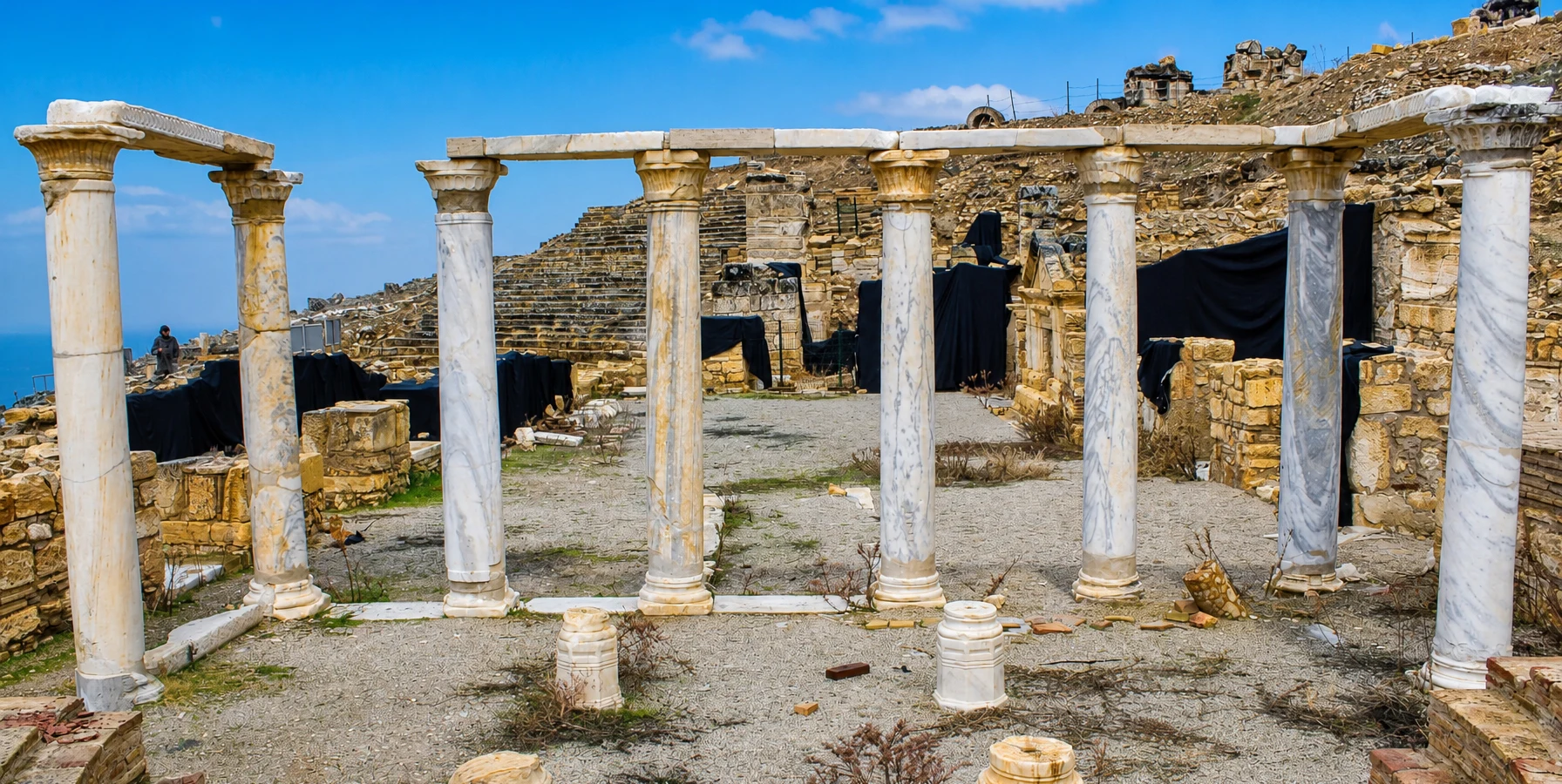
Continue toward Pamukkale’s travertine terraces and other important archaeological areas such as the monumental streets, necropolis and Byzantine church remains, following the site’s available routes.
For a broader history of the Lycos Valley, pair Pamukkale with Laodicea Ancient City or Colossae on a separate or extended private itinerary.
Roman performance monument.
Sculptures and history.
Travertine terraces.
Ancient funerary monuments.
Nearby ancient city.
Regional biblical context.
The tradition of Philip at Hierapolis and that of John at Ephesus show how communities in western Anatolia associated particular landscapes and monuments with the apostles.
Both places developed Christian pilgrimage architecture around the memory of revered figures. Yet the octagonal Martyrium at Hierapolis and the Basilica of St. John at Ephesus have quite different architectural histories and layouts.
Guests focused on Biblical and Early Christian Türkiye can study both regions in a carefully designed multi-day private programme rather than rushing between the monuments.
Tradition of St. Philip.
Tradition of St. John.
Apostolic pilgrimage.
Octagonal martyrium.
Large memorial basilica.
Multi-day heritage route.
Yes. A licensed guide can connect the visible masonry to the biblical Philip, Polycrates’s testimony, the fifth-century architectural programme, the 2011 excavations and the pilgrimage route. Without interpretation, many of the low stone walls can look similar.
Wow Cappadocia / Venere Travel can help arrange a private cultural itinerary including the Martyrium, Hierapolis ruins, theatre, archaeology museum and Pamukkale, subject to availability and the site’s access conditions.
Our private heritage trips can be organised at a comfortable pace with no compulsory shopping stops. Contact us to discuss whether you prefer archaeology, early Christian history, photography or a combination.
Private and flexible.
Licensed professional.
Biblical and Byzantine history.
Based on open pathways.
None required.
Tailored on request.
Morning: Enter Hierapolis through the agreed gate, visit the St. Philip hillside sanctuary while temperatures are comfortable, and explore the octagonal Martyrium and tomb church where visitor access is permitted.
Late morning / early afternoon: Continue to the Hierapolis Theatre and other Roman remains, then visit the archaeology museum for sculpture, inscriptions and theatre reliefs. Take a relaxed break for refreshments.
Afternoon: Enjoy the Pamukkale travertine landscape along authorised visitor routes. The order can be reversed or shortened for weather, seasonal timings, mobility or site closures; all times should remain flexible rather than promised as a fixed circuit.
St. Philip sanctuary.
Hierapolis Theatre.
Archaeology Museum.
Pamukkale terraces.
Adjust to guest interests.
Respect changing access.
Choose comfortable closed walking shoes with good traction. The sanctuary involves sloping paths, stone fragments and uneven surfaces, which may be awkward in smooth-soled footwear.
Bring drinking water, a sun hat, sunscreen and clothing suitable for the season. In cooler months take an extra layer, and after wet weather use more caution on exposed stone.
Keep your entry ticket or valid pass accessible, carry only essentials on the climb, and respect the site’s photography restrictions and protected archaeology.
Walking shoes with grip.
Hat and sunscreen.
Carry your own supply.
Layers for changing weather.
Keep site admission handy.
Do not climb ruins.
The most useful detailed historical account is published by the Denizli Provincial Directorate of Culture and Tourism. Its Hierapolis page includes the St. Philip Gate, bridge, staircase, bath, sacred fountain, tomb church, Roman tomb and Martyrium and explains why the 2011 discovery revised earlier assumptions.
The UNESCO World Heritage Centre documents the exceptional octagonal design and the Christian significance of Hierapolis. Archaeological and university research helps establish the distinction between the Martyrium and the excavated burial church.
For travel planning, consult the provincial seasonal opening-hours notice and the Turkish Museums official site and ticket pages. Timetables for different gates are not necessarily identical, and none of those general pages guarantees that the hilltop paths will be accessible at all times.
Denizli culture authority.
UNESCO World Heritage.
Italian mission publications.
Provincial 2026–27 schedule.
Official museum platform.
October 2026.
Essential answers on the archaeological monuments, biblical traditions, the 2011 discovery, walking conditions, opening hours and tickets. Practical details reflect an October 2026 review.
An early fifth-century octagonal Christian monument at Hierapolis, traditionally commemorating the martyrdom of Philip the Apostle.
On a hillside within the Hierapolis–Pamukkale archaeological site in Denizli province, Türkiye.
No. The Martyrium is the octagonal memorial sanctuary; the nearby three-aisled tomb church surrounds an earlier Roman tomb.
Philip is one of the Twelve Apostles named in the Gospels, especially the Gospel of John.
They are presented as distinct people in the New Testament; later traditions sometimes conflate them.
Ancient Christian sources and local tradition associate Philip’s death with Hierapolis. The specific historical circumstances cannot be independently verified.
Crucifixion is part of the traditional account of his martyrdom; it is not an archaeologically proven event.
The monumental octagonal building dates to the early fifth century AD.
Its design uses eight-sided geometry and has been related to Early Christian ideas of resurrection and renewal.
Eight main rectangular spaces open from the central octagon, with additional chapels and connecting rooms.
Archaeologists uncovered a church built around a revered first-century Roman tomb in 2011, interpreted as the tomb venerated as Philip’s.
No conclusive scientific identification of Philip’s individual remains is established by the discovery.
Archaeological work on the sanctuary included the Italian Archaeological Mission under Francesco D’Andria.
The reconstructed route included the St. Philip Gate, a bridge, an uphill staircase and preparation areas before the upper sanctuary.
A lower building used for bathing and preparation, separate from the octagonal Martyrium at the top.
A sacred fountain on the ancient pilgrims’ route to the shrine.
It is an archaeological monument rather than an ordinary functioning parish church; occasional permitted religious observances do not mean daily services.
Yes, it lies within the Hierapolis–Pamukkale World Heritage property inscribed in 1988.
No separate Martyrium ticket was found in the official listings reviewed; access is normally through the paid Hierapolis–Pamukkale site.
The official ticket listing showed €30 for foreign visitors at the time of review.
The official Hierapolis site profile states that eligible Turkish citizens can use Müzekart; check current conditions.
No separate daily timetable was verified. Entry depends on Hierapolis gate operations and whether its specific hillside route is open.
The provincial notice gives an 08:00 opening at north and south gates for the season from 14 September 2026 to 1 May 2027.
Do not assume so. Night access to some areas of Hierapolis does not guarantee access to the Martyrium hillside.
Approximately 45–90 minutes for the sanctuary area is a useful planning estimate, excluding some approaches from site entrances.
Expect an uphill, open-air archaeological route with uneven ground and possible steps.
Full step-free access cannot be guaranteed. Confirm the route directly with site staff before visiting.
Yes, with close supervision on the hillside and near ancient masonry; bring shoes with grip and water.
Do not fly without the relevant permissions; respect archaeological and aviation restrictions.
The Hierapolis Theatre, archaeology museum, Byzantine churches, necropolis and Pamukkale travertines are good combinations.
Yes. Hierapolis preserves other Byzantine religious remains; open paths and monument access vary.
Yes. Laodicea and Colossae add valuable wider Lycos Valley historical and Biblical context.
Yes, private cultural itineraries can be arranged with licensed guides, subject to availability and site rules.
No. Our private archaeology and heritage programmes can be arranged without compulsory shopping stops.
Use the Denizli Provincial Culture Directorate and official Turkish Museums pages, and confirm hill access with staff on the day.
Call 112 for an emergency.
Discover the stories behind the monuments with private transfers, licensed guides and no compulsory shopping stops.
Pair St. Philip’s sanctuary with classical archaeology and the landscape of Pamukkale.
Visit the Martyrium, ancient theatre and Pamukkale terraces at a comfortable pace.
Request a Private Tour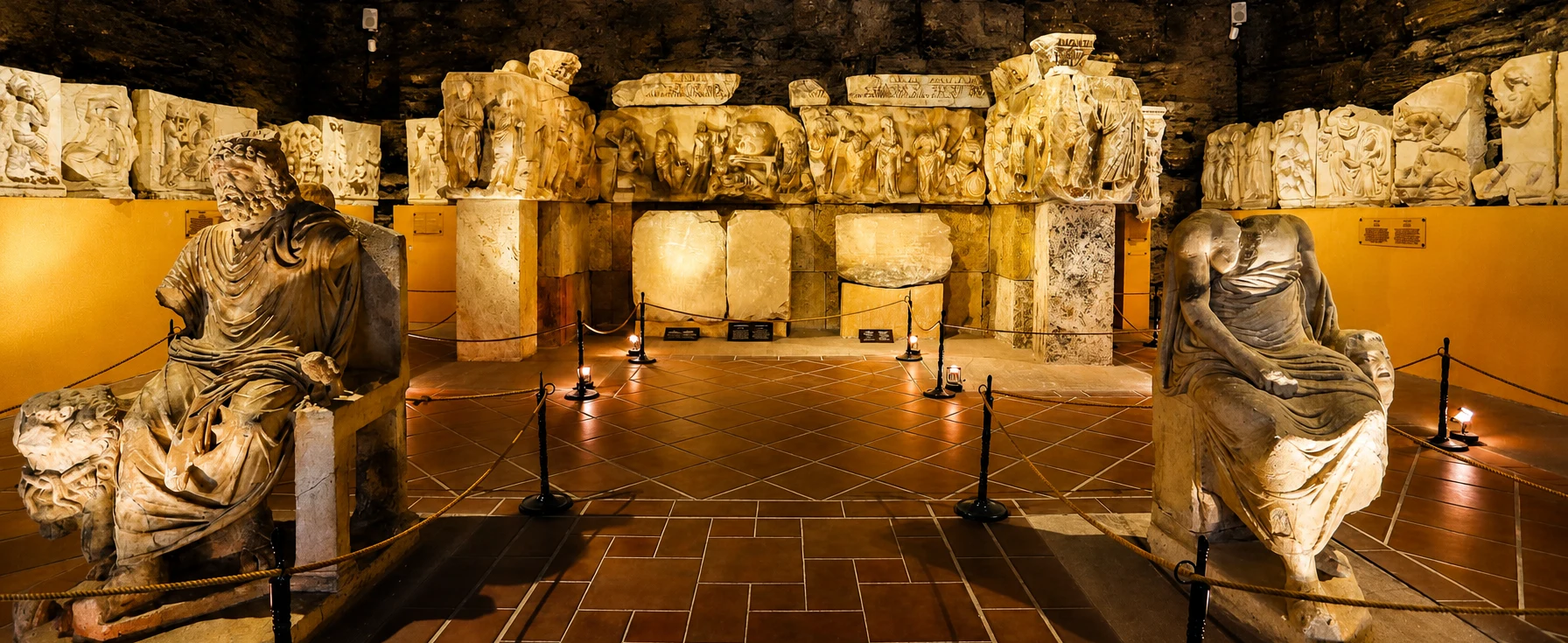
Explore Roman sculpture, theatre reliefs and the wider history of the sacred city.
Explore the Museum
Continue through the Lycos Valley’s biblical and archaeological heritage.
Discover LaodiceaBroaden your private itinerary with neighbouring archaeological and cultural sites.

Ask for a custom history-rich journey focused on churches and Christian archaeology.
Design Your Tour