Purpose-Made Bread
The traditional toast uses a bread produced specifically for Ayvalık Tostu rather than ordinary sliced sandwich bread.






Ayvalık Tostu, or Ayvalık Toast, is one of Türkiye's best-known toasted sandwiches. It takes its name from Ayvalık in Balıkesir Province, where it was first produced before spreading throughout the country.
What separates it from an ordinary toast is not simply the amount of filling. The registered traditional product is built around a distinctive Ayvalık toast bread made with wheat flour, chickpea yeast, sourdough, salt and water, then filled with butcher's sucuk, tulum or kaşar cheese and tomato.
In 2023, Ayvalık Tostu was registered by the Turkish Patent and Trademark Office as a Traditional Product Name. The official specification records the bread, required fillings and preparation method that define the traditional product.
Ayvalık Tostu is protected in Türkiye as a registered Traditional Product Name.
The half-moon-shaped bread is made specifically for the toast using chickpea yeast and sourdough.
The registered version requires butcher's sucuk together with tulum or kaşar cheese.
The toast began in Ayvalık and later became a familiar street-food favourite across Türkiye.
Essential information about one of the most famous foods associated with Türkiye's North Aegean coast.
Ayvalık, a historic coastal town in Balıkesir Province on the North Aegean.
Open Ayvalık on Google MapsA hot pressed sandwich prepared with a distinctive locally associated toast bread.
The registered method uses a cast toast press heated to 220°C.
TÜRKPATENT Traditional Product Name registration No. G6, registered in 2023.
Ayvalık Tostu grew from local bakery and buffet culture into one of Türkiye's most recognisable toasted sandwiches.
Ayvalık has long been known for its olive-oil culture, historic neighbourhoods and busy coastal food scene. Within that environment, a distinctive toasted sandwich developed around a bread produced specifically for the purpose.
The official TÜRKPATENT registration states that Ayvalık Tostu was first produced in Ayvalık and later became widely made across Türkiye. Its name therefore records the place where the food tradition began.
The exact inventor and first year are not identified in the official registration. What is firmly documented is the traditional combination of special toast bread, butcher's sucuk, tulum or kaşar cheese, tomato and hot pressing.
Over time, Ayvalık toast shops developed numerous versions with additional ingredients. Visitors today may encounter salami, sausage, pickles, sauces or salad-style fillings alongside the essential toasted bread, cheese and sucuk combination.
In 2023, Ayvalık Tostu received national registration as a Traditional Product Name, giving a formal definition to the composition and method associated with the classic product.
Special bread, generous filling and controlled pressing distinguish Ayvalık Tostu from an ordinary toasted sandwich.
The traditional toast uses a bread produced specifically for Ayvalık Tostu rather than ordinary sliced sandwich bread.
The registered bread is approximately 18–20 cm long and formed in a characteristic half-moon shape.
Nohut mayası, or chickpea yeast, is part of the registered bread formula together with sourdough.
Kasap sucuğu made from 100% beef is a required element of the registered traditional product.
The sandwich includes full-fat cow's-milk tulum cheese or kaşar cheese.
Thinly sliced tomato is added after the hot pressing stage in the official preparation method.
The registered production method specifies a cast toast machine operating at 220°C.
The finished toast is intended to be eaten immediately while the bread is crisp and the cheese is hot.
Ayvalık Tostu is a Turkish pressed sandwich made with a distinctive elongated, half-moon-shaped toast bread. In its registered traditional form, the bread contains wheat flour, chickpea yeast, sourdough, salt and water.
The sandwich is filled with butcher's sucuk and either tulum cheese or kaşar cheese, cooked in a hot cast toast press and finished with thinly sliced tomato before being served hot.
The bread's shape, fermentation and intended use are central to the identity of Ayvalık Tostu.
Pressing creates a toasted outer surface while warming the meat and melting the cheese inside.
The registered specification requires substantial amounts of sucuk and cheese rather than a thin filling.
It is closely associated with Ayvalık's casual buffet and snack culture and has spread throughout Türkiye.
Ayvalık Tostu is registered by the Turkish Patent and Trademark Office as a Geleneksel Ürün Adı, translated as a Traditional Product Name.
Ayvalık Tostu
The Traditional Product Name registration number is G6.
The application number is G2022/000027.
The application was filed on 15 June 2022.
Ayvalık Tostu was registered on 27 January 2023.
The registration holder is Ayvalık Municipality.
A Traditional Product Name is different from a geographical indication whose production is restricted to a defined territory. The registration recognises the traditional composition and production method of Ayvalık Tostu; the official record also notes that the food began in Ayvalık and later became widely produced throughout Türkiye.
The bread is one of the most important reasons Ayvalık Tostu feels different from an ordinary Turkish toast. It is baked specifically for the sandwich and designed to withstand generous filling and firm pressing without immediately falling apart.
Wheat flour forms the base of the registered toast bread.
Nohut mayası contributes to the traditional fermentation identity of the bread.
Ekşi maya is used together with chickpea yeast in the registered bread formula.
The remaining core bread ingredients are salt and water.
The finished registered bread is approximately 18–20 cm in length.
The baked bread is described as weighing approximately 75–80 grams.
Ayvalık toast bread is not simply a long roll. The registered description identifies a half-moon form approximately 18–20 cm long, with the widest part measuring around 10–11 cm.
Before baking, the dough is shaped first into small cylinders and then finished by hand into the curved form associated with the traditional bread.
The half-moon outline gives the bread a distinctive appearance even before it enters the toast press.
Each individual bread is intended to become one substantial hot sandwich.
The bread is sturdy enough to hold sucuk, cheese and tomato during preparation.
Its elongated shape is one of the easiest visual clues that distinguishes Ayvalık Tostu from standard square toast.
The official registration records a detailed production method for the special bread used in Ayvalık Tostu.
The registered version is more specific than the many mixed-toast variations sold around Türkiye. Its defining ingredients are the special bread, butcher's sucuk, cheese and tomato.
One purpose-made half-moon bread forms the base of the sandwich.
The registered product requires at least 70 g of kasap sucuğu produced from 100% beef.
At least 70 g of full-fat cow's-milk tulum or kaşar cheese is required.
Thinly sliced tomato is added after the hot pressing stage.
The official preparation method uses margarine on the outer surfaces of the bread before pressing.
Additional sucuk, salami and sausage may be included according to preference.
Sucuk is not merely an optional extra in the registered traditional product. Kasap sucuğu, or butcher's sucuk, is one of the elements that defines the official composition.
The registered sandwich uses at least 70 grams of butcher's sucuk.
The required kasap sucuğu is specified as being produced from 100% beef.
The official method describes sucuk cut into slices approximately 3 mm thick before pressing.
Other fermented or heat-treated sucuk, salami or sausage may be added in addition to the required traditional ingredients.
The registered traditional composition allows tulum cheese or kaşar cheese. Both are specified as full-fat cheeses made from cow's milk.
A full-flavoured option that gives the toast a more pronounced salty dairy character.
A familiar Turkish melting cheese that becomes soft and stretchy under the hot press.
The registered product requires at least 70 grams of tulum or kaşar cheese.
The official specification defines the cheese used in the registered product as full-fat cow's-milk cheese.
The registered preparation method is straightforward but precise. The bread, filling, heat and pressure all contribute to the final texture.
Ayvalık Tostu depends on more than ingredients. The official specification identifies a cast toast machine operating at 220°C as part of the traditional method.
The sandwich is not crushed completely flat. During cooking, the machine is adjusted with an apparatus so that approximately two centimetres of space remains, allowing the bread and filling to heat without being compressed into a thin sheet.
High heat quickly develops a crisp toasted surface.
The official method gives approximately five minutes for the hot pressing stage.
The press is kept from closing completely so the sandwich retains body and filling.
The finished toast is intended to reach the table without a long wait after pressing.
One of the small details recorded in the official method is that thinly sliced tomato is added after the toast leaves the press.
This keeps the tomato fresher and helps prevent excess moisture from soaking into the bread during the hot pressing stage.
The tomato goes inside only after the sucuk and cheese have been heated.
Cooler tomato brings freshness to the rich combination of meat, cheese and toasted bread.
Adding it later reduces the amount of tomato juice released into the bread under pressure.
The result combines crisp bread, hot filling and fresh vegetable texture.
Visitors often encounter versions far more elaborate than the registered core recipe. This is part of modern Ayvalık toast-shop culture, but it helps to distinguish those additions from the ingredients that define the traditional registered product.
Salami is a common additional meat filling and is explicitly permitted as an optional ingredient in the registered specification.
Sliced sausage is frequently added to mixed versions and is also allowed as an optional extra.
Some shops prepare richer versions with more than one style or quantity of sucuk.
Pickled cucumber is common in many contemporary shop versions, adding acidity and crunch.
Some popular mixed versions include Russian or American-style salad mixtures.
Ketchup and mayonnaise are common modern additions, although they are not required by the registered traditional formula.
Outside Ayvalık, the phrase “Ayvalık toast” is often used for a very full mixed sandwich containing several meats, cheese, pickles and sauces. The registered Traditional Product Name is more clearly defined.
Special Ayvalık bread, butcher's sucuk, tulum or kaşar cheese and tomato form the essential registered composition.
Shop interpretations may add salami, sausage, pickles, salad mixtures and sauces.
Both styles are part of the broad contemporary food culture associated with Ayvalık Tostu.
If you want a particular style, ask what the shop means by “original,” “mixed,” or “special” before choosing.
Traditional Ayvalık Tostu balances the spiced savoury flavour of sucuk with melted cheese, crisp toasted bread and the freshness of tomato.
The exact flavour changes depending on whether tulum or kaşar is used and whether optional fillings are added. Tulum gives a more assertive salty cheese character, while kaşar generally creates a milder and more familiar melted-cheese profile.
Beef sucuk gives the sandwich its dominant spiced and meaty flavour.
Melted tulum or kaşar adds richness and binds the filling together.
The pressed bread develops the toasted crust that gives the sandwich its satisfying first bite.
Tomato provides a lighter contrast after the rich hot filling.
A well-made Ayvalık Tostu should feel substantial rather than papery thin. The bread must become toasted and crisp while still supporting a generous quantity of filling.
The hot cast press toasts the outside of the bread until it develops a firm surface.
Inside, the bread remains softer where it meets the melting cheese and warm meat.
The cheese should be fully warmed and integrated with the sucuk.
Controlled press spacing allows the sandwich to keep thickness and structure.
Ayvalık Tostu is at its best when served immediately after pressing and finishing. It is a casual food, usually eaten as a quick lunch, snack or filling street-food meal.
The registered method specifically calls for hot service.
Shops may serve the long sandwich whole or slice it into easier-to-handle portions.
A dedicated toast shop or buffet is one of the most characteristic places to experience it.
Ayran or another cold drink works naturally beside the rich, hot sandwich.
Ayvalık Tostu is now made all over Türkiye, but trying it in Ayvalık itself adds the local setting that gave the sandwich its name.
In the town centre, long-established toast counters and casual eateries offer different interpretations. Rather than assuming every shop uses the same recipe, look at the menu and ask whether you are ordering a traditional, original, mixed or special version.
Explore the town's traditional toast-counter culture and compare different local versions.
Combine a toast stop with stone streets, historic houses and the town's olive-oil heritage.
Add one of Ayvalık's distinctive historic landmarks to a walking route through town.
Finish the day with one of Ayvalık's best-known panoramic viewpoints.
The registered description gives the bread a relatively short life. When stored, it should be kept at approximately +4°C and used for Ayvalık Tostu within a maximum of seven days.
Refrigerated storage is specified when the bread is not used immediately.
The registered bread should be used within seven days under chilled storage.
The production method also includes a one-day resting period after baking.
The freshly baked bread is rested in a dry environment before use or sale.
Ayvalık Tostu contains several common allergens and animal-derived ingredients. Travellers with dietary restrictions should confirm the exact version being prepared because fillings vary from one shop to another.
The bread is made from wheat flour and is not suitable for a standard gluten-free diet.
The registered traditional version includes tulum or kaşar cheese made from cow's milk.
Butcher's sucuk made from 100% beef is required in the registered traditional composition.
The traditional registered version contains sucuk and therefore is not vegetarian.
Both meat and dairy are central to the traditional product.
Mixed versions may include additional meats, sauces or salad mixtures that introduce further allergens.
Ayvalık Tostu is officially registered in Türkiye as a Traditional Product Name, not as a geographical indication tied to production exclusively inside Ayvalık.
This distinction matters. The official record recognises the traditional composition and production method and explicitly notes that Ayvalık Tostu began in Ayvalık before becoming widely produced across Türkiye.
The registration category protects a recognised traditional name, composition and method.
Ayvalık Tostu is one of Türkiye's registered traditional product names.
The name reflects the town where the toast was first produced.
The official record acknowledges that the food later became widely produced nationwide.
Because the name is widely used, travellers may encounter sandwiches that vary greatly. The clearest way to understand the registered tradition is to look for its defining bread and filling structure.
The traditional bread is elongated and curved rather than ordinary square toast bread.
Nohut mayası is one of the registered bread ingredients.
The registered composition uses at least 70 g of butcher's sucuk.
At least 70 g of tulum or kaşar cheese is required.
Tomato is added after pressing rather than cooked throughout the entire process.
Businesses using the registered traditional product designation may display the name and official Traditional Product Name emblem.
Balıkesir is associated with more than one famous toasted sandwich tradition. Ayvalık Tostu and Susurluk-style toast are both popular, but they should not be treated as the same food.
Ayvalık Tostu is associated with the North Aegean coast, while Susurluk's toast culture developed along one of western Türkiye's best-known road routes.
The registered Ayvalık product is defined by its distinctive chickpea-yeast and sourdough toast bread.
Butcher's sucuk with tulum or kaşar cheese and tomato forms the core registered filling.
Travelling across the province gives food lovers an opportunity to compare two very different toast traditions.
Ayvalık is better known internationally for olive oil, seafood and its Aegean landscape, yet Ayvalık Tostu occupies a different and equally recognisable part of everyday local food culture: quick, inexpensive, hot food prepared at a counter and eaten without ceremony.
Ayvalık toast is closely associated with small casual counters and dedicated tostçu businesses.
The sandwich depends on a purpose-made bread, connecting toast shops with local bread production.
Generous meat and cheese make it much more filling than a simple snack-sized toast.
Its spread throughout Türkiye transformed a local food into a nationally familiar name.
In Ayvalık, the toast sits beside olive oil, seafood, cookies and other distinctive regional specialities.
It remains an everyday food sold and eaten actively rather than a recipe preserved only for festivals or demonstrations.
Ayvalık Tostu is at its best straight from the press before steam softens the crisp exterior.
“Original,” “mixed” and “special” can mean different combinations from one toast shop to another.
The distinctive long, half-moon-shaped bread is one of the strongest signs that you are ordering the traditional style.
Traditional quantities of sucuk and cheese make this more substantial than an ordinary café toast.
If the shop offers both, the cheese choice can noticeably change the flavour of the sandwich.
If you have allergies or dietary restrictions, ask about sauces, salad mixtures and additional processed meats.
A toast stop fits naturally into a day exploring Ayvalık's historic centre and waterfront.
Ayvalık's food story continues beyond toast with local cookies and other regional specialities.
For travellers who enjoy local street food, Ayvalık Tostu is one of the easiest and most enjoyable ways to taste a food directly associated with the town.
Its appeal comes from the combination of a distinctive bread, generous savoury filling and a preparation method that produces a crisp, hot sandwich in only a few minutes.
The special toast bread is what most clearly separates Ayvalık Tostu from ordinary Turkish toast.
Eating it in Ayvalık connects a nationally famous food with the town that gave it its name.
The registered version uses a generous amount of beef sucuk rather than treating it as a minor garnish.
Different local shops make it easy to see how the traditional core has inspired a wide range of modern interpretations.
Ayvalık Tostu is only one chapter in a North Aegean food culture shaped by olive groves, bakeries, seafood and long-standing local recipes.
Continue with a distinctive local bakery tradition and a sweet contrast after a savoury toast.
Explore another local speciality associated with the coastal food culture of the Ayvalık area.
Discover the wider olive-oil landscape of the Gulf of Edremit and northern Aegean Balıkesir.
Try one of Balıkesir Province's most famous traditional desserts.
Continue through Balıkesir's road-food culture with its famous exceptionally foamy ayran.
Explore another protected Balıkesir food tradition built around dairy craft and long maturation.
A stop for Ayvalık Tostu can easily fit into a day of historic streets, beaches, viewpoints and coastal heritage.
Walk among stone houses, narrow streets and buildings shaped by the town's multicultural Aegean history.
Visit one of Ayvalık's distinctive historic religious landmarks.
Combine a food stop with one of the area's best-known long sandy beaches.
Head to the celebrated viewpoint for broad panoramas over the Ayvalık islands and Aegean coast.
Ayvalık Tostu is a hot pressed Turkish sandwich made with a special toast bread and, in its registered traditional form, butcher's sucuk, tulum or kaşar cheese and tomato.
It originated in Ayvalık, a coastal district of Balıkesir Province in western Türkiye.
Yes. It is registered by TÜRKPATENT as a Traditional Product Name.
The registration number is G6.
It was registered on 27 January 2023.
The application number is G2022/000027.
The application date is 15 June 2022.
The registration holder is Ayvalık Municipality.
It is registered as a Traditional Product Name rather than a geographical indication restricted to a defined production area.
Yes. The official registration itself notes that the food began in Ayvalık and later became widely produced throughout Türkiye.
Its defining features include a special half-moon-shaped bread made with chickpea yeast and sourdough, substantial sucuk and cheese filling and a traditional cast-press preparation method.
The registered bread contains wheat flour, water, chickpea yeast, sourdough and salt.
Yes. Nohut mayası, or chickpea yeast, is one of the registered bread ingredients.
Yes. The registered formula uses sourdough together with chickpea yeast.
The registered bread is half-moon shaped.
The finished bread is approximately 18–20 cm long.
The registered finished bread is approximately 75–80 g.
Dough portions are first formed into cylinders and then shaped by hand into the characteristic half-moon form.
The registered bread method specifies approximately 45–50 minutes of mixing and kneading.
Yes. The shaped dough is rested in a steam room for approximately 1–1.5 hours.
The official method specifies an oven preheated to approximately 205°C.
Yes. The registered method includes a one-day resting period at room temperature in a dry environment.
If stored, it should be refrigerated at around +4°C.
The registered description states that it should be used within a maximum of seven days under refrigerated storage.
The registered traditional version requires butcher's sucuk made from 100% beef.
At least 70 g of butcher's sucuk is required.
The traditional registered product uses full-fat cow's-milk tulum cheese or kaşar cheese.
At least 70 g of tulum or kaşar cheese is required.
Yes. Thinly sliced tomato is part of the registered composition.
The official method adds the tomato after the hot pressing stage.
Yes. The registered specification permits additional fermented or heat-treated sucuk, salami and sausage according to consumer preference.
No. Pickles are common in many modern mixed versions but are not required in the core registered traditional composition.
No. Salad-style fillings appear in many contemporary toast-shop versions but are not part of the essential registered formula.
No. They are common optional additions in modern versions rather than required elements of the registered traditional product.
The registered method specifies a cast toast machine operating at 220°C.
The official method gives an approximate cooking time of five minutes.
No. The registered method keeps approximately 2 cm of space in the press during cooking.
Yes. Hot service is part of the registered preparation method.
Expect crisp toasted bread, spiced beef sucuk, rich melted cheese and the fresh contrast of tomato.
The level of spice depends mainly on the sucuk used. It is savoury and seasoned, but individual products can range from mild to more strongly spiced.
No. The registered traditional version contains beef sucuk.
No. The traditional version contains both meat and dairy.
Yes. The bread is made from wheat flour.
Yes. Tulum or kaşar cheese is a defining part of the registered traditional sandwich.
Ayvalık itself offers the clearest connection between the sandwich and the town where the tradition began.
Ayran is a natural partner for a hot savoury toast, while tea and cold soft drinks are also common choices.
It can be. The registered filling quantities make it considerably more substantial than a small cheese toast.
Explore the town's olive-oil culture, local bakery products, seafood and regional sweets alongside its famous toast.
Its identity comes from the purpose-made chickpea-yeast and sourdough bread, generous sucuk-and-cheese filling, traditional hot pressing method and strong connection with Ayvalık's everyday food culture.
Ayvalık Tostu is especially photogenic when the image shows both its distinctive bread and the generous filling rather than treating it like an ordinary sandwich.
Photograph the toast while the bread is still deeply crisp and the cheese is visibly melted.
A diagonal cut reveals the layers of sucuk, cheese and tomato inside the long bread.
Show the complete sandwich to capture the half-moon profile that distinguishes Ayvalık toast bread.
An image at the counter can communicate the heat, pressure and everyday street-food character of the preparation.
Pair the food with stone façades, a casual toast counter or a North Aegean street setting.
Place the toast beside ayran or tea for a simple, believable serving scene.
Discover Ayvalık Tostu together with historic neighbourhoods, olive-oil heritage, coastal scenery and the flavours of the North Aegean.
Custom-designed private programs can combine Ayvalık's food culture with historic streets, olive-oil traditions, Cunda, Sarımsaklı Beach, Şeytan Sofrası and other North Aegean highlights according to your route and travel dates.
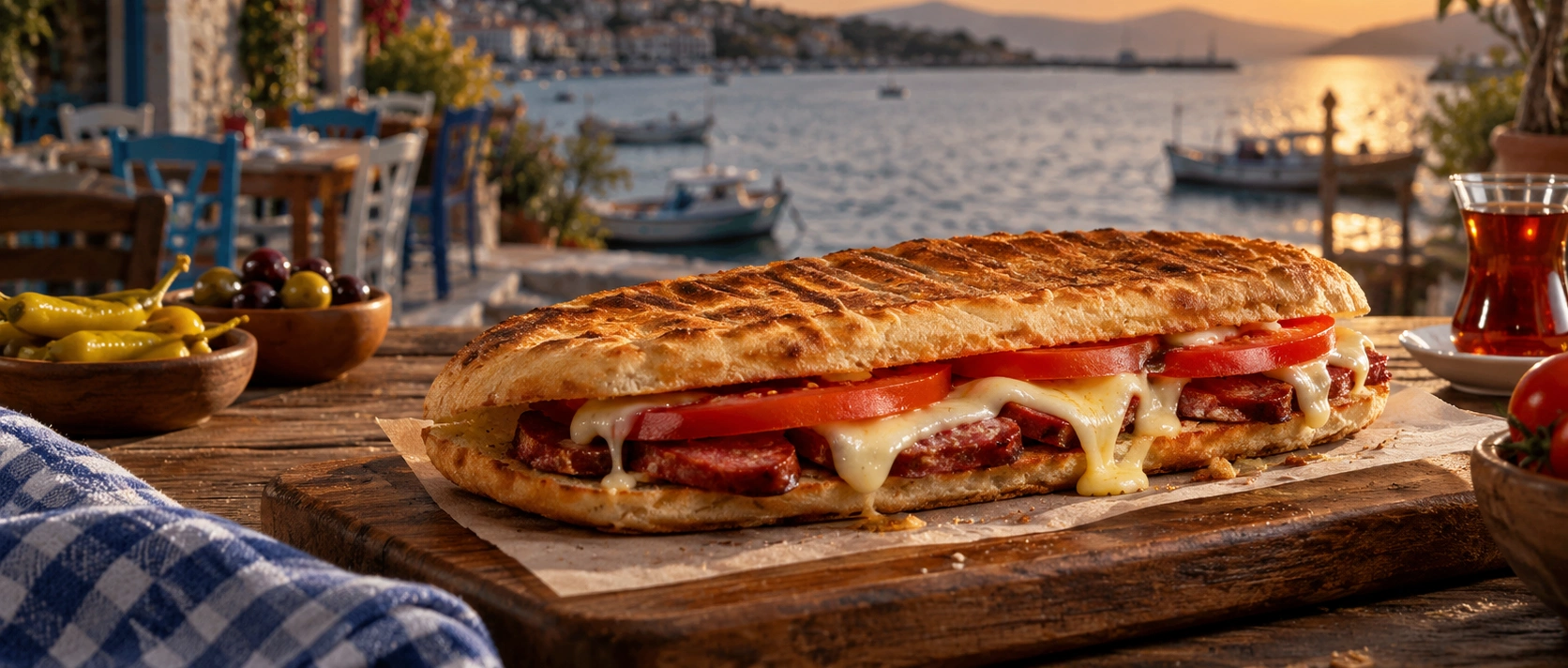
Explore Ayvalık through its famous toast, local bakery culture, olive-oil heritage and the flavours that make the town one of the North Aegean's most distinctive food destinations.
Request This Experience
Combine the town's stone architecture, historic neighbourhoods and olive-oil culture with local food stops and panoramic North Aegean scenery.
Request This Tour