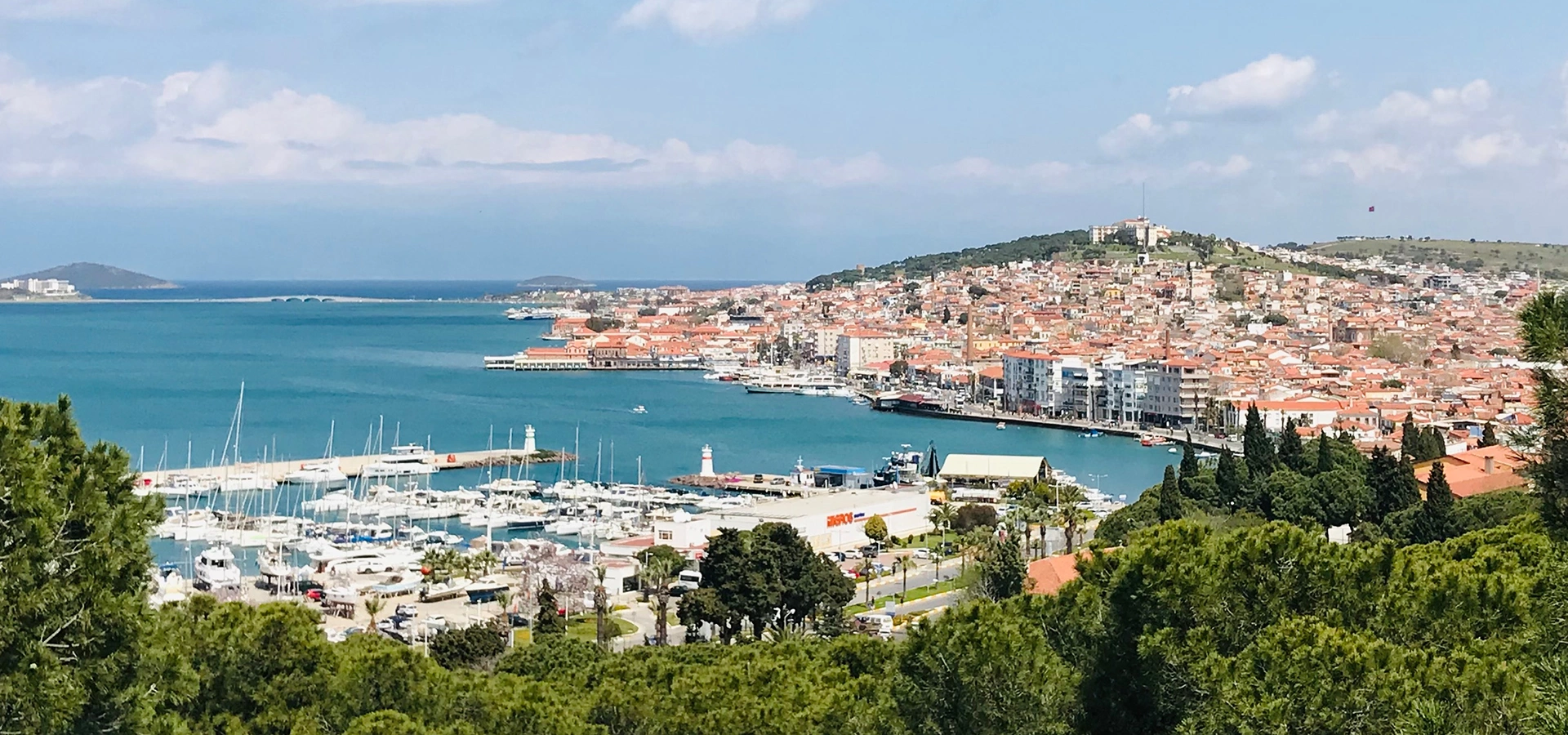
Ayvalık Travel Guide
Explore Ayvalık's stone neighbourhoods, waterfront, former churches, mosques, markets, local food and island-filled coastal landscape.
View Ayvalık Guide





Among the historic religious buildings of Ayvalık, Hamidiye Mosque occupies a very unusual position. Many of the town's best-known mosques — including Çınarlı, Saatli and Hayrettin Paşa — began life as Greek Orthodox churches and were adapted for Muslim worship after the population exchange. Hamidiye Mosque was different from the beginning: it was constructed as a mosque.
Official Turkish cultural inventories place the building in the second half of the 19th century and identify Sultan Abdülhamid II as its patron. The mosque served the relatively small Muslim community then living in a town whose population, architecture and neighbourhood structure were still overwhelmingly shaped by the Greek Orthodox community.
Its architecture is just as distinctive as its history. The mosque combines the central-domed, compact massing associated with Ottoman mosque architecture with a façade composition that official heritage sources compare to the pedimented language of Classical temple architecture. The result is an eclectic building that looks neither like a standard provincial Ottoman mosque nor like Ayvalık's converted churches.
The main body is close to square in plan and constructed from red cut stone. A four-columned entrance portico defines the approach, while a brick dome rises above a cylindrical drum. The composition is relatively restrained in decoration, meaning that its importance lies less in rich ornament than in form, proportion, material and urban symbolism.
Hamidiye Mosque is also important because its exact construction history is more complicated than a single date suggests. The original inscription has not survived, and Ayvalık heritage research notes that an 1897 Ottoman archival drawing already describes work connected with repairing or completing deficiencies in the mosque. This indicates that the building was already standing by that date, while the broader official dating remains the second half of the 19th century.
Unlike several famous Ayvalık mosques that were converted from churches, Hamidiye was designed for Muslim worship from the outset.
Official heritage sources associate the mosque with Sultan Abdülhamid II and the late Ottoman period.
A central Ottoman dome is combined with a façade language influenced by Classical architectural forms.
The near-square building is especially recognisable for its reddish masonry, four-columned entrance and domed silhouette.
Essential information for understanding one of the most historically unusual religious buildings in central Ayvalık.
Sakarya neighbourhood, Mevlana Caddesi, central Ayvalık, within the historic urban area.
Constructed as a mosque from the beginning, rather than converted from a church.
Official cultural sources state that it was commissioned by Sultan Abdülhamid II.
Generally dated to the second half of the 19th century; the exact completion date remains uncertain.
An Ottoman archival drawing from 1897 concerns work on the mosque, showing that the building already existed by then.
An unusual eclectic composition combining Ottoman central-domed planning with Classical-inspired façade elements.
The mosque is built primarily from distinctive red cut stone.
A compact, near-square prayer-hall composition beneath a central dome.
A brick dome rises from a cylindrical drum above the main body of the mosque.
The approach is marked by a four-columned son cemaat yeri, or entrance portico.
An active mosque; respectful visitor etiquette and prayer-time awareness are essential.
Allow around 20–35 minutes, or longer if combining it with a historic Ayvalık walking route.
Hamidiye Mosque is important precisely because it does not tell the same story as Ayvalık's most famous former churches. It gives visitors a rare opportunity to see a late Ottoman Muslim monument that was inserted into a town whose historic fabric was largely created around Orthodox churches.
Walk through central Ayvalık and the dominant 19th-century religious monuments are often former Greek Orthodox churches. Their size, stone façades, bell towers and neighbourhood locations reflect the demographic character of the town before the population exchange. Hamidiye Mosque stands apart from that pattern.
Built for the Muslim community during the reign of Sultan Abdülhamid II, the mosque represents a purpose-built Ottoman religious presence within a predominantly Christian urban environment. Architectural scholarship has therefore treated the building not only as a place of worship but also as an important element in Ayvalık's urban morphology and late Ottoman political landscape.
Its visual language is equally unusual. Instead of relying entirely on conventional mosque forms, the building brings together a compact domed volume, a columned entrance and Classical-inspired façade organisation. This eclecticism fits the broader 19th-century Ottoman world, when architects increasingly combined historical styles, local materials and new compositional ideas.
For travellers interested in architecture, Hamidiye is therefore one of the most useful buildings in Ayvalık for comparison. Visit it before or after Çınarlı Mosque, Saatli Mosque and Hayrettin Paşa Mosque, and the difference between a purpose-built mosque and an adapted church becomes immediately clear.
During much of the 18th and 19th centuries, Ayvalık — historically known in Greek as Kydonies — developed as an overwhelmingly Greek Orthodox town. Churches acted as major neighbourhood anchors, and residential areas grew around them. Muslim inhabitants were comparatively few and included people connected with administration and other official functions.
Hamidiye Mosque emerged during the reign of Sultan Abdülhamid II, who ruled the Ottoman Empire from 1876 to 1909. Official Turkish heritage sources date the building broadly to the second half of the 19th century and describe it as the only mosque in Ayvalık constructed as a mosque during the Ottoman period.
The absence of a surviving original construction inscription makes a precise completion date difficult to establish. Ayvalık heritage documentation draws attention to an Ottoman archival plan and elevation dated 1897 that refer to work on the mosque. Because the archival text concerns repairs or the completion of deficiencies, researchers have argued that the mosque must already have been standing before that document was prepared.
This uncertainty is useful rather than inconvenient: it reminds visitors that historic buildings are not always tied to one neat date. Hamidiye Mosque should be understood as a late-19th-century Abdülhamid II-period monument whose construction and early repair history is still being refined through archival research.
Unlike Çınarlı, Saatli and Hayrettin Paşa mosques, Hamidiye did not acquire its Muslim function after the 1923 population exchange. It was already a mosque decades earlier. That makes it essential for understanding that Muslim religious life existed in pre-exchange Ayvalık even though the community was much smaller than the Orthodox population.
At first glance, Hamidiye Mosque may appear less monumental than some of Ayvalık's enormous former churches. Its historical importance, however, comes from a different source: it represents the Muslim community of Ayvalık before the town's demographic transformation in the 20th century.
The distinction is fundamental. A converted church tells us about reuse after population change. Hamidiye Mosque tells us about coexistence before that change — a period when a small Muslim population lived inside a town whose dominant architectural and communal institutions were Orthodox Christian.
Academic research into Ayvalık's urban structure has gone further, interpreting the mosque's placement as symbolically important within the late Ottoman town. From this perspective, Hamidiye was more than a neighbourhood prayer hall: it also represented the presence of the Ottoman central administration within a settlement that had developed a particularly strong local Greek commercial and cultural identity.
Visitors do not need to accept a single political interpretation to appreciate the physical evidence. The mosque is visibly different from the church buildings around it, yet its materials and scale also connect it to Ayvalık's local architectural environment. That tension between difference and belonging is one of the reasons the building is so compelling.
Official cultural sources describe Hamidiye Mosque as an example of eclectic architecture. In practical terms, this means that the building does not follow a single historical style. Instead, it combines elements associated with different architectural traditions into one coherent composition.
The most important contrast is between the building's overall form and its façade language. The central-domed, almost cubic prayer hall belongs to a long Ottoman mosque tradition. At the same time, the entrance composition introduces columned and pediment-like forms that evoke the vocabulary of Classical architecture.
This blending of references was not unusual in the 19th century. Across the late Ottoman world, architects and patrons experimented with Neoclassical, Baroque, Rococo, Orientalist and other historicising languages. Hamidiye Mosque is a particularly interesting provincial example because those influences were adapted to Ayvalık's local stone-building tradition.
The compact prayer hall is organised beneath a single dominant dome, preserving a recognisably Ottoman mosque silhouette.
The main body is close to square, creating a concentrated interior rather than the elongated spatial organisation of a basilical church.
The entrance composition uses columns and a façade treatment that heritage sources compare with ancient pedimented temple architecture.
Red cut stone connects the mosque visually with the wider masonry culture of historic Ayvalık.
The building is not primarily celebrated for elaborate decoration; proportion, material and overall composition carry most of its architectural impact.
The unusual combination makes Hamidiye difficult to classify as a conventional example of any one late Ottoman mosque type.
The exterior should be studied slowly because Hamidiye's architectural significance lies in the relationship between a few strong elements rather than in dense surface decoration. The first feature most visitors notice is the colour of the masonry: the mosque is built from red cut stone, giving it a warmer and more distinctive appearance than a plastered or pale-stone mosque.
The entrance side is organised around a four-columned son cemaat yeri, the transitional space in front of the prayer hall. This porch-like zone creates depth and shadow while establishing a ceremonial approach to the main doorway.
Above the cubic body rises the dome on its cylindrical drum. The dome is an essential part of the composition because it immediately identifies the building as a purpose-built mosque while differentiating it from Ayvalık's long basilical church façades and cross-plan former churches.
The masonry is one of Hamidiye's defining visual characteristics and gives the building a strong connection with Ayvalık's stone architecture.
The entrance is framed by four columns, forming the mosque's son cemaat yeri and creating a clear threshold before the prayer hall.
The near-square body produces a concentrated, almost cubic volume rather than the elongated silhouette associated with many churches.
The dome rises from a rounded drum, giving the roofline a strong central emphasis.
The minaret provides the building's principal vertical accent and identifies the complex from surrounding streets.
Classical-inspired elements sit beside recognisably Ottoman mosque forms, creating the building's unusual stylistic character.
For photography and architectural observation, try to find a position where the entrance columns, dome and minaret can be read together. That combination explains the building far better than a close-up of any single decorative detail.
Hamidiye Mosque is described in official inventories as close to square in plan. This compact geometry gives the interior a very different spatial character from the long-axis church interiors found elsewhere in Ayvalık.
The central roof element is a brick dome resting on a cylindrical drum. From outside, the drum lifts the dome above the main walls and makes the roof structure visible across the surrounding neighbourhood. Inside, the dome concentrates attention toward the centre of the prayer hall.
This centralised arrangement belongs to a long architectural tradition in Ottoman mosque design, but Hamidiye does not simply reproduce a major imperial prototype on a smaller scale. Its local materials, eclectic façade and relatively modest dimensions create a distinctive provincial interpretation.
One of the most interesting parts of Hamidiye Mosque is the entrance composition. Official Turkish visitor information specifically highlights the way the building combines the central-domed cubic form of Ottoman mosque architecture with the pedimented language associated with ancient temple architecture.
This does not mean the mosque is a copy of a Greek or Roman temple. Rather, Classical architectural references were absorbed into a 19th-century eclectic design. Columns, strong horizontal divisions and pediment-like forms introduce a visual vocabulary that was increasingly familiar across Ottoman public and religious architecture of the period.
The four-columned son cemaat yeri also has a practical role. It mediates between exterior and interior, providing a sheltered zone before entering the prayer hall. At the same time, it gives the relatively small mosque a more formal and monumental street presence.
When comparing Hamidiye with the former churches of Ayvalık, focus on how the façade is organised. Church façades often stress a tall central entrance axis and basilical or cross-plan interior beyond. Hamidiye instead leads toward a compact domed interior conceived for Islamic worship from the beginning.
Hamidiye Mosque may have been commissioned within the Ottoman imperial context, but it still belongs visually to Ayvalık. The use of cut stone gives the building material continuity with the town's historic houses, churches, industrial buildings and civic architecture.
Official inventories describe the mosque specifically as being constructed from red cut stone. Depending on light and weather, the surfaces can appear reddish, rose, ochre or warm brown. This makes the building particularly attractive in low-angle morning or late-afternoon light.
The material also helps explain why Hamidiye does not feel like an imported architectural object simply placed in the town. Its form communicates Ottoman mosque architecture, while its masonry allows it to participate in the broader visual language of Ayvalık.
For visitors interested in local construction traditions, compare the stone carefully with nearby historic houses and churches. Differences in dressing, jointing, colour and architectural detailing reveal how the same regional building culture could serve very different religious and civic functions.
The minaret is one of the most important visual differences between Hamidiye Mosque and Ayvalık's former church buildings. While converted churches later acquired mosque elements, Hamidiye's religious identity was conceived within an Islamic architectural programme from the outset.
Seen together with the dome, the minaret creates a recognisable mosque silhouette above the surrounding historic fabric. This is especially meaningful in Ayvalık, where bell towers, former church façades and later mosque adaptations produce an unusually complex religious skyline.
The minaret should therefore be understood not simply as a functional element for the call to prayer but as part of the building's urban identity. In wider views, it helps visitors locate Hamidiye within the town and read the mosque as a deliberately visible late Ottoman monument.
When photographing the exterior, step back far enough to include both the minaret and dome whenever possible. Their relationship explains the building's massing far more clearly than a tightly cropped façade image.
Official heritage documentation notes that Hamidiye Mosque is not especially significant for elaborate ornamentation. This is useful to know before entering: visitors should focus first on spatial organisation, proportions and the relationship between the prayer hall and dome rather than expecting an interior covered with monumental painted decoration.
The experience is therefore quite different from Çınarlı Mosque, where surviving church-derived ornament and a complex pre-existing architectural framework dominate the interior. Hamidiye was conceived for Muslim worship, so the relationship between prayer direction, mihrab, minbar and central space is more straightforward.
The dome is the key interior spatial element. Stand where you can understand how it crowns the compact prayer hall.
The mihrab establishes the qibla direction and provides the principal liturgical focus of the prayer space.
The pulpit used for the Friday sermon is part of the mosque's active religious function rather than a museum display.
Natural light helps reveal the proportions of the centralised interior and changes noticeably through the day.
The interior is architecturally more restrained than several of Ayvalık's converted churches.
Carpets, furnishings and access arrangements can change because the building continues to function as a mosque.
As with any active mosque, do not treat the prayer hall as an architectural exhibition. If worshippers are present, keep a respectful distance and allow religious use to take priority.
The official Turkish cultural inventory records the monument under the name “Hamidiye Camii ve Şadırvanı” — Hamidiye Mosque and its şadırvan. A şadırvan is traditionally a fountain associated with the courtyard of a mosque, often connected with ritual washing before prayer.
The inventory entry is important because it reminds visitors to look at the mosque as a small religious complex rather than only as a domed building. Courtyard features, boundaries, later additions and the relationship between the mosque and its surrounding open space can all contribute to understanding the monument.
The present appearance and accessibility of individual courtyard elements can change through maintenance and restoration, so visitors should rely on what is visible on site rather than assuming that every historic feature described in an inventory remains unchanged.
Hamidiye Mosque has attracted academic attention because its importance extends beyond architectural style. Research on Ayvalık's urban morphology has examined what happened when a purpose-built Muslim religious monument was introduced into a town whose historic neighbourhoods had largely developed around Orthodox churches.
In traditional Christian quarters, churches often acted as spatial and social centres. Streets, houses and communal institutions accumulated around them over time. Hamidiye entered that already-established structure later, meaning its location can be read as a deliberate intervention rather than the original nucleus of a neighbourhood.
Architectural historian Kerem Özel has argued that the mosque's placement carried symbolic meaning connected with the increased visibility of Ottoman central authority in the town. This is an interpretation rather than a physical fact that can be proven simply by looking at the building, but it helps explain why Hamidiye has become important in studies of religion, power and urban form.
For visitors, the best way to understand this is to walk. Move between Hamidiye and the former churches of the historic centre, paying attention not only to façades but also to street patterns, slopes, sightlines and neighbourhood scale. The city itself becomes part of the architectural story.
Sultan Abdülhamid II reigned from 1876 to 1909, a period when the Ottoman Empire invested heavily in schools, transport infrastructure, administrative buildings, hospitals, clock towers and religious architecture across its provinces.
Architecture under Abdülhamid II did not follow one uniform visual language. Traditional Ottoman forms could appear beside Neoclassical, Orientalist, Neo-Gothic and other eclectic tendencies. Provincial buildings often combined centrally sponsored ideas with local materials and regional construction practices.
Hamidiye Mosque fits well within that wider environment. Its central dome communicates continuity with Ottoman mosque architecture, while its Classical-inspired entrance and red local stone make the building visually specific to its time and place.
The mosque's name itself preserves the connection with its patron. Hamidiye was widely used for institutions and buildings associated with Abdülhamid II, making the name part of the monument's historical identity rather than simply a modern neighbourhood label.
The fastest way to understand Hamidiye Mosque is to compare it with Ayvalık's other historic mosques. Their present religious function may be the same, but their architectural origins are not.
Purpose-built as a mosque in the late Ottoman period under Sultan Abdülhamid II; near-square, domed and eclectic in style.
Originally the monumental Hagios Georgios Greek Orthodox Church, later adapted for Muslim worship after the population exchange.
Originally Hagios Ioannis Church; its former bell tower became the clock tower that gives the mosque its modern name.
Another former Greek Orthodox church subsequently adapted as a mosque, preserving a very different spatial and architectural genealogy.
Seen together, these monuments prevent Ayvalık's religious history from being reduced to a single narrative. Hamidiye represents Muslim life before the exchange; the converted churches represent the dramatic repurposing of sacred buildings after the town's population changed.
The most important distinction: Hamidiye was created as a mosque rather than receiving that function later.
Its historical identity belongs directly to the Abdülhamid II period rather than to an earlier Orthodox congregation.
The prayer hall was designed around a compact domed composition instead of inheriting an east–west church axis.
Its unusual combination of Ottoman and Classical architectural references makes it stand apart even among purpose-built mosques.
The mosque has been studied as a meaningful late addition to Ayvalık's predominantly Orthodox historic urban structure.
Its significance lies more in planning, material and urban history than in spectacular interior ornament.
Try to include the portico, dome and minaret together; these three elements explain the building's architecture most clearly.
Low-angle sunlight can bring out warm reddish and ochre tones in the cut-stone masonry.
The four-columned entrance is one of the mosque's defining features and works well with both frontal and angled compositions.
The compact body, cylindrical drum and rounded dome create a strong sequence of geometric forms.
A wider frame helps explain how the mosque sits inside Ayvalık's dense historic urban fabric.
If photography is permitted, use available light and avoid flash so that worship is not disturbed.
Do not photograph people closely without permission, particularly during prayer or religious gatherings.
Photograph Hamidiye and a converted church-mosque on the same walk to record the dramatic difference in form.
Hamidiye Mosque remains a place of worship. Its historical value may attract travellers, but religious use always takes priority over sightseeing.
Shoes should be removed before entering the carpeted prayer area and placed where indicated.
Shoulders and knees should be covered. Women should carry a scarf in case head covering is requested.
Plan sightseeing between prayer periods rather than entering while a congregation is actively worshipping.
Silence phones and speak quietly, especially when worshippers are praying or reading.
Follow any current signs or instructions and never treat worshippers as part of a tourist photograph.
Do not cross barriers or enter sections reserved for worshippers simply to improve a photograph.
Friday noon prayer, Ramadan evenings, religious holidays and funerals can make the mosque significantly busier. At such times, postpone sightseeing and return when the building is quieter.
Good for a quiet visit and for combining the mosque with a longer walk through the historic centre before streets become busy.
Warm light can emphasise the mosque's reddish stone and create stronger shadows around the portico.
Mild temperatures make it easy to explore Hamidiye together with Ayvalık's wider historic neighbourhoods.
Visit earlier or later in the day to avoid strong midday heat, especially if you plan to walk between several monuments.
Excellent walking weather and softer light make autumn particularly pleasant for architectural exploration.
The town is quieter and atmospheric, although rain can make historic streets slippery.
Whatever the season, the most important timing issue is prayer. Aim for a quiet interval between the main congregational periods.
Enough to see the exterior, photograph the dome and minaret and take a brief look inside if access is appropriate.
Ideal for a standard visit with time to study the red masonry, portico, interior and urban setting.
Useful for architecture enthusiasts who want to examine the building slowly and photograph details from several viewpoints.
Allow this much if Hamidiye is one stop on a broader historic Ayvalık walk including Çınarlı, Saatli, Taksiyarhis and the waterfront.
The mosque itself is compact. Its real value grows when you compare it with the surrounding city and understand why a purpose-built Ottoman mosque is unusual in historic Ayvalık.
Hamidiye Mosque is in central Ayvalık and does not require a rural journey or long hike. However, visitors should remember that the surrounding historic street network was not designed for modern accessibility standards.
Old-town routes may include uneven paving, narrow pavements, gradients and changes in level. Entrance arrangements at active religious buildings can also change, particularly during maintenance or restoration.
Visitors who require step-free access should verify the current entrance situation locally before making a special journey for the interior. Do not assume that temporary ramps or alternative entrances will always be available.
For older travellers or anyone with limited mobility, a taxi can reduce the walking distance, but some exploration on foot is still useful if you want to appreciate the mosque's relationship with the surrounding neighbourhood.
Hamidiye Mosque is located in Sakarya Mahallesi on Mevlana Caddesi in central Ayvalık, Balıkesir. Because it lies within the urban area, it is straightforward to combine with the waterfront, old-town streets and other historic monuments.
The most rewarding option from central Ayvalık, especially if you want to understand how the mosque sits within the historic street pattern.
Convenient from Cunda, Sarımsaklı or accommodation outside the centre and useful for visitors with mobility concerns.
Central streets can be narrow and parking may be inconvenient. Parking in a suitable area and continuing on foot is often easier.
Walk inland through central streets toward Sakarya neighbourhood, turning the journey into part of a broader architectural walk.
When using navigation, search for Hamidiye Camii, Sakarya Mahallesi, Ayvalık. This extra location detail is useful because another historic Hamidiye Mosque also exists on Cunda Island and the two should not be confused.
Travellers searching online should be careful: there is also a Hamidiye Mosque on Cunda — Alibey Island. It is a separate historic building with a different location, appearance and architectural history.
The mosque described on this page is the central Ayvalık Hamidiye Mosque in Sakarya Mahallesi. It is the red-stone, centrally domed monument identified by official Turkish cultural sources as Ayvalık's purpose-built Ottoman mosque.
Search results, photographs and travel pages sometimes mix the two buildings because they share the same name and both lie within the wider Ayvalık district. Checking the neighbourhood before following directions will prevent an unnecessary trip to the wrong mosque.
Hamidiye Mosque functions primarily as a mosque, so it should not be expected to operate with museum-style opening hours or a fixed tourist timetable. Access depends on daily worship, Friday prayer, religious holidays, maintenance and local arrangements.
There is normally no museum-style admission ticket for visiting an active mosque. However, an open door does not automatically mean that every area is appropriate for sightseeing at that moment.
The safest approach is to visit during daylight and between prayer periods. If worship is beginning, wait outside and return later rather than entering with a camera or walking around the prayer hall.
The exact route does not need to be rigid. The value lies in moving between buildings of different origins and noticing how their plans, towers, domes, façades and neighbourhood positions reveal different chapters of Ayvalık's history.
Former Hagios Georgios Church and one of the best places to compare an adapted Orthodox monument with purpose-built Hamidiye.
Another major former church, easily recognised by the clock tower created from its earlier bell tower.
A restored Orthodox church presented as a museum, offering a valuable contrast with Ayvalık's active mosques.
A former Greek Orthodox church later adapted for Muslim worship, adding another chapter to Ayvalık's religious landscape.
Stone houses, narrow streets, workshops and former religious buildings create one of the northern Aegean's richest historic urban environments.
Walk back toward the harbour for island views, cafés, boats and the commercial setting that supported the town's 19th-century prosperity.
Search for Hamidiye Camii in Sakarya Mahallesi so you do not accidentally navigate to the different Hamidiye Mosque on Cunda.
Visit between prayers whenever possible so that sightseeing does not interfere with religious use.
Women should keep a light scarf available in case head covering is requested inside.
Understand the portico, dome and red-stone massing before entering the prayer hall.
Interpretation panels may be limited; understanding the history beforehand makes the building much more rewarding.
The mosque matters more for its architecture and urban history than for lavish decorative surfaces.
Seeing a purpose-built mosque and a converted church-mosque on the same walk reveals the difference immediately.
Use architecture as your primary subject and avoid photographing worshippers without permission.
Historic Ayvalık is best explored on foot, and surrounding streets can be uneven.
The mosque's relationship with the surrounding urban fabric is part of its historical significance.
It is in Sakarya Mahallesi on Mevlana Caddesi in central Ayvalık, Balıkesir.
No. Hamidiye is especially important because it was constructed as a mosque from the beginning.
Official Turkish cultural sources state that the mosque was commissioned by Sultan Abdülhamid II.
Official inventories place it in the second half of the 19th century. The exact completion date is uncertain because its original inscription has not survived.
An Ottoman archival plan and elevation dated 1897 refer to work on the mosque. Researchers use this as evidence that the building was already standing by that date.
No. Ayvalık has several historic mosques. Hamidiye's distinction is that official heritage sources identify it as the only mosque constructed as a mosque in Ottoman-period central Ayvalık, while several famous others were converted from churches.
It is described as eclectic, combining a central-domed Ottoman mosque composition with Classical-inspired façade elements.
Official visitor information highlights the combination of Ottoman central-domed planning with a pedimented Classical architectural language.
The building is especially known for its red cut-stone construction.
The main body is described as near-square in plan, creating a compact centralised prayer space.
A brick dome rises above a cylindrical drum over the main body of the mosque.
It is the son cemaat yeri, a transitional entrance and prayer zone commonly found in mosque architecture.
Official inventories describe the building as relatively restrained in ornament. Its importance lies more in architecture, material and urban history than lavish decoration.
It served the relatively small Muslim community living in late Ottoman Ayvalık. Scholars have also studied its broader symbolic role within a town whose historic structure was predominantly Greek Orthodox.
The name connects the mosque with Sultan Abdülhamid II; “Hamidiye” was widely used for institutions and buildings associated with his reign.
Yes. It remains an active place of Muslim worship.
Visitors are generally able to enter when religious use allows, provided that they follow mosque etiquette and avoid disturbing worshippers.
There is normally no museum-style admission fee because Hamidiye functions as a mosque rather than a ticketed attraction.
Wear modest clothing covering shoulders and knees. Women should carry a scarf in case head covering is requested.
Yes. Shoes should be removed before entering the carpeted prayer area.
It is better to wait until congregational prayer has finished, especially around Friday noon prayer and major religious occasions.
Photography may be possible when it does not disturb worshippers, but always follow current signs or staff guidance and avoid flash.
Around 20–35 minutes is enough for a thoughtful visit. Allow longer if you are studying architecture or combining it with nearby monuments.
Morning and late afternoon are pleasant for walking and exterior photography. The most important consideration is to visit between prayer periods.
Historic streets and entrance conditions can present challenges. Visitors requiring step-free access should confirm current arrangements locally.
You can reach central Ayvalık by car, but narrow streets and parking can make it easier to park nearby and continue on foot.
No. Central Ayvalık Hamidiye Mosque in Sakarya Mahallesi and Cunda Hamidiye Mosque are separate historic buildings. Online photographs and listings sometimes confuse them.
Combine the mosque with Çınarlı Mosque, Saatli Mosque, Taksiyarhis Monument Museum, Hayrettin Paşa Mosque, Ayvalık Old Town and the waterfront.
Hamidiye was purpose-built as a mosque. Çınarlı was originally the Greek Orthodox Hagios Georgios Church and was later converted to mosque use.
Yes, especially for travellers interested in Ottoman architecture, Ayvalık's religious history and the contrast between purpose-built mosques and converted churches.
Continue from Ayvalık's rare purpose-built Ottoman mosque into converted churches, museum heritage, old-town streets and the panoramic landscapes of the northern Aegean.
Compare Hamidiye with Ayvalık's converted church-mosques, then continue through the historic centre and out toward the coast.
Explore Ayvalık's stone neighbourhoods, waterfront, former churches, mosques, markets, local food and island-filled coastal landscape.
View Ayvalık Guide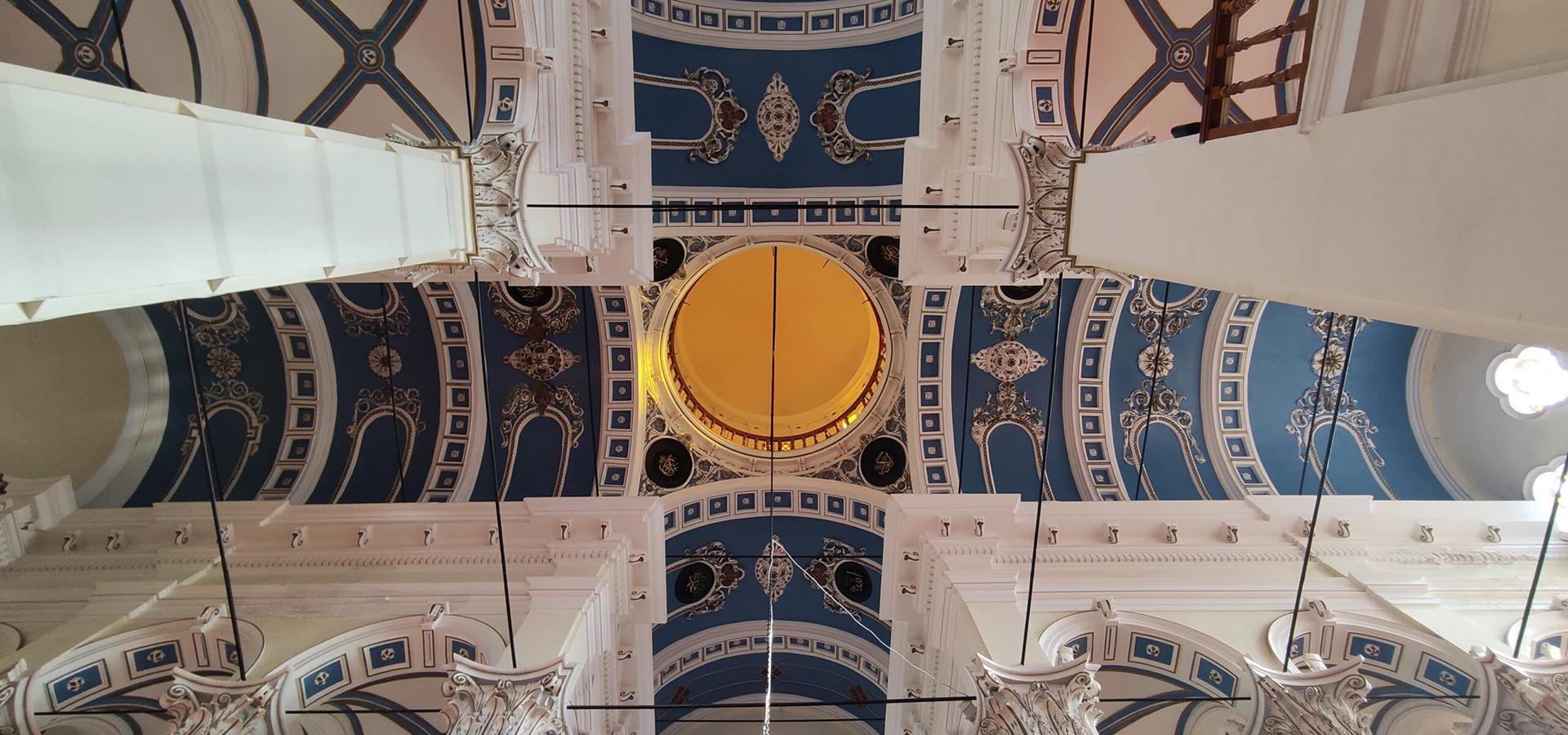
Compare purpose-built Hamidiye with the monumental former Hagios Georgios Church, today one of Ayvalık's most striking active mosques.
View Çınarlı Mosque Guide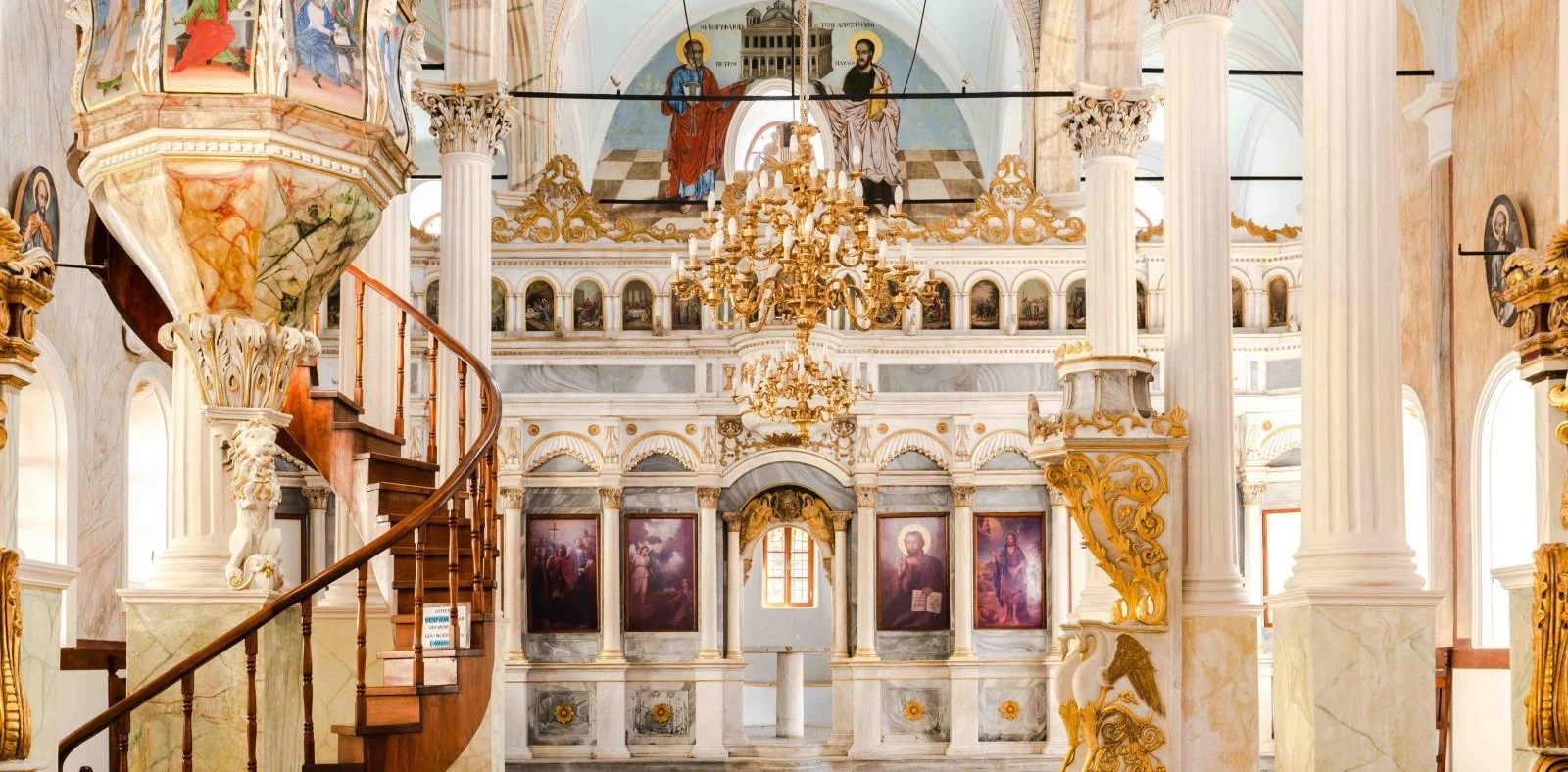
Step inside a restored Orthodox church preserved as a museum and compare its liturgical architecture with Hamidiye's purpose-built mosque plan.
View Taksiyarhis Guide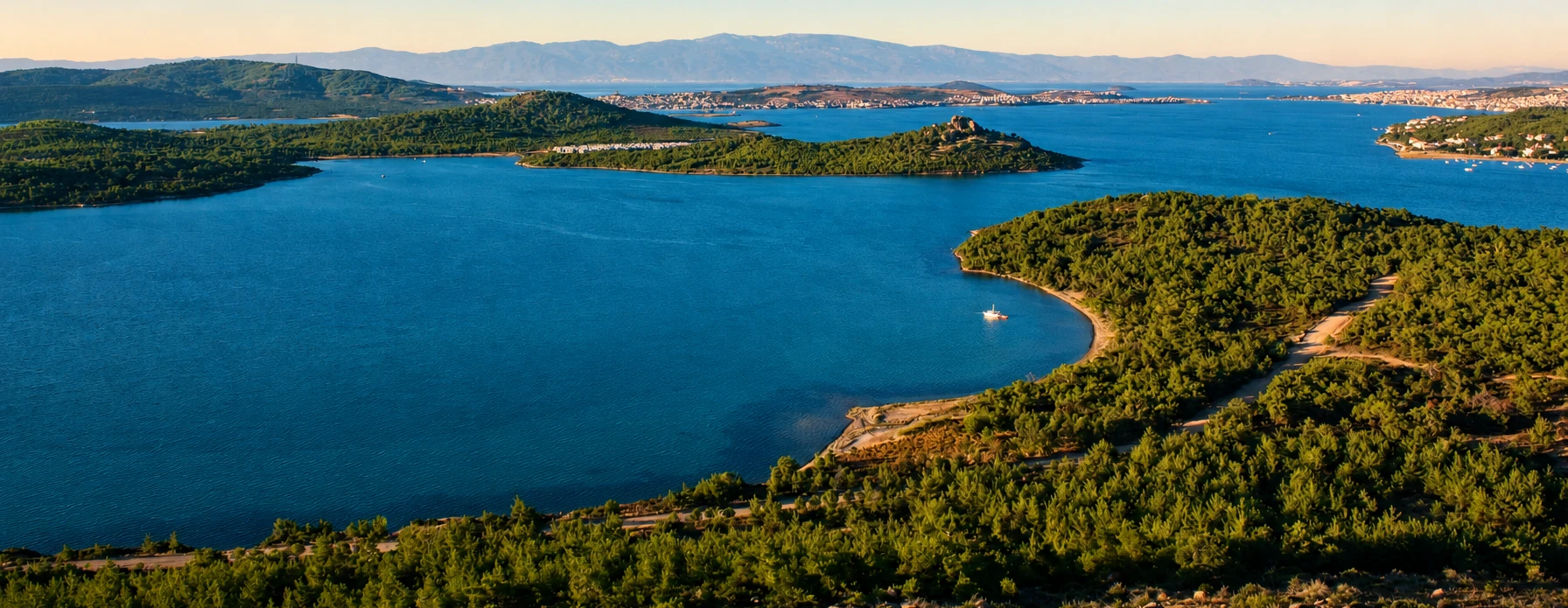
Finish a day of Ayvalık history with panoramic views across the islands, bays and North Aegean from the region's famous sunset viewpoint.
View Şeytan Sofrası Guide