Seledyn Heirloom Seed
The registered production method uses locally maintained Seledyn-type ancestral seed.






Sındırgı Çıtır Kavun is a geographically protected melon produced in the Çakıllı and Küçükbükü villages of Sındırgı, Balıkesir. It is grown from a locally preserved Seledyn heirloom seed line and is closely connected with traditional field cultivation and seed-saving practices.
The melon is recognised by its thin but hard and veined rind, green-and-yellow colouring and compact size. The registered specification gives a fruit diameter of approximately 10–15 cm. Its distinctive surface and eating character are the reason it is locally described as “çıtır,” meaning crisp or crunchy.
Sındırgı Çıtır Kavun received Turkish geographical-indication registration in 2023. It is protected as a Menşe Adı under TÜRKPATENT registration No. 1491.
Sındırgı Çıtır Kavun is registered by TÜRKPATENT as geographical indication No. 1491.
The protected melon is produced from locally preserved Seledyn-type heirloom seed rather than hybrid seed.
The registered fruit size is compact, with a diameter of approximately 10–15 centimetres.
The protected geographical area is limited to Çakıllı and Küçükbükü villages in Sındırgı.
Essential information about one of Sındırgı's most distinctive protected agricultural products.
Çakıllı and Küçükbükü villages, Sındırgı, Balıkesir, Türkiye.
Open Sındırgı on Google MapsA small heirloom melon with a thin, veined and firm rind.
TÜRKPATENT Menşe Adı registration No. 1491.
Traditional Seledyn heirloom seed saved from the season's first ripe fruits.
The protected melon survives through a farming tradition in which growers preserve seed from selected ripe fruits for the following season.
The identity of Sındırgı Çıtır Kavun is inseparable from the local seed stock maintained by growers in its protected production area. The registered method specifies the use of Seledyn-type heirloom seed and explicitly excludes hybrid seed.
Rather than purchasing new hybrid seed each year, growers collect seeds from mature melons of the first harvest and preserve them using a traditional method. The cleaned seeds are kept in cloth bags or pouches in a cool, dark environment until the next planting season.
This approach links one harvest directly with the next. The protected specification also requires direct sowing in the field rather than transplant production, making the entire cycle—from seed preservation to harvest—part of the product's geographical identity.
On 30 October 2023, Sındırgı Çıtır Kavun was formally registered as a Turkish geographical indication, protecting the defined relationship between the melon, its two-village production area and its traditional cultivation method.
A compact fruit, crisp character, hard veined surface and carefully preserved heirloom seed define the protected melon.
The registered production method uses locally maintained Seledyn-type ancestral seed.
Hybrid seed is excluded from the protected production system.
The protected specification records a fruit diameter of approximately 10–15 cm.
The outer rind is relatively thin but has a hard, distinctly veined surface.
At maturity, the rind develops a characteristic mixture of green and yellow tones.
The registered specification defines this measurable pH range for the protected melon.
The documented soluble dry matter range forms part of the product's analytical profile.
Protected production is geographically tied to these two villages of Sındırgı.
Sındırgı Çıtır Kavun is a protected local melon (Cucumis melo) grown from Seledyn-type heirloom seed in the villages of Çakıllı and Küçükbükü within Sındırgı district.
Its registered identity is based not only on appearance but also on the origin of its seed, direct-sowing method, local soils, seasonal field management, ripeness criteria and defined physical and chemical characteristics.
The protected product belongs to the species Cucumis melo.
Seed is preserved from selected ripe fruit for the following year's crop.
The registered method does not use a seedling-transplant system.
The protected geographical boundary covers Çakıllı and Küçükbükü villages.
Sındırgı Çıtır Kavun is registered by the Turkish Patent and Trademark Office as a Menşe Adı. The designation protects the relationship between the product, its narrowly defined production area and the officially registered cultivation system.
Sındırgı Çıtır Kavun
The TÜRKPATENT geographical-indication registration number is 1491.
The official application number is C2020/466.
The application was filed on 31 December 2020.
The geographical indication was registered on 30 October 2023.
The registration holder is Sındırgı Municipality.
The protected designation is a Menşe Adı.
Çakıllı and Küçükbükü villages in Sındırgı district, Balıkesir.
A Turkish Menşe Adı identifies a product whose defining characteristics are closely linked with a particular geographical environment and whose protected production takes place within that geographical boundary.
For Sındırgı Çıtır Kavun, the registered designation connects the name with the two villages of Çakıllı and Küçükbükü, traditional Seledyn heirloom seed, local growing conditions and the documented cultivation and harvest method.
Protected production is limited to Çakıllı and Küçükbükü.
The registered method specifies Seledyn-type heirloom seed.
Direct sowing, field care, ripening and harvest follow documented procedures.
Seed, production method, physical qualities and analytical values are subject to inspection.
Unlike geographical indications that cover an entire district, the protected area for Sındırgı Çıtır Kavun is especially narrow. It consists of the Çakıllı and Küçükbükü villages of Sındırgı district in Balıkesir Province.
The official specification links the melon with fertile soils locally described as boz toprak or kara toprak, associated with chernozem-type soil structure. The area's relatively high rainfall is also identified as helping enrich the soil with minerals.
Because the geographical boundary is so specific, origin is a central part of authenticity. A similar melon grown elsewhere does not automatically qualify for the protected name.
One of the two villages inside the official production boundary.
The second village included in the registered geographical area.
The protected villages lie within Sındırgı in inland Balıkesir.
Local rainfall and fertile soils are part of the environmental connection described in the registration.
The registered specification associates Sındırgı Çıtır Kavun with fertile soils described locally as boz toprak and kara toprak. These are identified in the registration as having a chernozem-type structure.
The connection is important because soil fertility forms part of the explanation for the product's local character. The specification also notes that higher rainfall in the protected area contributes to mineral enrichment of the soil.
One of the traditional local soil descriptions associated with protected cultivation.
Dark fertile soil is also specifically mentioned in the registered specification.
The registration links these soils with a fertile chernozem structure.
Higher local rainfall is described as contributing to soil mineral richness.
The protected production system uses a Seledyn-type heirloom seed. This seed material is not treated as an interchangeable input: preserving the local seed line is one of the defining elements of the product.
The official method states that hybrid seed is not used. Growers instead save seed from mature melons belonging to the first harvest and keep it for the next season.
The crop is produced from a locally maintained ancestral seed line.
Hybrid seed is excluded by the protected production specification.
Seed is collected from mature fruits of the season's first harvest.
Saved seed links one year's harvest directly with the following year's crop.
The geographical-indication specification records a traditional seed-preservation practice known as “bez süzme.” Seeds removed from selected ripe melons are placed into cloth bags or pouches and stored in a dark, cool environment until they are needed for planting.
The method is notable because it preserves seed without relying on hybrid replacement stock. The registration also describes the seeds as being kept without the use of substances such as medicines or hormones during this traditional storage process.
Mature melons from the first harvest provide seed for the following season.
Seeds are separated from the chosen fruit for preservation.
Traditional cloth bags or pouches are used rather than sealed modern seed systems.
The saved seed is protected from heat and light until the next planting season.
The most immediately recognisable feature of Sındırgı Çıtır Kavun is its outer surface. The rind is described as thin, veined and hard, creating the distinctive character behind the name “çıtır kavun.”
At maturity, the rind shows a mixture of green and yellow. The protected specification records a diameter of approximately 10–15 cm, making it more compact than many large commercial melon types.
The outer skin is relatively thin rather than heavily thickened.
The rind has a firm exterior structure associated with the “çıtır” description.
Visible surface veining contributes to the fruit's characteristic appearance.
Ripe fruit develops a blended green and yellow exterior.
The official geographical-indication specification records several measurable characteristics that help define Sındırgı Çıtır Kavun. These analytical values form part of the protected product profile.
The registered method states that land intended for Sındırgı Çıtır Kavun should be prepared for sowing by approximately 15 May. The field is ploughed thoroughly and then furrows are opened for planting.
Planting holes are made with hoes at intervals of at least 1 metre and to a depth of approximately 5–6 cm. If the soil already contains sufficient moisture, extra water is unnecessary at sowing; if it is dry, water is added to the holes.
The field is prepared before the main sowing period.
The soil is worked before planting furrows are created.
Planting holes are spaced widely enough for the spreading melon vines.
The registered method gives this approximate planting-hole depth.
Sındırgı Çıtır Kavun is direct-sown. The protected method does not use the seedling-transplant technique commonly seen in some commercial vegetable and melon production systems.
Approximately 8–10 seeds are placed into each prepared hole. The relatively high seed number reflects the fact that traditional heirloom seed may not germinate uniformly. The seeds are then covered with a mixture of soil and well-aged manure.
The specification notes that aged manure helps the seeds crack and germinate more quickly while avoiding the problems associated with fresh manure around newly emerging plants.
Seeds are planted directly into the field rather than raised as transplants.
Each planting hole receives several heirloom seeds to account for uneven germination.
Well-aged manure is mixed with soil above the newly planted seeds.
The protected production system specifically excludes transplant seedling production.
Germination begins quickly after sowing. According to the registered method, sprouting occurs toward the end of the first week, and seedlings should emerge fully from the seed within approximately 15 days.
At around 21 days after sowing, the first hand-hoeing is carried out. This helps aerate the roots and remove weeds while the base of the young plants is supported with additional soil.
The first visible germination normally begins around this stage.
The young plants should emerge fully from the seed.
The first hand cultivation takes place roughly three weeks after sowing.
Soil is drawn around the plant base to strengthen the developing vines.
After the first hand-hoeing, field cultivation continues at regular intervals. The registered method describes repeated hoeing, root-zone aeration, weed removal and inter-row cultivation by tractor.
These operations are generally repeated weekly while the plants are still developing and before the vines spread across the soil surface. This is a short but labour-intensive stage in which the crop quickly transforms from small seedlings into broad, ground-covering vines.
Early-season cultivation continues on a regular schedule.
Working the soil helps maintain a suitable environment around the developing roots.
Young vines are protected from competition while they establish.
Tractor cultivation can be used between rows before vines cover the field.
The registered production calendar places the beginning of flowering around the first week of July. The crop then moves quickly from flowering into fruit development during the hottest part of the season.
By approximately 20 July, the vines begin spreading widely enough to cover much of the field. During this stage, the developing melons continue growing and moving toward maturity.
Flowering begins around the first week of the month.
Warm conditions drive quick vine and fruit development.
Vines begin spreading sufficiently to cover the cultivated area.
The crop moves from flowering into melon formation and ripening.
One of the most interesting details in the registered production method is that routine irrigation is not normally carried out under typical weather conditions.
However, the specification allows watering when necessary. In particular, if temperatures around mid-July remain above approximately 35°C, irrigation may be needed to prevent the root system from weakening.
Under ordinary seasonal conditions, routine watering is not part of the method.
Very high mid-summer temperatures can create a need for supplemental water.
Watering during extreme heat helps prevent the root system from weakening.
The decision to irrigate is linked to actual field and temperature conditions.
The protected specification describes visible signs used to judge maturity. One of the most important is a scar-like crack or mark on the underside of the melon, indicating that the fruit has reached ripeness.
The fine hairs that develop on the melon during fruit growth also fall away as it matures. At the same time, marks locally known as “çıtırdak” become more pronounced and the rind develops its mature yellow-and-green colouring.
A crack-like scar beneath the fruit is an important maturity indicator.
Fine hairs present during development disappear as the melon reaches full maturity.
Characteristic surface marks become more distinct on ripe fruit.
The mature rind shows the protected product's characteristic mixed colouring.
The production cycle begins with field preparation in May. From sowing, the first melons generally require approximately 76–81 days to reach the first harvest.
Harvest continues while usable fruit remains on the vines. After approximately 15 August, dew events can become more common in the area, and melons developing later in the season may be somewhat smaller while remaining suitable for consumption.
By the end of September, roughly 90% of the harvest is normally completed according to the registered production description.
The soil is prepared and the growing cycle begins in spring.
This is the registered interval from sowing to the first harvest.
Summer is the heart of the melon season.
Most of the crop is harvested by the end of September.
The first harvest begins once the mature fruits show the recognised ripeness signs: underside scar marks, loss of surface hairs, clearer “çıtırdak” markings and the expected yellow-green rind colour.
The first mature fruits also have a second role. Their seeds are collected and preserved for the following year's production, making the first harvest both a food harvest and the beginning of the next agricultural cycle.
Picking continues as long as suitable melons remain in the field. Later fruits can be smaller, particularly after mid-August, but they may still be consumed.
Growers rely on defined surface and colour changes before picking.
The earliest ripe melons provide seed for the next growing season.
Harvest continues as individual fruits reach maturity.
Melons maturing later in the season may be more compact but remain edible.
Sındırgı Çıtır Kavun is a seasonal product rather than a melon intended for very long storage. After harvest, the registered specification states that it can be kept for up to approximately one month in a cool place protected from direct sunlight.
It is specifically described as unsuitable for storage through the winter. This makes the summer and early-autumn harvest period the most meaningful time to discover the fruit at its best.
This is the maximum post-harvest storage period given in the registered specification.
Lower temperatures help preserve the fruit after harvest.
Stored melons should be protected from sunlight.
The protected melon is intended to be enjoyed within its relatively short seasonal window.
The official registration focuses primarily on the fruit's physical surface, dimensions, chemical profile and traditional production system rather than providing a detailed tasting vocabulary.
What it clearly emphasises is the distinctive thin, veined and hard rind associated with the name “çıtır.” The compact 10–15 cm fruit and green-yellow mature colour also give it a recognisable appearance among regional melon varieties.
The protected fruit measures approximately 10–15 cm across.
A hard outer surface is one of the defining registered characteristics.
The rind carries visible surface veining rather than a perfectly smooth finish.
The melon is best understood as a fresh summer and early-autumn agricultural product.
Sındırgı Çıtır Kavun is fundamentally a fresh seasonal melon. Its protected identity concerns the fruit itself and the agricultural system behind it rather than a processed recipe.
For visitors, the most authentic experience is therefore simple: find the melon during its harvest season, serve it fresh and connect its flavour and texture with the farming landscape where it was grown.
Enjoyed directly as a seasonal melon during the harvest period.
Its season naturally places it among the refreshing fruits of warm-weather meals.
Seasonal purchasing offers the best opportunity to encounter the fruit close to its place of origin.
The melon is especially interesting when explored together with Sındırgı's rural landscape and other protected foods.
A small crisp melon is not automatically protected Sındırgı Çıtır Kavun. The registered designation identifies fruit produced in Çakıllı and Küçükbükü villages using the specified heirloom seed and production method.
The protected wording Sındırgı Çıtır Kavun and the Turkish Menşe Adı emblem are required on the product or packaging. If they cannot be placed directly there, they must be displayed visibly at the business.
Look for the registered wording Sındırgı Çıtır Kavun.
The Menşe Adı emblem identifies the protected designation of origin.
Authentic protected production comes from Çakıllı or Küçükbükü.
The registered crop uses Seledyn-type heirloom seed rather than hybrid seed.
The protected specification gives a diameter of approximately 10–15 cm.
Clear origin and protected-product identification matter more than appearance alone.
When buying Sındırgı Çıtır Kavun, start with origin. The geographical indication is limited to two villages, so a clear connection with Çakıllı or Küçükbükü in Sındırgı is more meaningful than a generic “local melon” description.
A mature fruit should also show the general registered appearance: compact size, green-yellow colouring and a thin, hard, veined rind. During the main season, local markets and sellers closer to Sındırgı provide the best opportunity to ask directly about provenance.
GI identification is the clearest link with the registered product.
Protected origin is limited to Çakıllı and Küçükbükü.
The registered melon is relatively compact in diameter.
A thin, veined and firm exterior is characteristic of the protected melon.
Summer and early autumn offer the strongest chance of finding fresh local fruit.
Keep the melon cool and away from direct sunlight after purchase.
The warm months offer the best chance to encounter active melon fields and fresh harvests.
Çakıllı and Küçükbükü form the protected geographical boundary.
The first harvest follows roughly 76–81 days after sowing, with summer at the heart of the season.
The heirloom seed tradition is one of the most distinctive parts of the product's story.
Melon fields are active agricultural land and should only be entered with permission.
Combine the food story with Sındırgı's rural villages, natural landscapes and local culture.
Sındırgı is also known for protected cornichons and other regional agricultural traditions.
Close-up images of the green-yellow veined surface show what makes the melon visually distinctive.
Sındırgı Çıtır Kavun tells a story that extends beyond the fruit itself. Its protected identity depends on local seed preservation, direct field sowing, traditional cultivation and the knowledge required to recognise full maturity.
The practice of saving seed from the first ripe melons is especially significant. It means the product is reproduced not simply through a commercial input but through a repeated agricultural tradition maintained from one growing season to the next.
For food travellers, the melon offers a useful window into the relationship between regional cuisine and farming knowledge: what appears on the table is the visible end of a much longer cycle of seed selection, soil preparation, cultivation, ripening and harvest.
Seed preservation carries the crop from one season into the next.
The protected product belongs specifically to two rural communities.
The fruit belongs naturally to the warm-season rhythm of local farming.
The Menşe Adı formally protects the connection between melon, method and place.
A geographical indication can help preserve more than a product name. In the case of Sındırgı Çıtır Kavun, the registration documents an agricultural system built around a local seed line and a narrowly defined village landscape.
By tying the protected name to Çakıllı and Küçükbükü, the registration gives formal recognition to the growers and production knowledge associated with those communities.
The product also contributes to Sındırgı's broader food identity alongside other locally recognised agricultural products and rural traditions.
The designation gives visibility to Çakıllı and Küçükbükü as the product's protected home.
The registration helps document and protect the use of the local heirloom seed.
Field preparation, ripeness signs and seed saving all form part of the agricultural story.
The protected melon adds another distinctive product to Balıkesir's diverse food landscape.
For travellers interested in regional Turkish food, heirloom agriculture and protected local products, Sındırgı Çıtır Kavun is particularly interesting because its identity reaches far beyond sweetness or appearance.
Its story combines a local seed line, a two-village geographical boundary, direct sowing, chernozem-type soils, distinctive ripeness signs and a short seasonal harvest that cannot simply be stored through winter.
The most meaningful way to discover it is close to its origin: visit Sındırgı during the harvest season, look for clearly identified local fruit and learn how growers preserve the seed that keeps the tradition alive.
Few food stories make the continuity between one harvest and the next so visible.
The protected production area consists of only two Sındırgı villages.
The hard, veined green-yellow surface gives the melon its recognisable appearance.
Its limited storage life makes the harvest period the best time to experience it.
Sındırgı Çıtır Kavun belongs to a remarkably diverse Balıkesir food landscape shaped by inland farming districts, olive country, dairy production, vineyards, rice fields and generations of regional food craftsmanship.
Explore the district, rural landscapes and village culture behind the protected melon.
Discover Sındırgı's other protected vegetable crop and its specialised pickling tradition.
Continue with one of Balıkesir's best-known geographically protected desserts.
Explore another protected crop shaped by Balıkesir's agricultural landscapes.
Move from village melon fields to another protected inland Balıkesir farming tradition.
Discover Balıkesir's rich dairy heritage through this distinctive protected cheese.
A melon does not become protected Sındırgı Çıtır Kavun simply because it is small, green-yellow or crisp. The designation represents a defined combination of geographical origin, heirloom seed, cultivation method, physical characteristics and analytical profile.
Protected fruit must come from Çakıllı or Küçükbükü village.
The registered method uses Seledyn-type heirloom seed and excludes hybrid seed.
The protected method does not use transplanted seedlings.
Fruit diameter, pH, acidity and soluble dry matter ranges are documented.
Field preparation, sowing, crop care, ripeness and harvest procedures are specified.
The protected name and Menşe Adı emblem are subject to defined usage rules.
Geographical-indication inspections are coordinated by Sındırgı Municipality. The inspection body consists of three specialists representing Sındırgı Municipality, the Sındırgı District Directorate of Agriculture and Forestry and the S.S. Yaylabayır Village Agricultural Development Cooperative.
Regular inspections are carried out once each year. Additional inspections may take place when complaints are received or whenever they are considered necessary.
Controls cover the suitability of the seed used, conformity with the registered production method, the physical characteristics of the fruit, pH and total acidity values, and correct use of the protected name and Menşe Adı emblem.
Inspectors can verify whether the registered heirloom seed requirement is being followed.
Cultivation practices are checked against the geographical-indication specification.
Appearance, pH and acidity form part of the official control system.
Correct use of the protected wording and Menşe Adı identification is inspected.
Sındırgı Çıtır Kavun is a geographically protected local melon grown from Seledyn-type heirloom seed in two villages of Sındırgı, Balıkesir.
The registered geographical boundary consists of Çakıllı and Küçükbükü villages in Sındırgı district, Balıkesir Province.
Yes. It is a registered Turkish geographical indication.
It is protected as a Menşe Adı.
The TÜRKPATENT registration number is 1491.
It was registered on 30 October 2023.
The geographical-indication application number is C2020/466.
The application was filed on 31 December 2020.
The registration holder is Sındırgı Municipality.
The protected production method uses Seledyn-type heirloom seed.
No. The registered method specifically states that hybrid seed is not used.
No. The geographical-indication specification states that the seedling method is not used; seeds are sown directly in the field.
The registration describes the fruit as having a thin rind with a hard, veined surface, characteristics associated with the local “çıtır” description.
At maturity, its rind is a mixture of green and yellow.
The registered diameter is approximately 10–15 cm.
The protected specification records a pH range of approximately 5.7–6.3.
The registered total acidity range is approximately 0.07–0.10 g/100 g, expressed as citric acid.
The registered range is approximately 9–9.42%.
The protected specification associates the crop with fertile boz or kara soils described as having a chernozem-type structure.
Seeds from selected first-harvest melons are kept in cloth bags or pouches in a cool, dark environment using a traditional method known as bez süzme.
The production area is prepared for sowing by approximately 15 May.
The registered method specifies spacing of at least approximately 1 metre.
They are prepared to a depth of approximately 5–6 cm.
Approximately 8–10 seeds are placed in each planting hole.
Sprouting begins toward the end of the first week, and emergence should be complete within approximately 15 days.
The first hand-hoeing takes place approximately 21 days after sowing.
Flowering normally begins around the first week of July.
Under normal weather conditions routine irrigation is not carried out, although watering may be needed when mid-summer temperatures rise above about 35°C.
The first harvest generally begins approximately 76–81 days after sowing.
Ripeness signs include a scar-like mark beneath the fruit, disappearance of surface hairs, clearer “çıtırdak” markings and mature green-yellow colouring.
Harvest continues through the season, with approximately 90% of the crop normally completed by the end of September.
It can be kept for up to approximately one month in a cool place away from direct sunlight.
No. The registered specification states that it is not suitable for long-term winter storage.
Its protected two-village origin, heirloom seed, traditional seed preservation, direct-sowing method, compact veined fruit and documented production cycle distinguish it from generic melons.
The strongest photography should connect the melon with the agricultural tradition behind it: the compact green-yellow fruit, its veined rind, spreading field vines, hand harvesting and heirloom seed preservation.
Photograph several ripe Sındırgı melons naturally arranged in a wooden harvest crate or field basket.
A detailed macro image can reveal the hard veined surface and mixed green-yellow colouring.
Show a mature fruit among broad leaves and spreading summer vines.
A grower lifting a ripe melon from the field gives scale and human context.
Photograph saved melon seeds with a traditional cloth pouch to illustrate the bez süzme tradition.
Wide views of melon fields around rural Sındırgı establish the geographical story behind the product.
Discover Sındırgı Çıtır Kavun together with local villages, protected foods, agricultural landscapes and the lesser-known interior of Balıkesir.
Custom-designed private programs can combine Sındırgı, seasonal agricultural experiences, village food culture, local markets and other Balıkesir highlights according to your dates and interests.
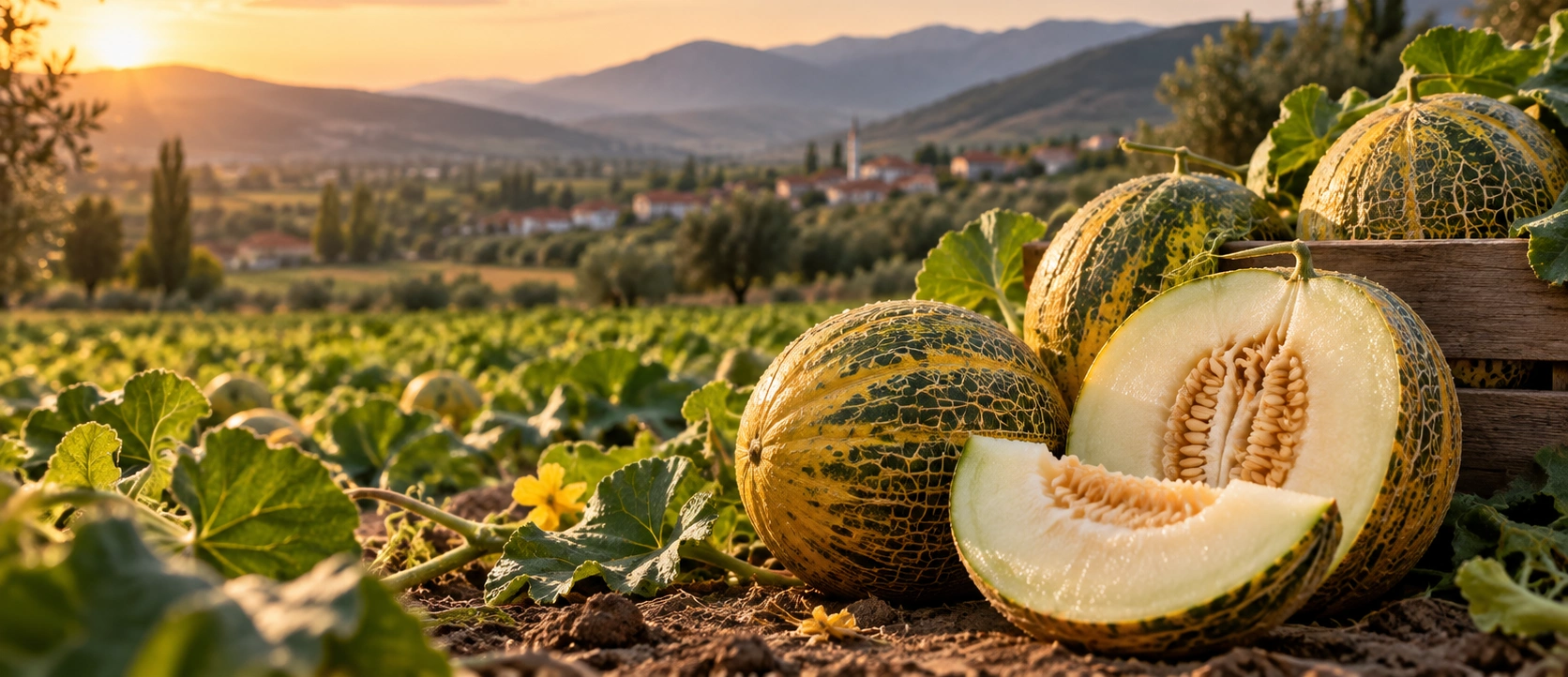
Explore Sındırgı through its protected crisp melon, heirloom seed tradition, village agriculture and seasonal local food culture.
Request This Experience
Combine Sındırgı's protected agricultural products with village landscapes, regional cuisine and other food traditions across Balıkesir.
Request This Tour