Long Grain
The registered rice has an average grain length of approximately 6.80–7.05 mm.






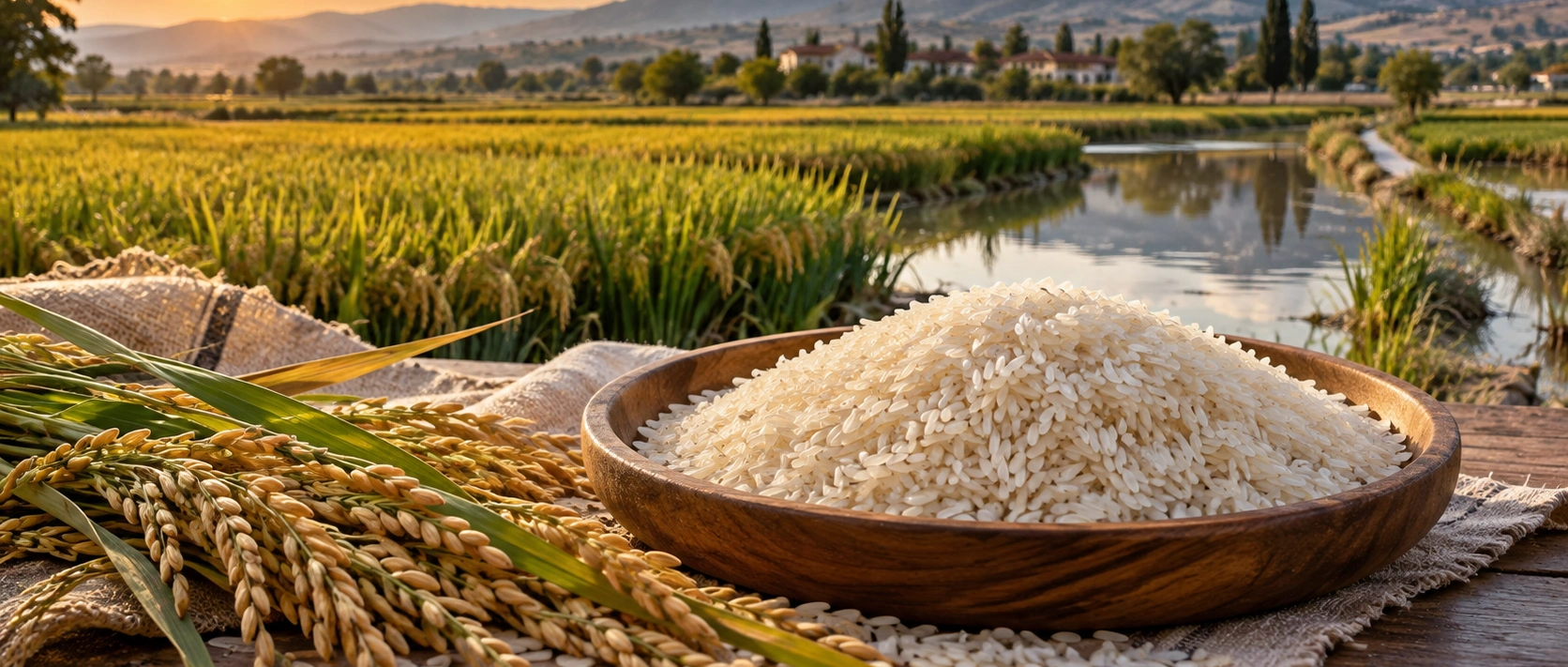
Balıkesir Gönen Pirinci is the geographically protected rice of Gönen in Balıkesir Province. It is produced from Oryza sativa paddy grown in Gönen and processed into a long-grain white rice with a glassy yet matt appearance.
Its identity is closely connected with Gönen Plain, certified Gönen seed, flooded rice fields, the district's summer sunshine and a production cycle that continues from field preparation and sowing through harvest, drying, milling and classification.
Balıkesir Gönen Pirinci received Turkish geographical-indication registration in 2025. It is protected as a Mahreç İşareti under TÜRKPATENT registration No. 1734, with the geographical boundary defined as Gönen district in Balıkesir.
Balıkesir Gönen Pirinci is registered by TÜRKPATENT as geographical indication No. 1734.
The protected specification classifies the finished rice among long-grain Type A rice.
Protected production uses the registered Gönen seed developed from the Bonni × Shinei cross.
The geographical boundary of the registered product is Gönen district in Balıkesir Province.
Essential information about one of Balıkesir's best-known rice-growing traditions.
Gönen district in Balıkesir Province, north-western Türkiye.
Open Gönen on Google MapsThe rice comes from paddy belonging to the cultivated species Oryza sativa.
TÜRKPATENT Mahreç İşareti registration No. 1734.
Long, broad, white grains classified as long-grain rice, Type A.
The protected rice reflects the relationship between Gönen's agricultural landscape, specialist seed, water management and generations of paddy-growing knowledge.
Rice cultivation has long held an important place in the agricultural economy of Gönen. The district's level lowlands, irrigated fields and established paddy-growing infrastructure created a landscape in which rice became more than simply another crop.
The registered product uses Gönen seed, a cultivar developed from the Bonni × Shinei cross and registered with the Trakya Agricultural Research Institute of the Turkish Ministry of Agriculture and Forestry. The seed is specifically identified in the geographical-indication specification.
Production takes place through a highly managed seasonal cycle. Fields are levelled and divided into bordered plots known as tava, seed is pre-germinated and broadcast into water, irrigation is carefully controlled, and the crop matures over approximately 120–125 days.
In 2025, this long-standing reputation and production relationship was formally recognised when Balıkesir Gönen Pirinci was registered as a Turkish geographical indication.
Grain shape, appearance, certified seed, growing period and measurable physical properties all contribute to the protected identity.
The registered rice has an average grain length of approximately 6.80–7.05 mm.
The grains are described as both long and broad, placing the product in the Type A long-grain group.
After milling, the finished rice has white grains with a clean, uniform appearance.
The specification characterises the grains as glassy while also having a matt surface appearance.
The protected technical description states that the rice does not contain a chalky area in the grain.
Production uses the registered Gönen seed obtained through authorised certified-seed channels.
The crop reaches maturity in approximately four months under the registered production system.
The specification places the harvest period between 1 September and 15 October.
Balıkesir Gönen Pirinci is rice produced from paddy of the species Oryza sativa grown in Gönen district. After harvest, the paddy is cleaned, dried, dehulled, milled, polished and classified to obtain the finished white rice.
The protected name refers to a defined product rather than simply any packet of rice carrying the word Gönen. Its specification identifies the geographical boundary, seed source, cultivation method, grain characteristics, post-harvest processing, packaging and controls.
The harvested crop is still enclosed in its husk and must be processed before becoming the white rice sold for cooking.
The protected production system specifies the Gönen cultivar registered with the Trakya Agricultural Research Institute.
The finished product is placed in the Type A long-grain category.
The protected reputation and production method are tied to Gönen district in Balıkesir.
Balıkesir Gönen Pirinci is registered by the Turkish Patent and Trademark Office as a Mahreç İşareti. The official registration defines the product, geographical area, registered seed, production method, physical and chemical characteristics, post-harvest handling and inspection system.
Balıkesir Gönen Pirinci
The TÜRKPATENT geographical-indication registration number is 1734.
The official application number is C2021/000121.
The application was filed on 19 March 2021.
The geographical indication was registered on 6 May 2025.
The registration holder is the Gönen Chamber of Agriculture (Gönen Ziraat Odası).
The protected designation is a Mahreç İşareti.
The registered geographical area is Gönen district, Balıkesir Province.
A Turkish Mahreç İşareti protects a product whose distinctive quality, reputation or other characteristics are associated with a defined geographical area.
For Balıkesir Gönen Pirinci, the official specification goes further than a simple place name: it requires the registered production stages to take place within Gönen and documents the cultivation and processing method used for the protected product.
The protected geographical boundary is Gönen district rather than Balıkesir Province as a whole.
The specification identifies the Gönen cultivar used for protected production.
Field preparation, germination, sowing, irrigation, harvest and post-harvest processing are documented.
The product is inspected for technical characteristics, production method, harvest, packaging, storage and correct use of the protected name.
Gönen lies in the fertile north-west of Balıkesir, where broad agricultural lowlands support intensive crop production. Rice fields depend on carefully levelled ground and controlled water, making the physical landscape of the plain especially important.
The geographical-indication specification also records strong summer sunshine in Gönen. This seasonal sunlight is associated with dry-matter accumulation in the developing rice grain during the important July and August growth period.
Rice cultivation depends on land that can be carefully levelled so water is distributed evenly.
Fields are divided into bordered plots so irrigation depth and flow can be managed.
High seasonal sunshine is specifically noted in the protected product specification.
Rice remains an important part of Gönen's farming economy and regional reputation.
Balıkesir Gönen Pirinci is produced with Gönen seed, a cultivar developed from the Bonni × Shinei cross and registered with the Trakya Agricultural Research Institute.
The protected specification states that seed used in production is obtained through firms within the geographical boundary that are authorised for certified seed production and source the seed through the research institute system.
The Gönen cultivar is specifically identified in the geographical-indication specification.
The registered Gönen seed was developed from this documented cross.
Protected production relies on seed supplied through authorised certified-seed channels.
The cultivar is cultivated within the defined agricultural landscape of Gönen.
The geographical-indication registration includes measurable characteristics that help define the protected rice.
Protected production follows a detailed cycle that begins with soil preparation and continues through sowing, irrigation, harvest, drying, milling and final classification.
Rice requires unusually precise field preparation because water must be distributed evenly across the growing area. The registered method begins with deep ploughing and the removal of stones, roots, crop residues and other obstacles.
The surface is then levelled using tractors or other suitable machinery. Once the land is even, irrigation channels are opened according to the slope so that the movement of water can be controlled.
The specification identifies 15–30 September as the period for deep soil preparation.
Stones, roots, old plant material and obstacles are removed before flooding.
A smooth field surface is essential for more even water distribution.
Channels are created according to the field slope so water can be managed efficiently.
A tava is a bordered field compartment designed to hold water. In the registered production method, these compartments are prepared between 1 and 20 April before sowing.
The borders allow growers to control flooding and water depth across the field. Once filled and the base has been prepared, the pre-germinated rice seed is broadcast across the wet surface.
Each tava is enclosed by low banks that help retain irrigation water.
The registered method places tava preparation between 1 and 20 April.
Water is introduced before the pre-germinated seed is broadcast.
The system gives growers more precise control over the flooded paddy environment.
Before sowing, selected clean and healthy seed is washed and soaked in clean water. The official method describes a 24-hour soaking stage in a warm environment, allowing the seed to absorb water and swell.
The soaked seed is then allowed to germinate for approximately two to three days. This prepares the seed for broadcast sowing into the flooded rice field.
Healthy certified seed forms the starting point of the protected production cycle.
Seed is cleaned before the soaking stage.
Water absorption prepares the seed for germination.
The sprouting seed is then ready to be broadcast into the prepared tava.
The registered sowing period for Gönen paddy is 30 April to 15 May. By this stage the bordered field compartments have been prepared and filled with water.
Pre-germinated seed is distributed by broadcast sowing over the flooded field. The specification gives a sowing quantity of approximately 150–200 kg per decare.
The registered sowing window begins at the end of April.
Sowing is completed by the middle of May.
Pre-germinated seed is spread across the prepared flooded field.
The specification records this approximate seed quantity per decare.
The registered method uses intermittent irrigation rather than treating the field as a permanently unmanaged body of water. Water management changes as the crop develops.
The specification describes initial, main, middle and final irrigation stages, with moisture targets adjusted according to plant development, temperature and soil conditions.
Water supports germination and early establishment after sowing.
When plants reach roughly 10–15 cm, water management supports active vegetative growth.
Moisture is reduced as the crop advances toward maturity.
Water is managed more conservatively as the grain completes ripening.
Rice fields require continuous management throughout the growing season. Fertilisation is carried out during the tillering stage after early plant growth has begun.
Weed control combines good seed, correct sowing and cultivation with physical removal and, where necessary, authorised crop-protection methods. The production specification also recognises the need to manage diseases and pests that can affect paddy.
Fertilisation supports the stage when the rice plant develops additional shoots.
Healthy sowing, field management and direct weed removal are part of crop care.
Growers monitor diseases and pests that can reduce yield or grain quality.
Water, nutrition and protection are adjusted as field and weather conditions change.
The protected Gönen rice crop matures in approximately 120–125 days. This places the main growth period across late spring and summer before the autumn harvest.
During July and August, the geographical-indication specification highlights Gönen's strong sunshine as an environmental factor supporting dry-matter accumulation in the developing grain.
The earliest part of the registered maturity range is approximately four months.
Natural seasonal conditions can extend the cycle slightly.
The crop develops through the strongest sunshine period of the year.
Mature paddy is harvested from September into mid-October.
The geographical-indication specification places harvest between 1 September and 15 October. Growers look for visible and physical signs of maturity rather than relying only on the calendar.
The crop is ready when around 80% of the panicles have turned straw-coloured and the grains in the lower sections are firm. Harvest can be carried out by combine harvester or by sickle.
The registered harvest window begins at the start of September.
Colour change provides a visible sign that the crop is approaching maturity.
Grain hardness is another maturity indicator described in the specification.
The registered harvest period continues until the middle of October.
Moisture is an important technical consideration in rice harvest. The specification notes that paddy in the field may reach approximately 25–30% moisture as harvest approaches, while a more suitable harvest moisture is around 18–22%.
Aeration and field management help bring the crop toward this range before cutting. Controlling moisture reduces the risk of damage and supports better handling after harvest.
The specification notes this higher moisture level can occur as harvest approaches.
This is identified as the preferred moisture range for harvesting.
Reducing excess moisture helps prepare the crop for cutting.
Appropriate moisture supports safer harvest and post-harvest handling.
Freshly harvested paddy is not yet the white rice used in the kitchen. It first passes through cleaning and drying stages designed to remove foreign material and reduce moisture.
The dried paddy is then dehulled and milled. Outer layers are removed, grains are polished and the finished rice is classified according to size, shape, colour, broken-grain condition, taste and aroma.
Stalks, stones, dust and other foreign material are removed.
Moisture is reduced naturally or with appropriate drying equipment.
The protective husk surrounding the paddy grain is removed.
Further processing removes outer layers from the grain.
Polishing gives the finished rice its clean white appearance.
Grains are sorted according to physical and sensory quality criteria.
In Turkish agricultural language, çeltik refers to rice in its paddy form: the harvested grain still enclosed in its husk. Pirinç is the edible rice obtained after the husk and other outer layers have been removed through milling.
This distinction matters when understanding Gönen production. Farmers grow and harvest çeltik in the fields; the milling process transforms that crop into the Balıkesir Gönen Pirinci sold for cooking.
Paddy rice: harvested grain still protected by its outer husk.
Milled edible rice after dehulling and further processing.
The agricultural crop is managed and harvested as çeltik.
The finished product reaches kitchens and markets as pirinç.
The registered specification calls for finished rice to be kept in a clean, dry and ventilated environment protected from direct sunlight and rain.
Rice packaged at approximately 12–14% moisture can, under the conditions described in the specification, be stored for up to one year. Storage areas should also be protected from insects and rodents.
The registered post-processing target helps support stable storage.
Excess humidity should be avoided.
Air movement helps keep storage conditions stable.
The official specification gives this storage period under the stated conditions.
The finished product has long, broad white grains. The official specification describes the rice as having a glassy internal appearance together with a matt surface character.
A particularly important technical detail is the absence of a chalky region in the grain. Together with size and weight measurements, these visual qualities help define the protected product.
The milled rice has the familiar clean white colour expected from polished rice.
This is the registered average grain-length range.
The grain is described as translucent or glassy rather than opaque and chalky.
The official description also records a matt visual finish.
Balıkesir Gönen Pirinci is a long-grain Type A rice, making it naturally suited to many of the rice dishes found across Turkish home cooking. Its most familiar role is in pilav, where the grain itself remains at the centre of the dish.
It can also be used in vegetable, chicken and meat pilafs, alongside legumes, or in recipes where long-grain rice is preferred. Exact water ratios and cooking times vary with soaking, pan size, heat and personal texture preference.
A simple butter or olive-oil pilaf keeps the focus on the grain.
Toasted orzo or vermicelli can be combined with the rice in a classic Turkish preparation.
Long-grain rice works naturally with stock and shredded or roasted chicken.
Seasonal vegetables can turn the rice into a complete side dish.
Plain rice is one of Türkiye's classic companions to kuru fasulye.
Long-grain rice can also be used in fillings when the recipe calls for a firmer grain.
A good pilaf begins with clean rice and controlled moisture. Many Turkish cooks rinse the rice until the water becomes noticeably clearer and may soak it before cooking, depending on the recipe.
The rice is then gently cooked with butter, olive oil or another preferred fat before hot water or stock is added. Resting the pilaf after cooking allows steam and moisture to redistribute through the grains.
Washing removes loose surface starch and any fine particles from handling.
Some pilaf methods soak the rice before cooking for more even hydration.
Hot water or stock helps the cooking process continue without a major temperature drop.
A short covered rest can improve the final texture of the pilaf.
The names are often encountered together in the marketplace, but they should not automatically be treated as identical. The registered geographical indication is Balıkesir Gönen Pirinci, and its official specification identifies the Gönen seed used for protected production.
Products sold commercially as “Gönen Baldo” may follow their own variety and labelling descriptions. When you specifically want the geographical-indication product, look for the registered name, the Balıkesir Gönen Pirinci logo and the Mahreç İşareti emblem.
The GI registered by TÜRKPATENT is Balıkesir Gönen Pirinci.
The GI specification names the Gönen cultivar developed from Bonni × Shinei.
Retail rice may use other variety or marketing names alongside Gönen.
The protected product should follow the geographical-indication labelling requirements.
A packet simply mentioning Gönen is not enough to establish that it is the protected geographical-indication product. The registered name and required geographical-indication identification provide the strongest clues.
The specification requires the Balıkesir Gönen Pirinci wording, its registered logo and the Mahreç İşareti emblem to appear on the product or packaging. Where direct placement is not possible, the identification must be displayed clearly at the business.
Look for the wording Balıkesir Gönen Pirinci.
Protected products should carry the Turkish Mahreç İşareti identification.
The registered Balıkesir Gönen Pirinci logo forms part of the official usage rules.
Packaging should identify the producer and traceable product information.
Protected production is connected with Gönen district in Balıkesir.
Long, broad, white grains should match the physical profile of the registered product.
When buying the protected rice, start with provenance and labelling rather than appearance alone. A clean packet, clear producer information, the protected name and correct geographical-indication marks are more reliable than a generic reference to Gönen.
For the rice itself, look for reasonably uniform grains with minimal visible dust, moisture damage or insect activity. Store the packet in a dry cupboard once you return home.
Check the registered name and producer information before buying.
The Mahreç İşareti emblem and protected product logo are important authenticity signals.
Avoid packages showing obvious moisture, contamination or pest damage.
After purchase, store rice away from humidity and direct sun.
Established producers, cooperatives and trusted food shops make provenance easier to verify.
Recent, clearly labelled stock gives you better traceability and storage information.
Travellers who want to understand the agricultural cycle should think in terms of the paddy season rather than supermarket availability. Sowing takes place from late April to mid-May, the fields remain actively green through summer, and harvest runs from early September to mid-October.
Finished rice can of course be purchased throughout the year when properly processed and stored, but the early-autumn harvest period offers the strongest connection with the landscape and farming tradition itself.
Pre-germinated seed is sown into prepared flooded fields.
The rice crop develops across the warm summer growing season.
Fields begin turning from green toward golden straw colours as grain matures.
The final part of the registered harvest period concludes.
September and early October are the most meaningful months for seeing the rice harvest landscape.
Paddy fields are private agricultural workplaces; photograph only from appropriate public areas unless invited.
Markets and regional food sellers can help you see how Gönen rice is presented locally.
If buying rice, ask where it was grown and whether it carries geographical-indication identification.
The fields, irrigation channels and harvest machinery explain the product better than a supermarket shelf alone.
A simple rice pilaf is one of the easiest ways to experience the grain in a familiar Turkish context.
Combine Gönen with the wider food traditions of Manyas, Bandırma, Susurluk and other districts.
Spring shows flooded fields and new growth; early autumn reveals the golden harvest stage.
Rice holds a central place in Turkish cooking, and Gönen's agricultural landscape gives that everyday ingredient a strong regional identity. The value of the protected product lies not only in how it tastes on the plate but also in the farming system behind it.
Preparing the crop requires certified seed, field levelling, water control, careful seasonal timing, crop management, harvest, drying and milling. Each bowl of rice therefore represents a much longer agricultural process than the finished grain might suggest.
Rice pilaf appears across everyday meals, festive tables and restaurant cooking in Türkiye.
Gönen's reputation for rice is tied directly to the farming economy of the district.
Rice production depends on carefully managed flooded fields and irrigation timing.
Drying, milling, polishing and sorting are essential stages before the rice reaches the kitchen.
For travellers interested in regional Turkish ingredients, Gönen rice is valuable because it reveals the agricultural story behind one of the country's most familiar staples.
The product is not defined by an elaborate recipe. Its interest comes from the combination of a registered cultivar, a specific farming landscape, controlled paddy production and the long-standing reputation of Gönen as a rice-growing district.
The long, broad Type A grain gives the protected product a clear physical identity.
The rice connects an everyday food directly with Gönen's agricultural landscape.
Paddy cultivation in Gönen depends on specialist seasonal knowledge and water management.
A simple pilaf keeps the focus on the rice itself.
Gönen rice belongs to a much larger Balıkesir food landscape that includes protected cheeses, olive products, meat traditions, desserts and regional drinks.
Discover another protected product from the fertile northern Balıkesir countryside.
Explore Balıkesir's famous foamy ayran and the roadside food culture of Susurluk.
Continue into the province's remarkable hard-cheese traditions and protected dairy heritage.
Move from rice fields to one of Balıkesir's best-known traditional cheese-based desserts.
Discover the protected lamb tradition that shapes many of the province's savoury dishes.
Add historical context to a journey through northern Balıkesir and the southern Marmara region.
A long grain alone does not make rice Balıkesir Gönen Pirinci. The protected designation represents a specific combination of origin, registered seed, documented cultivation, measurable grain characteristics and controlled post-harvest handling.
Protected Balıkesir Gönen Pirinci is tied to Gönen district in Balıkesir.
The specification identifies the Gönen cultivar used in production.
Length, weight, appearance, protein and moisture ranges are documented.
Sowing, irrigation, harvest, milling, packaging and storage are specified.
The protected name, logo and Mahreç İşareti emblem follow defined usage rules.
Production and labelling are subject to a formal geographical-indication control process.
Balıkesir Gönen Pirinci is a geographically protected long-grain rice produced from paddy grown in Gönen district of Balıkesir Province.
The registered geographical boundary is Gönen district in Balıkesir Province, Türkiye.
Yes. It is a registered Turkish geographical indication.
It is registered as a Mahreç İşareti.
The TÜRKPATENT registration number is 1734.
It was registered on 6 May 2025.
The official application number is C2021/000121.
The application was filed on 19 March 2021.
The registration holder is the Gönen Chamber of Agriculture (Gönen Ziraat Odası).
It comes from paddy belonging to the cultivated rice species Oryza sativa.
The specification identifies the registered Gönen seed developed from the Bonni × Shinei cross.
Yes. The protected product is classified as long-grain rice, Type A.
The registered average grain-length range is approximately 6.80–7.05 mm.
The finished milled rice has white grains.
The specification describes the grain as long, broad, glassy and matt, without a chalky region.
The crop matures in approximately 120–125 days.
The registered sowing period is from 30 April to 15 May.
Selected seed is washed, soaked and then pre-germinated for approximately two to three days.
Pre-germinated seed is broadcast into prepared water-filled field compartments known as tava.
A tava is a bordered paddy-field compartment designed to retain and control irrigation water.
The registered method uses intermittent irrigation adjusted to the stage of crop development and soil moisture.
The registered harvest period runs from 1 September to 15 October.
The specification looks for around 80% straw-coloured panicles and firm grains in the lower parts of the panicle.
Çeltik is paddy rice: the harvested grain before its outer husk has been removed.
Pirinç is the edible rice obtained after paddy has been dehulled and milled.
The paddy is cleaned, dried, dehulled, milled, polished and classified before packaging.
The specification calls for a hygienic, dry, ventilated environment protected from sunlight, rain, insects and rodents.
The specification states that rice at approximately 12–14% moisture can be stored for up to one year under the stated conditions.
Not automatically. The protected GI is specifically named Balıkesir Gönen Pirinci and its specification identifies the Gönen cultivar; commercial products labelled Gönen Baldo may use different variety or marketing descriptions.
Look for the full Balıkesir Gönen Pirinci name, its registered logo and the Turkish Mahreç İşareti emblem.
Yes. Its long-grain structure makes it well suited to pilaf-style cooking and many other rice dishes.
It can accompany meat, chicken, vegetables, legumes and many dishes from Turkish home cooking.
Summer shows active green paddy fields, while September and early October are the most meaningful months for seeing the crop mature and being harvested.
Its protected identity combines Gönen origin, registered seed, long-grain technical characteristics, a documented flooded-field production method and a long-standing regional reputation.
The strongest photographs should connect the finished white rice with the water, fields and agricultural work that make Gönen's paddy landscape distinctive.
Photograph clean long-grain rice in a simple ceramic or copper bowl with soft natural light.
Spring and early summer reflections immediately communicate the special water-based production system.
Dense green rice plants create a completely different visual story from the finished white grain.
September fields with straw-coloured panicles give the page strong seasonal context.
Hands holding freshly harvested paddy connect the product to the people behind it.
A side-by-side image of unhusked paddy and finished milled rice explains the transformation visually.
Discover Gönen's rice landscape together with local food traditions, rural scenery and the wider agricultural culture of northern Balıkesir.
Custom-designed private programs can combine Gönen, seasonal rice-field scenery, local markets, regional food and nearby destinations according to your travel dates and interests.
Explore Gönen through its protected rice, seasonal agricultural landscape, local food culture and the story of paddy farming on the Gönen Plain.
Request This Experience
Combine Gönen's rice tradition with the food heritage of Manyas, Bandırma, Susurluk and the surrounding Marmara countryside.
Request This Tour