Private Çamlıca Mosque Tour
Ask us about a tailor-made visit focusing on the mosque's architecture, symbolism, calligraphy, cultural complex, Islamic Civilizations Museum and panoramic setting.
Request a Custom Tour





Standing high above Istanbul's Asian side, Büyük Çamlıca Mosque is one of the most visible and ambitious religious complexes created in the city during the 21st century.
The mosque rises within the wider Çamlıca landscape of Üsküdar, an area historically associated with wooded hills, Ottoman excursion culture and panoramic views across the Bosphorus.
Construction took place during the 2010s, and the mosque was officially opened on 3 May 2019. Its scale immediately made it one of the defining landmarks of modern Istanbul.
The architecture deliberately draws on the visual language of the great Ottoman imperial mosques while combining it with contemporary engineering, modern building systems and a much broader cultural complex.
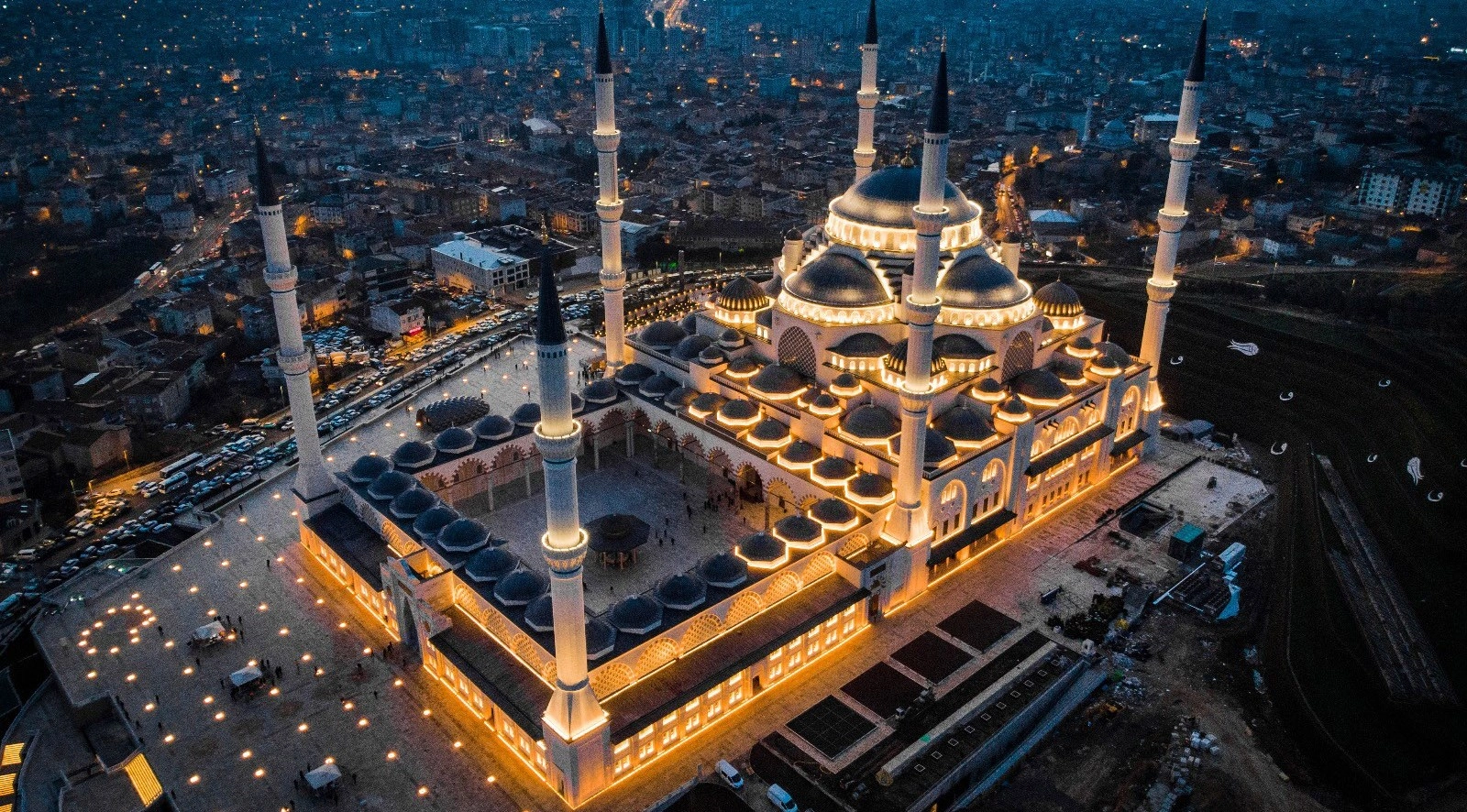
Six minarets frame the enormous central dome, while the interior combines stone, wood, carpet, calligraphy, geometric ornament and monumental proportions intended to continue Istanbul's long tradition of large congregational mosques.
The complex is much more than a prayer hall. It also includes cultural and educational facilities, among them the Islamic Civilizations Museum, exhibition spaces, a library, conference facilities, workshops and other community functions.
For travelers interested in Islamic architecture, modern Turkish religious design, Ottoman artistic traditions, calligraphy, Istanbul's changing skyline or Asian-side panoramas, Büyük Çamlıca Mosque is a particularly important stop.
The monumental six-minaret composition makes the mosque instantly recognizable across large parts of Istanbul.
A 34-meter-diameter main dome anchors the interior and continues the spatial tradition of Istanbul's classical congregational mosques.
Explore a major museum devoted to Islamic art, sacred heritage, manuscripts, decorative arts and historical collections.
The elevated location provides striking views over the Asian side and broad sections of the city beyond.
Essential information about Büyük Çamlıca Mosque, its opening, architecture, minarets, dome, cultural complex, museum, visitor etiquette, location and the best way to plan your visit.
On the Çamlıca heights in Istanbul's Üsküdar district on the Asian side.
Büyük Çamlıca Mosque was officially opened on 3 May 2019.
The mosque has six minarets: four rising 107.1 meters and two rising approximately 90 meters.
The central dome reaches approximately 72 meters in height and measures 34 meters in diameter.
The complex was designed to accommodate tens of thousands of worshippers during major congregational gatherings.
A modern interpretation drawing strongly from Ottoman and Seljuk religious architecture.
The Islamic Civilizations Museum opened within the complex in April 2022.
Allow 60–90 minutes for the mosque alone and two to three hours when adding the museum and wider complex.
Büyük Çamlıca Mosque is important because it represents one of the most ambitious attempts in modern Turkey to create a monumental mosque complex on the scale of Istanbul's historic imperial religious architecture.
For centuries, the city's most powerful skyline landmarks were the great mosques of the Historic Peninsula — structures such as Süleymaniye, Sultanahmet and the monumental domed complexes that shaped Ottoman Istanbul.
Çamlıca Mosque introduces that monumental language to the Asian side of the city on a site visible from enormous distances.
Its designers used familiar elements — central dome, cascading semi-domes, courtyard, arcades, monumental portals and multiple minarets — while adapting them to a contemporary reinforced structure equipped for modern circulation, lighting, acoustics, accessibility and security.
The result is both traditional and modern. It does not attempt to reproduce a single historic mosque exactly, but instead combines recognizable elements from Ottoman and Seljuk architecture into a new 21st-century composition.
Its importance also extends beyond architecture. The mosque functions as a major center of worship, education, exhibitions, cultural events, artistic production and Islamic heritage interpretation.
Because it dominates the elevated Çamlıca skyline, it has also become part of the continuing debate over how contemporary architecture should interact with Istanbul's historic urban silhouette.
The idea of constructing a major mosque on the Çamlıca heights developed during the early 21st century as part of a broader plan to create a prominent religious and cultural complex overlooking Istanbul.
A design process held in the early 2010s led to the project associated with architects Bahar Mızrak and Hayriye Gül Totu.
Construction began in 2013 and continued for roughly six years.
The mosque first began receiving worshippers shortly before the final official opening. The formal opening ceremony took place on 3 May 2019.
From the beginning, Büyük Çamlıca was planned as more than a large prayer space. Museum galleries, a library, art spaces, workshops, conference facilities and extensive service areas formed part of the wider complex.
The Islamic Civilizations Museum was later completed and opened in April 2022, strengthening the cultural dimension of the site.
Since its opening, the mosque has become an important destination for worshippers, domestic visitors and international travelers exploring Istanbul's Asian side.
Plans advanced for a monumental mosque and cultural complex on the Çamlıca heights.
Construction began on the large-scale mosque complex in Üsküdar.
The mosque began welcoming worshippers shortly before the formal inauguration.
Büyük Çamlıca Mosque received its official opening.
The Islamic Civilizations Museum opened within the wider mosque complex.
The mosque serves simultaneously as a major place of worship, visitor landmark and cultural center.
The architecture of Büyük Çamlıca Mosque is immediately recognizable as part of the broad tradition of Turkish monumental mosque design.
Its dominant composition is built around a large central dome supported visually by semi-domes and smaller domed elements that create the layered silhouette associated with classical Ottoman religious architecture.
Six slender minarets rise around the complex, emphasizing verticality and making the mosque legible from distant parts of Istanbul.
Arcaded courtyards, monumental entrance portals, stone surfaces, muqarnas-like transitions, traditional ornamental vocabulary and extensive calligraphy reinforce the historical references.
At the same time, the building uses modern structural systems and infrastructure capable of supporting enormous visitor numbers.
The mosque therefore works on two scales: from far away it appears as a powerful skyline monument, while from close range its experience depends on courtyards, doorways, carved details, inscriptions, carpet patterns, lighting and the changing rhythm of prayer.
The worship space is organized around a vast central domed volume designed for a large congregation.
Semi-domes and smaller domes create the layered profile familiar from Istanbul's Ottoman mosque tradition.
The minarets create a strongly symmetrical skyline composition visible from across the city.
Large paved and arcaded spaces organize movement between the mosque, entrances and wider complex.
Calligraphy, woodwork, stonework, decorative surfaces and carpet design connect the new mosque with historic craft traditions.
Lighting, acoustics, ventilation, elevators, security and visitor circulation reflect contemporary construction requirements.
One of the most distinctive aspects of Büyük Çamlıca Mosque is the deliberate use of numbers and dimensions as symbolic references.
Official descriptions explain that the mosque's six minarets symbolize the six articles or conditions of faith in Islamic belief.
Four of the minarets rise to approximately 107.1 meters, a numerical reference to the Battle of Manzikert in 1071, a landmark date in Turkish and Anatolian history.
The other two minarets rise to approximately 90 meters.
The central dome measures 34 meters in diameter, reflecting Istanbul's vehicle registration number, 34.
Its height of approximately 72 meters has been described in official presentations as symbolizing the many communities historically associated with Istanbul.
The interior also contains symbolic calligraphic programs, including names and inscriptions arranged in relation to Turkish and Islamic historical references.
The six minarets are the mosque's most immediately recognizable exterior feature.
Four taller minarets rise to approximately 107.1 meters and contain three balconies, while two additional minarets reach approximately 90 meters.
Their placement creates a balanced frame around the main dome and gives the building a visual scale that can be read from miles away.
In Ottoman architectural history, the number and height of minarets traditionally communicated status and importance. Büyük Çamlıca uses that established language on an unusually large modern scale.
The minarets are especially dramatic when seen from the Bosphorus, Üsküdar waterfront, Çengelköy or distant points on the European side, where they rise above the densely developed Asian hills.
The central dome is the architectural heart of Büyük Çamlıca Mosque.
Measuring approximately 34 meters in diameter, it spans an enormous section of the prayer hall and creates the central visual focus of the interior.
The dome rises approximately 72 meters, giving worshippers a strong sense of vertical space and directing the eye upward toward layers of ornament and calligraphy.
Supporting semi-domes and transitional structural elements distribute the visual weight outward, recalling the spatial logic of classical Ottoman mosques while using contemporary construction technology.
Natural and artificial light work together across the domed interior, changing the appearance of the decorative surfaces throughout the day.
The result is intentionally monumental but not empty: the scale is softened by repeated calligraphy, patterned carpet, woodwork, stone surfaces and smaller architectural details at human level.
At the summit of the main dome stands an exceptionally large alem, the traditional finial placed above domes and minarets in Islamic architecture.
The Çamlıca alem was designed on a scale appropriate to the enormous dome below it.
Official descriptions give its dimensions as approximately 7.77 meters high and 3.12 meters wide, with a weight of roughly 4.5 tons.
Although it appears relatively delicate from the ground, its true size becomes understandable only when compared with workers, architectural drawings or nearby structural elements.
The feature demonstrates how traditional mosque details had to be dramatically enlarged to remain visually proportionate to the overall structure.
The experience of Büyük Çamlıca begins before entering the main prayer hall.
Large exterior and interior courtyard spaces allow visitors to appreciate the symmetry of the mosque, the relationship between the dome and minarets, and the scale of the surrounding complex.
Arcaded porticoes provide shade and create a transitional zone between open exterior space and the enclosed sacred interior.
The monumental portals use stone, carved ornament, inscriptions and traditional decorative references to frame the movement into the mosque.
One of the principal entrance doors is itself a major work of craftsmanship, using traditional kündekâri-inspired wood construction, inlay and decorative detailing on an unusually large scale.
During major religious gatherings, courtyard areas also become important extensions of the congregational space.
The main prayer hall is the most impressive part of a visit.
A vast carpeted floor extends beneath the central dome, allowing uninterrupted rows of worshippers to form during congregational prayer.
The mihrab marks the direction of Mecca and forms the principal focal point of the qibla wall.
Beside it, the monumental minbar rises dramatically within the enormous interior. Official descriptions place its height at approximately 21 meters.
The preaching platform, decorative wall surfaces, chandeliers, calligraphy and surrounding architectural details all had to be designed at a scale capable of remaining visually effective inside such a vast space.
Despite the size, the interior relies heavily on traditional elements familiar from historic Turkish mosques: carpet, wood, stone, calligraphy, rhythmic arches and carefully controlled light.
The prayer niche indicates the qibla and forms the spiritual focus of the interior.
A monumental pulpit used for the Friday sermon and designed in proportion with the vast prayer hall.
An enormous custom-woven carpet unifies the prayer floor and organizes the visual rhythm of worship.
Large-scale Quranic inscriptions and devotional texts become major architectural elements rather than simple decoration.
Modern illumination works with natural light to reveal the domes, arches, inscriptions and decorative surfaces.
Contemporary sound systems allow recitation and sermons to remain intelligible across an exceptionally large interior.
Calligraphy plays a central role in the visual identity of Büyük Çamlıca Mosque.
Rather than treating inscriptions as small decorative panels, the designers use monumental calligraphic compositions across domes, arches and transitional surfaces.
The program includes Quranic passages and Divine Names arranged to remain visible despite the huge interior scale.
Official descriptions note that the complete Surah al-Fath was incorporated in an extensive calligraphic installation beneath the dome.
Additional inscriptions connected with Surah al-Hashr and the Names of Allah appear within the decorative program of the central dome.
The use of calligraphy continues one of the strongest traditions of Ottoman mosque decoration, where sacred text becomes inseparable from architecture.
Although Büyük Çamlıca Mosque is a modern building, much of its atmosphere comes from traditional Turkish decorative arts.
Large wooden doors reference the historic kündekâri tradition of assembling geometric wooden elements without relying on ordinary nailed construction.
Mother-of-pearl inlay, carved stone, metalwork, calligraphy and patterned textile surfaces add detail at a scale much closer to the individual visitor.
Geometric ornament and vegetal motifs connect the complex with centuries of Seljuk and Ottoman design vocabulary.
The contrast between monumental engineering and hand-crafted detail is one of the most rewarding aspects of the mosque for visitors interested in architecture.
Büyük Çamlıca Mosque was designed for very large congregations.
Official opening material described a total capacity of approximately 63,000 worshippers when the main prayer areas and associated congregational spaces are used together.
The carpeted indoor worship area alone can accommodate many thousands of people, while courtyards and exterior areas dramatically increase the total capacity during major gatherings.
This scale becomes most understandable during Friday prayers, Ramadan nights and religious festivals, when the building functions as a true metropolitan congregational mosque.
For ordinary sightseeing visits, however, the vast open interior may feel remarkably calm outside the busiest prayer periods.
To understand Büyük Çamlıca properly, it helps to think of it as a modern külliye rather than a standalone mosque.
Historic Ottoman külliyes were complexes in which a central mosque was surrounded by educational, charitable, social and community institutions.
Büyük Çamlıca adapts that idea for the 21st century.
The wider complex contains a major museum, art gallery, library, conference hall, art workshops, educational facilities and spaces used for cultural programs and public events.
This broader function means a visitor can spend considerably longer here than at a mosque whose experience is limited primarily to the prayer hall.
A major collection exploring Islamic art, sacred heritage, manuscripts, science, court culture and decorative traditions.
Large exhibition spaces allow the complex to host changing cultural and artistic programs.
The complex includes extensive reading and study areas for adults and younger visitors.
A large hall supports lectures, gatherings, discussions and cultural events.
Dedicated spaces support traditional arts, craft practice and educational activities.
Children's and religious educational facilities expand the complex beyond worship and tourism.
The Islamic Civilizations Museum is one of the most important cultural components of the Büyük Çamlıca Mosque complex.
Opened in April 2022, the museum occupies roughly 10,000 square meters of enclosed exhibition space.
Its displays draw on works connected with major historic Turkish collections and explore the development of Islamic civilization through art, belief, science, court culture, manuscripts, sacred objects and material heritage.
Visitors may encounter Quran manuscripts, calligraphy, textiles, ceremonial objects, coins, arms, tiles, scientific objects and material associated with the holy cities of Mecca and Medina.
The museum also uses digital installations and multimedia interpretation, creating a very different experience from the monumental architecture of the mosque above.
For travelers deeply interested in Ottoman and Islamic history, the museum can easily require as much time as the mosque itself.
The museum opened to visitors in April 2022.
Approximately 10,000 square meters of enclosed museum space.
Calligraphy, manuscripts, textiles, tiles, metalwork and decorative objects form major parts of the collection.
Objects associated with religious devotion and the holy places are among the museum's most significant displays.
Ceremonial, courtly and artistic objects help explain the Ottoman contribution to Islamic civilization.
Multimedia installations supplement traditional object displays and appeal especially to younger visitors.
The museum is designed thematically rather than simply as a chronological collection of objects.
Historic handwritten Qurans reveal changing scripts, illumination traditions and book arts across the Islamic world.
Calligraphic panels describing the physical and moral qualities of the Prophet Muhammad represent a distinctive Ottoman devotional tradition.
Historic textiles and ceremonial objects connected with Mecca illustrate the Ottoman relationship with the holy cities.
Objects connected with the Ottoman Surre processions help explain the ceremonial dispatch of gifts toward Mecca and Medina.
Coins, weapons, textiles and ceremonial pieces reveal political and artistic histories across different Islamic states.
Scientific objects and interpretive displays explore intellectual traditions within Islamic civilization.
The mosque's location is almost as important as its architecture.
Built on elevated ground within the Çamlıca area, the complex commands broad views across Asian Istanbul and toward the Bosphorus.
Open terraces and exterior areas around the site allow visitors to appreciate how dramatically the mosque sits above surrounding neighborhoods.
Depending on atmospheric conditions, views extend across large sections of the city and help explain why the mosque can itself be seen from so many distant locations.
For a wider open-air panorama, visitors can also combine the mosque with nearby Çamlıca Hill.
Büyük Çamlıca Mosque is not primarily a tourist monument. It is an active mosque used every day for prayer and major religious gatherings.
The rhythm of the site changes throughout the day around the five daily prayer times.
Friday midday prayer is especially important and can draw very large congregations.
Ramadan evenings, holy nights and the Eid festivals can also produce significantly larger crowds than an ordinary weekday.
Visitors are welcome to appreciate the architecture respectfully, but sightseeing should never interrupt prayer or block worshippers moving through the building.
The rules are similar to those at other active mosques in Istanbul, but the large scale of Büyük Çamlıca can make the visitor experience feel more like entering a major public complex.
Shoulders and knees should be covered. Clothing should be appropriate for an active religious space.
Women entering principal prayer areas should follow the mosque's current guidance regarding head covering.
Shoes must be removed before entering carpeted prayer areas. Follow signs and use designated storage where provided.
Conversation, phone calls and group explanations should remain quiet inside the mosque.
Do not walk directly in front of people who are praying or occupy areas required by worshippers.
Photography is generally most appropriate when it does not disturb worship, invade privacy or use intrusive equipment.
Expect much larger crowds around Friday midday prayer and give worshippers priority.
Access patterns may change during Ramadan, Eid, holy nights, funerals or special ceremonies.
Entry to the mosque for respectful visiting is generally separate from the ticketed or scheduled arrangements that may apply to museum and cultural facilities.
Because Büyük Çamlıca is an active religious complex, mosque access can be affected by congregational prayer, special religious events and security arrangements.
The Islamic Civilizations Museum and other cultural spaces may operate according to their own opening hours and admission conditions.
Visitors should therefore distinguish between mosque access and museum access when planning the day.
Visitors can generally enter respectfully outside situations where worship or special arrangements limit access.
Religious services always take precedence over sightseeing.
Separate visitor hours and ticket arrangements may apply to the Islamic Civilizations Museum.
Large public and religious complexes can use controlled entrances and security screening.
The wider complex includes toilets, ablution facilities, parking and cultural spaces.
Friday, Ramadan and religious holidays can change crowd levels and normal visitor circulation.
Usually the easiest time for a calm architectural visit with lighter visitor traffic.
Good for seeing the interior without interfering with major congregational worship.
Warm light can make the stone exterior, domes and minarets particularly photogenic.
Exterior lighting and the deep evening sky can create dramatic architectural photographs.
Spiritually significant but much busier around midday congregational prayer.
A memorable religious atmosphere, especially in the evening, but expect heavier crowds and altered routines.
Often best for long-distance city views from the elevated site.
Pleasant on the hill after a hot day, though atmospheric haze may soften distant views.
Enough for a brief exterior, courtyard and prayer-hall visit when access is straightforward.
A comfortable mosque visit with time for architecture, calligraphy and panoramic exterior areas.
Ideal for a slower architectural visit with photography and time to explore the wider complex.
Recommended when adding the Islamic Civilizations Museum.
Combine the mosque, museum and Çamlıca Hill.
Add Üsküdar, Kuzguncuk or Çengelköy for a broader introduction to Asian Istanbul.
Büyük Çamlıca Mosque is one of the strongest contemporary architectural photography subjects in Istanbul.
The biggest challenge is scale. A normal lens may struggle to include the central dome and several minarets from close range.
Wide-angle lenses work well in the courtyards, while telephoto lenses are useful from distant viewpoints around Çamlıca and the Bosphorus.
Inside, concentrate on symmetry, the main dome, the mihrab, minbar, calligraphy and repeating arches.
Late afternoon and blue hour can be especially effective for the exterior because the pale stone and illuminated domes stand out against the changing sky.
Use the principal courtyard axes to align the dome, portals and minarets.
Shoot upward beneath the central dome to emphasize scale, calligraphy and geometric organization.
Look for doors, inscriptions, stone carving, carpet patterns and decorative woodwork.
Late afternoon often gives the exterior warmer depth and stronger shadows.
Blue hour combines architectural lighting with enough sky color to preserve the silhouette.
Photograph the mosque from Bosphorus neighborhoods or other elevated points to show its relationship with the city.
Büyük Çamlıca was constructed as a modern major public complex and includes accessibility planning that is far more extensive than at many historic mosques.
Vehicle access and large parking facilities can reduce the amount of uphill walking required to reach the site.
Elevators and modern circulation systems help connect different levels of the complex.
However, the mosque is extremely large. Even when individual routes are accessible, the total walking distance between parking, courtyards, prayer hall and museum can still be considerable.
Visitors with limited mobility should allow additional time and use the closest suitable drop-off or parking arrangements available on the day.
Büyük Çamlıca Mosque is located in the Üsküdar district on elevated ground above the Bosphorus.
For many visitors, the easiest approach is to travel to Üsküdar or the wider Kısıklı–Çamlıca area and continue by bus, taxi or private vehicle.
The M5 metro line is useful for reaching the inland Üsküdar corridor, after which a shorter road connection can complete the journey.
Taxis are especially practical when combining the mosque with Çamlıca Hill, because the surrounding terrain is steep and the principal attractions are separated by major roads.
Drivers should expect heavier traffic and parking pressure around Friday prayer, religious holidays, weekends and large events.
Continue inland by bus or taxi toward Büyük Çamlıca Mosque.
Use the M5 line as part of the journey toward the Kısıklı–Çamlıca area, then complete the final connection locally.
Usually the simplest direct option from Üsküdar, Kadıköy or nearby Asian-side neighborhoods.
Cross to the Asian side by ferry or rail, then continue toward Çamlıca by road transport.
Travel inland and uphill from Çengelköy by taxi or local transport.
Convenient outside peak periods, with extensive parking associated with the complex.
Plan architectural sightseeing around major congregational periods whenever possible.
Bring clothing suitable for an active mosque rather than treating the site only as a tourist attraction.
Museum access can follow a different schedule from the mosque itself.
The complex is huge and involves more walking than many visitors expect.
Road congestion around Çamlıca and Üsküdar can significantly change travel times.
Controlled access or screening may be used during busy periods and special events.
Wide-angle photography is especially useful in the courtyard and beneath the central dome.
Give yourself time to appreciate the smaller decorative details after absorbing the building's enormous scale.
A logical route helps make sense of the enormous complex.
This route combines the monumental mosque with the older recreational landscape of Çamlıca Hill.
Büyük Çamlıca Mosque works especially well as the monumental architectural highlight of a full day on Istanbul's Asian side.
Combine the mosque with historic gardens, traditional excursion culture and one of Istanbul's classic panoramic viewpoints.
Explore Ottoman mosques, markets, ferry life and one of the most atmospheric waterfronts on the Asian side.
Discover historic houses, churches, synagogues, mosques and a rich multicultural neighborhood landscape.
Descend toward the Bosphorus for tea, bakeries, historic architecture and waterfront life.
Explore the Bosphorus shore and the neighborhood associated with Beylerbeyi Palace.
Return toward Salacak for one of Istanbul's most iconic Bosphorus landmarks.
Continue south for markets, restaurants, cafés, street life and a completely different Asian-side atmosphere.
Continue planning with Istanbul's mosques, palaces, churches, museums, bazaars and historic neighborhoods.
Büyük Çamlıca Mosque is in Istanbul's Üsküdar district on the Asian side, on elevated ground within the wider Çamlıca area.
Construction began in 2013 and continued for roughly six years.
The mosque began receiving worshippers shortly before its formal inauguration and was officially opened on 3 May 2019.
It is widely described by Turkish official sources as Turkey's largest mosque complex in terms of congregational scale and overall capacity.
Official opening information cited a total capacity of approximately 63,000 worshippers when the principal prayer and associated congregational areas are used together.
The mosque has six minarets.
Four minarets rise approximately 107.1 meters, while two are approximately 90 meters high.
The height was chosen as a symbolic numerical reference to the Battle of Manzikert in 1071.
The main dome measures approximately 34 meters in diameter and rises about 72 meters.
Official descriptions connect the 34-meter diameter with Istanbul's number 34.
The design is associated with Turkish architects Bahar Mızrak and Hayriye Gül Totu.
It is a contemporary monumental mosque strongly inspired by Ottoman and Seljuk architectural traditions.
Yes. Visitors can generally enter respectfully when access is appropriate, but worship and religious events always take priority.
The mosque itself is an active place of worship rather than a conventional ticketed monument. Separate admission arrangements may apply to museum facilities.
Women entering principal prayer areas should follow the mosque's current modest-dress guidance, including head covering where required.
Yes. Shoes are removed before entering the carpeted prayer hall.
Photography is generally possible when done respectfully, but visitors should avoid disturbing prayer or photographing individual worshippers intrusively.
Yes. The Islamic Civilizations Museum forms a major part of the wider complex.
The museum opened in April 2022.
Collections include Islamic calligraphy, manuscripts, sacred objects, textiles, coins, arms, tiles, scientific objects and important examples of Ottoman and Islamic decorative arts.
Allow around one hour for the mosque itself and two to three hours if you also visit the museum and wider complex.
A weekday morning or a period between major prayers is usually best for architecture and photography with fewer crowds.
Friday is spiritually important but significantly busier around midday prayer. Sightseers who want a quiet visit may prefer another day or a different time.
Yes, especially for travelers interested in modern mosque architecture, Islamic art, monumental interiors and Istanbul's changing skyline.
Yes. The two destinations complement each other very well, but they are separate sites and using a taxi or private vehicle between them is usually more practical than walking.
Yes. Üsküdar is one of the best waterfront districts to combine with the mosque on the same day.
Yes. Çengelköy offers a pleasant Bosphorus waterfront contrast to the monumental hilltop mosque.
The modern complex includes accessibility features and elevators, although the enormous scale means visitors should still expect significant walking distances.
The elevated complex offers broad views across Istanbul, although the exact panorama depends on where you stand and current visibility.
Remember that Büyük Çamlıca is first and foremost an active mosque.
Follow modest-dress expectations and any current guidance at the entrance.
Do not block prayer rows, entrances or movement through the prayer hall.
Avoid intrusive portraits and never turn prayer into a spectacle.
Follow all signs concerning shoes, barriers, restricted areas and museum objects.
Large tour groups should keep explanations quiet and move away from active prayer areas.
Discover Büyük Çamlıca through a private route combining modern mosque architecture, Islamic art, Istanbul's skyline, panoramic viewpoints and historic Asian-side neighborhoods — without compulsory shopping stops.
Build a private itinerary around Büyük Çamlıca Mosque, the Islamic Civilizations Museum, Çamlıca Hill, Üsküdar, Kuzguncuk, Çengelköy, Beylerbeyi or other Asian-side highlights according to your interests.
Ask us about a tailor-made visit focusing on the mosque's architecture, symbolism, calligraphy, cultural complex, Islamic Civilizations Museum and panoramic setting.
Request a Custom Tour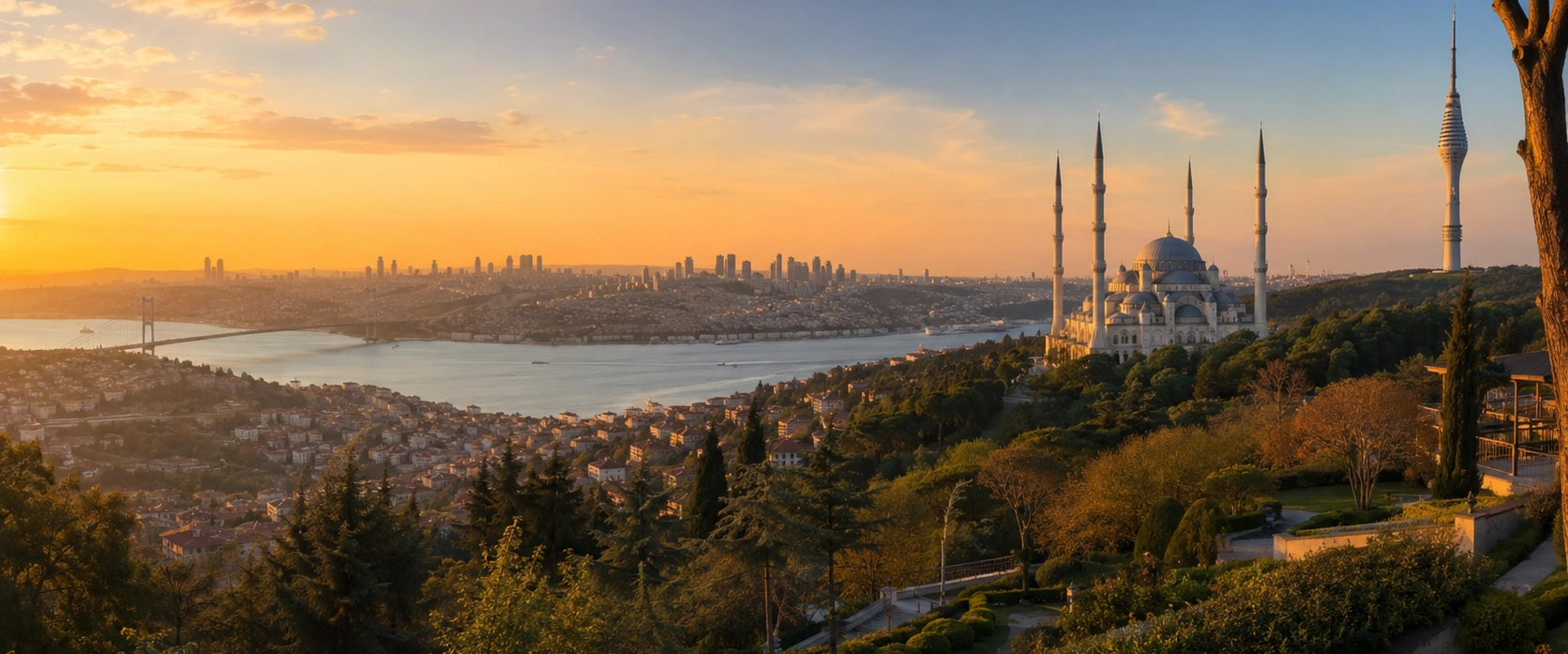
Combine the mosque with Büyük Çamlıca's landscaped gardens, Ottoman excursion culture, Turkish tea and panoramic Bosphorus views.
Explore Çamlıca HillCombine Çamlıca Mosque with Üsküdar, Kuzguncuk, Çengelköy, Beylerbeyi, Kadıköy or other Asian-side districts according to your interests and available time.
Create a private Istanbul itinerary around sacred architecture, Bosphorus neighborhoods, Ottoman history, viewpoints, multicultural heritage, food and local culture.
View Private Istanbul Tours
Continue planning with Istanbul's mosques, churches, palaces, museums, bazaars, Bosphorus districts, viewpoints and historic neighborhoods.
Explore Istanbul