Travel Back 8,500 Years to Bursa's First Farming Communities
Long before Bursa became a
Roman city,
Byzantine stronghold
or Ottoman capital,
people were already building permanent villages,
growing crops,
raising animals,
making pottery
and burying their dead in the countryside west of the modern city.
Their story survives at
Aktopraklık Höyük,
one of the most important prehistoric archaeological sites in northwestern Türkiye.
Located near
Akçalar in the Nilüfer district of Bursa,
on terraces east of
Lake Uluabat,
Aktopraklık preserves evidence of human settlement beginning around
6400 BCE
and continuing for roughly a thousand years through the
Late Neolithic and Chalcolithic periods.
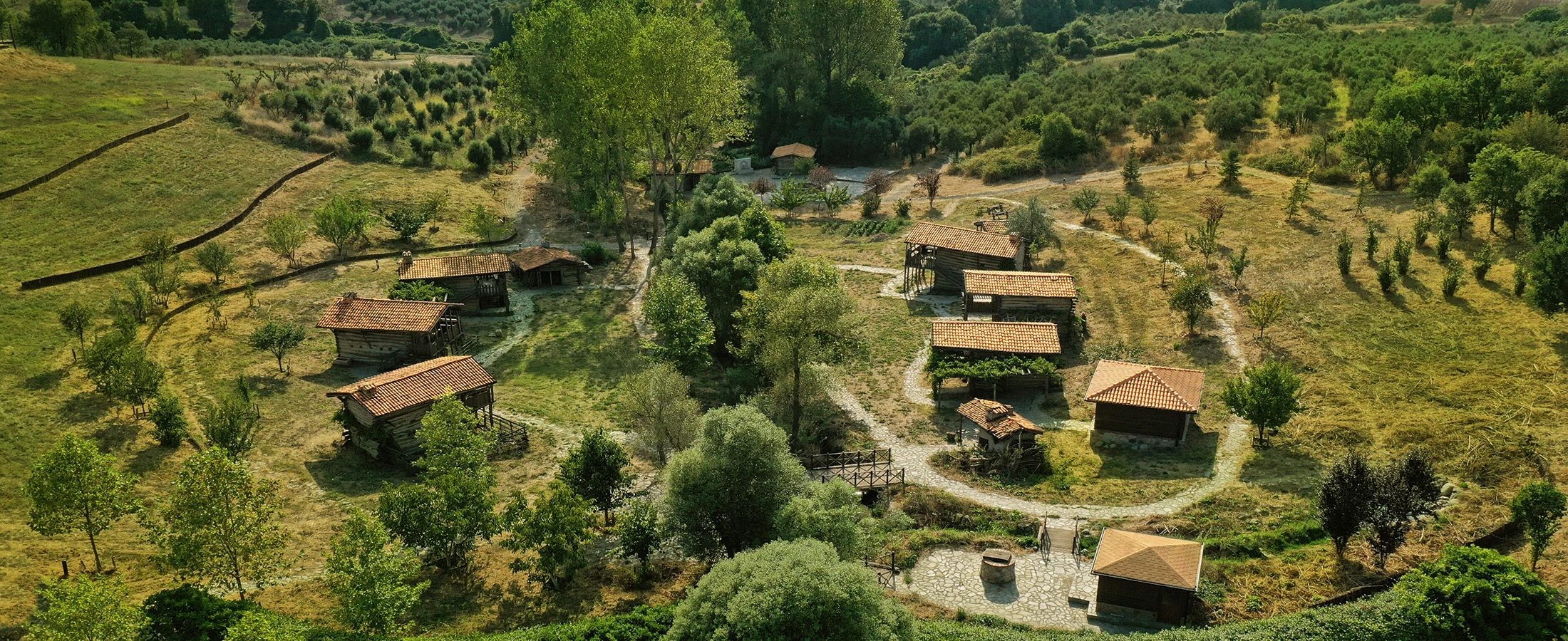
What makes Aktopraklık especially enjoyable for travellers is that it is not simply an excavation site.
The archaeological remains have become the centre of an extensive
archaeopark and open-air museum
where visitors can move between reconstructed prehistoric villages,
actual excavation areas,
experimental archaeology spaces
and a traditional village created with historic buildings brought from the Bursa countryside.
One reconstructed settlement represents life roughly
8,500 years ago,
while another demonstrates the increasingly organised villages of the
Chalcolithic period.
The difference between them is immediately visible.
Simple rounded dwellings constructed with lightweight materials gradually give way to more substantial rectangular buildings,
organised open spaces,
courtyards
and settlement boundaries.
Aktopraklık therefore allows visitors to do something an archaeological display case alone cannot achieve:
walk through the changing scale and organisation of prehistoric village life.
The site is also scientifically important.
Its long occupational sequence provides evidence for the development of the earliest farming societies in northwestern Anatolia
and contributes to the wider archaeological discussion surrounding the movement of farming communities,
technologies
and cultural traditions between
Anatolia,
the Marmara region
and southeastern Europe.
8,500 Years of History
Discover settlement layers beginning around 6400 BCE, thousands of years before classical Bursa or the Ottoman Empire.
Neolithic Village
Enter reconstructed dwellings inspired by the earliest archaeological architecture discovered at Aktopraklık.
Chalcolithic Village
See how later communities created more substantial houses, courtyards and increasingly organised settlement plans.
Real Excavation Areas
Study archaeological remains in the landscape where they were discovered rather than seeing the story only inside a museum.
Ancient Burials
Learn how changing burial traditions provide rare evidence about family, community and prehistoric concepts of death.
Experimental Archaeology
Workshops, archaeological activities and reconstructed spaces help visitors understand how archaeologists interpret ancient life.