





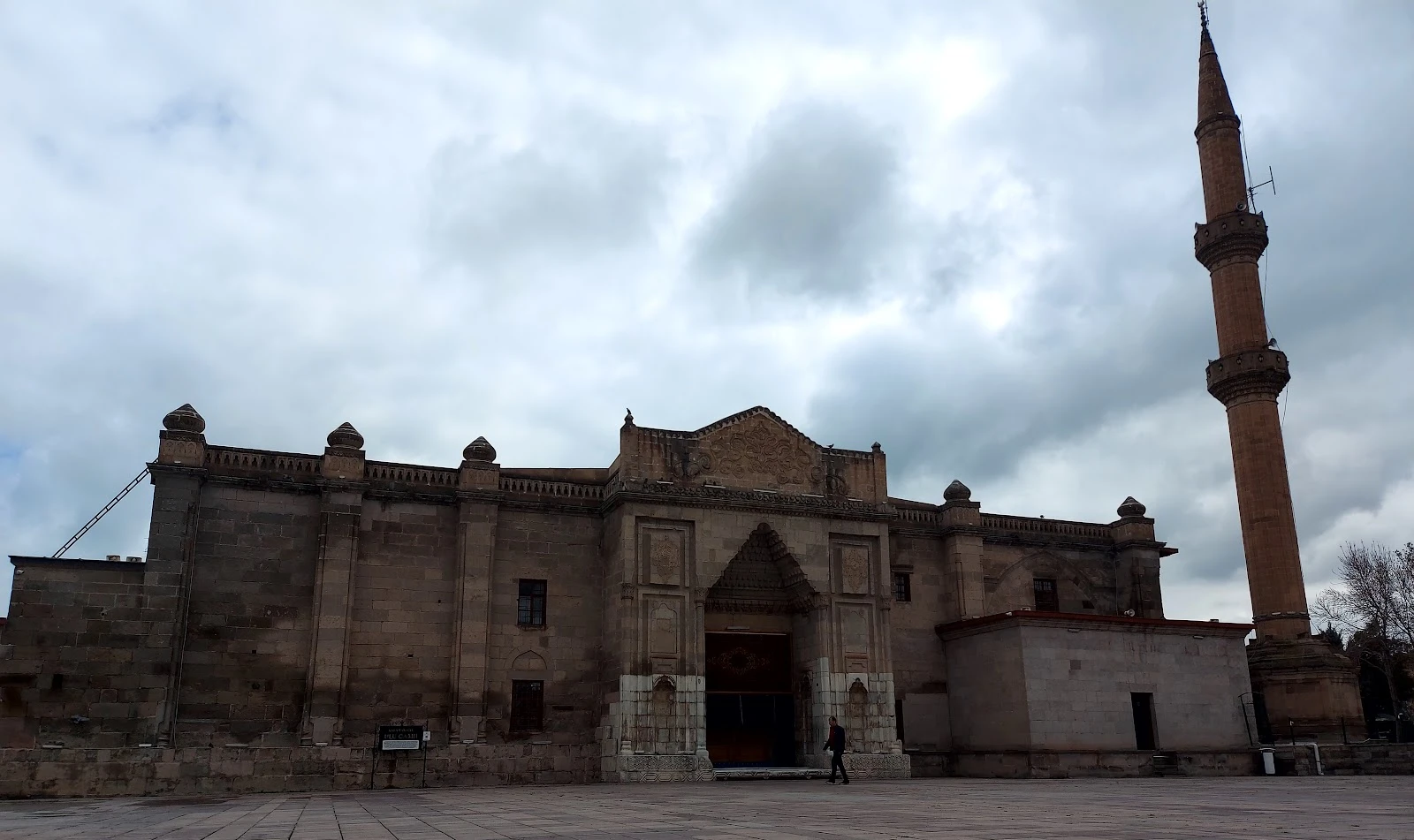
Aksaray Travel Guide / Aksaray Historic Centre
History and significance
Aksaray’s congregational mosque links the Seljuk city with the Karamanid rebuilding of the fifteenth century. The provincial culture authority associates its foundation with Rükneddin Mesud and records an inscription dated AH 811 (1408–09), naming Mehmed Bey and the architect Firuz. This layered history matters: the monument should not be described as an untouched single-period building.
Approach the western monumental portal to appreciate the geometric stone carving. Inside, arcades divide a nearly square prayer hall; the ebony wooden minbar, associated with the craftsman Nüştekin el-Cemali, is particularly celebrated for its intricate joinery and inscriptions. A working mosque is also a living religious place, not simply an architectural exhibit.
In-depth research: archaeology, architecture and context
From the Seljuks to the Karamanids
Aksaray Ulu Mosque cannot be read as the product of a single building campaign. The Provincial Directorate of Culture and Tourism traces an original foundation to the Anatolian Seljuk ruler Rükneddin Mesud, whose reign ran from 1116 to 1155. The surviving inscription, however, records a much later intervention in AH 811 (1408–09), commissioned by Mehmed Bey of the Karamanid dynasty and associated with an architect named Firuz. The apparent gap is important: a medieval mosque could retain an earlier sacred site, furnishings and memories while its enclosing masonry was rebuilt. Visitors should distinguish the claimed Seljuk foundation from the securely attested fifteenth-century reconstruction rather than assign every visible stone to the twelfth century.
The wooden minbar as an artwork
Inside, the most significant object is the historic wooden minbar, the pulpit from which the Friday sermon is delivered. Provincial descriptions identify ebony and the intricate kündekâri method of geometric joinery, in which shaped wooden pieces are assembled to create interlocking patterns. A close look reveals why a furnishing can be as revealing as the walls: its geometry requires a different craft tradition from the stonecutting visible outside. Historical discussions connect its inscription with Seljuk patronage, yet later repairs and the building's Karamanid phase complicate a simple attribution. Respect worshippers, never touch or photograph people without permission, and observe the wood from the public visitor area.
Why its setting matters
Aksaray sat in the political and commercial orbit of the Anatolian Seljuks and later of the Karamanids before becoming part of the Ottoman world. Religious buildings were also social anchors, surrounded by shops, teaching institutions and everyday services. For this reason the best way to understand the Ulu Mosque is a neighborhood walk rather than a single façade photograph. Continue to Zinciriye Medrese to compare institutional learning, to Paşa Hamamı for communal bathing, and to the Azmi Millî industrial heritage site for the city's twentieth-century modernization. The separately written Old Aksaray guide gives that urban route rather than repeating this monument's architectural history.
Closer look: evidence and interpretation
The monument as a layered historical document
A visitor encounters an apparently coherent stone mosque, but its history is an accumulation of political and building phases. Provincial heritage descriptions connect the earliest foundation with the Anatolian Seljuk ruler Mesud and major work with the Karamanids. The surviving inscription associates the rebuilding ordered in AH 811 (1408–09 CE) with Mehmed Bey and names the architect Firuz. It is therefore unsafe to say that the entire masonry visible today was built in the twelfth century. The distinction matters: the decorative entrance and present structural arrangement reflect later interventions as much as the medieval foundation. A restoration inscription, patronage tradition, and material fabric need not be contemporary.
The ebony minbar and the craft of assembly
The mosque's wooden pulpit is a destination in its own right. Descriptions identify ebony, interlocking geometric joinery associated with kündekâri, inlaid details, inscriptions and the master Nüştekin el-Cemâlî. Observe how repeated polygons create a coherent field across the pulpit panels. Geometric refinement was not merely ornamental: expensive timber, skilled joining, and labor-intensive lettering demonstrated the prestige of a congregational mosque. Wooden objects may survive the rebuilding of the stone walls around them; the pulpit's date cannot automatically be used to date the building. If the pulpit cannot be examined closely, use the museum's interpretation of Aksaray's Seljuk craftsmanship instead of entering a restricted area.
Read the prayer hall before looking for a single founder
The official architectural account describes a nearly square enclosure with stone piers and arches subdividing the prayer space. This is neither a small neighborhood mescit nor a later Ottoman imperial dome mosque. The spacious interior supported congregational Friday worship and urban ceremonial life. Look first at the west portal, then move visually along the arcades toward the qibla wall. The historical question is not simply 'who built it?' but how successive rulers used the city's most prominent mosque to demonstrate continuity. The paired itinerary is Zinciriye Medrese, where education rather than congregational worship shaped a different monumental plan.
On-site observation and suggested approach
For a careful on-site reading, start outside with the entrance inscription and decorated portal; only after that, move into the hall if prayer arrangements allow. Compare stone arches with the separate wooden minbar rather than assuming that all craftwork belongs to one construction phase. Aksaray Museum can supply background on Seljuk-era carpet and carved-wood culture. Treat worshippers and staff as the primary users of the building, and choose a time outside congregational prayers for a slow architectural visit.
What to look for
Read the portal and the minbar as two different material traditions: dressed masonry presents public authority while the carved wood expresses the virtuosity of medieval Anatolian workshops.
A useful historical sequence is to ask who commissioned the building, which later rulers altered it and how its purpose changed. Medieval architecture can survive through substantial Ottoman and modern interventions, so the visible monument may be a composite of periods.
Reading Aksaray’s urban layers
The city’s monuments make the most sense as parts of an evolving urban system. Religious institutions, commercial streets, education, public bathing and industrial production served different communities at different times. A building’s current use may be quite different from its original purpose, and restoration can introduce new surfaces beside older fabric.
Planning your visit
Most central stops can be combined on foot, though accessibility varies by pavement, steps and worship schedules. Dress respectfully at mosques and confirm opening arrangements before entering restored monuments.
Access, opening hours, admission arrangements and conservation closures can change. Check the official tourism information or contact the relevant site authority shortly before visiting; this guide deliberately avoids unverified ticket prices or fixed opening hours.
How this stop fits into a wider itinerary
For an itinerary that follows the actual sites rather than generic attractions, start with the Aksaray province guide. Nearby and related destinations are linked in the Explore nearby panel. Confirm local access before setting out, especially for places with active worship, excavations, cliffs or seasonal wetlands.
Further reading and official references
The following sources provide regional context and, where available, monument-specific documentation. Some dates and attributions remain debated; consult conservation publications for specialist study.