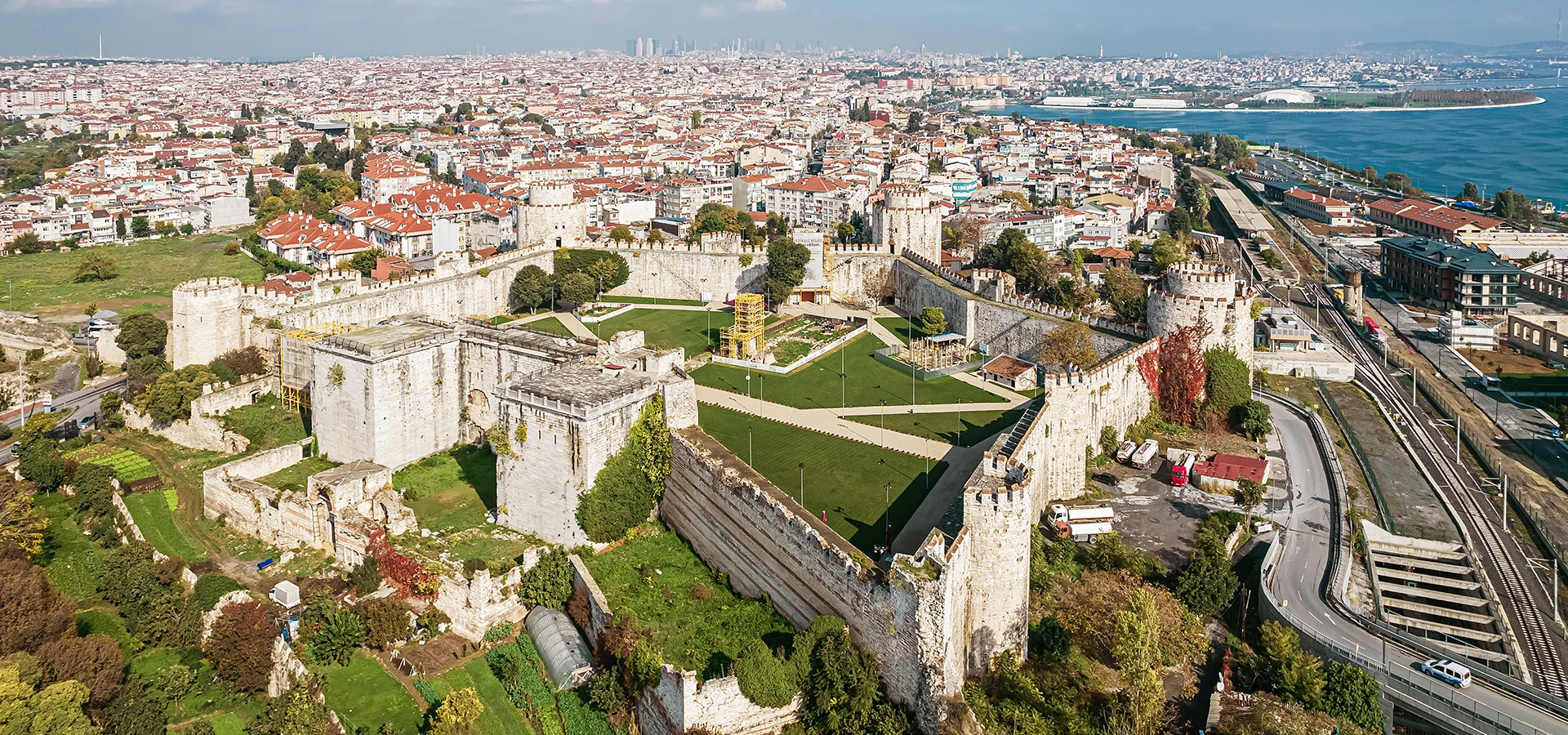
Private Yedikule Fortress Tour
Ask us about a tailor-made route focused on the Golden Gate, Byzantine engineering, Ottoman treasury and prison history, Osman II and the surrounding land walls.
Request a Custom Tour





Yedikule Fortress, known in Turkish as Yedikule Hisarı or Yedikule Zindanları, stands at the southern end of Istanbul's great land walls near the Sea of Marmara. Its name means the Fortress of the Seven Towers, but the monument is far more than a single-period castle.
At its heart is the Golden Gate, the monumental ceremonial entrance through which Byzantine emperors made triumphal arrivals into Constantinople. After the Ottoman conquest, Sultan Mehmed II enclosed this prestigious gateway within a new inner fortress, adding towers and walls in 1457–1458.
Yedikule later served as an imperial treasury, secure state fortress, garrison and high-status prison. Foreign ambassadors, rulers, court officials and political prisoners were held here. Its darkest association is with the imprisonment and death of the young Ottoman sultan Osman II in 1622.
Today, Yedikule offers one of Istanbul's most powerful encounters with both Byzantine and Ottoman history. Visitors can examine massive towers, the Golden Gate, the fortress courtyard, archaeological remains and views toward the Walls of Constantinople.
Explore a fortress formed from Byzantine defenses and Ottoman additions.
See the ceremonial Roman gateway once reserved for imperial triumphs.
Discover the stories of sultans, diplomats, rulers and political captives.
Read Byzantine and Ottoman history in one monumental architectural complex.
Essential information for visiting Istanbul's Fortress of the Seven Towers.
Yedikule Meydanı Sokak in the Fatih district of Istanbul, near the Sea of Marmara.
Open on Google MapsLate Roman and Byzantine Golden Gate, combined with an Ottoman fortress built in 1457–1458.
Yedikule means “Seven Towers,” referring to the towers incorporated into the fortress complex.
Ceremonial gateway, fortress, treasury, garrison, state prison, museum and cultural venue.
Currently listed as 09:00–17:00, Tuesday through Sunday; closed Monday. Verify before visiting.
Allow 1.5–2 hours, or longer when guided tours and tower routes are available.
Yedikule preserves Roman imperial ceremony, Byzantine defense and Ottoman state power within one remarkable complex.
Few places in Istanbul bring different eras together as clearly as Yedikule. The fortress incorporates part of the 5th-century Theodosian Walls and the monumental Golden Gate, then adds a strongly defined Ottoman inner castle created immediately after the conquest of Constantinople.
For Byzantine emperors, the Golden Gate represented victory and legitimate rule. Its central passage and flanking marble pylons formed a ceremonial entrance on the great road leading toward the imperial heart of the city. Statues, inscriptions and gilded architectural details once made the approach far more elaborate than it appears today.
For the Ottomans, enclosing the gate within a secure fortress transformed an emblem of the old capital into part of the new imperial order. Yedikule protected the treasury during an early phase of Ottoman rule and later became a prison for politically sensitive captives. Its walls therefore tell stories not only of architecture, but also of diplomacy, succession struggles and the risks of court politics.
The fortress also belongs to the Historic Areas of Istanbul UNESCO World Heritage Site through the land-wall zone. For travelers following our guide to places to visit in Istanbul, it offers a rewarding alternative to the busier monuments around Sultanahmet.
The story begins before the Ottoman fortress existed. Constantinople's western defenses were rebuilt on a monumental scale during the reign of Emperor Theodosius II in the early 5th century. At the southern end of this system stood the Golden Gate, a marble-faced ceremonial structure associated with imperial arrivals and triumphal processions.
Scholars continue to discuss the precise construction sequence of the Golden Gate. One interpretation connects an earlier triumphal arch with Theodosius I around AD 390; another treats the gateway and its flanking pylons as part of the Theodosian II building program of the early 5th century. Whatever its exact sequence, the gate became Constantinople's most prestigious land entrance.
As Byzantine power declined, the great portals were reduced or blocked for security. After Mehmed II conquered Constantinople in 1453, he ordered a new fortress behind the Golden Gate. Three Ottoman towers and connecting curtain walls were added in 1457–1458, enclosing the Byzantine towers and producing the seven-towered complex.
The new stronghold initially served important state functions. Sources associate it with the Ottoman treasury and the secure storage of valuable documents, arms, coins and precious metals. When the main treasury moved to Topkapı Palace, Yedikule increasingly became a state prison for high-ranking captives.
During later centuries, the fortress housed a small community with a garrison, houses, a mosque and water facilities. It also served at different times as a gunpowder store and educational site. Yedikule entered museum administration in 1895, underwent major restoration between 1958 and 1970, and has received a new program of conservation and visitor improvements under Fatih Municipality since 2019.
The Golden Gate and its pylons emerge as Constantinople's monumental ceremonial entrance.
Mehmed II captures Constantinople and begins reshaping it as the Ottoman capital.
New Ottoman towers and walls create the enclosed Fortress of the Seven Towers.
Sultan Osman II is imprisoned and killed at Yedikule during a political crisis.
The fortress is transferred to museum administration.
Restoration, archaeological investigation and public visitor programs continue in stages.
The Golden Gate, or Porta Aurea, is the most important Byzantine element inside Yedikule. Constructed in pale marble with three archways and powerful flanking pylons, it was designed to impress rather than function merely as an ordinary city gate.
The central opening was the grandest passage, while the side arches served related ceremonial and practical movement. Ancient descriptions and surviving fixing holes suggest that the structure carried bronze letters, statues and other rich decoration. The name “Golden Gate” probably referred to gilded doors or ornaments that once caught the light.
The imperial road continued from this entrance across Constantinople toward the ceremonial center near the Great Palace and Hagia Sophia. Victorious emperors used the gate to present themselves as defenders and rulers of the Roman world. Its architecture therefore expressed political authority as strongly as military strength.
A monumental central passage was framed by two smaller side openings.
Large pale-stone towers distinguished the gate from the brick-and-stone land walls.
Triumphal entries used the gateway to connect victory with legitimate imperial rule.
Statues, inscriptions, metalwork and reliefs once created a richer appearance.
The main openings were narrowed or sealed as security needs changed.
The gate became the monumental southern side of Mehmed II's new fortress.
Yedikule has an irregular, approximately five-sided plan shaped by the pre-existing line of the Theodosian Walls. Its seven-tower identity combines the fortified elements around the Golden Gate with towers added by Mehmed II on the city-facing side.
The contrast between construction phases is one of the fortress's greatest attractions. Byzantine sections use characteristic alternating stone and brick masonry, while the Ottoman towers and connecting walls create a more self-contained citadel. The courtyard held the buildings needed by a permanent garrison and small residential community.
The marble-faced Byzantine structures frame the fortress's most prestigious architectural feature.
Existing defensive towers were absorbed into the new Ottoman enclosure.
Mehmed II added strong round and polygonal towers on the side facing the city.
High masonry walls joined the towers and created a controlled inner fortress.
The open interior once contained houses, service buildings, a mosque and water facilities.
Historic routes connected the courtyard with towers, chambers and elevated wall walks.
Tower names and functions changed over time, and modern descriptions are not always consistent. Names commonly encountered include the Young Osman Tower, Armory Tower, Treasure Tower, Dungeon Tower and the tower associated with Sultan Ahmed III. It is best to use the labels displayed on site during your visit.
Access to individual towers and elevated sections can change during restoration or events. Even when some interiors are closed, the courtyard and exterior architecture reveal the fortress's layered history.
Study the monumental arches and marble pylons of Constantinople's ceremonial entrance.
Learn about the political crisis that ended with the death of Sultan Osman II in 1622.
Discover how the secure early Ottoman fortress protected state valuables and documents.
Explore the history of diplomatic and political prisoners held within Yedikule.
See remains associated with the small mosque once serving the fortress community.
Archaeological work has revealed Byzantine and early Ottoman walking surfaces.
Stand within the open enclosure that once functioned as a guarded neighborhood.
Observe how Yedikule joins the southern beginning of the Theodosian Walls.
The fortress's popular name, Yedikule Dungeons, can make it seem as though it was built only as a prison. In reality, its functions changed over time. During the early Ottoman period, Yedikule's strong walls protected part of the imperial treasury and other important state property.
After the treasury was transferred to Topkapı Palace, Yedikule became especially associated with high-ranking prisoners. These were not ordinary inmates in a modern prison system. They included foreign ambassadors detained when diplomatic relations collapsed, deposed rulers, princes, governors, court officials and political rivals.
Conditions depended on a prisoner's identity, political value and the circumstances of detention. Some captives could maintain servants, receive food and communicate with the outside world; others faced interrogation, isolation or execution. This range of experiences explains why Yedikule appears in diplomatic memoirs, travel writing, legends and literature.
The last emperor of Trebizond became one of the early high-status captives associated with Yedikule.
The Georgian king spent years in Ottoman captivity at the fortress.
The deposed Ottoman sultan was brought to Yedikule and killed in 1622.
The Wallachian prince and members of his family were imprisoned before their execution in 1714.
Diplomats could be detained when the Ottoman Empire entered war with their states.
The French diplomat and writer recorded his late 18th-century captivity and observations.
The most dramatic event in Yedikule's history occurred in 1622. Sultan Osman II, later remembered as Genç Osman or Young Osman, had become deeply dissatisfied with the Janissaries after military difficulties and attempted to reduce their political influence.
A rebellion in Istanbul led to his deposition. The young sultan was humiliated, taken through the city and confined at Yedikule. He was killed inside the fortress, becoming the first Ottoman sultan to be murdered after deposition. The event shocked the empire and damaged the political legitimacy of those responsible.
Later storytelling added emotional and sometimes legendary details to the tragedy. When visiting the tower associated with Osman II, distinguish between the well-documented political crisis and stories that developed afterward. Both are part of Yedikule's cultural memory, but they do not carry the same historical certainty.
Yedikule's prison history has inspired stories of underground tunnels, hidden treasure, inscriptions by doomed prisoners, secret executions and supernatural events. Some traditions preserve genuine memories, while others were exaggerated by later retellings.
False. The complex was created as a secure fortress and treasury before prison use became prominent.
False. Yedikule is best known for politically important rulers, officials, diplomats and state prisoners.
Some markings are historically meaningful, but not every scratched name or symbol can be authenticated.
Stories of secret passages are popular; access claims should be treated cautiously unless supported by archaeology.
A well linked by tradition with executions forms part of the fortress's grim popular mythology.
The fortress genuinely held state valuables, encouraging later tales of wealth still hidden in its walls.
Restoration, guided-tour schedules and events can affect which towers or wall walks are open.
Expect stone paving, uneven ground, historic stairs and occasionally slippery surfaces.
The courtyard is exposed, especially during hot summer afternoons.
A rushed visit misses the construction details that distinguish Byzantine and Ottoman phases.
A guide helps explain tower names, prison stories and features that are easy to overlook.
Historic stairs, high walls and uneven surfaces require active supervision.
Do not enter closed chambers or climb masonry outside designated visitor routes.
Continue to the land walls, Samatya or Panorama 1453 for a deeper historical route.
Begin in the main courtyard to understand the overall shape of the fortress. Look toward the Golden Gate and identify the difference between the ancient land-wall line and the Ottoman towers built toward the city. This orientation makes the rest of the visit much easier to follow.
Continue toward the Golden Gate. Examine the blocked arches, marble construction, fixing holes and later masonry. Then follow the available tower route, paying particular attention to the spaces associated with the treasury, state prison and Osman II.
Finish with the courtyard's archaeological remains and a broad view of the towers. After leaving the fortress, walk around the exterior where permitted to see its relationship with the moat and the Theodosian Walls. If you have additional time, continue north to Belgradkapı or travel to Panorama 1453 at Topkapı.
Yedikule Fortress is in the Yedikule neighborhood of Fatih, close to the southern end of Istanbul's historic land walls. The official Fatih Municipality listing currently gives opening hours of 09:00–17:00, Tuesday through Sunday, with Monday closed.
Opening arrangements, admission prices, guided tours and access to individual towers can change because of restoration, special events, public holidays or operational needs. Confirm the latest information shortly before your visit instead of relying on older travel blogs.
Much of the visit is outdoors, while towers and passages can be cooler, darker and steeper. Season, daylight and weather therefore influence the experience.
Mild temperatures and green surroundings make this one of the most comfortable seasons.
Soft light and pleasant walking weather suit both history and photography.
Visit early to avoid strong heat in the open courtyard and along exposed walls.
The fortress can feel dramatic and quiet, but rain may make stone surfaces slippery.
Tuesday through Friday is often calmer than weekends, subject to events and school visits.
Good visibility improves exterior views and makes architectural details easier to read.
Enough for a quick courtyard visit and a first look at the Golden Gate.
A good minimum for the principal towers, architecture and historical displays.
Ideal for a relaxed first visit with photography and careful exploration.
Suitable when a detailed guided tour or extended tower route is available.
Combine the fortress with nearby land-wall gates and a meal in Samatya.
Add Panorama 1453, Chora, Tekfur Palace or selected northern wall sections.
Yedikule offers monumental architecture, layered masonry and dramatic contrasts between bright courtyards and dark tower interiors. Follow current rules for photography, tripods and event areas.
Use a wide composition to show the towers and the scale of the enclosure.
Photograph marble blocks, blocked arches, brick repairs and lost-decoration fixing holes.
Lower light can reveal the texture of weathered stone and alternating masonry.
A camera with good low-light performance helps where flash use is restricted.
Frame repeating towers and curtain walls to emphasize depth and defensive geometry.
Never climb, cross barriers or enter unstable spaces for a dramatic angle.
The courtyard may be easier to access than the towers and elevated routes. Historic stairs, uneven stone, narrow passages, thresholds and limited handrails can create significant barriers. Restoration may also change the available route.
The main open area provides important views without requiring every tower climb.
Some tower routes involve steep, narrow or irregular steps.
Stone paving and archaeological areas require careful footing.
Contact the fortress directly to confirm the current step-free route and accessible facilities.
A compact stroller may work in the courtyard but is unsuitable for many stairs.
Ask staff about seating, shade and currently available visitor facilities.
Yedikule lies southwest of Sultanahmet in the Fatih district. It is not directly on Istanbul's T1 tram route, but Marmaray, buses and taxis make it straightforward to reach with a little planning.
Travel to Kazlıçeşme station, then continue on foot or by a short taxi ride.
Check current suburban rail stopping patterns and pedestrian routes before relying on Yedikule station.
Municipal bus routes serve Yedikule, Kazlıçeşme, Samatya and nearby coastal roads.
A practical choice from Sultanahmet, Aksaray or central Fatih, especially for small groups.
Traffic and local parking conditions vary; avoid assuming spaces will be available beside the entrance.
Strong walkers can approach from Samatya or combine the fortress with the southern land walls.
Yedikule is a natural starting point for exploring Istanbul beyond Sultanahmet. Combine it with city walls, historic neighborhoods, museums and monuments across the western peninsula.
Follow the Theodosian fortifications north from the fortress toward Belgradkapı and Topkapı.
See a restored public gate and the layered land-wall defenses north of Yedikule.
Explore a historic neighborhood known for local restaurants, churches and multicultural heritage.
Learn about the Ottoman conquest through an immersive museum near Topkapı.
Continue north to one of Istanbul's most important monuments of late Byzantine art.
Visit a restored Byzantine palace structure beside the northern land walls.
Connect the Golden Gate's imperial road with Constantinople's greatest surviving monument.
Discover the Ottoman imperial residence that later housed the state treasury.
Yedikule is an Ottoman inner fortress built around the Byzantine Golden Gate and part of Constantinople's Theodosian Walls.
Yedikule means “Seven Towers” in Turkish, referring to the towers incorporated into the fortified complex.
It is in the Yedikule neighborhood of Fatih, near the Sea of Marmara at the southern end of Istanbul's land walls.
Sultan Mehmed II created the Ottoman fortress in 1457–1458 by adding towers and walls around much older Byzantine defenses.
The Ottoman enclosure is more than 560 years old, while the Golden Gate and incorporated land-wall structures are about 1,600 years old.
It is both. The complex combines a Byzantine ceremonial gateway and defensive towers with an Ottoman inner fortress.
The Golden Gate was Constantinople's monumental ceremonial entrance, used for imperial triumphal arrivals and later incorporated into Yedikule.
The name is generally linked to gilded doors, bronze decoration or other golden architectural ornaments that no longer survive.
No. It was created as a secure fortress and was initially associated with the imperial treasury. State-prison use became important later.
Captives included deposed rulers, foreign diplomats, princes, governors, court officials and Sultan Osman II.
After a Janissary rebellion deposed him in 1622, the young sultan was taken to Yedikule and killed inside the fortress.
Yes. The official municipal listing currently gives visiting hours of 09:00–17:00 from Tuesday to Sunday, with Monday closed. Verify before travel.
As checked in August 2026, the official listing states 09:00–17:00, Tuesday through Sunday. The fortress is closed Monday.
Fees and guided-tour arrangements can change. Check the official Yedikule listing or contact the fortress for the latest price.
Do not assume national Museum Pass acceptance, because the site is municipally managed. Confirm the current admission policy directly.
Allow about 1.5–2 hours for a comfortable first visit, more if a detailed guided route is available.
Only towers and wall walks officially opened by site staff may be used. Access can change during restoration.
Yes for children interested in castles and history, but adults must supervise them closely around stairs, uneven surfaces and heights.
The courtyard may be partly accessible, but historic towers and stairs create barriers. Contact the site to confirm the current step-free route.
Marmaray to Kazlıçeşme followed by a walk or short taxi ride is a practical option. Buses and taxis also serve the area.
Yes. The fortress is attached to the southern end of the land walls and combines well with Belgradkapı, Silivrikapı or Panorama 1453.
Yes. It is one of Istanbul's best places for understanding the transition from Byzantine Constantinople to the Ottoman capital.
Use official paths and respect all temporary closures during conservation work.
Historic stonework can be unstable, and climbing causes further physical damage.
Scratching names or symbols permanently harms archaeological surfaces.
Carry away bottles, food packaging and all other waste.
Access rules protect both visitors and fragile sections of the fortress.
Keep entrances clear and avoid intrusive photography of local residents.
Connect Yedikule with the Golden Gate, Walls of Constantinople, Panorama 1453, Chora and historic Fatih neighborhoods through a private route shaped around your interests and without compulsory shopping stops.
Choose a focused fortress visit or combine Yedikule with a deeper exploration of Constantinople's defenses and conquest history.
Ask us about a tailor-made route focused on the Golden Gate, Byzantine engineering, Ottoman treasury and prison history, Osman II and the surrounding land walls.
Request a Custom Tour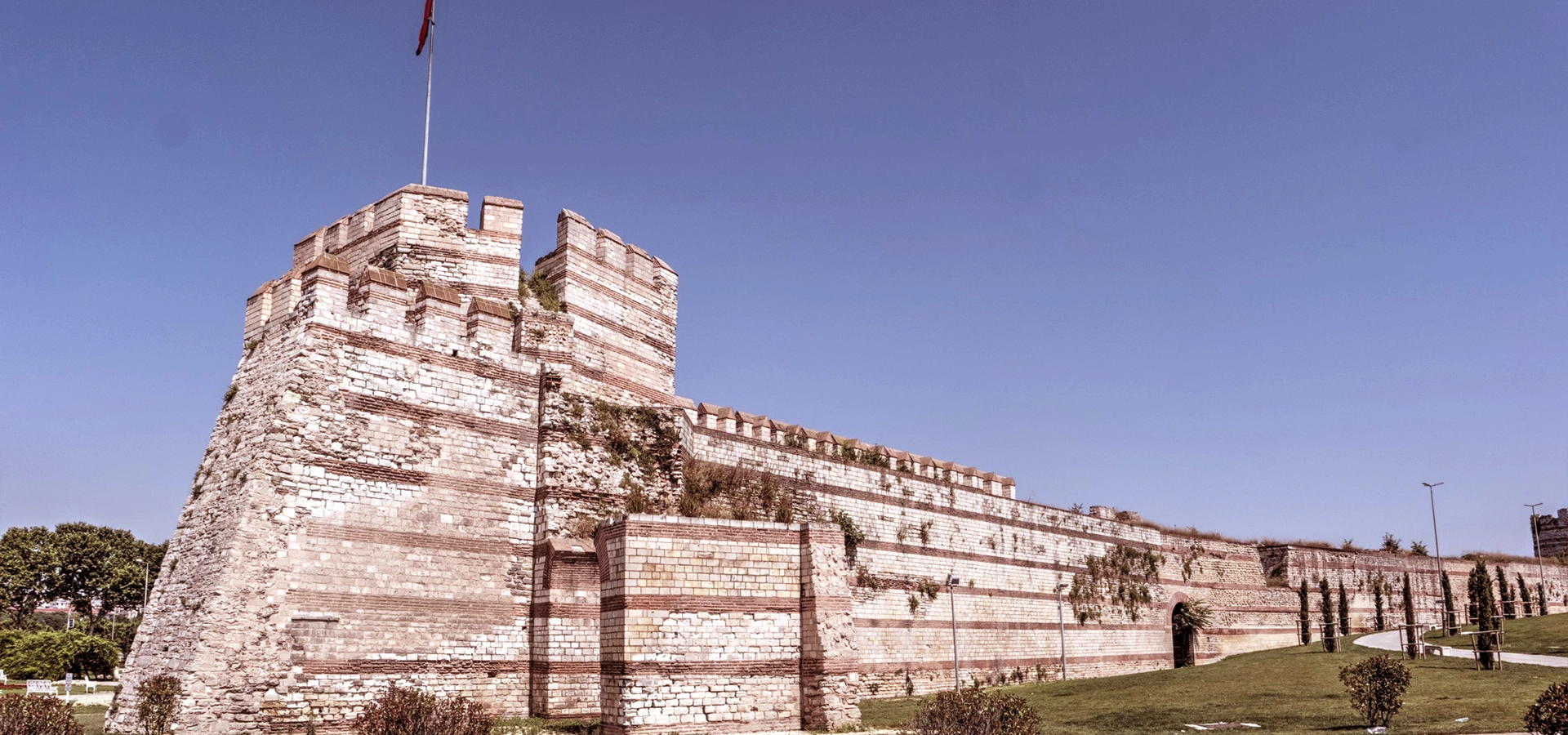
Continue from Yedikule along the great land defenses toward Belgradkapı, Silivrikapı, Topkapı, Edirnekapı and the Blachernae quarter.
Explore the City WallsConnect the fortress with the monuments of the Byzantine capital and Ottoman imperial city.
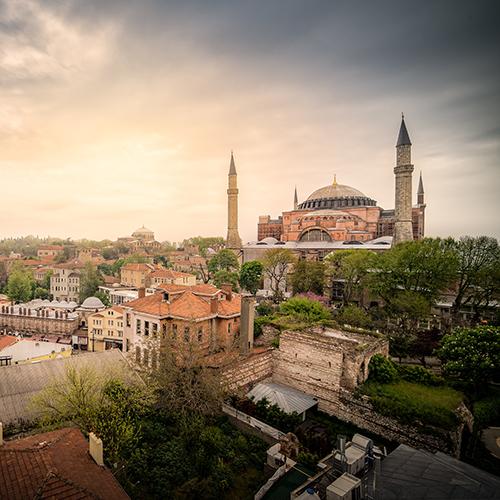
Explore the masterpiece that stood at the spiritual and ceremonial heart of Constantinople.
Explore Hagia Sophia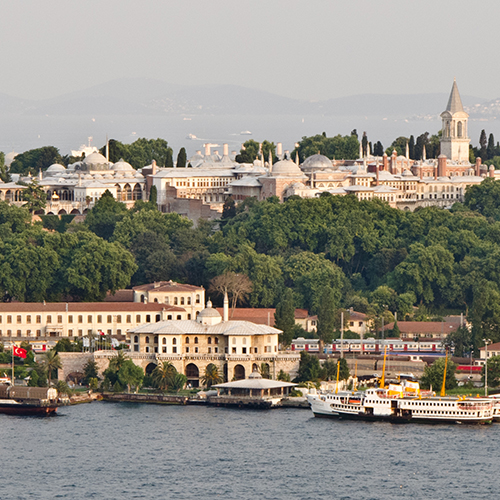
Discover the Ottoman imperial residence where the central treasury was later secured.
Explore Topkapı Palace
Continue to Chora, Fener, Balat, the Grand Bazaar and the Historic Peninsula.
Continue Exploring Istanbul