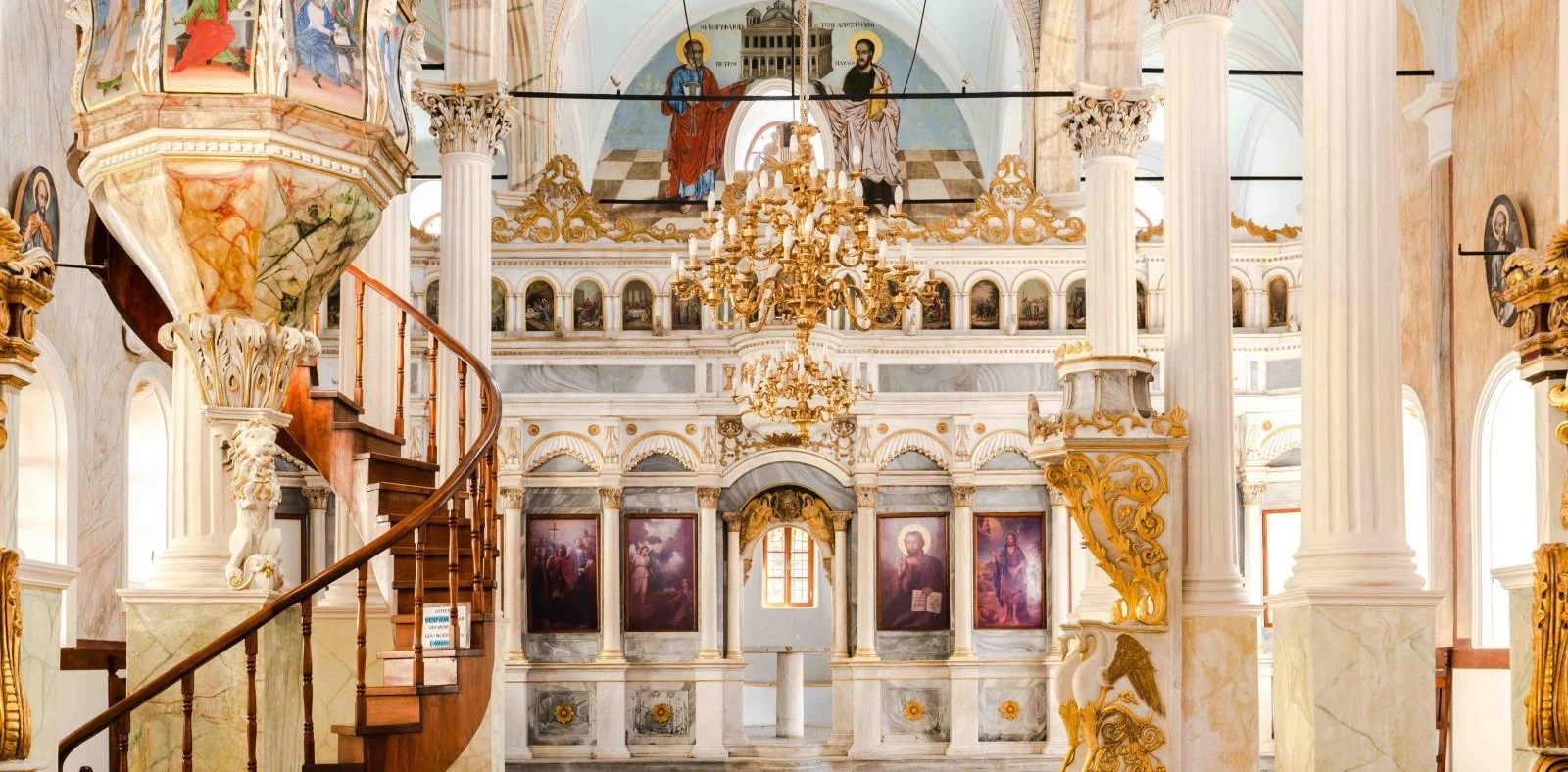
Taksiyarhis Monument Museum
Compare Saatli Mosque with one of central Ayvalık's most important preserved Greek Orthodox churches, rich in painted decoration and historic architectural detail.
View Taksiyarhis Guide





In the historic streets of central Ayvalık stands a religious building unlike an ordinary Ottoman mosque. Tall arched windows, monumental columns, a cross-shaped spatial arrangement and a distinctive tower immediately reveal that Saatli Mosque began its life as a Greek Orthodox church.
The present building was constructed in 1869–1870 as Hagios Ioannis Church, also written Hagios Ioannes, Agios Ioannis, Agia Ianni or Aya Yanni in different sources and transliterations. Ayvalık's official heritage authority attributes the design of this second church building to Emmanuel Kounas, an Ayvalık-born architect associated with several of the town's major late-19th-century churches.
Following the enormous demographic changes created by the Greco-Turkish population exchange, the former church was adapted for Muslim worship and began serving as a mosque in 1928. Rather than disappearing beneath an entirely new building, much of the original architectural framework survived.
That survival is exactly what makes Saatli Mosque so important today. Walk through the entrance and you can still read the building's earlier ecclesiastical architecture in its columns, arches, vaulted spaces, galleries and central dome, while the mihrab, minbar, carpets, calligraphy and adjacent minaret express its continuing life as a mosque.
Its name — Saatli Camii, the “Mosque with the Clock” — comes from the former church bell tower, which was transformed into a clock tower. Together, the clock tower and minaret form one of the most striking architectural silhouettes in the old town.
The present monument was constructed in 1869–1870 as the second known Hagios Ioannis Greek Orthodox church on the site.
Ayvalık's heritage authority attributes the present church design to the important local architect Emmanuel Kounas.
After the population exchange, the former church was adapted for Muslim worship and has continued as a mosque.
The former bell tower was transformed into a clock tower, creating the landmark from which Saatli Mosque takes its modern name.
Essential information for understanding and visiting one of the most remarkable historic religious buildings in central Ayvalık.
Historic central Ayvalık, Balıkesir, within walking distance of the old town's traditional streets and major monuments.
Hagios Ioannis Church, with several transliterations including Agios Ioannis, Hagios Ioannes and Aya Yanni.
The current monumental structure is dated by Ayvalık's heritage authority to 1869–1870.
The present church building is attributed to Emmanuel Kounas, an important Ayvalık architect of the late Ottoman period.
The former Greek Orthodox church began serving as a mosque in 1928.
“Saatli” means “with a clock”, referring to the clock installed in the former bell tower.
The historic building preserves a cross-shaped church arrangement centred on a dome and vaulted arms.
Saatli Mosque remains an active Muslim place of worship, not simply a museum or historical monument.
There is normally no museum-style admission ticket, but visitors should respect worship and any local access arrangements.
Allow around 30–45 minutes for the mosque and exterior architectural details.
Dress respectfully as you would for any active mosque; shoulders and knees should be covered and shoes removed before entering.
The architecture is exceptionally photogenic, but avoid photographing worshippers closely or disturbing prayer.
Ayvalık contains many reminders of its Greek Orthodox past, but Saatli Mosque allows you to experience that history inside a building that remains alive and in use. It is neither an abandoned church nor a conventional museum display. It is a historic church architecture that has continued into a second religious life.
That makes the building particularly revealing. Many travellers know that Ayvalık once had a large Orthodox Christian population, but the scale and prosperity of that community become much easier to understand when standing beneath Saatli Mosque's high vaults, columns and central dome.
The building also helps explain the transformation of Ayvalık after the population exchange. Religious buildings changed function as communities changed, and Saatli Mosque became part of the everyday spiritual life of the Muslim population that settled in the town.
Architecturally, it is one of the most unusual interiors in Ayvalık. The original church proportions remain legible, while Islamic furnishings and religious elements have been incorporated into the inherited space.
Finally, the exterior provides one of the old town's most memorable visual compositions: a former church bell tower transformed into a clock tower standing beside a later minaret. Few single views communicate Ayvalık's layered history so clearly.
The history of Saatli Mosque extends further back than the present 19th-century building. Research presented by the Ayvalık Area Directorate indicates that a Hagios Ioannis neighbourhood already existed in the early 18th century and that an earlier church on or associated with the site may date to approximately 1700–1710.
This matters because the building visitors see today was not necessarily the first church serving the community. Ayvalık expanded dramatically during the Ottoman period, and older religious buildings were frequently enlarged, replaced or completely rebuilt as local population and prosperity increased.
The present monumental Hagios Ioannis Church belongs to that later phase of urban development. Ayvalık's official heritage chronology dates what it calls the second Hagios Ioannis structure to 1869, with reconstruction generally placed in 1869–1870.
The church belonged to the mature architectural landscape of 19th-century Ayvalık, when substantial Orthodox churches, schools, houses, commercial buildings and industrial structures were reshaping the town.
Following the population exchange between Greece and Türkiye in the 1920s, Ayvalık underwent a fundamental demographic transformation. The former church eventually entered a new chapter, becoming a mosque in 1928.
Visitors researching Saatli Mosque online will quickly encounter conflicting dates. Many tourism articles and older descriptions give an approximate construction date of around 1850 or simply describe the church as a mid-19th-century building.
More detailed heritage research published by the Ayvalık Area Directorate, however, distinguishes between the history of the earlier Hagios Ioannis church and the present structure. It identifies the current building as the second Hagios Ioannis Church and places its construction in 1869–1870.
This distinction provides a much clearer explanation for the contradictory dates. Hagios Ioannis was an older religious institution, but the monumental building standing today belongs to the later 19th-century rebuilding phase.
For that reason, this guide uses 1869–1870 as the date of the present structure while acknowledging that the church community and an earlier building existed considerably before it.
Before becoming Saatli Mosque, the monument was known as Hagios Ioannis Church. The name refers to Saint John, although English and Turkish sources transliterate the Greek name in several different ways.
You may therefore encounter Hagios Ioannis, Hagios Ioannes, Agios Ioannis, Agia Ianni, Agai Ianni, Ayos İanni or Aya Yanni. These variations generally refer to the same historic church rather than to separate monuments.
The church formed part of a densely built Orthodox neighbourhood within the prosperous Ottoman-era town of Kydonies, the Greek name historically associated with Ayvalık.
Its scale is revealing. This was not a small rural chapel but a substantial urban religious monument designed for a significant congregation. The generous interior volume, galleries, monumental columns and elaborate architectural treatment all communicate the importance of the parish that built it.
Today, even after its conversion into a mosque, the ecclesiastical skeleton of Hagios Ioannis remains unusually easy to recognise.
One of the most valuable details preserved in modern heritage research is the attribution of the present Hagios Ioannis building to Emmanuel Kounas, an architect from Ayvalık.
Kounas is associated with several major late-19th-century religious buildings around Ayvalık. The heritage chronology also connects him with the 1873 Taksiyarhis Church on Cunda and the later Hagios Georgios Church, today's Çınarlı Mosque.
These buildings help reveal that Ayvalık's major churches were not isolated monuments. They belonged to a wider local architectural culture supported by the town's wealth, skilled craftspeople and substantial Orthodox population.
Looking closely at Saatli Mosque, visitors can see the ambitious qualities of this period: carefully proportioned façades, monumental interior supports, classical decorative references and an architectural scale far beyond that of a modest neighbourhood chapel.
The current Hagios Ioannis building was constructed during one of Ayvalık's strongest periods of urban and commercial development.
Emmanuel Kounas was from Ayvalık rather than being an architect brought in from a distant imperial centre.
The monumental Taksiyarhis Church on Cunda is also attributed to Kounas.
The later Hagios Georgios Church, now Çınarlı Mosque, is another structure associated with the same architect.
To understand why Hagios Ioannis became a mosque, it is necessary to understand the extraordinary transformation experienced by Ayvalık in the early 20th century.
Ayvalık had for generations been strongly associated with its Greek Orthodox population. The compulsory population exchange agreed between Greece and Türkiye after the Greco-Turkish War radically altered that demographic structure.
Orthodox Christian residents departed, while Muslim communities arriving from territories that became part of Greece were resettled in Türkiye, including in and around Ayvalık.
Buildings that had served the former Christian population therefore entered a new phase. Some deteriorated, some were given secular functions and several churches were adapted as mosques for the Muslim communities now living in the town.
Hagios Ioannis was among them. In 1928, the former church began serving as a mosque, creating the institution now known as Saatli Camii.
This should be understood within the profound movement of populations and the reorganisation of communities across the Aegean rather than as an isolated architectural event.
The conversion required the building to function according to Islamic worship while working within an architectural space originally designed for Orthodox Christian liturgy.
A mihrab was incorporated to indicate the direction of Mecca, a minbar provided the pulpit used for sermons and the floor was arranged for Muslim congregational prayer.
A minaret was also added beside the historic church building, providing the vertical element traditionally associated with a mosque and the call to prayer.
Ayvalık Municipality records that the church's icons were covered with paint following the conversion. At the same time, much of the architectural framework remained in place rather than being removed.
This is why visitors can still read the earlier church so clearly today. Columns, arches, vaulted ceilings, upper galleries, windows and the central domed arrangement continue to shape the interior.
Introduced to orient Muslim prayer toward the qibla and Mecca.
The mosque pulpit became part of the new Islamic worship arrangement.
The interior was adapted for rows of congregational Muslim prayer.
A minaret beside the former church visually expresses the building's later function as a mosque.
The most instantly recognisable feature of the monument is the tower rising from the former church. During the Christian period this was associated with the church's bell tower.
After the building became a mosque, the tower was adapted and a clock became its defining feature. The mosque consequently became known locally as Saatli Camii — literally, the Mosque with the Clock.
The tower is more than a decorative curiosity. It provides a visible reminder that the structure was not originally designed as a mosque and allows the earlier ecclesiastical architecture to remain legible from the surrounding streets.
Ayvalık Municipality records that the upper section of the bell tower was damaged in the 1944 earthquake. Later repair and adaptation contributed to the tower's modern appearance.
When photographing the exterior, try to include both the clock tower and minaret in the same frame. Their side-by-side presence is perhaps the clearest single visual summary of the building's two major religious chapters.
Official Balıkesir cultural information describes the historic monument as a rectangular building organised internally according to a cross-shaped plan. The central crossing is covered by a relatively small dome, while the arms are defined by vaulted spaces.
This arrangement is fundamentally different from the spatial organisation visitors might expect in a mosque originally designed for Islamic worship. It is one of the reasons the building's Christian architectural origin is immediately noticeable.
The entrance is particularly elegant. Official descriptions draw attention to a four-columned portico and decorative treatment incorporating acanthus leaves, a classical motif commonly used throughout Mediterranean and European architectural traditions.
Large windows bring substantial natural light into the high interior, while columns divide and frame the central space. Upper-level galleries preserve another feature strongly associated with the building's church period.
The result is not a structure in which one historical layer completely erased another. Instead, Saatli Mosque allows visitors to see how the same monumental shell has accommodated different forms of worship across more than a century and a half.
Do not rush directly through the entrance. Saatli Mosque rewards several minutes of exterior observation because the building's complicated history is particularly easy to read from outside.
Look upward at the former bell tower and notice how it remains architecturally integrated with the church building beneath it.
The minaret represents the later mosque phase and creates a striking contrast beside the former church tower.
Tall windows emphasise the vertical proportions expected of a substantial 19th-century church interior.
The columned entrance and decorative capitals preserve the building's monumental ecclesiastical character.
Move around the building where possible to understand how the central dome rises above the cross-shaped internal arrangement.
Step farther down the surrounding street to appreciate how strongly the monument rises above Ayvalık's tightly packed historic houses.
The interior is the reason architectural travellers should make time for Saatli Mosque rather than viewing only its clock tower from the street.
Large columns rise through the prayer hall and support arches that define the original church bays. Above them, vaulted ceilings and the central dome create a tall, airy volume very different from many purpose-built neighbourhood mosques.
The upper galleries are another important surviving church feature. Together with the column arrangement, they help visitors reconstruct the original Orthodox spatial hierarchy even without specialist architectural knowledge.
Islamic religious elements now occupy this inherited framework. The mihrab identifies the qibla, the minbar serves the mosque's sermon tradition, calligraphic elements reflect Muslim worship and carpets organise the floor for prayer.
The coexistence of those features is what makes the interior memorable. You are not simply looking at an old church or a later mosque interior; you are looking at a building in which both histories remain structurally visible.
Look closely at the capitals above the principal columns, where classical and ecclesiastical decorative vocabulary survives.
Acanthus-leaf decoration connects the monument with the classical revival language used in many 19th-century Mediterranean buildings.
The vaults reveal the cross-shaped church organisation more clearly than the rectangular exterior alone suggests.
Stand toward the centre and look upward to understand how the dome marks the architectural crossing.
The elevated galleries are among the clearest reminders of the building's original ecclesiastical organisation.
The repeated tall windows illuminate the volume and contribute strongly to the building's church-like verticality.
Rather than attempting to classify every visible element as exclusively “Christian” or “Muslim,” Saatli Mosque is best understood as a building that has accumulated different layers through time.
Its basic architecture belongs to Hagios Ioannis Church: the monumental volume, cross arrangement, dome, vaults, columns, galleries and former bell tower.
Its present religious function is Islamic: Muslim worship takes place inside, the prayer direction is marked by the mihrab, the minbar serves Friday sermons and the minaret belongs to the mosque phase.
Neither story makes much sense without the other. Removing the church history would make the architecture difficult to explain; ignoring the mosque's nearly century-long religious life would turn an active place of worship into nothing more than an archaeological object.
For visitors interested in cultural history, this coexistence is one of the most meaningful aspects of the monument.
The building's modern appearance was also shaped by natural disaster. Ayvalık Municipality records that the upper part of the historic bell tower was destroyed during the 1944 earthquake.
The tower was subsequently repaired and its clock became the feature most strongly associated with the monument's popular name.
This is useful to remember when comparing old photographs, architectural descriptions and the building seen today. Historic monuments rarely survive unchanged; earthquakes, repairs, new religious functions and conservation interventions all contribute to their present form.
The tower therefore represents several different periods at once: the original church architecture, earthquake damage, later reconstruction and its long-standing identity as Ayvalık's famous clock-bearing mosque.
Unlike Taksiyarhis Monument Museum, Saatli Mosque is not primarily operated as a visitor attraction. It remains an active religious building.
Visitors are generally welcome outside periods when access may be restricted for prayer, religious ceremonies, cleaning or local requirements, but sightseeing should always remain secondary to worship.
Friday around the midday congregational prayer is particularly important. If your goal is architectural sightseeing, another period will normally provide a quieter and more considerate visit.
Speak quietly, silence mobile phones and avoid walking immediately in front of someone who is praying.
These simple courtesies make it entirely possible to appreciate the building's remarkable history without interfering with its present religious life.
Shoes should be removed before entering the carpeted prayer area and placed where locally indicated.
Visitors should wear modest clothing appropriate to an active religious building.
Women should be prepared to cover their hair when entering the mosque; carrying a light scarf is useful.
The acoustics amplify conversation considerably, so even ordinary speech can become disruptive.
Give anyone who is praying generous space and avoid walking directly in front of them.
Photograph architecture rather than worshippers, especially during prayer.
Excellent for quieter surrounding streets, cooler temperatures and an unhurried architectural visit.
Usually convenient for combining the mosque with Ayvalık's historic streets, markets and nearby monuments.
Good for escaping summer heat briefly, but avoid disrupting midday prayer and remember Friday requires particular sensitivity.
Beautiful exterior light can emphasise the clock tower, windows and surrounding stone streets.
Because Saatli Mosque is active, there is no single sightseeing timetable that should be treated as permanent. Religious use takes priority, and access can occasionally change.
Enough to see the exterior, clock tower and principal interior space during a fast old-town walk.
Ideal for most visitors who want to understand the history, inspect the interior and photograph the exterior carefully.
Worthwhile for architecture, photography or religious-history enthusiasts who want to study details rather than simply enter and leave.
Combine the mosque with Taksiyarhis Monument Museum and a walking circuit through Ayvalık's historic neighbourhoods.
The strongest exterior composition usually includes both vertical elements because together they tell the building's story.
The monument is large relative to the narrow historic surroundings, so moving farther away helps avoid extreme distortion.
The dome, vaults, columns and galleries make excellent vertical compositions.
The interior architecture lends itself naturally to centred views along columns and arches.
Strong daylight entering through tall windows can create very bright highlights beside darker interior surfaces.
Wait rather than composing photographs around people praying. Architecture can be photographed without compromising privacy.
Saatli Mosque stands within central historic Ayvalık, surrounded by the dense street pattern of the old town. For most visitors already exploring Ayvalık centre, the easiest approach is simply on foot.
The best option if you are already in central Ayvalık. Walking also allows you to experience the historic houses and street fabric surrounding the mosque.
A taxi can bring you close to the historic centre, after which the final approach may be easier on foot depending on traffic and street access.
Driving directly into narrow old-town streets is rarely the most enjoyable approach. Park in an appropriate central area and continue walking.
Travel across to central Ayvalık and continue on foot once you reach the old-town area.
The monument's urban setting is part of the experience. Approaching on foot through the surrounding streets gives a much better sense of how a large Orthodox church once functioned within the dense neighbourhood around it.
Saatli Mosque is surrounded by the compact historic fabric of Ayvalık rather than a purpose-built visitor car park. Narrow streets and limited spaces make searching for parking immediately beside the mosque unnecessary and often inconvenient.
If you are driving, use a legitimate public or commercial parking area in central Ayvalık and continue on foot.
This also makes sightseeing much easier because many nearby monuments are close together and the streets between them contain historic houses, shops and architectural details that are easy to miss from a vehicle.
Summer weekends and holiday periods can make central Ayvalık particularly busy, so arriving earlier in the day reduces both parking stress and pedestrian congestion.
Saatli Mosque is a 19th-century religious monument within Ayvalık's old urban fabric, so visitors should not expect the seamless accessibility of a modern purpose-built attraction.
Steps at entrances, changes in level, historic thresholds and the surrounding street surfaces can make access more difficult for wheelchair users or travellers with limited mobility.
The exact access arrangement may change through maintenance or local adaptation. Anyone who requires guaranteed step-free entry should therefore confirm current conditions before making a special journey.
Even if interior access proves difficult, the exterior, tower, minaret and surrounding historic streets still provide substantial architectural interest.
One of the best things about visiting Saatli Mosque is that the experience begins well before you reach the entrance.
The surrounding neighbourhood belongs to Ayvalık's extraordinary historic urban landscape of narrow streets, closely packed stone buildings, old workshops, houses and former religious institutions.
Looking at the mosque within this setting helps explain its original role. Hagios Ioannis was not a remote pilgrimage church but an urban parish monument serving a community living around it.
Walk slowly before and after your visit. Façades, door surrounds, balconies, stonework and fragments of older buildings throughout the area help reconstruct the social world in which the church once functioned.
From here, it is natural to continue toward Taksiyarhis Monument Museum and other historic quarters rather than returning immediately to a vehicle.
Former Hagios Ioannis Church, reconstructed in 1869–1870 and converted to a mosque in 1928. Especially important for its clock tower and surviving church interior.
A former Greek Orthodox church preserved as a museum, allowing visitors to examine Christian decorative and liturgical elements in a different context.
Another monumental former Orthodox church later converted to a mosque, traditionally known as Hagios Georgios and also associated with Emmanuel Kounas.
Seeing these buildings together provides a far richer understanding of Ayvalık's architecture than visiting any single monument in isolation.
For travellers interested in architecture or population-exchange history, this comparison is particularly valuable because the buildings preserve different combinations of Christian heritage, later Islamic use and modern conservation.
The times are deliberately relaxed. Ayvalık is best explored as an architectural landscape rather than as a checklist of individual monuments.
One of central Ayvalık's most important surviving Greek Orthodox churches, now preserved as a monument museum with remarkable decorative details.
Explore historic stone houses, narrow streets, former workshops, markets and the urban environment in which Hagios Ioannis originally stood.
Another major former Greek Orthodox church converted into a mosque and an excellent architectural comparison with Saatli Mosque.
Continue across to Alibey Island for historic streets, the Taksiyarhis church complex, waterfront restaurants and island atmosphere.
Finish the day above the Aegean at Ayvalık's famous volcanic hilltop viewpoint, particularly impressive toward sunset.
Combine a cultural morning in old Ayvalık with swimming on the district's famous long sandy coastline.
The clock tower and minaret tell much of the building's history before you even step through the door.
Older descriptions often say “around 1850,” but detailed heritage research dates the present church structure later.
A lightweight scarf is useful for women visiting several active mosques during an Ayvalık walking day.
If worship is taking place, wait quietly or return slightly later rather than treating the prayer hall as a sightseeing space.
Visitors often focus only on the central dome, but the upper galleries are equally important evidence of the building's church origins.
Seeing both buildings makes the difference between museum preservation and continuing religious reuse particularly clear.
The historic centre is far more rewarding on foot and several major monuments are relatively close together.
The narrow exterior streets and tall interior make wider compositions useful for architectural photography.
Interpretive panels and visitor infrastructure may be limited because the building's primary function is worship.
Even a 30-minute visit becomes much more meaningful once you start identifying the church and mosque elements separately.
Saatli Mosque is located in the historic centre of Ayvalık, Balıkesir, within the old urban area containing many of the town's traditional stone buildings and former churches.
Yes. The present building was constructed as the Greek Orthodox Hagios Ioannis Church.
Its historic church name was Hagios Ioannis. Different sources also use spellings such as Agios Ioannis, Hagios Ioannes, Agia Ianni and Aya Yanni.
Ayvalık's official heritage chronology dates the present building to 1869–1870. An earlier Hagios Ioannis church or parish existed before the current structure.
Older tourism descriptions commonly give an approximate mid-19th-century date. More detailed heritage research distinguishes the earlier church history from the current structure and dates the second Hagios Ioannis building to 1869–1870.
Ayvalık's heritage authority attributes the present building to Emmanuel Kounas, an architect from Ayvalık.
He was an Ayvalık architect associated with several major late-19th-century churches in the region, including Hagios Ioannis and Cunda's Taksiyarhis Church.
The former Hagios Ioannis Church began serving as a mosque in 1928.
The conversion occurred after Ayvalık's demographic transformation during the Greco-Turkish population exchange, when the town's former Orthodox population departed and Muslim communities settled in the area.
Saatli means “with a clock.” The name refers to the clock installed in the former church bell tower.
The tower originated as part of the church's bell-tower arrangement, but its present appearance reflects later adaptation and repair, including changes after earthquake damage.
Ayvalık Municipality records that the upper part of the bell tower collapsed during the 1944 earthquake.
Yes. Its church origins remain very clear in the cross-organised plan, columns, arches, vaults, galleries, dome and former bell tower.
Islamic worship elements including a mihrab, minbar and minaret were incorporated, while much of the original church architecture remained.
Ayvalık Municipality records that icons inside the former church were covered with paint after the building was converted into a mosque.
The historic structure is rectangular externally but organised internally in a cross-shaped arrangement, with a central dome and vaulted arms.
Look for the columned entrance, acanthus decoration, monumental interior columns, upper galleries, arches, vaulted ceilings, central dome, clock tower and minaret.
Yes. It is an active mosque and its present religious function should take priority over sightseeing.
Non-Muslim visitors can generally enter respectfully outside restricted periods, but access may be limited during prayer, religious ceremonies, maintenance or other local requirements.
As an active mosque rather than a conventional museum, Saatli Mosque does not normally operate with a standard museum admission ticket.
Yes. Shoes should be removed before entering the carpeted prayer area.
Women should be prepared to cover their hair when entering an active mosque. Carrying a light scarf is the easiest solution.
Men should wear respectful clothing covering the shoulders and knees rather than beachwear or very short shorts.
Architectural photography is generally possible when conditions allow, but avoid photographing worshippers closely or disrupting prayer.
Morning and late morning are convenient for combining Saatli Mosque with an old-town walking route. Avoid disturbing congregational prayer, particularly on Friday around midday.
Allow around 30–45 minutes for an unhurried visit including both the exterior and interior.
Yes. Its significance extends far beyond worship: it is an important monument for understanding Ayvalık's architecture, population history and changing urban identity.
No. Saatli Mosque is the former Hagios Ioannis Church in central Ayvalık. Taksiyarhis is a different historic Orthodox church, with important examples both in Ayvalık and on Cunda.
No. Çınarlı Mosque is another former Orthodox church in Ayvalık, historically Hagios Georgios. Both buildings illustrate the reuse of former churches as mosques.
Yes. They are natural companions on an Ayvalık heritage walk because one remains an active mosque while the other preserves a former church primarily as a museum monument.
Yes. Explore central Ayvalık and Saatli Mosque first, then continue to Cunda for its historic streets, waterfront and monuments.
It is part of the historic urban fabric itself, so the mosque is best experienced as one stop within a wider walking exploration of old Ayvalık.
The surrounding historic streets are narrow and parking can be limited. It is generally easier to park appropriately in central Ayvalık and approach on foot.
Historic steps, thresholds and surrounding street surfaces may create difficulties. Visitors requiring guaranteed step-free access should confirm current arrangements locally.
Few monuments in Ayvalık display the town's historical layers as clearly. Its Orthodox church architecture, clock tower, mosque furnishings and minaret allow two major chapters of local religious history to be read within one building.
Continue through Ayvalık's old Greek neighbourhoods, monumental churches, island landscapes and spectacular North Aegean viewpoints.
Explore Ayvalık's remarkable architectural heritage before continuing to Cunda, the Aegean coast and the region's famous sunset landscapes.
Compare Saatli Mosque with one of central Ayvalık's most important preserved Greek Orthodox churches, rich in painted decoration and historic architectural detail.
View Taksiyarhis Guide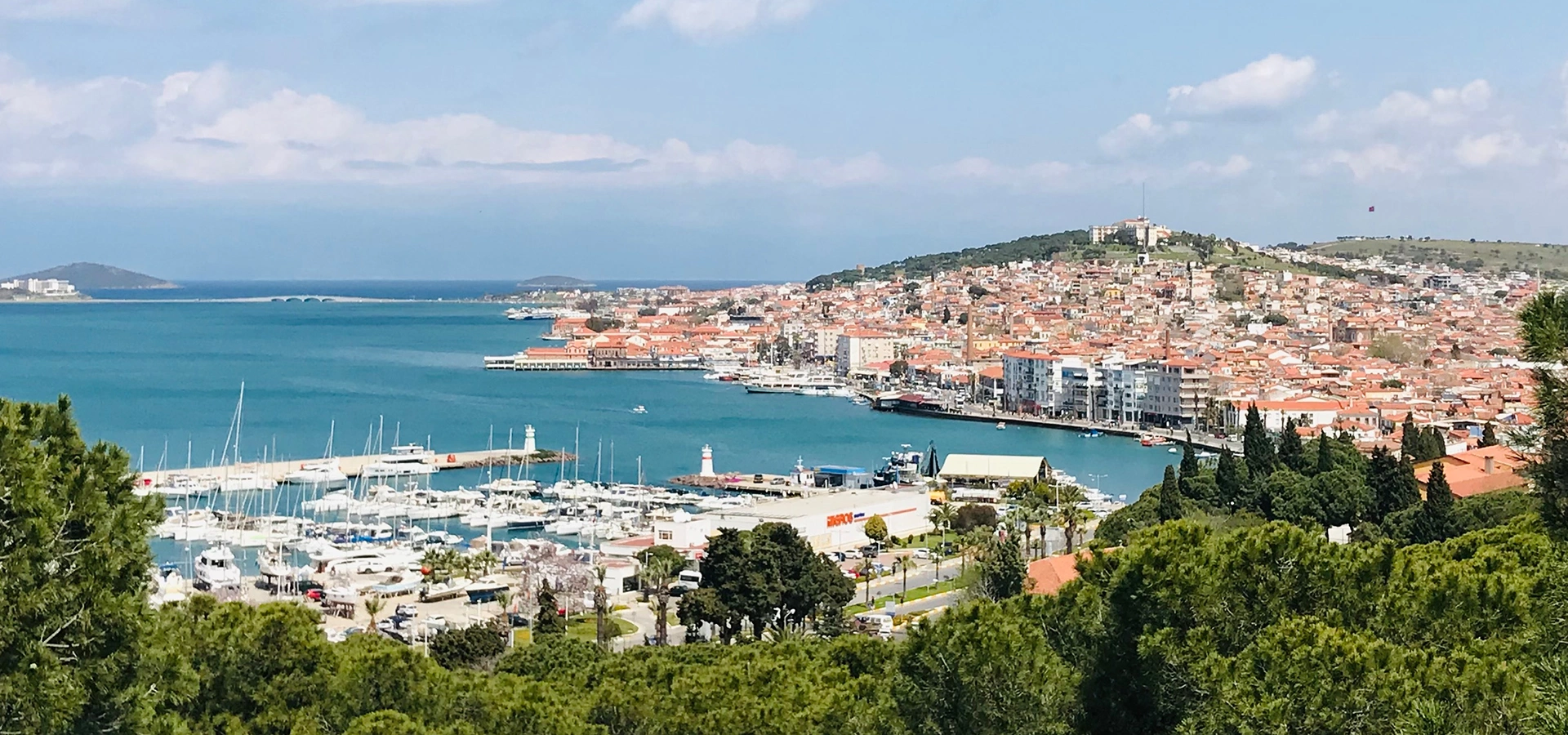
Discover the wider town behind Saatli Mosque: old Greek neighbourhoods, stone houses, former churches, markets, olive-oil culture and the historic waterfront.
View Ayvalık Guide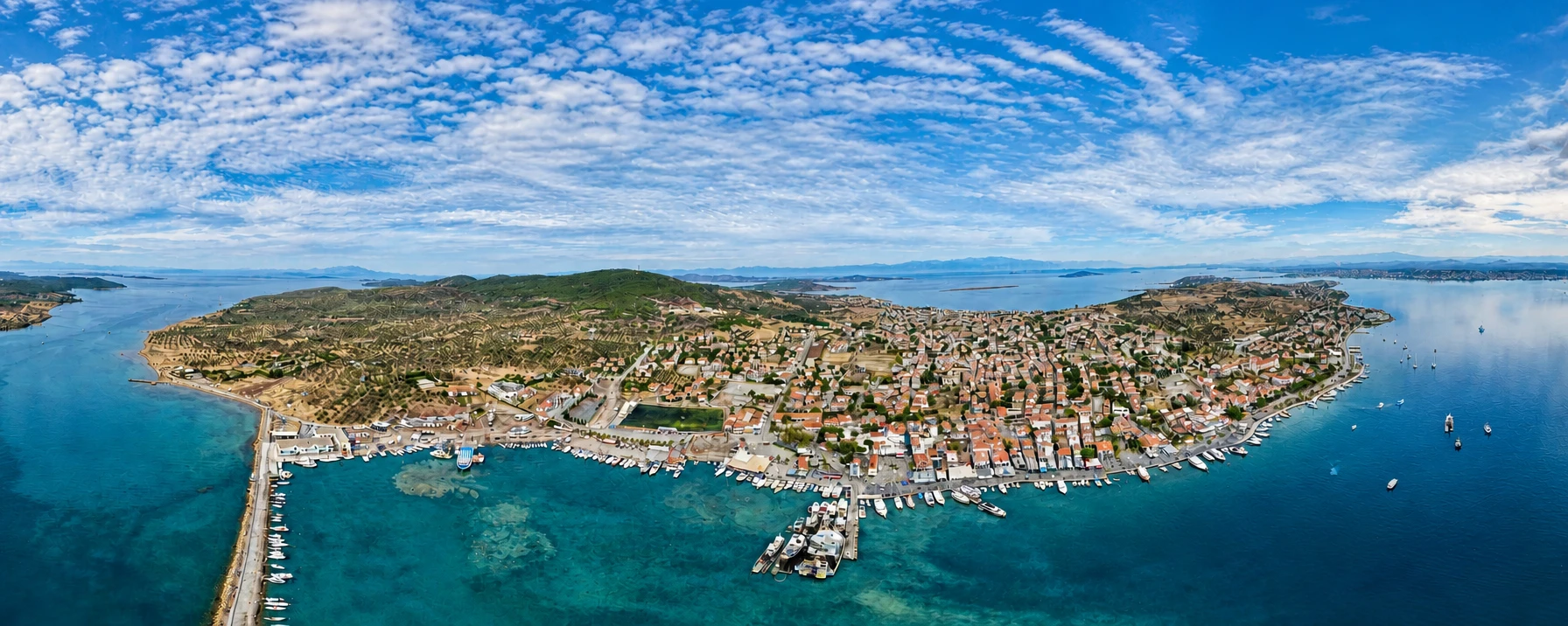
Cross to Alibey Island for another remarkable chapter of Ayvalık's Greek Orthodox heritage, along with stone streets, waterfront dining and island views.
View Cunda Guide
After exploring Ayvalık's historic religious monuments, finish the day above the Aegean at the region's famous volcanic hilltop sunset viewpoint.
View Şeytan Sofrası Guide