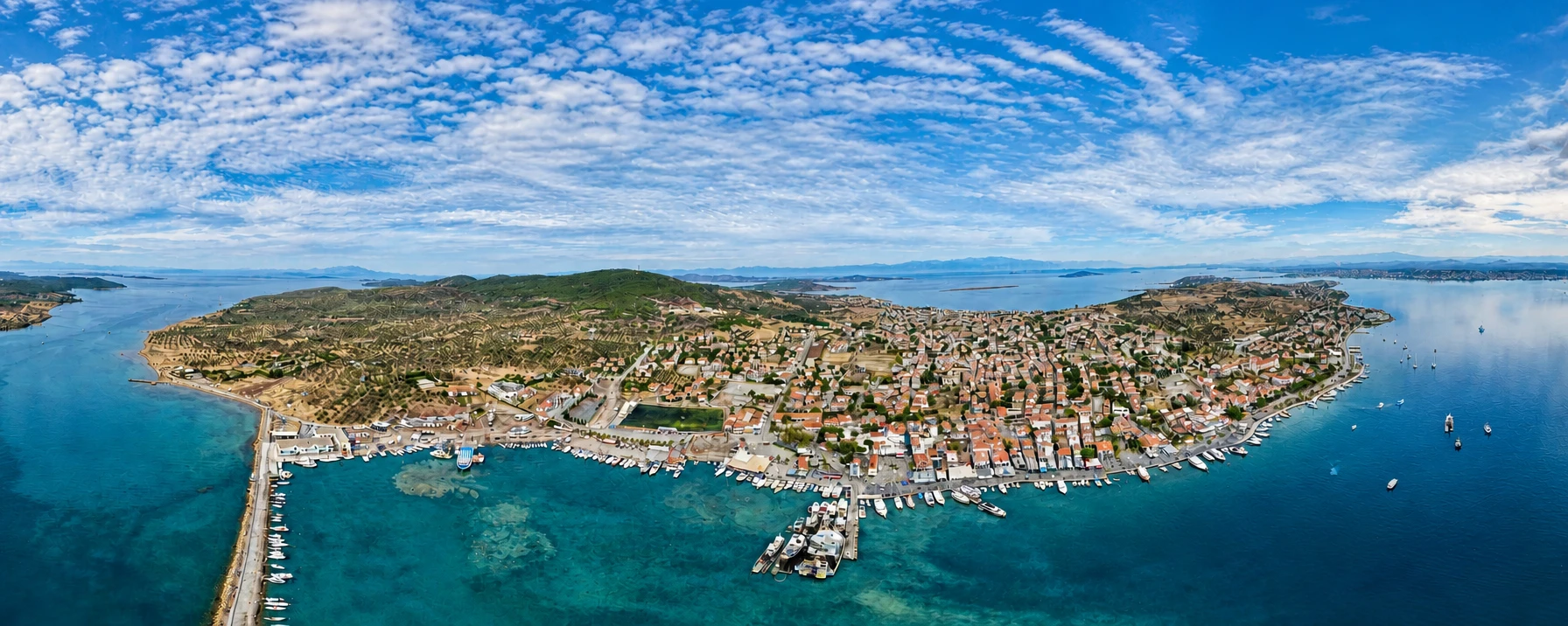
Private Cunda Island & Ayvalık Experience
Ask us about a tailor-made day combining Cunda's historic streets, Taksiyarhis, island viewpoints, Ayvalık heritage and a relaxed Aegean lunch.
Request a Custom Tour





Just off the coast of Ayvalık in Balıkesir Province, Cunda Island is one of the most characterful destinations on Türkiye's North Aegean coast. Officially known as Alibey Island, Cunda combines a remarkably preserved historic settlement with a working waterfront, olive-covered hills, secluded bays, Greek Orthodox heritage and a food culture shaped by the sea and the population movements of the early 20th century.
Cunda is not an island you visit for one monument. Its appeal comes from the relationship between many layers: 19th-century stone houses, former churches, old workshops, narrow streets, fishing boats, taverns, windmills, olive groves and views across the Ayvalık archipelago. The island's historic urban fabric preserves the scale of a prosperous Aegean town, while restored landmarks give visitors a way to understand the community that created it.
The island's best-known monument is the Taksiyarhis Church, rebuilt in its present form in the 19th century and today restored as the Cunda Rahmi M. Koç Museum. Higher above the town, the restored Agios Yannis chapel and windmill now form the Sevim and Necdet Kent Library, with one of Cunda's most memorable panoramas. Elsewhere, lost churches, surviving monastery ruins and former civic buildings reveal how extensive the island's Greek Orthodox cultural landscape once was.
Cunda is equally rewarding outside the old town. Much of the surrounding island and marine landscape belongs to the Ayvalık Islands Nature Park, where olive groves, maquis, rocky shores, small bays and views toward the surrounding islands create a very different experience from the restaurant-filled waterfront. This is why Cunda works so well for slow travel: you can spend one day walking through architecture and history, and the next swimming, taking a boat trip or following the road toward the quieter northern coves.
Food is part of the destination rather than an afterthought. Papalina, seasonal fish, seafood meze, wild Aegean herbs, artichokes, samphire and olive-oil dishes belong to the island's identity. Dinner on the waterfront may be Cunda's most familiar image, but the deeper experience comes from combining that evening atmosphere with the streets, churches, stories and landscapes behind it.
Walk among neoclassical houses, old shops, cobbled lanes and churches that preserve the scale of Cunda's late Ottoman Greek settlement.
The island's landmark Greek Orthodox church has been restored and now operates as the Cunda Rahmi M. Koç Museum.
Climb to the restored Agios Yannis chapel and windmill for one of the best panoramas across Cunda, Ayvalık and the surrounding islands.
Papalina, seafood, meze, local herbs and olive-oil dishes make eating on Cunda an essential part of understanding the island.
Essential information for planning a visit to Alibey Island and understanding the historic landscape of Cunda.
Ayvalık District, Balıkesir Province, on Türkiye's North Aegean coast.
Alibey Adası; Cunda remains the historic and overwhelmingly familiar name used in everyday travel language.
Older sources use forms including Yunda / Cunda and the Greek Moschonisi / Moschonesi.
Cunda is linked to Lale Island by a bridge and from there to the Ayvalık mainland, so no ferry is required to arrive by car.
Taksiyarhis Church, today the Cunda Rahmi M. Koç Museum.
The Sevim and Necdet Kent Library occupies a restored Agios Yannis chapel beside a reconstructed historic windmill.
Olive groves, maquis, rocky coves and protected marine scenery define the island beyond the historic centre.
Papalina, a small local fish strongly associated with Cunda, together with seafood, meze and olive-oil dishes.
Walk the old town, then use a car, taxi, bicycle or boat to reach the island's quieter coves and countryside.
One full day minimum; two nights are much better if you want the old town, beaches, food and slower island atmosphere.
May–June and September–October for comfortable walking, pleasant evenings and fewer peak-summer crowds.
Architecture, cultural history, food, photography, swimming, island drives, romantic stays and slow Aegean travel.
Cunda is worth visiting because it preserves an unusually complete combination of historic architecture, living neighbourhoods, religious heritage, food traditions and protected Aegean landscape within a compact island setting.
The first reason is the urban atmosphere. The old settlement is dense enough to explore on foot but large enough to reward wandering. Streets climb between stone houses with timber shutters, courtyards, projecting upper floors and old shopfronts. Some buildings are beautifully restored, others remain weathered, and that mixture prevents the town from feeling like a reconstructed open-air museum.
The second reason is the island's Greek Orthodox heritage. Taksiyarhis is the most visible monument, but it is only one part of a much wider network of churches, chapels and monasteries. The remains of Panagia and Agios Panteleimon, the Agios Yannis complex on the hill and Ayışığı Monastery on the Pateriça side show that Cunda once possessed a religious landscape far richer than a single surviving church suggests.
The third reason is the population-exchange history. Cunda's demographic and cultural life changed fundamentally after the Greco-Turkish population exchange of the 1920s. Muslims arriving from Crete and other Aegean communities brought their own language habits, food traditions and memories, creating a new social landscape inside an older architectural one. Much of what visitors now experience as “Cunda culture” was shaped by this meeting of inherited buildings and new communities.
Finally, Cunda is a place where history and leisure genuinely work together. You do not have to choose between museums and the sea. A morning can be spent in churches and stone streets, the afternoon in a quiet cove and the evening over meze beside fishing boats. Few destinations on the North Aegean coast make that combination feel so natural.
Cunda lies immediately west of Ayvalık on Türkiye's North Aegean coast, facing a sheltered sea filled with small islands and peninsulas. It is the largest inhabited island in the Ayvalık island group and forms part of the landscape that protects Ayvalık's inner waters from the open Aegean.
Although Cunda is a true island geographically, it is connected to the mainland road network. A historic causeway links the mainland to Lale Island, and the channel between Lale and Cunda is crossed by a bridge. This makes Cunda unusually easy to reach: visitors can arrive by car or public transport without needing to coordinate a ferry crossing.
The historic town occupies the southern part of the island, facing Ayvalık and the sheltered inner sea. The northern and western parts are much quieter, with olive groves, maquis, rural roads, beaches, coves and protected landscapes extending toward Pateriça and the outer shore.
The name most commonly used by residents, travellers, hotels, restaurants and tourism publications today.
The official Turkish name, associated with Ali Çetinkaya, the Ottoman officer and later statesman connected with the Ayvalık front in 1919.
Forms recorded in Ottoman-period sources and often discussed in relation to the gradual development of the modern name Cunda.
The historic Greek name used by the island's Greek Orthodox community; it is often translated or interpreted as referring to a fragrant or musk-scented island.
These names are not interchangeable historical labels from the same period. They reflect different languages, administrations and communities. For modern travellers, the simplest rule is that Cunda and Alibey Island refer to the same place, while Moschonisi is especially useful when researching the island's Greek Orthodox past.
The Ayvalık island group has a long settlement history stretching back into antiquity. Ancient geographical traditions refer to islands and settlements in the gulf, while later Byzantine and medieval occupation left a more fragmentary archaeological record. Cunda's surviving townscape, however, is primarily the product of the Ottoman and late Ottoman periods rather than the ancient world.
Academic architectural research records Cunda under Ottoman forms such as Cezire-i Yunda, Yunda and Cunda. The island came under Ottoman control in the 15th century and developed alongside Ayvalık as maritime security improved and the North Aegean economy expanded.
By the 18th and especially the 19th century, the island had become a prosperous Greek Orthodox settlement with fishing, trade, olive cultivation and maritime connections. Churches, schools, shops, houses, windmills and monasteries formed a dense cultural landscape. Cunda became an independent municipality from Ayvalık in 1862 and later a subdistrict in the early 20th century.
The wars and population movements of the early 20th century transformed the island completely. The Orthodox Greek population departed, and Muslim populations arriving through the population exchange — particularly from Crete and other Aegean communities — settled in the town. The physical town remained, but its inhabitants, language patterns, religious practices and domestic life changed dramatically.
Cunda's modern identity therefore cannot be reduced to “a Greek island town in Türkiye” or to a purely Republican-era resort. It is a layered Aegean settlement in which old Greek Orthodox architecture, Ottoman administration, population-exchange memory, Cretan-influenced foodways and contemporary Turkish island life all occupy the same streets.
The strongest visual character of old Cunda was shaped by the island's Greek Orthodox community. By the late Ottoman period, the settlement had developed the institutions of a substantial Aegean town: parish churches, chapels, monasteries, schools, shops, workshops, warehouses, houses and windmills.
The surviving urban fabric shows that this was not a scattered fishing village. Many houses were built in carefully laid streets, often using local stone and adapting to sloping ground. Commercial rooms could occupy the lower levels while family life took place above. Courtyards, masonry garden walls and narrow passages created transitions between public street life and private domestic space.
Religious buildings helped organise neighbourhood identity. Taksiyarhis survives as the island's most complete monumental church, while the sites of Panagia and Agios Panteleimon remind visitors that several important churches disappeared during the 20th century. The Agios Yannis complex on the hill and monasteries in the countryside show that sacred buildings also extended beyond the dense centre.
When exploring Cunda today, it is useful to look beyond individual “attractions.” The town itself is the historical object. Street widths, house orientation, old plot boundaries and the relationship between churches and neighbourhoods preserve information even where the original use of a building has changed.
The compulsory population exchange between Greece and Türkiye, formalised in 1923, is central to understanding modern Cunda. The island's Orthodox population left during the upheavals surrounding the end of the Greco-Turkish conflict, while Muslim refugees and exchangees from the Aegean world were resettled in Cunda and the wider Ayvalık region.
Among the most influential newcomers were Muslims from Crete. Their presence left a deep mark on island culture, especially in domestic cooking, herb use, seafood traditions and family memory. For generations, some Cretan-origin families also preserved elements of the Cretan Greek language alongside Turkish.
This demographic change altered the use of architecture. Churches lost their original congregations; houses received new families; public buildings were adapted to new functions; and some monuments fell into disuse. Taksiyarhis, for example, later served non-religious purposes before eventual restoration, while other churches disappeared almost entirely.
For travellers, the population exchange should not be treated as a decorative background story. It explains why Cunda's built environment and living culture come from overlapping communities. The island's architecture largely reflects the pre-1922 settlement, while much of its modern culinary and social identity developed through the people who arrived afterward.
Cunda's historic centre is one of the best places in the North Aegean to experience a late Ottoman island town at walking speed. The architecture is not monumental in every street; much of its beauty comes from proportion, material and repetition.
Many historic houses use local stone masonry, often left exposed after restoration or combined with plastered façades.
Traditional windows, shutters and upper-floor details soften heavy masonry and create the island's familiar Aegean street character.
Larger houses and religious buildings display symmetry, pilasters, pediments and other details associated with 19th-century neoclassical taste.
The region's distinctive stone was used in important buildings including Taksiyarhis and contributes to the warm colour of Ayvalık-area architecture.
Behind many street façades, enclosed outdoor spaces historically supported cooking, storage, domestic work and family life.
Historic houses now function as homes, small hotels, cafés, restaurants and shops, keeping much of the old town actively occupied.
The most rewarding streets are often those without a famous landmark. Leave the waterfront, walk uphill and pay attention to door lintels, masonry joints, old shop openings, reused stones and the way newer life has been fitted into older buildings.
The most important standing monument in Cunda's historic centre is Taksiyarhis Church, dedicated to the Archangels. Earlier worship existed on the site, but the building seen today belongs to the 19th-century development of the island and is generally dated in its present monumental form to 1873.
The church is a rectangular basilica-type structure with a central dome and neoclassical architectural language. Local sarımsak stone was used in its construction. The interior preserves decorative religious imagery, floral and geometric ornament and the spatial grandeur expected of a principal community church.
After the departure of the Orthodox congregation, the building passed through several uses and periods of damage. It was briefly adapted as a mosque without a minaret in the late 1920s, later used as a storage building and seriously affected by the 1944 earthquake. By the late 20th century it was a protected but deteriorated monument.
The Rahmi M. Koç Museology and Culture Foundation undertook restoration work after receiving the building for cultural use, and the museum opened in 2014. Today the church architecture forms the setting for a collection that includes mechanical objects, models, toys, transport-related pieces and other items connected with the broader Rahmi M. Koç Museum collections.
Above the old town, a restored chapel and windmill form one of Cunda's most recognisable landmarks. The Sevim and Necdet Kent Library occupies the historic Agios Yannis chapel, part of a monastic complex that once stood on the hill overlooking the settlement.
Institutional history published by the Vehbi Koç Foundation describes the chapel and associated windmill as belonging to an important monastic complex whose origins reached back to the late medieval period. After the population exchange the complex lost its original community and deteriorated. The surviving remains were later restored through the initiatives of Rahmi M. Koç.
The library opened in 2007. Its core collection includes more than 1,300 books belonging to diplomat Necdet Kent and donated by his son Muhtar Kent. The institution is named for Necdet Kent and his Ayvalık-born wife, Sevim Kent.
Even visitors who do not spend long inside the library should climb the hill. The terrace and windmill area provide a broad view over Cunda's red-tiled roofs, Ayvalık, the causeway, the inner sea and surrounding islands. Late afternoon is especially beautiful, though the path can be steep and busy in summer.
Taksiyarhis can create the impression that Cunda's Orthodox heritage survives in one great church. In reality, the historic settlement contained several major churches, and some of the most important were lost during the 20th century.
Architectural research has examined two especially significant examples: Panagia (Koimesis Theotokou) and Agios Panteleimon. Both changed repeatedly during their long histories and reached important late 19th-century forms before being demolished in the mid-20th century.
Their former sites survive within the modern urban fabric, although they do not present visitors with complete monuments. This makes them easy to overlook. Yet they are valuable for understanding Cunda because they demonstrate that the island's religious geography once included multiple parish centres rather than a single dominant church.
For travellers with a strong interest in architectural history, old photographs and archival plans can transform these apparently empty or fragmentary places into meaningful stops. They also provide an important reminder that heritage is not limited to buildings that happened to survive intact.
One of Cunda's largest historic buildings is the structure traditionally known as Despot Evi — the Despot House. Built in 1862, it became one of the island's most imposing secular landmarks and passed through a succession of public and institutional uses after the death of the clergyman associated with its construction.
Historical accounts published by the present operator state that the building was later purchased by the Ottoman administration and used as a government building. In the Republican period it served as an orphanage and school, after which it stood abandoned for many years and suffered from earthquake damage, fire, weather and inappropriate alterations.
A major restoration programme began after the property was leased for adaptive reuse, and the building reopened as a hotel in 2019. It remains a useful example of a broader question visible across Cunda: how can very large historic buildings survive when their original institutional function has disappeared?
Because Despot House operates as a hospitality property rather than a conventional museum, visitors should respect private areas. Even from the surrounding streets, however, its scale and formal architecture make it an important stop when reading Cunda's 19th-century urban prosperity.
Cunda's Christian heritage extends far beyond the old town. Roads and tracks through the olive-covered countryside lead toward former chapels and monasteries that once served rural communities, farms and religious retreat.
The best known is Ayışığı Manastırı — the Moonlight Monastery — on the Pateriça side of the island. Official cultural-heritage information considers it an 18th-century foundation, though its exact original construction date is uncertain. The complex included a walled courtyard with a church and associated monastic structures.
Architectural evidence suggests later rebuilding and repair, including 19th-century work using local sarımsak stone. The monastery suffered heavily from natural deterioration and human damage. Official heritage information currently describes it as closed to visitors, so it should not be treated as a freely accessible ruin or a hiking destination that can simply be entered.
Its importance is nevertheless considerable. Ayışığı shows that Cunda's historical life reached deep into the rural landscape. The island was not divided into “town” and “empty countryside”; agricultural land, monasteries, water systems, olive groves and coastal routes were all connected.
The waterfront is the most immediately recognisable side of Cunda. Fishing boats, excursion vessels, cafés, taverns and restaurants line the sheltered shore, while the old town rises behind them toward Taksiyarhis and Aşıklar Hill.
During the day the waterfront works as a transport and meeting zone. Boats depart for excursions, supplies move through the harbour and visitors cross between the pier and the market streets. By early evening, tables begin to dominate the scene and the harbour becomes the island's principal social space.
This is the right place for a long dinner, but not necessarily the best place to spend the whole day. Cunda becomes much more interesting once you move one or two streets inland, where commercial activity drops and the historic residential fabric becomes easier to read.
For photography, return to the waterfront at several different times. Morning light gives a quieter sense of working harbour life; late afternoon reveals the architecture behind the boats; and evening brings the lively restaurant atmosphere for which the island is famous.
Cunda belongs to a much larger protected island and marine environment. Ayvalık Islands Nature Park was declared in 1995 and today covers approximately 19,624 hectares, most of it marine area. Official nature-conservation information lists 21 islands within the park, including Alibey — Cunda — itself.
The nature park is important because it protects more than scenic coastline. Olive groves, Mediterranean maquis, rocky shores, marine habitats and a diverse plant community form a cultural-natural landscape shaped by centuries of human use.
Official nature-tourism information identifies activities such as walking, photography, birdwatching and diving. Visitors should remember that the protected area is not a single fenced park with one entrance. It is a broad landscape containing roads, private land, shorelines, islands and marine zones, so access conditions differ from place to place.
The best way to experience this side of Cunda is to leave the historic centre for at least a few hours. Drive or cycle toward the quieter parts of the island, stop where access is clearly permitted, and look back toward the dense settlement. The contrast between compact stone town and open olive landscape is one of Cunda's defining features.
Cunda is surrounded by many small bays rather than one continuous resort beach. Some are organised beach areas, some belong to hotels or businesses, and others are simple rocky or pebbly coves reached by island roads.
A broad rural area on the northern side of the island, known for quieter coves, olive landscapes and a very different atmosphere from central Cunda.
Often mentioned in official tourism promotion for clear water and swimming; access is easiest as part of an island drive or boat route.
Another small Cunda cove promoted for swimming, especially for travellers who want to leave the busy harbour behind.
Daily boat trips from Ayvalık and Cunda commonly stop at small bays and island waters that are difficult or impossible to reach comfortably by road.
Useful at many North Aegean swimming spots because shorelines may be rocky, pebbly or uneven rather than sandy.
The North Aegean can become windy. A calm-looking bay in the morning may feel very different later in the day, so follow local advice.
Do not assume every cove visible on a map has public road access, parking or facilities. Some routes cross private or protected land, and access arrangements can change. For a stress-free swimming day, use clearly signed public access, an established beach facility or a licensed boat excursion.
Food is one of the strongest reasons to stay overnight on Cunda. The island's cuisine reflects the sea, Ayvalık's olive culture and the culinary memory of families who arrived from Crete and elsewhere in the Aegean during the population exchange.
Cunda's signature small fish. It is strongly associated with the island and is best ordered when locally available and in season.
Cold and warm small plates make it easy to build a long dinner around several flavours rather than a single main course.
Seasonal greens dressed with olive oil and lemon are central to the wider Ayvalık and Cretan-influenced table.
Deniz börülcesi is one of the classic coastal meze choices and pairs naturally with fish and other vegetable dishes.
Often prepared with olive oil, vegetables and herbs, reflecting the lighter style associated with Aegean cooking.
The defining ingredient of the region. Taste it in vegetable dishes, salads and simple preparations where the oil itself remains obvious.
Ask what is seasonal and locally available rather than choosing only by menu familiarity.
A regional sweet using fresh curd cheese, often served with syrup or seasonal accompaniments.
A good Cunda dinner is usually unhurried. Start by looking at the meze display, ask what fish arrived that day and order gradually. The point is not to collect famous dishes as quickly as possible; it is to experience the rhythm of an Aegean table.
Cunda's food culture makes much more sense once you notice how completely the wider Ayvalık landscape is shaped by olive trees. Olive cultivation has supported households, trade and local industry for generations, and the groves remain one of the strongest visual links between town, countryside and cuisine.
Older island life depended on more than fishing. Families combined maritime work with agriculture, animal husbandry, small-scale processing and trade. Rural monasteries and farmsteads also belonged to this productive landscape.
Today olive oil is sold everywhere from specialist shops to market shelves, but quality varies. If you want to buy oil, look for clear harvest information, producer details and proper storage rather than choosing only by decorative packaging.
The most interesting souvenir is often something that connects directly with this landscape: a well-produced local olive oil, olives, a regional herb product or a food item you can actually use after returning home.
Choose reputable regional producers and check harvest date, storage and packaging.
A practical edible souvenir that directly reflects the agricultural identity of Ayvalık.
Herb mixtures, preserves, soaps and other olive-based products are widely available, though quality varies between shops.
Small boutiques occupy restored buildings in the historic centre and often sell ceramics, textiles, prints and contemporary handmade items.
Look for publications about Ayvalık, the population exchange and local architecture if you want a deeper reminder of the island than a generic souvenir.
Cunda is more rewarding when shopping remains part of the walk rather than the purpose of the day.
The island's greatest practical advantage is that it is connected by road. You can drive directly from Ayvalık to Cunda without putting the vehicle on a ferry.
Follow the road toward Lale Island and Cunda. Driving time is short outside peak traffic, but summer congestion can make the final approach much slower.
Municipal and minibus services connect Ayvalık with Cunda. They are useful if you want to avoid parking in the historic centre.
Boats operate between Ayvalık and Cunda; current library visitor information describes hourly departures as an alternative to road transport. Verify the schedule on the day.
Balıkesir Koca Seyit Airport is the nearest airport to the wider Ayvalık area. Continue by road transfer or rental car.
Reach Ayvalık by road from the south, then continue across the island connection. A rental car is particularly useful if Cunda is part of a wider North Aegean itinerary.
Technically possible as a long walk, but not the best use of time for most visitors. Use public transport or a boat, then explore the historic centre on foot.
Cunda's road connection is itself part of local history. Ayvalık Municipality records that Lale Island was connected to the mainland in 1817 by a long low causeway created through filling and road construction.
The channel between Lale Island and Cunda was later crossed by a bridge built in 1964. Municipal heritage information describes it as Türkiye's first bridge crossing a strait. The modern road connection has since been upgraded, but the older bridge remains important in local memory and in the story of how Cunda became accessible by continuous road.
For the island, this connection was transformative. It reduced dependence on boats for everyday movement, brought Cunda closer to Ayvalık's economy and later helped turn the island into a major domestic tourism destination.
It also created a modern challenge: summer traffic. If you are staying in Cunda, choose accommodation with a clear parking plan or be prepared to leave the car outside the tightest part of the historic centre.
The best way to experience the historic centre. Many of the most interesting lanes are narrow, steep or inconvenient for cars.
Very useful for Pateriça, beaches and the rural side of the island, but unnecessary for short movements within the old centre.
Convenient for evening meals or beach transfers when you do not want to deal with parking.
Rewarding outside the busiest centre, though summer heat, hills, traffic and road surfaces should be taken seriously.
Ideal for seeing the island from the water and reaching bays that are awkward by road.
In peak season, park once and walk. Repeatedly moving a car through central Cunda usually wastes more time than it saves.
Fresh, green and quiet. Excellent for walking and photography, but sea temperatures remain cool and some seasonal businesses operate reduced hours.
One of the best periods overall: long daylight, comfortable evenings, active restaurants and good conditions for combining history with the sea.
Peak season. Best for swimming and nightlife but also the busiest period for traffic, restaurants, accommodation and the old town.
Excellent sea conditions often continue while the strongest summer crowds begin to ease. One of Cunda's most attractive months.
Ideal for food, walking and cultural exploration. Swimming can still be possible in good weather, though conditions become less predictable.
A different island: quieter streets, local life and dramatic weather, but fewer tourism businesses may be open and wind or rain can limit outdoor plans.
For first-time visitors who want both cultural exploration and the sea, late May, June, September and early October usually provide the best balance.
Enough only for a quick waterfront walk and one landmark. You will see Cunda, but you will not really experience it.
Walk the old town, visit Taksiyarhis and climb toward the hilltop library. Good for a day trip from Ayvalık.
A strong introduction combining architecture, the waterfront, a museum, the viewpoint, a long meal and some free wandering.
Much better because you experience the island after day-trippers leave and can enjoy dinner without watching the clock.
Ideal for most visitors. Use one day for the historic centre and another for beaches, Pateriça, a boat trip or wider Ayvalık.
Excellent for slow travel, photography, swimming, food-focused travel and combining Cunda with Ayvalık and nearby North Aegean sites.
The waterfront and newer roads are relatively straightforward, but the historic centre includes cobbled surfaces, narrow pavements, steep streets, thresholds and irregular paving. Accessibility therefore varies considerably within a short distance.
The climb toward Aşıklar Hill and the Sevim and Necdet Kent Library is especially steep. Visitors with limited mobility may prefer to approach as close as practical by vehicle and confirm the remaining access conditions locally.
Taksiyarhis Museum operates as a managed museum and is easier to plan around than open historic streets, but anyone requiring specific step-free access should contact the institution before arrival rather than assuming every part of a 19th-century church is equally accessible.
For travellers with mobility concerns, the best strategy is to choose centrally located accommodation, use taxis for steeper movements and build the day around fewer but more meaningful stops.
Cunda works well for families because the day can be varied. A museum visit can be followed by ice cream, a short boat ride, time by the sea or an early dinner on the waterfront.
The Rahmi M. Koç Museum is especially useful for children who may not be interested in church architecture alone, because the collection includes mechanical and transport-related objects that create a more visual experience.
The main practical challenges are summer heat, steep streets and traffic. Use the cooler morning for uphill exploration, avoid pushing a tightly scheduled walking programme through midday and keep water with you.
For younger children, choose one or two heritage stops rather than trying to “complete” every attraction. Cunda is at its best when the family has time to sit, eat and enjoy the island rather than moving constantly.
The classic panorama over red-tiled roofs, the inner sea and the Ayvalık island landscape.
Photograph both the monumental façade and the way the church rises above dense residential streets.
Look for worn stone, shutters, doors, steps and small domestic details rather than only broad street scenes.
Earlier hours are better for fishing boats and harbour life before restaurant tables dominate the shore.
The waterfront and stone buildings become especially atmospheric in the period just after sunset.
Olive groves, dry-stone walls, maquis and quiet coves show a completely different side of the island.
Cunda is highly photogenic, but remember that many beautiful façades are private homes. Do not enter courtyards, photograph residents at close range without permission or treat lived-in neighbourhoods as a film set.
Historic doorways and courtyards may belong to residents. Stay in public space unless clearly invited inside.
Do not climb ruins, remove fragments or scratch names into old stone and plaster.
Do not force entry across private property to reach a cove visible on a map or social-media post.
Parking once and walking protects the experience for residents and visitors while reducing congestion in narrow streets.
Spend with independent food producers, small shops and local businesses rather than treating the island only as a photo stop.
Take rubbish out, avoid fire risk and follow access restrictions in protected landscapes.
The old streets are quieter in the morning and far more comfortable for photography in summer.
For popular summer evenings and weekends, reserve a table rather than assuming the best-known waterfront restaurants will have space.
Cobbles, slopes and polished old stone are easier with supportive footwear.
Especially important when walking uphill or exploring the rural side of the island in summer.
Taksiyarhis closes on Mondays according to current official information, while seasonal closing times vary.
In July and August, moving the car repeatedly through central Cunda is often the least efficient way to explore.
If your schedule allows it, one night changes the experience completely by giving you early morning and late evening without day-trip pressure.
Cunda is a place for wandering. Do not schedule every half hour or you will miss the quality that makes the island special.
Walk the waterfront and old town, visit Taksiyarhis, climb to the hilltop library and windmill, explore the upper neighbourhoods and stay for a long evening meal.
Spend the morning around Pateriça or on a boat trip, then cross to Ayvalık for its historic streets, markets, churches-turned-mosques, olive-oil heritage and sunset viewpoints.
Two days are enough to understand why Cunda and Ayvalık should be experienced together. Cunda provides the island settlement, harbour and rural landscape; Ayvalık adds a larger historic town, industrial olive heritage and a different urban scale.
A third day removes the pressure to choose between culture and the sea. It also gives you flexibility if strong wind changes boat or beach plans.
The essential companion to Cunda, with a much larger historic centre, old churches, markets, olive-oil industrial heritage and excellent food.
A famous viewpoint south of Ayvalık overlooking the archipelago and surrounding North Aegean landscape, especially popular near sunset.
A long beach area south of Ayvalık for travellers who want a more conventional swimming day alongside cultural exploration.
Continue east along the Edremit Gulf for archaeology, Roman mosaics and the ancient landscape beneath Mount Ida.
Add forests, mountain villages, mythology and hiking to a North Aegean itinerary centred on Ayvalık and Cunda.
A distinctive ethnographic stop near Edremit, useful for travellers continuing toward Kazdağı and the northern gulf.
For a wider Balıkesir journey, combine the coast with one of Türkiye's important wetland landscapes.
South of Ayvalık, one of western Türkiye's great ancient cities provides a powerful archaeological contrast to Cunda's late Ottoman heritage.
Best for atmosphere and walking to restaurants, Taksiyarhis and the waterfront. Expect narrow streets, evening activity and limited parking.
Quieter and more residential, often with attractive views, but steeper walking back from the harbour.
A good compromise if you want easier parking and road access while remaining close enough to walk into town.
Best for peace, swimming and nature, but you will depend more on a car or taxi for dinners and museums.
A practical alternative for travellers who want Cunda as a day or evening trip while keeping access to Ayvalık's larger historic centre.
Many boutique properties occupy restored stone houses. Ask about stairs, room size, parking and sound insulation before booking.
Yes. Alibey Adası is the official name, while Cunda is the historic and commonly used name.
Cunda is part of Ayvalık district in Balıkesir Province on Türkiye's North Aegean coast.
No. Cunda is connected to the mainland road network through Lale Island and can be reached directly by car, bus or minibus.
Yes. Passenger boats operate between Ayvalık and Cunda, especially in the tourism season. Current official library visitor information describes hourly departures, but schedules should be checked on the day.
Historic stone houses, Greek Orthodox heritage, Taksiyarhis Church, the hilltop library and windmill, seafood, papalina, olive-oil cuisine, sunsets and island coves.
Taksiyarhis Church, now the Cunda Rahmi M. Koç Museum, is the island's most important surviving monumental building.
An earlier church existed on the site, while the present monumental building is associated with the 19th century and is commonly dated to 1873.
The restored church contains a collection of mechanical objects, models, toys, transport-related pieces and other items connected with the Rahmi M. Koç Museum collections.
No. Current official museum information lists Monday as the weekly closing day, with seasonal Tuesday–Sunday hours. Verify current information before visiting.
It is the hill above Cunda's historic centre where the restored Agios Yannis chapel, Sevim and Necdet Kent Library and windmill overlook the island and Ayvalık.
Yes. Current official visitor information lists free admission.
The island's demographic structure changed during the conflict and population movements of the early 1920s. The compulsory population exchange between Greece and Türkiye was formalised in 1923, and Muslim exchangees — especially people from Crete and other Aegean communities — settled in the area.
Yes. The island historically contained several churches and chapels. Panagia and Agios Panteleimon were major churches but were demolished in the 20th century; their sites survive only fragmentarily.
Official cultural-heritage information currently describes Ayışığı Monastery as closed to visitors. Do not enter restricted or unsafe areas.
Try papalina when available, seasonal fish, seafood meze, wild herbs, samphire, artichokes and dishes prepared with Ayvalık olive oil.
Yes, but the island is known more for small coves and organised beach areas than for one long sandy beach. A car or boat makes it easier to reach quieter swimming spots.
One full day is a good minimum. Two nights are ideal if you want to combine history, food, swimming and the island's quieter rural side.
June and September are especially attractive for travellers who want warm weather, active restaurants and good sea conditions without the very peak of midsummer pressure.
Yes, particularly on weekends and in July–August. Traffic, parking and popular restaurants can become very busy.
Not for the historic centre. A car becomes useful if you want Pateriça, rural coves or a wider North Aegean road trip.
The historic centre is highly walkable, but some streets are steep and paved with uneven stone. Aşıklar Hill requires a noticeable climb.
Parts of the waterfront are manageable, but the historic core includes steep slopes, cobbles and thresholds. Travellers requiring step-free access should plan specific sites in advance.
Yes, very easily. However, staying overnight gives you the island in the early morning and after the main day-trip crowds leave.
Yes, but it will be a selective visit. For a deeper experience, devote one day to Cunda and another to Ayvalık.
Absolutely for travellers interested in architecture, food and local life. Winter is much quieter, though some tourism businesses reduce their hours and weather can be windy or rainy.
Yes for travellers who enjoy historic towns, Aegean food, architecture, sea views and slow travel. Its real value comes from the combination rather than from any single attraction.
A private route can connect Cunda's Greek Orthodox heritage and island landscapes with Ayvalık's historic centre, olive culture, coastal viewpoints and the archaeological and natural sites of the wider North Aegean.
Tell us whether your priority is architecture, population-exchange history, food, photography, beaches, archaeology or a complete multi-day North Aegean itinerary, and we can shape the programme around your interests.
Ask us about a tailor-made day combining Cunda's historic streets, Taksiyarhis, island viewpoints, Ayvalık heritage and a relaxed Aegean lunch.
Request a Custom Tour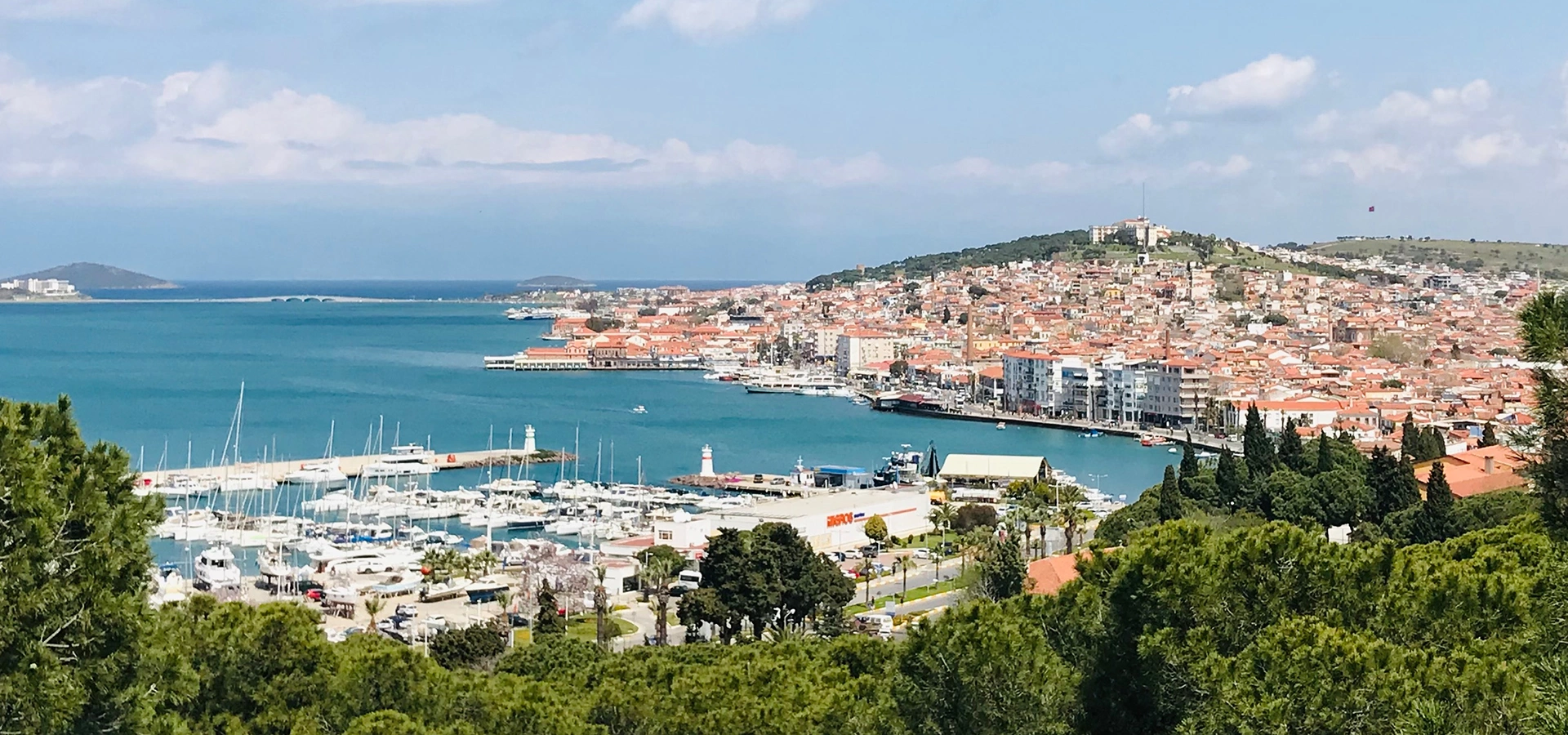
Continue across the water to explore one of Türkiye's most distinctive historic coastal towns, with churches, old olive-oil buildings, markets and stone streets.
View Ayvalık Guide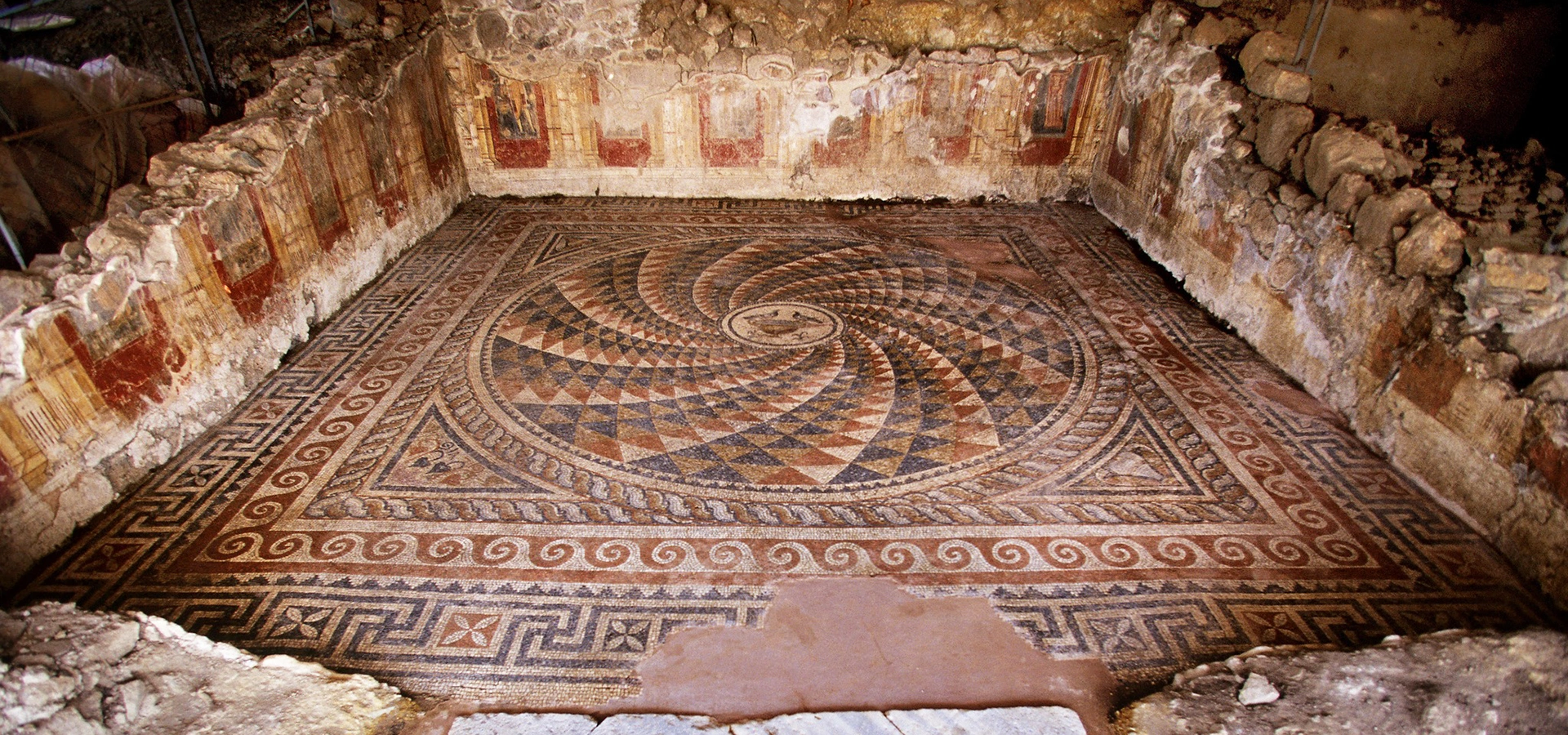
Add Roman mosaics, ancient Mysian history and the lower slopes of Mount Ida to a cultural journey along the Edremit Gulf.
View Antandros Guide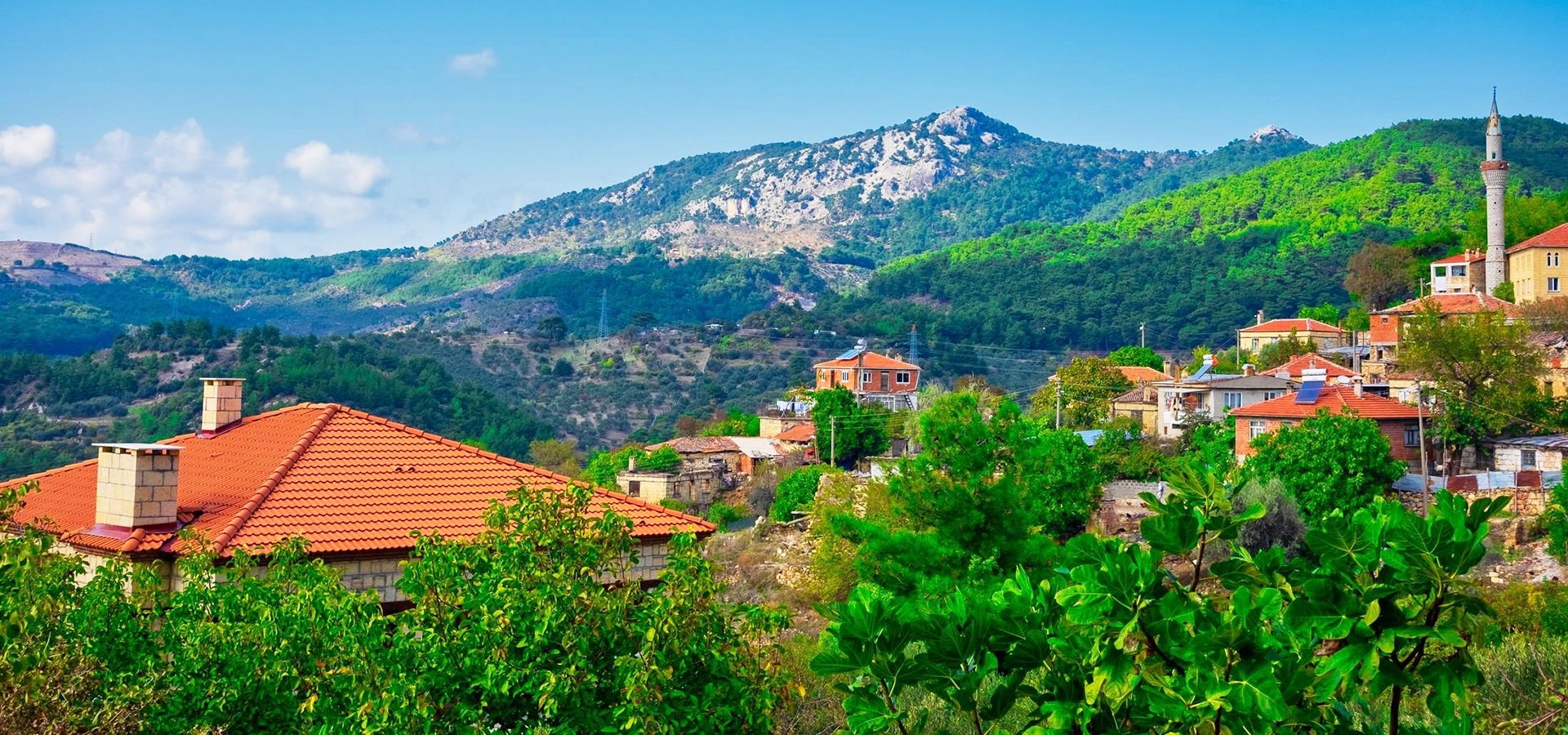
Extend the journey from Cunda's Aegean island landscape into mountain forests, mythology, villages and the natural heritage of the Edremit Gulf.
View Mount Ida Guide